Dementia and Incontinence, How Do We Help Without Taking Away Dignity?
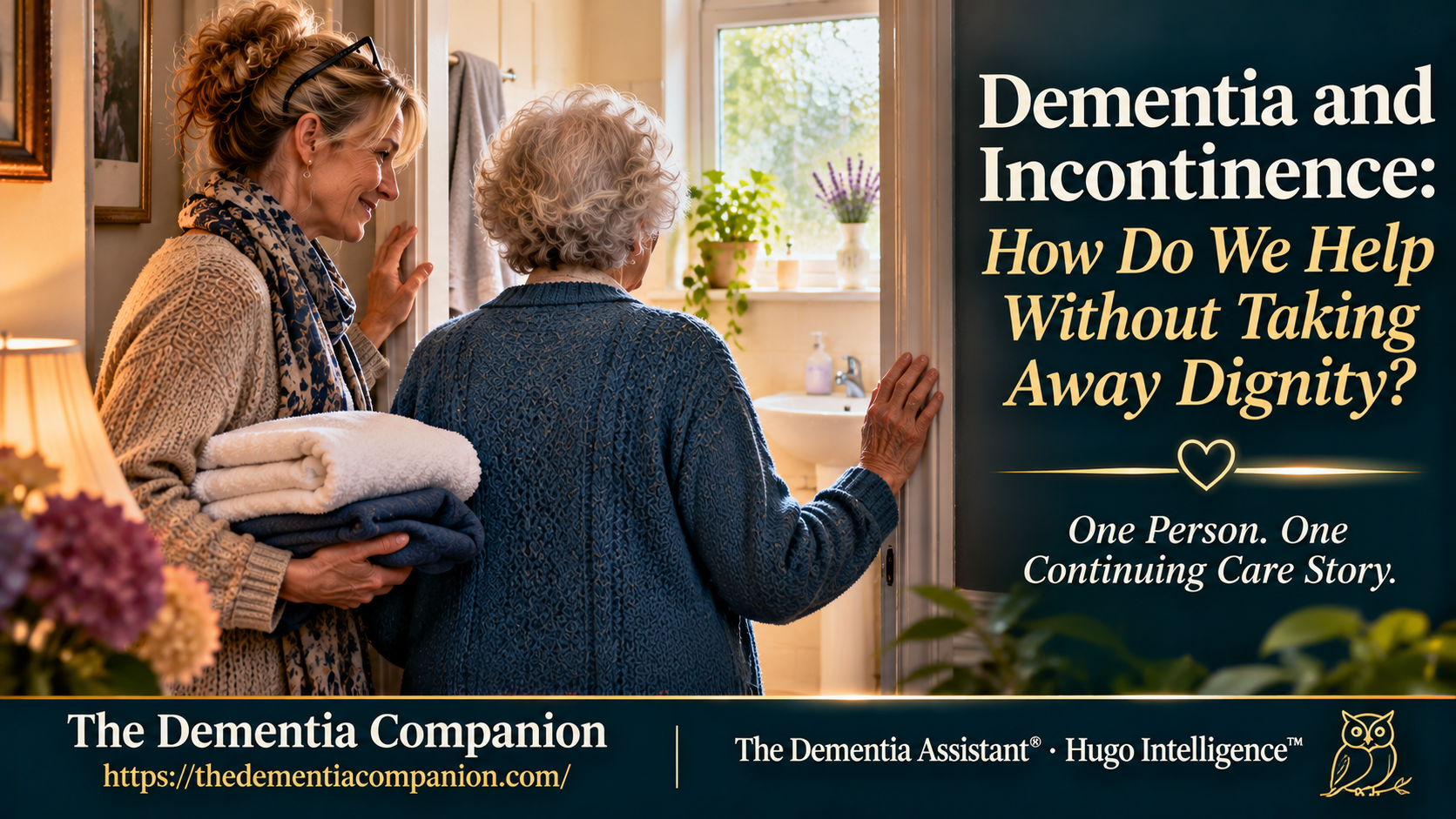
Dementia and Incontinence: How Do We Help Without Taking Away Dignity?
When Mum starts having toileting accidents, it can be upsetting for her and worrying for the family. But needing a little help with bladder or bowel control should never mean losing privacy, independence or dignity.
By Louise Donaghy, Dementia Practitioner, Founder of The Dementia Companion and The Dementia Assistant®, Creator of Hugo Intelligence™
It begins with something small.
Perhaps Mum has had an accident on the way to the toilet.
Perhaps you’ve noticed some damp clothing tucked away in her bedroom.
Perhaps Dad has started getting up several times during the night.
Or perhaps there’s been an accident in the bathroom, and Mum is terribly embarrassed.
You offer to help.
She tells you she’s absolutely fine.
You notice she’s upset.
And suddenly, something as ordinary as going to the toilet has become a difficult conversation.
You don’t want to embarrass her.
You don’t want her feeling that she’s losing her independence.
But you also don’t want her to be uncomfortable, unwell or struggling without the right support.
So what should families do when someone living with dementia begins experiencing incontinence or toileting difficulties?
Start by protecting the person’s dignity, considering possible medical causes and exploring what might help them continue using the toilet as independently and comfortably as possible.
Some difficulties may be related to dementia.
Others may involve constipation, urinary tract problems, medication effects, mobility difficulties or another health condition that needs assessment.
And not every toileting accident means someone has permanently lost bladder or bowel control.
The most important thing to remember is that incontinence is a health and support need, not a personal failure.
Mum is still Mum.
She still deserves privacy.
She still deserves choices.
And she should never be made to feel ashamed because something has become difficult.
Why does someone with dementia begin having toileting accidents?
There are several possible explanations.
Dementia can affect memory, communication, awareness, mobility and the ability to carry out familiar activities.
Someone might recognise that they need the toilet but have difficulty finding it.
They may struggle to undo their clothing quickly enough.
They may have trouble recognising the toilet itself.
Or they may find it difficult to communicate that they need assistance.
But dementia is not the only possible cause.
Other contributing factors include:
- Urinary tract infections or other urinary conditions.
- Constipation or bowel problems.
- Medication side effects.
- Prostate problems.
- Diabetes or other medical conditions.
- Reduced mobility or pain.
- Difficulty managing clothing.
- Poor bathroom lighting.
- Changes in familiar routines.
- Difficulty recognising or communicating the need to use the toilet.
Sometimes several factors are involved.
A person may have good bladder control but struggle to reach the bathroom in time.
Another person may develop a medical condition that affects their continence.
Someone else may need help recognising when to go.
The cause matters because some problems can be treated, reduced or managed more effectively with appropriate support.
Dementia UK, Alzheimer’s Society and the US Alzheimer’s Association all recommend considering possible underlying causes rather than automatically attributing incontinence to dementia.
Does incontinence mean Mum’s dementia is getting worse?
Not necessarily.
Although bladder and bowel difficulties can occur as dementia progresses, they do not automatically establish that the condition has worsened.
Imagine Mum has always managed her personal care independently.
Recently, she’s had several accidents.
The family assumes her dementia is progressing.
But perhaps Mum has developed a urinary problem.
Perhaps she’s constipated.
Perhaps a new medication is affecting her bladder.
Or perhaps her arthritis is making it difficult to reach the toilet or manage her clothing.
Those possibilities deserve consideration.
If toileting difficulties are new, persistent or worsening, arrange an appropriate healthcare assessment.
A GP, primary care clinician or continence specialist may be able to identify contributing factors.
Don’t allow a dementia diagnosis to overshadow another health problem that deserves attention.
And please don’t assume that because Mum has experienced one accident, she must now be dependent on somebody for every visit to the toilet.
The right support should be based on what she actually needs.
What is the difference between incontinence and difficulty getting to the toilet?
This is an important distinction.
Incontinence generally means the involuntary loss of urine or stool.
But somebody may also experience what is often described as functional incontinence.
That means they may have difficulty getting to or using the toilet in time because of physical, cognitive or environmental challenges.
For example, Dad might recognise that he needs to urinate.
But he struggles to find the bathroom when he wakes during the night.
Or Mum may feel the urge to use the toilet but cannot undo the buttons on her trousers quickly enough.
Perhaps a walking aid is difficult to manoeuvre through the bathroom doorway.
Perhaps the toilet seat is difficult to distinguish from the surrounding floor.
These situations may require a different approach from a bladder condition that causes leakage without warning.
An occupational therapist, continence nurse or other appropriate professional may be able to suggest practical adjustments.
We shouldn’t assume somebody has lost the ability to control their bladder when the real difficulty may be accessing or using the toilet.
Could a urinary tract infection be causing the problem?
A urinary tract infection, or UTI, is one possible explanation for new urinary symptoms.
Someone may experience:
- Pain or burning when passing urine.
- A more frequent or urgent need to urinate.
- New or worsening leakage.
- Lower abdominal discomfort.
- Blood in the urine.
- Fever or other signs of illness.
Some people living with dementia may find it difficult to explain these symptoms.
However, we need to be careful about something.
New confusion does not automatically mean someone has a UTI.
Sudden confusion can have many possible causes, including delirium, and requires urgent medical assessment.
Older adults may also have bacteria present in their urine without having a symptomatic infection. A positive urine test alone does not necessarily establish that antibiotics are required.
If Mum has new urinary symptoms or appears unwell, seek appropriate medical advice.
If she becomes suddenly confused, follow emergency guidance.
In the UK, the NHS advises calling 999 for sudden confusion.
In the United States, seek emergency medical assessment, using 911 when appropriate.
Elsewhere, contact the relevant emergency service.
Please don’t wait for a routine continence appointment when someone is acutely unwell.
What if Mum is constipated?
Constipation can contribute to both bowel and bladder difficulties.
A person may have discomfort.
They may feel bloated.
They may struggle to pass stools.
And in some cases, severe constipation or faecal impaction can cause leakage of liquid stool around the blockage.
This can look like diarrhoea even though constipation is part of the underlying problem.
It’s one reason not to assume that every bowel accident has the same explanation.
If Mum develops new bowel leakage, persistent constipation or significant discomfort, seek medical advice.
Don’t automatically give laxatives, enemas or other treatments without considering her individual health and professional guidance.
And don’t assume that restricting her food or fluids will solve the problem.
A proper assessment may identify something that can be treated or managed more comfortably.
What should I say when Mum has an accident?
This is where kindness and natural communication can make a real difference.
Imagine Mum has wet her clothing.
She’s embarrassed.
Perhaps she’s trying to hide what happened.
Perhaps she’s insisting nothing is wrong.
Or perhaps she’s upset because she knows she’s had an accident but doesn’t want anybody else to know.
Try not to make the incident the centre of attention.
You might say:
“That’s all right, Mum. Let’s get you comfortable.”
Or:
“Would you like a hand finding something fresh to wear?”
Or:
“Don’t worry about the clothes. We can sort those out.”
If Mum doesn’t want help immediately and there is no urgent health concern, consider giving her some privacy and returning to the conversation gently.
Avoid saying:
“You’ve done it again.”
Or:
“Why didn’t you go to the toilet earlier?”
Or:
“You should have told me.”
The person may not have been able to recognise or communicate what was happening.
And even if they did recognise it, embarrassment can make asking for assistance difficult.
Our response should reduce discomfort and protect dignity, not add shame.
What if Mum tries to hide wet clothes or bedding?
Sometimes families discover damp clothing tucked away in a wardrobe.
Or a wet sheet has been hidden.
Perhaps Mum insists she hasn’t had an accident.
Before assuming she’s being deliberately dishonest, consider how she may be feeling.
She might be embarrassed.
She may not remember what happened.
She may want to remain independent.
Or she may be frightened that having accidents will lead to decisions she doesn’t want.
You might say:
“Mum, I’ve noticed some laundry that needs doing. I’ll put it in the wash. Is there anything you’d like help with?”
There’s no need to conduct an investigation into who put the trousers behind the wardrobe.
The washing machine isn’t interested in a confession.
But if accidents are happening regularly, the underlying problem still deserves assessment.
You can protect Mum’s dignity while also making sure her health and comfort are properly considered.
How can we make the toilet easier to find and use?
Sometimes small changes can make a meaningful difference.
But we should always consider the individual.
Make the bathroom easier to recognise
Clear signage may help some people.
A familiar picture or the word “Toilet” on the door may be useful.
Other people may find signs unnecessary or confusing.
Try an approach that suits Mum.
Improve lighting
Make sure the route to the bathroom is appropriately lit, especially at night.
Poor lighting can make familiar spaces more difficult to navigate.
But avoid creating unnecessary glare or harsh changes in lighting.
Keep the route clear
Remove avoidable obstacles and trip hazards.
Consider whether Mum can move safely through doorways and around furniture.
If mobility is difficult, ask an occupational therapist for individual advice.
Make the toilet easier to use
Some people benefit from a toilet seat that contrasts with the surroundings.
Others may need grab rails, suitable seating or adjustments to the bathroom layout.
Equipment should be assessed for the person’s needs rather than purchased simply because it appears on a dementia checklist.
Consider clothing
Perhaps Mum has difficulty managing buttons, belts or complicated fastenings.
Easier-to-manage clothing may help her remain independent.
But don’t simply replace her wardrobe without discussing it.
Her preferences still matter.
If Mum loves her favourite trousers, perhaps there’s a way to adapt the support rather than automatically taking them away.
The aim is to make using the toilet easier, not make the person’s home feel like a care facility.
Can a regular toileting routine help?
Sometimes.
Some people benefit from gentle reminders or being offered the opportunity to use the toilet at familiar times.
For example:
- After waking.
- Before going out.
- Before bedtime.
- At intervals suggested by a continence professional.
- At times that fit the person’s established bowel or bladder habits.
But there is an important distinction between offering support and imposing a rigid schedule.
Mum shouldn’t feel that she has to ask permission to use her own toilet.
And nobody should be pressured into sitting on the toilet when they don’t want or need to.
A continence adviser may recommend an individualised approach based on assessment.
That could include a bladder or bowel diary and practical strategies.
A supportive routine should work with the person, not turn their day into a timetable of toilet visits.
Should we stop giving Mum drinks to prevent accidents?
No. Not as a general solution.
This is a common temptation.
Perhaps Mum has been getting up during the night.
Or perhaps there have been several accidents during the afternoon.
A family member wonders whether reducing drinks might help.
But restricting fluids without appropriate medical advice can contribute to dehydration, constipation and other health problems.
It may even make urinary symptoms worse.
Dementia UK and the US Alzheimer’s Association both advise against withholding fluids as a way of managing incontinence.
Encourage appropriate hydration according to the person’s individual health needs.
If the person has heart failure, kidney disease, swallowing difficulties or a prescribed fluid restriction, follow professional advice.
A healthcare professional may also help assess whether caffeine, drink timing or other factors are relevant.
The goal is to support bladder health and comfort, not solve one problem by creating another.
What about continence pads, protective underwear and bedding?
Continence products can be useful.
For some people, they provide reassurance and help maintain independence.
For others, introducing them may feel embarrassing or unnecessary.
Possible products include:
- Absorbent pads.
- Protective or pull-up underwear.
- Washable bed protectors.
- Waterproof mattress covers.
- Appropriate skin-care products.
- Other aids recommended after assessment.
But not every product is suitable for every person.
Fit, comfort, absorbency, skin health, ease of use and the person’s preferences all matter.
A continence nurse or specialist can advise about suitable options.
In parts of the UK, NHS continence products may be available following assessment, although eligibility and provision vary locally.
In the USA, insurance and state-funded coverage depend on the particular plan and programme.
Continence products should support comfort and dignity, not replace assessment of a potentially treatable problem.
And we should avoid assuming that the person needs an indwelling urinary catheter simply because managing accidents has become difficult.
Catheters have medical risks and require appropriate clinical indications and professional management. They should not be introduced merely for caregiver convenience.
How do we protect Mum’s skin and personal hygiene?
Prolonged contact with urine or stool can irritate the skin.
Someone may develop soreness, redness or skin breakdown.
This can be uncomfortable and sometimes painful.
If Mum needs assistance after an accident, support her to clean and dry her skin gently.
Respect her privacy.
Use appropriate products and follow individual professional advice about skin protection.
If she uses absorbent products, ensure they’re changed as needed.
If there’s persistent redness, broken skin, pain or another skin concern, seek professional assessment.
And remember that assisting someone with intimate care involves more than completing a task.
Explain what you’re doing.
Ask permission where possible.
Keep the person covered appropriately.
Allow them to do what they can independently.
Offer choices about who helps.
Dignity isn’t something we provide after personal care is finished. It belongs in every part of how that care is offered.
What if Mum refuses help changing her clothes?
This can be especially difficult.
Perhaps Mum has had an accident.
You want to help her get comfortable.
But she refuses.
She tells you to leave her alone.
Or insists she doesn’t need assistance.
Try to consider what the situation may feel like from her perspective.
Perhaps she doesn’t understand why you’re offering help.
Perhaps she’s embarrassed.
Perhaps she doesn’t want somebody touching her clothing.
Perhaps she’s frightened.
Or perhaps she simply wants privacy.
You might say:
“Mum, would you like to choose something fresh to put on?”
Or:
“Shall I leave these clothes here for you?”
Or:
“Would you prefer me to help, or would you like a little time?”
Where safe, consider pausing and trying again later.
If essential hygiene needs remain unmet, particularly where there is a risk of skin damage or illness, seek appropriate professional advice.
Don’t routinely force intimate care.
A dementia diagnosis does not automatically remove someone’s ability to make decisions.
Capacity, consent, safety and any necessary intervention must be considered under the applicable legal framework.
Good personal care should protect the person’s rights as well as their physical wellbeing.
What if Dad has bowel incontinence?
Bowel incontinence can be particularly distressing for the person and family.
It may involve leakage, difficulty reaching the toilet or a problem with recognising or communicating the need to pass stools.
Possible contributing factors include constipation, diarrhoea, mobility difficulties, neurological conditions and other bowel disorders.
A proper clinical assessment is important.
Don’t assume that bowel leakage is simply a natural part of dementia.
And don’t use medication to stop bowel movements without appropriate professional advice.
A GP or relevant clinician may consider the person’s bowel habits, medication, diet, fluid intake and health conditions.
Specialist continence services may help develop an individual plan.
The person’s comfort, hygiene, nutrition and dignity should remain central.
If bowel accidents are new, persistent, accompanied by pain or associated with other concerning symptoms, seek medical advice.
When should we seek medical help for incontinence?
New or worsening urinary or bowel symptoms should be discussed with a healthcare professional.
Seek prompt medical advice if the person experiences:
- New or worsening urinary leakage.
- Pain or burning when urinating.
- Blood in the urine.
- Fever or signs of infection.
- Persistent or severe constipation.
- New bowel leakage.
- Recurrent urinary problems.
- Skin damage or soreness.
- Difficulty emptying the bladder.
- Symptoms that substantially affect daily life or wellbeing.
Seek urgent help for concerning symptoms such as severe pain, inability to pass urine despite feeling a full bladder, fever with significant illness or suspected urinary retention.
Sudden confusion requires immediate medical assessment.
In the UK, call 999 for sudden confusion, as advised by the NHS.
Use local emergency or urgent care services in other countries.
Don’t assume all new symptoms are caused by dementia.
And don’t wait to finish a care diary before seeking necessary medical help.
Who can help families with continence problems?
The right professional depends on the person’s symptoms and location.
United Kingdom
A GP or relevant healthcare professional can assess new symptoms and consider a referral to a bladder and bowel or continence service.
Depending on local arrangements, support may involve a continence nurse, district nurse, occupational therapist, physiotherapist or other specialist.
In England, continence services are generally arranged through local NHS services, although referral routes and product provision vary.
Scotland, Wales and Northern Ireland have their own health service arrangements.
Families should contact the appropriate GP practice or local health service to understand access.
United States
Families can begin with the person’s primary care clinician.
Depending on the problem, a referral may be made to a urologist, geriatrician, continence professional, pelvic health specialist or another appropriate clinician.
Coverage for consultations, therapies and continence supplies depends on the person’s insurance and state programmes.
The Alzheimer’s Association also provides practical guidance about dementia and incontinence.
Canada
Start with the person’s healthcare provider or relevant provincial or territorial service.
The Alzheimer Society of Canada provides guidance on toileting and personal care.
Access to continence assessment and funded supplies varies by location.
Australia
Dementia Australia and Continence Health Australia provide information and support.
A GP or appropriate clinician can arrange further assessment.
Government-funded aged care or continence-related support may be relevant depending on eligibility.
Republic of Ireland
Families can speak with the GP or public health nursing service about continence concerns and possible assessment.
The Health Service Executive provides clinical guidance on individualised continence care.
The Alzheimer Society of Ireland can also help families identify relevant support.
Across every country, the principle remains the same: understand the individual problem and obtain the right professional assessment rather than assuming dementia explains everything.
What should families record when toileting needs change?
This is where a short, factual record can help.
Not a detailed account of every private moment.
Not a document that makes Mum feel watched.
But a respectful record of information that may help a professional understand what is happening.
Consider noting:
When did the problem begin?
Was it sudden or gradual?
What happened?
Was it urinary leakage, bowel leakage or difficulty reaching the toilet?
Were there any symptoms?
Pain, constipation, fever, urgency or other concerns?
What was happening at the time?
Was the person getting out of bed, trying to remove clothing or finding the bathroom difficult?
What did the person say?
Include their own words where possible.
What support helped?
For example, changing clothing, improving bathroom access or following professional advice.
What professional advice was obtained?
Record confirmed recommendations and follow-up arrangements.
A fictional example
“Wednesday, approximately 10.30am: Mum had urinary leakage while walking to the bathroom. She said she had needed the toilet urgently. She was able to change her clothing with some help and preferred privacy. No other symptoms reported at the time. GP appointment requested because the problem is new.”
That tells us something useful.
It doesn’t label Mum as incapable.
It doesn’t guess the cause.
And it doesn’t make an ordinary moment of care sound humiliating.
Compare it with:
“Mum wet herself again and is becoming difficult.”
The second version gives very little useful information and risks reducing her to the problem.
Good documentation should help us understand the person’s needs while protecting their dignity.
How do we stop toileting problems becoming the whole care plan?
This matters enormously.
When someone begins experiencing incontinence, the family can understandably become focused on preventing accidents.
What time did Mum last use the toilet?
Has she had enough to drink?
Should we change her clothing?
Does she need another continence product?
Is the bathroom accessible?
These are important questions.
But Mum’s life should not suddenly revolve entirely around her bladder.
She may still enjoy gardening.
Going for coffee.
Seeing her grandchildren.
Choosing her own clothes.
Going for a walk.
Or spending time with her friends.
A person-centred care plan should include support for continence where needed.
But it should also preserve the person’s identity, choices, abilities and meaningful activities.
The goal isn’t simply fewer accidents. It’s helping Mum continue living a life that feels like her own.
How can a family-held care plan help professionals understand Mum’s needs?
Imagine Mum receives support from several services.
Her GP.
A continence nurse.
A home care agency.
An occupational therapist.
Perhaps a hospital or community nursing team.
Each professional service may maintain its own records.
But who is preserving the continuing picture from Mum’s point of view?
What she has always managed independently.
What she finds embarrassing.
How she prefers assistance to be offered.
What language she feels most comfortable using.
What clothing she prefers.
How she communicates discomfort.
Which support arrangements have helped.
And how her needs have changed over time.
This is where a family-held, person-centred dementia care plan can be valuable.
It gives the person or family a place to keep appropriate information together.
Not just medical details.
But the little things that help another person understand who Mum is.
The care plan does not replace formal continence assessments, clinical records or professional care instructions.
It complements them.
And when another professional becomes involved, the family can share relevant information with appropriate permission.
Different professionals. Different services. One person. One continuing story.
Meet Hugo Intelligence™: When a private worry feels difficult to ask about
Sometimes families find toileting problems embarrassing to discuss.
Perhaps Mum has started having accidents.
Perhaps Dad refuses continence products.
Perhaps you’re worried about how to help with personal care without upsetting the person.
Or perhaps you don’t know which professional to contact.
You might ask:
“Hugo, Mum has dementia and has started having urinary accidents. What should we consider?”
Or:
“Hugo, Dad gets embarrassed when we offer help with changing his clothes. How can we approach this more gently?”
Or:
“Hugo, can you help me prepare questions for a continence assessment?”
Hugo Intelligence™ provides natural, conversational, person-centred dementia guidance within The Dementia Assistant®.
You can explain what’s happening in ordinary language.
Ask follow-up questions.
Explore possible reasons for difficulties.
And consider practical approaches without judgement.
You don’t have to know the correct medical terminology.
Perhaps your first question is simply:
“Hugo, Mum keeps having accidents and I don’t know how to help without upsetting her.”
That’s enough to begin.
Hugo can help you think through practical approaches and prepare questions for healthcare professionals.
But he cannot diagnose incontinence, identify the cause of urinary symptoms, prescribe treatment or replace a continence assessment.
When medical symptoms need professional attention, seeking that help comes first.
Hugo’s conversational intelligence: You don’t need to explain everything perfectly
One of the reasons I created Hugo was to make practical guidance easier to explore through conversation.
Families don’t always know what to ask first.
Perhaps you’re trying to understand why Mum is having accidents.
You might begin by explaining what has changed.
Then ask about bathroom accessibility.
Then ask what to say when Mum becomes embarrassed.
Then explore what information would be useful for the GP.
Hugo allows you to develop those questions rather than treating every concern as a completely separate conversation.
You can ask for explanations in everyday language.
You can explore several possible approaches.
And you can work through questions gradually.
The aim isn’t to produce one generic answer. It’s to help families explore what might matter for this particular person.
Hugo’s personalised guidance through Mum’s selected care plan
You can ask Hugo general dementia questions without selecting a care plan.
But when you choose Mum’s individual care plan, Hugo can use relevant recorded information about her routines, preferences, abilities, communication and support needs.
Perhaps Mum has always preferred managing her personal care independently.
Perhaps she finds unfamiliar carers uncomfortable.
Perhaps her mobility has changed.
Perhaps she prefers assistance from a female carer.
Or perhaps the family has recorded that she finds complicated clothing fastenings difficult.
Those details may help shape more personalised guidance.
Instead of simply asking:
“How do I manage incontinence in dementia?”
You could ask:
“Hugo, Mum values her privacy and becomes embarrassed when we offer help. How might we support her using what we know about her preferences?”
That is the difference between general information and guidance informed by the person’s own circumstances.
Hugo doesn’t automatically have access to every family member’s care plan.
The user selects the individual care plan they want Hugo to consider.
The suggestions remain educational guidance, not a clinical assessment.
That’s Person-Centred Intelligence®. One person at a time.
Hugo and the Care Planning Centre™: Keeping important information together
Continence difficulties may change over time.
Perhaps Mum needs a medical review.
Perhaps an occupational therapist recommends an adaptation.
Perhaps a continence nurse advises a particular care approach.
Perhaps a home carer begins providing assistance.
The Dementia Assistant® includes the Care Planning Centre™, where the person or family can build and maintain a continuing, person-centred care plan.
Through guided care planning and Talk to Hugo, families can explore relevant questions and record information in the appropriate sections.
This may include:
- The person’s daily routines.
- Their preferences about privacy and personal care.
- What they can manage independently.
- Their communication needs.
- Relevant health information.
- Professional recommendations.
- Support they welcome.
- Changes in everyday abilities.
- Observations that may be useful during appointments.
- Important documents and care arrangements.
The family reviews the information before it becomes part of their continuing record.
And that record can evolve as the person’s needs change.
The family-held care plan remains part of the person’s continuing care information, rather than belonging exclusively to whichever care organisation is currently involved.
It does not replace the professional’s own care plan or clinical duties.
It helps preserve the person’s story alongside them.
Save and organise your conversations with Hugo
Perhaps you ask Hugo about Mum’s changing toileting needs today.
Next week, you want to prepare for a continence appointment.
Later, you may want to explore how to introduce a new care arrangement.
Within The Dementia Assistant®, you can save, categorise and revisit Hugo conversations.
That means you can return to earlier guidance and continue exploring questions as circumstances change.
Saved conversations are educational support.
They are not verified medical records or professionally approved treatment plans.
But they can help families keep useful discussions organised.
The care plan preserves the person’s continuing information. Saved conversations help preserve continuity in the questions you’re exploring.
Hugo’s multilingual support: Privacy, dignity and the person’s preferred language
This is especially important when we’re discussing intimate care.
Perhaps Mum grew up speaking Welsh.
Perhaps Dad prefers Irish, Hindi, Spanish or French.
Perhaps family members live in different countries.
Or perhaps someone living with dementia finds it easier to explain discomfort in their familiar language.
Some people living with dementia experience changes in how they use different languages, although this varies between individuals.
We should never assume that everyone automatically returns to a childhood language.
But we should recognise that language forms part of someone’s identity.
And discussing private care needs may be particularly difficult when the person cannot communicate comfortably.
The Dementia Assistant® supports 12 interface languages and provides dictation and translation capabilities spanning 201 languages.
These tools can help families record observations, organise care information and communicate across language barriers.
Dictation may help someone record information without typing.
Translation may help appropriately involved relatives understand relevant care details.
Hugo’s conversational approach also makes it possible to explore concerns in ordinary language.
Not every platform feature is available in all 201 languages.
And important medical, medication, consent and safeguarding information should be checked for accuracy.
Qualified interpreters should be involved when needed for important professional discussions.
Because preserving someone’s dignity means understanding them in the language and manner they feel comfortable using.
Hugo and Family Circle: Supporting relatives without sharing every private detail
Perhaps Mum’s daughter provides most of her personal care.
Her son manages appointments.
Another relative lives abroad.
And several people want to know how Mum is getting on.
The Dementia Assistant® includes Family Circle features to support appropriate communication between involved relatives.
But not every detail of personal care needs to be shared.
Mum’s toileting difficulties are private health information.
Family members should respect her wishes and relevant access permissions.
Perhaps relatives only need to know that Mum is receiving additional support.
Perhaps somebody needs to help arrange an appointment.
Or perhaps the family needs to coordinate care visits.
The aim is to provide the right information to the right people, not create a family broadcast about every private moment.
Hugo and the Carer Wellbeing Hub: Supporting the person providing intimate care
This part matters too.
Providing continence care can be physically demanding.
There may be laundry.
Interrupted sleep.
Additional personal care.
Difficult conversations.
And perhaps a sense that nobody else understands what daily care involves.
Some family carers may feel embarrassed discussing these responsibilities.
Others may be exhausted.
Or they may feel guilty for finding the situation difficult.
The Dementia Assistant® includes the Carer Wellbeing Hub, alongside practical educational resources and Hugo’s conversational guidance.
Families can explore ways to organise support and prepare questions for professionals.
But the platform does not replace practical assistance, training, medical assessment or appropriate respite care.
If you’re struggling to manage intimate care safely, ask for professional support.
Recognising the person’s dignity also means recognising the wellbeing and limits of the person helping them.
How does dementia continence support work internationally?
Families around the world face similar practical dilemmas, but healthcare pathways differ.
United Kingdom: Start with the GP or appropriate healthcare service. A continence adviser, community nurse or specialist bladder and bowel service may be involved. Referral arrangements and product provision vary by UK nation and local service.
United States: Speak with the primary care clinician and ask whether a specialist continence, bladder or bowel assessment is needed. The Alzheimer’s Association and Alzheimer’s Foundation of America provide practical family guidance.
Canada: The Alzheimer Society of Canada offers advice about toileting routines, communication, dignity and adaptations. Healthcare and funded services depend on provincial or territorial arrangements.
Australia: Dementia Australia and Continence Health Australia provide practical resources. A GP or other clinician can advise about assessment and relevant support.
Republic of Ireland: Families can speak with the GP or public health nursing service. HSE guidance supports individualised assessment and continence care planning.
In other countries, begin with the appropriate primary care or community health service.
The country may change the route to support. It shouldn’t change the principle that the person’s dignity, health and choices matter.
What if the family can no longer manage continence care alone?
Sometimes the support needed becomes more demanding.
Perhaps Mum requires help several times each night.
Perhaps her husband is finding the physical work difficult.
Perhaps there are ongoing skin problems.
Or perhaps the family carer is exhausted.
This is not a situation in which somebody should simply be told to try harder.
Ask for a review of the person’s care needs.
Consider whether trained home care staff, community nursing, continence services or other support would be appropriate.
In England, the person can request a care needs assessment through adult social care, and unpaid carers can request a separate carer’s assessment.
Other UK nations and countries have their own arrangements.
A professional assessment may help identify equipment, practical assistance or changes in care arrangements.
The person living with dementia deserves appropriate support, and the family carer should not have to manage every intimate care need alone.
A practical dementia and incontinence checklist for families
If someone you love is experiencing new toileting difficulties, consider:
- [ ] Have we asked how the person feels about the situation?
- [ ] Is there a new symptom or possible medical cause?
- [ ] Have pain, constipation and urinary problems been considered?
- [ ] Could medication be contributing?
- [ ] Is the person able to find the toilet easily?
- [ ] Can they access the bathroom safely?
- [ ] Is clothing easy enough for them to manage?
- [ ] Would an individualised toileting routine be helpful?
- [ ] Are they drinking appropriately for their health needs?
- [ ] Have we considered professional continence assessment?
- [ ] Are continence products suitable and comfortable?
- [ ] Is skin health being protected?
- [ ] Are privacy and consent respected during personal care?
- [ ] Are we recording relevant changes factually?
- [ ] Does the continuing care plan need updating?
- [ ] Do the family and care professionals understand the person’s preferences?
- [ ] Is the family carer receiving enough practical support?
- [ ] Do we know whom to contact if symptoms become urgent?
You don’t need to answer every question today.
Start with immediate health concerns.
Then explore what might make everyday life easier.
The goal is not to create a perfect toileting routine. It’s to support the person with comfort, dignity and as much independence as possible.
Mum is still Mum, even when she needs help with the most private things
I want to finish with something that matters to me enormously.
When someone begins needing help with toileting, families sometimes feel that another part of their independence has disappeared.
Perhaps Mum is embarrassed.
Perhaps Dad feels uncomfortable accepting assistance from his daughter.
Perhaps the person providing care doesn’t quite know how to make the situation feel natural.
It can be difficult.
But needing help with personal care does not change who someone is.
Mum is still the woman who raised her family.
Who worked hard.
Who knows how she likes her tea.
Who has opinions about almost everything.
And who may still be perfectly capable of telling you that you’ve put the towels in completely the wrong cupboard.
Some things, thankfully, remain reassuringly familiar.
She may need help getting to the toilet.
She may need support changing clothing.
She may need medical assessment or specialist continence products.
But none of that means she has lost her right to privacy.
Or the right to make choices.
Or the right to be treated with respect.
Person-centred dementia care is not simply about managing accidents. It’s about protecting the person through moments when they may feel particularly vulnerable.
Sometimes that means offering assistance quietly.
Sometimes it means stepping back.
Sometimes it means changing the environment.
And sometimes it means recognising that professional help is needed.
But whatever the circumstances, the person deserves dignity.
Not because they can still manage everything independently.
Because dignity has never depended on independence in the first place.
⸻
Ask Hugo: Your Questions About Dementia, Incontinence and Dignity
Hugo, Mum has dementia and has started having toileting accidents. What should we do?
Hugo 🦉: Begin by helping Mum feel comfortable and protecting her privacy.
New incontinence may have several causes, including urinary conditions, constipation, medication effects or difficulties accessing the toilet.
Arrange a medical assessment where appropriate.
I can help you explore practical questions, but I cannot diagnose the cause.
Does incontinence mean Mum’s dementia is getting worse?
Hugo 🦉: Not necessarily.
Bladder and bowel difficulties can occur with dementia, but they may also have other causes that need assessment.
Don’t automatically assume the dementia has progressed.
What should I say when Mum is embarrassed after an accident?
Hugo 🦉: Use gentle, respectful language.
You might say, “That’s all right, Mum. Let’s get you comfortable.”
Avoid blame or unnecessary discussion of the accident.
Offer choices and privacy wherever possible.
What if Dad refuses help changing his clothes?
Hugo 🦉: Consider whether he’s embarrassed, uncomfortable, frightened or simply wants privacy.
Explain what you’re offering and give him choices.
Where safe, pause and try a different approach.
If essential care needs remain unmet, seek professional support.
Can dementia cause someone to forget where the toilet is?
Hugo 🦉: Yes. Dementia can sometimes affect recognising or finding familiar places.
Clear signage, appropriate lighting and an accessible bathroom may help some people.
An occupational therapist can advise about individual adaptations.
Could constipation be causing accidents?
Hugo 🦉: Constipation can contribute to bladder and bowel difficulties.
Severe constipation may sometimes cause leakage around impacted stool.
A healthcare professional should assess persistent or concerning symptoms before treatment is changed.
Should we reduce Mum’s drinks to prevent accidents?
Hugo 🦉: Don’t restrict fluids without appropriate medical advice.
Inadequate hydration can worsen health problems, including constipation.
Follow any individual fluid guidance given by healthcare professionals.
Can Hugo help us prepare for a continence assessment?
Hugo 🦉: Yes. I can help you organise factual observations and questions about what has changed, the person’s routines and support needs.
The assessment itself must be completed by an appropriate healthcare professional.
Can Hugo help us create Mum’s own care plan?
Hugo 🦉: Yes. The Dementia Assistant® includes the Care Planning Centre™, where families can create and maintain individual, person-centred care plans.
You can record strengths, preferences, routines, relevant observations and professional information.
Can Hugo use Mum’s existing care plan?
Hugo 🦉: Yes, when you select Mum’s individual care plan.
I can use relevant recorded information to provide more personalised suggestions.
Without selecting a plan, I can still provide general dementia guidance.
Can I save our conversations about Mum’s care?
Hugo 🦉: Yes. You can save, categorise and revisit Hugo conversations within The Dementia Assistant®.
This can help you return to previous guidance and prepare questions as circumstances change.
Can Hugo support families in different languages?
Hugo 🦉: The Dementia Assistant® supports 12 interface languages and dictation and translation capabilities spanning 201 languages.
These tools can help families organise and communicate care information.
Important clinical details should always be checked for accuracy.
Can Family Circle help relatives share care responsibilities?
Hugo 🦉: Family Circle can support appropriate care updates and communication.
The person’s privacy, wishes and permissions should guide what is shared.
Private toileting information should only be shared when relevant and appropriate.
What if I’m exhausted from providing continence care?
Hugo 🦉: Your wellbeing matters too.
You may need additional practical help, a care needs review or a carer’s assessment.
The Dementia Assistant® includes carer wellbeing resources, but those do not replace professional or practical support.
Can Hugo tell us which continence products Mum should use?
Hugo 🦉: I can explain general types of products and questions to consider.
But a continence professional should help assess suitability, especially when skin health, mobility or other medical needs are involved.
Can Hugo help in the middle of the night?
Hugo 🦉: You can explore non-urgent dementia questions through The Dementia Assistant® whenever the platform is available.
I am not an emergency service, live continence nurse or replacement for professional overnight care.
How much does The Dementia Assistant® cost?
Hugo 🦉: The UK Family subscription is £4.99 per month.
Every subscription includes a 30-day complimentary trial.
You can explore Hugo Intelligence™, person-centred care plans, daily notes, saved conversations, Family Circle, multilingual tools and carer wellbeing resources.
For international subscriptions, check the current local pricing on the platform.
⸻
One Person. One Continuing Care Story.
When someone living with dementia begins experiencing toileting difficulties, several professionals may become involved.
The GP.
A continence nurse.
A district or community nurse.
An occupational therapist.
A home care provider.
Perhaps a hospital or specialist service.
Each may maintain its own appropriate professional records.
But the person living with dementia and their family should also have their own continuing place for care information.
A place to preserve the person’s wishes.
Their routines.
Their strengths.
Their communication preferences.
Their language.
Their relevant health information.
Their daily observations.
Their preferences about privacy and personal care.
And the approaches that help them feel comfortable and respected.
The Dementia Assistant® was created to put the person living with dementia and their family at the centre of their own continuing care information.
Not because families should replace healthcare professionals.
Not because an AI system can diagnose incontinence.
And certainly not because a person’s most private moments should become information everybody can see.
But because the person’s care story belongs to them.
Their family-held care plan can develop as their needs change.
Hugo Intelligence™ can provide conversational guidance informed by the individual care plan the user selects.
Daily notes can help preserve relevant observations.
Saved conversations can support continuity in questions and guidance.
Family Circle can help relatives communicate appropriately.
Life Story and Memory & Moments can preserve the person’s identity beyond their care needs.
And multilingual tools can support families across different languages and countries.
From the first concerns about memory, through diagnosis, changing support needs and later-life care, the person’s continuing record can remain available as their circumstances change.
The Dementia Assistant® doesn’t replace professional medical records, clinical assessments or statutory care plans.
It complements them.
Because the person living with dementia should never become lost between different services.
And needing help with personal care should never mean losing control of their own identity.
Different professionals. Different services. One person. One continuing story.
Would You Like Hugo to Help You Support Mum With Dignity?
If Mum has started experiencing toileting difficulties and immediate medical concerns have been addressed, you can begin with a conversation.
Tell Hugo about Mum.
What matters to her.
Her usual routines.
What she manages independently.
How she prefers assistance to be offered.
And what you’re finding difficult.
Hugo can help you explore relevant questions, organise observations and prepare for conversations with appropriate healthcare professionals.
Within The Dementia Assistant®, families can use:
- Hugo Intelligence™: Natural, conversational, person-centred dementia guidance.
- Care Planning Centre™: Guided creation and review of individual care plans.
- Talk to Hugo: Conversational help exploring and recording relevant care-planning information.
- Family-held continuing care plans: Information maintained independently of any single care provider.
- Daily notes and observations: Record meaningful changes factually and respectfully.
- Saved and categorised Hugo conversations: Return to useful discussions as circumstances change.
- Family Circle: Share appropriate updates with involved relatives while respecting privacy.
- Life Story and Memory & Moments: Preserve the person’s identity, interests, relationships and personal history.
- Multilingual support: 12 interface languages and dictation and translation capabilities spanning 201 languages.
- Dementia Academy™: Practical learning and educational resources.
- Carer Wellbeing Hub: Support for the emotional and practical needs of family carers.
- Crisis Support: Educational information about recognising urgent concerns and seeking appropriate professional help.
Created by dementia practitioner Louise Donaghy and powered by Person-Centred Intelligence®, The Dementia Assistant® helps families keep the person at the centre of their continuing care story.
Every subscription includes a 30-day complimentary trial.
Explore The Dementia Assistant®:
https://thedementiaassistant.com/
The Dementia Companion, home of The Dementia Assistant® and Hugo 🦉
https://thedementiacompanion.com/
Louise and Hugo ❤️🦉
Louise Donaghy
Founder & CEO of The Dementia Assistant®
Created and powered by Person-Centred Intelligence®
Creator of Hugo Intelligence™
⸻
Continue Exploring Dementia Care and Support
Ask Hugo: Everyday Dementia Questions
https://thedementiacompanion.com/ask-hugo/
Person-Centred Dementia Care
https://thedementiacompanion.com/dementia-care/
Dementia Communication Tips for Carers
https://thedementiacompanion.com/articles/dementia-communication-tips/
Dementia Crisis Support
https://thedementiacompanion.com/dementia-crisis-support/
Inside The Dementia Assistant®
https://thedementiacompanion.com/inside-the-app/
⸻
Authoritative References and Further Reading
United Kingdom
- Dementia UK: How Dementia Can Affect Incontinence
Practical guidance on possible causes, dignity, personal care, skin health and support.
https://www.dementiauk.org/information-and-support/health-advice/incontinence/
- Alzheimer’s Society: Toilet Problems, Continence and Dementia
Information about bladder and bowel difficulties, possible medical causes and person-centred approaches.
- Alzheimer’s Society: Continence Aids and Professional Support
Guidance about continence assessments, practical products and specialist services.
https://www.alzheimers.org.uk/get-support/living-with-dementia/continence-aids-professional-support
- NHS: Looking After Someone With Dementia
Official information about toileting problems, constipation and accessing continence advice.
https://www.nhs.uk/conditions/dementia/living-with-dementia/looking-after-someone/
- NHS: Urinary Incontinence
Information about symptoms, causes, assessment and treatments for urinary incontinence.
https://www.nhs.uk/conditions/urinary-incontinence/
- NHS: Urinary Tract Infections
Information about UTI symptoms, including urinary leakage, and when to seek medical advice.
https://www.nhs.uk/conditions/urinary-tract-infections-utis/
- NHS: Sudden Confusion (Delirium)
Official guidance explaining why sudden confusion requires immediate medical assessment.
https://www.nhs.uk/symptoms/confusion/
- NICE: Dementia, Assessment, Management and Support (NG97)
Person-centred dementia care, recognising other health needs and supporting quality of life.
https://www.nice.org.uk/guidance/ng97/chapter/recommendations
- NHS Inform Scotland: Personal Care in Dementia
Scottish NHS information about toileting, constipation, personal care and specialist continence support.
- Dementia Carers Count: Continence Care
Practical information for families about supporting continence and maintaining dignity.
United States
- Alzheimer’s Association: Incontinence
Guidance about possible causes, communication, accessible bathrooms, hydration and person-centred care.
https://www.alz.org/help-support/caregiving/daily-care/incontinence
- National Institute on Aging: Common Medical Problems in Alzheimer’s Disease
US government information about urinary and bowel problems, possible causes and caregiver support.
https://www.nia.nih.gov/health/alzheimers-disease-common-medical-problems
- Alzheimer’s Foundation of America: Managing Incontinence
Information about practical support, communication and possible medical problems.
https://alzfdn.org/alzheimers-today-volume-17-number-3/managing-incontinence/
International
- Alzheimer Society of Canada: Toileting and Incontinence
Guidance about maintaining independence, bathroom adaptations and respectful personal care.
- Dementia Australia: Continence
Information about assessing bladder and bowel concerns, supporting the person and managing changes.
https://www.dementia.org.au/living-dementia/home-life/continence
- Continence Health Australia: Dementia and Incontinence
Practical advice about dementia, continence assessment, communication and support options.
- Health Service Executive Ireland: Continence Assessment and Management
National nursing guidance supporting individualised bladder and bowel assessment and care planning.
- Alzheimer Society of Ireland: Supports and Services That May Help
Information about community support, public health nursing and accessing advice for continence care.
⸻
Important information: This article provides general educational guidance and does not replace clinical assessment, continence treatment, professional personal care or emergency services. New or worsening urinary and bowel symptoms need appropriate medical assessment. Sudden confusion requires immediate medical help. Services, referral arrangements and funding vary internationally.
Reviewed: 21 November 2026
You May Also Find Helpful
Need help with your own situation? Ask Hugo.
One Person. One Continuing Care Story. The Dementia Companion is where you discover guidance. Inside The Dementia Assistant®, talk with Hugo, save and categorise conversations, record daily notes and involve authorised supporters in a continuing care plan centred around the person.
Ask Hugo About This · Start Your Continuing Care Plan — Families · Continuing Care Planning — Professionals
Personal guidance requires the appropriate account and subscription access. Care-plan information is used only with authorised access and the required consent and selection steps. All subscription plans include a 30-day complimentary trial.