Mum with Dementia Can’t Tell Me She’s in Pain. How Can I Recognise It?
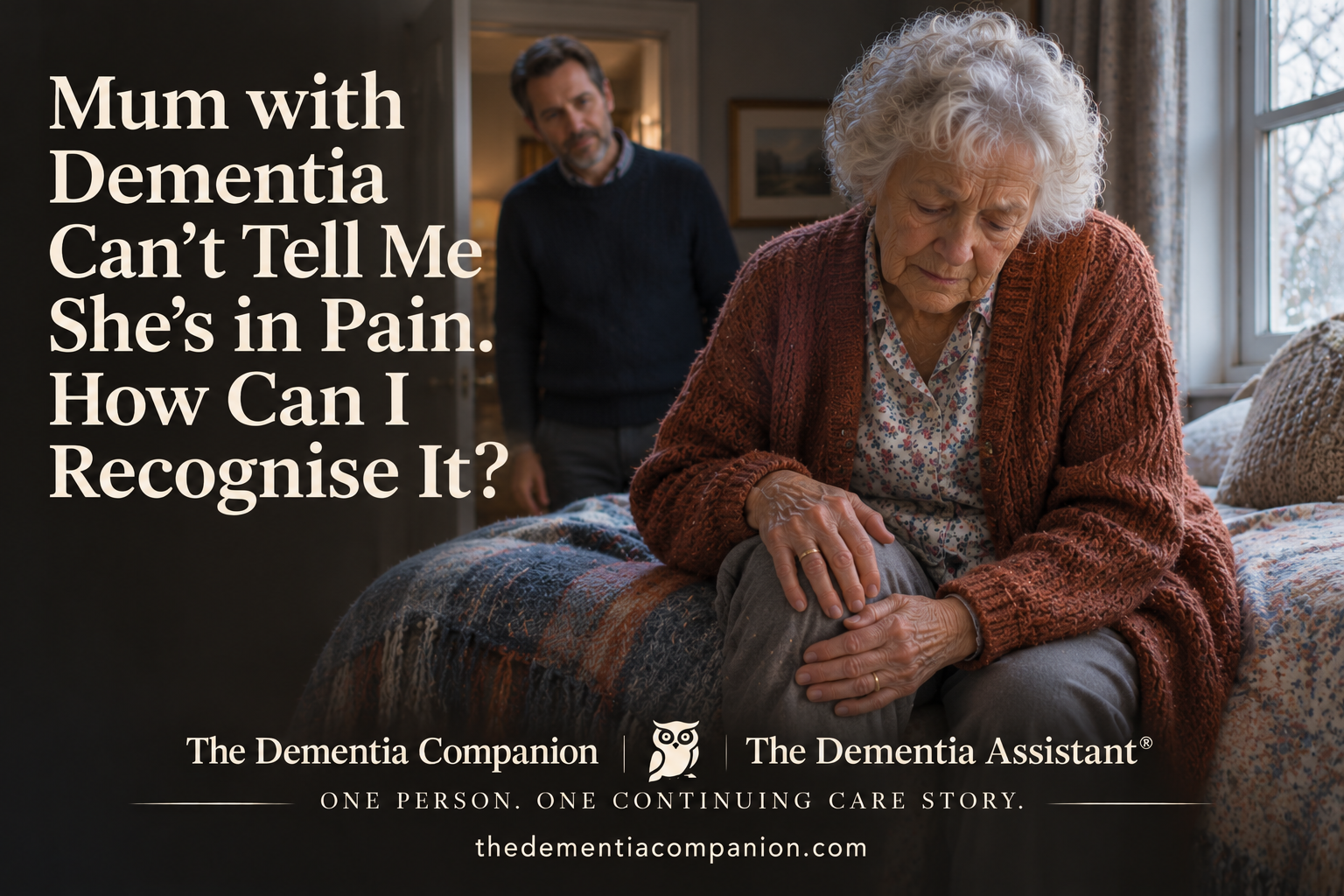
Mum with Dementia Can’t Tell Me She’s in Pain. How Can I Recognise It?
One Person. One Continuing Care Story. | Article 37 of 40
By Louise Donaghy, Dementia Practitioner, Founder of The Dementia Companion and The Dementia Assistant®, and Creator of Hugo Intelligence™.
You arrive at Mum’s house, put the kettle on and notice that something isn’t quite right.
She’s sitting in her favourite armchair, but she doesn’t seem comfortable.
She keeps shifting her position.
When you ask if she’s all right, she smiles.
“I’m fine, love.”
But when she stands up, she winces.
You ask whether anything hurts.
“No, no. Nothing wrong with me.”
Then you notice that she’s holding her knee.
She walks a little differently.
She’s not interested in her usual afternoon stroll, and when you help her put on her cardigan, she becomes unusually upset.
“Leave me alone!”
You stop.
Because that isn’t like Mum.
Yesterday, she enjoyed your company. Today, everything seems to irritate her.
You wonder whether her dementia is getting worse.
Whether she’s becoming anxious.
Whether you’ve done something wrong.
Or whether something else is happening that nobody has recognised.
What if Mum is in pain but can no longer explain it?
This is one of the important challenges families can face when supporting someone living with dementia.
And it is something we must never overlook.
The answer is to listen to the person first, even when their words are limited, and then look carefully for changes in facial expression, movement, sounds, sleep, appetite, behaviour and everyday activities.
These may be clues that someone is uncomfortable or in pain.
But they are not proof.
A healthcare professional needs to assess possible causes, identify any illness or injury and recommend appropriate treatment.
There is something I want families to understand from the beginning.
A person living with dementia does not stop experiencing pain because they can no longer describe it.
Their discomfort remains real.
Their need for relief remains important.
And their voice deserves to be heard, even when that voice has become quieter or harder to understand.
Why can dementia make it difficult to explain pain?
Pain is a physical and emotional experience.
Being able to explain it involves several different abilities.
We need to recognise the sensation.
Understand that something hurts.
Identify where it is coming from.
Find the right words.
And communicate those words to somebody else.
Dementia may affect one or more parts of that process.
Mum may struggle to find the words
Perhaps Mum knows that something feels uncomfortable but cannot remember the word for knee, stomach or shoulder.
She might say:
“It’s not right.”
“Something’s wrong.”
“I don’t like it.”
Or simply:
“Oh dear.”
She may point, hold a part of her body or move away when somebody approaches.
These are all forms of communication worth noticing.
She may not be able to identify where the pain is coming from
Sometimes a person recognises that they feel unwell but cannot identify the source.
They may become distressed during an activity without understanding why.
For example, Mum might become upset when getting dressed because moving her shoulder hurts.
But she may not be able to explain that connection.
Instead, the family sees someone apparently refusing help.
She may forget that she was in pain
Memory difficulties can make it harder for some people to recall or report previous episodes of discomfort.
If a doctor asks whether Mum has experienced pain during the past week, she may say no.
Yet the family may have observed repeated signs of discomfort.
This is why information from someone who knows the person well can be important.
Mum may still be able to tell you
Please don’t overlook this.
Not every person living with dementia loses the ability to describe pain.
Some can explain it clearly.
Others may communicate better when questions are simplified or asked in their preferred language.
Some may be able to point to the painful area even when words are difficult.
Always begin by asking Mum what she is experiencing rather than assuming she cannot tell you.
The challenge is adapting our communication to the individual.
What are the signs that someone with dementia may be in pain?
Dementia UK, Dementia Australia and NHS-related clinical guidance describe several changes that may suggest pain or physical discomfort.
Some are obvious.
Others are much more subtle.
- Changes in facial expression
Mum may frown.
Grimace.
Clench her jaw.
Close her eyes tightly.
Or look unusually worried when moving.
Perhaps you notice a particular expression when she stands from her chair.
Perhaps she looks uncomfortable when bending down.
These observations may be significant, especially if they are different from her usual behaviour.
But facial expressions need context.
A frown can also mean confusion, frustration or concentration.
We should not automatically label every expression as pain.
- Unusual sounds
Some people express discomfort through sounds rather than words.
You might notice:
- Groaning or moaning.
- Crying.
- Calling out.
- Repeated sighing.
- Unusual vocalisations.
- Saying “Oh” or “Stop” during particular activities.
Pay attention to when the sound happens.
Does Mum groan when standing?
When turning in bed?
When somebody touches her arm?
When she’s eating?
The circumstances may help a clinician understand what needs assessing.
- Protecting a part of the body
This is something families can sometimes recognise quite clearly.
Perhaps Mum holds her shoulder.
Keeps one arm close to her body.
Avoids putting weight on one leg.
Protects her stomach.
Or moves away when a particular area is touched.
These movements may indicate discomfort or injury.
Don’t repeatedly press or move the area to test whether it hurts.
If you suspect an injury, seek appropriate medical assessment.
- Changes in walking or movement
Mum may begin walking more slowly.
She might limp.
Become reluctant to climb stairs.
Struggle to rise from a chair.
Or stop participating in an activity she previously enjoyed.
For example, someone who loves gardening may suddenly refuse to go outside.
The family might assume she has lost interest.
But perhaps her hip hurts.
Perhaps her shoes are uncomfortable.
Perhaps she has developed a painful foot problem.
A change in activity can be an important clue, not simply a loss of motivation.
- Changes in mood or behaviour
This is where recognising pain becomes particularly important.
Mum may become unusually irritable.
Restless.
Tearful.
Withdrawn.
Frightened.
Or resistant to assistance.
These changes can sometimes be associated with pain.
But they can also have other causes, including fear, infection, medication effects or changes in the environment.
A person should never automatically be described as aggressive or difficult without considering whether something is hurting.
- Changes in sleep
Pain can make settling or remaining comfortable difficult.
Perhaps Mum wakes repeatedly.
Moves around in bed.
Calls out when changing position.
Or seems unusually tired during the day.
Sleep difficulties can have many causes, so professional assessment may be needed.
- Changes in eating
Someone with toothache or uncomfortable dentures may avoid chewing.
A sore mouth may make drinking uncomfortable.
Abdominal pain or constipation may reduce appetite.
Mum may push meals away without explaining why.
A sudden change in eating deserves attention, particularly when accompanied by weight loss, swallowing difficulties or other symptoms.
- Becoming unusually quiet or withdrawn
Not everybody expresses pain through agitation.
Some people become very still.
They may stop joining conversations.
Spend longer sitting in one place.
Or appear less interested in their surroundings.
This can be particularly easy to overlook.
Sometimes we notice the person shouting.
But fail to notice the person who has stopped speaking.
A change from Mum’s usual behaviour may matter more than whether the behaviour appears dramatic.
What if Mum says she isn’t in pain?
Take her answer seriously.
But consider whether she can understand the question and communicate what she feels.
Some people may respond more easily to familiar words.
Instead of:
“Are you experiencing pain?”
Try:
“Are you sore anywhere?”
“Does something hurt?”
“Is your knee uncomfortable?”
“Can you show me where?”
Ask one question at a time.
Allow time for an answer.
Watch for gestures and facial expressions.
If Mum says no but repeatedly grimaces whenever she stands, describe those observations to her healthcare professional.
Do not argue.
You might say:
“All right, Mum. I noticed that standing looked uncomfortable. Shall we ask the doctor to check?”
The aim is to respect Mum’s account while ensuring that possible discomfort is not dismissed.
Could Mum’s anger or distress actually be pain?
Sometimes, yes.
And this is one reason person-centred care matters so much.
Imagine Mum has painful arthritis in her shoulder.
A care worker arrives to help her get dressed.
The worker gently lifts Mum’s arm to put it through her cardigan.
Mum cries out.
“Stop!”
The worker tries again.
Mum pushes the worker away.
The visit is recorded as:
“Refused personal care.”
But what if the real problem was that moving her shoulder caused pain?
The situation looks completely different when we consider that possibility.
Instead of trying harder to persuade Mum, the next step should be to assess what is happening.
Is the shoulder painful?
Has there been an injury?
Does Mum need medical treatment?
Could the way dressing assistance is provided be adapted following professional advice?
This is not to say that every refusal is caused by pain.
Mum may also be frightened, uncomfortable with the worker or exercising a genuine preference.
Behaviour can communicate a need, but we must investigate rather than assume we know what it means.
Where might the pain be coming from?
People living with dementia can experience the same painful conditions as anyone else.
Some common possibilities deserve particular attention.
Arthritis and joint pain
Arthritis may cause discomfort during walking, standing, dressing or moving in bed.
Mum may protect a knee, hip, hand or shoulder.
If she becomes reluctant to move, ask whether pain or stiffness may be contributing.
A GP or appropriate clinician can assess the situation.
Dental problems
Toothache can be extremely painful.
So can sore gums, mouth ulcers and poorly fitting dentures.
If Mum stops eating familiar foods, refuses dentures or appears uncomfortable when chewing, arrange appropriate dental advice.
Painful dental problems should not be overlooked because a person has dementia.
Constipation
Constipation may cause abdominal discomfort, bloating and changes in appetite or behaviour.
Some people cannot explain what is wrong.
A healthcare professional should assess persistent constipation, abdominal pain or significant changes in bowel habits.
Urinary problems and infections
Pain or burning when passing urine, abdominal discomfort and other symptoms may suggest a urinary or related health problem.
However, confusion alone does not prove a urinary tract infection.
A clinician should assess symptoms appropriately and consider other possible causes.
Do not assume every change in behaviour is a UTI.
Skin irritation and pressure damage
Painful skin may develop from irritation, wounds, pressure damage or other conditions.
People who spend long periods sitting or lying down may need appropriate skin assessments and repositioning support.
Report redness, wounds, swelling or signs of skin breakdown to a healthcare professional.
Injuries and falls
Sometimes a person has fallen but cannot explain what happened.
They may become reluctant to stand or use a limb.
A new limp or sudden pain following a possible fall needs particular care.
If Mum may have a fracture, head injury or another serious injury, seek urgent or emergency help.
Do not force her to stand or walk.
Other illnesses
Pain may also arise from headaches, digestive conditions, infections and many other medical problems.
The cause must be assessed rather than guessed.
Dementia does not mean that every new symptom belongs to dementia.
What can families do when they suspect Mum is in pain?
Start by making sure she is safe and comfortable.
If there are emergency symptoms, seek emergency medical assistance.
Otherwise, try to understand the pattern and arrange appropriate professional assessment.
Notice what happens before the discomfort
Does Mum become upset when standing?
When being washed?
During meals?
When turning in bed?
Or when somebody helps her put on shoes?
The activity may provide a useful clue.
Notice what happens afterwards
Does she settle when allowed to rest?
Does she remain distressed?
Does she return to an activity?
Does the same response happen again?
This information can help describe the situation, although it cannot establish the medical cause.
Check ordinary comfort needs
Consider whether Mum is too hot or cold.
Whether her clothing is tight.
Whether she’s sitting comfortably.
Whether she needs the toilet.
Whether footwear fits.
Or whether something in the environment is causing discomfort.
Address simple problems when you can do so safely.
But don’t let environmental adjustments delay medical assessment when there is ongoing or significant pain.
Ask for a clinical review
Explain what you’ve noticed.
If the concern is new or worsening, contact the GP or appropriate healthcare service promptly.
Ask the clinician to consider possible pain alongside other causes of distress.
A pain assessment may include examination, review of health conditions, medication, mobility and observations from family or carers.
What is an observational pain assessment tool?
Sometimes a person has difficulty explaining pain verbally.
Healthcare professionals may then use a structured observational pain assessment tool alongside their clinical assessment.
Examples include:
PAINAD: Pain Assessment in Advanced Dementia.
Abbey Pain Scale: An observational pain assessment approach used in some care settings.
These tools consider observable signs that may be associated with discomfort.
For example, facial expression, vocalisation, movement, breathing or changes in behaviour, depending on the tool.
NICE recommends considering structured observational pain assessment alongside self-reported pain and standard clinical assessment in moderate to severe dementia, and alongside clinical assessment when someone cannot self-report.
NICE also recommends reassessment when behaviour changes suggest pain or after pain treatment.
Can families use these tools themselves?
Families can learn about the kinds of observations professionals consider.
However, a score is not a diagnosis.
These tools have limitations.
They should not be used as a substitute for a clinical examination or to make independent medication decisions.
Ask the healthcare professional which assessment method is appropriate and how family observations can contribute.
The important point is that Mum should not be denied a proper pain assessment simply because she cannot answer a conventional question.
How should pain be treated in someone living with dementia?
Treatment depends on the cause, severity, health conditions, other medicines and the person’s wishes.
A clinician may recommend suitable pain relief, treatment for an underlying condition or other approaches.
For some people, physiotherapy or appropriate movement support may help.
Others may benefit from changes to seating, footwear, positioning or daily activities.
There is no single treatment suitable for everyone.
Be careful with medication
Some pain medicines have risks, particularly when a person has other health conditions or takes several medicines.
Potential issues may include interactions, constipation, drowsiness, kidney problems or increased falls risk, depending on the medication.
Ask the GP, prescriber or pharmacist for advice.
Do not begin giving additional medicines or change prescribed treatment without appropriate guidance.
Hugo cannot prescribe painkillers or recommend an individual dose.
Review whether treatment is helping
Pain management should not end when a prescription is issued.
Ask how the person should be reviewed.
Has Mum become more comfortable?
Is she able to move more easily?
Are there new side effects?
Does she seem distressed at particular times?
Are there still signs that need further investigation?
The purpose of pain treatment is to improve comfort, wellbeing and quality of life, not merely produce a better score on a form.
When is pain an emergency?
Seek immediate emergency assistance if Mum has signs of a heart attack or stroke, severe breathing difficulty, collapse, a suspected serious fracture, major injury or another life-threatening condition.
Sudden severe pain, particularly when accompanied by alarming symptoms, needs prompt medical attention.
A sudden marked change in confusion or alertness also requires urgent assessment.
In the UK, NHS guidance advises emergency assessment for sudden confusion.
For non-life-threatening but concerning symptoms in England, NHS 111 can advise on urgent care. Healthcare arrangements vary across the UK nations.
International emergency numbers include:
- United Kingdom: 999 or 112.
- United States and Canada: 911.
- Australia: 000.
- Republic of Ireland: 999 or 112.
Use the appropriate emergency service for your location.
If Mum cannot explain what is wrong but appears seriously unwell, do not wait for her to describe the symptoms perfectly.
Pain that cannot be described can still be an emergency.
What if Mum is in hospital or a care home?
This is where families’ knowledge of the individual can be especially valuable.
Imagine Mum is admitted to hospital after a fall.
She cannot explain whether her hip hurts.
She becomes distressed whenever staff help her move.
But the nurses have only just met her.
They may not know that she usually smiles when getting out of bed.
They may not know that she has never shouted during personal care before.
They may not know which expressions or gestures are unusual for her.
A family member can provide important context.
You might say:
“Mum doesn’t usually make that noise when she moves.”
“She has been protecting her left leg since yesterday.”
“She normally enjoys getting dressed, but now she becomes distressed when her shoulder is moved.”
These observations can help professionals consider whether pain assessment is needed.
Ask how pain is being assessed
Families can reasonably ask:
“Has Mum been assessed for pain?”
“How are staff recognising discomfort when she cannot explain it?”
“Is an observational pain assessment appropriate?”
“What treatment has been recommended?”
“How will you check whether it’s helping?”
“What should we report if she becomes distressed again?”
The aim is to collaborate with the clinical team.
It is not to make diagnoses on their behalf.
Don’t dismiss the person’s own words
If Mum can say that something hurts, listen.
Even if her description changes or she finds it difficult to identify the exact location.
Her account should be considered alongside professional examination and other relevant information.
A care plan should help staff understand Mum, not replace their responsibility to assess her.
What about pain in advanced dementia or at the end of life?
Some people with advanced dementia have significant communication difficulties.
Pain assessment and comfort become particularly important.
A person may not be able to explain symptoms or request relief in the usual way.
Their expressions, movements, vocalisations and changes in comfort may become important sources of information.
Families can help professionals understand what is normal for the person and what has changed.
Palliative care professionals may support assessment and management of pain and other symptoms where appropriate.
The person’s wishes, previously expressed preferences, current comfort and relevant legal decision-making arrangements must remain central.
End-of-life care is not simply about managing medication.
It also involves dignity, comfort, familiar relationships, emotional support and recognising the person behind the illness.
No one should have to endure avoidable pain because dementia has made communication more difficult.
How can I explain Mum’s pain concerns to the GP?
Specific examples are usually more helpful than general statements.
Instead of:
“Mum has become really difficult recently.”
Try:
“Over the past four days, Mum has become distressed when standing from her chair. She holds her right knee and has stopped going for her usual walk.”
Instead of:
“She’s refusing food.”
Try:
“Mum has started turning away food that requires chewing. She removes her dentures and appears uncomfortable during meals.”
Instead of:
“She’s aggressive when carers wash her.”
Try:
“Mum cries out and pulls her left arm away when staff help her dress. This is a recent change.”
These examples do not diagnose a cause.
They give the professional something specific to investigate.
A fictional appointment summary
Person: Margaret, aged 82.
Relevant history: Lives with Alzheimer’s disease and arthritis.
Usual abilities: Walks short distances indoors, enjoys gardening and participates in dressing with support.
Recent change: Over one week, increasingly reluctant to stand and repeatedly holds her left knee.
Observed signs: Grimacing during movement, reduced walking and difficulty settling in her usual chair.
What Mum says: “I’m fine,” but sometimes says “Oh dear” when standing.
Family concern: Possible pain or injury requiring assessment.
Requested action: Clinical review of the change in mobility and possible pain.
This is a much more useful starting point than simply recording that Margaret has been unsettled.
How can a continuing care plan help recognise pain earlier?
Imagine Mum has several people involved in her care.
Her daughter visits on Monday.
A professional carer arrives on Tuesday.
Her son visits on Wednesday.
A district nurse attends on Thursday.
Each person may observe something different.
Perhaps the daughter notices Mum is no longer walking to the garden.
The carer sees that dressing has become uncomfortable.
Her son notices she is eating less.
The nurse finds that Mum appears distressed when repositioning.
If each observation remains separate, the pattern may not be clear.
But when relevant information is brought together, the family and professionals may recognise that something needs investigating.
This is where the family’s own continuing care information becomes valuable.
What should the care plan include?
Usual comfort and abilities: How Mum normally moves, sleeps, eats and responds to personal care.
Known health conditions: Relevant diagnoses, allergies and professional treatment information.
Communication preferences: How Mum expresses discomfort, including her preferred words, gestures and facial expressions.
Observed changes: New behaviours, movements or difficulties that may suggest discomfort.
Known pain triggers: Activities associated with previously assessed pain, such as certain movements or positions.
What has helped: Appropriate measures agreed with professionals and Mum’s response to them.
Current professional guidance: Relevant pain management recommendations and clinical review arrangements.
When to seek help: Agreed escalation instructions and urgent warning signs.
What should families avoid?
Avoid writing:
“Mum is aggressive because her arthritis is getting worse.”
Unless a clinician has established the relevant cause, that is an assumption.
Instead, record what was observed:
“Mum cried out and pushed the carer’s hand away when her right shoulder was moved during dressing. Clinical advice requested.”
The difference is important.
One statement claims to know the explanation.
The other helps a professional investigate.
Meet Hugo Intelligence™: helping families understand what might be happening
This is one of the reasons I created Hugo Intelligence™.
Because families don’t always know what question to ask.
Sometimes all they know is that something has changed.
Mum seems uncomfortable.
Dad has stopped eating.
A husband becomes distressed during washing.
A wife is suddenly reluctant to walk.
And the person supporting them is left wondering:
“Is this dementia, or is something wrong?”
Hugo Intelligence™ is the conversational, person-centred guidance system within The Dementia Assistant®, powered by Person-Centred Intelligence®.
His name represents:
H — Human
U — Understanding
G — Guidance
O — One person at a time
Hugo is represented by our owl mascot.
But his purpose goes far beyond answering an isolated question.
He helps families explore concerns through natural, continuing conversations.
Begin with the concern in your own words
You might say:
“Hugo, Mum has dementia and she keeps holding her knee. She says she isn’t in pain, but she’s stopped walking around the garden and gets upset when we help her stand. What should I do?”
Hugo can explain general information about possible signs of pain and the importance of clinical assessment.
He can help you consider which observations may be useful to record.
He can suggest respectful words for conversations with Mum.
And he can help you prepare questions for her GP.
Hugo cannot determine whether Mum is in pain, diagnose the cause or prescribe treatment.
That requires appropriate professional assessment.
Hugo’s continuing conversations
You might then explain:
“She has arthritis.”
“She had a fall last week.”
“She isn’t eating properly.”
“She becomes upset when carers help her dress.”
“She doesn’t remember whether something hurts.”
“What should I tell the GP?”
Hugo can continue exploring the situation as you share more information.
He can help you organise your questions.
He can explain general clinical terminology in everyday language.
And he can help you consider how different observations might be relevant.
The purpose is to support understanding and appropriate action, not to replace a professional examination.
General Hugo: guidance without a care plan
You can ask Hugo general questions without selecting an individual care plan.
For example:
“What are common signs of pain in somebody with advanced dementia who cannot speak?”
Hugo can provide general educational information and explain why assessment may be needed.
Personalised Hugo: using the person’s selected care plan
Now imagine the family has created an individual care plan for Margaret.
It includes her communication preferences, mobility, relevant health information, routines and previous observations.
When the user explicitly selects Margaret’s care plan, Hugo can use relevant information recorded in that selected plan to offer more personalised educational guidance.
For example:
“Hugo, using Margaret’s care plan, help me organise the changes we’ve noticed in her mobility and comfort before her GP appointment.”
Hugo can consider the relevant recorded information when helping structure the discussion.
He may also help suggest how to communicate in a way that reflects Margaret’s preferences.
Hugo does not automatically access every care plan in an account.
The user must select the individual person’s plan.
Families supporting several people can maintain separate plans.
This is important for keeping the person’s information relevant and appropriately separated.
The Care Planning Centre™ and guided Talk to Hugo
The Care Planning Centre™ helps people living with dementia and their families develop, review and maintain individual person-centred care plans.
Many families have never created a care plan before.
They may know their loved one very well but struggle to organise that information for professionals or other relatives.
Through guided Talk to Hugo conversations, users can explore questions such as:
“What does Mum normally do independently?”
“How does she usually show discomfort?”
“What health conditions are relevant?”
“What has changed recently?”
“What support does she prefer?”
“What has the doctor recommended?”
“What should a new carer know?”
Relevant information can be organised into appropriate sections of the care plan, with the user reviewing what is recorded.
The platform also offers support with care-plan reviews, gap suggestions and clearer professional wording.
The goal is not to turn families into clinicians.
It is to help them preserve relevant information about the person, with their strengths, preferences, dignity and choices at the centre.
Daily notes: recognising patterns between appointments
The Dementia Assistant® includes daily notes that can help families record relevant observations over time.
For example:
Monday: Margaret walked to the garden but appeared uncomfortable when standing from her chair.
Tuesday: Margaret held her left knee and declined her usual afternoon walk. She said she was not in pain when asked.
Wednesday: Margaret became distressed during dressing when her leg was moved. Family contacted the GP.
Thursday: Clinical assessment arranged. Family updated relevant care information following the professional’s advice.
These examples are fictional.
They do not establish the cause of Margaret’s discomfort.
But they show how daily observations may help identify a developing concern.
And they allow families to share a clearer timeline with professionals.
Saved and categorised Hugo conversations
Families can save and categorise Hugo conversations.
This means a useful discussion about pain recognition can be revisited alongside later questions about comfort, mobility or preparing for another appointment.
Saved conversations support continuity in educational guidance.
They are not verified clinical records or professional instructions.
Document organisation and exports
The Dementia Assistant® also provides tools for organising relevant reports, assessments and care information.
Applicable export formats include PDF, Word, CSV and JSON.
Families can maintain their own relevant information and share it appropriately with authorised professionals.
The family’s care record complements professional clinical records.
It does not replace them.
Family Circle: different observations, one person’s needs
Sometimes a family member notices a change before anyone else.
But they may not see the whole pattern.
A daughter notices Mum is uncomfortable when walking.
A son sees that she is avoiding certain foods.
A professional carer observes distress during personal care.
Another relative notices she is sleeping poorly.
Family Circle supports appropriate communication and relevant updates between involved relatives.
This can help the family develop a more consistent understanding of changes.
But Family Circle does not replace clinical assessment or real-time supervision.
The person’s wishes, privacy, consent and access permissions must guide information sharing.
Not everybody automatically needs access to all health information.
Life Story and Memory & Moments: pain is experienced by a person, not a diagnosis
Understanding somebody’s personal history can help us understand the activities they value and the ways they communicate.
Perhaps Mum has always been an enthusiastic gardener.
Perhaps she loves dancing.
Perhaps she has spent years walking her dog.
Perhaps she has always been a very private person who rarely complains about discomfort.
This history doesn’t diagnose pain.
But it may help family members recognise when something has changed.
If Mum suddenly stops gardening, that matters because gardening matters to Mum.
If she stops dancing, it isn’t simply another activity lost from a checklist.
It’s something meaningful that may deserve investigation.
The Life Story and Memory & Moments features help families preserve important experiences, relationships, routines and preferences.
This information can support a fuller understanding of the individual.
And sometimes that understanding helps us notice the small differences that others might miss.
Multilingual support: pain deserves to be understood in the person’s own language
Pain can be difficult to communicate even when two people speak the same language.
For multilingual families, the challenge may be greater.
Perhaps Mum uses a familiar expression from childhood when something hurts.
Perhaps she prefers speaking Welsh, Irish, Hindi, Spanish or another language.
Perhaps relatives live in different countries and need to share observations with one another.
The Dementia Assistant® offers 12 interface languages, with dictation and translation capabilities spanning 201 languages.
These tools can support communication, note-taking and the organisation of care information across different languages.
Not every platform feature is available in all 201 languages.
And important clinical information must be verified by appropriate professionals.
For medical appointments, pain assessments, medication instructions and consent discussions, professional interpreting may be needed.
Some people living with dementia experience changes in language use, but this varies between individuals.
Do not assume that everybody returns to their childhood language.
Ask what works best for the person.
Being able to describe discomfort in familiar words is part of dignity, safety and person-centred care.
Dementia Academy™, crisis guidance and the Carer Wellbeing Hub
The Dementia Assistant® includes educational resources through the Dementia Academy™.
These support understanding of dementia, practical care and person-centred communication.
The platform also includes educational crisis guidance to help families recognise when urgent or additional professional help may be required.
Hugo cannot provide emergency intervention or real-time medical assessment.
And what about the family carer?
Watching somebody you love appear uncomfortable can be deeply upsetting.
Especially when you don’t know what is wrong.
You may find yourself constantly checking Mum’s expression.
Wondering whether she’s hurting.
Worrying that you missed something.
And feeling responsible for interpreting every movement.
That is an enormous burden.
The Carer Wellbeing Hub recognises the emotional pressure of caring.
But families need practical human support too.
Seek advice from healthcare professionals.
Share concerns with the care team.
Ask for an assessment when you’re worried.
And remember that recognising possible pain is not the same as being responsible for diagnosing and treating it.
You can be the person who notices something important without having to become the person who solves every medical problem.
Ask Hugo: 17 questions families ask about dementia and recognising pain
- Can someone with advanced dementia still feel pain?
Yes. Dementia does not mean a person stops experiencing pain. Some people may have difficulty recognising, locating or communicating discomfort. Their pain deserves appropriate assessment and treatment.
- What are the signs of pain when someone with dementia cannot speak?
Possible signs include grimacing, moaning, protecting a body part, changes in movement, withdrawing from activities, disturbed sleep or reduced eating. These signs are not specific to pain, so medical assessment is important.
- Why does Mum say she isn’t in pain when she appears uncomfortable?
She may have difficulty identifying or explaining the sensation, understanding the question or recalling earlier discomfort. She may also genuinely not be experiencing pain. Respect her answer while reporting repeated observations to a clinician.
- Can pain make someone with dementia angry?
Pain can contribute to irritability, distress or resistance to assistance. However, anger may have other explanations. Look at the circumstances and seek appropriate clinical assessment rather than assuming pain is the cause.
- Why does Mum cry out when carers help her dress?
She may experience pain during movement, feel frightened or dislike the way assistance is provided. Pause, respect her response and consider possible causes. New or repeated distress during movement should be clinically assessed.
- Can toothache cause someone with dementia to refuse food?
Yes. Dental pain, sore gums and uncomfortable dentures may affect chewing and eating. Arrange appropriate dental or medical advice rather than assuming the person has simply lost their appetite.
- Can constipation cause distress in dementia?
Yes. Constipation can cause discomfort and may contribute to changes in behaviour or appetite. A healthcare professional should assess persistent symptoms and recommend appropriate treatment.
- Could a new limp mean Mum is in pain?
Possibly. A limp may suggest pain, injury or another mobility problem. A new or worsening change requires assessment, especially after a fall. Do not force someone to walk if a serious injury is suspected.
- What if Mum suddenly becomes unusually quiet?
A marked change from usual behaviour deserves attention. Pain is one possibility, but illness, medication effects, delirium and other causes may be relevant. Sudden significant changes can require urgent assessment.
- What is the Abbey Pain Scale?
The Abbey Pain Scale is an observational pain assessment tool used in some clinical and care settings for people who have difficulty communicating pain. It contributes to assessment but does not independently diagnose the cause.
- What is PAINAD?
PAINAD stands for Pain Assessment in Advanced Dementia. It is a structured observational tool that helps clinicians consider possible pain-related signs. Its results should be interpreted alongside the person’s own report, history and clinical examination.
- Should I give Mum painkillers if I think she’s uncomfortable?
Seek advice from the appropriate clinician or pharmacist, particularly if she takes other medication or has complex health conditions. Do not guess doses or change prescribed treatment. Significant or persistent pain needs clinical assessment.
- Can pain be mistaken for dementia progression?
Sometimes a new change in behaviour or functioning may relate to untreated pain or another health condition rather than dementia progression. That is why new or worsening symptoms should be investigated.
- How can I tell hospital staff that Mum may be in pain?
Describe specific changes, such as grimacing during movement, protecting a limb or reduced eating. Explain what is normal for Mum and ask how pain is being assessed and reviewed.
- What should I record about possible pain?
Record when it happens, what Mum says or does, the activity involved, any visible changes, how long it lasts and what action was taken. Avoid diagnosing the cause yourself. Seek medical advice when indicated.
- Can Hugo use Mum’s care plan to help us prepare for a pain assessment?
Yes. Hugo can provide general educational guidance. When you explicitly select Mum’s individual care plan, he can use relevant recorded information to help organise questions and observations for professionals. He cannot diagnose pain or prescribe treatment.
- How can we keep Mum’s pain information connected as her care changes?
The Dementia Assistant® supports individual care plans, daily notes, document organisation and saved Hugo conversations. Family Circle can help authorised relatives exchange relevant updates. Appropriate information may be shared with professionals, respecting consent and privacy.
One Person. One Continuing Care Story.
Different professionals. Different services. One person. One continuing story.
Imagine Mum begins experiencing discomfort.
Her daughter notices that she’s walking differently.
A home carer notices distress during dressing.
The GP examines her.
A physiotherapist assesses mobility.
A nurse reviews skin integrity.
Perhaps a dentist becomes involved.
Later, Mum may have a hospital admission or require more support at home.
Different professionals.
Different assessments.
Different care records.
But Mum is still the same person.
The same woman who loves her garden.
Who has particular ways of expressing discomfort.
Who dislikes being rushed.
Who has her own routines, preferences, health history and wishes.
And whose pain should never be overlooked because different services hold different pieces of information.
The family should have its own continuing care information
This is the central principle behind The Dementia Assistant®.
People living with dementia, and their families where appropriate, can maintain their own continuing person-centred care information independently of any single provider.
They can begin from the earliest memory concerns.
The plan can develop through GP appointments, memory assessments and diagnosis.
It can continue through everyday life, home care, hospital admissions, rehabilitation, residential care and palliative or end-of-life support where relevant.
The person or family can review and update information as circumstances change.
The story should remain connected
If Mum has a particular way of showing discomfort, that may be important for the next person supporting her.
If a physiotherapist has recommended particular mobility arrangements, the family may need access to those details.
If the GP has advised a review of pain symptoms, relevant observations can be recorded.
If Mum moves into another care setting, her preferences and communication needs should not have to be rediscovered from scratch.
Appropriate information can be shared with professionals, subject to consent, privacy, permissions and the applicable legal arrangements.
One person. One individual care plan.
Mum’s plan should reflect more than her diagnosis.
It should describe her history.
Her strengths.
Her abilities.
Her preferences.
Her relevant health information.
How she communicates.
What brings comfort.
What has changed.
And what matters most to her.
The family-held plan complements professional medical records, clinical assessments, statutory care plans and treatment instructions.
It does not replace them.
But it gives the person and family an opportunity to maintain their own coherent picture across different services.
The plan should develop as Mum’s needs change
What helps Mum today may not be appropriate in six months.
Her abilities may change.
Her health may change.
Her support arrangements may change.
The care plan should change with her.
But her dignity, identity and right to compassionate assessment should never change.
One person.
One individual life story.
One continuing person-centred care plan.
Different professionals may become involved.
Different organisations may provide support.
But the person remains.
That is what One Person. One Continuing Care Story means.
A gentle invitation to meet Hugo
If Mum seems uncomfortable but cannot explain what is wrong, you may be frightened of missing something important.
You may not know how to describe what you’ve noticed.
Or what to ask the GP.
You can begin by asking Hugo.
Explain the changes you’ve seen.
Explore general information about possible signs of pain.
Ask for help organising your observations.
Prepare questions for the healthcare professional.
And when you choose to create and explicitly select Mum’s individual care plan, Hugo can use relevant information recorded in that plan to help make the conversation more person-centred.
The Dementia Companion is our public educational home for practical articles, dementia information and Ask Hugo resources.
The Dementia Assistant® is the interactive environment where families can continue their conversations with Hugo Intelligence™, develop person-centred care plans, record daily notes, organise documents, save guidance, preserve Life Story and Memory & Moments information, and communicate appropriately through Family Circle.
The platform also includes multilingual capabilities, the Dementia Academy™, educational crisis guidance and the Carer Wellbeing Hub.
All subscriptions include a 30-day complimentary trial.
The UK Family subscription is £4.99 per month after the trial.
International prices are shown through the relevant subscription options.
Explore practical dementia guidance:
https://thedementiacompanion.com/
Meet Hugo and explore The Dementia Assistant®:
https://thedementiaassistant.com/
Hugo provides educational guidance, not medical diagnosis, physical examination, medication prescribing, emergency intervention, statutory assessments or legally binding decisions.
One final thought
Sometimes the most important thing a person tells us is something they cannot put into words.
A hand resting protectively on a knee.
A wince when standing.
A favourite meal left untouched.
A sudden reluctance to do something they once enjoyed.
These moments may seem small.
But they can be important.
And they deserve attention.
Mum may not always be able to explain what hurts.
She may not remember when the discomfort began.
She may not be able to point to the right place.
But that doesn’t make her experience any less real.
So let’s keep asking.
Keep listening.
Keep noticing.
And seek the professional help needed to understand what is happening.
Because compassionate dementia care is not simply about responding to what somebody says.
Sometimes, it is about recognising that they are trying to tell us something in another way.
The words may become harder to find. But the person should never become harder to hear.
And her continuing story deserves to be understood.
With love,
Louise and Hugo ❤️🦉
Louise Donaghy
Founder & CEO of The Dementia Assistant®
Created and powered by Person-Centred Intelligence®
Creator of Hugo Intelligence™
⸻
Continue exploring with The Dementia Companion
Dementia Care: Person-Centred Support
https://thedementiacompanion.com/dementia-care/
Dementia Crisis Support: What to Do in Difficult Moments
https://thedementiacompanion.com/articles/dementia-crisis-support-guide/
Inside The Dementia Assistant®
https://thedementiacompanion.com/inside-the-app/
Meet Hugo
https://thedementiacompanion.com/meet-hugo/
Explore the Ask Hugo Library
https://thedementiacompanion.com/ask-hugo/
Related reading in our One Person. One Continuing Care Story series includes recognising changing dementia care needs, repeated falls, refusing personal care, changes in eating and understanding distress.
References and authoritative guidance
1. NICE, United Kingdom. Dementia: assessment, management and support for people living with dementia and their carers, NG97. Includes recommendations on self-reported and observational pain assessment and reassessment when changes occur.
https://www.nice.org.uk/guidance/ng97/chapter/recommendations
2. Dementia UK. Understanding dementia and pain. Explains possible pain signals, common causes, assessment approaches and the Abbey Pain Scale.
https://www.dementiauk.org/information-and-support/health-advice/pain-and-dementia/
3. Alzheimer’s Society, UK. Mental, physical and speech abilities in the later stages of dementia. Includes difficulties recognising and communicating pain.
https://www.alzheimers.org.uk/about-dementia/stages-and-symptoms/mental-and-physical-activities
4. Alzheimer’s Society, UK. Dental and mouth care. Describes recognising dental discomfort when a person cannot explain symptoms.
https://www.alzheimers.org.uk/get-support/living-with-dementia/dental-mouth-care
5. Alzheimer’s Society, UK. Reducing and managing behaviour that challenges. Includes consideration of pain and other physical causes of changes in behaviour.
https://www.alzheimers.org.uk/about-dementia/stages-and-symptoms/dementia-symptoms/managing-behaviour-changes
6. Dementia Australia. Pain. Describes recognising pain, possible causes and seeking professional assessment.
https://www.dementia.org.au/living-dementia/staying-healthy/pain
7. Dementia Support Australia. Identifying and responding to pain. Practical information about observational assessment and changes in care needs.
https://www.dementia.com.au/resource-hub/identifying-and-responding-to-pain
8. HealthLink BC, Canada. Dementia: Assessing Pain. Guidance on communication, recognising changes and the importance of family observations.
https://www.healthlinkbc.ca/healthwise/dementia-assessing-pain
9. Alzheimer Society of Canada. What do I need to know about caring for the person? Includes recognition of non-verbal pain signs in advanced dementia.
https://alzheimer.ca/en/help-information/im-caring-person-living-dementia/end-life-care/what-do-i-need-know-about-caring
10. Alzheimer’s Association, USA. Late-Stage Alzheimer’s and Dementia Caregiving. Includes recognition of pain and illness in people with advanced communication difficulties.
https://www.alz.org/help-support/caregiving/stages-behaviors/late-stage
11. National Institute on Aging, USA. Taking a Person With Alzheimer’s Disease to the Hospital. Describes recognising discomfort and helping hospital staff understand the person’s needs.
https://www.nia.nih.gov/health/alzheimers-caregiving/taking-person-alzheimers-disease-hospital
12. Health Service Executive, Republic of Ireland. Second Irish National Audit of Dementia. Includes recognition of observational pain assessment methods in dementia hospital care.
https://www.hse.ie/eng/dementia-pathways/files/report-of-the-second-irish-national-audit-of-dementia.pdf
13. NHS, UK. Sudden confusion (delirium). Emergency guidance for acute changes in confusion.
https://www.nhs.uk/symptoms/confusion/
14. Alzheimer’s Society, UK. How to support a person with dementia during a hospital stay. Includes communication, pain management and family involvement.
https://www.alzheimers.org.uk/get-support/help-dementia-care/during-hospital-stay
Editorial and safety note: This article provides general educational information, not an individual pain assessment, diagnosis or treatment plan. Signs of distress are not specific to pain. New, persistent or worsening symptoms require appropriate clinical evaluation, and emergency symptoms require urgent help. All fictional examples are illustrative and do not describe identifiable clients.
You May Also Find Helpful
Need help with your own situation? Ask Hugo.
One Person. One Continuing Care Story. The Dementia Companion is where you discover guidance. Inside The Dementia Assistant®, talk with Hugo, save and categorise conversations, record daily notes and involve authorised supporters in a continuing care plan centred around the person.
Ask Hugo About This · Start Your Continuing Care Plan — Families · Continuing Care Planning — Professionals
Personal guidance requires the appropriate account and subscription access. Care-plan information is used only with authorised access and the required consent and selection steps. All subscription plans include a 30-day complimentary trial.