Person-Centred Dementia Care Plan: Complete Checklist
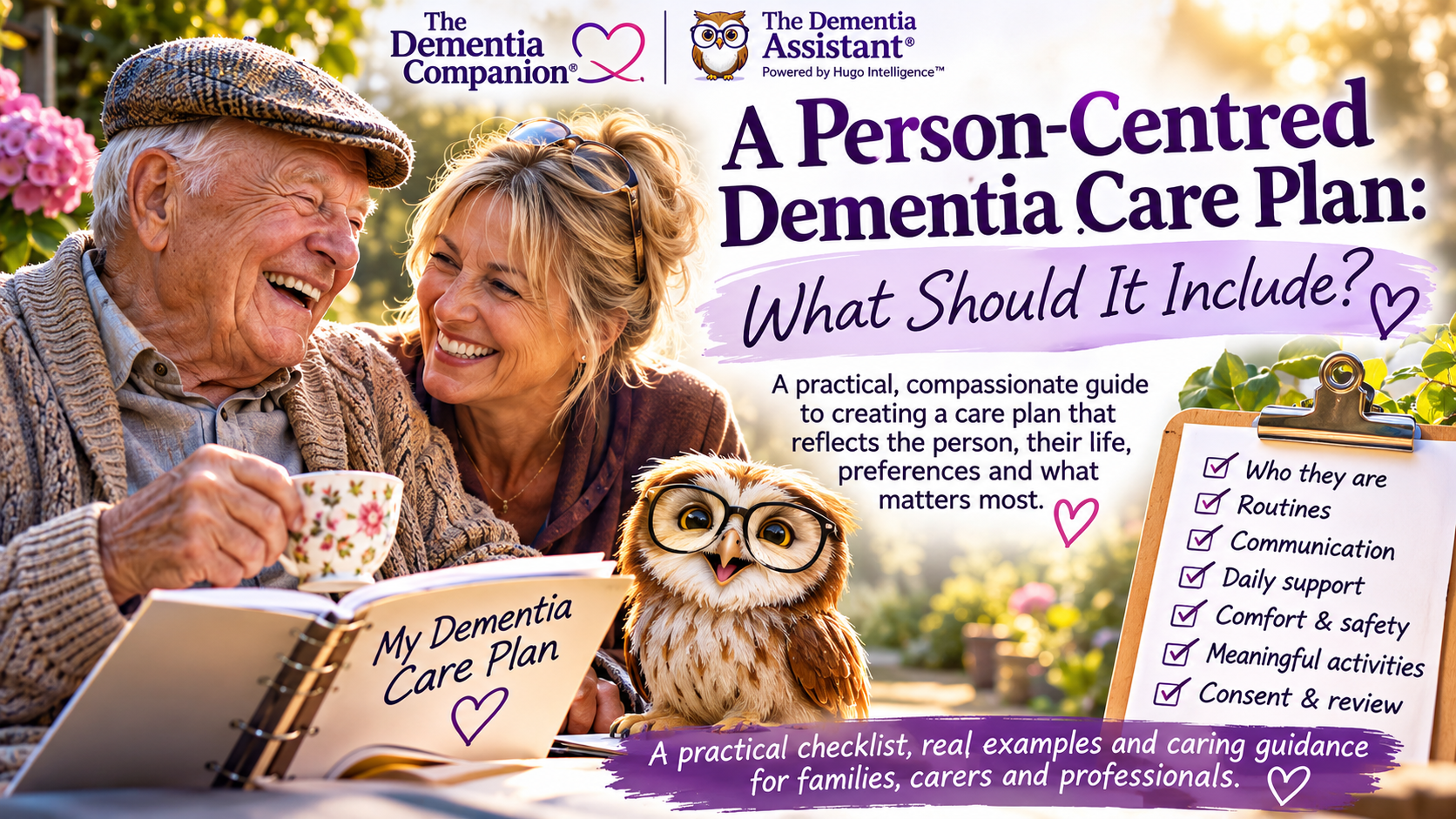
A Person-Centred Dementia Care Plan: What Should It Include?
Because a person is so much more than a diagnosis, a medication list and what time they like their breakfast.
By Louise Donaghy, Founder of The Dementia Assistant® and The Dementia Companion®, Creator of Hugo Intelligence™
A care plan should tell me about the person, not just their dementia
Imagine arriving at someone’s home for the very first time.
You’ve been given a care plan. Excellent. You open it and read:
“Mrs Jones. Dementia. Requires assistance with personal care. Can become agitated. Encourage independence.”
Well, that’s helpful, isn’t it?
You’ve learned almost nothing about Mrs Jones, apart from the fact that she has dementia and occasionally gets upset. Which, quite frankly, might describe any of us on a Monday morning before the first cup of tea.
What you haven’t learned is that she prefers to be called Betty, that she was a fiercely independent schoolteacher, that she speaks Welsh when she’s tired, and that she likes to wash and dress before breakfast because she’s done it that way for 70 years.
You also haven’t learned that being rushed makes her anxious, that she can wash her face and hands perfectly well if you give her time, or that she absolutely cannot stand strangers calling her “sweetheart”.
And who could blame her?
That is the difference between a care plan that describes someone’s difficulties and a person-centred dementia care plan that helps us understand the person.
A good care plan doesn’t simply tell us what someone needs help with. It explains who they are, what matters to them, what they can still do, how they communicate, and how we can support them without taking away their independence, dignity or identity.
Whether you’re a daughter caring for your mum, a husband supporting your wife, a professional carer, a dementia nurse or a care manager, the aim is the same.
To make sure the person receives support that feels familiar, respectful, safe and, above all, personal.
What is a person-centred dementia care plan?
A person-centred dementia care plan is a practical, individualised record of someone’s needs, abilities, wishes, preferences, routines and agreed support.
It helps family members, care workers and healthcare professionals provide consistent care while recognising that the person living with dementia remains an individual with their own history, relationships, choices and rights.
It should answer five important questions:
- Who is this person, beyond their diagnosis?
- What matters most to them, and what can they still do independently?
- What support do they need, and how would they like it provided?
- Who is responsible for different parts of their care?
- When and how should their care plan be reviewed?
A good dementia care plan should also be flexible.
Someone might manage an activity comfortably on Monday but need additional reassurance on Tuesday. That doesn’t mean they’ve suddenly forgotten everything. Their sleep, health, environment, confidence or level of distress may have changed.
The plan needs to recognise those differences rather than treating every day as identical.
In England, the Care Quality Commission’s Regulation 9 requires regulated providers to deliver person-centred care, involving people in planning and reviewing their support. NICE also recommends coordinated, individualised care planning for people living with dementia.
But person-centred care isn’t simply about meeting a regulation.
It’s about remembering that we’re supporting a human being, not managing a collection of symptoms.
- Start with the person: their life, strengths and identity
Before discussing medication, mobility or personal care, spend some time getting to know the person.
What would they want someone new to understand about them?
A life story doesn’t need to be a 40-page autobiography, although some of the people I’ve worked alongside could certainly give us one. And I suspect a few chapters would be rather entertaining!
Start with the details that make a difference to everyday support.
Include:
- Their preferred name, pronouns and form of address.
- Their background, career, interests and important achievements.
- The people, places and relationships that matter to them.
- Their personality, humour, beliefs and values.
- Their preferred language and cultural identity.
- Things they enjoy, dislike or find uncomfortable.
- What makes them feel proud, useful, valued and independent.
- Skills and abilities they want to continue using.
Most importantly, ask what they can still do.
Dementia may change how someone approaches a task, but it doesn’t automatically remove their ability to participate.
Perhaps they can no longer prepare an entire Sunday lunch independently, but they can still peel potatoes, stir gravy or tell you that you’ve made the Yorkshire puddings all wrong.
That participation matters.
We shouldn’t be so busy doing things for someone that we forget to do things with them.
Care planning question: What does this person want to remain involved in, and how can we make that possible?
- Record daily routines and personal preferences
Routine can provide familiarity and reassurance, particularly when someone finds change difficult.
But please remember, a routine is not the same as a timetable imposed by somebody else.
If someone has enjoyed a leisurely breakfast at 9.30 am for most of their adult life, suddenly expecting them to be washed, dressed and sitting at the breakfast table at 7 am may not be particularly person-centred.
Especially if they’re anything like me before coffee.
A dementia care plan should include how the person prefers to live their day.
Record:
- Their usual waking and sleeping times.
- Preferred breakfast, meals and drinks.
- Bathing, washing, dressing and grooming preferences.
- Clothing choices and personal presentation.
- Rest periods and preferred activities.
- Important religious or cultural routines.
- Familiar evening habits and bedtime preferences.
- Changes in energy, concentration or comfort during the day.
It can also help to record which parts of a routine the person can manage alone and where they welcome assistance.
For instance:
“Margaret prefers to choose her own clothes. Offer two suitable outfits and allow time for her to decide. She can usually dress her upper body independently but sometimes appreciates help with buttons.”
That tells the next person exactly what supportive care looks like.
It also protects Margaret from having her choices quietly taken away because someone else happens to be in a hurry.
- Communication: understand how the person connects with others
Communication difficulties are common in dementia, but they vary enormously.
One person may struggle to find particular words. Another might need more processing time. Someone else may communicate their needs more through facial expressions, gestures or behaviour.
And a person who speaks several languages may feel more comfortable using their first language in certain situations.
The care plan should help others understand how best to communicate with this particular person.
Include:
- Their preferred language and communication style.
- Whether they use hearing aids, glasses or communication aids.
- Helpful ways of approaching and introducing yourself.
- How much processing time they usually need.
- Whether short, clear explanations are helpful.
- Words, phrases or topics they find reassuring.
- Communication approaches they dislike.
- How they express pain, discomfort, tiredness or distress.
- Whether an interpreter or speech and language therapist is needed.
A useful entry might say:
“Peter prefers people to approach from the front, introduce themselves and speak calmly. Allow him time to respond before repeating a question. He wears hearing aids and hears best when background television noise is reduced.”
Now we’ve given the next carer something genuinely useful.
And one small but important reminder: speaking louder isn’t necessarily the same as making ourselves understood.
Sometimes the most helpful communication skill is knowing when to stop talking and give someone time.
- Personal care, dignity and everyday support
This is where many dementia care plans become very clinical.
“Washing assistance required.”
“Dressing assistance required.”
“Toileting support required.”
These may identify needs, but they don’t explain how support should be offered.
Personal care is personal. For someone who has managed their own washing, dressing and intimate care for decades, suddenly needing assistance can feel uncomfortable, embarrassing or even frightening.
A thoughtful care plan should explain how to preserve the person’s privacy, dignity and choice.
Consider:
- What the person can manage independently.
- Where they prefer assistance.
- Whether they prefer a particular caregiver where practical.
- Their preferred products, clothing and bathing routine.
- Whether they need physical assistance, prompting or supervision.
- How to offer help without rushing or taking over.
- How to respond respectfully if support is declined.
- What changes should be recorded or reported.
If someone refuses a shower, that doesn’t automatically mean they’re being difficult.
Perhaps the bathroom is cold. Perhaps they’re frightened of slipping. Perhaps they don’t understand why someone they barely know is asking them to undress.
Or perhaps they simply don’t want a shower right now.
We all have preferences.
A person-centred care plan helps us understand possible reasons and adapt the approach, without assuming we know exactly what the person is experiencing.
It should also record how to respect refusal, consider alternatives and seek appropriate help if essential care cannot be provided safely.
- Eating, drinking, medication and physical health
A dementia care plan should cover the practical aspects of maintaining health and wellbeing.
But it shouldn’t turn family carers into medical professionals or ask care workers to make clinical decisions outside their training.
Include relevant information about:
- Favourite foods and drinks.
- Food allergies and medically advised dietary requirements.
- Cultural or religious food preferences.
- Support needed to prepare or eat meals.
- Drinking routines and any identified hydration needs.
- Dentures, oral care and dental concerns.
- Mobility and falls-related support.
- Sleep and rest.
- Pain and how discomfort may be expressed.
- Continence and toileting support.
- Existing health conditions and relevant professional guidance.
- Medication responsibilities and where the current authorised medication record is kept.
Record any prescribed texture changes, thickened fluids or swallowing precautions exactly as advised by the relevant clinician.
If someone coughs or chokes when eating, has new swallowing difficulties, or begins losing weight unexpectedly, professional assessment may be needed.
Medication information must also be accurate, current and managed according to the person’s needs and the responsibilities of those supporting them. Any administration, prompting, storage or monitoring arrangements should be clearly documented.
A care plan can help everyone understand these responsibilities, but it must not replace a prescription, medication administration record or professional assessment.
And a change in someone’s behaviour should never automatically be dismissed as “just the dementia”.
Pain, constipation, infection, dehydration, medication effects, poor sleep and other health problems can all affect how someone feels and functions.
A new or sudden change deserves attention.
- Emotional wellbeing, distress and changes in behaviour
I have always felt that one of the most important questions we can ask is:
“What might this person be trying to tell us?”
Not every change in behaviour has an obvious explanation.
Someone may begin pacing, repeatedly asking for a family member, resisting assistance or becoming distressed at particular times.
Rather than simply writing “agitated in the evening”, a useful care plan should help people notice patterns and consider possible needs.
Record:
- What the person may find upsetting or overwhelming.
- Known situations that can increase distress.
- Early signs that they may be uncomfortable.
- Possible physical, emotional or environmental contributors.
- What has helped previously.
- What approaches have made the situation worse.
- How the person prefers to be comforted.
- When additional assessment or professional support is needed.
For example:
“Anne sometimes becomes unsettled when several people are speaking at once. Reduce competing noise, offer a quieter space and ask whether she would like someone to sit with her. Record any new patterns of distress and report significant changes.”
That’s considerably more useful than:
“Anne can be challenging.”
Challenging for whom? And what has actually happened?
Words matter.
Care records should describe what was observed, not label someone’s character.
The aim is to understand possible unmet needs and support the person’s wellbeing, not simply make their behaviour easier for everyone else to manage.
- Relationships, family involvement and meaningful activities
A person’s life doesn’t stop being important because they need care.
Their relationships, sense of purpose, hobbies, humour and favourite places may be just as important as their physical needs.
A care plan should recognise the people they want around them and the activities that make life enjoyable.
Include:
- Important relationships and preferred contact arrangements.
- People the person wants involved in their care.
- Friends, neighbours, pets and community connections.
- Activities they enjoy or previously enjoyed.
- Music, television, gardening, cooking or other interests.
- Religious, cultural and social connections.
- Opportunities to make choices and contribute.
- Adaptations that could support participation.
Meaningful activity isn’t necessarily an organised session involving laminated worksheets and a timetable.
Sometimes it’s watering the plants, brushing the dog, sorting a drawer, having a conversation or sitting outside with a cup of tea.
And sometimes someone simply wants a bit of peace and quiet.
That’s meaningful too.
The important question is whether the activity matters to the person.
Not whether it looks impressive in the daily notes.
- Comfort, safety and independence: finding the balance
Safety is important. Nobody is suggesting otherwise.
But there’s a difference between protecting someone from avoidable harm and removing every activity because it involves some uncertainty.
A person-centred dementia care plan should identify risks while considering the person’s preferences, abilities and rights.
This might include:
- Falls and mobility concerns.
- Safe use of kitchen equipment.
- Leaving home or becoming lost.
- Managing medicines and appointments.
- Home environment and lighting.
- Sensory needs and accessibility.
- Emergency contact arrangements.
- Assistive equipment and technology.
- Safeguarding concerns.
- Individualised strategies to support independence.
The goal should be proportionate, agreed support, rather than unnecessary restriction.
For example, if a person enjoys making tea but sometimes forgets to switch off the kettle, the answer may involve assessing safer equipment, making the environment easier to use, or offering discreet assistance.
It shouldn’t automatically be to ban them from the kitchen forever.
Decisions about significant restrictions, complex risks or someone’s capacity to make a particular decision require appropriate professional assessment and the relevant legal safeguards.
- Involve the person in writing their own dementia care plan
One of the greatest mistakes we can make is assuming that a dementia diagnosis means somebody can no longer contribute to decisions.
It doesn’t.
Dementia affects people differently, and the ability to make a decision can depend on the specific decision and the circumstances.
Whenever possible, the person should be supported to express their preferences, understand their options and take part in planning their care.
That might mean:
- Having conversations at a comfortable time of day.
- Using simple, clear information.
- Allowing additional thinking time.
- Offering choices individually rather than all at once.
- Using pictures, written prompts or communication aids.
- Involving someone the person trusts, with their agreement where appropriate.
- Returning to a discussion later if they are tired or distressed.
In England and Wales, the Mental Capacity Act 2005 provides the legal framework for decisions where capacity is in question.
A diagnosis alone doesn’t establish that somebody lacks capacity.
Capacity is decision-specific and time-specific. People must be supported to make decisions wherever possible, and an unwise decision doesn’t itself prove a lack of capacity.
Where somebody lacks capacity for a particular decision, the appropriate legal process must be followed, including best-interests decision-making and consideration of the least restrictive option.
Family members should be listened to, but being someone’s son, daughter, husband or wife does not automatically give legal authority to make every decision on their behalf.
These arrangements differ between countries, and readers outside England and Wales should check the applicable laws and procedures.
A care plan should record the person’s wishes and participation, not simply what everyone else has decided is best for them.
- Consent, confidentiality and sharing information
Families often share care responsibilities with several people.
A daughter might organise appointments. A husband might manage daily routines. A professional carer might record observations. A GP or dementia nurse may oversee clinical needs.
Everyone needs appropriate information, but that doesn’t mean everyone should automatically have access to every detail.
A care plan should record:
- Who the person agrees may see or receive information.
- What information can be shared and for what purpose.
- Relevant consent decisions.
- Any legally authorised representatives.
- How confidential records are stored and accessed.
- How changes to permissions are managed.
- Who is responsible for updating information.
Consent to care and the legal basis for processing or sharing information are related but distinct matters.
Health and care providers have professional confidentiality and data protection responsibilities, and the legal rules can differ depending on the purpose of sharing, the recipient and the circumstances.
Where capacity or consent is uncertain, professional guidance should be sought rather than assuming permission.
Good information sharing should help people provide coordinated support without unnecessarily exposing someone’s private life.
Even within a family, people deserve dignity and privacy.
- What does a good dementia care plan entry actually look like?
Let’s look at a clearly fictional example.
Meet Margaret, aged 79.
Margaret is a fictional person created to demonstrate practical care planning.
She’s a retired florist who enjoys gardening, classical music, strong tea and having the final say about her wardrobe.
She lives with dementia and sometimes needs assistance with her morning routine.
Vague care plan entry:
“Margaret requires support with personal care and may become agitated.”
Technically, that’s information.
But what should a new carer actually do with it?
A more useful, person-centred care plan entry:
What matters to Margaret: Margaret values privacy and independence. She prefers to wash and dress before breakfast, likes to choose her own clothes and dislikes being rushed.
What Margaret can do: She can usually wash her face and upper body independently when toiletries are placed within reach.
Support agreed: The caregiver should introduce themselves, explain what assistance is available, offer Margaret a choice of two outfits if she wants help selecting clothes, and allow sufficient time for her to complete the tasks she can manage.
If Margaret becomes distressed: Pause, check whether she wants privacy or a break, and offer to return later. Do not force personal care. Record what happened and escalate any ongoing concerns through the agreed care arrangements.
Responsibility: The person providing morning care follows the agreed support plan and records any significant changes. The named care coordinator reviews repeated difficulties with Margaret and the appropriate people involved in her care.
Review: Revisit the approach if Margaret’s abilities, wishes, safety or level of distress change.
Notice the difference?
The second version explains what matters to Margaret, what she can do, how support should be offered, what to do if something isn’t working, and who is responsible.
That’s what turns a piece of paperwork into a useful care plan.
- Who does what? Agree responsibilities clearly
Even the most beautifully written dementia care plan is not much use if everyone assumes somebody else is doing something.
A family may believe the care agency is monitoring meals.
The care agency may assume the family is doing it.
The GP may not be aware that eating habits have changed.
And meanwhile, nobody has a complete picture.
A practical care plan should identify:
The person living with dementia: Their wishes, choices, priorities and involvement in decisions.
Family and unpaid carers: The support they have agreed to provide, their availability and their own limits.
Professional care workers: Their agreed tasks, recording responsibilities and escalation procedures.
Healthcare professionals: Clinical assessments, diagnosis, medication management and treatment decisions within their professional roles.
A named coordinator: The individual responsible for helping keep the plan joined up, arranging reviews and ensuring important updates reach the relevant people.
For each significant need, it helps to record what support is required, who is responsible, when it should happen and what changes need reporting.
The family’s wellbeing matters here too.
A care plan shouldn’t quietly assume that one exhausted relative can be available 24 hours a day, seven days a week.
Unpaid carers may need their own assessment, practical assistance and opportunities for respite.
Supporting the person living with dementia and supporting the people caring for them should never be treated as competing priorities.
Both matter.
- When should a dementia care plan be reviewed?
A care plan is a living document, not something written once and filed away until somebody remembers where they put it.
Dementia-related needs can change, sometimes gradually and sometimes unexpectedly.
A care plan should be reviewed whenever significant changes occur, including:
- A hospital admission or discharge.
- A fall or other safety incident.
- New or worsening difficulties with eating, drinking or swallowing.
- Changes in mobility or personal care needs.
- New distress or communication difficulties.
- Medication changes requiring an update to support arrangements.
- Changes in living arrangements or family circumstances.
- New wishes or preferences expressed by the person.
- Concerns raised by the person, relatives or care staff.
In England, NICE recommends an initial review of home care plans within six weeks of starting the service, with regular reviews thereafter, at least annually. Earlier review is needed when circumstances change.
Different care settings, professional services and individual needs may require more frequent review.
For families managing their own informal care plan, a short scheduled check-in can be useful, alongside immediate updates when something important changes.
Ask:
“Is this still helping?”
“Does the person still want support provided this way?”
“What has changed?”
“What can we do differently?”
And most importantly:
“Have we asked the person?”
- Dementia care planning checklist: what should you include?
Use this practical checklist when creating, updating or reviewing a person-centred dementia care plan.
Personal identity and life story
- [ ] Preferred name and form of address
- [ ] Life history, interests, achievements and values
- [ ] Personal strengths and retained abilities
- [ ] Cultural, religious and spiritual preferences
- [ ] Preferred language and communication style
- [ ] Important relationships and social connections
Daily living and personal support
- [ ] Morning and evening routines
- [ ] Washing, dressing, grooming and toileting preferences
- [ ] Food, drink and mealtime choices
- [ ] Sleep, rest and comfort needs
- [ ] Mobility and accessibility requirements
- [ ] Activities the person can do independently
- [ ] Agreed assistance, prompts and adaptations
Health and wellbeing
- [ ] Relevant diagnoses and clinical contacts
- [ ] Current medication support arrangements
- [ ] Allergies and relevant clinical precautions
- [ ] Pain and discomfort indicators
- [ ] Nutrition, hydration and swallowing concerns
- [ ] Sensory and communication needs
- [ ] Emotional wellbeing and known sources of distress
- [ ] Clear guidance on reporting sudden changes
Safety, relationships and quality of life
- [ ] Individual safety considerations
- [ ] Support that protects independence
- [ ] Interests and meaningful activities
- [ ] Family, friendships, pets and community involvement
- [ ] Reassuring approaches and familiar comforts
- [ ] Personal goals and desired outcomes
Consent, responsibilities and review
- [ ] The person’s involvement and wishes recorded
- [ ] Relevant consent and information-sharing arrangements
- [ ] Legal representatives identified where applicable
- [ ] Named care coordinator and other responsibilities
- [ ] Emergency contacts and escalation arrangements
- [ ] Date created and last updated
- [ ] Next planned review
- [ ] Relevant professional assessments and recommendations
This checklist is a starting point, not a substitute for an individually assessed care plan.
Not every person will need every section in the same level of detail.
The right care plan is the one that reflects the person, supports real decisions and can actually be used by the people providing care.
- Can AI help families create a person-centred dementia care plan?
Creating a dementia care plan can feel overwhelming, particularly when a family is still coming to terms with a diagnosis, waiting for a memory clinic appointment or trying to coordinate several different professionals.
Where do you start?
What information matters?
How do you put everything into words?
And how do you make sure the important details don’t disappear between appointments, phone calls and conversations?
This is one of the reasons I created The Dementia Assistant®, powered by Hugo Intelligence™ and Person-Centred Intelligence®.
I wanted families to have somewhere to bring together the information they were already trying desperately to remember, organise and explain.
Within The Dementia Assistant®, families and professionals can build a person-centred care plan step by step.
You can record the person’s routines, preferences, strengths, communication needs, relationships and support requirements. You can add relevant documents, maintain daily care notes and keep a record of changes over time.
Hugo can guide you through questions you may not have thought to ask and help turn your answers into clearer, more useful care-plan wording.
You can also select a person’s care plan when using Ask Hugo so that the guidance is informed by the information you’ve chosen to provide about them.
For example, instead of simply asking:
“How do I help someone with dementia who refuses personal care?”
You can explore the question alongside the person’s own preferences, routines and previously recorded support needs.
That makes the conversation more relevant to the individual.
Hugo isn’t there to replace the person, their family or their healthcare professionals.
He’s there to help everyone ask better questions, organise important information and think more carefully about the person behind the diagnosis.
Clinical assessments, medication decisions, safeguarding concerns and legal decisions must still involve the appropriately qualified people.
AI should help us become more person-centred, never less.
- Frequently asked questions about dementia care plans
What should a dementia care plan include?
A dementia care plan should cover the person’s identity, life story, strengths, preferences, communication, daily routines, physical and emotional needs, meaningful activities, safety, relationships, consent, support responsibilities and review arrangements.
It should explain not just what care is required, but how the person wishes to receive it.
What is the difference between a care plan and a person-centred care plan?
A basic care plan may focus mainly on tasks, diagnoses and identified needs.
A person-centred care plan goes further by recording the individual’s wishes, values, independence, strengths and preferred ways of receiving support.
The distinction is not the length of the document. It’s whether the information genuinely helps people understand and support the person.
Can a family member write a dementia care plan?
Yes. Families can create a practical care record to organise preferences, routines, contacts, agreed support and observations.
The person living with dementia should be involved wherever possible.
A family-created plan can complement professional care planning, but it doesn’t replace required assessments, clinical instructions or formal plans produced by regulated services.
Does everyone with dementia need the same type of care plan?
No. Dementia affects individuals differently.
Some people may need only occasional prompts and practical adjustments. Others may require more substantial personal care, clinical support or supervision.
Care plans should reflect individual needs and be reviewed as circumstances change.
How often should a dementia care plan be updated?
Update it whenever needs, abilities, preferences or care arrangements change.
For formal home care services in England, NICE recommends an initial review within six weeks and subsequent regular review at least annually, with earlier review when necessary.
Other services may have different review requirements.
Can someone with dementia make decisions about their own care?
Yes. A dementia diagnosis doesn’t automatically remove someone’s ability or right to make decisions.
They should be supported to participate, and the relevant legal framework must be followed if capacity for a particular decision is in doubt.
What is an example of a person-centred care plan goal?
Instead of “improve independence”, a more useful goal might be:
“Support Margaret to choose her clothing and complete the parts of her morning routine she can manage, offering assistance only where needed and reviewing the approach if her preferences or abilities change.”
The goal describes an individual outcome and the support needed to work towards it.
Can a dementia care plan be used before diagnosis?
Yes. Families can begin recording observations, preferences, routines, appointments and support needs while waiting for a clinical assessment.
This can help them communicate relevant information to healthcare professionals.
However, a care plan should not be used to diagnose dementia or assume that memory difficulties have a particular cause. New or concerning symptoms require appropriate medical assessment.
The most important part of any dementia care plan
If there’s one thing I’d love you to take away from this article, it’s this:
A dementia care plan should never become more important than the person it was written for.
It’s easy to get caught up in paperwork.
Risk assessments, medication records, appointments, reviews, signatures, dates. The list can seem endless.
And yes, much of that information is important.
But somewhere among those pages is a person who has lived a whole life.
Someone who has loved, worked, laughed, argued, raised a family perhaps, travelled, danced, made mistakes and accumulated memories that deserve to be respected.
Someone who may still enjoy a joke, have a strong opinion about their tea, or know perfectly well when you’re trying to hurry them along.
Dementia may change the support they need.
It doesn’t make their identity, dignity or preferences any less important.
So when you’re creating a care plan, don’t just ask:
“What does this person need help with?”
Ask:
“Who is this person, what matters to them, and how can we help them continue living their life in a way that feels right for them?”
That’s where person-centred dementia care begins.
And that’s what a truly useful care plan should protect.
Need help creating a dementia care plan? Ask Hugo 🦉
You don’t have to work everything out on your own.
At The Dementia Companion®, you’ll find practical articles, guidance and resources to help you understand dementia and support the person behind the diagnosis.
And through The Dementia Assistant®, you can meet Hugo Intelligence™, your person-centred AI guide.
Hugo can help you explore what belongs in a care plan, build the person’s profile, organise important information and develop practical support guidance that reflects their individual life.
All subscription plans include a 30-day complimentary trial.
Visit:
The Dementia Companion®:
https://thedementiacompanion.com/
The Dementia Assistant®:
https://thedementiaassistant.com/
Because good dementia care doesn’t begin with a form.
It begins with a person.
Louise and Hugo ❤️🦉
Louise Donaghy
Founder & CEO of The Dementia Assistant®
Created and powered by Person-Centred Intelligence®
Creator of Hugo Intelligence™
⸻
Important: This article provides general educational guidance. It is not a substitute for individual medical, legal, safeguarding or professional care advice. The legal and regulatory examples relate primarily to England and Wales, with England-specific care regulation identified where relevant. Readers elsewhere should consult guidance applicable to their country or region.
References and Further Reading
The following professional guidelines and resources support the recommendations in this article.
1. National Institute for Health and Care Excellence (NICE).
Dementia: Assessment, Management and Support for People Living with Dementia and Their Carers (NG97).
Guidance on person-centred dementia care, individualised support, care coordination and involving people living with dementia in decisions about their care.
https://www.nice.org.uk/guidance/ng97
2. National Institute for Health and Care Excellence (NICE).
Home Care: Delivering Personal Care and Practical Support to Older People Living in Their Own Homes (NG21).
Recommendations covering personalised care planning, involving people in decisions, coordinating support and regularly reviewing care arrangements.
https://www.nice.org.uk/guidance/ng21
3. Care Quality Commission (CQC).
Regulation 9: Person-Centred Care.
Explains the legal requirements for person-centred care within CQC-regulated health and social care services in England, including involving people in planning and reviewing their support.
https://www.cqc.org.uk/guidance-regulation/providers/regulations-service-providers-and-managers/health-social-care-act/regulation-9
4. NHS.
Mental Capacity Act.
Explains the principles of the Mental Capacity Act 2005, supporting people to make decisions, assessing capacity and making decisions in their best interests when legally necessary.
https://www.nhs.uk/social-care-and-support/making-decisions-for-someone-else/mental-capacity-act/
5. NHS England.
Sharing Information with Unpaid Carers.
Guidance on confidentiality, consent and appropriate sharing of health and care information with family members and unpaid carers.
https://digital.nhs.uk/data-and-information/information-governance/guidance/sharing-information-with-unpaid-carers
6. NHS.
End of Life Care for People with Dementia.
Information about planning ahead, recording personal wishes and supporting appropriate care decisions as dementia progresses.
https://www.nhs.uk/conditions/dementia/living-with-dementia/palliative-care/
⸻
Article: A Person-Centred Dementia Care Plan: What Should It Include?
Author: Louise Donaghy, Founder of The Dementia Assistant® and The Dementia Companion®, Creator of Hugo Intelligence™.
Published: 20 November 2026
Disclaimer: This article is for educational purposes and does not replace individual medical, legal or professional care advice. UK legal and regulatory guidance may differ across the four nations, and international readers should consult the relevant guidance in their own country.
Further Reading and Helpful Dementia Resources
Creating a person-centred dementia care plan is only the beginning. Explore more practical guidance from The Dementia Companion®:
* Dementia and Sundowning: Why It Happens and How to Ease It
https://thedementiacompanion.com/articles/dementia-and-sundowning/
* Dementia Communication and Everyday Support
Explore our articles on communicating with someone living with dementia, responding to repeated questions and understanding distress.
https://thedementiacompanion.com/
* Creating Your Own Person-Centred Dementia Care Plan
Discover how The Dementia Assistant® and Hugo Intelligence™ can help families and professionals organise daily notes, personal preferences, routines and individual care needs.
https://thedementiaassistant.com/
The Dementia Companion®, home of The Dementia Assistant® and Hugo 🦉
https://thedementiacompanion.com/
You May Also Find Helpful
- How Do I Know When Mum with Dementia Needs a Care Home?
- Mum with Dementia Is Coming Home from Hospital. How Do I Make Sure Her Care Continues?
- How Do I Know If Mum's Dementia Care Needs Are Changing?
- Mum with Dementia Can’t Tell Me She’s in Pain. How Can I Recognise It?
- Need help with this situation? Ask Hugo
Need help with your own situation? Ask Hugo.
One Person. One Continuing Care Story. The Dementia Companion is where you discover guidance. Inside The Dementia Assistant®, talk with Hugo, save and categorise conversations, record daily notes and involve authorised supporters in a continuing care plan centred around the person.
Ask Hugo About This · Start Your Continuing Care Plan — Families · Continuing Care Planning — Professionals
Personal guidance requires the appropriate account and subscription access. Care-plan information is used only with authorised access and the required consent and selection steps. All subscription plans include a 30-day complimentary trial.