How Do I Know When Mum with Dementia Needs a Care Home?
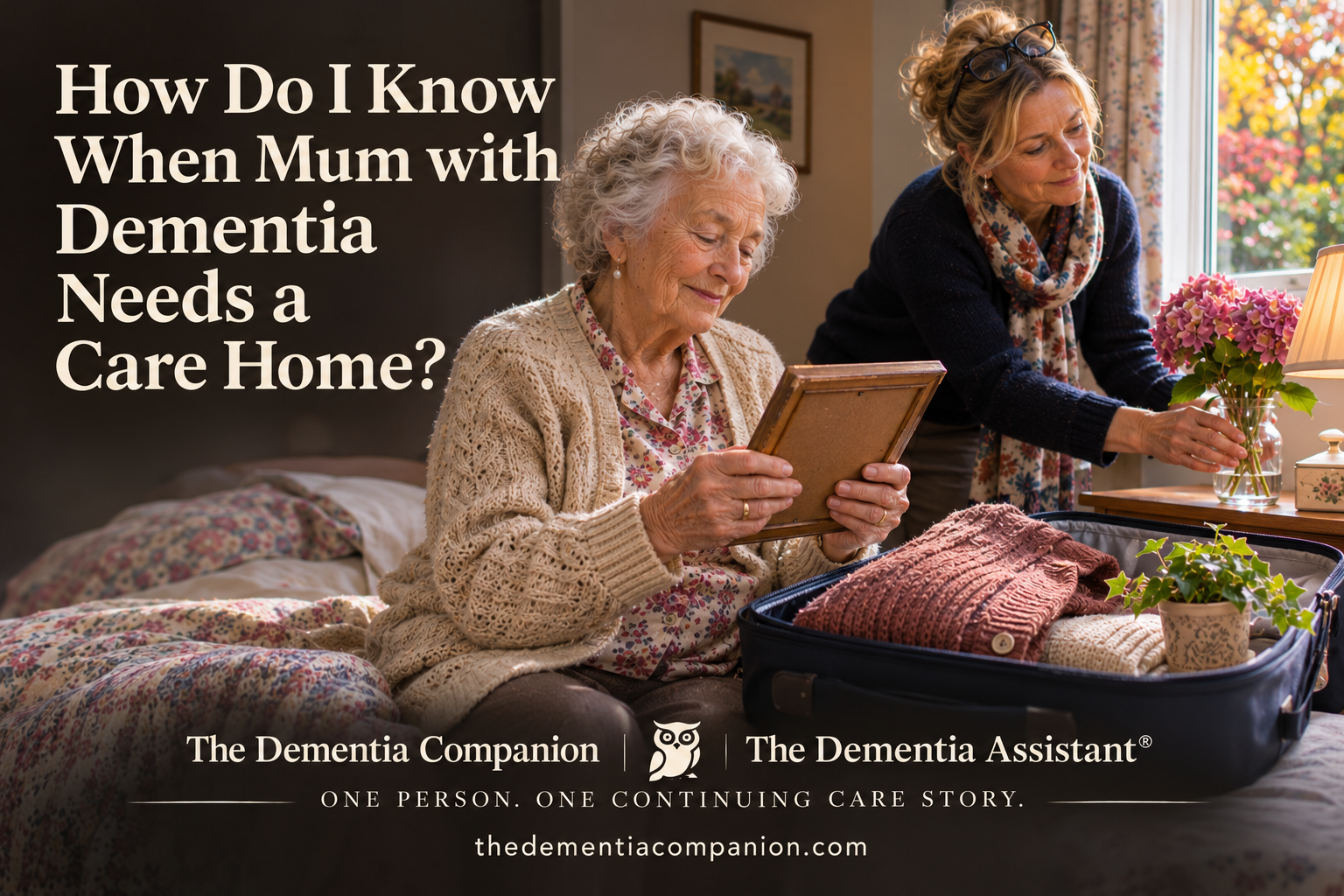
How Do I Know When Mum with Dementia Needs a Care Home?
One Person. One Continuing Care Story. | Article 40 of 40
By Louise Donaghy, Dementia Practitioner, Founder of The Dementia Companion and The Dementia Assistant®, and Creator of Hugo Intelligence™.
It might begin with a telephone call.
Mum has fallen again.
Or perhaps the neighbour found her wandering outside in her slippers.
Maybe the home carers have been struggling to meet her needs.
Perhaps she’s been getting up throughout the night, forgetting meals or becoming frightened when nobody is nearby.
You arrange another appointment.
Another assessment.
Another conversation about increasing her support.
And somehow you find yourself asking a question you never imagined wanting to ask.
Is it time for Mum to move into a care home?
Even thinking about it can make you feel dreadful.
Because this is Mum.
The woman who brought you up.
Who made sure you had clean clothes, something to eat and a place to feel safe.
The woman who always knew where everything was, even when nobody else in the house had the faintest idea.
She’s the person who looked after you.
Now you’re wondering whether you can continue looking after her.
You may have promised that she’d never have to leave her home.
Perhaps she made you promise.
Perhaps she has always said:
“Don’t you ever put me in one of those places.”
And now you’re sitting at the kitchen table, staring at a care-home brochure, feeling as though you’ve broken a promise before you’ve even made a decision.
I want to begin by telling you something important.
Considering residential care does not mean you have stopped loving Mum.
It means you’re recognising that her needs, your circumstances or the available support may have changed.
But neither does a dementia diagnosis automatically mean somebody needs a care home.
Many people continue living at home with appropriate support, sometimes for a considerable time.
So how do you know when a care home may be necessary?
The answer is to look at whether Mum’s health, safety, wellbeing and individual care needs can still be met appropriately at home, what additional support is available, what Mum wants and whether the current arrangements are sustainable for everyone involved.
A proper assessment can help you explore these questions.
There is no single dementia stage, number of falls or behaviour that automatically determines when somebody must move.
And there is no universal date on the calendar when home care suddenly becomes the wrong choice.
The decision should be about the person.
Her needs.
Her wishes.
Her rights.
Her relationships.
The support available.
And the environment in which she can experience the best possible care and quality of life.
Because the goal isn’t simply to keep Mum at home for as long as physically possible.
Nor is it to move her into residential care at the first sign of difficulty.
The goal is to help Mum live as safely, comfortably and meaningfully as possible, wherever her care is provided.
What are the signs that someone with dementia may need a care home?
There are several situations that may suggest it’s time to review whether the current arrangements can still meet someone’s needs.
These are reasons to seek assessment, not an automatic checklist for admission.
- Mum is no longer safe with the support currently available
Perhaps she’s falling regularly.
Perhaps she cannot summon help when something goes wrong.
Perhaps she leaves the house and becomes lost.
Or perhaps she is using appliances in ways that create serious risks.
Some risks can be reduced through treatment, suitable equipment, environmental changes or additional care.
Others may remain significant despite these measures.
The question is not whether Mum can live without any risk.
Nobody does.
It’s whether the risks have been assessed and whether proportionate, acceptable support can manage them.
- Mum needs assistance throughout the day and night
Perhaps she now needs help getting out of bed.
Assistance with washing, dressing and continence.
Support with eating and drinking.
Medication assistance.
Reassurance when distressed.
And somebody available when she wakes during the night.
Individual home care visits may no longer cover all those needs.
That doesn’t automatically mean residential care is the only option.
But it is a reason to review whether more extensive support is available and appropriate.
- Her health and personal care needs are becoming difficult to manage
Maybe Mum has lost weight.
Perhaps she’s experiencing recurrent falls.
Maybe she has developed pressure damage or significant mobility difficulties.
Perhaps she needs more complex clinical care.
A professional assessment should consider whether the necessary treatment and support can be provided at home, through community services or in a suitable residential setting.
Medical complexity matters, but the correct setting depends on the individual needs and available professional services.
- She is frequently distressed or frightened
Mum may become frightened when left alone.
Perhaps she no longer recognises her surroundings.
Perhaps she follows relatives constantly.
Or she becomes distressed when care workers arrive.
Before concluding that she needs residential care, consider possible causes.
Pain.
Infection.
Medication effects.
Poor sleep.
Loneliness.
Unfamiliar people.
Communication difficulties.
Or changes in the environment.
NICE recommends exploring clinical and environmental reasons for distress in dementia.
A move will not automatically resolve distress, and an unfamiliar environment can initially make things harder.
But some people may benefit from a more consistent level of support than can reasonably be provided in their current home.
- The family can no longer provide the care required
This is often the part families struggle to acknowledge.
Perhaps Mum’s husband is also elderly.
Perhaps her daughter is managing a job and children alongside providing care.
Perhaps the family has been taking turns staying overnight.
Perhaps nobody has slept properly for weeks.
Or perhaps the main carer has developed health problems.
The sustainability of the caring arrangement is a legitimate part of assessing care needs.
The question isn’t whether the family loves Mum enough.
It’s whether the necessary support can be provided safely, reliably and with appropriate regard for everyone’s wellbeing.
- The current home may no longer meet Mum’s needs
Perhaps the stairs have become unsafe.
Perhaps there are significant access difficulties.
Perhaps she needs equipment or adaptations that cannot reasonably be accommodated.
Perhaps she lives somewhere isolated from essential support.
An occupational therapy assessment may help explore adaptations.
But sometimes the environment itself becomes a significant limitation.
That deserves consideration alongside the person’s wishes and alternative living arrangements.
Does dementia automatically mean someone will need residential care?
No.
A dementia diagnosis does not automatically mean that somebody must move into a care home.
Some people live well at home with relatively modest assistance.
Others need extensive support.
Some may move into supported accommodation or residential care.
And some may continue receiving appropriate support in their own homes for the remainder of their lives.
There are many variables.
The dementia type.
Other health conditions.
The person’s abilities and preferences.
Their home environment.
The support available locally.
Their financial circumstances.
And the people involved in their care.
We should never treat the diagnosis as more important than the individual.
Someone living with dementia may still have significant strengths, meaningful relationships and the ability to make decisions.
Their support should reflect those abilities rather than automatically removing independence.
What should we try before deciding that home care is no longer enough?
Before making a major move, ask whether there are other suitable arrangements that might meet Mum’s needs.
Not every option will be available or appropriate.
And some situations require urgent action.
But where there is time to plan, exploring alternatives can be valuable.
More home care
Perhaps Mum currently has one short visit each morning.
Her needs may now require additional visits or more support with particular activities.
An assessment can help establish what is needed.
Overnight support
If Mum needs supervision or assistance at night, ask about available overnight care arrangements.
These may include waking-night or sleeping-night services, depending on local availability and the level of support required.
Clarify the responsibilities and limitations of the arrangement.
Companionship and daytime activities
Sometimes isolation and lack of meaningful activity contribute to distress.
A suitable day service, regular companionship or community support may help some people.
But companionship alone cannot replace essential personal or nursing care.
Respite care
A short stay in an appropriate residential setting may provide temporary support and allow the family carer to rest.
In some circumstances it may also help the person and family become familiar with a care environment.
However, respite isn’t always suitable, and availability, consent and funding vary.
Occupational therapy and home adaptations
Grab rails.
Accessible washing facilities.
Appropriate mobility equipment.
Improved lighting.
Safer access to essential rooms.
These may help preserve independence.
But adaptations should be based on the person’s actual needs and professional recommendations.
Rehabilitation or specialist medical input
Some changes in function may relate to a recent illness, pain, medication or another potentially treatable condition.
Physiotherapy, occupational therapy or medical review may improve the situation.
Do not assume that a recent decline is necessarily permanent.
A formal care needs review
This is often the most important step.
Ask the relevant professional service to assess what support Mum requires now, rather than relying on an assessment completed months ago.
Sometimes the answer will be more help at home. Sometimes it will be residential care. The important thing is making the decision with appropriate information.
What if Mum needs round-the-clock care?
People sometimes assume that round-the-clock care automatically means a nursing home is necessary.
Not always.
The type of support required matters.
There is a difference between needing somebody available for personal support and requiring ongoing care from registered nursing staff.
Residential care homes may provide accommodation, meals, personal care and support.
Nursing homes provide additional nursing services for people whose needs require them.
Terminology and regulation vary internationally.
Some services offer specialist dementia support.
Others support people with a wide range of care needs.
A professional assessment should consider which type of setting can meet Mum’s individual requirements.
Ask whether the home can continue meeting her needs if they change.
And remember that having a dementia unit or describing a service as dementia-friendly does not automatically establish the quality of its care.
The people, training, culture and actual practice matter.
How do I involve Mum in the decision?
This is one of the most important parts of the whole process.
Mum should not disappear from the conversation simply because she has dementia.
Begin by asking what matters to her.
Where does she feel comfortable?
What worries her?
What does she want to continue doing?
How does she feel about receiving more support?
Would she like to visit a prospective home?
Does she have strong preferences about location, privacy or daily routines?
Give her understandable information
A long discussion about complex funding arrangements may be overwhelming.
Try explaining the decision in manageable parts.
You might say:
“Mum, we’re looking at ways to make sure you have the help you need.”
Or:
“Would you like to visit somewhere with us and see what you think?”
Or:
“I know how important your home is to you. We want to understand what matters most before making any decisions.”
Give her time.
Allow questions.
Use her preferred language.
And avoid asking her to prove what she remembers.
What if Mum says she never wants to leave home?
Take her wishes seriously.
Don’t immediately dismiss them because you are worried about safety.
Ask what home means to her.
Perhaps it’s the garden.
Her neighbours.
Her independence.
Her possessions.
Her memories.
Or simply the feeling of knowing where she is.
Some of those things may be preserved through home support.
Others may help guide the choice and personalisation of a care-home environment.
A refusal should not automatically be treated as evidence of incapacity.
Where there is a genuine concern about her ability to make the particular decision, the appropriate legal and professional processes must be followed.
Who decides whether Mum moves into a care home?
This depends on Mum’s ability to make the particular decision and the relevant legal arrangements.
Dementia does not automatically remove someone’s decision-making rights.
Where Mum can make an informed decision with appropriate support, her decision must be respected within the applicable legal framework.
If she lacks capacity for the specific decision, an authorised decision-maker or appropriate legal process may be required.
England and Wales
The Mental Capacity Act 2005 provides the framework for assessing capacity and making decisions when a person lacks capacity.
Capacity is decision-specific.
A person must be supported to make their own decision wherever possible.
Where capacity is lacking, decisions must follow the relevant best-interests requirements and consider less restrictive alternatives.
A valid registered health and welfare Lasting Power of Attorney may be relevant, depending on its terms and whether the donor lacks capacity for the decision.
A property and financial affairs LPA alone does not confer general authority to decide where someone lives.
More complex disputes or restrictions may require additional legal processes.
Scotland
Scotland has a separate framework, including the Adults with Incapacity (Scotland) Act 2000.
Relevant powers, the person’s wishes and statutory principles must be considered.
Northern Ireland
Northern Ireland has its own legal arrangements, with provisions of the Mental Capacity Act (Northern Ireland) 2016 introduced in phases.
The applicable requirements need to be checked for the particular circumstances.
Republic of Ireland
Ireland’s Assisted Decision-Making (Capacity) Act 2015, as amended, provides a framework for supporting decision-making.
The Decision Support Service offers information about relevant arrangements.
USA, Canada and Australia
Decision-making and substitute decision-making laws vary by state, province or territory.
A family relationship does not automatically authorise a relative to make every accommodation or healthcare decision.
Seek appropriate local legal and professional guidance.
The important principle is that Mum’s diagnosis should never be treated as permission to take away her choices without proper assessment and lawful authority.
How do I choose the right care home for someone with dementia?
This is where families can feel overwhelmed.
You may be given several brochures.
Every home looks lovely in the photographs.
There are flowers, comfortable chairs and somebody smiling beside a tray of biscuits.
All perfectly pleasant.
But you need to understand what everyday care is actually like.
A beautiful building is not the same thing as good dementia care.
Visit the home if possible
Look beyond the reception area.
Are residents treated respectfully?
Do staff appear to know people as individuals?
Do they speak to residents, rather than simply talking about them?
Is the atmosphere calm and welcoming?
Do people have opportunities for meaningful activity?
Are individual routines respected?
Can residents choose where to spend time?
Ask about staff experience
What dementia-specific training do staff receive?
How are new workers supported?
How are communication difficulties managed?
How does the home approach distress or refusal of personal care?
Who reviews care plans?
How are concerns about pain, falls, eating or medication escalated?
How are family observations considered?
Ask about consistency
Will Mum regularly see familiar carers?
What happens when staffing changes?
How are important preferences communicated during handovers?
Can her familiar daily routines continue?
Ask about healthcare access
How are GP or primary care appointments arranged?
Is nursing support available when needed?
How does the home access dietitians, physiotherapists, occupational therapists and speech and language therapists?
What happens when somebody becomes acutely unwell?
Can the home meet more complex needs, or might another move eventually be necessary?
Ask about family involvement
Can relatives visit in ways that respect the resident’s wishes and the home’s arrangements?
How are families informed about significant changes?
Who is the main contact?
How are concerns or complaints handled?
How does the home involve Mum in decisions?
Check independent inspection information
In England, families can consult the Care Quality Commission’s information and inspection reports.
Other UK nations have separate regulators.
The USA, Canada, Australia and Ireland also have different regulatory systems.
Inspection information can be useful, but it should be considered alongside visits, conversations and the person’s specific needs.
Choose the environment that best understands Mum, not simply the one with the most impressive entrance hall.
Twelve questions to ask when visiting a dementia care home
Take these questions with you.
- What experience does the home have supporting people with Mum’s particular needs?
- How are residents involved in everyday decisions and care planning?
- Can Mum keep familiar routines, including her preferred waking, mealtime and bedtime arrangements?
- How do staff respond when someone is distressed, frightened or refusing support?
- What training and supervision do staff receive in dementia care?
- Will she regularly see familiar members of staff?
- What medical and nursing support is available, and what happens when needs change?
- How are medication, falls, nutrition, pain and safeguarding concerns managed?
- Can Mum bring meaningful possessions and personalise her room?
- How are relatives involved, and how are relevant updates shared?
- What exactly is included in the fees, and which services cost extra?
- How will the home use Mum’s existing person-centred information to help staff understand her from the beginning?
The last question matters enormously.
Because Mum should not arrive as an unfamiliar diagnosis and a collection of admission forms.
She should arrive as an individual with a life story.
How much does a dementia care home cost?
This is often one of the family’s greatest worries.
And the answer varies significantly.
Fees depend on the country, region, provider, level of care and individual funding arrangements.
The cost of specialist dementia support may also differ between facilities.
Never assume that a diagnosis of dementia automatically entitles someone to fully funded residential care.
Similarly, never assume the family must pay every cost without an assessment.
Seek official guidance relevant to where the person lives.
United Kingdom
In England, the local authority can assess care and support needs.
Where relevant, a separate financial assessment determines what contribution may be required under the applicable rules.
NHS Continuing Healthcare may be relevant for some adults with qualifying primary health needs, but eligibility is not based on a dementia diagnosis alone.
Scotland, Wales and Northern Ireland have different funding systems, eligibility rules and financial arrangements.
Obtain advice specific to the UK nation concerned.
United States
Residential memory care, assisted living and nursing home services may have different funding arrangements.
Medicare generally does not cover long-term custodial care.
Medicaid may help eligible people with certain long-term care costs, subject to programme and state rules.
Private funds, insurance, veterans’ benefits or other arrangements may also be relevant.
Families should obtain an individual assessment of coverage and costs.
Canada
Long-term care is organised through provincial and territorial systems.
Eligibility, funding, accommodation charges and access arrangements vary.
Contact the relevant provincial or territorial health authority.
Australia
Government-funded aged care arrangements operate under Australia’s current aged care framework.
The Aged Care Act 2024 commenced on 1 November 2025.
My Aged Care provides information on assessment, residential services, eligibility, costs and the applicable funding arrangements.
Care arrangements and contributions depend on individual circumstances.
Republic of Ireland
The Nursing Homes Support Scheme, commonly known as Fair Deal, can provide financial support towards eligible long-term nursing home care.
It involves care needs and financial assessments.
The HSE provides official guidance on applying and understanding contributions.
Before signing an agreement
Ask for written information about fees.
Check what is included.
Ask about additional charges.
Understand how fees may change.
Seek independent financial or legal advice where necessary.
Do not rely on verbal assurances alone.
And do not make assumptions about property, inheritance or family contributions without checking the applicable rules.
What if the family disagrees about residential care?
This can be enormously upsetting.
One daughter may believe Mum needs residential care immediately.
A son may insist she’s perfectly fine.
Another relative may be worried about the cost.
Someone else may say:
“But Mum always told us she’d never go into a home.”
Different family members may genuinely see different things.
Perhaps one visits at weekends.
Another provides daily personal care.
One sees Mum enjoying a pleasant afternoon.
Another knows she has been awake frightened throughout the night.
Both experiences may be true.
Bring the discussion back to Mum’s actual needs
What can she manage?
What support does she receive?
What is no longer working?
What does she want?
What are the professional findings?
Which alternatives have been considered?
What are the risks and benefits of each option?
A formal assessment can help the family move beyond arguing about personal opinions.
Record the reality, including strengths
Not:
“Mum can’t do anything anymore.”
But:
“Mum still enjoys conversation and manages some familiar activities. She now requires substantial assistance with personal care and overnight support.”
That is a much clearer starting point.
Family members should not use their opinions as a substitute for Mum’s own wishes or lawful decision-making arrangements.
Where disagreements are serious, independent advocacy, mediation or legal advice may be appropriate.
What if Mum becomes upset about moving?
A move into residential care can be an enormous change.
Mum may feel frightened.
Angry.
Confused.
Or deeply sad.
She may miss her home.
She may ask to return.
She may struggle with unfamiliar routines.
These feelings deserve respect.
Introduce the new environment thoughtfully
Where possible, involve Mum before the move.
Visit the home.
Meet familiar staff.
Discuss what she would like in her room.
Ask how her routines can be preserved.
If gradual visits or introductions are appropriate and available, consider them.
Bring meaningful belongings
A photograph.
A favourite blanket.
Her familiar cardigan.
A treasured ornament.
Perhaps the little vase she’s had since her wedding.
These objects may help the room feel personal.
But remember that familiarity can involve more than possessions.
Staff need to understand how Mum likes to be spoken to and what makes her comfortable.
Avoid automatic promises
If Mum asks:
“When am I going home?”
Don’t automatically promise she will leave tomorrow if that isn’t the plan.
Try to understand what she is expressing.
Perhaps she misses familiarity.
Perhaps she’s frightened.
Perhaps she wants reassurance.
You might say:
“You’re missing home, Mum.”
“What do you miss most?”
“Shall we sit together for a little while?”
The response should reflect her individual understanding and emotional needs.
Allow time for adjustment
Some people settle relatively comfortably.
Others need considerable time.
A difficult first day does not necessarily mean the placement is wrong.
But ongoing distress, unmet needs or concerns about care quality should never simply be dismissed as adjustment.
Speak with the care team and request a review when necessary.
What if I feel guilty after Mum moves into a care home?
I wish this feeling were discussed more openly.
Because families can carry an extraordinary amount of guilt.
You may feel relieved that somebody else is now available overnight.
Then feel guilty for being relieved.
You may miss having Mum at home.
Then remember how exhausted you were.
You may visit and find her sleeping peacefully.
Then cry all the way back to the car because leaving feels unbearable.
Sometimes you may even enjoy an uninterrupted night’s sleep and wake feeling as though you’ve done something wrong.
But your love for Mum was never measured by how many nights you managed without sleeping.
Or how many meals you prepared.
Or whether you personally completed every care task.
Moving into a care home changes the arrangements for providing support. It does not end the relationship.
You can remain her daughter.
Her son.
Her husband.
Her wife.
Her friend.
The person who knows her favourite songs.
The person who remembers how she likes her tea.
The person who can tell a new care worker that she hates being rushed but loves talking about her garden.
There is still a valuable place for you in Mum’s life.
And if you need support managing guilt, grief or emotional exhaustion, seek it.
Your wellbeing matters too.
Does moving into residential care mean Mum has lost her independence?
Not necessarily.
Independence is not only about performing tasks without assistance.
It can also involve choice.
Dignity.
Control over everyday routines.
Maintaining relationships.
Enjoying meaningful activities.
And having preferences respected.
Mum may no longer be able to manage medication independently.
But she might still choose what to wear.
What music to listen to.
Where to sit.
Who she wants to spend time with.
Or what she would like for breakfast.
Some decisions may require support.
Others may remain entirely within her abilities.
The care plan should recognise those differences.
Person-centred residential care should support the person’s remaining abilities rather than automatically taking over everything.
What should happen during the first weeks in a care home?
The move should not be treated as the end of care planning.
It is another transition.
Mum’s needs may change as she settles.
Staff may learn more about her.
The family may notice things worth sharing.
And professional recommendations may need reviewing.
Agree how information will be communicated
Who is Mum’s main contact within the home?
How will significant changes be reported?
How are care reviews arranged?
How can Mum and the family raise concerns?
Who attends medical appointments?
What information can be shared with relatives, subject to appropriate permissions?
Review whether the support is working
Is Mum comfortable?
Does she appear to feel safe?
Are her routines being respected?
Is she eating and drinking appropriately?
Are pain or mobility concerns being assessed?
Does she enjoy meaningful interaction?
Are her relationships being supported?
Does the professional care plan reflect what she actually needs?
The aim isn’t to expect a perfect experience every day.
It is to ensure that the care remains attentive, responsive and appropriate to the individual.
Meet Hugo Intelligence™: when families face a decision they never wanted to make
This is exactly the sort of difficult, emotional decision I wanted families to be able to talk through with Hugo Intelligence™.
Hugo is the conversational, person-centred guidance system within The Dementia Assistant®, powered by Person-Centred Intelligence®.
Hugo stands for:
H — Human
U — Understanding
G — Guidance
O — One person at a time
He is represented by our owl mascot.
But Hugo is not simply a chatbot offering a generic list of care-home advantages and disadvantages.
His purpose is to help people explore individual concerns through natural, continuing conversations.
You can begin with an honest question
Perhaps you say:
“Hugo, Mum’s dementia is getting harder to manage. She’s falling, she gets frightened at night and I’m exhausted. I promised I’d never put her in a care home. How do I know what to do?”
You don’t need to make your question sound professional.
You can explain the situation as it feels.
Hugo can help explore general information about changing care needs, available support options and questions to raise with professionals.
He can help you consider Mum’s wishes.
What support she currently receives.
What may have changed.
What alternatives might be worth exploring.
And where an individual care assessment is needed.
Hugo can ask follow-up questions
For example:
“What can Mum still manage independently?”
“Which activities are becoming difficult?”
“What risks have been identified?”
“Does she need help overnight?”
“Have her health and medication been reviewed?”
“What additional support has been considered?”
“What does Mum want?”
“What is the family realistically able to provide?”
“Has a professional care needs assessment been completed?”
These questions can help families organise their concerns.
They don’t determine whether a care home is necessary.
Continuing conversations
The first question may be about whether Mum needs residential care.
The next might be:
“Hugo, what should I ask when visiting a dementia care home?”
Then:
“How can I introduce Mum to the new environment without frightening her?”
Or:
“What should the care home know about Mum’s routine?”
And later:
“Mum has moved. How can we make sure her new care plan reflects who she is?”
Hugo can continue those educational conversations as circumstances change.
General Hugo: guidance without a care plan
Families can ask general dementia questions without creating or selecting an individual care plan.
For example:
“What are the signs that someone living with Alzheimer’s may need residential care?”
Hugo can provide general information and explain why professional assessment matters.
Personalised Hugo: using Mum’s explicitly selected care plan
Now imagine the family has created a care plan for Margaret.
It includes her current abilities, routines, communication preferences, important relationships, health information and support needs.
When the user explicitly selects Margaret’s individual care plan, Hugo can use relevant information from that plan to offer more personalised educational guidance.
For example:
“Hugo, using Margaret’s care plan, help us prepare questions for the care-home visits that reflect her needs, independence and personal preferences.”
Hugo can consider the relevant recorded information.
He might help organise questions about how staff will support Margaret’s established routine, preferred language, privacy or meaningful activities.
Hugo does not automatically access every care plan in an account.
The user must select the individual person’s plan.
Families supporting more than one person can maintain separate care plans.
Hugo cannot decide whether someone lacks legal capacity, authorise a move, determine eligibility for funding or replace the relevant clinical, social care and legal professionals.
The Care Planning Centre™: helping Mum’s story travel with her
The Care Planning Centre™ helps people living with dementia and their families develop, review and maintain individual person-centred care information.
Through guided Talk to Hugo conversations, families can explore relevant questions.
For example:
“What does Mum enjoy doing?”
“Which routines make her comfortable?”
“How does she prefer to receive personal care?”
“Who are her important relationships?”
“What causes distress?”
“What helps her feel reassured?”
“What support does she need?”
“What professional recommendations should be recorded?”
Relevant information can be organised into appropriate sections of the care plan, with the user reviewing what is recorded.
The platform also includes care-plan review tools, gap suggestions and assistance improving professional wording.
The care plan should be useful to new people
Imagine a member of staff meeting Margaret for the first time.
Instead of receiving only a list of diagnoses, they can be given appropriate information about the person.
Margaret prefers to be called Maggie.
She loves gardening.
She worked as a florist.
She enjoys an early breakfast.
She becomes uncomfortable when rushed.
She prefers a quiet introduction before personal care.
She loves talking about her grandchildren.
She values her privacy.
This information doesn’t replace the care home’s professional assessment.
But it may help staff understand her as a person from the beginning.
The person shouldn’t have to lose their identity every time the people providing care change.
Daily notes: recognising what changes after the move
The Dementia Assistant® includes daily notes to help families record appropriate observations over time.
These can remain useful after a move into residential care.
For example:
Monday: Margaret moved into the care home. Her daughter helped arrange familiar photographs and spoke with staff about her morning preferences.
Wednesday: Margaret enjoyed visiting the garden with support. She appeared more comfortable when a familiar member of staff introduced the activity.
Friday: Family noticed that Margaret seemed distressed during a visit. They raised the concern with her key worker and requested a review of possible causes.
Sunday: Margaret enjoyed listening to familiar music with her granddaughter.
These are fictional examples.
Daily notes should be factual and respectful.
They do not replace the provider’s professional care records, incident reporting or clinical responsibilities.
Their purpose is to help the family preserve its own continuing understanding.
Saved Hugo conversations, documents and exports
The family’s questions don’t end when Mum moves.
They may want to understand professional recommendations.
Prepare for a care review.
Explore approaches to communication.
Or organise questions about changing needs.
Hugo conversations can be saved, categorised and revisited.
This helps families continue their educational discussions rather than beginning every new concern from scratch.
Saved AI conversations are not verified clinical records or professional instructions.
The Dementia Assistant® also supports document organisation and applicable exports, including PDF, Word, CSV and JSON.
Relevant care information may be shared appropriately with the care home or other professionals, subject to Mum’s wishes, consent, lawful authority and access permissions.
The family-held record complements professional records.
It does not replace them.
Family Circle: staying involved even when Mum no longer lives at home
Perhaps Mum’s daughter lives nearby.
Her son lives in another country.
A granddaughter visits at weekends.
Another relative attends appointments.
Different family members may remain involved in different ways.
Family Circle supports appropriate communication and sharing relevant updates between authorised relatives.
This can help them stay connected around Mum’s care.
But access must respect her privacy, wishes, consent and permissions.
Not everyone automatically needs access to all sensitive information.
And a digital family update does not replace professional communication, in-person care or the person’s own participation.
Life Story and Memory & Moments: making sure Mum arrives as herself
There is a whole lifetime behind every care-home bedroom door.
Perhaps Mum was a teacher.
A nurse.
A gardener.
A musician.
A mother who raised six children.
A woman who spent years travelling.
Perhaps she loves Irish music.
Perhaps she grew up in a village by the sea.
Perhaps she always insists on choosing her own clothes.
These things matter.
Life Story and Memory & Moments within The Dementia Assistant® help preserve relationships, achievements, interests, personal history and meaningful experiences.
This information can help families and professionals maintain a fuller understanding of the person.
Perhaps a familiar photograph creates an opportunity for conversation.
Perhaps her favourite music helps her feel comfortable.
Perhaps gardening remains important, even if she now needs support to participate.
Memories should be used respectfully.
A photograph should never become a test of whether Mum remembers somebody.
The goal is comfort, identity and connection.
A person doesn’t stop having a life story because their address changes.
Multilingual support: preserving language and cultural identity
Moving into a care home can be particularly challenging when the person’s preferred language or cultural background differs from that of the staff.
Perhaps Mum prefers Welsh.
Irish.
Hindi.
Spanish.
French.
Or another language.
Perhaps she enjoys familiar cultural food.
Religious practices.
Music.
Customs.
Or particular expressions that make her feel understood.
These should be considered when planning care.
The Dementia Assistant® offers 12 interface languages, with dictation and translation capabilities spanning 201 languages.
These tools can help families record and organise relevant information across languages.
They may also support relatives living in different countries.
Not every platform feature is available in all 201 languages.
Medical, legal, medication and other safety-critical information must be professionally verified when necessary.
Professional interpreting may be required for important assessments and consent discussions.
Some people living with dementia experience changes in language use, but this varies between individuals.
Never assume everybody returns to a childhood language.
Ask about the person’s individual communication preferences.
Language and cultural identity belong to the person, wherever they receive care.
Dementia Academy™, crisis guidance and the Carer Wellbeing Hub
The Dementia Assistant® provides dementia learning and educational support through the Dementia Academy™.
These resources help families and professionals explore dementia understanding, communication and practical care approaches.
The platform also includes educational crisis guidance to help people recognise circumstances that require urgent or additional professional help.
Hugo is not an emergency response service.
He cannot physically supervise somebody, investigate safeguarding concerns, provide clinical assessment or authorise care decisions.
Supporting the person who has been providing care
The Carer Wellbeing Hub recognises the physical and emotional pressures experienced by family carers.
Moving Mum into residential care may reduce some practical responsibilities.
But it does not automatically remove worry, grief or guilt.
You may still need support.
You may need somebody to talk to.
You may need time to recover from years of disrupted sleep and constant responsibility.
You may also need help adjusting to a different relationship with Mum.
You are still an important part of her life.
And you deserve support through that change.
Ask Hugo: 17 questions families ask about dementia and moving into a care home
- How do I know when Mum with dementia needs a care home?
Consider whether her health, safety, personal care and wellbeing needs can be met appropriately at home, what additional support is available and whether current care is sustainable. A professional care needs assessment can help explore suitable options. No single dementia stage automatically determines the decision.
- What are the signs that dementia care at home is no longer enough?
Possible signs include persistent unmet care needs, serious safety concerns, extensive day-and-night support requirements or a caring arrangement that can no longer be sustained. These concerns should prompt assessment, not automatic admission.
- Does Mum have to move into a care home because she has Alzheimer’s?
No. A dementia diagnosis does not automatically require residential care. The appropriate setting depends on individual needs, preferences, risks, available services and relevant decision-making arrangements.
- Can Mum remain at home if she needs help overnight?
Possibly. Overnight care and other support arrangements may be available. Whether they are sufficient depends on her assessed needs, safety and the reliability and sustainability of available support.
- Should we try respite care first?
Respite may be helpful in some circumstances, providing temporary support and a break for carers. It should be suitable for the individual and follow appropriate consent and care arrangements. It is not a compulsory step before residential care.
- What’s the difference between a residential care home and a nursing home?
Residential care generally provides accommodation and assistance with everyday living. Nursing homes provide additional registered nursing care for people with qualifying needs. Exact terminology, staffing and regulation differ between countries.
- Does Mum have the right to refuse a care home?
A dementia diagnosis does not automatically remove her right to decide. Decision-making ability must be considered for the particular decision under the applicable law. Where capacity is lacking, appropriate authorised or statutory decision-making procedures are required.
- Can a health and welfare LPA decide where Mum lives?
In England and Wales, a valid registered health and welfare LPA may be relevant when the donor lacks capacity for the decision, within its scope and legal requirements. Complex disputes or restrictions may require further legal processes. Other jurisdictions use different arrangements.
- What if Mum says she wants to stay in her own home?
Take that wish seriously. Explore what home means to her, whether suitable support could meet her needs and what alternatives may preserve important aspects of her life. Her wishes remain relevant even when another person is legally authorised to decide.
- How much does dementia residential care cost?
Costs vary widely by location, provider, care needs and funding arrangements. Request a written fee breakdown and advice about the relevant assessment and funding system. Do not assume dementia automatically qualifies someone for fully funded care.
- Does the NHS pay for dementia care homes?
Not automatically. In England, local authority funding and NHS Continuing Healthcare are separate arrangements with different criteria. Qualifying healthcare needs, not the diagnosis alone, determine NHS Continuing Healthcare eligibility. Other UK nations have different systems.
- How can I tell whether a care home is good for someone with dementia?
Visit, observe interactions, ask about staff training and consistency, examine inspection information and explore how residents’ wishes are respected. Check whether the home can meet the person’s current and foreseeable care needs.
- What if Mum keeps asking to go home after moving?
Explore what she may be expressing. She could be missing familiarity, relationships, security or a particular place. Respond compassionately without automatically promising an unrealistic return date. Persistent distress warrants a review of possible causes and care arrangements.
- What if I feel guilty about moving Mum into residential care?
Guilt can be a powerful part of the experience. A move changes how care is provided but does not end your relationship. Seek emotional and practical support, stay involved in ways that suit Mum and recognise the importance of sustainable, appropriate care.
- What information should we give the care home about Mum?
Share relevant information about her life story, communication preferences, abilities, routines, meaningful relationships, health needs, distress triggers and what helps. Respect privacy, consent and appropriate permissions. The home’s professional assessment and records remain essential.
- Can Hugo help us prepare for choosing a dementia care home?
Yes. Hugo can provide general educational guidance, help organise questions and explore person-centred considerations. When the user explicitly selects Mum’s individual care plan, Hugo can use relevant recorded information to offer more personalised educational support. He cannot determine legal capacity, funding eligibility or whether a placement is suitable.
- Can Mum’s continuing care plan stay with her when she moves into residential care?
Yes. The person or family can continue maintaining their own care information within The Dementia Assistant®. The plan can be updated as needs change, with relevant information shared appropriately. It complements, rather than replaces, the care home’s professional records and responsibilities.
One Person. One Continuing Care Story.
Different professionals. Different services. One person. One continuing story.
We’ve reached the final article in this campaign.
And I want to bring us back to the reason it began.
Imagine Mum’s journey from the very first concerns about memory.
Perhaps she began forgetting appointments.
Her GP arranged an assessment.
She was referred to a memory clinic.
Eventually, a diagnosis was made.
The family began learning about dementia.
They discovered new ways to communicate.
They adapted routines.
They helped with medication.
They supported appointments.
They arranged home care.
A dementia nurse became involved.
Perhaps Mum needed rehabilitation after a fall.
Maybe there was a hospital admission.
An occupational therapist recommended equipment.
A different care agency began providing support.
Then, one day, the family began considering residential care.
Another assessment.
Another provider.
Another care plan.
Another new team of professionals.
But Mum is still Mum.
The same woman who once held your hand on your first day of school.
Who knows the family traditions.
Who has particular ways of doing things.
Who enjoys certain foods.
Who may dislike being rushed.
Who has her own sense of humour.
Who has lived an entire life that deserves to be remembered.
And whose wishes and dignity remain important.
One person, not ten disconnected care records
Different services need their own professional records.
A GP has medical information.
A memory clinic has assessment findings.
A hospital has its clinical notes.
A home care agency has its care plan.
A residential care provider creates its own professional documentation.
These records have important purposes.
But the person remains the same individual throughout.
And families often find themselves repeatedly explaining the same history, routines and preferences whenever care changes.
This is the problem that The Dementia Assistant® was created to help address.
One continuing family-held care plan
The person living with dementia, and their family where appropriate, can maintain their own continuing person-centred care information.
It can begin from the first memory concerns.
Long before a formal diagnosis.
The plan can develop through appointments, assessments, diagnosis and everyday life.
It can continue through home care, hospital admissions, rehabilitation and residential care.
And it can remain relevant through palliative and end-of-life support where appropriate.
The information is maintained within the person’s or family’s own care-planning environment, independently of any single provider.
The care plan should grow with the person
Mum’s needs may change.
Her mobility may change.
Her communication may change.
Her support requirements may increase.
Or she may recover abilities following illness or rehabilitation.
The care plan should reflect those changes.
But it should continue preserving her identity, strengths, preferences, wishes and meaningful relationships.
Families should not have to begin again
Imagine Mum moves into a care home.
A new worker asks:
“What does she enjoy?”
The family can share the relevant information.
Another asks:
“How does she show that she’s uncomfortable?”
That may already be recorded.
A third wants to understand her morning routine.
The family can explain what has previously worked.
Later, another professional becomes involved.
And the same continuing information can help the family describe Mum’s circumstances without reconstructing everything from memory.
The person’s own record complements professional care
This distinction is essential.
The Dementia Assistant® does not replace:
Professional clinical records.
Care-home assessments.
Statutory care plans.
Medication instructions.
Safeguarding procedures.
Legal decision-making arrangements.
Or the responsibilities of regulated care providers.
It complements them.
The individual or family can maintain their own relevant information and share it with appropriate professionals, respecting consent, privacy, permissions and applicable law.
The person remains the centre
The most important part of the plan isn’t the diagnosis.
It is the person.
Who she is.
What she enjoys.
What she can still do.
What matters most to her.
How she communicates.
What helps her feel safe.
What support she needs.
And how she wants to be treated.
A change of address should never mean a loss of identity.
Different professionals.
Different services.
Different care settings.
One person. One continuing care story.
That is the principle behind The Dementia Assistant®.
And it is the message I hope families will carry from this entire series.
A gentle invitation to meet Hugo
If you’re wondering whether Mum needs a care home, you may feel frightened, uncertain and overwhelmed.
You may be worrying about her safety.
Her wishes.
The cost.
The family.
And whether you’re making the right decision.
You don’t need to have all the answers before asking for guidance.
You can begin by talking to Hugo.
Describe what is happening.
Explore questions about changing care needs.
Prepare for a professional assessment.
Consider what to ask when visiting care homes.
And when you explicitly select Mum’s individual care plan, Hugo can use relevant recorded information to help explore more person-centred questions.
The Dementia Companion is our public educational home for practical dementia articles, Ask Hugo resources and family guidance.
https://thedementiacompanion.com/
The Dementia Assistant® is the interactive platform where families can continue conversations with Hugo Intelligence™, develop person-centred care plans, save and categorise conversations, record daily notes, organise documents, preserve Life Story and Memory & Moments information, and stay appropriately connected through Family Circle.
It also includes multilingual tools, the Dementia Academy™, educational crisis guidance and the Carer Wellbeing Hub.
All subscriptions include a 30-day complimentary trial.
The UK Family subscription costs £4.99 per month after the trial.
International subscription prices are available through the platform.
Meet Hugo and explore The Dementia Assistant®:
https://thedementiaassistant.com/
Hugo provides educational guidance, not medical diagnosis, medication prescribing, emergency intervention, legal capacity determination, statutory assessments, individual care-home suitability decisions or legally binding advice.
One final thought, from me to you
If you are reading this because you’re considering residential care for somebody you love, I want you to remember something.
A person’s home is important.
Their belongings matter.
Their familiar surroundings can mean the world to them.
And their wish to remain there deserves serious consideration.
But home is also about something deeper.
Feeling safe.
Being understood.
Being treated with dignity.
Having choices.
Being surrounded by people who know and care about you.
Sometimes those things can continue in a person’s own house.
Sometimes more support is needed.
And sometimes a different environment may be better able to meet their needs.
That decision is never simply about an address.
It’s about the person.
Perhaps you promised Mum you’d always look after her.
Perhaps you’ve spent years trying to honour that promise.
And now you are wondering whether moving her into a care home means you’ve failed.
But perhaps looking after Mum doesn’t always mean personally providing every part of her care.
Sometimes it means recognising when she needs more support than one family can reasonably provide.
It means finding people who will treat her well.
Making sure her wishes are heard.
Speaking up when something isn’t right.
And remaining part of her life.
You can still visit.
Still share stories.
Still laugh together.
Still sit beside her.
Still hold her hand.
And still be her daughter, son, spouse or friend.
The care arrangements may change. The relationship doesn’t have to end.
That is what I want families to remember.
And it’s what I want every person living with dementia to experience.
A life that remains their own.
A voice that continues to matter.
A story that is never reduced to a diagnosis.
One Person. One Continuing Care Story.
From the first question to the final stages of care.
With love,
Louise and Hugo ❤️🦉
Louise Donaghy
Founder & CEO of The Dementia Assistant®
Created and powered by Person-Centred Intelligence®
Creator of Hugo Intelligence™
⸻
Continue exploring with The Dementia Companion
Person-Centred Dementia Care
https://thedementiacompanion.com/dementia-care/
Explore the Ask Hugo Questions Library
https://thedementiacompanion.com/ask-hugo/
Inside The Dementia Assistant®
https://thedementiacompanion.com/inside-the-app/
Meet Hugo Intelligence™
https://thedementiacompanion.com/meet-hugo/hugo-intelligence/
The Dementia Companion Wellbeing Hub
https://thedementiacompanion.com/wellbeing-hub
Meet Hugo and begin your continuing care plan
https://thedementiaassistant.com/
Related reading in our One Person. One Continuing Care Story series includes:
- Mum with Dementia Won’t Let Home Carers In.
- Mum with Dementia Keeps Falling.
- Mum with Dementia Can’t Tell Me She’s in Pain.
- Mum with Dementia Is Coming Home from Hospital.
- Mum Seems Fine at the GP but Struggles at Home.
- Mum with Dementia Follows Me Everywhere.
References and authoritative guidance
1. Alzheimer’s Society, UK. Care options: When is the right time to move someone into care?
https://www.alzheimers.org.uk/get-support/help-dementia-care/care-homes-who-decides-when
2. Alzheimer’s Society, UK. Who makes the decision to move a person with dementia into a care home?
https://www.alzheimers.org.uk/get-support/help-dementia-care/care-homes-who-chooses
3. Dementia UK. Considering a care home for a person with dementia.
https://www.dementiauk.org/information-and-support/specialist-diagnosis-and-support/considering-a-care-home-for-a-person-with-dementia/
4. NHS, UK. Dementia and care homes.
https://www.nhs.uk/conditions/dementia/care-and-support/care-homes/
5. NHS, England. Getting a care needs assessment.
https://www.nhs.uk/social-care-and-support/help-from-social-services-and-charities/getting-a-needs-assessment/
6. NHS, England. Financial assessment for social care.
https://www.nhs.uk/social-care-and-support/help-from-social-services-and-charities/financial-assessment-means-test/
7. NICE. Dementia: assessment, management and support for people living with dementia and their carers, NG97.
https://www.nice.org.uk/guidance/ng97/chapter/recommendations
8. Care Quality Commission, England. Find a care home and view inspection information.
https://www.cqc.org.uk/care-services/find-care-home
9. GOV.UK. Health and welfare attorneys under a Lasting Power of Attorney.
https://www.gov.uk/manage-lasting-power-attorney/health-welfare
10. Alzheimer’s Association, USA. Long-term care.
https://www.alz.org/help-support/caregiving/care-options/long-term-care
11. Medicare, USA. Long-term care coverage.
https://www.medicare.gov/coverage/long-term-care
12. Medicare, USA. Compare nursing homes.
https://www.medicare.gov/care-compare/
13. Alzheimer Society of Canada. Long-term care.
https://alzheimer.ca/en/help-information/im-caring-person-living-dementia/long-term-care
14. Alzheimer Society of Canada. Moving into long-term care.
https://alzheimer.ca/en/help-information/im-caring-person-living-dementia/long-term-care/moving-long-term-care
15. Dementia Australia. Residential care.
https://www.dementia.org.au/living-dementia/care-options/residential-care
16. Australian Government. My Aged Care.
https://www.myagedcare.gov.au/
17. Alzheimer Society of Ireland. Nursing Home Care in Ireland.
https://alzheimer.ie/get-support/nursing-home-care-in-ireland/
18. Health Service Executive, Republic of Ireland. Fair Deal Scheme: Care needs assessment.
https://www2.hse.ie/services/schemes-allowances/fair-deal-scheme/care-needs-assessment/
19. Health Service Executive, Republic of Ireland. Finding the right nursing home.
https://www2.hse.ie/services/schemes-allowances/fair-deal-scheme/finding-the-right-nursing-home/
Editorial and safety note: This article provides general educational guidance, not an individual residential care recommendation, financial assessment or legal decision. Dementia does not automatically remove decision-making capacity or require residential placement. Funding, consent, safeguarding and care-home regulation vary by jurisdiction. Seek appropriate professional advice for individual decisions. All family scenarios are fictional and do not describe identifiable clients.
You May Also Find Helpful
Need help with your own situation? Ask Hugo.
One Person. One Continuing Care Story. The Dementia Companion is where you discover guidance. Inside The Dementia Assistant®, talk with Hugo, save and categorise conversations, record daily notes and involve authorised supporters in a continuing care plan centred around the person.
Ask Hugo About This · Start Your Continuing Care Plan — Families · Continuing Care Planning — Professionals
Personal guidance requires the appropriate account and subscription access. Care-plan information is used only with authorised access and the required consent and selection steps. All subscription plans include a 30-day complimentary trial.