Mum with Dementia Sleeps Most of the Day. Is This Normal?
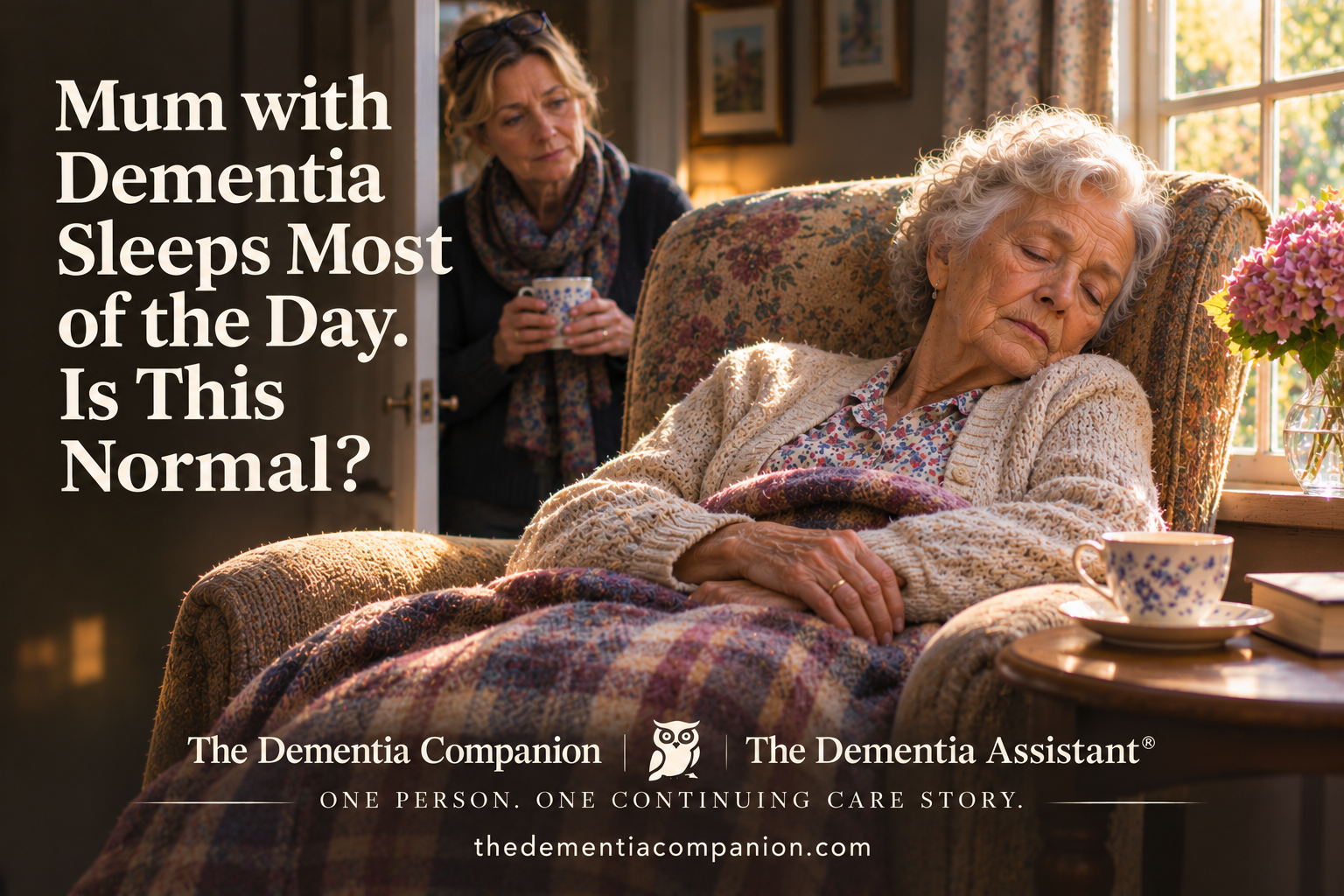
Mum with Dementia Sleeps Most of the Day. Is This Normal?
One Person. One Continuing Care Story. | Article 39 of 40
By Louise Donaghy, Dementia Practitioner, Founder of The Dementia Companion and The Dementia Assistant®, and Creator of Hugo Intelligence™.
You arrive at Mum’s house just after lunchtime.
She’s asleep in her favourite chair.
The television is on, the curtains are half-open and there’s a cup of tea sitting untouched beside her.
You smile, put the kettle on and leave her to rest.
After all, everybody enjoys an afternoon nap.
An hour later, Mum is still asleep.
You gently wake her.
“Hello, Mum. Fancy a cup of tea?”
She opens her eyes, smiles and tells you she’s tired.
You make her something to eat, but she doesn’t seem particularly interested.
Before you’ve finished washing the dishes, she’s asleep again.
You begin thinking about yesterday.
And the day before.
Actually, Mum seems to be sleeping an awful lot lately.
She used to enjoy her afternoon programmes, pottering around the garden and reminding everybody that nobody made tea quite like she did.
Now she spends much of the day dozing.
You find yourself asking a question that many families eventually face.
Is Mum sleeping so much because of her dementia, or is something else wrong?
The answer is that increased sleeping can occur in people living with dementia, particularly as the condition progresses, but a new or significant change in sleepiness should never automatically be attributed to dementia.
Pain, infection, medication effects, poor-quality sleep, depression, dehydration and other health conditions may contribute.
Some causes can be treated.
Others require adjustments to daily support.
And sometimes the person simply needs more rest.
The important thing is to understand what has changed, how Mum is feeling and whether she needs medical assessment.
Because sleeping more is not automatically a problem.
But overlooking the reason sometimes can be.
Why might someone with dementia sleep more than before?
Dementia can affect the systems involved in regulating sleep and wakefulness.
Depending on the type and stage of dementia, people may experience changes in their sleep patterns.
Some become more wakeful at night.
Some sleep for longer periods during the day.
Others experience fragmented sleep, becoming tired despite spending many hours in bed.
But dementia does not affect everybody in the same way.
Changes in the brain
The brain helps regulate when we feel awake and when we feel sleepy.
Some forms of dementia can affect these processes.
A person may experience changes in their normal sleep-wake rhythm.
They may become sleepy earlier in the evening or have difficulty remaining awake during the day.
However, changes in sleep patterns are not enough to determine the type or stage of dementia.
Everyday activities may become more tiring
Tasks that once seemed effortless may now require greater concentration.
Following conversations, processing information, making decisions or managing unfamiliar situations can be tiring for some people living with dementia.
Mum may need more rest after activities that previously felt straightforward.
But tiredness should still be considered in the context of her overall health.
Sleep at night may not be restful
Mum may spend eight or nine hours in bed without getting enough restorative sleep.
Perhaps she wakes frequently.
Needs the toilet.
Experiences pain.
Feels anxious.
Or has a sleep-related breathing problem.
She may appear to sleep all day because she is not sleeping well at night.
Other medical conditions may be contributing
This is particularly important.
Not every change belongs to dementia.
A person living with dementia can also experience heart disease, diabetes, anaemia, thyroid problems, infections, sleep apnoea, depression and many other health conditions.
Some of these may cause fatigue or sleepiness.
A clinician can consider whether investigation is appropriate.
The diagnosis of dementia should never become a reason to stop looking for other explanations.
Is it normal for Mum to sleep more as dementia progresses?
Some people with more advanced dementia spend increasing amounts of time asleep.
Their physical abilities may have changed.
They may have greater difficulty remaining engaged with their surroundings.
Their overall health may also be more fragile.
However, the amount someone sleeps varies considerably.
There is no reliable number of daytime sleeping hours that proves dementia has reached a particular stage.
And increased sleeping alone cannot tell us how quickly dementia is progressing.
Look at Mum’s usual pattern
Perhaps Mum has enjoyed an afternoon nap for forty years.
That may simply be part of her routine.
But if she previously stayed awake throughout the day and has suddenly begun sleeping for most of it, the change deserves attention.
The question is not only:
“How much is Mum sleeping?”
It is also:
“Is this normal for Mum, and what else has changed?”
What medical problems can cause excessive sleepiness in dementia?
Several possibilities deserve consideration.
Infection or acute illness
An infection or other illness may cause someone to become unusually tired or less responsive.
Some people living with dementia cannot easily describe symptoms.
A family may notice changes in eating, movement, alertness or behaviour.
Sudden drowsiness or confusion may indicate delirium or another serious condition and requires urgent assessment.
Do not assume an infection is present solely because Mum is sleepy.
Medication side effects
Some medicines can cause drowsiness.
This may be particularly relevant after a new prescription, a change in dose or a hospital admission.
Medicines used for sleep, anxiety, allergies, pain and some mental health conditions may contribute, depending on the specific treatment.
Ask the GP, prescriber or pharmacist to review the medication if sleepiness has increased.
Do not stop or adjust prescribed medication independently.
Pain or discomfort
Mum may sleep poorly because she is uncomfortable.
Arthritis, dental problems, constipation or other painful conditions can interrupt sleep.
She may then become tired during the day.
Pain may also be difficult for her to explain.
Watch for changes in movement, facial expression and behaviour, and seek assessment where appropriate.
Depression
Depression can affect sleep, motivation, appetite and energy.
Some people sleep more than usual.
Others sleep less.
A person living with dementia can also experience depression.
Do not assume withdrawal or reduced interest is simply dementia progression.
A healthcare professional can assess possible depression and discuss appropriate support.
Dehydration or poor nutrition
Inadequate fluid or food intake can contribute to weakness and fatigue.
Mum may be forgetting to drink, struggling with meals or experiencing another health problem.
Seek professional advice if her intake has changed significantly.
Sleep apnoea
Some people experience repeated interruptions to breathing during sleep.
Possible clues include loud snoring, witnessed breathing pauses and excessive daytime sleepiness.
A clinician can assess whether sleep apnoea or another sleep disorder may be present.
What about Lewy body dementia?
Dementia with Lewy bodies can involve significant fluctuations in attention and alertness.
A person may appear very sleepy or less responsive at certain times and more alert at others.
Excessive daytime sleepiness can also occur.
However, sleepiness alone does not establish a diagnosis of Lewy body dementia.
If you notice pronounced fluctuations, discuss them with an appropriate clinician.
A sudden change in consciousness or responsiveness still requires urgent assessment.
When should I worry about Mum sleeping too much?
The most important distinction is between a gradual change that needs assessment and an acute change that may require urgent help.
Seek emergency help if Mum:
- Cannot be awakened normally or is unresponsive.
- Has severe difficulty breathing.
- Has symptoms suggesting a stroke, such as sudden facial drooping, arm weakness or speech changes.
- Collapses or experiences another life-threatening event.
Use the appropriate emergency service.
In the UK, call 999 or 112. In the USA and Canada, call 911. In Australia, call 000. In Ireland, call 999 or 112.
Seek urgent medical advice for:
- Sudden or marked increases in drowsiness.
- New confusion or fluctuating alertness.
- Significant changes after a fall or possible head injury.
- Sleepiness accompanied by concerning illness symptoms.
- New difficulty eating, drinking or taking essential medication.
- Rapid deterioration from the person’s usual level of functioning.
Sudden confusion should be treated as a medical concern, not automatically as dementia progression.
Arrange a routine clinical review when:
Mum has gradually begun sleeping much more, is regularly missing meals or activities, seems unusually fatigued or has changed since starting medication.
Even when the change is not an emergency, it deserves investigation.
Should I wake Mum when she sleeps during the day?
That depends on the circumstances.
There is no universal rule that someone living with dementia must remain awake throughout the afternoon.
Rest can be important.
But excessive daytime sleeping may also interfere with meals, medication, activity and night-time sleep.
Consider what Mum needs
Is she recovering from illness?
Has she slept poorly overnight?
Does she seem comfortable?
Can she wake normally?
Is she missing essential food, fluids or prescribed treatment?
Does she want to rest?
If Mum is comfortable and her health needs are being met, a short daytime nap may be perfectly reasonable.
But if she is unusually difficult to wake or her sleepiness is new and significant, seek medical advice.
Avoid forcing activity
Repeatedly waking Mum simply because you think she should be doing something can cause unnecessary distress.
Equally, leaving her asleep throughout the day without considering why she is so tired may overlook an important health issue.
The goal is a balance that respects Mum’s wishes and supports her wellbeing.
How can I help Mum sleep better at night?
Begin by understanding her current routine.
Ask what she enjoys and what makes her comfortable.
Consider whether her day has a gentle, recognisable structure.
Encourage appropriate daylight exposure
Daylight can help support the body’s sleep-wake rhythm.
If Mum enjoys sitting by the window or spending time outside, this may be a pleasant part of her routine.
Make sure the environment is comfortable and safe.
Include meaningful daytime activities
Activities should reflect Mum’s interests and abilities.
Perhaps she enjoys music.
Looking through photographs.
Gardening.
Folding familiar laundry.
Walking with appropriate support.
Or sitting with somebody she loves.
The purpose is not to keep Mum busy every minute.
It is to support enjoyment, connection and a suitable daily rhythm.
Review evening routines
A calm and familiar bedtime routine may help some people.
Consider lighting, noise, comfort and whether Mum needs assistance with toileting or other personal needs.
If she is experiencing pain or persistent sleep difficulties, seek clinical advice.
Review medicines and sleep problems professionally
Avoid independently introducing sleeping tablets or supplements.
Some sleep medicines carry particular risks for older adults, including confusion and falls.
A healthcare professional should review persistent sleep difficulties and any proposed treatment.
What if Mum sleeps all day and stays awake all night?
This can be exhausting for families.
Mum may be awake when everybody else needs to sleep.
She may become unsettled or wander around the house.
Perhaps she believes it is morning.
Or wants breakfast at two o’clock.
First, consider whether there are medical causes, including pain, medication effects or a sleep disorder.
Then review her environment and routine.
You might say:
“It’s still nighttime, Mum. You’re safe. Shall we sit together for a moment?”
Or:
“Would you like a drink before we settle again?”
Keep your response calm and respectful.
Avoid arguing about the time.
If night-time wakefulness creates safety risks or becomes persistent, seek professional advice.
And if you’re the person staying awake night after night, your own need for support matters too.
What if Mum sleeps more after coming home from hospital?
A hospital stay can leave somebody physically exhausted.
Mum may have been unwell, slept poorly and experienced significant disruption.
Some additional rest during recovery may be expected.
But don’t assume that all new drowsiness is simply recovery.
Medication changes, ongoing illness, delirium and other complications may need review.
Compare Mum’s current abilities and alertness with her usual pattern.
Ask the discharge team or GP what changes are expected and which require assessment.
If she becomes suddenly difficult to wake or acutely confused, seek urgent help.
How can I tell whether Mum is tired, bored or depressed?
This is not always easy.
And families should not feel expected to diagnose the difference.
Try noticing the wider pattern.
Does Mum become more alert when someone she enjoys seeing arrives?
Does she still take pleasure in familiar activities?
Has she lost interest in things that usually matter to her?
Is she eating differently?
Does she seem sad, worried or withdrawn?
Has her sleep pattern changed?
These observations may help a healthcare professional understand the situation.
But no single response proves whether the cause is fatigue, boredom, depression or something else.
Don’t assume every quiet moment is sadness
Sometimes Mum may simply enjoy sitting peacefully.
She doesn’t have to be entertained constantly.
Perhaps she’s watching the birds.
Listening to music.
Or enjoying the warmth of the afternoon sun.
A meaningful life includes quiet moments too.
The important thing is whether she is comfortable, supported and able to experience the things that matter to her.
What should I tell the GP about Mum’s increased sleeping?
Specific observations are more helpful than saying only that Mum sleeps a lot.
For example:
“Over the past three weeks, Mum has gone from having a short afternoon nap to sleeping for several hours during the day. She is also less interested in meals.”
Or:
“Since starting a new medicine, Dad has become noticeably drowsier during the morning.”
Or:
“Mum has recently been awake for much of the night and then sleeps through breakfast.”
Include relevant information about medication, illness, appetite, hydration, mobility and changes in alertness.
The clinician can decide what assessment or investigation is appropriate.
How can the family’s continuing care plan help?
Imagine Mum has several people supporting her.
Her daughter visits in the morning.
A professional carer attends at lunchtime.
Her son visits in the evening.
Each notices something different.
The daughter finds Mum asleep when she arrives.
The carer notices that Mum is eating less.
Her son says Mum was unusually tired during their evening conversation.
Individually, these observations may not seem significant.
Together, they suggest a pattern worth investigating.
Record the changes clearly
A continuing care plan can preserve Mum’s usual routine, communication preferences, health information and support arrangements.
Daily notes can record changes such as:
Monday: Mum slept for approximately two hours after lunch. Ate her evening meal and was alert during conversation.
Tuesday: Mum appeared unusually tired throughout the morning and declined breakfast. Family contacted the GP for advice.
Wednesday: Mum attended a clinical review. Relevant professional recommendations were recorded.
These examples are fictional.
The family should record factual observations rather than assuming a diagnosis.
The plan can then be updated following professional assessment.
Meet Hugo Intelligence™: understanding changes in Mum’s sleep
This is exactly the sort of concern that families can bring to Hugo Intelligence™.
Because sometimes you don’t know whether something is important.
You just know Mum isn’t quite herself.
Hugo Intelligence™ is the conversational, person-centred guidance system within The Dementia Assistant®, powered by Person-Centred Intelligence®.
Hugo stands for:
H — Human
U — Understanding
G — Guidance
O — One person at a time
Hugo is represented by our owl mascot.
But he is much more than a character answering isolated questions.
He supports natural, continuing conversations about dementia and everyday care.
Begin with a simple question
You might say:
“Hugo, Mum has dementia and she seems to be sleeping most of the day. She used to be much more active. What should I be looking for?”
Hugo can explain general information about possible reasons for increased sleepiness.
He can help you consider relevant changes.
He can suggest questions to discuss with the GP.
And he can help you organise your observations.
Hugo’s follow-up conversations
You might then explain:
“She has recently come home from hospital.”
“Her medication has changed.”
“She’s awake during the night.”
“She doesn’t seem interested in food.”
“She has Lewy body dementia.”
“What should I tell the doctor?”
Hugo can continue the conversation as new information is provided.
He can help families understand general information without pretending to know the individual’s diagnosis.
Hugo cannot determine why Mum is sleepy, assess her consciousness or decide whether a medical emergency is occurring.
Urgent symptoms require appropriate medical services.
General Hugo and personalised Hugo
A family can ask general questions without selecting a care plan.
For example:
“What causes excessive daytime sleepiness in dementia?”
Hugo can provide general educational guidance.
When the user explicitly selects Mum’s individual care plan, Hugo can use relevant information recorded in that selected plan to offer more personalised educational support.
For example:
“Hugo, using Mum’s care plan, help me organise the changes in her sleep and daily routine before her GP appointment.”
Hugo can consider relevant recorded details, such as Mum’s usual routines and communication preferences.
He does not automatically access every care plan.
The user must select the individual plan they want considered.
Families can maintain separate plans for different people.
The Care Planning Centre™ and guided Talk to Hugo
The Care Planning Centre™ helps people living with dementia and their families develop and maintain individual person-centred care plans.
Through guided Talk to Hugo, families can explore relevant care-planning questions conversationally.
For example:
“What is Mum’s usual sleep routine?”
“What helps her feel comfortable?”
“What activities does she enjoy?”
“What has changed?”
“Which professional recommendations need recording?”
Relevant information can be organised into appropriate care-plan sections, with the user reviewing what is recorded.
The platform also supports care-plan reviews, gap suggestions and clearer professional wording.
A care plan should preserve Mum’s strengths and choices, not simply document her difficulties.
Daily notes, saved conversations and document organisation
The Dementia Assistant® provides daily notes that can help families observe patterns over time.
These might include sleep, appetite, mobility, mood, activities and professional appointments.
Families can also save and categorise Hugo conversations.
Perhaps they discuss sleep today and later return to questions about medication or changes in daily routine.
Saved conversations help maintain continuity in educational guidance.
They are not verified medical records or professional instructions.
The platform also includes document organisation and applicable exports, including PDF, Word, CSV and JSON.
Relevant clinical reports and professional recommendations can be organised within the family’s own continuing care environment.
Original professional records and instructions remain authoritative.
Family Circle: recognising changes together
One relative may notice that Mum sleeps through breakfast.
Another may notice she is awake late at night.
A third may observe that she seems unusually tired after a care visit.
Family Circle supports appropriate communication between involved relatives.
This can help the family share relevant observations.
But information sharing must respect Mum’s wishes, privacy, consent and access permissions.
Not every family member automatically needs access to every detail.
And Family Circle does not replace urgent professional communication or clinical monitoring.
Life Story and Memory & Moments: remembering what matters to Mum
Perhaps Mum has always enjoyed an afternoon nap.
Perhaps she loves listening to music after lunch.
Perhaps she prefers quiet mornings and becomes more alert later in the day.
These preferences matter.
Life Story and Memory & Moments help preserve meaningful routines, interests, relationships and experiences.
This can help families distinguish between longstanding preferences and new changes.
It also reminds us that Mum’s day should not be measured only by how many hours she remains awake.
The quality of those hours matters.
A quiet conversation.
A favourite song.
A walk in the garden.
A shared laugh.
These moments remain meaningful even when Mum needs more rest.
Multilingual support: understanding Mum’s needs in her preferred language
Sleep and fatigue can be difficult to describe.
For multilingual families, language differences may make communication more complicated.
The Dementia Assistant® offers 12 interface languages, with dictation and translation capabilities spanning 201 languages.
These capabilities can help families record observations and communicate across languages.
They may be particularly useful when relatives live in different countries or when the person living with dementia prefers a language other than English.
Not every feature is available in all 201 languages.
Important medical and medication information must be verified appropriately, with professional interpreting where necessary.
Some people living with dementia experience changes in language use, but this varies.
Never assume that everyone returns to a childhood language.
Ask what the person understands and prefers.
Dementia Academy™, crisis guidance and the Carer Wellbeing Hub
The Dementia Academy™ provides educational resources about dementia and practical support.
The platform also includes educational crisis guidance to help families recognise when urgent professional help may be required.
Hugo is not an emergency response service.
He cannot monitor somebody’s consciousness, provide physical supervision or arrange emergency treatment.
And what about the person providing care?
If Mum sleeps during the day but stays awake all night, the family may become exhausted.
Perhaps you’re constantly checking whether she’s breathing comfortably.
Perhaps you’re frightened to leave her alone.
Perhaps you haven’t slept properly yourself.
The Carer Wellbeing Hub recognises these pressures.
But digital guidance cannot replace practical help.
Talk to the appropriate healthcare professionals.
Ask about support services.
Consider respite arrangements where available.
And explain clearly if caring responsibilities have become unsafe or unmanageable.
Mum’s wellbeing matters. So does the wellbeing of the people supporting her.
Ask Hugo: 17 questions families ask about dementia and excessive sleeping
- Is it normal for someone with dementia to sleep all day?
Some people with dementia sleep more as their condition progresses. However, excessive or newly increased sleepiness can also have medical causes. A significant change should be assessed rather than automatically attributed to dementia.
- Does sleeping more mean Mum’s dementia is getting worse?
Not necessarily. Sleep changes can occur with dementia progression, but medication, illness, depression and poor night-time sleep may also contribute. Sleeping more alone cannot establish progression.
- Why does Mum sleep after every meal?
She may be tired, have disrupted night-time sleep or experience another health problem. If the pattern is new, pronounced or associated with other symptoms, seek clinical advice.
- Can dementia medication cause sleepiness?
Some medicines may contribute to drowsiness, depending on the medication and individual circumstances. Ask the prescriber or pharmacist for a review. Do not change prescribed treatment independently.
- Should I wake Mum from her afternoon nap?
Consider her usual routine, comfort, health needs and whether she can wake normally. There is no universal rule. Unusual difficulty waking requires urgent assessment.
- Can infection make someone with dementia sleep more?
Yes. Infection or other acute illness may contribute to fatigue or reduced alertness. Sudden significant drowsiness or confusion needs urgent medical assessment.
- Why does Mum sleep all day but stay awake at night?
Dementia-related changes in sleep-wake rhythms, pain, medication effects and other sleep disorders may contribute. Persistent problems deserve clinical review and individualised support.
- Could Mum be depressed rather than tired?
Depression can affect sleep, energy, appetite and interest in activities. A professional assessment is needed to distinguish possible causes.
- Is daytime sleepiness common in Lewy body dementia?
Excessive daytime sleepiness and fluctuations in alertness can occur in Lewy body dementia. However, new or sudden changes still require assessment.
- Can dehydration make Mum unusually tired?
Inadequate fluid intake may contribute to weakness and fatigue. If Mum is drinking poorly or appears unwell, seek medical advice.
- What if Mum is difficult to wake?
If she is unresponsive or cannot be awakened normally, seek emergency help immediately. Do not assume this is a normal feature of dementia.
- Can pain make someone sleep more during the day?
Pain may disturb sleep at night, contributing to daytime tiredness. It can also affect activity and behaviour. A clinician should assess suspected pain.
- Should I keep Mum busy so she doesn’t sleep?
Meaningful activities and a suitable routine may help, but forcing constant activity is not person-centred. Respect her need for rest and investigate significant changes.
- What should I record about Mum’s sleep?
Record approximate sleep and wake times, changes in alertness, medication changes, appetite, activities and any other relevant symptoms. Share concerns with the appropriate clinician.
- What if Mum sleeps more after hospital discharge?
Some fatigue may accompany recovery, but medication effects, ongoing illness and delirium may also be relevant. Follow discharge guidance and seek assessment for concerning changes.
- Can Hugo help us understand Mum’s sleeping pattern?
Hugo can provide general educational information and help organise observations and questions. When the user explicitly selects Mum’s care plan, Hugo can consider relevant recorded information for more personalised guidance. He cannot diagnose the cause.
- How can we keep Mum’s sleep information connected between professionals?
The Dementia Assistant® supports individual care plans, daily notes, document organisation and saved Hugo conversations. Appropriate information can be shared with professionals, subject to consent and privacy. The family’s record complements clinical records.
One Person. One Continuing Care Story.
Different professionals. Different services. One person. One continuing story.
Imagine Mum’s journey.
She begins experiencing memory difficulties.
Her GP arranges an assessment.
She attends a memory clinic.
A diagnosis is made.
The family learns how to support her.
Over time, her needs change.
She may begin sleeping more.
Perhaps a medication review is needed.
Perhaps she develops an illness.
Perhaps she is admitted to hospital.
A nurse observes her alertness.
A doctor reviews her medication.
A care worker notices that she is sleeping through lunch.
Her daughter remembers that Mum used to spend every afternoon in the garden.
Different people see different parts of the picture.
But Mum is still the same person.
And the family should not have to start from the beginning every time a new professional becomes involved.
The family’s own continuing care information
The Dementia Assistant® helps people living with dementia and their families maintain their own person-centred care information independently of any single care provider.
They can begin recording information from the earliest memory concerns.
The plan can develop through diagnosis, everyday life, home care, hospital admissions, rehabilitation, residential care and palliative or end-of-life support where appropriate.
It can preserve Mum’s routines, preferences, relevant health information, communication needs and changing abilities.
Recognising changes across time
Perhaps Mum used to sleep for thirty minutes after lunch.
Now she sleeps for several hours.
That difference may be important.
A continuing record can help the family describe the change accurately.
Following professional assessment, relevant recommendations can be added to the family’s own information.
The plan should be reviewed as circumstances change.
One person. One individual care plan.
Mum’s care plan should not simply say:
“Dementia. Sleeps frequently.”
It should explain the person.
Her normal routine.
What she enjoys.
What has changed.
What helps her feel comfortable.
Her relevant health needs.
And the professional advice that applies to her.
This is the difference between recording a symptom and preserving a person’s continuing story.
The family-held plan complements professional records
The Dementia Assistant® does not replace GP records, hospital notes, clinical assessments, statutory care plans or medical decisions.
It complements them.
The person or family can maintain their own continuing source of information and share relevant details with professionals when appropriate.
Consent, privacy, the person’s wishes and applicable legal arrangements remain central.
Different professionals may change. Different services may become involved. But Mum’s identity and continuing story should remain connected.
That is the meaning of:
One Person. One Continuing Care Story.
A gentle invitation to meet Hugo
If Mum is sleeping more than usual and you’re worried, you don’t have to begin with a complicated medical question.
You can simply ask Hugo.
Explain what you’ve noticed.
Ask about possible reasons for changes in sleep.
Explore questions to discuss with the GP.
Record relevant observations.
And, when you explicitly select Mum’s individual care plan, Hugo can use relevant recorded information to support a more person-centred educational conversation.
The Dementia Companion is our public home for practical dementia education, articles and Ask Hugo resources.
The Dementia Assistant® is our interactive platform, bringing together Hugo Intelligence™, individual care plans, guided care planning, saved conversations, daily notes, Family Circle, Life Story, Memory & Moments, multilingual support, educational resources and carer wellbeing guidance.
Every subscription includes a 30-day complimentary trial.
The UK Family subscription is £4.99 per month after the trial.
International subscription prices are available through the platform.
Explore The Dementia Companion:
https://thedementiacompanion.com/
Meet Hugo and explore The Dementia Assistant®:
https://thedementiaassistant.com/
Hugo provides educational guidance, not medical diagnosis, medication prescribing, emergency intervention, statutory assessments or legally binding decisions.
One final thought
There may come a time when Mum needs more rest than she once did.
Perhaps she no longer has the energy for long afternoons in the garden.
Perhaps she prefers a quiet conversation to a busy family gathering.
Perhaps a short walk is enough.
Or perhaps today she simply wants to sit in her favourite chair and listen to the radio.
That’s all right.
A meaningful life doesn’t have to be a busy one.
But when something changes, we owe it to Mum to ask why.
Not because every change is frightening.
And not because every afternoon nap is a medical problem.
But because she deserves the same attention to her health, comfort and wellbeing as anybody else.
Dementia may change how Mum spends her days. It should never change how carefully we listen to what those days are telling us.
With love,
Louise and Hugo ❤️🦉
Louise Donaghy
Founder & CEO of The Dementia Assistant®
Created and powered by Person-Centred Intelligence®
Creator of Hugo Intelligence™
⸻
Continue exploring with The Dementia Companion
The Dementia Companion
https://thedementiacompanion.com/
The Dementia Assistant®
https://thedementiaassistant.com/
Related topics in our continuing-care series include recognising pain, hospital discharge, changes in care needs, sundowning and understanding distress.
Authoritative references
1. NICE. Dementia: assessment, management and support for people living with dementia and their carers, NG97.
https://www.nice.org.uk/guidance/ng97/chapter/recommendations
2. NHS. Sudden confusion (delirium).
https://www.nhs.uk/symptoms/confusion/
3. NHS. Excessive daytime sleepiness (hypersomnia).
https://www.nhs.uk/conditions/excessive-daytime-sleepiness-hypersomnia/
4. NHS. Sleep apnoea.
https://www.nhs.uk/conditions/sleep-apnoea/
5. NHS. Dementia with Lewy bodies.
https://www.nhs.uk/conditions/dementia-with-lewy-bodies/
6. Alzheimer’s Association, USA. Sleep issues and sundowning.
https://www.alz.org/help-support/caregiving/stages-behaviors/sleep-issues-sundowning
7. National Institute on Aging, USA. Alzheimer’s and dementia: Tips for better sleep.
https://www.nia.nih.gov/health/alzheimers-changes-behavior/sleep-problems-and-sundowning-alzheimers-disease
8. Alzheimer’s Society, UK. Sleep problems and dementia.
https://www.alzheimers.org.uk/about-dementia/symptoms-and-diagnosis/sleep-problems
9. Dementia Australia. Dementia and sleep.
https://www.dementia.org.au/
10. Alzheimer Society of Canada. Help and information about living with dementia.
https://alzheimer.ca/en/help-support
11. Healthdirect Australia. Sleep disorders.
https://www.healthdirect.gov.au/sleep-disorders
12. Health Service Executive, Republic of Ireland. Dementia.
https://www2.hse.ie/conditions/dementia/
Editorial note: This article provides general educational guidance. Excessive sleepiness can have multiple causes and requires individual clinical assessment where indicated. Sudden changes in consciousness or responsiveness require urgent or emergency care. All family scenarios are fictional.
You May Also Find Helpful
Need help with your own situation? Ask Hugo.
One Person. One Continuing Care Story. The Dementia Companion is where you discover guidance. Inside The Dementia Assistant®, talk with Hugo, save and categorise conversations, record daily notes and involve authorised supporters in a continuing care plan centred around the person.
Ask Hugo About This · Start Your Continuing Care Plan — Families · Continuing Care Planning — Professionals
Personal guidance requires the appropriate account and subscription access. Care-plan information is used only with authorised access and the required consent and selection steps. All subscription plans include a 30-day complimentary trial.