Why Does Someone With Dementia Say They Need to Go to Work?
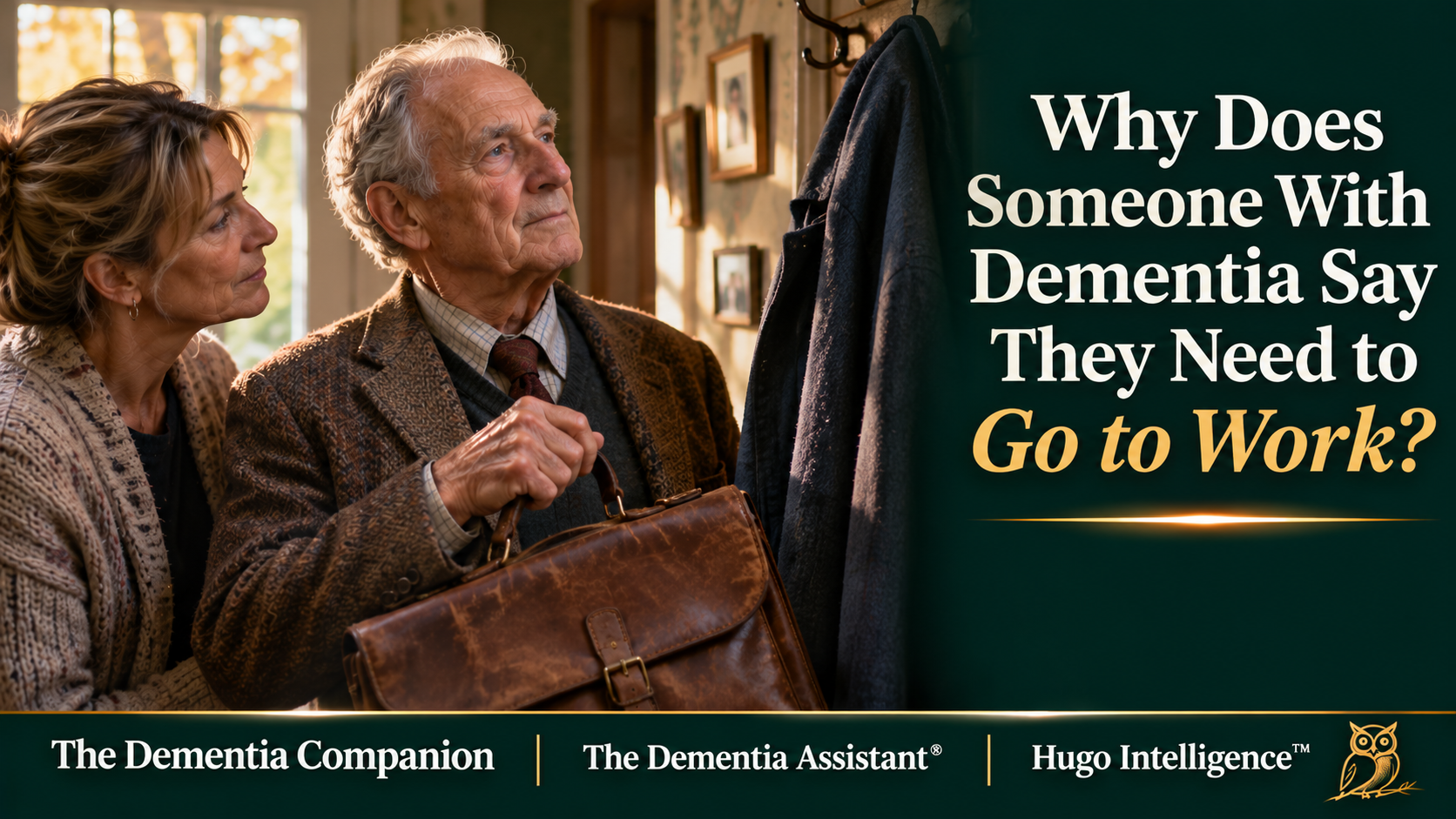
Dad retired twenty years ago. Yet every morning at eight, he reaches for his coat and says he is going to be late. What is he trying to tell us?
By Louise Donaghy, Dementia Practitioner and Founder of The Dementia Assistant®
"Where are my keys?"
"What do you need them for, Dad?"
"Work. I'll be late if I don't leave now."
Dad hasn't worked at the factory for more than two decades. The factory itself has gone. Yet he is standing in the hallway with the same purposeful expression he had when the early shift started at six.
The family's instinct may be to correct him: "Dad, you're retired. You haven't worked there for years."
Sometimes that helps. Sometimes it leads to an argument, fresh worry or a determined search for the front door.
A person living with dementia may say they need to go to work because an earlier routine or responsibility feels current, because they are looking for purpose or reassurance, or because their surroundings and sense of time are confusing. There is no single explanation. Ask what the person is trying to achieve, assess safety and respond to their needs rather than merely trying to win a debate about the date.
Why can work still feel so important?
For many people, work wasn't simply a place they went. It was part of who they were.
Dad might have been a carpenter who took pride in repairing things. Mum might have spent forty years as a teacher, nurse, cleaner, shopkeeper or office manager. A former farmer may still think the animals need feeding. Someone who raised children and ran a household may speak of needing to collect the children or get dinner ready as their important daily work.
A familiar role can carry identity, responsibility, belonging and a sense of usefulness. Dementia may affect awareness of time and the ability to connect past experiences with the present, but it does not make those values meaningless. Dementia UK specifically notes that someone may believe they need to go to work long after retirement, and recommends looking at the person's underlying feelings and needs.
It is also possible that the person is bored, restless, anxious about a task, uncomfortable or simply wants to go outside. Don't assume every reference to work means the same thing.
Is it time-shifting, anxiety or a current concern?
Some people living with dementia talk or behave as though they are in an earlier phase of life. This is often described as time-shifting. Dad may be experiencing the morning as if he still has an early shift.
But check the practical context. Did he wake in a strange place? Is he worried somebody is waiting? Was there a change in routine? Does he want activity or companionship? Has he been sitting without anything meaningful to do? Is he physically uncomfortable?
Try asking without making it an examination:
"What sort of work were you doing today, Dad?"
"Sounds as though you've got something important to do. What's worrying you about being late?"
"Would you like to tell me what you enjoyed about that job?"
If he can explain, listen. If he cannot, you can still acknowledge the feeling. What matters is not deciding for him that this must be an old memory, but finding out what he needs now.
What should I say when Dad insists he is late for work?
There is no guaranteed script. These are starting points, not instructions to recite word for word.
If he seems worried: "You don't want to let anyone down, do you? Let's work out what you need."
If he wants his work bag: "That bag looks important to you. Tell me about the work you used to do."
If the conversation is becoming heated: "I can see this matters. We can leave the argument aside for a moment."
If he wants to feel useful: "Could you help me with something? I'd value your advice."
If he wants to go out and it is safe: "Shall we get some fresh air together?"
Avoid automatically saying "Your boss has phoned; you're off today" or inventing an employer's message. An elaborate false story can confuse the person or undermine trust. Often you can acknowledge the emotion without claiming something untrue.
Likewise, repeating "You've been retired since 2003!" may be factually correct but unhelpful if he cannot retain the information. Some people appreciate gentle orientation. Others experience it as a distressing contradiction. Let the person's response guide you.
Can meaningful activity replace the sense of purpose?
Sometimes activities connected with former roles can be comforting. But meaningful does not mean pretending someone has a job they no longer hold or giving them childish tasks.
A retired mechanic might enjoy discussing an old car, sorting safe tools with supervision or helping plan a simple repair. A former receptionist may enjoy organising greeting cards or household paperwork. A former gardener may enjoy potting plants. Someone who cooked for a large family might help choose a menu or stir ingredients if safe.
Ask first. They may not want to be reminded of work at all. Their interests may have changed, or they may want rest rather than another task.
Don't create pointless busywork and then insist it is therapeutic. The activity should offer real choice, satisfaction and connection.
A fictional example: Dad, formerly a postman, repeatedly asks when his shift begins. Rather than telling him he's mistaken, his daughter asks what he likes most about his rounds. He talks about neighbours and gardens. They arrange an afternoon walk in a familiar, safe area where he can enjoy those things. It does not remove every future question, but it respects what he values.
What if Dad is putting on his coat and actually leaving?
This is where curiosity and safety must work together.
Some people can still go out independently. Others may be at risk of becoming disorientated or unable to return home. Assess the person's actual abilities, any previous incidents, the weather, traffic, mobility and whether accompaniment is appropriate. Don't assume either total freedom or total confinement is automatically safe.
If possible, offer to accompany him without a confrontation: "I'd like some fresh air too. Shall we go together?"
If he is becoming lost, repeatedly leaving in dangerous circumstances or unable to navigate safely, seek a professional review of care and support. Avoid unsafe restraint or locking someone in a way that prevents emergency escape. Consider a person-centred walking and safety plan, including the person's own wishes.
If someone goes missing, contact the police promptly. There is no requirement to wait 24 hours. Use local emergency services if there is immediate danger. In the UK, the Herbert Protocol can help families prepare information in advance.
What if the need to work appears suddenly?
A new or abrupt change in confusion, behaviour or alertness needs medical assessment. Consider pain, infection, medication effects, sleep problems and delirium rather than assuming it is just dementia. In the UK, the NHS advises calling 999 for sudden confusion; elsewhere use the appropriate emergency medical route.
If the pattern is persistent and upsetting, discuss it with the GP, memory service or dementia specialist. Note what happened, the person's words and what helped. Avoid diagnosing the cause in your notes.
How should we record the pattern without labelling Dad?
A useful note might read:
"Monday 8.10am. Dad put on his coat and carried his old work bag, saying he was late for a shift. He appeared worried about letting colleagues down. We spoke about his years as an engineer; he chose to sit with his photographs. No attempt to leave after that conversation."
A note saying only "Dad wandering and confused again" loses most of the useful information.
Include when it happens, the words used, possible discomfort, what mattered to the person and the outcome. Record facts, not assumptions. A family-held care plan can also include his former work, favourite routines, strengths and the things he still enjoys doing.
Meet Hugo Intelligence™: Guidance connected to the person
You might begin with: "Hugo, Dad says he needs to go to the factory every morning. Why might that be?"
Hugo can explore general possibilities, gentle ways to respond and practical questions for the care team. You can follow up: "He becomes upset if I say he's retired. What could I try instead?" His conversation can be saved and revisited.
When a user selects Dad's individual care plan, Hugo can consider relevant recorded details about his previous occupation, routines, communication preferences, meaningful activities and safety arrangements. Without a selected plan, Hugo offers general guidance. He does not silently retrieve every family member's information.
The Care Planning Centre™ and guided Talk to Hugo can help the family organise Dad's strengths and life story, relevant daily observations, contacts and professional advice. Family Circle can support appropriately permissioned updates, while Life Story and Memory & Moments preserve the person beyond the difficulty. The Carer Wellbeing Hub recognises the needs of those supporting him.
Multilingual families can use supported interfaces, dictation and translation to help preserve the person's preferred language and important background information. The platform offers 12 interface languages and dictation/translation capabilities spanning 201 languages, with different feature availability and the need for verification of important clinical information.
Hugo is not a live supervisor, medical diagnostician or emergency service. It cannot decide that someone is safe to go out alone.
Ask Hugo: Common family questions
Why does Dad keep saying he is late for work? He may be reconnecting with an earlier routine, trying to meet a responsibility, feeling restless or experiencing a different sense of time. Explore what he means rather than assuming.
Should I tell him he's retired? Gentle factual reminders may suit some people, but repeated corrections can distress others. Consider his understanding and response.
Can I tell him his boss gave him the day off? Avoid inventing false promises as a default. Often acknowledging responsibility and offering reassurance is enough.
Should I give him a pretend job? Offer authentic, safe, age-appropriate activities he chooses, rather than forcing meaningless tasks.
What if he heads towards the door? Assess immediate safety, offer accompaniment if appropriate and seek professional risk assessment for repeated concerns.
Can his care plan help? Yes. His own history, favourite activities and communication preferences can help family and professionals choose respectful approaches.
Can Hugo use that plan? Yes, when you select his plan. It remains general without one.
Can Hugo help at night? It offers non-urgent educational guidance when available, but not emergency response or overnight supervision.
One Person. One Continuing Care Story
Different professionals may see different parts of a person's life: the GP, memory clinic, support worker, hospital team, home-care agency or specialist service. The person remains one individual throughout. That is why the family's own continuing record should preserve strengths, preferences, communication, meaningful relationships, relevant observations and professional recommendations, instead of allowing their identity to disappear across separate organisational notes.
The Dementia Assistant® provides family-held, individual care plans through the Care Planning Centre™, guided Talk to Hugo, daily observations, document organisation, Life Story, Memory & Moments, Family Circle and saved conversations. Care-plan information can be updated and shared appropriately, with the person's wishes, privacy, consent and permissions respected. It complements, and never replaces, the care plans, medical records, prescriptions or statutory assessments held by professionals.
Hugo Intelligence™ provides natural conversational dementia guidance. People can ask general questions without selecting a care plan. When a user explicitly selects a particular person's care plan, Hugo can use relevant information recorded in that plan to offer more individualised educational suggestions. Hugo does not automatically access all plans, make diagnoses, decide someone's legal capacity or replace urgent professional care. Conversations can be saved, categorised and revisited.
The Dementia Assistant® offers multilingual workflows. Coverage varies by feature, content, browser, device and subscription access. Important clinical and legal information needs appropriate human verification, and qualified interpreting where necessary.
The Dementia Companion offers free practical articles and education at https://thedementiacompanion.com/ . Families can explore Hugo, individual care plans, learning resources and the Carer Wellbeing Hub at https://thedementiaassistant.com/ . The UK Family subscription is £4.99 a month, with a 30-day complimentary trial for all subscriptions. International pricing should be checked on the platform.
Different professionals. Different services. One person. One continuing story.
Louise, Hugo and Charlie ❤️🦉✨
Louise Donaghy | Founder & CEO of The Dementia Assistant® | Created and powered by Person-Centred Intelligence® | Creator of Hugo Intelligence™
References and further reading
- Dementia UK, Managing distress in a person living with dementia: https://www.dementiauk.org/information-and-support/health-advice/coping-with-distress/
- Dementia UK, Restlessness and agitation in dementia: https://www.dementiauk.org/information-and-support/health-advice/dealing-with-restlessness/
- Alzheimer's Society, Why a person with dementia might be walking about: https://www.alzheimers.org.uk/about-dementia/stages-and-symptoms/dementia-symptoms/dementia-walking-about
- Dementia UK, Creating a life story: https://www.dementiauk.org/information-and-support/living-with-dementia/creating-a-life-story/
- NHS, Sudden confusion (delirium): https://www.nhs.uk/symptoms/confusion/
- National Institute on Aging (USA), Communicating with someone who has Alzheimer's: https://www.nia.nih.gov/health/alzheimers-changes-behavior-and-communication/communicating-someone-who-has-alzheimers
Educational information, not individual medical, safety or legal advice. Seek urgent help for sudden confusion or immediate danger. Guidance and emergency systems differ internationally.
You May Also Find Helpful
- Mum Keeps Asking for Her Mother Who Died Years Ago. What Should I Say?
- Mum with Dementia Follows Me Everywhere and Panics When I Leave. What Can I Do?
- Mum with Dementia Keeps Phoning Me All Day. What Can I Do?
- Mum Keeps Checking the Front Door or Trying to Leave. What Is She Looking For?
- Need help with this situation? Ask Hugo
Need help with your own situation? Ask Hugo.
One Person. One Continuing Care Story. The Dementia Companion is where you discover guidance. Inside The Dementia Assistant®, talk with Hugo, save and categorise conversations, record daily notes and involve authorised supporters in a continuing care plan centred around the person.
Ask Hugo About This · Start Your Continuing Care Plan — Families · Continuing Care Planning — Professionals
Personal guidance requires the appropriate account and subscription access. Care-plan information is used only with authorised access and the required consent and selection steps. All subscription plans include a 30-day complimentary trial.