Mum with Dementia Keeps Phoning Me All Day. What Can I Do?
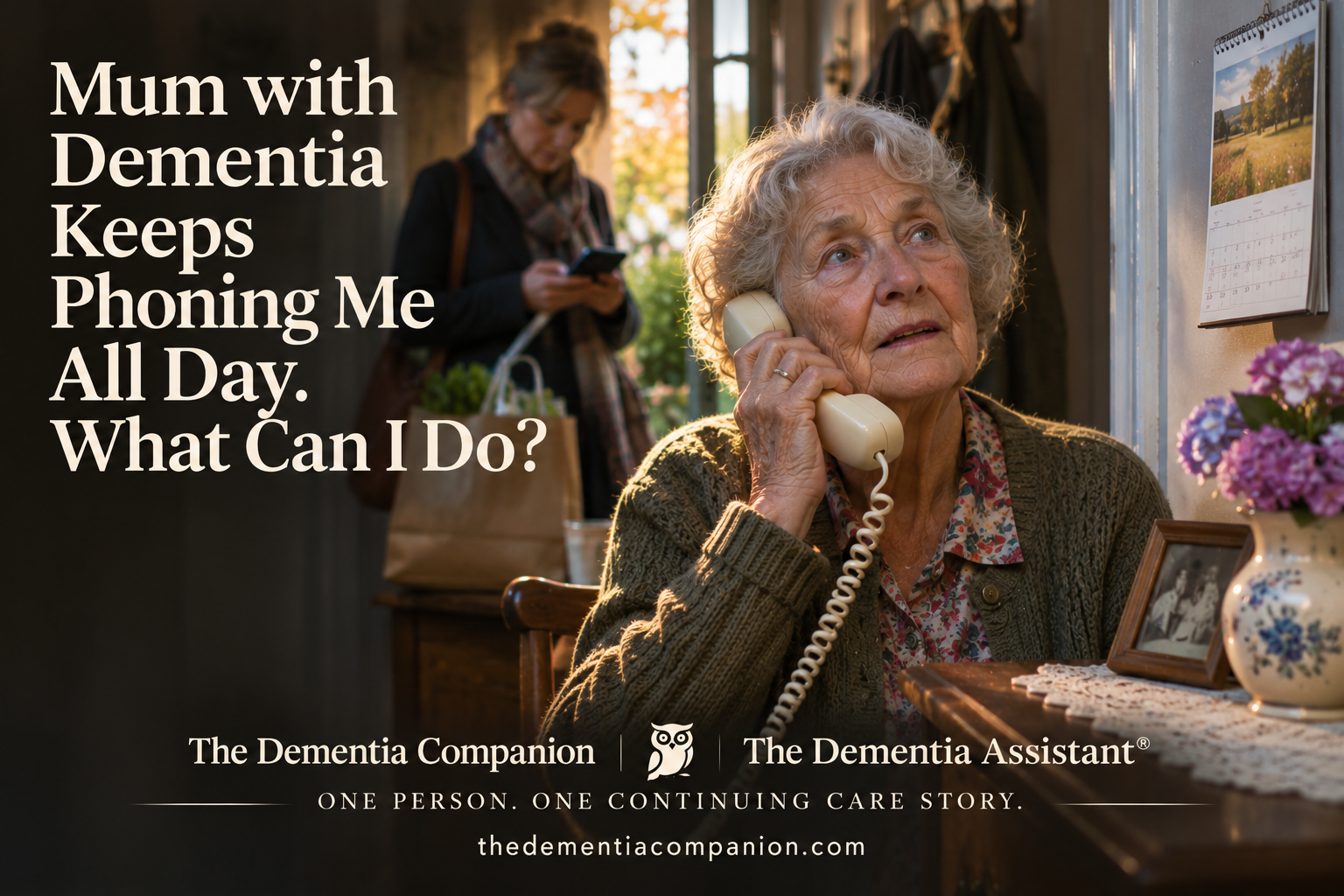
Mum with Dementia Keeps Phoning Me All Day. What Can I Do?
One Person. One Continuing Care Story. | Article 33 of 40
By Louise Donaghy, Dementia Practitioner, Founder of The Dementia Companion and The Dementia Assistant®, and Creator of Hugo Intelligence™.
Your phone rings.
It’s Mum.
“Hello, love. Just checking you’re all right.”
You smile.
“Yes, Mum, I’m fine. How are you?”
You have a lovely little conversation, tell her you’ll visit tomorrow and say goodbye.
Ten minutes later, your phone rings.
It’s Mum.
“Hello, love. Just checking you’re all right.”
You explain that you’ve already spoken.
She sounds surprised.
“Oh, did we? I don’t remember that!”
You reassure her, have another little chat and return to what you were doing.
Then the phone rings again.
And again.
By lunchtime, you’ve answered eleven calls.
You’re trying to work, you’ve got your own family responsibilities, and you’re beginning to wonder whether your mobile phone has officially become an extension of Mum’s handbag.
You love her dearly.
You know she’s not doing it to irritate you.
But you’re exhausted.
And the hardest part?
You’re frightened not to answer, because what if the next call is the one where she genuinely needs help?
This is a situation many families experience when supporting someone living with dementia.
And it can become one of the most emotionally demanding parts of caring.
Because how do you balance your own life with somebody who seems to need constant reassurance?
The answer is to try to understand why Mum is calling, respond to the feeling behind the calls, introduce reassuring routines where helpful, and make sure genuine safety needs are covered without expecting one person to remain constantly available.
Repeated phone calls can be linked to memory difficulties, anxiety, loneliness, uncertainty or an unmet need.
Mum may not remember making the previous call.
She may feel reassured when she hears your voice, only for that reassurance to fade as she becomes uncertain again.
The goal is not simply to stop the telephone ringing.
It’s to help Mum feel safer and more connected, while ensuring the family has sustainable support arrangements.
And there’s something particularly important here.
Mum’s need for reassurance is real.
But so is your need to live your own life.
Both deserve understanding.
Why does someone with dementia keep phoning the same person?
There isn’t one explanation that applies to everybody.
But memory difficulties can play an important part.
Mum may not remember the previous conversation
Imagine you’re worried about something.
You telephone your daughter.
She reassures you.
You feel better.
But a short time later, you cannot remember that conversation.
The original worry returns.
You pick up the telephone.
From your perspective, you’re calling for the first time.
This is why saying:
“Mum, you’ve already called me twelve times today!”
may be confusing or upsetting.
She may genuinely have no recollection of those calls.
Alzheimer’s Society identifies repeated contact with relatives as one possible expression of anxiety in dementia.
But we must remember that the person’s emotional experience is just as important as the memory difficulty.
She may be seeking reassurance
Perhaps Mum has always turned to you when something worries her.
Now she may be experiencing more uncertainty throughout the day.
She might worry about whether she has an appointment.
Whether somebody is coming.
Whether she’s forgotten to do something.
Whether you are safe.
Or whether she is going to be left alone.
When she hears your voice, she feels reassured.
But she may need that reassurance again.
It isn’t necessarily the information she’s looking for.
Sometimes it is the feeling of knowing someone is there.
She may be lonely
For many older people, the telephone is an important connection with the outside world.
Perhaps Mum’s husband has died.
Perhaps she no longer drives.
Perhaps her friends have moved away or are less able to visit.
Perhaps her days have become quieter.
When she picks up the telephone, she may simply want company.
We should never dismiss loneliness as a dementia symptom.
It is a human experience that deserves attention.
She may be worried about something specific
Repeated calls sometimes contain a pattern.
Perhaps Mum always asks:
“What time are you coming?”
“Have I got an appointment?”
“Where’s my handbag?”
“Is somebody collecting me?”
These may be clues to a particular concern.
Rather than answering only the words, explore what might be worrying her.
You might say:
“You sound a little worried, Mum. Is there something on your mind?”
Give her time.
She may not be able to explain clearly, but the question is worth asking.
What should I say when Mum rings for the tenth time?
This is where families need practical words, not another lecture about being patient.
You may already have been patient nine times.
And by the tenth call, you might be trying to remember whether you’ve eaten lunch yourself.
The first thing to consider is whether Mum knows she has already called.
If she doesn’t, reminding her repeatedly may not help.
When she asks whether you’re coming
Mum says:
“Are you coming to see me today?”
You could say:
“I’m coming tomorrow after lunch, Mum.”
If a written reminder helps her, you might arrange a clearly visible note with her.
For example:
“Sarah is visiting on Tuesday after lunch.”
But a note only helps if Mum can find it, understand it and use it.
Do not rely on written reminders if they are no longer effective for her.
When she worries that something has happened to you
Mum says:
“I haven’t heard from you. I thought something had happened!”
Rather than arguing about the earlier calls, try:
“I’m all right, Mum. It’s lovely to hear your voice.”
Or:
“You sound worried. I’m safe, and I’m glad you called.”
If appropriate, explain when she can expect the next contact.
When she simply wants to chat
Sometimes Mum doesn’t have a particular question.
She may just want a familiar voice.
If you have time, enjoy the conversation.
Ask about her day.
Talk about something meaningful.
Share a little news.
It doesn’t have to be a discussion about dementia.
Mum is still your mum.
She is allowed to enjoy a chat without it being treated as a problem to solve.
When you genuinely cannot talk
You can be kind and clear.
“Mum, I’m working at the moment, but I’ll ring you this afternoon.”
Or:
“I can’t have a long chat just now. I’ll speak to you later, love.”
Only promise a call if you can realistically make it.
Repeatedly promising something that doesn’t happen may increase uncertainty.
And if Mum is unable to understand or retain the arrangement, consider whether she needs another form of reassurance or support.
Will scheduled telephone calls help?
They can help some people.
A familiar routine may make the day feel more predictable.
For example, the family might agree that someone calls in the morning and again in the afternoon.
Some people benefit from seeing the arrangement written beside the telephone.
Others enjoy a calendar with photographs or names showing who is visiting.
The Alzheimer Society of Canada suggests regular check-ins as one way to support people living with dementia who are managing at home.
But there’s an important distinction.
A scheduled call should provide reassurance, not become a rule that prevents Mum from asking for genuine help.
If Mum is frightened, unwell or experiencing an emergency, she needs an appropriate way to seek assistance.
What if Mum forgets the calling schedule?
Then the schedule may not be enough.
You can still try it, but observe whether it actually helps.
If Mum continues to telephone repeatedly, the underlying need may remain unresolved.
Perhaps she needs more social contact.
Perhaps she is anxious about being alone.
Perhaps she needs help with daily activities.
Or perhaps she no longer feels sufficiently secure between visits.
A written reminder cannot replace the practical support a person may need.
Could the telephone itself be making things more difficult?
Sometimes, yes.
Modern telephones can be surprisingly complicated.
A touchscreen may display unfamiliar symbols, notifications or advertisements.
A person may accidentally call the same contact several times.
They may struggle to recognise whether a call has ended.
Or they may find themselves pressing buttons without understanding what they do.
Consider whether the phone is suitable
Some people prefer a familiar landline.
Others manage a mobile phone well.
Certain accessible telephones offer larger buttons, clearer displays or photograph-based contact options.
But avoid assuming that a new device will automatically be easier.
A person who has used the same telephone for twenty years may find it reassuringly familiar.
Suddenly replacing it could make matters worse.
Ask what Mum finds difficult.
Consider whether an occupational therapist or appropriate dementia support professional could help review communication needs.
Could a voicemail message provide reassurance?
For some people, hearing a familiar recorded voice may help.
A simple message might say:
“Hello Mum, it’s Sarah. I can’t answer just now, but I’ll call you when I can.”
However, not everybody understands voicemail.
Mum may believe you’ve answered personally.
She may be frightened by a recorded message.
Or she may leave repeated messages without feeling reassured.
Try to understand her response rather than assuming the technology will solve the problem.
Should I stop answering every call?
This is one of the hardest decisions.
And there is no universal answer.
The family needs to consider why Mum is calling, her ability to recognise emergencies and what support is available.
If the calls are primarily seeking reassurance, a planned arrangement may help reduce the pressure on one person.
But if Mum lives alone, has significant safety difficulties or cannot reliably summon help, simply ignoring her calls could leave important needs unmet.
Before setting boundaries, ask:
What would happen if Mum genuinely needed assistance while nobody answered?
Is there another trusted contact?
Does she have appropriate in-person support?
Can she use an emergency alert?
Would she recognise an emergency?
Is somebody checking on her regularly?
A professional review may be needed if the current arrangements are no longer safe or sustainable.
It is reasonable to establish boundaries
Being a loving daughter or son does not mean you must answer every non-urgent call immediately.
You may need uninterrupted time to work, rest or care for your own family.
But boundaries work best when they’re supported by realistic arrangements.
That might mean sharing calls between relatives, arranging companionship, reviewing daily support or involving an appropriate professional service.
The answer should not be to leave one exhausted person holding a telephone twenty-four hours a day.
What if Mum becomes upset when I don’t answer?
She may feel frightened or rejected.
She might say:
“Nobody cares about me.”
“You never ring.”
“I’ve been waiting all day.”
Those words can be painful.
Especially when you’ve spent half your morning on the telephone with her.
Try to respond to the emotion rather than arguing about the number of calls.
You could say:
“I’m sorry you’ve been feeling alone, Mum.”
“I’m here now.”
“Would you like to tell me what’s worrying you?”
But don’t use reassurance as a reason to ignore persistent distress.
If Mum repeatedly feels unsafe or abandoned, explore whether she needs additional emotional, social or practical support.
What if Mum phones at night?
Nighttime calls need particular attention.
Mum may wake and believe it is morning.
She may feel disorientated.
She may be frightened because the house is quiet.
Or she may have a physical need, such as pain or needing the toilet.
If calls have recently increased at night, consider whether her sleep, health or daily routine has changed.
A professional review may be appropriate.
If she is suddenly much more confused, significantly unwell or behaving very differently from usual, seek urgent medical assessment.
Nighttime calls that repeatedly disrupt everybody’s sleep may also indicate that the current care arrangements need reviewing.
The family should not have to choose between Mum’s safety and complete exhaustion.
What if Mum phones other people repeatedly?
Sometimes the calls are not limited to one relative.
Mum may telephone neighbours, friends, distant family members or former colleagues.
She may not remember contacting them earlier.
This can create misunderstandings.
Someone might believe she is deliberately demanding attention.
Another person may become worried that something serious has happened.
Where appropriate, explain the situation respectfully to people Mum trusts.
You might say:
“Mum has been finding it difficult to remember recent telephone conversations. We’re working on a way to help her feel reassured and keep everybody informed.”
Do not share her diagnosis or private information unnecessarily.
Her wishes, privacy and consent matter.
You might also ask whether a trusted friend would enjoy making a regular social call.
The goal should be connection, not simply distributing the repeated calls among several people.
Could repeated phone calls mean Mum is no longer safe living alone?
Not necessarily.
Repeated calls alone do not establish that someone can no longer live independently.
But the circumstances matter.
If Mum calls because she cannot remember whether she’s eaten, taken medication or locked the door, those everyday difficulties need consideration.
If she repeatedly reports being frightened, lost or unable to manage basic tasks, an assessment may be appropriate.
If she is unable to use the phone reliably in an emergency, that presents a different concern.
A person-centred assessment should consider her abilities, wishes, environment, support network and actual risks.
The answer isn’t automatically residential care.
It may involve additional home support, appropriate equipment, more meaningful daytime activities or a revised care plan.
Could Mum be vulnerable to telephone scams?
This is an important issue that deserves its own attention.
A person who enjoys using the telephone may receive calls from strangers claiming to be from banks, utility companies, government departments or other organisations.
Dementia may affect the person’s ability to recognise suspicious requests or assess unfamiliar situations.
But we should never assume that everyone living with dementia lacks financial decision-making ability.
The risks need individual consideration.
What should families look for?
Possible warning signs include unexplained payments, unusual purchases, unfamiliar callers repeatedly contacting Mum, or someone asking her to provide passwords, bank details or personal information.
Modern scams can also involve impersonating relatives.
A caller may claim to be a daughter or grandson who urgently needs money.
Caller identification is not always reliable because numbers can be spoofed.
Even a familiar-looking number is not proof of identity.
Practical safeguards
Talk with Mum about how she prefers to manage suspicious calls.
Consider provider-approved call screening or blocking tools where appropriate.
Help her identify trusted contacts.
Agree on a safe way of checking unexpected requests for money.
If a caller claims to be from the bank, verify the claim through an independently obtained official number.
Do not use the telephone number provided by the suspicious caller.
Any restrictions on Mum’s telephone or financial arrangements must respect her rights, wishes, consent and applicable legal arrangements.
Protection should never become an excuse to remove a person’s ability to communicate with the outside world unnecessarily.
What if Mum has already given money or information to a scammer?
Act promptly.
Contact the bank or card provider using verified contact details.
Seek advice from the appropriate fraud reporting service.
Report relevant concerns to police or safeguarding services where necessary.
The exact procedures vary between countries.
Hugo can help explain general safety information, but he cannot investigate fraud, freeze accounts or act as an emergency safeguarding service.
When should I speak to the GP or dementia specialist?
Repeated calling may be linked to memory difficulties or emotional needs.
But a new or significant change deserves attention.
Arrange professional advice if Mum has become persistently distressed, increasingly anxious or unable to manage activities that were previously familiar.
Consider whether something physical or environmental has changed.
Pain, sleep problems, illness, medication effects, loneliness and sensory difficulties can all be relevant.
A clinician may need to assess anxiety, depression or other treatable conditions.
Sudden confusion is different.
If Mum suddenly becomes markedly more confused or unwell, seek urgent medical assessment.
In the UK, NHS guidance advises calling 999 or attending A&E for sudden confusion.
In other countries, follow the relevant emergency medical guidance.
Do not assume that dementia explains every change.
International support: UK, USA, Canada, Australia and Ireland
The communication principles may be similar across countries, but healthcare, safeguarding and fraud reporting arrangements vary.
United Kingdom
Families can speak with the GP, memory service or relevant dementia specialist.
Alzheimer’s Society and Dementia UK provide guidance about anxiety, repeated behaviour and family support.
For suspicious calls, Ofcom provides consumer guidance. Fraud reporting arrangements differ between Scotland and the rest of the UK.
Social care, consent and safeguarding procedures also vary across the four UK nations.
United States
Families can speak with a primary care clinician, neurologist, geriatrician or appropriate dementia specialist.
The Alzheimer’s Association provides guidance on repetition and communication.
The Federal Trade Commission provides telephone scam advice and accepts reports through ReportFraud.ftc.gov.
Healthcare, privacy and decision-making laws vary by jurisdiction.
Canada
The Alzheimer Society of Canada offers guidance on repetitive behaviour, maintaining relationships and living safely.
Families can discuss concerns with the person’s healthcare provider.
Suspected fraud can be reported through relevant police services and Canada’s national fraud reporting arrangements.
Provincial and territorial healthcare and legal requirements vary.
Australia
A GP and appropriate dementia support services can help assess persistent anxiety or changing support needs.
Dementia Australia provides information and support.
Scamwatch is the national consumer scam reporting service.
Care, consent and safeguarding arrangements vary by state and territory.
Republic of Ireland
Families can approach the GP, relevant HSE services and the Alzheimer Society of Ireland.
An Garda Síochána and ComReg provide guidance about scam calls and fraud reporting.
Consent, decision-making and safeguarding arrangements must follow Irish law.
In every country, the person living with dementia should remain involved in decisions about their communication, safety and care wherever possible.
How can a family-held care plan help with repeated calls?
Imagine a family supporting Margaret.
Margaret lives at home.
Her daughter receives frequent calls throughout the day.
Her son notices that the calls increase when Margaret is alone in the afternoon.
A visiting carer discovers that Margaret becomes frightened when she cannot find her appointment calendar.
A friend notices that Margaret seems much happier on days when she has company.
Each person has noticed something useful.
But unless those observations are brought together, nobody may recognise the pattern.
What could the family record?
A person-centred care plan might include:
What Margaret says: “When are you coming?” and “I’ve been waiting for you.”
When calls happen: Most frequently between 2 pm and 5 pm.
How she appears: Often worried at the beginning of the conversation.
Possible contributing factors: Limited afternoon companionship, difficulty remembering arrangements and uncertainty about appointments.
What helps: A calm greeting, regular visits and discussing something she enjoys.
What hasn’t helped: Reminding her how many times she has called or becoming frustrated about previous conversations.
Communication preferences: Margaret prefers her familiar landline, enjoys speaking with family and dislikes complicated mobile-phone menus.
Safety arrangements: Appropriate family contacts and agreed steps for seeking urgent help.
Professional involvement: GP review requested because anxiety has increased.
Review date: After the assessment and changes to afternoon support.
This is a fictional example, not a description of an identifiable client.
The point is to record what the person experiences and what helps, rather than simply writing:
“Mum keeps ringing and driving everybody mad.”
That may describe how the family feels at five o’clock on a difficult Tuesday.
But it doesn’t help the next person understand Margaret.
Meet Hugo Intelligence™: understanding the need behind the call
This is the sort of everyday dilemma I wanted Hugo Intelligence™ to help families explore.
Hugo is the conversational, person-centred AI guidance system within The Dementia Assistant®, powered by Person-Centred Intelligence®.
His name represents:
H — Human
U — Understanding
G — Guidance
O — One person at a time
Hugo is represented by our owl mascot.
But he is not intended to be another chatbot giving families a fixed collection of answers.
His purpose is to support natural conversations that help people explore what may be happening and consider practical, compassionate approaches.
Start with the question you actually have
You might say:
“Hugo, my mum keeps phoning me twenty times a day. She doesn’t remember calling, and I feel terrible because I’m starting to dread hearing my phone ring.”
You do not need clinical terminology.
You do not need to know how to write a care plan.
You can begin with the situation as you experience it.
Hugo can provide general educational guidance about repetition, anxiety, communication and practical support.
He can help you consider what might be driving the calls and prepare questions for professionals where needed.
Hugo’s continuing conversations
You could then explain:
“She lives alone.”
“She’s frightened when I don’t answer.”
“She calls mostly in the afternoon.”
“Her husband died last year.”
“She’s been having trouble remembering appointments.”
“I need to work, and I cannot answer every call.”
Hugo can explore the developing situation through follow-up questions.
Rather than treating each message as a completely separate problem, the conversation can build on the information you’ve provided.
You might ask him to suggest natural words to use.
Or help you think about whether a calling routine could be useful.
Or identify observations you should discuss with the GP.
General Hugo and personalised Hugo
There are two important ways to use Hugo.
General Hugo
You can ask general dementia questions without creating or selecting an individual care plan.
Hugo can provide educational information based on what you choose to tell him.
Personalised Hugo
When you explicitly select a particular person’s care plan, Hugo can use relevant information recorded in that selected plan to help offer more individualised guidance.
For example:
“Hugo, using Mum’s care plan, help me explore what might make her afternoon feel more reassuring, based on her routines and preferences.”
Hugo can consider the relevant information available about Mum.
That might include her preferred contact arrangements, meaningful activities, previous observations and the support she enjoys.
Hugo does not automatically access every care plan in an account.
The user must select the individual plan they want considered.
Families supporting several people can maintain separate care plans for each person.
Hugo does not automatically monitor telephone calls, provide emergency response, independently assess safety or replace professional clinical judgement.
The Care Planning Centre™ and guided Talk to Hugo
The Care Planning Centre™ helps people living with dementia and their families develop, review and maintain individual care information.
Through guided Talk to Hugo conversations, users can explore relevant care-planning questions.
For example:
“What is Mum’s preferred way of keeping in touch?”
“Who are her trusted contacts?”
“What times of day does she seem most unsettled?”
“What routines give her confidence?”
“What should another relative know when she calls?”
“What are the agreed arrangements for urgent help?”
Relevant information can be organised into appropriate care-plan sections, with users reviewing what is recorded.
The platform also supports care-plan reviews, gap suggestions and help improving professional wording.
A family should not need years of professional experience to begin recording what matters to somebody they love.
The care plan should preserve the person’s strengths, choices and wishes alongside their support needs.
Daily notes and saved Hugo conversations
The Dementia Assistant® includes daily notes for recording relevant observations over time.
For this situation, a note might say:
“Margaret called her daughter several times this afternoon asking when she was visiting. She appeared worried during the first call. Later, she enjoyed a visit from a neighbour and did not appear distressed during the remainder of the visit.”
This is more informative than simply recording the number of calls.
It captures the person’s experience and the circumstances.
Families can also save and categorise Hugo conversations.
This allows them to revisit useful educational guidance and continue exploring related questions.
Saved AI conversations are not verified clinical records and should not be treated as professional instructions.
The platform provides document organisation and applicable care-information exports, including PDF, Word, CSV and JSON.
Appropriate records can be shared with authorised professionals when needed, subject to consent, privacy and access arrangements.
Family Circle: one daughter shouldn’t have to answer everything
In many families, one person gradually becomes the main point of contact.
Perhaps Mum always rings her daughter because that’s what she’s done for years.
But the daughter may also be working, caring for children or dealing with her own health and responsibilities.
A son may live elsewhere.
Another relative may be available at different times.
Family Circle supports appropriate communication and updates between involved family members.
This may help relatives develop a more consistent picture of what Mum needs and agree realistic ways of sharing support.
However, information sharing must respect the person’s wishes, consent, privacy and appropriate permissions.
The aim is not to create a family surveillance system.
It is to help the right people understand the same individual.
And sometimes, to recognise that additional professional support is needed rather than continuing to stretch the family beyond what it can reasonably provide.
Life Story and Memory & Moments: who does Mum want to talk to?
Sometimes understanding somebody’s communication history helps us recognise what the telephone means to them.
Perhaps Mum always rang her sister after breakfast.
Perhaps she spent decades checking that her children had arrived home safely.
Perhaps her husband used to telephone during every lunch break.
Perhaps she has always loved a good chat.
The Life Story and Memory & Moments features within The Dementia Assistant® help families preserve meaningful relationships, routines, experiences and preferences.
This might include the people Mum feels closest to, subjects she enjoys discussing and ways she prefers to stay connected.
It can also preserve photographs, memories and familiar stories that make conversations more enjoyable.
A person may struggle to remember the previous telephone call while still valuing the relationship behind it.
That connection deserves to be protected.
Multilingual support: keeping families connected across borders
Family support often crosses international boundaries.
A daughter may live in the UK.
A son may live in Australia.
Another relative may be in Ireland or Canada.
The person living with dementia may prefer speaking a language other than English.
The Dementia Assistant® provides 12 interface languages, with dictation and translation capabilities spanning 201 languages.
These capabilities can help multilingual families record information and communicate across language barriers.
They may support relatives who find speaking easier than typing and help preserve the person’s preferred language and cultural identity.
Not every feature is available in all 201 languages.
Important medical, legal, medication and other safety-critical information must be professionally verified where necessary.
Some people living with dementia experience changes in language use, but this varies between individuals.
Never assume everybody returns to their childhood language.
Ask what language and communication style the person prefers.
Familiar words can be part of feeling connected, understood and safe.
Dementia Academy™, crisis guidance and the Carer Wellbeing Hub
The Dementia Assistant® includes wider learning resources through the Dementia Academy™.
These support families and professionals with understanding dementia, communication and person-centred care.
Educational crisis guidance helps users recognise when additional or urgent professional assistance may be necessary.
Hugo cannot physically supervise someone, provide emergency intervention, investigate fraud or replace statutory safeguarding arrangements.
And what about the family carer?
I want to say something particularly important here.
If you’re receiving repeated calls throughout the day, it’s understandable that you may sometimes feel overwhelmed.
You might love Mum more than anything.
But the constant interruption can make it difficult to work, concentrate, relax or spend time with other people.
You may start feeling anxious whenever the telephone rings.
Then you feel guilty for feeling anxious.
It’s a difficult cycle.
The Carer Wellbeing Hub recognises the emotional and practical pressures that caring can bring.
But digital guidance isn’t a substitute for human support.
If the calls are affecting your health or ability to manage everyday responsibilities, ask about practical help, respite and appropriate care services.
You deserve a sustainable caring arrangement.
Helping Mum feel secure should never depend entirely on one family member becoming exhausted.
Ask Hugo: 17 questions families ask about repeated telephone calls in dementia
- Why does my mum with dementia keep calling me every ten minutes?
She may not remember making previous calls or may be seeking reassurance, company or help with a concern. Anxiety and loneliness can also contribute. Consider what she says, when she calls and how she feels rather than assuming one cause.
- Does Mum know she’s already called fifteen times?
She may not. Short-term memory difficulties can make it hard to remember recent conversations. However, experiences vary. Avoid automatically assuming she is deliberately repeating calls or trying to get attention.
- What should I say when Mum calls again with the same question?
Try responding calmly and briefly, as though the question is new to her. Acknowledge any underlying worry. For example, “I’m coming tomorrow after lunch. You’re not on your own with this.”
- Should I tell Mum how many times she’s called?
Usually, counting the calls aloud will not address the reason for them and may cause embarrassment or distress. However, if Mum understands and wants to discuss the pattern, involve her respectfully in finding solutions.
- Can a regular telephone schedule help?
It may help some people by making contact more predictable. A written reminder can also be useful if the person can understand and use it. But scheduled calls do not replace appropriate arrangements for urgent assistance.
- What if Mum keeps calling because she’s lonely?
Explore opportunities for meaningful social contact. This might include visits, friendships, community activities or companionship support. Respect what she actually enjoys rather than assuming any activity will help.
- Is it wrong to let Mum’s calls go to voicemail?
Not automatically. Carers need boundaries and rest. But first consider whether Mum can recognise emergencies and access appropriate help. If safety or unmet care needs are concerns, review support arrangements rather than relying on unanswered calls.
- What if Mum gets upset when I don’t answer?
Acknowledge her feelings without arguing about previous calls. You might say, “You sound worried. I’m here now.” If persistent anxiety is affecting her wellbeing, seek professional advice and consider whether more support is needed.
- Can dementia cause someone to phone at night?
Yes, nighttime confusion, anxiety, sleep disruption or physical needs may contribute. Consider health, comfort and safety. New or significant changes warrant medical review.
- Would a simpler telephone help?
Possibly. Some people benefit from familiar controls, large buttons or photograph-based contacts. But changing equipment can also create confusion. Choose according to the person’s abilities and preferences.
- What if Mum repeatedly calls neighbours or friends?
Consider explaining relevant communication difficulties to trusted people with Mum’s involvement or consent where possible. Encourage respectful responses and explore whether she needs more companionship or reassurance.
- How can I protect Mum from telephone scams?
Discuss suspicious calls, help identify trusted contacts and consider appropriate screening or call-blocking services. Never assume a familiar caller ID proves the call is genuine. Respect Mum’s rights and legal decision-making arrangements.
- Does calling repeatedly mean Mum can no longer live alone?
Not by itself. However, consider whether she is calling because she cannot manage everyday needs, feels persistently unsafe or cannot summon urgent help. These concerns may require assessment.
- Could Mum’s repeated calling be caused by anxiety?
Yes. Anxiety is one possible cause, but it should not be assumed. Pain, loneliness, health changes and practical difficulties may also contribute. Persistent or worsening anxiety deserves professional attention.
- What should I record about Mum’s calls?
Record relevant times, concerns expressed, apparent distress, possible triggers, what helped and any safety issues. Keep observations proportionate and respectful rather than recording every call simply to prove how often she telephones.
- Can Hugo help us find a more personalised approach?
Yes. Hugo can provide general educational guidance and explore relevant questions. When you explicitly select Mum’s individual care plan, he can use relevant information from that plan to offer more personalised suggestions. Clinical, legal and safeguarding decisions remain with appropriate people and professionals.
- How can we keep all this information together as Mum’s needs change?
The Dementia Assistant® supports individual care plans, daily notes, saved and categorised Hugo conversations, organised documents and appropriate communication through Family Circle. Families can maintain their own continuing information and share relevant details with professionals when authorised.
One Person. One Continuing Care Story.
Different professionals. Different services. One person. One continuing story.
Imagine Mum starts phoning her daughter repeatedly.
At first, the family thinks it’s simply memory loss.
Then somebody notices that she seems particularly frightened in the afternoons.
Her GP considers whether anxiety or another health problem may be contributing.
An occupational therapist reviews aspects of her home environment and daily functioning.
A visiting carer discovers that Mum enjoys company after lunch.
Another relative notices that she becomes more settled after a meaningful activity.
Each person sees something different.
Each professional may record information in a separate system.
But Mum is still the same person.
The same woman who has always loved talking to her family.
Who may be grieving a lost relationship.
Who wants to feel safe.
Who has her own routines, preferences, history and wishes.
Her continuing story should not be scattered across different services, leaving the family to explain everything again and again.
The person or family should maintain their own continuing information
This is the central purpose of The Dementia Assistant®.
The person living with dementia, and their family where appropriate, can begin recording relevant information from the first concerns about memory.
Their care plan can develop through GP appointments, memory assessments, diagnosis and everyday life.
As needs change, it can continue through home care, hospital admissions, rehabilitation, residential care and palliative or end-of-life support where relevant.
Their own care-planning environment can preserve information about what matters to the person.
One individual care plan
Mum’s plan should reflect Mum.
Her strengths.
Her abilities.
Her relationships.
Her communication preferences.
Her meaningful memories.
Her routines.
Her relevant health information.
What causes distress.
What helps.
And what she wants for her own life.
It should be reviewed as circumstances change.
The person should participate in decisions as much as possible, with consent, privacy, capacity and legal requirements respected.
The family’s record complements professional care
The Dementia Assistant® does not replace medical records, clinical assessments, statutory care plans or legally authorised decisions.
It complements them.
The family can maintain its own continuing source of relevant information rather than relying exclusively on separate provider records.
Appropriate information can then be shared with professionals when needed.
One person. One life story. One continuing person-centred care plan.
That is the meaning behind our campaign.
And it’s why the story should remain connected even when the professionals around the person change.
A gentle invitation to meet Hugo
If Mum keeps phoning you throughout the day, you may feel caught between wanting to reassure her and needing some space to manage your own life.
You can begin by asking Hugo.
Explain what is happening.
Describe when the calls occur.
Talk about what you’ve tried.
Ask for practical words to use.
Explore what might be causing the worry and what support may help.
When you choose to create and explicitly select Mum’s individual care plan, Hugo can consider relevant information from that plan to help make the guidance more person-centred.
The Dementia Companion is our public educational home for practical articles, dementia information and Ask Hugo resources.
The Dementia Assistant® is our interactive platform, bringing together Hugo Intelligence™, the Care Planning Centre™, guided Talk to Hugo, saved conversations, daily notes, document organisation, Family Circle, Life Story, Memory & Moments, multilingual capabilities, the Dementia Academy™ and the Carer Wellbeing Hub.
All subscriptions include a 30-day complimentary trial.
The UK Family subscription is £4.99 per month after the trial.
International subscription prices are available through the platform.
Explore practical dementia guidance:
https://thedementiacompanion.com/
Meet Hugo and explore The Dementia Assistant®:
https://thedementiaassistant.com/
Hugo provides educational guidance, not medical diagnosis, prescribing, emergency intervention, real-time monitoring, statutory assessments or legally binding decisions.
One final thought
The next time Mum phones, try to remember that she may not be counting the calls.
She may simply be looking for the comfort of hearing somebody she loves.
Perhaps your voice helps her feel safe.
Perhaps it reminds her that she’s not alone.
Perhaps, for a few minutes, the world makes a little more sense.
But I also want you to remember something.
You are allowed to put your own phone down.
You are allowed to work.
Rest.
See your friends.
Spend time with your children.
And enjoy moments when you’re not thinking about dementia.
The answer isn’t to make Mum feel abandoned.
It’s to build the right support around her so that connection and reassurance don’t depend entirely on one exhausted family member.
Because good dementia care should protect relationships, not gradually wear them away.
And the person receiving care and the people supporting them all deserve compassion.
One person. One continuing care story. A family supported along the way.
With love,
Louise and Hugo ❤️🦉
Louise Donaghy
Founder & CEO of The Dementia Assistant®
Created and powered by Person-Centred Intelligence®
Creator of Hugo Intelligence™
⸻
Continue exploring with The Dementia Companion
Repeated Questions in Dementia: Ask Hugo
https://thedementiacompanion.com/ask-hugo/dementia-repeated-questions/
Dementia, Fear and Reassurance: Ask Hugo
https://thedementiacompanion.com/ask-hugo/dementia-fear-reassurance/
Creating a Person-Centred Dementia Care Plan
https://thedementiacompanion.com/ask-hugo/person-centred-dementia-care-plan/
Inside The Dementia Assistant®
https://thedementiacompanion.com/inside-the-app/
Explore the Ask Hugo Library
https://thedementiacompanion.com/ask-hugo/
References and authoritative guidance
1. Alzheimer’s Society (UK). Anxiety and dementia. Includes information about repeated calls, loneliness, anxiety and reassurance.
https://www.alzheimers.org.uk/about-dementia/stages-and-symptoms/anxiety-dementia
2. Alzheimer’s Society (UK). Repetitive behaviour and dementia.
https://www.alzheimers.org.uk/about-dementia/stages-and-symptoms/dementia-symptoms/repetitive-behaviour
3. Dementia UK. How to communicate with someone with dementia remotely.
https://www.dementiauk.org/information-and-support/living-with-dementia/how-to-communicate-with-someone-with-dementia-remotely/
4. Dementia UK. Prevent a person with dementia from being scammed.
https://www.dementiauk.org/information-and-support/financial-and-legal-support/prevent-a-person-with-dementia-from-being-scammed/
5. NHS (UK). Coping with dementia behaviour changes.
https://www.nhs.uk/conditions/dementia/living-with-dementia/behaviour/
6. NHS (UK). Sudden confusion (delirium).
https://www.nhs.uk/symptoms/confusion/
7. Ofcom (UK). How to protect yourself from scam calls, texts and messages. Updated 2026.
https://www.ofcom.org.uk/phones-and-broadband/scam-calls-and-messages/how-to-protect-yourself-from-scam-calls-texts-and-messages
8. Ofcom (UK). What to do about a scam call, text or message. Updated August 2026.
https://www.ofcom.org.uk/phones-and-broadband/scam-calls-and-messages/what-to-do-about-a-scam-call-text-or-message
9. Alzheimer’s Association (USA). Repetition.
https://www.alz.org/help-support/caregiving/stages-behaviors/repetition
10. Federal Trade Commission (USA). Phone scams.
https://consumer.ftc.gov/articles/phone-scams
11. Alzheimer Society of Canada. Repetitive behaviours.
https://alzheimer.ca/en/help-support/im-caring-person-living-dementia/understanding-symptoms/repetitive-behaviours
12. Alzheimer Society of Canada. Living safely and independently.
https://www.alzheimer.ca/en/help-support/im-living-dementia/living-well-dementia/living-safely-independently
13. Dementia Australia. Anxiety.
https://www.dementia.org.au/living-dementia/mood-and-behaviour-changes/anxiety
14. Scamwatch (Australia). Phone scams.
https://www.scamwatch.gov.au/types-of-scams/phone-scams
15. Alzheimer Society of Ireland. Services and support that may help.
https://alzheimer.ie/living-with-dementia/i-am-a-carer-family-member/services-and-support-that-may-help/
16. Commission for Communications Regulation (Ireland). Scam calls and texts.
https://www.comreg.ie/advice-information/scam-calls/
This article provides general educational guidance. Repeated calls can reflect different individual needs and should not automatically be attributed to dementia progression. Sudden confusion or urgent safety concerns require appropriate professional or emergency assistance. Financial protection, privacy, consent and legal authority must follow local requirements. Family examples are fictional.
You May Also Find Helpful
- Mum Keeps Asking for Her Mother Who Died Years Ago. What Should I Say?
- Mum with Dementia Follows Me Everywhere and Panics When I Leave. What Can I Do?
- Mum Keeps Checking the Front Door or Trying to Leave. What Is She Looking For?
- Why Does Mum Become Exhausted at Family Gatherings? Dementia and Sensory Overload
Need help with your own situation? Ask Hugo.
One Person. One Continuing Care Story. The Dementia Companion is where you discover guidance. Inside The Dementia Assistant®, talk with Hugo, save and categorise conversations, record daily notes and involve authorised supporters in a continuing care plan centred around the person.
Ask Hugo About This · Start Your Continuing Care Plan — Families · Continuing Care Planning — Professionals
Personal guidance requires the appropriate account and subscription access. Care-plan information is used only with authorised access and the required consent and selection steps. All subscription plans include a 30-day complimentary trial.