Mum Keeps Checking the Front Door or Trying to Leave. What Is She Looking For?
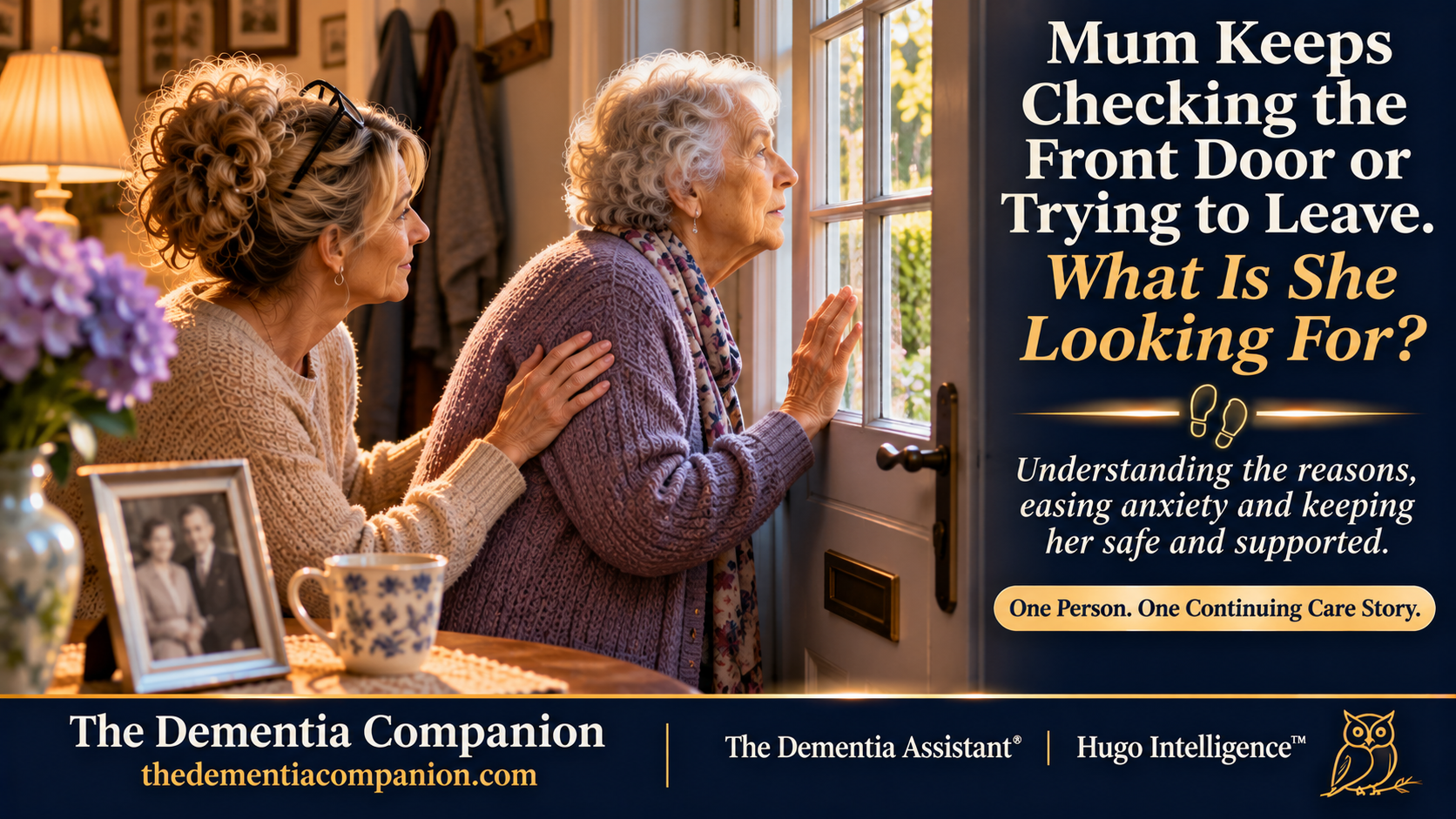
Mum Keeps Checking the Front Door or Trying to Leave. What Is She Looking For?
She’s checked the front door six times in twenty minutes. Now she’s putting on her coat and telling you she needs to leave. But where is she going, and what might she be trying to tell you?
By Louise Donaghy, Dementia Practitioner, Founder of The Dementia Companion and The Dementia Assistant®, Creator of Hugo Intelligence™
“Mum, where are you going?”
“Just checking.”
She closes the front door.
Walks back into the sitting room.
Sits down.
Three minutes later, she’s up again.
Back to the door.
Looking through the glass.
Checking the handle.
Looking down the road.
You ask if she’s expecting somebody.
“No, no. Just having a look.”
A few minutes later, the coat goes on.
Then the handbag appears.
And now Mum is absolutely determined that she needs to go somewhere.
You’re beginning to feel like the front door has become the most popular attraction in the entire house.
You’ve tried telling her that nobody is coming.
You’ve explained that it’s nearly bedtime.
You’ve reassured her that she’s safe.
And yet she keeps returning.
Perhaps you’re worried she’ll leave without telling you.
Perhaps she has already become lost once.
Or perhaps you’re frightened that the next time you turn your back, she’ll be halfway down the road.
But before we decide how to stop Mum checking the door, there’s another question worth asking.
What might Mum be looking for, waiting for or trying to do?
Someone living with dementia may repeatedly check the front door or attempt to leave because they’re looking for reassurance, expecting someone, following a familiar routine, wanting exercise, experiencing discomfort or having difficulty recognising where they are.
Sometimes they have a clear destination in mind.
Sometimes they know they need to do something but cannot explain what it is.
And sometimes the act of checking the door may be helping them feel more certain about their surroundings.
The best starting point is to understand the person’s experience, explore possible causes and support safe independence rather than automatically treating every attempt to leave as a problem.
However, if Mum is becoming disorientated, repeatedly getting lost or putting herself in danger, appropriate safety planning and professional support are essential.
Because this isn’t simply about keeping a door closed.
It’s about understanding the person who keeps opening it.
Why does someone with dementia keep checking the front door?
There isn’t one explanation that fits everybody.
Dementia can affect memory, orientation, perception, communication and how someone interprets their surroundings.
But checking the door can also be an ordinary human response to something we’re expecting or worrying about.
Think about it.
If you’re waiting for a delivery, you might check the window every few minutes.
If someone you love is late coming home, you may listen for their car.
If you’re getting ready for an appointment, you might check the time, collect your keys and head towards the door.
Now imagine remembering the feeling that something important is about to happen, but not being able to remember exactly what it is.
You might keep checking too.
For someone living with dementia, possible explanations include:
- Waiting for a family member or friend.
- Looking for a familiar person.
- Feeling that they need to go to work.
- Expecting the children to return from school.
- Wanting to visit somewhere meaningful.
- Feeling unsure whether they are at home.
- Looking for reassurance that the surroundings are safe.
- Following a long-established routine.
- Wanting fresh air, exercise or companionship.
- Feeling bored, restless or uncomfortable.
- Experiencing anxiety, pain or another unmet need.
And sometimes there may be no obvious explanation.
We should explore the person’s circumstances rather than assuming that the dementia has created a meaningless behaviour.
The repeated action may be telling us something worth understanding.
Is Mum trying to leave, or is she checking that everything is safe?
These can be two different situations.
Perhaps Mum checks the front door because she wants to make sure it’s locked.
Perhaps she is waiting for someone to arrive.
Perhaps she worries that somebody might come in.
Or perhaps she’s preparing to go outside.
Watch what happens without turning the situation into an interrogation.
Does Mum look through the window?
Does she test the handle?
Does she collect her handbag?
Does she ask where someone is?
Does she appear anxious?
Does she seem comfortable once she’s looked outside?
Or does she repeatedly head towards the road?
These observations may help distinguish checking, reassurance-seeking and attempts to go out.
For example, Mum might say:
“Have you locked the door?”
And then ask again five minutes later.
Perhaps she doesn’t remember checking it.
Or perhaps she’s still feeling worried.
You might respond:
“The door’s secure, Mum. Would you like to check it with me?”
If this is comfortable for her, involving her may provide reassurance.
But repeated checking can sometimes become more distressing rather than reassuring.
If that happens, try understanding the worry rather than repeatedly demonstrating the lock.
The aim isn’t to make Mum stop asking questions. It’s to understand what she needs to feel comfortable and safe.
What if Mum thinks she’s waiting for somebody?
This is something families may recognise.
Perhaps Mum is standing at the door because she believes her husband is coming home from work.
But he retired twenty years ago.
Perhaps she’s waiting for children who are now grown adults.
Or perhaps she’s expecting her own mother.
You know that nobody is coming.
Mum may experience things differently.
Repeatedly correcting the date or explaining that somebody died many years ago may cause additional distress.
But that doesn’t mean you must invent a story or confirm something untrue.
Try beginning with the feeling.
“Are you waiting for somebody, Mum?”
If she mentions a person, you might say:
“You’re thinking about Dad. Tell me what you’re missing about him.”
Or:
“You seem worried about everyone getting home.”
Then consider what reassurance might help.
A familiar photograph.
A conversation about someone important.
A phone call to an available family member, if appropriate.
Or simply sitting together for a while.
There is no guarantee that these approaches will work.
And there are circumstances where clear, factual orientation is important.
But recognising the emotion may be more helpful than repeatedly challenging the person’s understanding of time.
Why does Mum say she needs to go home when she’s already home?
This is one of the most emotionally difficult questions families ask.
And it deserves its own understanding.
Sometimes, when someone living with dementia says they want to go home, they may be thinking about a previous home.
Perhaps their childhood house.
Perhaps the home where they raised their family.
Perhaps somewhere associated with security, belonging or familiar relationships.
Other times, they may genuinely not recognise their present surroundings.
Or they may simply be unhappy or uncomfortable where they are.
We should never assume that “home” always means the same thing.
You might ask:
“Mum, what are you missing about home?”
Or:
“What would make you feel more comfortable here?”
You may discover she’s worried about someone.
Or wants something familiar.
Or simply needs a little reassurance.
Alzheimer’s Society explains that wanting to go home can sometimes reflect a search for the feelings associated with home rather than a specific address.
But the individual’s own explanation matters most.
The task isn’t to convince Mum that she’s mistaken. It’s to explore what home means to her in that moment.
For more guidance on this particular question, explore our Ask Hugo resource:
https://thedementiacompanion.com/ask-hugo/dementia-wants-to-go-home/
Could Mum be following an old routine?
Absolutely.
And this is where knowing the person’s life story becomes particularly useful.
Imagine Mum worked at a local school for thirty years.
Every weekday morning, she collected her handbag, put on her coat and left at a familiar time.
Now she has dementia.
Sometimes she still feels that familiar responsibility.
Perhaps she says:
“I’ll be late.”
Or:
“The children will be waiting.”
Or simply:
“I need to go.”
Her intention may be connected to an important role she held for many years.
But don’t assume that every person who previously worked outside the home is trying to return to work.
Ask what matters to her.
If she explains that she needs to be somewhere, acknowledge the concern.
“It sounds like you’ve got something important to do.”
Then ask whether she would like to tell you about it.
If appropriate, you might offer a familiar, meaningful activity.
Perhaps sorting some papers.
Helping with a household task.
Or discussing the work she enjoyed.
Sometimes, being able to participate in something purposeful may be more reassuring than being told there’s nothing to do.
The person may be responding to a familiar sense of responsibility, not simply trying to escape the house.
What if Mum keeps putting on her coat and collecting her handbag?
Try not to focus only on the coat.
Consider the entire situation.
Does Mum seem ready for an appointment?
Is she looking for somebody?
Has she been sitting indoors for a long time?
Does she want a walk?
Does she feel uncomfortable?
Perhaps she’s always enjoyed going out in the afternoon.
Perhaps the handbag is something she associates with being prepared.
Or perhaps she doesn’t know why she’s collected it.
You could ask:
“Mum, were you thinking of going somewhere?”
If she can explain, listen.
If she wants some fresh air, a short accompanied walk might be appropriate, depending on her abilities, preferences and safety.
If she seems tired or overwhelmed, consider whether a quieter activity would be more comfortable.
If there’s an immediate risk, take appropriate steps to keep everyone safe.
But don’t assume that collecting a coat automatically means an emergency.
We need to understand the person’s intention, their abilities and the circumstances, not simply react to an object in their hand.
What should I say when Mum insists she needs to leave?
The most helpful words will depend on the person and what they’re experiencing.
Here are some natural examples families can adapt.
When Mum says, “I have to go now”
You might say:
“You’ve somewhere important in mind. Where were you hoping to go?”
If she cannot explain, try:
“Would you like me to sit with you for a moment?”
When Mum says, “Someone’s coming for me”
You could respond:
“You seem to be expecting someone. Is there anybody you’re worried about?”
When Mum says, “I’m going home”
You might say:
“Home is important to you. Tell me what you’re missing.”
When Mum says, “I need to get to work”
Try:
“You always took your work seriously. What did you enjoy most about it?”
When Mum repeatedly checks whether the door is locked
You might say:
“The door is secure. Would you like to check it together?”
When Mum wants to go outside
If it’s safe and practical:
“Would you like us to go for a little walk together?”
When Mum appears frightened
Try:
“You seem worried. I’m here. Would you like to tell me what’s troubling you?”
These aren’t magical phrases.
They are starting points.
Some people will respond well to reassurance.
Others may need quiet, physical comfort, a change in environment or appropriate professional help.
And sometimes the person may not want to talk at all.
The goal is to listen beyond the words while respecting the person’s choices and need for safety.
What if Mum becomes angry when I try to stop her leaving?
This is where the situation can become especially difficult.
Perhaps Mum is determined to leave.
You’re worried she’s going to become lost.
You stand in front of the door.
She becomes angry.
You insist she cannot go.
She raises her voice.
And suddenly, you’re arguing in the hallway.
Neither of you feels safe or understood.
Where possible, avoid turning the doorway into a confrontation.
Don’t physically block, grab or restrain someone simply because they’re trying to go outside.
If the situation is calm and it is safe, consider offering to accompany them.
“Mum, would you like some company?”
Or:
“Where would you like to go? Let’s work out how we can get there.”
If she is distressed, give her appropriate space.
Speak calmly.
Try not to overwhelm her with explanations.
However, if she is at immediate risk of serious harm, safety takes priority.
Seek appropriate emergency assistance when necessary.
And if repeated attempts to leave are creating danger, ask for a professional review of the care arrangements.
Person-centred care does not mean ignoring danger. It means finding the least restrictive, safest and most respectful response appropriate to the situation.
Is walking about the same as wandering?
You may have seen the word wandering used in dementia information.
It is a common search term and appears in many clinical, research and support resources.
But language matters.
Someone may be walking with purpose.
Looking for somebody.
Trying to complete a familiar task.
Seeking exercise.
Or moving because they feel uncomfortable.
Calling all of these experiences “wandering” can unintentionally suggest that the person’s movement is meaningless.
That’s why many dementia organisations now use terms such as walking about, walking with purpose, getting lost or losing one’s way, depending on the circumstances.
However, some people living with dementia may become disorientated or leave a safe environment without being able to return.
That creates a genuine safety concern.
Walking is not automatically a problem. Becoming lost, distressed or exposed to danger is.
The distinction matters because our response should protect the person’s freedom while addressing specific risks.
How can we keep Mum safe without taking away her independence?
Start by understanding the actual risk.
Does Mum enjoy independent walks and return without difficulty?
Has she become lost before?
Does she struggle to recognise the way home?
Does she leave in unsuitable clothing?
Does she go outside at night?
Does she have mobility problems?
Is she able to ask for help?
Has anything changed recently?
A person-centred assessment can help identify practical support.
This might include:
Familiar walking routes
If Mum enjoys walking, explore routes that are comfortable and appropriate for her abilities.
Companionship
Perhaps a friend, relative or carer could accompany her on regular outings.
Accessible outdoor space
If she enjoys the garden, consider whether it can be made easier and safer to use without unnecessarily restricting her freedom.
Identification
With appropriate agreement and consideration of privacy, Mum may find a help card or suitable form of identification reassuring.
Practical reminders
Some people benefit from simple reminders about where they’re going or whom to contact.
Professional advice
An occupational therapist, dementia specialist or relevant care professional may help assess specific risks and support options.
And remember that the safest approach isn’t always the most restrictive one.
We should be looking for ways to help Mum continue going out safely, not simply ways to stop her leaving the house.
Should we lock the front door to stop someone with dementia leaving?
This needs careful consideration.
Keeping an ordinary front door securely locked to protect against intruders is different from deliberately confining a person inside a property.
Never lock someone inside a home in a way that prevents safe emergency evacuation.
Fire safety is essential.
So are the person’s rights and decision-making capacity.
A dementia diagnosis does not automatically authorise family members to restrict someone’s freedom of movement.
If Mum is repeatedly attempting to leave and there are significant safety concerns, ask appropriate professionals for an individual risk assessment and advice about lawful, proportionate arrangements.
In England and Wales, the Mental Capacity Act may be relevant to certain decisions.
Other UK nations and countries have their own legal frameworks.
Restrictions must not be introduced casually or simply for convenience.
And installing complicated locks or barriers may create additional risks, including during a fire or medical emergency.
The aim is to protect Mum, not turn her home into somewhere she feels trapped.
Can a door alarm, sensor or GPS device help?
Sometimes.
Assistive technology may help families manage particular risks.
For example, a door sensor might notify an appropriate person when an external door is opened.
A personal alarm may provide a way to call for assistance.
And some location devices can help identify where a person is if they become lost.
But there are important limitations.
A device doesn’t necessarily tell you why someone has left.
It doesn’t physically accompany them.
It doesn’t guarantee that someone will respond in time.
And it cannot replace necessary human care or supervision.
Privacy and consent also matter.
Where possible, involve the person in the decision.
Explain what the technology does.
Discuss who receives information.
Consider whether the device is comfortable and practical.
And establish whether somebody can respond when an alert is triggered.
The Alzheimer Society of Canada specifically advises considering the person’s values, privacy, freedom and independence when choosing location-tracking technology.
Technology should support the person’s safety and choices, not become an excuse to monitor every movement without justification.
What if Mum goes missing?
If Mum has left home and you cannot establish where she is, act promptly.
Do not wait 24 hours to report a missing person.
In the UK, contact the police promptly when a person living with dementia is missing and you are concerned for their safety.
Call 999 if they are in immediate danger or vulnerable to serious harm. Use 101 for non-emergency police contact where appropriate.
In the USA, the Alzheimer’s Association advises contacting 911 if a missing person with dementia cannot be located within 15 minutes, and sooner when there is immediate danger.
In Canada, Australia, Ireland and elsewhere, follow the local emergency and missing-person reporting procedures. Never delay reporting because you believe a minimum waiting period applies.
Provide the police with relevant information, including:
- The person’s name and description.
- A recent photograph.
- When and where they were last seen.
- What they were wearing.
- Important health and communication information.
- Places they may visit.
- Previous addresses or familiar destinations.
- Any relevant mobility difficulties.
- Contact details for people who may have seen them.
If appropriate, family members may check nearby places while someone remains available at home in case Mum returns, but do not delay contacting the police or put anyone in danger.
What if Mum comes home safely?
First, make sure she’s physically well and comfortable.
Avoid greeting her with an angry interrogation.
She may already feel frightened, embarrassed or confused.
You might say:
“I’m glad you’re home, Mum. Are you all right?”
Then consider what happened and whether professional support or a review of the safety arrangements is needed.
The aim is to learn from the event and reduce future risks, not make Mum feel punished for leaving.
What is the Herbert Protocol?
The Herbert Protocol is a UK police initiative that helps families prepare useful information in case a vulnerable person, including someone living with dementia, goes missing.
It is used in many police force areas, including Northern Ireland.
Families can complete a form containing relevant details such as:
- Personal information and a recent photograph.
- Important health information.
- Communication needs.
- Familiar destinations.
- Previous addresses.
- Places associated with the person’s life history.
- Emergency contacts.
The information can then be supplied promptly to the police if the person goes missing.
Ask your local police service about its current Herbert Protocol arrangements.
Dementia UK provides guidance about preparing this information.
https://www.dementiauk.org/information-and-support/living-with-dementia/herbert-protocol/
The Herbert Protocol is a preparation tool. It is not a replacement for contacting the police immediately when necessary.
What if Mum keeps trying to leave at night?
This can be particularly worrying.
Perhaps Mum gets up at 2am and prepares to go shopping.
Perhaps Dad believes it’s time for work.
Perhaps someone wakes and doesn’t recognise their surroundings.
Or perhaps they are restless because of pain, toileting needs or disturbed sleep.
There may be several possible causes.
Consider whether:
- The person is physically uncomfortable.
- They need the toilet.
- They’re frightened or confused.
- Medication may be affecting sleep.
- Their sleep-wake pattern has changed.
- They have another health problem.
- Their nighttime environment is unfamiliar or difficult to navigate.
If nighttime attempts to leave are new, persistent or creating danger, seek a healthcare and care-needs review.
Don’t automatically assume the problem is sundowning.
And don’t use sedating medication simply to prevent somebody moving around without appropriate clinical assessment.
Hugo can help you organise non-urgent questions about routines and support.
But he cannot provide physical supervision or emergency intervention.
If a family carer is unable to sleep because they’re continually trying to keep somebody safe, the care arrangements themselves may need additional support.
Could pain, illness or medication be contributing?
Yes.
And this is another reason to look beyond the action of opening the door.
Perhaps Mum has become more restless because she’s uncomfortable.
Perhaps she has a urinary problem.
Perhaps a medication has changed.
Perhaps she is constipated.
Or perhaps she has developed an illness affecting her alertness or behaviour.
NICE recommends assessing potential clinical and environmental causes when someone living with dementia experiences distress.
If the behaviour is new, increasing or associated with other symptoms, contact the GP or appropriate clinician.
Sudden confusion requires urgent medical assessment.
In the UK, the NHS advises calling 999 for sudden confusion.
In the USA and other countries, contact the appropriate emergency medical service when someone becomes acutely confused or seriously unwell.
Don’t wait to see whether a communication technique works when there may be an acute medical problem.
And don’t assume that an illness is definitely present because Mum checks the door.
The point is to consider possible causes without jumping to conclusions.
What should we record when Mum repeatedly checks the door?
A short factual record can be useful, particularly if the behaviour is new or increasing.
You don’t need to record every movement.
And Mum shouldn’t feel as though she’s being watched constantly.
But relevant observations may help the family and professionals understand patterns.
Consider:
When does it happen?
Morning, afternoon, evening or night?
What happens beforehand?
Has someone left?
Was there an appointment?
Was Mum resting or doing an activity?
What does Mum say?
Does she mention a person, a place or an important task?
What is she trying to do?
Checking the lock, looking outside, collecting belongings or leaving?
How does she appear?
Comfortable, anxious, upset, frustrated or determined?
What happens next?
Does she settle?
Does a walk help?
Does reassurance help?
Does she become distressed?
Were there any safety or health concerns?
Was she disorientated, at risk of getting lost or showing signs of illness?
A fictional example
“Thursday, approximately 4.20pm: Mum checked the front door four times during half an hour. She said she was waiting for her husband. She appeared worried and repeatedly looked down the road. Daughter sat with her and they talked about her husband and their previous home. Mum then chose to sit in the garden. No attempt to leave the property occurred.”
That gives useful context.
It records Mum’s words.
It describes what happened.
And it avoids assuming why she was worried.
Compare it with:
“Mum was wandering around the door again.”
The second statement tells us very little.
A person-centred record should help us understand the experience, not reduce the person to a repeated behaviour.
How can Mum’s life story help us understand where she wants to go?
This is one of the reasons personal history matters in dementia care.
Perhaps Mum has lived in several different homes.
Perhaps she used to visit her sister every afternoon.
Perhaps she spent years walking to work.
Perhaps she regularly collected the grandchildren from school.
Or perhaps she loved walking to the garden centre.
Those experiences may provide clues about what she finds meaningful.
But they are not proof of what she’s thinking today.
We should never assume that because someone worked in a school thirty years ago, every attempt to leave is about work.
Instead, we can use life-story information to ask better questions.
“Mum, were you thinking of going somewhere familiar?”
Or:
“Would you like to tell me about the place you’re missing?”
Sometimes a photograph, a familiar song or a conversation about a meaningful place may help.
At other times, the person might simply want to go outside.
And that’s perfectly reasonable when it can be done safely.
Knowing the person’s history should help us listen more carefully, not create explanations for them without asking.
What if different family members respond in different ways?
This is where families can become frustrated with one another.
Perhaps Mum’s daughter tries to reassure her.
Her son tells her she mustn’t go outside.
Dad gets upset and locks the door.
A neighbour offers to take her for a walk.
And everybody thinks their approach is the correct one.
Meanwhile, Mum is becoming increasingly confused about why people keep arguing in the hallway.
A consistent, person-centred plan can help.
Discuss what the family has noticed.
Agree which concerns need professional assessment.
Consider what Mum wants.
And establish sensible, safe arrangements.
For example, the plan might explain:
- Mum enjoys walking and wants to remain active.
- She sometimes checks the door because she’s expecting someone.
- She feels more comfortable when people explain what’s happening calmly.
- She has previously become lost on an unfamiliar route.
- She enjoys accompanied walks in the garden.
- Relevant safety arrangements have been discussed with professionals.
- Family members know whom to contact if she goes missing.
That is far more useful than simply telling everybody:
“Don’t let Mum out.”
Good care planning isn’t about getting the whole family to control the person in the same way. It’s about helping everyone understand and support that individual appropriately.
When should families request more professional support?
Ask for professional help when:
- The person repeatedly becomes lost or disorientated.
- There are attempts to leave during dangerous conditions.
- Walking about is associated with new distress or illness.
- There are significant falls or mobility risks.
- The person is frequently trying to leave at night.
- Family carers can no longer provide safe support.
- Existing care arrangements are not meeting the person’s needs.
- Restrictions are being considered because of safety concerns.
- The family is unsure how to balance independence with protection.
A GP or dementia specialist may review health-related concerns.
An occupational therapist may assess the home environment.
Social care services may assess support needs.
And specialist dementia services may help explore distress, communication or changing care needs.
In England, the person can request a care needs assessment through adult social care, and an unpaid carer can request a separate carer’s assessment.
Scotland, Wales and Northern Ireland have their own services and arrangements.
Seeking additional support should not mean that Mum automatically loses her independence or must move into residential care.
The purpose is to understand what she needs and explore appropriate ways of providing it.
Meet Hugo Intelligence™: Looking beyond the front door
This is exactly the kind of everyday question I wanted families to feel comfortable asking Hugo.
Perhaps Mum has been checking the door repeatedly.
Perhaps Dad keeps looking for his car keys.
Perhaps the family is worried that someone might go missing.
Or perhaps you’ve tried reassurance, but nothing seems to settle the concern.
You might ask:
“Hugo, Mum keeps checking the front door. What might she be looking for?”
Or:
“Hugo, Dad puts on his coat every evening and says he needs to go. How can I respond without upsetting him?”
Or:
“Hugo, Mum has become lost twice. What information should we prepare for a professional safety assessment?”
Hugo Intelligence™ provides conversational, person-centred dementia guidance within The Dementia Assistant®.
You can explain what’s happening in ordinary language.
Ask follow-up questions.
Explore communication approaches.
And prepare questions for appropriate professionals.
Hugo cannot know exactly what Mum is thinking.
He cannot assess an immediate danger, track a missing person, provide physical supervision or replace professional care.
But he can help families explore the situation more thoughtfully.
Not simply “How do I stop Mum going out?” but “What matters to Mum, what might she be experiencing, and how can we support her safely?”
That is a very different way of approaching the problem.
Hugo’s conversational intelligence: You don’t need to know what to ask first
Sometimes the family doesn’t have a neat question.
Perhaps you’re sitting at the kitchen table after a difficult afternoon.
Mum has checked the door repeatedly.
You’ve become frustrated.
And you’re worried that you’ve handled the situation badly.
You might simply begin:
“Hugo, Mum keeps going to the front door and I’m worried.”
You can then explore the situation gradually.
What happens before she checks the door?
Does she mention somebody?
Is she frightened?
Does she want to go outside?
Has she become lost previously?
What support is already available?
And what concerns should be discussed with a healthcare or social care professional?
You might then ask:
“Hugo, what could I say when Mum insists she’s waiting for someone?”
Or:
“How can we preserve her independence while reducing the risk of getting lost?”
Or:
“What should we record to help the GP understand what’s happening?”
Hugo’s conversational approach allows families to explore connected questions rather than treating every concern as a completely separate problem.
Hugo can also support speaking and listening in supported languages, where the platform’s voice features are available.
The aim is to make guidance easier to explore, one question at a time, without requiring families to understand complicated terminology before they begin.
Hugo’s personalised guidance through Mum’s selected care plan
This is one of the important differences within The Dementia Assistant®.
You can ask Hugo general dementia questions without selecting a care plan.
But when you choose Mum’s individual care plan, Hugo can use relevant recorded information about her life, routines, preferences, strengths and circumstances.
Perhaps her plan explains that she worked in a school.
Perhaps she enjoys going for walks.
Perhaps she prefers a quiet afternoon.
Perhaps she becomes anxious when her daughter leaves.
Or perhaps the family has recorded concerns about finding her way home.
These details may help shape more personalised suggestions.
Instead of asking:
“How do I stop wandering in dementia?”
You could ask:
“Hugo, Mum enjoys walking and has always valued her independence. She has recently been getting confused about where she wants to go. How can we support her safely while keeping her usual activities?”
Hugo can explore the question using the information the user has chosen to make available.
He doesn’t automatically access every person’s care plan.
The relevant individual care plan must be selected for Hugo to use that person’s information.
And personalised suggestions do not replace professional assessments or emergency safety arrangements.
That’s Person-Centred Intelligence®. One person at a time.
Hugo and the Care Planning Centre™: Keeping the person’s care story together
Imagine Mum receives support from several different services.
Her GP.
A memory clinic.
An occupational therapist.
A home care provider.
Perhaps adult social care.
And maybe a specialist dementia nurse.
Each may maintain its own professional records.
But the family needs somewhere to preserve the information that connects Mum’s everyday experiences.
Her routines.
Her favourite places.
The people she trusts.
Her communication preferences.
Her mobility and walking habits.
Relevant health concerns.
Professional advice.
Changes noticed at home.
And the approaches that help her feel more comfortable.
Within The Dementia Assistant®, the Care Planning Centre™ allows the person or family to build and maintain an individual, person-centred care plan.
Through the guided Talk to Hugo approach, families can explore relevant questions conversationally and organise information in the appropriate sections.
They can record:
- The person’s life history and strengths.
- Their wishes and preferences.
- Familiar routines and meaningful activities.
- Communication and language needs.
- Everyday support requirements.
- Important relationships.
- Relevant safety concerns.
- Professional contacts and advice.
- Daily observations and changes.
- Care arrangements that have been reviewed or agreed.
The family can update the information as circumstances change.
And when a new professional becomes involved, they can share relevant information appropriately.
The family-held care plan remains part of the person’s continuing care information rather than belonging exclusively to one care provider.
It does not replace statutory care assessments, safeguarding duties, professional care plans or emergency arrangements.
It complements them.
Because Mum’s life shouldn’t become a different story every time somebody new arrives.
Hugo’s saved conversations: Return to what you’ve already explored
Perhaps today you’re asking why Mum checks the door.
Next week, you want to discuss a walking routine.
Later, you’re preparing for an occupational therapy assessment.
Or perhaps you need to revisit guidance after an incident.
Within The Dementia Assistant®, you can save, categorise and organise conversations with Hugo.
That means useful discussions can be revisited instead of disappearing among unrelated questions.
You can return to earlier guidance.
Explore another aspect of the situation.
And continue preparing for relevant professional conversations.
But saved AI conversations are not official risk assessments or emergency plans.
The person or family should keep the relevant professional documents and check information for accuracy.
The care plan helps preserve the person’s continuing information. Saved Hugo conversations help preserve continuity in the questions being explored.
Hugo’s multilingual support: Understanding what the person is trying to communicate
This is particularly important when someone is frightened or disorientated.
Perhaps Mum grew up speaking Welsh.
Perhaps Dad prefers Irish.
Perhaps a family member lives in the USA and speaks Spanish.
Perhaps relatives communicate in Hindi, French or Portuguese.
Or perhaps the person living with dementia finds it easier to express a worry in the language they know best.
Language is part of identity.
And some people living with dementia experience changes in how they use different languages, although this varies between individuals.
We should never assume somebody automatically returns to a childhood language.
But we should recognise the importance of their communication preferences.
The Dementia Assistant® supports 12 interface languages and provides dictation and translation capabilities spanning 201 languages.
These tools can help families record observations, organise care information and communicate across language barriers.
Dictation can make it easier to record notes without typing.
Hugo’s conversational and supported voice features can also provide another way to explore questions.
Not every feature is available in all 201 languages.
Important clinical, legal and safety information must be checked for accuracy.
Qualified interpreters should be used when necessary for professional discussions.
Because understanding what someone needs begins with giving them the best possible opportunity to express themselves.
Hugo and Family Circle: Keeping relatives informed without taking away Mum’s voice
Perhaps Mum’s daughter visits every morning.
Her son lives abroad.
A neighbour occasionally accompanies her on a walk.
And another relative attends medical appointments.
Everybody wants Mum to be safe.
But not everybody sees the same part of her day.
One person knows she’s been checking the front door.
Another knows she enjoys walking.
Somebody else knows she’s become anxious when left alone.
The Dementia Assistant® includes Family Circle features to support appropriate sharing of relevant care updates.
Families can communicate about practical arrangements and changing support needs, subject to the person’s wishes, privacy and access permissions.
But not every movement or private concern needs to be shared with the entire family.
And relatives shouldn’t begin making decisions about Mum as though she has no voice.
The aim is to help everyone work around the same person-centred understanding, not turn Mum’s independence into a family vote.
Hugo and the Carer Wellbeing Hub: Supporting the family member who is worried
I also want to recognise something families sometimes struggle to say.
Watching somebody repeatedly try to leave can be frightening.
Perhaps you’re worried Mum will become lost.
Perhaps you haven’t slept properly because you’re listening for the front door.
Perhaps you feel guilty every time you ask her to stay inside.
Or perhaps you’re simply exhausted from repeating the same conversation.
Those feelings deserve attention.
The Dementia Assistant® includes the Carer Wellbeing Hub, alongside Hugo’s conversational guidance and dementia education resources.
Families can explore concerns and prepare questions about additional support.
But the platform cannot provide live physical supervision, emergency rescue or practical respite.
If you’re no longer able to manage safely, ask the relevant professional services for a care review.
Supporting Mum’s independence should not depend on one family member becoming frightened and exhausted every day.
International dementia support: UK, USA and beyond
Families experience these concerns across the world.
But healthcare services, missing-person procedures, legal arrangements and available technology differ.
United Kingdom
In the UK, families can seek advice from the GP, memory clinic, dementia support services and relevant adult social care or Health and Social Care services.
Alzheimer’s Society provides guidance about walking about and maintaining independence.
Dementia UK offers guidance about the Herbert Protocol and reducing the risk of someone going missing.
If somebody is missing and in immediate danger, call 999.
United States
The Alzheimer’s Association provides guidance on getting lost, leaving home and managing safety risks.
Families can discuss individual concerns with the person’s healthcare team and explore local caregiver support services.
If somebody is missing, follow local police guidance. The Alzheimer’s Association recommends calling 911 if the person has not been located within 15 minutes, and sooner when immediate danger is suspected.
Canada
The Alzheimer Society of Canada provides guidance on disorientation, losing one’s way and supporting people to remain safely active.
Some provinces offer additional missing-person and community safety initiatives.
Families should check their provincial services and contact emergency authorities promptly when someone is missing and at risk.
Australia
Dementia Australia offers guidance about walking, changed behaviour and safe independence.
The person’s GP and relevant dementia services may help assess changes in support needs.
Call 000 for an emergency in Australia.
Republic of Ireland
The Alzheimer Society of Ireland provides support relating to dementia symptoms, everyday activities and changing care needs.
Families can contact the GP or relevant community services for support.
For an immediate emergency, call 112 or 999.
Other countries
Begin with the local healthcare and dementia support organisations.
Ask about missing-person procedures, safe walking support, assistive technology and relevant care services.
The country may change the route to help. But the person’s dignity, identity and right to appropriate support remain central.
A practical dementia front-door and leaving-home checklist
If someone you love repeatedly checks the front door or attempts to leave, consider:
- [ ] Have we asked what the person is looking for or hoping to do?
- [ ] Are they waiting for someone?
- [ ] Could a familiar routine be involved?
- [ ] Do they want fresh air, activity or companionship?
- [ ] Are they frightened, uncomfortable or disorientated?
- [ ] Could there be a physical health concern?
- [ ] Has the behaviour changed suddenly?
- [ ] Have we considered their personal history and meaningful places?
- [ ] Are we avoiding unnecessary arguments or confrontation?
- [ ] Can they continue walking safely with suitable support?
- [ ] Have actual risks of getting lost been considered?
- [ ] Are there safe walking or garden arrangements?
- [ ] Are any safety devices appropriate, consented to and properly monitored?
- [ ] Have we avoided unsafe confinement or restrictions?
- [ ] Do we have an appropriate missing-person plan?
- [ ] Is a Herbert Protocol form relevant in the UK?
- [ ] Have professional services been involved where needed?
- [ ] Are relevant observations recorded factually?
- [ ] Does the person-centred care plan reflect their wishes and changing needs?
- [ ] Are appropriately involved relatives aware of agreed arrangements?
- [ ] Is the family carer receiving enough practical support?
You don’t have to complete everything today.
Start with what Mum may need and any immediate safety concerns.
Then consider what support would help her remain active, comfortable and involved in her own life.
The goal isn’t simply to keep the door closed. It’s to understand what matters to the person standing beside it.
Perhaps Mum isn’t trying to leave us behind
I want to finish with something that I think families will recognise.
When someone repeatedly checks the front door, it can feel relentless.
You’re constantly watching.
Constantly listening.
Wondering whether the door has opened.
Wondering whether Mum is about to go out.
Wondering whether you can even go upstairs for five minutes.
And perhaps, after the sixth trip to the hallway, you find yourself saying:
“Mum, will you please stop checking that door?”
Then you feel guilty.
Because you know she’s not trying to make your day difficult.
But you’re tired.
And worried.
And only human.
I understand why families find this so exhausting.
But imagine what Mum may be experiencing.
Perhaps she feels that someone should be coming.
Perhaps she’s remembering a familiar responsibility.
Perhaps she wants to walk to a place she loves.
Perhaps she doesn’t recognise her surroundings.
Or perhaps she’s feeling unsettled and doesn’t know how to explain why.
We can’t know without listening, observing and understanding the individual.
But there’s something important here.
Mum isn’t simply a person who keeps going to the door.
She’s a woman with a lifetime of journeys behind her.
The familiar walk to school.
The trip to work.
The excitement of going on holiday.
The weekly visit to see somebody she loves.
The front door that has welcomed friends, family and neighbours for decades.
The place where she waved her children off.
And the place where she waited for them to come home.
A front door can mean much more than a way out.
Sometimes it means belonging.
Sometimes it means responsibility.
Sometimes it means hope.
And sometimes, of course, it simply means somebody wants to go outside and enjoy the fresh air.
Which, if we think about it, is a perfectly reasonable thing to want.
Our task is to explore what Mum needs, support her choices and protect her from avoidable harm.
Not to assume that every journey must stop because she has dementia.
Because good dementia care isn’t about closing down someone’s world.
It’s about understanding the world they are experiencing and helping them remain connected to it.
One person.
One continuing care story.
And a lifetime of meaningful journeys that still deserve respect.
⸻
Ask Hugo: Your Questions About Checking Doors, Leaving Home and Dementia
Hugo, Mum keeps checking the front door. What might she be looking for?
Hugo 🦉: There are several possibilities.
Mum may be expecting someone, following a familiar routine, looking for reassurance or wanting to go somewhere meaningful.
Dementia may also affect how she recognises her surroundings.
I can help you explore possible explanations, but I cannot know exactly what Mum is thinking.
Why does Mum keep putting on her coat and handbag?
Hugo 🦉: She may feel that she has somewhere important to go.
Try asking gently what she’s planning.
Consider whether she wants a walk, is expecting somebody or is following a familiar routine.
If there are concerns about her becoming lost, appropriate safety planning is important.
What should I say when Mum insists she’s going home?
Hugo 🦉: Begin by exploring what home means to her.
You might ask, “What are you missing about home?”
Reassurance, familiar conversation or an appropriate change of activity may help.
Avoid assuming that her words always refer to a particular address.
What if Mum checks the door because she thinks somebody is coming?
Hugo 🦉: Try understanding whom she’s expecting and whether she feels worried.
Acknowledge her concern without automatically confirming something untrue.
You might offer reassurance or talk about the person she’s thinking of.
Should I stop Mum from walking outside?
Hugo 🦉: Not automatically.
Walking can support wellbeing, independence and enjoyment.
The important question is whether she can walk safely in her circumstances and what assistance she may need.
A professional assessment may help when risks are significant.
Can I lock the door to stop Mum going out?
Hugo 🦉: Never lock someone inside in a way that creates a fire or evacuation danger.
Restrictions on freedom require careful consideration of the person’s rights, capacity and applicable law.
Seek professional advice about safe, lawful and proportionate arrangements.
Can a GPS tracker help Mum remain independent?
Hugo 🦉: Location devices can sometimes support safety, but they have limitations.
Consider Mum’s wishes, privacy, consent, ability to use the device and who will respond if assistance is needed.
Technology does not replace necessary care or supervision.
What should I do if Mum goes missing?
Hugo 🦉: Contact the police promptly.
Do not wait 24 hours.
In the UK call 999 if she is in immediate danger. In the USA follow local emergency procedures, using 911 where appropriate.
Have a recent photograph, description and relevant information ready.
I cannot locate missing people or contact emergency services for you.
What is the Herbert Protocol?
Hugo 🦉: It’s a UK police initiative that helps families prepare important information in case a person living with dementia goes missing.
Ask your local police service about its current arrangements.
The form helps police respond but does not replace reporting someone missing.
Can Hugo help us prepare a person-centred safety plan?
Hugo 🦉: Yes. I can help you explore the person’s routines, preferences, meaningful places, current support arrangements and questions for professionals.
But I cannot conduct a formal risk assessment or guarantee someone’s safety.
Can Hugo use Mum’s existing care plan?
Hugo 🦉: Yes, when you select Mum’s individual care plan.
I can use relevant recorded information to offer more personalised guidance.
Without a selected plan, I can still provide general dementia information.
Can we record the changes we’re noticing?
Hugo 🦉: Yes. The Dementia Assistant® includes daily notes and the Care Planning Centre™.
You can record factual observations and relevant professional guidance while respecting the person’s privacy.
Can Hugo help us create Mum’s continuing care plan?
Hugo 🦉: Yes. The Care Planning Centre™ supports individual person-centred care plans.
Through Talk to Hugo, you can explore questions about Mum’s strengths, wishes, routines, communication and support needs.
The family can maintain the information as circumstances change.
Can I save our conversations about Mum’s behaviour?
Hugo 🦉: Yes. You can save, categorise and revisit conversations within The Dementia Assistant®.
That can help you return to earlier guidance and prepare for professional discussions.
Can Hugo support families in other languages?
Hugo 🦉: The Dementia Assistant® supports 12 interface languages and dictation and translation capabilities spanning 201 languages.
These features can help families communicate and organise information across languages.
Important clinical, legal and safety information must always be checked for accuracy.
Can Hugo help at night if Mum keeps trying to leave?
Hugo 🦉: You can explore non-urgent dementia questions whenever the platform is available.
But I am not an emergency service, physical supervisor or replacement for overnight care.
If Mum is in immediate danger or has gone missing, contact the appropriate emergency services.
Can Family Circle help relatives understand the situation?
Hugo 🦉: Family Circle can support appropriate sharing of relevant care updates.
Mum’s wishes, privacy and access permissions should guide what information is shared.
What if I’m exhausted from constantly worrying about Mum leaving?
Hugo 🦉: Your wellbeing matters too.
You may need a professional review of the support arrangements, additional practical help or respite.
The Dementia Assistant® includes the Carer Wellbeing Hub, but it cannot replace human care and professional support.
How much does The Dementia Assistant® cost?
Hugo 🦉: The Family subscription costs £4.99 per month in the UK.
Every subscription includes a 30-day complimentary trial.
You can explore Hugo Intelligence™, the Care Planning Centre™, daily notes, saved conversations, Family Circle, Life Story, multilingual features and carer wellbeing resources.
International pricing is available on the platform.
⸻
One Person. One Continuing Care Story.
When someone living with dementia begins repeatedly checking the front door or attempting to leave, several different people may become involved.
The GP.
The memory clinic.
A dementia nurse.
An occupational therapist.
A home care provider.
Adult social care.
Perhaps the police, if the person becomes missing or vulnerable.
Each service may maintain its own professional records.
But Mum is still one person.
Her wishes matter.
Her independence matters.
Her familiar routines matter.
Her life history matters.
Her communication needs matter.
And the places and relationships that bring meaning to her life still matter.
Dementia care shouldn’t become fragmented across different organisations, leaving families to explain the same person from the beginning every time somebody new becomes involved.
This is why I created The Dementia Assistant®.
To give the person living with dementia and their family their own continuing place for care information.
A place to record what matters to Mum.
Her routines.
Her strengths.
Her preferences.
Her favourite places.
Her communication and language needs.
Her relevant health information.
Her daily observations.
And changes in the support she needs.
A place to organise documents and prepare for professional appointments.
A place where information can continue as the services around Mum change.
And through Hugo Intelligence™, a place to explore questions, save conversations and receive person-centred guidance informed by the individual’s selected care plan.
The Care Planning Centre™ can help preserve the family’s own continuing record.
Daily notes can capture factual observations.
Life Story and Memory & Moments can preserve Mum’s identity and meaningful experiences.
Family Circle can support appropriate communication between involved relatives.
The Carer Wellbeing Hub can help recognise the needs of the people providing care.
And multilingual features can support families who speak different languages or live in different countries.
The Dementia Assistant® does not replace emergency services, professional risk assessments, clinical records, statutory care plans or safeguarding responsibilities.
It complements them.
The person and family can maintain their own information and share relevant details appropriately throughout the journey.
From the first concerns about memory.
Through diagnosis.
Through changing routines and abilities.
Through different professionals and care arrangements.
And throughout later-life and end-of-life care.
Different professionals. Different services. One person. One continuing story.
Because Mum should never become lost between organisations.
And her wish to go somewhere should never mean the people supporting her forget to ask where she wants to go, or why.
Would You Like Hugo to Help You Understand What’s Happening With Mum?
If Mum repeatedly checks the front door, wants to leave or has become worried about familiar places, you don’t have to begin with a complicated form.
You can begin with a conversation.
Tell Hugo about Mum.
What matters to her.
Where she used to enjoy going.
What she has been saying.
What you’ve noticed.
And what concerns are worrying you.
Hugo can help you explore person-centred questions, organise observations and prepare for relevant professional discussions.
Within The Dementia Assistant®, families can use:
- Hugo Intelligence™: Natural, conversational dementia guidance with practical follow-up questions.
- Care Planning Centre™: Guided creation and review of individual, person-centred care plans.
- Talk to Hugo: Conversational help exploring information for the person’s care plan.
- Family-held continuing care plans: Information maintained independently of any single professional provider.
- Daily notes and observations: Record meaningful changes factually and respectfully.
- Saved and categorised Hugo conversations: Revisit guidance as circumstances change.
- Family Circle: Support appropriate family communication and updates.
- Life Story and Memory & Moments: Preserve identity, favourite places, meaningful activities and relationships.
- Multilingual support: 12 interface languages and dictation and translation capabilities spanning 201 languages.
- Hugo Voice: Speak and listen to guidance in supported languages where available.
- Dementia Academy™: Practical learning and educational resources.
- Carer Wellbeing Hub: Support for the emotional and practical needs of family carers.
- Crisis Support: Educational guidance about recognising urgent concerns and accessing appropriate professional help.
Created by dementia practitioner Louise Donaghy and powered by Person-Centred Intelligence®, The Dementia Assistant® helps families keep the person at the centre of their own continuing care story.
Every subscription includes a 30-day complimentary trial.
Explore The Dementia Assistant®:
https://thedementiaassistant.com/
The Dementia Companion, home of The Dementia Assistant® and Hugo 🦉
https://thedementiacompanion.com/
Louise and Hugo ❤️🦉
Louise Donaghy
Founder & CEO of The Dementia Assistant®
Created and powered by Person-Centred Intelligence®
Creator of Hugo Intelligence™
⸻
Continue Exploring Dementia Care and Support
Ask Hugo: When Someone Wants to Go Home
https://thedementiacompanion.com/ask-hugo/dementia-wants-to-go-home/
Ask Hugo: Everyday Dementia Questions
https://thedementiacompanion.com/ask-hugo/
Dementia and Sundowning
https://thedementiacompanion.com/articles/dementia-and-sundowning/
Dementia Communication Tips for Carers
https://thedementiacompanion.com/articles/dementia-communication-tips/
Person-Centred Dementia Care
https://thedementiacompanion.com/dementia-care/
Family Dementia Support
https://thedementiacompanion.com/family-dementia-support
⸻
Authoritative References and Further Reading
United Kingdom
- Alzheimer’s Society: Why a Person With Dementia Might Be Walking About
Explains possible reasons for walking, including familiar routines, meaningful destinations, discomfort and disorientation.
- Alzheimer’s Society: Supporting a Person With Dementia Who Walks About
Practical guidance about safe walking, understanding distress and planning for someone becoming lost.
- Alzheimer’s Society: Trailing, Following, Checking and Dementia
Information about repeated checking, reassurance, feeling safe and changes in behaviour.
https://www.alzheimers.org.uk/about-dementia/stages-and-symptoms/dementia-symptoms/trailing-checking
- Alzheimer’s Society: Difficult Questions and Telling the Truth
Guidance about responding sensitively when somebody living with dementia asks to go home or believes they are in another place.
https://www.alzheimers.org.uk/about-dementia/stages-and-symptoms/difficult-questions-truth-telling
- Dementia UK: The Herbert Protocol
Information about preparing details that can help police locate a person with dementia who goes missing.
https://www.dementiauk.org/information-and-support/living-with-dementia/herbert-protocol/
- Dementia UK: Living Aids and Assistive Technology
Guidance about door sensors, telecare and other tools that may support safety and independence.
- NICE: Dementia, Assessment, Management and Support (NG97)
National recommendations about person-centred dementia care and structured assessment of distress, including possible clinical and environmental causes.
https://www.nice.org.uk/guidance/ng97/chapter/recommendations
- Police.uk: What to Do When Someone Goes Missing
Official guidance explaining that families do not need to wait 24 hours before reporting someone missing.
- Police.uk: Vulnerable People at Risk of Going Missing
Official advice about preparing information for someone living with dementia, including the Herbert Protocol.
- NHS: Sudden Confusion (Delirium)
Explains why sudden confusion requires immediate medical assessment.
https://www.nhs.uk/symptoms/confusion/
United States
- Alzheimer’s Association: Wandering and Dementia
Practical guidance about leaving home, recognising risks, planning ahead and responding when somebody goes missing.
https://www.alz.org/help-support/caregiving/stages-behaviors/wandering
Canada
- Alzheimer Society of Canada: Disorientation and Losing One’s Way
Guidance about getting lost, walking about and preparing appropriate safety arrangements.
- Alzheimer Society of Canada: Tracking Devices
Advice about choosing location technology while considering personal freedom, privacy, consent and independence.
Australia
- Dementia Australia: Wandering
Explains reasons a person may walk about, how families can respond and what to do if someone goes missing.
https://www.dementia.org.au/living-dementia/mood-and-behaviour-changes/wandering
- Dementia Australia: Walking Safely
Guidance for people living with dementia who want to continue walking and participating in their community.
https://www.dementia.org.au/living-dementia/home-life/walking-safely
Republic of Ireland
- Alzheimer Society of Ireland: Understanding Change
Information about changes in behaviour, walking about and supporting the person.
https://alzheimer.ie/wp-content/uploads/2018/11/B5-Understanding-Change-web.pdf
⸻
Important information: This article provides general educational guidance and does not replace medical assessments, individual safety planning, professional care advice, safeguarding procedures or emergency services. If someone living with dementia is missing or in immediate danger, contact local police or emergency services promptly. Sudden confusion requires urgent medical assessment. Legal arrangements and safety services vary internationally.
Reviewed: 21 November 2026
You May Also Find Helpful
- Mum Keeps Asking for Her Mother Who Died Years Ago. What Should I Say?
- How Do I Know When Mum with Dementia Needs a Care Home?
- Why Does Mum Become Exhausted at Family Gatherings? Dementia and Sensory Overload
- Mum Has Dementia but Insists Nothing Is Wrong. What Can We Do?
- Need help with this situation? Ask Hugo
Need help with your own situation? Ask Hugo.
One Person. One Continuing Care Story. The Dementia Companion is where you discover guidance. Inside The Dementia Assistant®, talk with Hugo, save and categorise conversations, record daily notes and involve authorised supporters in a continuing care plan centred around the person.
Ask Hugo About This · Start Your Continuing Care Plan — Families · Continuing Care Planning — Professionals
Personal guidance requires the appropriate account and subscription access. Care-plan information is used only with authorised access and the required consent and selection steps. All subscription plans include a 30-day complimentary trial.