Mum Keeps Asking for Her Mother Who Died Years Ago. What Should I Say?
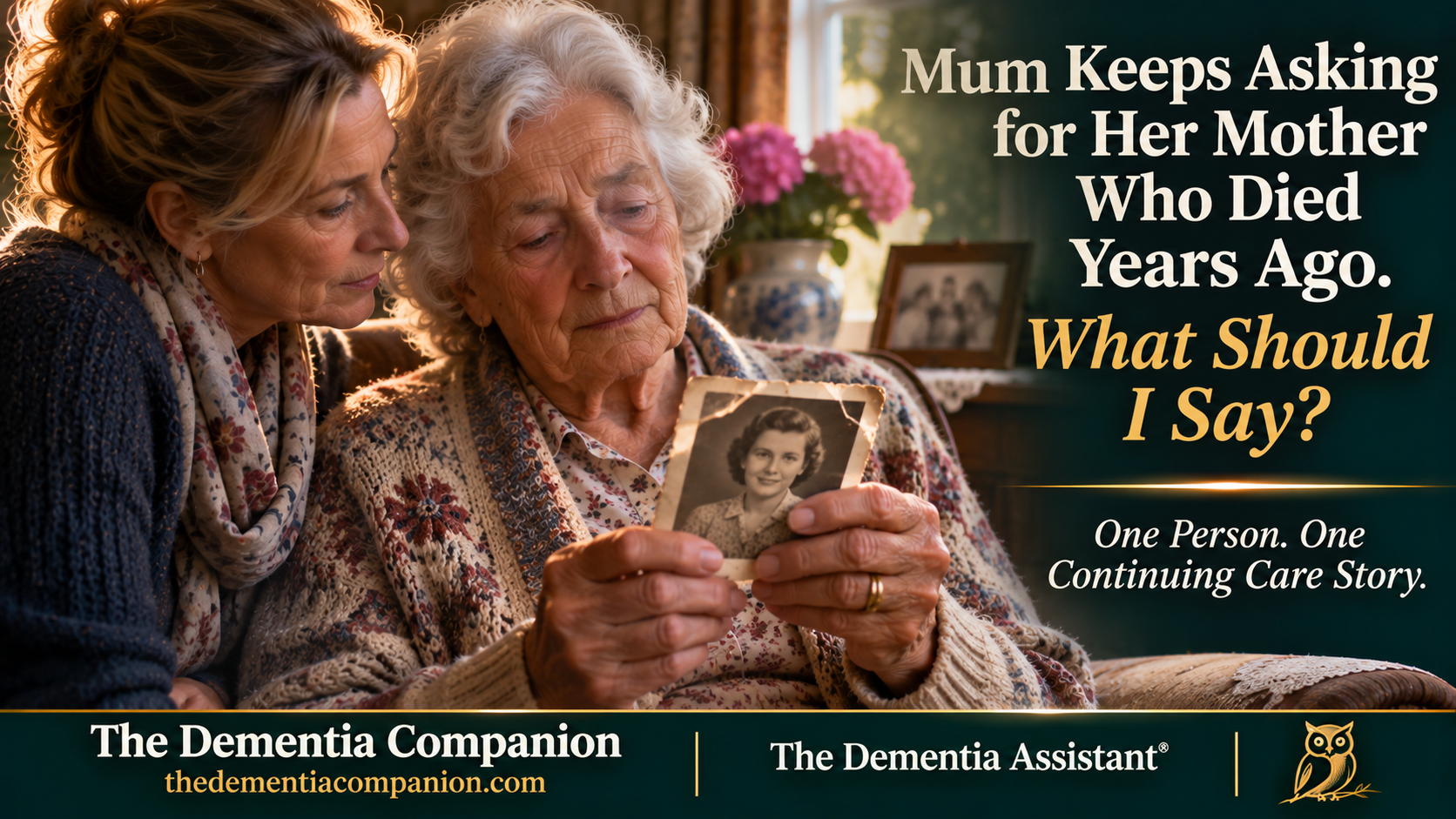
Mum Keeps Asking for Her Mother Who Died Years Ago. What Should I Say?
Sometimes, when someone living with dementia asks for their mother, they may not simply be asking where she is. They may be looking for someone who once made the world feel safe.
By Louise Donaghy, Dementia Practitioner, Founder of The Dementia Companion and The Dementia Assistant®, Creator of Hugo Intelligence™
“Where’s my mum?”
It’s a simple question.
Four little words.
But they can leave a family member wondering how on earth to answer.
Perhaps you’re sitting with Mum over a cup of tea.
She’s been quite content, looking through photographs and chatting about the garden.
Then, completely unexpectedly, she asks:
“Has my mother been yet?”
You hesitate.
Because your grandmother died forty years ago.
You remember her funeral.
You remember how upset Mum was.
You remember the years when the family spoke about her with affection.
And now Mum is sitting beside you, waiting for an answer.
Do you tell her that her mother died?
Do you explain it happened many years ago?
Do you change the subject?
Or do you simply say something reassuring and hope the question disappears?
And what happens if she asks again five minutes later?
When someone living with dementia repeatedly asks for a mother, father, partner or another person who has died, the most compassionate response is usually to begin by recognising their feelings, understanding what they may need and considering whether repeating the news of the death would help or cause unnecessary distress.
That does not mean automatically lying.
It does not mean pretending the person is still alive.
And it certainly does not mean assuming everybody living with dementia should receive the same response.
Some people can understand and process a gentle reminder about a death.
Others may experience the news as though they’re hearing it for the first time, repeatedly.
And sometimes the question isn’t really about where somebody is.
Perhaps it’s about love.
Belonging.
Comfort.
A familiar voice.
Or simply wanting Mum.
Because, even when we’re grown up, sometimes there’s nobody quite like our mother.
And a lifetime of memories and feelings can be much more complicated than a calendar.
Why does someone with dementia ask for a mother who died years ago?
There are several possible explanations, and we should never assume we know exactly what an individual is experiencing.
Dementia can affect the way someone remembers events, recognises time and connects experiences from different periods of their life.
A person may have difficulty recalling that a parent has died.
They may remember their mother vividly from childhood while finding more recent events difficult to recall.
Or they may feel as though they’re living in a much earlier period of their life.
This is sometimes called time-shifting.
It doesn’t mean every memory from the past is perfectly preserved.
And it doesn’t happen to everyone.
But it can help explain why someone who is now eighty might speak as though they are waiting for their mother to return from work.
For a moment, the person may be experiencing a different sense of time from everyone around them.
Imagine Mum remembers being a little girl waiting by the front window.
Her mother is out shopping.
She knows that eventually the door will open, and her mother will return.
That memory may carry a strong sense of safety and familiarity.
Many years later, Mum may experience that feeling again.
But there are other possibilities.
Perhaps she is lonely.
Perhaps she feels frightened.
Perhaps she is uncomfortable in unfamiliar surroundings.
Or perhaps she simply wants to remember someone she loved.
The question may contain an important emotional need, even when the factual circumstances belong to the distant past.
Our first job is to listen.
Not to assume.
Is Mum asking for her mother because she feels frightened or unsafe?
Possibly.
For many people, a mother represents protection, reassurance and belonging.
Of course, not everyone had a happy relationship with their mother.
Some people experienced difficult family relationships, separation, neglect or trauma.
That is why personal history matters.
But where the relationship was loving, the person’s mother may represent someone they trusted deeply.
Perhaps Mum is feeling unsettled.
Perhaps she is in hospital.
Perhaps a new carer has arrived.
Perhaps she doesn’t recognise the room.
Or perhaps she simply woke from a sleep and feels uncertain about where she is.
She may ask:
“Where’s my mum?”
What she needs in that moment might be reassurance.
You could try:
“You’re thinking about your mum. Is there something worrying you?”
Or:
“You seem a little unsettled. Would you like me to sit with you?”
Or simply:
“I’m here with you, Mum.”
Notice something important.
None of those responses tells her that her mother is alive.
And none forces her to experience the news of the death again.
They begin with what she may be feeling.
If she wants to talk about her mother, follow her lead.
If she needs quiet companionship, that may be enough.
Sometimes the most helpful response is not an explanation of where someone is, but reassurance that the person asking is not alone.
Should I tell Mum that her mother died?
There isn’t one answer that applies in every situation.
And I think families deserve to understand why.
When someone living with dementia asks about a person who has died, we need to consider their understanding, wishes, circumstances and emotional response.
Alzheimer’s Society explains that repeating news of a death can sometimes cause someone to experience the shock of bereavement over and over again.
Dementia UK also recognises that continually breaking the same painful news may be inappropriate when the person cannot retain the information.
However, we should not conclude that people living with dementia must never be told the truth.
When telling the truth may be appropriate
Perhaps Mum has recently lost her husband.
She understands what has happened.
She is grieving.
And she asks to talk about him.
Avoiding the truth or changing the subject every time may prevent her from expressing her grief.
She may want honest information.
She may wish to attend a funeral.
She may want to remember him.
Or she may ask a direct question and understand the answer.
In these circumstances, gentle honesty and emotional support may be important.
You might say:
“Mum, I have some sad news. Your husband died. I’m so sorry. I’m here with you.”
Use clear language appropriate to the person’s understanding.
Allow time.
Offer support.
And consider involving a trusted professional if the situation is especially difficult.
When repeating the truth may cause unnecessary distress
Now imagine a different situation.
Mum asks where her mother is.
You explain that her mother died forty years ago.
Mum begins crying.
She is devastated.
Later, she becomes settled.
Ten minutes afterwards, she asks again.
You repeat the news.
And she experiences that terrible shock all over again.
At this point, it’s reasonable to question whether repeatedly giving the same factual answer is helping.
You might instead respond:
“You’re missing your mum today.”
Or:
“Would you like to tell me about her?”
Or:
“She was very important to you, wasn’t she?”
These responses acknowledge Mum’s feelings without repeatedly delivering distressing news.
The aim isn’t to withhold the truth for convenience. It’s to respond thoughtfully to the person’s ability to understand it and the effect it has on their wellbeing.
Is it wrong to avoid telling someone with dementia that their parent has died?
Not automatically.
But we should distinguish between compassionate communication, avoiding unnecessary detail and deliberately inventing a false story.
Some families feel deeply uncomfortable not giving a direct factual answer.
Others feel distressed because repeating the truth causes their loved one to grieve as though the death has just occurred.
Both experiences deserve understanding.
I would encourage families to consider three questions.
First: What is Mum actually asking or needing?
Is she searching for reassurance?
Does she want to talk about her mother?
Is she worried something has happened?
Or is she asking for information she can understand and use?
Second: What happens when we answer?
Does a gentle explanation help?
Does she remember and process it?
Or does she repeatedly experience severe distress?
Third: Can we respond honestly to the emotion without inventing a story?
Often we can.
For example:
“You sound as though you’re missing her.”
“She meant a great deal to you.”
“Tell me something you loved about her.”
These responses don’t invent a visit, promise a telephone call or pretend somebody is coming.
They simply recognise an important relationship.
And there may be times when a person explicitly wants a factual answer and would feel betrayed by evasiveness.
Their preferences should matter too.
Person-centred communication isn’t about following a universal rule. It’s about understanding the individual and responding with kindness, respect and sound judgement.
What should I say when Mum asks, “Where’s my mother?”
Sometimes the simplest words are the most helpful.
Here are examples to adapt to the person and the situation.
When Mum seems calm and curious
“You’re thinking about your mum today. What was she like?”
Or:
“Tell me about something you enjoyed doing together.”
This may open a pleasant conversation.
When Mum seems worried
“You seem worried about your mum. Is there something on your mind?”
Or:
“I’m here with you. Would you like me to stay for a while?”
When Mum asks when her mother is coming
“You’re hoping to see her. What would you like to tell her?”
This allows Mum to express what matters without promising a visit that cannot happen.
When Mum says, “I need my mum”
“You really want your mum at the moment. Would you like to sit with me?”
Perhaps she needs companionship more than an explanation.
When Mum is already grieving
“You miss her terribly, don’t you? Would you like to talk about her?”
Don’t rush to distract her if she wants to express genuine grief.
When Mum asks you to telephone her mother
“You’d really like to speak to her. What were you wanting to tell her?”
This may help you understand the concern.
If she needs urgent reassurance or is trying to solve a practical problem, respond to that need honestly.
When a gentle factual reminder is appropriate
“Mum, I know this is painful. Your mother died many years ago. I’m here with you, and we can talk about her if you’d like.”
Use a response like this when it is appropriate to the person’s understanding and preferences.
If it repeatedly causes severe distress without helping, reconsider the approach with those supporting her.
The right words may change from one day to another.
There is no perfect script. There is only the person in front of us and our responsibility to understand them as well as we can.
What if Mum starts crying because she misses her mother?
Let her have her feelings.
We can sometimes be so anxious to remove distress that we forget sadness is also part of being human.
Mum may genuinely miss her mother.
That feeling deserves respect.
You don’t have to make it disappear immediately.
You might say:
“You loved her very much.”
Or:
“I can see how much you miss her.”
If she welcomes physical affection, you might offer a hand to hold or sit close beside her.
But don’t assume everyone wants to be touched when upset.
Ask or observe what helps.
Perhaps Mum wants to look at a photograph.
Perhaps she enjoys hearing a familiar song.
Perhaps she needs to talk.
Or perhaps she simply wants somebody nearby without too many questions.
And if she says she’d rather not discuss it, respect that too.
Comforting someone doesn’t always mean changing how they feel. Sometimes it means allowing them to feel it without being alone.
What if Mum becomes upset every time we tell her that her mother died?
Then it’s worth reviewing how the family responds.
Suppose Mum asks every afternoon:
“Where’s my mother?”
And each afternoon somebody explains that her mother died many years ago.
Every time, Mum becomes devastated.
She cries.
She asks why nobody told her.
She may even believe the death has happened that very day.
If this pattern continues, repeating the news may be causing more harm than helping.
Instead, the family could agree to begin with the feeling.
For example:
“You seem to be missing your mum.”
Then explore what she needs.
Perhaps companionship.
Perhaps a familiar memory.
Perhaps reassurance.
This isn’t about creating a false reality for Mum.
It’s about recognising that she may not be able to retain the information and that repeatedly delivering it may be unnecessarily distressing.
Dementia UK’s guidance specifically acknowledges that there may be a point at which it is appropriate to stop repeatedly breaking the same bad news.
However, if Mum understands what happened, wishes to discuss the death or is actively processing grief, an entirely different response may be appropriate.
The response should be based on Mum’s individual understanding and wellbeing, not simply on how frequently she asks.
Should we use photographs and memories of Mum’s mother?
They can be very helpful, provided Mum enjoys them.
A photograph may offer a connection with someone important.
Perhaps Mum recognises her mother’s smile.
Perhaps she remembers the kitchen where she grew up.
Perhaps she starts telling a story about family holidays.
Or perhaps she laughs about her mother’s cooking.
And sometimes, let’s be fair, the family cooking deserves to be remembered for all the wrong reasons.
Every family has at least one legendary recipe that should probably have remained a secret.
But the memories may be valuable.
You could sit together and say:
“That’s a lovely photograph of your mum.”
Or:
“I love this picture of you both.”
Or:
“She looks very happy here.”
Avoid turning photographs into a memory test.
Instead of:
“Who is that? You remember, don’t you?”
Try:
“That’s your mum in the garden. What a lovely photograph.”
Allow Mum to respond if she wants.
Don’t insist that she identify everybody correctly.
And remember that photographs aren’t always comforting.
Some may trigger sadness, confusion or painful experiences.
If Mum becomes distressed, consider putting the photograph away and trying something else.
Life Story work should help preserve identity and connection, not create another situation in which someone feels they have failed to remember.
What if Mum asks for her mother when she’s frightened at night?
The time and circumstances may offer clues.
Perhaps Mum wakes and doesn’t recognise the bedroom.
Perhaps she feels frightened in the dark.
Perhaps she’s uncomfortable.
Perhaps she’s had a vivid dream.
Or perhaps she feels lonely.
She may call:
“Mum!”
And for a moment, her own mother may be the person she most wants.
Before assuming the question is simply about memory, consider whether Mum needs help with something immediate.
Is she in pain?
Does she need the toilet?
Is she too hot or cold?
Is she frightened by something in the room?
Has her sleep changed?
You might say:
“I’m here, Mum. You’re safe. Is anything bothering you?”
Where appropriate, gentle lighting, a familiar voice or a comfortable routine may help.
But if the change is sudden or she seems acutely confused or unwell, seek medical advice promptly.
Not every nighttime worry is caused by dementia alone.
Could loneliness be part of the reason Mum keeps asking for her mother?
Possibly.
Perhaps Mum feels isolated.
Perhaps she’s recently moved into residential care.
Perhaps her husband has died.
Or perhaps she spends long periods without familiar company.
Asking for her mother may be connected to a wish for closeness or reassurance.
But we shouldn’t assume loneliness is always the explanation.
Ask about her feelings and everyday experiences.
Does she enjoy company?
Does she want more visitors?
Would she welcome a familiar activity?
Does she have meaningful things to do?
Perhaps she would enjoy sitting with somebody who knows her history.
Perhaps music helps her feel connected.
Perhaps she wants to spend time in the garden.
Or perhaps she prefers quiet companionship to an organised activity.
The important thing is that support should reflect Mum’s own preferences, not simply keep her occupied so she stops asking questions.
What if Mum never had a happy relationship with her mother?
This is why I feel so strongly about person-centred care.
We mustn’t romanticise every mother-child relationship.
Some people had wonderful mothers.
Others experienced bereavement very young.
Some were separated from their parents.
Some grew up in care.
Others experienced family conflict, abuse or neglect.
And some people have complicated feelings involving both love and hurt.
If Mum asks for her mother, we shouldn’t automatically tell her how wonderful that relationship must have been.
Perhaps it wasn’t.
This is where knowing the person’s life story is invaluable.
Ask gently rather than assuming.
“What are you thinking about when you mention your mum?”
Or:
“Would you like to tell me about her?”
Follow the person’s response.
If the subject causes distress, consider whether another approach would be more appropriate.
Person-centred care means respecting someone’s real history, not replacing it with a happier story because that’s easier for us to understand.
What if Mum believes she’s a little girl again?
Some people living with dementia experience periods when they seem to understand themselves as being much younger.
They may talk about school.
Expect to see their parents.
Worry about being late home.
Or ask permission to do something they haven’t needed permission for in decades.
But don’t assume this means they have literally become a child.
Mum remains an adult with a lifetime of experience, dignity and rights.
Avoid speaking to her as though she’s a little girl.
Don’t use a childish voice.
Don’t call her a naughty girl for wanting her mother.
And don’t turn her concerns into a game unless she genuinely enjoys the interaction.
You can respect the period of life she appears to be describing while continuing to treat her as an adult.
For example:
“You used to enjoy going home after school. Tell me about those days.”
That allows connection without infantilising.
The person’s experience of time may change. Their entitlement to respect does not.
Is asking for a deceased parent the same as a hallucination?
Not necessarily.
This distinction matters.
A person may ask for their mother because they believe she is still alive.
They may remember an earlier period of life.
Or they may be searching for reassurance.
That isn’t automatically a hallucination.
A hallucination involves perceiving something without an external stimulus, such as seeing or hearing a person who isn’t present.
Someone may also have a mistaken belief about where another person is, without actually seeing them.
These are different experiences and may require different support.
If Mum says:
“Where’s my mother?”
that is not enough to conclude she’s hallucinating.
If she says she can see her mother sitting in the room, the situation may warrant further exploration.
If these experiences are new, troubling or associated with other changes, seek appropriate medical advice.
Our existing hallucinations guidance explores how to respond without dismissing the person’s experience.
Good dementia support begins by understanding what is actually happening, not attaching a label before we’ve listened.
What if Mum keeps asking the same question every few minutes?
This can become emotionally exhausting.
Especially if the question concerns somebody you loved and lost too.
Perhaps Mum asks where her mother is.
You respond gently.
She settles.
Five minutes later, she asks again.
And again.
And again.
By the sixth time, you may feel your patience beginning to disappear.
Which is not exactly helped by the fact that somebody has left you to answer the question while they are in another room making a cup of tea.
You may understand why Mum is asking.
But that doesn’t mean repeating the conversation is easy.
Try to remember that each question may feel new to her.
If she cannot remember the previous answer, she may not understand why you’re frustrated.
Keep the response simple.
You might say:
“You’re thinking about your mum again.”
Then listen.
If a particular reassurance helps, use it consistently.
If Mum enjoys photographs, have a familiar one available.
If the question happens at predictable times, consider whether comfort, companionship or an activity could help.
But don’t expect the repetition to disappear simply because you’ve found a good phrase.
Sometimes the aim is not to stop the question. It’s to make the experience less distressing for Mum and more manageable for those supporting her.
What should professional carers know about Mum asking for her mother?
Quite a lot, actually.
Imagine Mum receives support from a home care agency.
A new carer arrives.
Mum asks:
“Where’s my mum?”
The carer doesn’t know her history.
They respond:
“Your mother died years ago.”
Mum becomes devastated.
The carer is surprised.
And the family later discovers that Mum experienced a painful conversation that might have been approached differently.
Now imagine the professional had access to relevant information about Mum’s life and preferences.
They might know:
- Her mother’s name.
- Whether they had a loving or difficult relationship.
- Whether Mum enjoys talking about her.
- What usually prompts the question.
- Whether repeated reminders of the death cause distress.
- What responses have helped.
- Which photographs or familiar activities Mum enjoys.
- How Mum prefers people to communicate.
That information could help the professional respond more thoughtfully.
It should never become a rigid script that prevents staff from listening to Mum on the day.
But it provides context.
And that’s exactly why a continuing person-centred care plan matters.
A new professional should not have to discover Mum’s deepest emotional experiences through trial and error if the family already has relevant information they can appropriately share.
What if Mum’s questions are becoming more frequent or distressing?
A repeated question isn’t automatically a medical emergency.
But persistent distress deserves attention.
Ask whether anything has changed.
Has Mum recently moved?
Has somebody important died?
Has her sleep changed?
Does she seem lonely?
Is she in pain?
Has medication changed?
Is she experiencing new confusion?
NICE recommends assessing clinical and environmental causes of distress in people living with dementia.
That can include pain, delirium and problems associated with the care environment.
A GP or appropriate dementia specialist may help when distress is persistent, significantly worse or affecting everyday life.
Grief, depression, anxiety and other concerns may also need support.
If Mum suddenly becomes confused or markedly different from her usual presentation, seek emergency medical assessment rather than assuming it is dementia progression.
In the UK, the NHS advises calling 999 for sudden confusion.
In the USA, use 911 for medical emergencies.
Elsewhere, follow the appropriate local emergency arrangements.
Hugo can help families explore general questions, but he cannot diagnose the cause of new symptoms or provide emergency care.
What if answering the question brings back my own grief?
This deserves its own space.
Because when Mum asks for her mother, you may be remembering your grandmother.
But what if Mum is asking for your father?
The husband she loved for fifty years.
The man you still miss.
The father whose funeral you attended.
And now you’re being asked to explain his absence again.
Perhaps you haven’t fully come to terms with losing him.
Perhaps the question catches you unexpectedly.
Perhaps you’re having a difficult day.
And suddenly you’re trying to comfort Mum while managing your own sadness.
That’s hard.
You don’t have to be endlessly composed.
You don’t have to find the perfect sentence every time.
And you don’t have to manage every difficult conversation alone.
Consider whether another family member or trusted professional can help.
Talk about your own grief with someone you trust.
Seek bereavement or carer support when needed.
And remember that caring for someone living with dementia can bring its own forms of loss, uncertainty and emotional exhaustion.
Supporting Mum’s feelings should never mean pretending you don’t have feelings of your own.
How can we record what helps Mum feel connected to her mother?
This is where a family-held care plan becomes valuable.
Not because we want to turn every emotional moment into paperwork.
Far from it.
But because a little thoughtful information can make an enormous difference when someone new becomes involved in Mum’s care.
You might record:
Who was her mother?
Her name, important memories and what the relationship meant to Mum.
What does Mum usually ask?
Does she ask where her mother is?
Whether she’s coming?
Or whether she can go and see her?
When does the question arise?
After waking?
During the evening?
When a visitor leaves?
In unfamiliar surroundings?
How does Mum seem to feel?
Worried?
Comfortable?
Sad?
Looking for reassurance?
What responses have helped?
Talking about her mother?
Sitting quietly together?
Looking at a photograph?
Listening to music?
What causes additional distress?
For example, repeated factual reminders about the death may lead to a strong grief response.
What does Mum prefer?
Where she can express a preference, include her own wishes about discussing family history and difficult news.
A fictional example
“Mum has recently been asking for her mother, Mary, particularly in the late afternoon. She sometimes appears worried and asks whether Mary is coming home. Repeatedly explaining that Mary died many years ago has caused significant distress. Mum has previously enjoyed talking about Mary’s garden and looking at their family photographs. When she asks, it may help to acknowledge that she is thinking about Mary, listen and offer companionship. Please respond to how Mum feels at the time rather than following a fixed script.”
This is much more helpful than:
“Mum gets confused about her dead mother.”
The first account preserves an important relationship.
It explains the family observations.
And it suggests an individualised way to approach a sensitive subject.
That’s the difference between recording a symptom and preserving part of a person’s life.
Meet Hugo Intelligence™: When you don’t know what to say
This is precisely the kind of deeply personal question I wanted families to feel comfortable bringing to Hugo.
Perhaps Mum has asked for her mother again.
Perhaps you’ve told her the truth and she’s become upset.
Perhaps you’re worried that avoiding the question is dishonest.
Or perhaps you simply don’t know how to comfort her.
You could ask:
“Hugo, Mum keeps asking for her mother, who died forty years ago. What should I say?”
Or:
“Hugo, Mum becomes heartbroken every time we remind her that her mother died. Is there a kinder way to respond?”
Or:
“Hugo, Dad keeps asking for his wife who died last year. How can I support him without dismissing his grief?”
Hugo Intelligence™ provides natural, conversational, person-centred dementia guidance within The Dementia Assistant®.
You can describe the situation in ordinary language.
You can ask follow-up questions.
Explore different communication approaches.
And consider what may help the person feel understood.
Hugo cannot know exactly what Mum is remembering or feeling.
He cannot determine whether she should be told about a death in every circumstance.
But he can help families think through the person’s preferences, emotional responses and possible support needs.
He can also help them prepare questions for dementia specialists and other professionals when necessary.
The aim isn’t for Hugo to give everyone the same perfect sentence. It’s to help families explore what would be most compassionate for the individual person they love.
Hugo’s conversational intelligence: A continuing conversation, not a single answer
Sometimes the first question is only the beginning.
You might ask:
“Hugo, Mum keeps asking for her mother.”
Then explain:
“Her mother died years ago, but Mum doesn’t seem to remember.”
Then add:
“Every time we tell her, she cries.”
Perhaps you want to explore whether a photograph might help.
Perhaps you want to know how to respond when Mum asks to telephone her mother.
Or perhaps you’re worried that your own sadness is affecting how you respond.
Hugo’s conversational approach allows families to explore connected questions.
You don’t need to know all the answers before you begin.
You don’t need to understand technical terms such as time-shifting, reminiscence or emotional validation.
You can simply tell Hugo what’s happening.
And continue from there.
H — Human. U — Understanding. G — Guidance. O — One person at a time.
That’s the principle behind Hugo.
Hugo’s personalised guidance through Mum’s selected care plan
This is one of the important differences between general dementia information and guidance informed by a person’s own circumstances.
You can ask Hugo general dementia questions without selecting a care plan.
But when you choose Mum’s individual care plan within The Dementia Assistant®, Hugo can use relevant recorded information about her life, preferences, routines and support needs.
Perhaps Mum’s care plan explains that:
- Her mother’s name was Mary.
- They had a close relationship.
- Mum grew up in a small village.
- Mary loved gardening.
- Mum enjoys talking about the family home.
- She finds old photographs comforting.
- She becomes upset when repeatedly reminded of Mary’s death.
- She prefers quiet, gentle conversations.
Those details may help Hugo offer more relevant suggestions.
Instead of a generic question:
“What should I say when somebody with dementia asks for their mother?”
You could ask:
“Hugo, using Mum’s selected care plan, how might we respond when she asks for Mary, considering her love of gardening and how upset she becomes when we repeat the news of Mary’s death?”
Hugo can help explore approaches informed by what the family has recorded.
But he does not automatically access every care plan.
The user must select the individual’s care plan when they want Hugo to use that information.
And the family should continue to review the guidance and consider Mum’s feelings in the moment.
That’s Person-Centred Intelligence®. One person at a time.
Hugo and the Care Planning Centre™: Preserving the person behind the question
When families begin creating a care plan, they may think about medical information first.
Diagnosis.
Medication.
Appointments.
Personal care.
Support arrangements.
All important.
But what about the people who shaped someone’s life?
Their mother.
Their father.
Their husband or wife.
The friends they loved.
The places they called home.
These relationships are part of the person.
Within The Dementia Assistant®, the Care Planning Centre™ helps families create and maintain an individual, person-centred care plan.
Through guided Talk to Hugo conversations, users can explore and organise relevant care information.
This might include:
- Personal history and important relationships.
- The person’s strengths and abilities.
- Meaningful memories.
- Communication preferences.
- Preferred language and cultural identity.
- Daily routines and familiar activities.
- Emotional reassurance and support needs.
- Experiences that may cause distress.
- Approaches that have helped.
- Relevant professional recommendations.
The person or family reviews what is recorded.
And the care plan can develop as needs and circumstances change.
It is not simply a document about what care somebody receives. It is also a way of preserving who they are.
That becomes particularly valuable when different professionals are involved.
Hugo’s saved conversations: Returning to guidance when circumstances change
Perhaps today you’re asking how to respond when Mum asks for her mother.
Tomorrow you want to explore a photograph or familiar activity.
Next week, Mum starts asking at bedtime.
Later, you’re preparing to explain the situation to a new care provider.
Within The Dementia Assistant®, you can save, categorise and revisit Hugo conversations.
That means you can return to the questions you’ve already explored and consider them alongside new circumstances.
You don’t have to begin every discussion from scratch.
But saved AI conversations are educational guidance.
They aren’t professional clinical assessments or proof of what Mum is experiencing.
The care plan preserves relevant information about Mum. Saved conversations help the family maintain continuity in the guidance they’re exploring.
Hugo’s multilingual support: When Mum remembers her mother in another language
This is one of the reasons our international approach matters.
Perhaps Mum grew up speaking Welsh.
Perhaps Dad is more comfortable speaking Irish.
Perhaps the person’s first language is Spanish, Hindi, French, Portuguese or another language.
Or perhaps family members live in different countries.
Someone living with dementia may experience changes in how they use different languages.
This varies considerably.
We should never assume that every person returns to their childhood language.
But a familiar language may be particularly important when someone is frightened, emotional or remembering childhood.
Imagine Mum begins speaking about her own mother in Welsh.
Her daughter understands some Welsh but isn’t confident.
Or imagine a family supporting a parent in the United States who prefers speaking Spanish.
The Dementia Assistant® supports 12 interface languages and provides dictation and translation capabilities spanning 201 languages.
These features can help families:
- Record observations in an accessible way.
- Use dictation when typing is difficult.
- Organise care information across languages.
- Communicate appropriately with relatives in different countries.
- Preserve important language preferences in the person’s care plan.
- Explore dementia questions more naturally.
Not every feature is available in all 201 languages.
And important clinical, legal and consent-related information should be checked for accuracy, with qualified interpreters when appropriate.
Because a person shouldn’t lose the opportunity to express what matters simply because the people around them speak a different language.
Hugo and Life Story: Preserving the people who shaped Mum’s life
This is where I think the emotional value of a continuing care story becomes especially clear.
Mum may not always remember which day it is.
She may become confused about where she is.
She may ask for somebody who died many years ago.
But the people who shaped her life still deserve to be recognised.
The Dementia Assistant® includes Life Story and Memory & Moments features.
These can help preserve meaningful information about:
- Family relationships.
- Childhood memories.
- Important places.
- Personal achievements.
- Familiar traditions.
- Favourite music.
- Cultural and religious identity.
- Photographs and special experiences.
- Activities the person enjoys.
Families can use this information to support connection and help appropriately involved professionals understand the person.
But we shouldn’t use memories as a test.
Nor should we assume all recollections will be pleasant.
The person’s own preferences and reactions should guide how this information is used.
Mum’s mother may no longer be alive, but her importance in Mum’s life is still part of her story.
Hugo and Family Circle: Helping relatives respond with shared understanding
Perhaps Mum’s daughter visits every morning.
Her son lives abroad.
A granddaughter visits at weekends.
And professional carers provide additional support.
Mum may ask each of them about her mother.
One person tells her the truth.
Another changes the subject.
Someone else promises that her mother is coming to visit.
And Mum becomes confused or distressed by these different responses.
The Dementia Assistant® includes Family Circle features to support appropriate communication between involved relatives.
Families can share relevant care updates, subject to the person’s wishes, privacy and access permissions.
They might agree that Mum usually responds well to talking about her mother’s garden.
Or that repeated reminders of the death have caused distress.
Or that Mum sometimes prefers quiet company rather than conversation.
The aim isn’t to impose one rigid response on everyone.
It’s to help people approach Mum with a shared understanding of her experiences and preferences.
Family Circle should support Mum’s voice and dignity, not turn private emotional moments into information everyone automatically receives.
Hugo and the Carer Wellbeing Hub: When the question hurts you too
Sometimes the person asking isn’t the only one experiencing grief.
Perhaps you miss your grandmother.
Perhaps Mum is asking for your father, and you’re still grieving his death.
Perhaps you’re emotionally exhausted from repeating the same difficult conversation.
Or perhaps you feel guilty because sometimes you simply don’t know what to say.
The Dementia Assistant® includes the Carer Wellbeing Hub, alongside Hugo’s conversational guidance and practical educational resources.
Families can explore questions about emotional strain, communication and finding support.
But Hugo cannot replace professional bereavement counselling, mental health care or human companionship.
If the situation is becoming overwhelming, consider speaking with a GP, dementia specialist, bereavement service or trusted person.
Mum deserves compassionate support. And the family member supporting her deserves compassion too.
International dementia support: UK, USA and beyond
Families across the world encounter these difficult questions.
The human experience is familiar, although healthcare systems and available services vary.
United Kingdom
Alzheimer’s Society and Dementia UK provide guidance about difficult questions, time-shifting, bereavement and compassionate communication.
Families can seek help from GPs, memory clinics, Admiral Nurses and relevant community dementia services.
NICE guidance supports person-centred communication and assessment of distress.
United States
The Alzheimer’s Association provides advice on responding to difficult beliefs and behaviour without unnecessary confrontation.
The National Institute on Aging also offers guidance about communication, dignity and supporting family caregivers.
Families can seek support from the person’s healthcare team and local Alzheimer’s services.
Canada
The Alzheimer Society of Canada encourages respectful communication and meaningful connection.
Its guidance includes listening to the person’s feelings and using familiar conversations and activities when appropriate.
Australia
Dementia Australia provides guidance about difficult truth-telling decisions, recognising emotion and responding to the individual.
Local clinical teams and dementia support services may help when distress is persistent.
Republic of Ireland
Families can seek information and support through the Alzheimer Society of Ireland, their GP and relevant community services.
The person’s wishes, communication needs and emotional wellbeing remain important.
Other countries
Contact the relevant national dementia organisation or healthcare professional for locally appropriate advice.
Across countries, the key principle remains consistent.
Listen to the person, respect their history, consider their emotional needs and seek professional support when necessary.
A practical checklist when Mum asks for someone who has died
If someone you love repeatedly asks for a deceased parent, partner or friend, consider:
- [ ] Have we listened to the question without immediately correcting it?
- [ ] Do we know what the relationship meant to the person?
- [ ] Are they looking for information, reassurance or companionship?
- [ ] Do they seem calm, worried, frightened or sad?
- [ ] Can they understand and retain a gentle factual explanation?
- [ ] Does repeating the news of the death cause significant distress?
- [ ] Are we avoiding inventing unnecessary false promises?
- [ ] Have we considered the person’s preferences about honesty?
- [ ] Would talking about the relationship help?
- [ ] Does the person enjoy photographs, music or reminiscence?
- [ ] Are there painful or traumatic memories we should respect?
- [ ] Does the question arise at particular times or in particular settings?
- [ ] Could loneliness, pain, illness or discomfort be contributing?
- [ ] Does persistent distress need professional assessment?
- [ ] Have we recorded useful observations respectfully?
- [ ] Does the person’s care plan include relevant life-story information?
- [ ] Do involved carers understand the person’s preferences?
- [ ] Are the family members providing support looking after their own wellbeing?
You don’t have to find a perfect answer.
And you don’t have to turn every conversation into a care-planning exercise.
Sometimes Mum may simply need someone to sit beside her and listen.
Maybe Mum isn’t asking us to find her mother
I want to finish with something that I think is particularly important.
Imagine Mum sitting in her favourite chair.
She’s holding an old photograph.
In the picture is a young woman with a familiar smile.
Perhaps she has her hair neatly curled.
Perhaps she’s standing in the garden.
Perhaps she’s holding a little girl who would one day grow up to become your mum.
Mum looks at the photograph.
Then at you.
And asks:
“Where’s my mother?”
You know her mother isn’t coming.
You know she died many years ago.
And you know you cannot bring her back.
But perhaps, for this moment, you can offer something else.
You can sit beside Mum.
You can listen.
You can ask what she remembers.
You can share a story.
You can let her speak about someone she loved.
You might discover that her mother made wonderful cakes.
Or that she had the most beautiful garden.
Or that she could be absolutely terrifying when somebody walked mud through her clean kitchen.
There’s always somebody in the family who takes the kitchen floor very seriously.
And perhaps, for a few moments, you’re not talking about dementia at all.
You’re talking about a woman who mattered.
A family.
A childhood.
A relationship.
A life.
Perhaps Mum smiles.
Perhaps she cries.
Perhaps she changes the subject.
And perhaps, ten minutes later, she asks the question again.
You may not be able to make the question disappear.
You may not be able to restore every memory.
And you certainly cannot bring back the person she’s missing.
But you can help preserve the love and meaning of that relationship.
Because Mum is not simply forgetting that her mother died. She may also be remembering how much her mother meant to her.
And that deserves more than a correction.
It deserves understanding.
It deserves tenderness.
And it deserves a response that recognises the whole person sitting in front of us.
One Person. One Continuing Care Story.
Sometimes the most important part of someone’s care isn’t what we can persuade them to remember.
It’s what we choose to remember about them.
⸻
Ask Hugo: Your Questions About Dementia and Asking for Someone Who Has Died
Hugo, why does Mum keep asking for her mother who died years ago?
Hugo 🦉: There are several possible explanations.
Mum may be remembering an earlier period of life, finding it difficult to recall the death or seeking reassurance connected with her mother.
She may simply want to talk about someone she loved.
I can help you explore the situation, but I cannot know exactly what Mum is experiencing.
Should I tell Mum that her mother is dead?
Hugo 🦉: That depends on Mum’s understanding, wishes and emotional response.
Some people benefit from a gentle, factual explanation.
Others may experience repeated reminders as fresh bereavement.
Consider her individual circumstances and seek professional advice if you’re unsure or the distress is significant.
Is it lying if I don’t tell Mum her mother died?
Hugo 🦉: Responding to Mum’s feelings without immediately repeating the news is not necessarily the same as inventing a false story.
You might acknowledge that she misses her mother or invite her to talk about their relationship.
Try to respect Mum’s preferences while avoiding unnecessary distress or misleading promises.
What should I say when Mum asks, “Where’s my mother?”
Hugo 🦉: You might gently ask:
“You’re thinking about your mum. Would you like to tell me about her?”
Or:
“You seem worried. Is something troubling you?”
The most appropriate response depends on what Mum needs in that moment.
What if Mum starts crying when I tell her the truth?
Hugo 🦉: Offer reassurance, comfort and time to express her feelings.
If she repeatedly experiences severe grief without retaining the information, consider whether continuing to repeat the news is helpful.
A dementia specialist can help you explore an individualised approach.
What if Mum asks me to telephone her mother?
Hugo 🦉: Try understanding what she wants to say.
You might ask:
“Is there something you’d like to tell your mum?”
Avoid promising a telephone call or visit that cannot happen.
If Mum needs reassurance or practical help, respond to that need.
Is asking for a deceased parent a hallucination?
Hugo 🦉: Not necessarily.
Mum may believe her mother is alive or be remembering an earlier time without actually seeing or hearing her.
A hallucination involves a perception without a corresponding external stimulus.
New or distressing experiences may warrant professional assessment.
What if Mum believes she’s a child again?
Hugo 🦉: Dementia can sometimes affect the person’s sense of time.
She may speak about childhood events as though they’re happening now.
Respond respectfully and avoid speaking to her as though she is a child.
She remains an adult with her own identity and rights.
Could Mum be asking for her mother because she feels frightened?
Hugo 🦉: Possibly.
A parent may represent comfort or security, although relationships differ.
Consider whether Mum is unsettled, uncomfortable, lonely or in unfamiliar surroundings.
Ask what might help her feel safe without assuming you know the cause.
Can photographs help Mum feel connected to her mother?
Hugo 🦉: They may help if Mum enjoys them.
You could look at familiar photographs together and allow her to talk.
Avoid turning it into a test of memory.
If photographs cause distress, follow her response and consider another activity.
What if Mum had a difficult relationship with her mother?
Hugo 🦉: Her personal history matters.
Don’t assume the relationship was loving or reassuring.
Listen to how Mum describes her mother and respect difficult memories.
Person-centred guidance should reflect her actual experiences.
Can Hugo help us create a care plan that includes Mum’s life story?
Hugo 🦉: Yes.
The Dementia Assistant® includes the Care Planning Centre™, Life Story and Memory & Moments features.
You can record meaningful relationships, communication preferences, routines, strengths and relevant observations.
Can Hugo use Mum’s existing care plan?
Hugo 🦉: Yes, when you select Mum’s individual care plan.
I can use relevant recorded information to provide more personalised guidance.
Without a selected plan, I can still answer general dementia questions.
Can I save our conversations about Mum’s questions?
Hugo 🦉: Yes.
You can save, categorise and revisit conversations within The Dementia Assistant®.
This helps you return to earlier guidance and explore related questions as circumstances change.
Can Hugo help in different languages?
Hugo 🦉: The Dementia Assistant® supports 12 interface languages and dictation and translation capabilities spanning 201 languages.
These features can help multilingual families communicate and organise care information.
Not every feature is available in every language, and important clinical information must be verified appropriately.
Can Family Circle help relatives respond more consistently?
Hugo 🦉: Yes.
Family Circle can support appropriate sharing of relevant care updates.
For example, relatives may find it useful to know that Mum prefers talking about her mother’s garden rather than repeatedly hearing distressing news.
Mum’s privacy, wishes and access permissions must guide what is shared.
What if I’m grieving the same person Mum keeps asking about?
Hugo 🦉: Your feelings matter too.
You may need support from relatives, friends or bereavement professionals.
The Dementia Assistant® includes the Carer Wellbeing Hub, but it does not replace human emotional support or professional care.
When should I seek medical advice?
Hugo 🦉: Seek professional advice if Mum’s distress becomes persistent, significantly worse or affects her wellbeing.
If she becomes suddenly confused or acutely unwell, seek emergency medical assessment.
I cannot diagnose the cause of her symptoms.
How much does The Dementia Assistant® cost?
Hugo 🦉: The UK Family subscription costs £4.99 per month.
Every subscription includes a 30-day complimentary trial.
You can explore Hugo Intelligence™, person-centred care planning, saved conversations, Family Circle, Life Story, Memory & Moments and multilingual support.
For international prices, check the current subscription options displayed on the platform.
⸻
One Person. One Continuing Care Story.
When someone living with dementia begins asking for a parent, partner or loved one who has died, several people may become involved.
The family.
The GP.
The memory clinic.
A dementia nurse.
A home care provider.
A hospital team.
Perhaps a residential care service.
Each may have its own professional records.
But Mum is still one person.
Her family relationships remain part of her life.
Her personal history matters.
Her childhood matters.
Her experiences matter.
Her language and cultural identity matter.
And the people she has loved remain part of her story.
Dementia care should not become fragmented across different organisations, leaving families to explain the same person from the beginning whenever a new professional becomes involved.
This is why I created The Dementia Assistant®.
To give the person living with dementia and their family their own continuing place for person-centred care information.
A place to record:
- The person’s life story and meaningful relationships.
- Their wishes and preferences.
- Their strengths and abilities.
- Their familiar routines.
- Their communication and language needs.
- Their relevant health information.
- Daily observations and changes.
- Important professional advice.
- Support arrangements.
- Approaches that help the person feel understood.
A place where the family can maintain information as different services become involved.
And through Hugo Intelligence™, a place to explore questions naturally, save conversations and receive guidance informed by the individual’s care plan when the user chooses to select it.
The Care Planning Centre™ supports the person’s own continuing record.
Daily notes help preserve factual observations.
Life Story and Memory & Moments help protect the person’s identity and history.
Family Circle supports appropriate communication between relatives.
The Carer Wellbeing Hub recognises the needs of those providing care.
And multilingual features help families maintain care information across different languages and countries.
The Dementia Assistant® does not replace clinical records, professional assessments, medical advice or statutory care plans.
It complements them.
The person and family can maintain their own information and share relevant details appropriately.
From the first concerns about memory.
Through diagnosis.
Through changes in communication and everyday abilities.
Through different professionals and care settings.
And throughout later-life and end-of-life care.
Different professionals. Different services. One person. One continuing story.
Because Mum should never become lost between organisations.
And the people who shaped her life should not disappear from her care story simply because she sometimes struggles to remember what happened to them.
Would You Like Hugo to Help You Understand What Mum Is Experiencing?
If Mum keeps asking for her mother or somebody else who has died, you don’t need to begin with a complicated form.
You can begin with a conversation.
Tell Hugo about Mum.
Who her mother was.
What that relationship meant to her.
What Mum has been asking.
How she seems to feel.
What responses you’ve tried.
And what you’re finding difficult.
Hugo can help you explore person-centred communication, prepare questions for professionals and organise relevant information in Mum’s own continuing care plan.
Within The Dementia Assistant®, families can use:
- Hugo Intelligence™: Natural, conversational, person-centred dementia guidance.
- Care Planning Centre™: Guided creation and review of individual care plans.
- Talk to Hugo: Conversational support for exploring relevant care-planning information.
- Family-held continuing care plans: Individual information maintained independently of any one care provider.
- Daily notes and observations: Record relevant experiences factually and respectfully.
- Saved and categorised Hugo conversations: Return to guidance and continue exploring questions.
- Family Circle: Support appropriate family communication.
- Life Story and Memory & Moments: Preserve meaningful relationships, memories and personal identity.
- Multilingual support: 12 interface languages and dictation and translation capabilities spanning 201 languages.
- Dementia Academy™: Practical learning and educational resources.
- Carer Wellbeing Hub: Support for the emotional and practical needs of family carers.
- Crisis Support: Educational guidance about recognising urgent concerns and accessing appropriate professional help.
Created by dementia practitioner Louise Donaghy and powered by Person-Centred Intelligence®, The Dementia Assistant® helps families keep the individual at the centre of their continuing care story.
Every subscription includes a 30-day complimentary trial.
Explore The Dementia Assistant®:
https://thedementiaassistant.com/
The Dementia Companion, home of The Dementia Assistant® and Hugo 🦉
https://thedementiacompanion.com/
Louise and Hugo ❤️🦉
Louise Donaghy
Founder & CEO of The Dementia Assistant®
Created and powered by Person-Centred Intelligence®
Creator of Hugo Intelligence™
⸻
Continue Exploring Dementia Care and Support
Ask Hugo: Everyday Dementia Questions
https://thedementiacompanion.com/ask-hugo/
Ask Hugo: When Someone With Dementia Wants to Go Home
https://thedementiacompanion.com/ask-hugo/dementia-wants-to-go-home/
Ask Hugo: When Someone Keeps Packing a Bag
https://thedementiacompanion.com/ask-hugo/dementia-packing-a-bag/
Explore The Dementia Assistant®
https://thedementiaassistant.com/
⸻
Authoritative References and Further Reading
United Kingdom
- Alzheimer’s Society: Difficult Questions and Telling the Truth to a Person With Dementia
Guidance about time-shifting, deceased relatives, repeated grief and compassionate responses.
https://www.alzheimers.org.uk/about-dementia/stages-and-symptoms/difficult-questions-truth-telling
- Alzheimer’s Society: Is It Okay to Lie to Someone With Dementia?
Explores the ethical and emotional challenges of truth-telling, reassurance and avoiding unnecessary distress.
https://www.alzheimers.org.uk/blog/lying-to-someone-with-dementia
- Dementia UK: Breaking Difficult News to a Person With Dementia
Specialist guidance on bereavement, the person’s understanding and the circumstances in which repeating painful news may be inappropriate.
- Alzheimer’s Society: Supporting the Person With Dementia to Grieve
Information about remembering someone who has died, grief, photographs, familiar activities and emotional support.
https://www.alzheimers.org.uk/get-support/help-dementia-care/supporting-person-dementia-grieve
- NICE: Dementia, Assessment, Management and Support (NG97)
National recommendations on person-centred care, communication and assessing possible causes of distress.
https://www.nice.org.uk/guidance/ng97/chapter/recommendations
- NHS: Sudden Confusion (Delirium)
Official guidance explaining why sudden confusion requires emergency medical assessment.
https://www.nhs.uk/symptoms/confusion/
United States
- Alzheimer’s Association: Treatments for Behaviour
Guidance about responding to the person’s emotions, avoiding unnecessary confrontation and understanding underlying needs, including when someone asks for a parent who has died.
https://www.alz.org/alzheimers-dementia/treatments/treatments-for-behavior
- National Institute on Aging: Communicating With Someone Who Has Alzheimer’s Disease
US government guidance about respectful communication, reassurance, patience and adapting conversations.
- National Institute on Aging: Caring for Yourself
Practical guidance about the emotional and physical needs of family caregivers.
https://www.nia.nih.gov/health/alzheimers-caregiving/caring-yourself
Canada
- Alzheimer Society of Canada: Making Visits Meaningful
Information about difficult questions, family relationships, listening, reminiscence and meaningful connection.
Australia
- Dementia Australia: Is It Ever Okay to Lie to Someone Living With Dementia?
Guidance addressing deceased loved ones, reassurance, individual preferences and avoiding unnecessary emotional distress.
https://www.dementia.org.au/news/it-ever-okay-lie-someone-living-dementia
- Dementia Australia: How to Talk About Dementia
Guidance on respectful, person-first language and communication.
https://www.dementia.org.au/about-dementia/how-talk-about-dementia
Republic of Ireland
- Alzheimer Society of Ireland: Activities
Guidance about meaningful activities, connection and shared experiences for people living with dementia.
https://alzheimer.ie/living-with-dementia/i-am-a-carer-family-member/activities/
- Alzheimer Society of Ireland: Looking After Yourself
Information about the needs of family carers, emotional wellbeing and finding support.
https://alzheimer.ie/living-with-dementia/i-am-a-carer-family-member/looking-after-yourself/
⸻
Important information: This article provides general educational guidance and does not replace professional medical, psychological or dementia-care assessment. Responses to bereavement, time-shifting and distress should reflect the person’s wishes, understanding and individual circumstances. New or significantly worsening symptoms require appropriate clinical assessment. Sudden confusion requires urgent medical attention.
Reviewed: 21 November 2026
You May Also Find Helpful
Need help with your own situation? Ask Hugo.
One Person. One Continuing Care Story. The Dementia Companion is where you discover guidance. Inside The Dementia Assistant®, talk with Hugo, save and categorise conversations, record daily notes and involve authorised supporters in a continuing care plan centred around the person.
Ask Hugo About This · Start Your Continuing Care Plan — Families · Continuing Care Planning — Professionals
Personal guidance requires the appropriate account and subscription access. Care-plan information is used only with authorised access and the required consent and selection steps. All subscription plans include a 30-day complimentary trial.