Mum with Dementia Follows Me Everywhere and Panics When I Leave. What Can I Do?
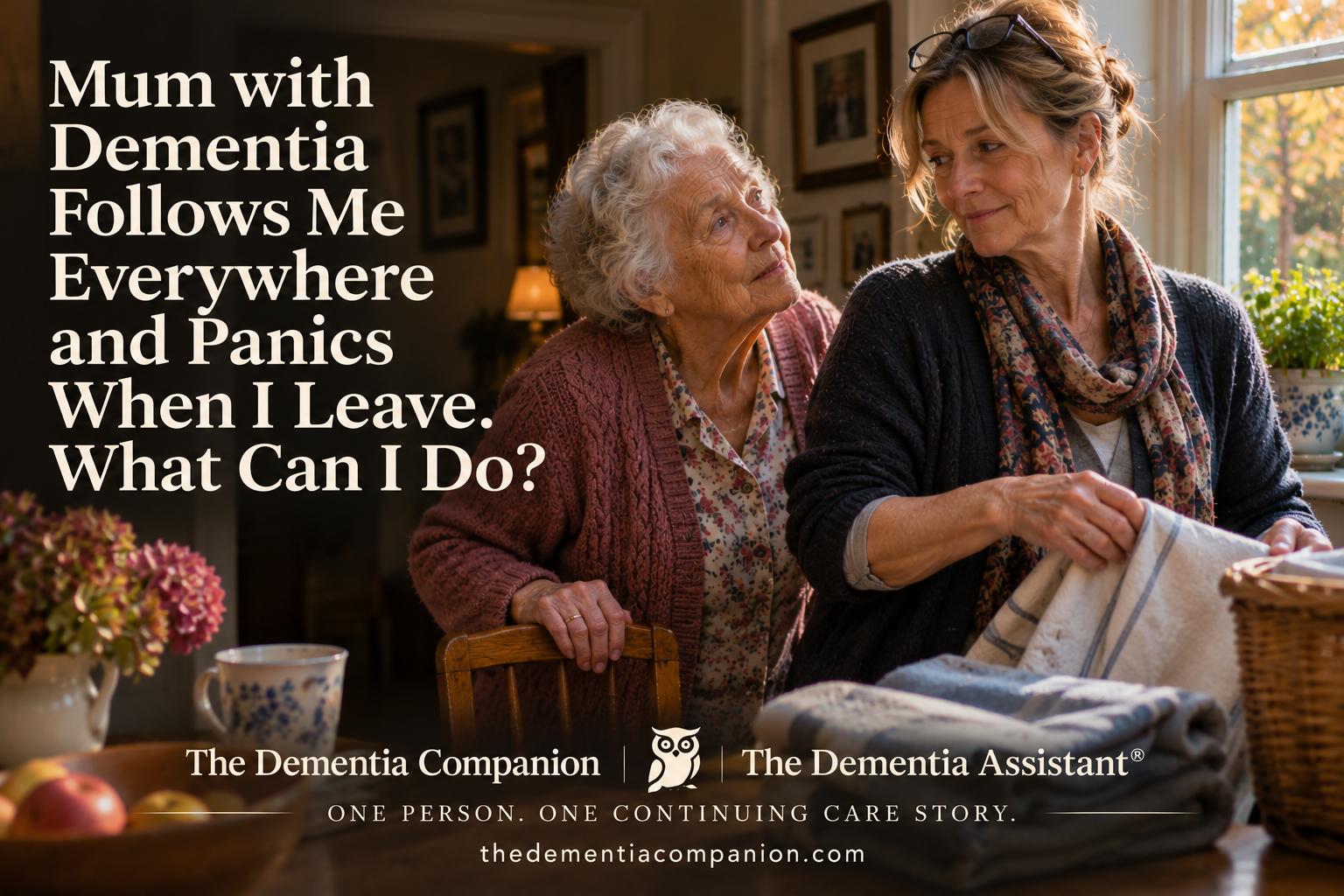
Mum with Dementia Follows Me Everywhere and Panics When I Leave. What Can I Do?
One Person. One Continuing Care Story. | Article 35 of 40
By Louise Donaghy, Dementia Practitioner, Founder of The Dementia Companion and The Dementia Assistant®, and Creator of Hugo Intelligence™.
You walk into the kitchen.
Mum follows.
You go upstairs to put the washing away.
Mum follows.
You pop into the bedroom to get something.
Mum appears in the doorway.
You go to the bathroom.
“Mum, I’ll only be a minute!”
“All right, love.”
Thirty seconds later:
“Are you still in there?”
You begin to wonder whether you should start charging admission for the grand tour of your own house.
And perhaps, on a good day, you both find it a little amusing.
But the reality can become exhausting.
You cannot make a cup of tea without Mum appearing beside you.
You cannot answer a telephone call privately.
You cannot put the washing away, have a shower or sit quietly with your own thoughts.
And when you need to leave the house, even for a short while, Mum becomes frightened.
“Where are you going?”
“Why can’t I come?”
“You’re not leaving me here, are you?”
You reassure her.
You explain.
You promise you’ll be back.
But as soon as you move towards the door, the worry returns.
And before long, you find yourself feeling guilty for wanting something as ordinary as half an hour alone.
So why does someone living with dementia follow a family member everywhere, and what can you do when they become frightened whenever you’re out of sight?
This experience is sometimes called shadowing.
It describes a person repeatedly following, checking on or wanting to remain close to somebody they trust.
Dementia can make the world feel confusing or unfamiliar. A familiar person may provide reassurance and a sense of safety.
When that person disappears from view, even briefly, anxiety may increase.
The most helpful approach is to understand what Mum is experiencing, look for possible unmet needs, provide reassurance and build familiar, safe routines that support both her wellbeing and your need for rest.
But please don’t assume that following someone is always caused by dementia.
Pain, illness, environmental changes, anxiety, loneliness or difficulties communicating may also contribute.
And one more thing.
Mum may not be trying to control where you go. She may simply be frightened of losing the person who helps her world make sense.
That is a very different way of looking at the situation.
What is shadowing in dementia?
The term shadowing describes a situation where a person living with dementia stays particularly close to another person, frequently follows them or checks where they are.
The Alzheimer’s Society also uses the terms trailing, following and checking.
For example, Mum may:
- Follow you from room to room.
- Become unsettled when she cannot see you.
- Call your name repeatedly.
- Stand beside you while you complete household tasks.
- Ask where you are going whenever you move.
- Become distressed when you leave the house.
- Look for you even when another familiar person is present.
Not everyone living with dementia experiences shadowing.
And it is not a diagnosis in itself.
The NHS explains that following a partner or carer may be connected with a need for reassurance that the person is safe and not alone.
Dementia Australia also recognises that shadowing may reflect anxiety or discomfort within the environment.
The important question isn’t simply:
“How do I stop Mum following me?”
It’s:
“What does Mum need when she feels she cannot let me out of her sight?”
That question brings us much closer to person-centred care.
Why does Mum become frightened when she can’t see me?
Imagine that you’re in an unfamiliar building.
You don’t know which room you’re in.
You aren’t completely sure why you’re there.
You remember that somebody you trust was standing beside you.
Then, suddenly, they’re gone.
You might start looking for them.
You might call out.
You might feel frightened.
And when you find them, you’d probably want to stay close.
Now imagine experiencing that uncertainty several times throughout the day.
For some people living with dementia, the familiar person is an important source of reassurance.
Mum may forget where you’ve gone
You tell Mum:
“I’m just going upstairs.”
She understands.
But a short time later, she may not remember what you said.
She notices you’re missing.
Her surroundings may suddenly feel less secure.
She begins searching.
When she finds you, she feels reassured.
Then the same thing may happen again.
This is not necessarily because your explanation was poor.
It may be difficult for her to retain it.
She may not feel confident in her surroundings
Sometimes dementia affects a person’s confidence in places that were once familiar.
A house may still look like home, but certain rooms, routines or objects may feel confusing.
Mum might feel more comfortable when you’re nearby because you help her interpret what’s happening.
She may also rely on you for decisions she once made independently.
She may be worried about being abandoned
For some people, separation can trigger genuine fear.
Perhaps Mum has experienced significant bereavement.
Perhaps she has recently moved home.
Perhaps her usual support arrangements have changed.
Or perhaps she cannot easily understand when someone will return.
These experiences may contribute, but we should never assume that a particular life event explains the behaviour without understanding the individual.
You may have become her main source of security
If you’re the person who helps Mum with appointments, meals, reassurance and everyday routines, she may naturally look to you when she feels uncertain.
You have become familiar and predictable.
That can be a wonderful part of a close relationship.
But it can also create an enormous burden when Mum feels unable to manage without you nearby.
Supporting Mum shouldn’t mean that you have to become her entire world.
Sometimes the most compassionate next step is helping her feel secure with other people and activities too.
Is shadowing the same as separation anxiety?
The experiences may overlap, but the terms are not identical.
Shadowing describes the observable behaviour of following or checking.
Separation anxiety describes distress associated with being apart from someone.
Not everybody who follows a family member is experiencing a diagnosable anxiety condition.
A person might follow because they want company, have forgotten where somebody went or need help with an everyday task.
Another person might experience significant distress whenever a trusted relative leaves.
If Mum appears persistently frightened, has severe anxiety or cannot tolerate ordinary separations, seek advice from her GP or an appropriate dementia specialist.
The aim is to understand what is happening, not apply a label and assume the explanation is complete.
What should I say when Mum follows me everywhere?
The words should be simple, reassuring and respectful.
You don’t need a complicated explanation.
And you certainly don’t need to turn every movement around the house into a formal announcement.
Although, after the fifteenth trip to the kitchen, you could be forgiven for considering a timetable.
If Mum follows you into another room
You might say:
“I’m just putting the washing away, Mum. Would you like to sit with me?”
Or:
“I’m here. You’re welcome to keep me company.”
If she enjoys being involved, perhaps she could help with an appropriate task.
The NHS suggests that including someone in ordinary household activities may be helpful when they repeatedly follow a carer.
If Mum asks where you’re going
Try:
“I’m just going into the kitchen.”
“I’ll be in the next room.”
“You can come with me if you’d like.”
Keep the explanation short.
If Mum can understand and retain the information, it may reassure her.
If she cannot remember it, repeating the same explanation more loudly is unlikely to help.
If Mum becomes frightened
You might say:
“You seem worried, Mum.”
“I’m here with you.”
“Would you like me to sit beside you?”
If gentle touch is something she enjoys, you might offer your hand.
But don’t automatically assume that physical contact will be comforting.
Her personal preferences and boundaries matter.
If Mum asks, “You’re not leaving me, are you?”
Rather than dismissing the concern, you could say:
“You don’t want to be on your own. I understand.”
“Let’s talk about what’s worrying you.”
“We’ll make sure you know who’s here with you.”
Don’t promise you will never leave.
That may be impossible to maintain.
Reassurance should be compassionate and realistic.
What if Mum follows me into the bathroom?
This may sound like a small issue.
It isn’t.
Everybody needs privacy.
And carers can find it particularly difficult when they have almost none.
You may feel that Mum doesn’t understand why you need a few minutes alone.
She may be frightened when the door closes.
Or she may simply want to remain nearby.
Try a calm, familiar explanation
You might say:
“Mum, I’m going into the bathroom. I’ll see you when I come out.”
If she’s comfortable and can safely wait, perhaps she could sit nearby with something she enjoys.
A familiar chair, music or a suitable activity may help.
If another trusted person is available, they might offer companionship.
But please don’t leave Mum unsupervised simply because you need privacy if doing so would expose her to serious risks.
This is where appropriate support arrangements matter.
Your right to privacy is real. Mum’s need for safety is real too. A sustainable care arrangement needs to respect both.
How can I help Mum feel secure when I leave the room?
For some people, predictable routines and familiar surroundings can help.
Try to observe what Mum actually finds reassuring.
Let her know where you’ll be
A short explanation may be enough.
“I’m going upstairs to get my jumper.”
If she can see the stairs and understands where you’re going, that might help her remain comfortable.
If she becomes worried, offer reassurance.
Create a familiar place to sit
Perhaps Mum enjoys sitting at the kitchen table.
Perhaps she prefers the living room.
Perhaps she likes watching the birds from a particular window.
Make sure the place is comfortable and safe.
Include familiar objects or activities that she genuinely enjoys.
But avoid expecting Mum to remain somewhere simply because you’ve told her to.
Invite her to join an activity
If she’s comfortable helping, perhaps she can fold towels, sort photographs, arrange flowers or participate in another familiar task.
The aim is meaningful involvement, not keeping Mum occupied so that she won’t notice you.
An activity should respect her abilities, interests and wishes.
Avoid disappearing without explanation as a routine strategy
It may be tempting to slip out when Mum isn’t looking.
Sometimes families do this because they’re afraid of upsetting her.
But if she then discovers that you’ve disappeared unexpectedly, it may increase fear or mistrust.
Where possible, use a calm, understandable explanation and arrange appropriate support.
The approach must reflect Mum’s ability to understand, the situation and any safety needs.
What if Mum panics when I leave the house?
This can be particularly difficult.
Perhaps you need to collect a prescription.
Perhaps you have an appointment.
Perhaps you simply want to meet a friend for coffee.
Mum becomes distressed as soon as she sees you reaching for your coat.
She may follow you to the door.
She may cry.
She may become angry.
Or she may insist on coming with you.
The first question is whether she can safely remain alone.
Assess whether being alone is appropriate
Consider Mum’s current abilities and needs.
Can she recognise and respond to emergencies?
Can she safely manage essential activities during your absence?
Is she at risk of falling, leaving the house, using unsafe appliances or becoming severely distressed?
Does she understand how to contact help?
Would a trusted person need to remain with her?
These questions require an individual assessment.
If Mum cannot safely remain alone, do not use brief separations as an experiment in independence.
Arrange appropriate supervision and support.
If she can safely manage short periods alone
Consider whether predictable, agreed arrangements might make separations easier.
You could explain where you’re going and when you expect to return, using words and reminders that suit Mum’s understanding.
For example:
“I’m going to collect something from the pharmacy. I’ll be back after lunch.”
If she finds reminders helpful, a familiar clock, calendar or short written note might provide reassurance.
But these only help when she can understand and use them.
Some people may gradually become more comfortable with short, planned separations.
Others may not.
Don’t continue an approach that repeatedly causes significant distress without seeking advice.
And don’t treat a professional anxiety treatment technique as something families must improvise themselves.
Can another family member or carer help?
Yes, and this can be an important part of developing more sustainable care.
Imagine Mum feels secure only when her daughter is present.
Her son visits, but she continues asking for her daughter.
A home carer arrives, but Mum refuses to stay with them.
The daughter feels unable to leave.
This doesn’t mean other relatives or carers are unsuitable.
It may mean that familiarity and trust need time to develop.
Introduce support through enjoyable activities
Perhaps Mum enjoys gardening.
A familiar relative might spend time with her in the garden.
Perhaps she enjoys a particular television programme.
Another person could join her for that.
Perhaps she likes talking about her childhood.
A visiting companion might begin by getting to know her life story.
The aim is to help Mum build comfortable relationships with other people.
Not to trick her into accepting care.
Keep introductions consistent
Regular visits from familiar people may be more reassuring than constantly changing arrangements.
Where possible, ask care providers for continuity.
Allow time for trust to develop.
Consider the person’s communication preferences, language and cultural identity.
And don’t assume the first unsuccessful visit means the arrangement can never work.
Share caring responsibilities realistically
Family members can sometimes divide responsibilities.
But this should reflect actual availability and capability.
If relatives cannot provide enough support, professional services may be needed.
The solution shouldn’t always be to ask the main carer to do even more.
What if Mum becomes jealous or angry when I spend time with somebody else?
This can be emotionally painful.
Perhaps Mum becomes upset when you talk to your partner.
Perhaps she interrupts conversations.
Perhaps she asks why you’re paying attention to somebody else.
It can feel as though you’re constantly being pulled in different directions.
But it is important not to assume that Mum is deliberately trying to control your relationships.
She may feel uncertain, frightened or unable to understand what’s happening.
Try including her where appropriate
If she enjoys the company, perhaps she can join a conversation or activity.
Introduce people clearly.
Explain what is happening.
Give her time to process the situation.
Respect private time too
Some conversations need to happen privately.
If Mum requires supervision, arrange for another suitable person to support her.
You should not have to abandon your relationships, work or personal wellbeing because caring responsibilities have become overwhelming.
Where those arrangements cannot currently be made safely, seek a care review.
What if the shadowing becomes worse in the evening?
Some people become more unsettled later in the day.
Fatigue, changes in lighting, disrupted routines and environmental demands may contribute.
But shadowing in the evening is not automatically sundowning.
Look at the circumstances.
Is Mum tired?
Is she hungry or thirsty?
Does she need the toilet?
Is the room noisy?
Has someone recently left?
Is she frightened by shadows or unfamiliar surroundings?
Could there be pain or another physical problem?
A predictable, comfortable evening routine may help some people.
Persistent or increasing distress should be discussed with an appropriate healthcare professional.
Don’t assume every evening difficulty is simply part of dementia.
What if Mum has suddenly started following me everywhere?
This deserves particular attention.
If Mum has been comfortable spending time alone and suddenly becomes frightened, unusually dependent or significantly more confused, consider whether something has changed in her health or environment.
Possible contributing factors may include:
- Pain or physical discomfort.
- Acute illness.
- Medication effects.
- Sleep problems.
- Sensory difficulties.
- A recent move or change in routine.
- Anxiety, depression or another emotional difficulty.
- Delirium or other acute medical problems.
NICE recommends assessing possible clinical and environmental causes of distress in dementia.
If there has been a gradual change, arrange a clinical review as appropriate.
If Mum suddenly becomes significantly confused or acutely unwell, seek urgent medical assessment.
In the UK, the NHS advises emergency assessment for sudden confusion, including calling 999 or attending A&E.
Elsewhere, follow the relevant local urgent or emergency healthcare guidance.
Hugo cannot diagnose the cause of sudden changes.
Does shadowing mean Mum’s dementia is getting worse?
Not necessarily.
Shadowing may occur at different stages and for different reasons.
It does not, by itself, establish dementia progression.
Some people become more anxious after changes in their environment or relationships.
Others may experience increased memory difficulties or need more reassurance.
Physical health and medication issues may also contribute.
If the behaviour is new, significantly worsening or interfering with everyday life, seek professional advice.
Record what has changed and what you have observed.
Avoid assuming that every new difficulty represents permanent decline.
Should Mum be given medication for anxiety?
Not automatically.
Anxiety in dementia deserves assessment.
The healthcare professional should consider possible physical, psychological and environmental causes.
NICE recommends psychosocial and environmental approaches as part of managing distress.
In appropriate circumstances, psychological treatment or medication may be considered by qualified professionals.
However, the suitability of any treatment depends on the individual’s needs, dementia type, other conditions, medicines and risks.
Do not give sedatives or over-the-counter calming products simply to stop Mum following you.
Some medicines can create additional risks, including drowsiness, falls or confusion.
Never change prescribed medicines without advice.
The aim is to understand and relieve distress, not simply suppress a behaviour that is inconvenient for somebody else.
What if I feel completely overwhelmed by Mum following me?
I want to spend some time on this because it’s important.
You can love somebody deeply and still find constant closeness overwhelming.
You may feel guilty because Mum is frightened.
You may feel guilty because you want to leave.
You may even feel guilty because you’re annoyed at being followed into the kitchen for the eighteenth time.
That’s an exhausting amount of guilt to carry.
But needing privacy doesn’t mean you love Mum any less.
Being a daughter, son, husband, wife or partner doesn’t remove your need for independence.
You may need time to work.
To rest.
To see friends.
To have a conversation without interruption.
Or simply to sit with a cup of tea and hear absolutely nothing for ten glorious minutes.
Ask for practical support
If Mum requires constant reassurance or supervision, the caring arrangements may need reviewing.
Consider whether family members, professional carers, companionship services or appropriate respite arrangements could help.
In England, an unpaid carer can ask the local council for a carer’s assessment.
Other UK nations and countries have different support pathways.
Tell professionals what you can realistically manage
It is important to describe the impact of the situation honestly.
For example:
“Mum becomes very distressed whenever I leave the room. I haven’t been able to leave her safely without another person for several weeks. I’m exhausted and need help reviewing her support.”
That’s useful information.
It explains both Mum’s needs and the sustainability of the current arrangement.
A person-centred approach doesn’t mean the family’s wellbeing becomes invisible.
What if Mum follows me so closely that somebody could fall?
Sometimes constant following creates a physical safety concern.
Perhaps Mum stands directly behind you while you’re cooking.
Perhaps she follows closely on the stairs.
Perhaps she tries to walk through a narrow doorway at the same time as you.
If she has mobility or balance difficulties, this may increase the risk of falls.
Consider how to make shared activities safer.
You might invite her to sit nearby while you prepare food.
Or encourage an appropriate task at the table.
If walking is difficult, a physiotherapist or occupational therapist may help assess mobility and the home environment.
Avoid physically pushing, restraining or confining Mum simply because she is following you.
If there is an immediate safety threat, seek appropriate help.
What if Mum is in hospital or a care home and follows staff?
Shadowing isn’t limited to family homes.
A person may become particularly attached to a familiar nurse, care worker or member of staff.
They may follow that person or become distressed when a shift changes.
This may be connected to unfamiliar surroundings, uncertainty or the comfort of a trusted relationship.
Relevant life history and communication information can help.
A care plan might explain:
“Margaret becomes anxious when she cannot identify a familiar person nearby. She benefits from calm introductions, clear explanations and knowing who will be supporting her.”
A provider can consider consistency, meaningful activities, reassurance and appropriate staff arrangements.
A family-held care plan can help communicate what has worked previously.
But it does not replace the provider’s own risk assessments, professional responsibilities or care records.
How can I record shadowing in Mum’s continuing care plan?
This is where ordinary family observations can become useful information.
Imagine Mum follows her daughter throughout the morning.
Her son notices that she becomes particularly frightened when somebody leaves the house.
A visiting carer discovers that she settles when involved in a familiar activity.
The GP wants to understand whether the distress has changed over time.
Each person holds a different piece of information.
Bringing those observations together can help everyone understand the pattern.
What might the family record?
What happens: Mum frequently follows her daughter between rooms and becomes distressed when she cannot see her.
When it happens: Particularly in the late afternoon and when familiar people leave.
How Mum appears: Worried, sometimes calling out or asking whether she has been left alone.
Possible contributing factors: Changes to routine, unfamiliar visitors, tiredness or other concerns requiring assessment.
What helps: Calm reassurance, familiar conversation, being included in comfortable activities and spending time with trusted people.
What hasn’t helped: Repeatedly saying “Stop following me” or leaving unexpectedly without a suitable support arrangement.
Mum’s preferences: Enjoys gardening, music and having familiar people nearby. Dislikes being rushed.
Safety considerations: Review of whether she can remain alone safely and whether constant following creates mobility risks.
Professional involvement: GP or dementia specialist review requested for persistent anxiety.
Review arrangements: Reconsider support following professional recommendations and changes in the family’s capacity to provide care.
This is a fictional example.
The details in a real care plan should reflect the actual person.
A useful daily note
“Tuesday, 3.15 pm. Margaret followed her daughter from the living room to the kitchen several times. She appeared worried when her daughter went upstairs. She settled while sitting nearby folding towels together. No physical illness was apparent during the visit. Family discussing persistent anxiety and support needs with the GP.”
This provides much more useful information than:
“Mum was clingy all afternoon.”
One describes the person’s experience and what appeared to help.
The other labels her.
And that difference matters.
Meet Hugo Intelligence™: looking beyond the behaviour
This is exactly the sort of everyday situation that inspired Hugo Intelligence™.
Hugo is the conversational, person-centred guidance system within The Dementia Assistant®, powered by Person-Centred Intelligence®.
Hugo stands for:
H — Human
U — Understanding
G — Guidance
O — One person at a time
He is represented by our owl mascot.
But Hugo isn’t intended to be another generic chatbot that simply provides an answer and ends the conversation.
His purpose is to help families and professionals explore dementia-related questions naturally, with the individual person’s circumstances at the centre.
Begin with the question you actually have
You might say:
“Hugo, Mum follows me absolutely everywhere. She panics when I leave the room, and I can’t even have a shower without her calling for me. I’m exhausted. What can I do?”
Hugo can help you explore general information about shadowing, anxiety, reassurance and possible unmet needs.
He can suggest things to consider, practical phrases to try and questions to raise with appropriate professionals.
He cannot know exactly what Mum is feeling.
But he can help you explore possibilities rather than jumping straight to conclusions.
Hugo can continue the conversation
You might explain:
“She doesn’t remember where I’ve gone.”
“She becomes particularly frightened in the evening.”
“She’s recently moved in with me.”
“She won’t stay with my brother.”
“She enjoys helping with the washing.”
“She gets upset when I put on my coat.”
“I need help arranging some time for myself.”
Hugo can respond to follow-up questions and help you think through the situation gradually.
You can ask for simpler explanations.
You can explore alternative approaches.
You can ask for words that feel natural rather than clinical.
And you can return to related questions later.
General Hugo: help without a care plan
You can ask Hugo general dementia questions without first creating a care plan.
For example:
“What does shadowing mean in dementia, and how can families respond?”
Hugo can offer general educational guidance and explain when professional assessment may be helpful.
Personalised Hugo: using the individual care plan you select
Now imagine the family has created a care plan for Margaret.
The plan includes her routines, communication preferences, meaningful activities, relationships, health information and previous observations.
When the user explicitly selects Margaret’s individual care plan, Hugo can use relevant information from that plan to offer more personalised educational guidance.
For example:
“Hugo, using Margaret’s care plan, help us explore how she could feel more comfortable when her daughter needs to leave for an appointment.”
Hugo can consider the relevant information recorded about Margaret’s preferences, her responses to different activities and existing support arrangements.
Hugo does not automatically access every care plan in an account.
The user must select the individual person’s plan.
Families supporting more than one person can maintain separate care plans.
And Hugo’s educational guidance must be reviewed against relevant professional advice where health, capacity, safeguarding or safety is involved.
The Care Planning Centre™ and guided Talk to Hugo
Many families know their loved one extremely well.
They know their favourite foods.
Their habits.
The things that upset them.
The people they trust.
But turning that knowledge into an organised care plan can feel overwhelming.
The Care Planning Centre™ helps people living with dementia and their families create, review and maintain individual person-centred care plans.
Through guided Talk to Hugo conversations, users can explore care-planning questions in everyday language.
For example:
“What makes Mum feel safe?”
“Who does she feel comfortable spending time with?”
“What activities does she enjoy?”
“What happens when someone leaves the room?”
“What support does she need during the day?”
“What has the GP recommended?”
“How should a new carer approach her?”
Relevant information can be organised into appropriate sections of the individual’s care plan, with the user reviewing what is recorded.
The platform also provides care-plan review tools, suggestions for missing information and help improving professional wording.
The aim is to make care planning accessible without requiring families to become professional care planners overnight.
One person, not a generic dementia template
Margaret’s plan should reflect Margaret.
Another person living with dementia might follow their spouse for completely different reasons.
Their life history may be different.
Their relationships may be different.
Their communication needs may be different.
Their support arrangements may be different.
That is why person-centred planning matters.
Daily notes: recognising the pattern over time
The Dementia Assistant® includes daily notes for recording relevant changes and observations.
This can help families see whether shadowing is connected to particular times, routines or circumstances.
For example:
Monday: Margaret became worried when her daughter went upstairs. She settled when they sat together.
Tuesday: Margaret enjoyed a familiar music activity with another relative and appeared comfortable while her daughter was nearby.
Wednesday: Margaret became distressed after an unexpected change to the afternoon routine.
Thursday: Margaret spent time gardening with a familiar companion and appeared content during the visit.
These examples are fictional.
They do not establish the cause of the behaviour.
But they show how factual observations may help families and professionals understand what is happening.
Records should include what the person enjoys and can still do, not simply difficulties.
Saved Hugo conversations, documents and exports
A family might begin with one question about Mum following them.
Later, they may want to discuss arranging companionship.
Then they may need help preparing questions for a GP appointment or reviewing the care plan.
Within The Dementia Assistant®, Hugo conversations can be saved, categorised and revisited.
This supports continuity in the family’s questions and guidance.
Saved AI conversations are not verified clinical records or professional instructions.
The platform also provides document organisation and applicable care-information exports, including PDF, Word, CSV and JSON.
Families can maintain their own information and share relevant details with authorised professionals, subject to consent, privacy and access arrangements.
The family-held care information complements professional records rather than replacing them.
Family Circle: sharing the responsibility for reassurance
In many families, one person gradually becomes the centre of everything.
Perhaps Mum has always relied on her daughter.
Perhaps her husband now provides most of the care.
Perhaps one relative lives close by while others live hundreds of miles away.
Different people may notice different things.
Family Circle supports appropriate communication between involved relatives.
This can help families exchange relevant updates and coordinate support.
For example, one relative might record that Mum enjoyed a particular activity.
Another might explain which introduction helped her feel comfortable.
A third may be able to provide companionship at a time when the main carer needs rest.
The person’s wishes, consent, privacy and permissions must always guide access.
And Family Circle is not a substitute for practical care.
If Mum needs another person physically present, a digital update alone cannot provide that supervision.
Life Story and Memory & Moments: understanding who makes Mum feel safe
There is a lifetime behind every close relationship.
Perhaps Mum has always been particularly close to her daughter.
Perhaps she and her husband spent decades doing everything together.
Perhaps she grew up in a large family where there was always somebody nearby.
Perhaps a particular song, photograph or familiar activity brings comfort.
The Life Story and Memory & Moments features within The Dementia Assistant® help preserve meaningful personal information.
This can include:
- Important relationships.
- Family history.
- Significant experiences.
- Interests and hobbies.
- Cultural identity.
- Favourite places.
- Familiar routines.
- Memories and activities that bring comfort.
This information may help relatives and professionals understand what makes Mum feel secure.
But it shouldn’t be used to assume that every familiar photograph or memory will be comforting.
Personal history can include painful experiences as well as happy ones.
The individual’s preferences and responses should guide how memories are used.
The goal is connection, not testing what somebody remembers.
Multilingual support: reassurance in the person’s preferred language
For multilingual families, language can be an important part of emotional reassurance.
Perhaps Mum prefers hearing a familiar expression in Welsh, Irish, Hindi, Spanish or another language.
Perhaps she communicates most comfortably in English but uses another language with particular relatives.
Perhaps family members live in different countries and need to share relevant information.
The Dementia Assistant® offers 12 interface languages, with dictation and translation capabilities spanning 201 languages.
These can help families communicate, record notes and organise information across languages.
Not every platform feature is available in all 201 languages.
And medical, legal, medication and other safety-critical information must be professionally verified when necessary.
Some people living with dementia experience changes in language use, but this varies between individuals.
We should never assume that everybody returns to a childhood language.
Ask which language and communication style the person prefers.
Sometimes a familiar phrase can communicate reassurance more naturally than a lengthy explanation.
Language is part of identity, and identity belongs within the continuing care story.
Dementia Academy™, crisis guidance and the Carer Wellbeing Hub
The Dementia Assistant® includes wider educational resources through the Dementia Academy™.
These help families and professionals explore dementia, practical support and person-centred communication.
The platform also includes educational crisis guidance to help users recognise situations requiring urgent or additional professional support.
Hugo is not an emergency response service.
He cannot physically supervise somebody, assess an acute medical condition or dispatch assistance.
When the carer needs support too
The Carer Wellbeing Hub recognises the emotional and practical pressure of caring.
And shadowing can be particularly draining.
You may feel responsible for Mum’s comfort every waking moment.
You may struggle to leave the house.
You may have stopped seeing friends.
You may feel guilty whenever you want a little time alone.
But the answer should not be to keep stretching yourself until you reach breaking point.
Ask for support.
Discuss respite arrangements.
Review whether Mum needs more companionship or supervision.
Speak with healthcare or social care professionals if the situation is no longer manageable.
Caring for someone doesn’t mean surrendering every part of your own life.
And helping Mum build a wider circle of familiar, trusted support may benefit both of you.
Ask Hugo: 17 questions families ask about dementia shadowing and separation anxiety
- Why does my mum with dementia follow me everywhere?
She may feel safer when you are nearby, forget where you have gone or need reassurance. Anxiety, environmental changes, loneliness or an unmet need may contribute. Shadowing describes the behaviour, not its confirmed cause.
- What is shadowing in dementia?
Shadowing is when a person repeatedly follows, checks on or stays close to someone they trust. It may include calling out whenever that person leaves the room. It is not a separate dementia diagnosis.
- Is Mum deliberately trying to stop me leaving?
Not necessarily. She may genuinely feel frightened or uncertain when you are out of sight. Listen to what she says and observe her response rather than assuming she is deliberately controlling your movements.
- What should I say when Mum follows me from room to room?
Try a calm, simple explanation, such as “I’m going into the kitchen. Would you like to come with me?” If she enjoys participating in a familiar activity, consider inviting her to join you safely.
- Why does Mum panic when I put on my coat?
She may associate your coat with you leaving and becoming unavailable. She might not understand when you will return. Explore whether she needs reassurance, familiar companionship or additional support during your absence.
- Should I sneak out while Mum isn’t looking?
Avoid making unexpected disappearance your usual approach. It may increase distress or mistrust. Where possible, explain the arrangement calmly and ensure suitable support. The approach depends on her understanding and safety needs.
- Can Mum learn to feel comfortable when I’m not there?
Some people may become more comfortable with predictable routines and familiar alternative carers. Others continue to need significant reassurance or supervision. Don’t force separations or continue approaches that cause severe distress without professional advice.
- What if Mum follows me into the bathroom?
Your privacy matters. Try a short explanation and a familiar activity, or arrange for another suitable person to offer companionship. If Mum cannot safely remain alone, review support arrangements rather than leaving her at risk.
- Is shadowing a sign that dementia is getting worse?
Not by itself. Shadowing can have several explanations. New or worsening distress should prompt consideration of health, medication, environment and support needs, with medical assessment when appropriate.
- What if Mum follows me more in the evening?
Look for patterns involving tiredness, lighting, changing routines, hunger, discomfort or anxiety. It may overlap with evening distress, but do not automatically assume it is sundowning.
- Could Mum be in pain or unwell?
Yes. Physical discomfort or illness can contribute to distress. Sudden changes, new symptoms or markedly increased confusion need appropriate clinical assessment. Sudden confusion may require emergency care.
- Should we give Mum medication to stop the anxiety?
Medication should never be the automatic response. A clinician should consider the causes, potential benefits and risks, and appropriate non-drug support. Do not start sedatives or change prescribed medicines independently.
- What if Mum won’t stay with another family member?
Consider whether the person is familiar, whether the introduction is comfortable and what activities Mum enjoys. Trust may develop through regular, positive contact. If significant distress persists, seek professional support.
- Can someone with dementia safely be left alone?
That depends on the person’s individual abilities, environment, health and safety risks. A dementia diagnosis or shadowing alone does not decide the answer. When there are concerns, request an appropriate care and safety assessment.
- How do I cope when I never get a moment to myself?
Seek practical support rather than relying solely on coping strategies. Discuss shared care, respite, companionship and a carers’ assessment where available. Your health and ability to provide sustainable care matter.
- Can Hugo help us find an approach suited to Mum?
Yes. Hugo provides general educational guidance and continuing conversations. When you explicitly select Mum’s individual care plan, Hugo can use relevant information from that plan to offer more personalised suggestions. He cannot diagnose anxiety, establish safety or replace professional assessment.
- How can we keep information about Mum’s anxiety and reassurance needs together?
The Dementia Assistant® supports individual person-centred care plans, daily notes, saved and categorised Hugo conversations, document organisation and appropriate updates through Family Circle. Relevant information can be shared with authorised professionals, respecting privacy and consent.
One Person. One Continuing Care Story.
Different professionals. Different services. One person. One continuing story.
Imagine Mum begins following her daughter everywhere.
At first, it seems like an ordinary change in her behaviour.
Then she starts becoming distressed when her daughter leaves the house.
The family asks the GP for advice.
A dementia specialist considers whether anxiety or another issue may be contributing.
Perhaps an occupational therapist assesses the home environment and daily routines.
A visiting carer begins providing companionship.
Later, the family introduces additional support.
Over time, Mum’s needs may change again.
Different professionals become involved.
Different services maintain their own records.
But Mum remains the same individual.
The same woman with a lifetime of relationships, routines, preferences, experiences and wishes.
Her continuing story should not disappear every time somebody new becomes involved.
The family should have its own continuing care information
This is the central principle behind The Dementia Assistant®.
The person living with dementia, and their family where appropriate, can maintain their own individual care information independently of any single care provider.
They can begin with the first concerns about memory.
Their care plan can continue through GP appointments, memory assessments, diagnosis and everyday life with dementia.
As needs change, it can develop through home care, hospital admissions, rehabilitation, residential care and palliative or end-of-life support when relevant.
The information remains within their own continuing care-planning environment.
One person. One individual life story.
Mum’s care plan shouldn’t simply record:
“Follows daughter constantly.”
It should help others understand:
Who Mum trusts.
What makes her feel safe.
Which activities she enjoys.
How she prefers to communicate.
What causes distress.
What has helped before.
What she can still do independently.
What support has been recommended.
And what matters most to her.
That information can help the next professional or carer approach Mum with greater understanding.
A care plan should change as needs change
Perhaps Mum can comfortably spend an afternoon with another trusted relative today.
In six months, she may need a different approach.
Perhaps she becomes more independent with familiar support.
Perhaps her needs increase.
The care plan should reflect those changes.
It must never become a document completed once and left untouched.
One individual care plan. One continuing story that develops with the person.
The person and family maintain their own record
The Dementia Assistant® does not replace medical records, professional assessments, statutory care plans or legally authorised decisions.
It complements them.
Different organisations may maintain separate clinical and professional records.
But the person or family can maintain their own continuing picture of what matters.
Appropriate information can be shared with professionals when needed, subject to the person’s wishes, consent, privacy, permissions and relevant law.
This can help avoid beginning the same story from scratch every time care arrangements change.
Different professionals. Different services. One person. One continuing story.
That isn’t simply a campaign slogan.
It explains why The Dementia Assistant® exists.
A gentle invitation to meet Hugo
If Mum follows you everywhere, you may be wondering how to help her feel secure without losing every moment of your own independence.
You might not know whether the behaviour is caused by memory difficulties, anxiety, loneliness or another need.
You might simply be exhausted.
You can begin by asking Hugo.
Explain what is happening.
Describe when Mum becomes worried.
Talk through what you’ve already tried.
Ask for practical words to use.
Explore questions for the GP, dementia specialist or care provider.
And when you choose to create and explicitly select Mum’s individual care plan, Hugo can help you explore her circumstances using relevant information from that plan.
The Dementia Companion is our public educational home for practical dementia articles, family guidance and Ask Hugo resources.
The Dementia Assistant® is our interactive platform where families can continue their conversations with Hugo Intelligence™, create individual care plans, save and categorise guidance, record daily notes, organise documents, preserve Life Story and Memory & Moments information, and stay appropriately connected through Family Circle.
The platform also includes multilingual support, the Dementia Academy™, educational crisis guidance and the Carer Wellbeing Hub.
All subscriptions include a 30-day complimentary trial.
The UK Family subscription costs £4.99 per month after the trial.
International prices are available through the platform.
Explore practical dementia guidance:
https://thedementiacompanion.com/
Meet Hugo and explore The Dementia Assistant®:
https://thedementiaassistant.com/
Hugo provides educational guidance, not medical diagnosis, prescribing, emergency intervention, physical supervision, statutory assessments or legally binding decisions.
One final thought
The next time Mum follows you into the kitchen, try to remember what your presence may represent.
Familiarity.
Security.
A trusted voice.
Somebody who helps her understand what’s happening.
Perhaps she isn’t following because she wants to interrupt your day.
Perhaps she is following because, at that moment, being near you makes her feel safe.
But I also want you to remember something about yourself.
You are allowed to need space.
You are allowed to have a life beyond caring.
You are allowed to say that the current arrangements are becoming too much.
And you are allowed to ask for help.
The solution isn’t to make Mum feel abandoned.
It’s to understand what she needs and develop support that doesn’t depend entirely on one exhausted person.
Sometimes the smallest changes help.
A familiar activity.
A calm explanation.
A trusted companion.
A little reassurance.
And sometimes more substantial professional support is needed.
Because good dementia care is not about making someone stop following.
It’s about helping them feel secure enough that they don’t always need to.
One person.
One individual life story.
One continuing care plan.
And a family supported along the way.
With love,
Louise and Hugo ❤️🦉
Louise Donaghy
Founder & CEO of The Dementia Assistant®
Created and powered by Person-Centred Intelligence®
Creator of Hugo Intelligence™
⸻
Continue exploring with The Dementia Companion
Dementia Communication Tips for Carers
https://thedementiacompanion.com/articles/dementia-communication-tips/
How to Support a Parent with Dementia
https://thedementiacompanion.com/articles/how-to-support-a-parent-with-dementia/
Dementia Care: Person-Centred Support
https://thedementiacompanion.com/dementia-care/
The Dementia Companion Wellbeing Hub
https://thedementiacompanion.com/wellbeing-hub
Ask Hugo: Practical Dementia Questions
https://thedementiacompanion.com/ask-hugo/
Inside The Dementia Assistant®
https://thedementiacompanion.com/inside-the-app/
References and authoritative guidance
1. Alzheimer’s Society (UK). Trailing, following, checking and dementia. Explains why someone may follow a trusted person and seek reassurance.
https://www.alzheimers.org.uk/about-dementia/stages-and-symptoms/dementia-symptoms/trailing-checking
2. NHS (UK). Coping with dementia behaviour changes. Includes following a partner or carer, communication and practical reassurance.
https://www.nhs.uk/conditions/dementia/living-with-dementia/behaviour/
3. Dementia Australia. Shadowing. Guidance on following, anxiety, reassurance and support for carers.
https://www.dementia.org.au/living-dementia/mood-and-behaviour-changes/shadowing
4. Dementia UK. Managing anxiety in a person living with dementia.
https://www.dementiauk.org/information-and-support/health-advice/managing-anxiety/
5. Alzheimer’s Society (UK). Anxiety and dementia.
https://www.alzheimers.org.uk/about-dementia/stages-and-symptoms/anxiety-dementia
6. NICE (UK). Dementia: assessment, management and support for people living with dementia and their carers, NG97. Includes recommendations for assessing distress and person-centred interventions.
https://www.nice.org.uk/guidance/ng97/chapter/recommendations
7. Alzheimer’s Association (USA). Anxiety and agitation. Includes possible causes, reassurance and supportive approaches.
https://www.alz.org/help-support/caregiving/stages-behaviors/anxiety-agitation
8. Alzheimer Society of Alberta and Northwest Territories (Canada). Frequently asked questions. Includes situations where a person follows a spouse or carer.
https://www.alzheimer.ca/ab/en/about-dementia/what-dementia/common-questions-about-dementia/frequently-asked-questions
9. Alzheimer Society of Canada. Communication with people living with dementia.
https://www.alzheimer.ca/en/help-information/i-have-friend-or-family-member-who-lives-dementia/communicating-people-living
10. Healthdirect Australia. How to care for someone with dementia at home. Includes following carers, communication and safety.
https://www.healthdirect.gov.au/conditions/dementia/how-to-care-for-someone-with-dementia-at-home
11. Alzheimer Society of Ireland. Services and support that may help families and carers.
https://alzheimer.ie/living-with-dementia/i-am-a-carer-family-member/services-and-support-that-may-help/
12. NHS (England). Carer’s assessments.
https://www.nhs.uk/social-care-and-support/support-and-benefits-for-carers/carer-assessments/
13. NHS (England). Carers’ breaks and respite care.
https://www.nhs.uk/social-care-and-support/support-and-benefits-for-carers/carer-breaks-and-respite-care/
14. NHS (UK). Sudden confusion (delirium).
https://www.nhs.uk/symptoms/confusion/
Editorial and safety note: This article provides general educational guidance. Shadowing does not automatically establish a specific anxiety disorder, dementia stage or loss of decision-making ability. New or worsening distress, medical changes and safety concerns need appropriate professional assessment. Clinical and legal arrangements differ between jurisdictions. All family examples are fictional.
You May Also Find Helpful
Need help with your own situation? Ask Hugo.
One Person. One Continuing Care Story. The Dementia Companion is where you discover guidance. Inside The Dementia Assistant®, talk with Hugo, save and categorise conversations, record daily notes and involve authorised supporters in a continuing care plan centred around the person.
Ask Hugo About This · Start Your Continuing Care Plan — Families · Continuing Care Planning — Professionals
Personal guidance requires the appropriate account and subscription access. Care-plan information is used only with authorised access and the required consent and selection steps. All subscription plans include a 30-day complimentary trial.