Why Is Dad Becoming Angry or Aggressive With Dementia, and What Can We Do?
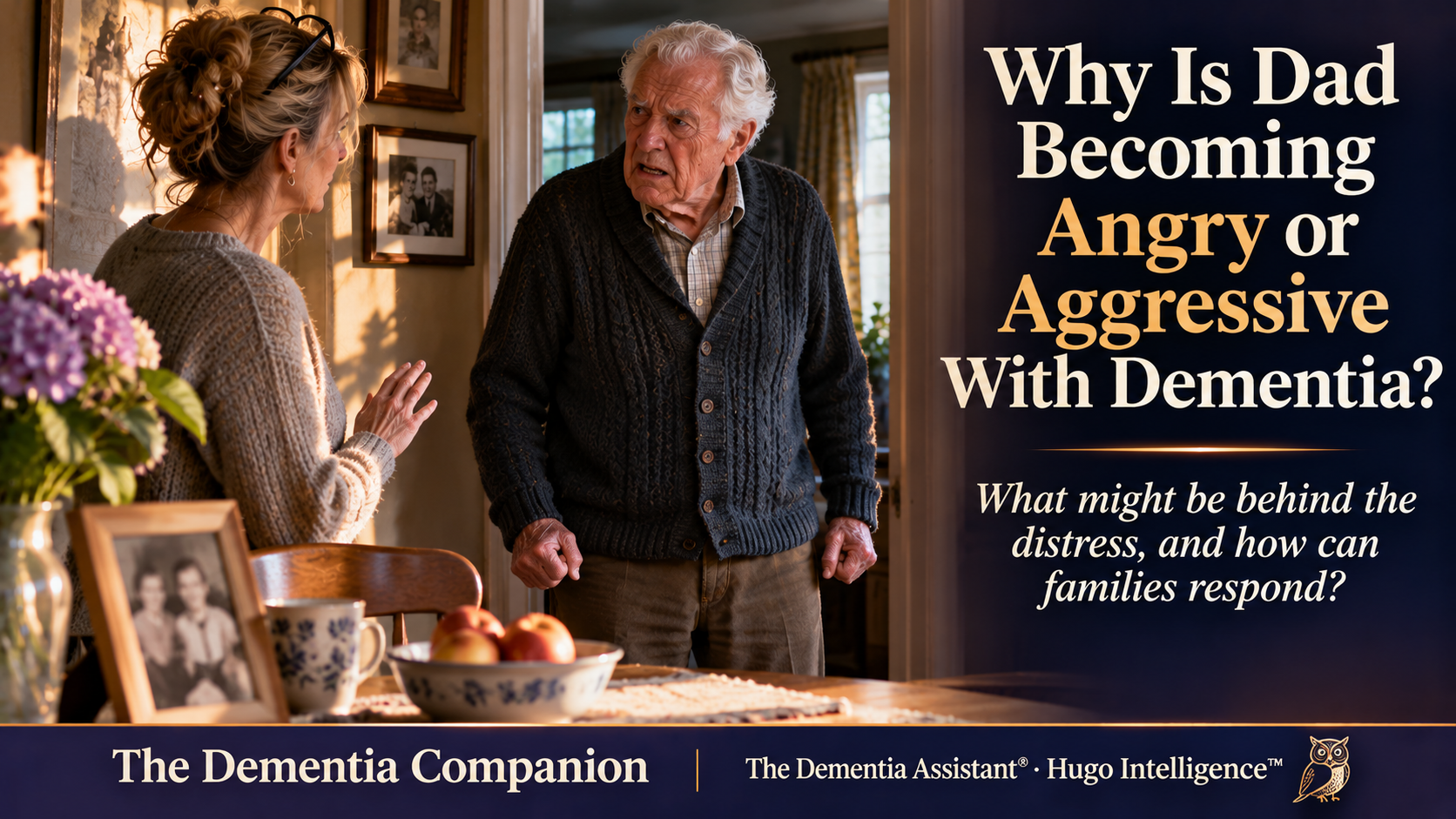
Why Is Dad Becoming Angry or Aggressive With Dementia, and What Can We Do?
When someone you love starts shouting, accusing or lashing out, it can be frightening and heartbreaking. But before we see the aggression, we need to understand the person, what might be causing their distress and how everyone can remain safe.
By Louise Donaghy, Dementia Practitioner, Founder of The Dementia Companion and The Dementia Assistant®, Creator of Hugo Intelligence™
“He was never like this before.”
It’s a sentence families sometimes say very quietly.
Perhaps Dad has started shouting when you try to help him.
Perhaps he becomes angry when you remind him about an appointment.
Perhaps he has begun accusing you of interfering with his belongings.
Or perhaps something happened yesterday that frightened you.
You reached out to help him put on his jacket.
He suddenly pushed your hand away.
Raised his voice.
And told you to leave him alone.
You stood there wondering what you’d done wrong.
Because this is Dad.
The man who taught you to ride a bicycle.
Who could fix practically anything with a screwdriver, a roll of tape and a level of confidence that wasn’t always justified.
The man who made everyone laugh at family gatherings.
And now there are moments when he seems frightened, frustrated or angry, sometimes towards the very people trying hardest to help him.
You might find yourself thinking:
Does he hate me?
Is the dementia changing his personality?
Am I making things worse?
What if he hurts someone?
These are difficult questions, and families deserve answers that are practical, compassionate and honest.
Anger or aggression in someone living with dementia can have several possible causes, including pain, fear, frustration, difficulty communicating, changes in the environment or changes in how the brain processes information.
It may also indicate an illness or another health problem that needs assessment.
But not every person living with dementia becomes aggressive, and we should never assume that aggression is inevitable or that every incident has the same explanation.
The most useful starting point is to protect everyone’s safety, consider what the person may be experiencing and seek appropriate support to understand what is happening.
Because recognising distress is important.
But so is protecting the person living with dementia and the people around them.
Why does someone with dementia become angry or aggressive?
The first thing to understand is that anger doesn’t always mean somebody is deliberately trying to cause distress.
Dementia can affect memory, perception, communication, judgement and emotional regulation.
A person may have difficulty understanding what is happening.
They may struggle to explain discomfort.
They may feel overwhelmed by questions or unfamiliar situations.
Or they may believe that somebody is interfering with something important to them.
Imagine Dad has always been independent.
He’s managed his own home for decades.
He’s chosen his clothes.
Handled his own finances.
Decided when he gets up, what he eats and where he goes.
Then, gradually, other people begin stepping in.
They remind him what to do.
Correct him when he’s mistaken.
Move his belongings.
Help him with personal care.
And sometimes make decisions before he’s had the opportunity to express what he wants.
Some of that assistance may be necessary.
But imagine how it might feel if you didn’t always understand why it was happening.
Perhaps the anger is partly about feeling that control is slipping away.
Perhaps it’s fear.
Perhaps it’s frustration.
Or perhaps something completely different is happening.
Behaviour can be a form of communication, especially when someone finds it difficult to explain what they need.
But we should never assume we know exactly what that communication means.
The person’s experience needs to be explored individually.
Could Dad be angry because he’s in pain?
Absolutely.
And this is one of the most important possibilities to consider.
Someone living with dementia may have difficulty identifying, describing or communicating pain.
Perhaps Dad has arthritis.
Perhaps his shoulder hurts when somebody helps him dress.
Perhaps he’s constipated.
Perhaps his dentures are uncomfortable.
Perhaps he’s experiencing a urinary problem, another illness or an unwanted medication effect.
He may not say:
“My shoulder hurts when you lift my arm.”
Instead, he might pull away, shout or refuse assistance.
That doesn’t automatically establish pain as the cause.
But it makes physical comfort an important part of understanding the situation.
NICE guidance recommends checking for clinical and environmental causes when someone living with dementia experiences distress, including pain, delirium and inappropriate care.
Dementia UK and Alzheimer’s Society also emphasise that physical discomfort and illness may contribute to changes in behaviour.
What should families look for?
Consider:
- Has Dad recently complained of pain?
- Does he seem uncomfortable when moving?
- Does he react when a particular area is touched?
- Has his appetite or sleep changed?
- Is he having difficulty using the toilet?
- Has medication recently changed?
- Does he appear generally unwell?
- Is the anger new or very different from his usual behaviour?
If you notice concerning changes, contact the GP or appropriate healthcare professional.
Don’t diagnose the cause yourself.
And don’t assume that because Dad has dementia, discomfort is simply something everybody must learn to live with.
A person living with dementia still deserves proper assessment and treatment for other health problems.
What if Dad suddenly becomes aggressive when he has never been like this before?
A sudden change needs particular attention.
If someone becomes abruptly confused, unusually agitated, distressed or markedly different from their normal presentation, they may be experiencing an acute medical problem.
One possibility is delirium, which can occur alongside dementia.
Other causes may include pain, illness, dehydration, medication effects or other urgent health conditions.
Delirium can develop quickly and requires prompt medical assessment.
In the UK, the NHS advises calling 999 for sudden confusion.
In the United States, seek emergency medical care for severe sudden confusion or an immediate medical emergency, using 911 when appropriate.
In other countries, contact the relevant emergency medical service.
Do not assume that a sudden change is simply dementia progressing.
And do not wait several days collecting observations if Dad appears acutely unwell.
Hugo can help explain general information and prepare questions.
But he cannot assess an emergency, diagnose delirium or determine whether somebody is medically safe.
When urgent assessment is needed, healthcare comes first.
What should I do when Dad becomes angry in the moment?
This is where a few practical changes may help.
But first, an important distinction.
If Dad is shouting but nobody is in immediate danger, a calm, person-centred response may help reduce distress. If there is a threat of physical harm, safety comes first.
You do not have to remain in danger to demonstrate patience or compassion.
- Stop what you’re doing
If you’re helping Dad with a task and he becomes distressed, consider whether the task can safely be paused.
Perhaps you’re helping him put on his coat.
He pulls away.
Raises his voice.
And tells you to stop.
Rather than continuing to dress him, you might say:
“All right, Dad. We can leave the coat for a moment.”
Sometimes stopping the immediate demand creates space for the person to settle.
- Give him physical space
Avoid crowding him.
Don’t stand over him.
Try not to block his way or make him feel trapped.
Keep your movements calm and non-threatening.
If he’s clearly upset, touching his arm or trying to hug him may not be welcome.
Someone who usually enjoys physical affection might feel differently when frightened or overwhelmed.
Ask before touching where possible.
- Keep your voice gentle and your words simple
When somebody raises their voice, it’s natural to respond more loudly.
Especially if they’re accusing you of something upsetting.
But escalating the volume can make communication more difficult.
Try:
“Dad, I can see you’re upset. I’m listening.”
Or:
“Let’s leave this for now.”
Or:
“Would you like a little space?”
Don’t deliver a long explanation while the person is distressed.
Short, respectful phrases may be easier to understand.
- Avoid arguing about who’s right
Perhaps Dad believes you’ve moved his wallet.
You haven’t.
You know you haven’t.
And you’re tempted to explain exactly where he left it, complete with evidence.
But if he’s frightened or upset, proving your innocence may not help in that moment.
You could say:
“I can see you’re worried about your wallet. Shall we look for it together when you’re ready?”
You’re acknowledging the concern without confirming an accusation that hasn’t been established.
- Offer a comfortable next step
If it’s safe and appropriate, consider something familiar.
A quieter room.
A favourite chair.
A drink.
A familiar activity.
Or simply time alone.
But don’t assume distraction will always work.
Sometimes the person needs medical attention.
Sometimes they need a change in the way care is being offered.
And sometimes the situation requires additional professional support.
There is no single phrase that stops aggression in every person living with dementia.
The aim is to understand the individual and respond appropriately.
What if Dad becomes physically aggressive?
This deserves a clear answer.
If Dad is attempting to hit, push, grab or otherwise hurt someone, prioritise immediate safety.
Where possible:
- Step back and create distance.
- Avoid arguing, confronting or cornering him.
- Move children and other vulnerable people away from danger.
- Leave the immediate area if you can do so safely.
- Do not try to physically restrain him unless an immediate emergency makes action unavoidable and it is safe and lawful to do so.
- Call emergency services if anyone is in immediate danger.
In the UK, call 999 for an immediate emergency.
In the USA, call 911.
Elsewhere, use your local emergency number.
Tell responders that the person has dementia, describe what is happening and explain any immediate medical concerns.
It is possible to recognise that someone may be frightened or distressed while also recognising that their behaviour is dangerous.
Compassion does not require anyone to accept violence.
And having dementia does not mean injuries or threats should be ignored.
If there have been repeated episodes of physical aggression, seek professional help to review the situation and plan safer support.
If you are frightened of what may happen when you’re alone, discuss that with the appropriate services.
Your safety matters too.
Why does Dad become angry when I try to help him wash or get dressed?
Personal care can be an especially sensitive situation.
Think about what it involves.
Someone enters your private space.
They may ask you to remove clothing.
They may touch your body.
They may hurry you.
And they may be doing all this when you don’t fully understand why assistance is needed.
For someone who has always valued independence and privacy, this can feel uncomfortable or frightening.
Sometimes the support is necessary.
But the approach may need changing.
Perhaps Dad prefers a male carer.
Perhaps he dislikes being rushed.
Perhaps he would rather wash in the evening.
Perhaps he can manage some parts independently.
Perhaps a particular movement causes pain.
You might ask:
“Dad, would you like to wash your face yourself while I get the towel ready?”
Or:
“Would you prefer to get dressed after breakfast?”
Offer manageable choices.
Explain what you’re doing.
Preserve privacy.
Allow time.
If he becomes distressed, pause when safe to do so.
For essential hygiene or health needs that remain unmet, seek professional guidance about an appropriate, individualised approach.
The aim isn’t simply to complete the task. It’s to support the person with dignity.
Why does Dad seem angrier with me than with visitors?
This can be particularly painful.
Perhaps Dad shouts at you regularly.
Then the neighbour visits.
Suddenly he’s smiling.
Chatting.
Asking about the garden.
And looking perfectly content.
The neighbour leaves and says:
“He seems absolutely fine to me.”
You stand there wondering whether you’re living in a different house.
There are several possible explanations.
The person may find short social visits less demanding than daily care.
Certain tasks may create stress.
Fatigue may affect them later in the day.
Different environments or communication styles may influence how comfortable they feel.
Or the visitor may simply not be present during the difficult moments.
But we shouldn’t assume that every family experiences the same pattern.
And we shouldn’t dismiss repeated distress just because somebody appears settled during a brief appointment.
A factual record can help professionals understand the broader picture.
You might explain:
“Dad is usually sociable during visits. However, he has become distressed during personal care on several mornings. We’ve recorded what happened and would like help understanding whether pain or another problem is contributing.”
That’s not criticising Dad.
It’s giving professionals useful information.
What if Dad says cruel things he has never said before?
This can hurt more than people sometimes realise.
Perhaps Dad tells you he doesn’t want you in his house.
Perhaps he says you never help him.
Perhaps he accuses you of being selfish.
And perhaps those words stay with you long after he has settled.
You may understand intellectually that dementia can affect emotions, communication and behaviour.
But understanding that doesn’t automatically stop the words from hurting.
You are allowed to feel upset.
You are allowed to step away when necessary.
And you are allowed to seek support.
Try not to argue about your relationship during the most distressed moments.
Instead, prioritise calm and safety.
When Dad is comfortable, you may be able to reconnect through something familiar.
A cup of tea.
A shared photograph.
A conversation about the garden.
Or a favourite activity.
Not every difficult moment needs to be followed by a long discussion about what was said.
And not every family will find the same approach helpful.
The person living with dementia deserves understanding. The family member receiving the anger deserves understanding too.
What if Dad’s anger is caused by something in the environment?
Our surroundings can affect how comfortable we feel.
Perhaps the television is too loud.
Several people are talking.
The room is hot.
A new carer has arrived.
Or Dad is being asked to complete three tasks at once.
He may be finding it difficult to process everything happening around him.
Consider whether there are patterns.
Does the distress occur during particular activities?
At certain times of day?
When the room is busy?
When unfamiliar people arrive?
When he is tired?
Or when somebody interrupts a familiar routine?
Sometimes an adjustment helps.
Less noise.
More time.
A familiar person.
Clearer explanations.
Or a different approach to care.
Dementia Australia’s guidance on changed behaviour encourages families to consider communication, activity, unmet needs, personal history, environment and dementia-related changes.
That is a useful reminder.
We shouldn’t examine the person in isolation from the world around them.
What should I say when Dad is angry?
There are no perfect scripts.
And we should never force everybody with dementia to respond to identical phrases.
But here are some examples families can adapt.
When Dad says, “Leave me alone!”
You might say:
“All right, Dad. I’ll give you some space. I’m nearby if you need me.”
When Dad says, “You’re always telling me what to do!”
You might respond:
“I don’t want you to feel pushed. What would you prefer?”
When Dad shouts because he cannot find something
Try:
“You seem worried. Let’s see whether we can find it.”
When Dad doesn’t want assistance with dressing
You might say:
“That’s all right. We can take our time. Would you like to do this part yourself?”
When Dad becomes frightened by an unfamiliar person
You could introduce the person calmly:
“Dad, this is Sarah. She’s here to help us today. Would you like to sit together for a moment first?”
When Dad becomes upset because he’s struggling with a task
Try:
“This feels frustrating, doesn’t it? Shall we work through it together?”
And sometimes the most respectful response is simply to stop talking.
Give him time.
Let the situation settle.
Listening isn’t always about finding more words. Sometimes it’s about creating enough space for the person to feel heard.
What should we record after an episode of aggression?
This is where families can begin to build a clearer understanding.
Not by labelling Dad as difficult.
Not by writing that he was deliberately causing trouble.
But by recording what actually happened.
A short factual account may include:
What happened beforehand?
Was Dad being helped with dressing?
Had someone arrived unexpectedly?
Was there noise or activity?
What did Dad say or do?
Describe the behaviour, rather than making assumptions about his intentions.
How did he appear?
Was he frightened, tearful, uncomfortable or visibly distressed?
Include observations, not unsupported diagnoses.
How did the family or carer respond?
Did someone pause the task?
Offer space?
Call for help?
What happened afterwards?
Did Dad settle?
Was someone injured?
Was professional advice sought?
Were there possible health concerns?
Record any reported pain, recent illness, medication changes or other relevant information.
A fictional example
“Monday, approximately 8.30am: Dad was being helped to put on his jumper. He shouted, ‘Stop pulling my arm,’ and pushed the helper’s hand away. Assistance was paused and Dad was given space. He settled after several minutes. Later, Dad said his shoulder was sore. GP contacted for advice about the pain and change in behaviour.”
That’s helpful.
It identifies what happened.
It includes Dad’s own words.
And it raises a possible physical concern without pretending to know the cause.
Now compare that with:
“Dad was aggressive and uncooperative again.”
The second version tells us very little.
It doesn’t explain what happened.
It doesn’t reflect Dad’s experience.
And it may lead people to approach him with an unfair expectation before they’ve even met him.
Person-centred documentation should help us understand someone, not reduce them to a behaviour.
When should we seek professional help for aggression in dementia?
Seek professional advice when aggression is new, persistent, increasing, causing distress or creating safety concerns.
A GP or relevant dementia specialist may consider:
- Pain or physical illness.
- Delirium or other acute changes.
- Medication effects.
- Sleep difficulties.
- Anxiety, depression or other mental health concerns.
- Communication needs.
- Environmental factors.
- Whether the current care arrangements are suitable.
- Whether specialist dementia or mental health assessment is needed.
NICE recommends structured assessment of distress before treatment, looking for clinical and environmental causes.
Depending on the circumstances, involvement from a community mental health team, old-age psychiatrist, dementia specialist nurse or other professional may be appropriate.
Don’t wait until a family member is injured before explaining that the situation has become difficult.
And if you are frightened, say so clearly.
Professionals need to understand both the person’s distress and the impact on those providing care.
Will medication help with aggression in dementia?
Sometimes medication may be considered, but it requires careful individual assessment.
It should not be the automatic response to anger or distress.
NICE recommends psychosocial and environmental approaches as part of initial and ongoing management.
Antipsychotic medicines carry significant risks for people living with dementia.
In UK guidance, they should be considered only in specific circumstances, such as a risk of harm or severe distress associated with agitation, hallucinations or delusions, following appropriate assessment.
They should be used cautiously, at the lowest effective dose for the shortest appropriate time, with regular review.
Certain types of dementia, particularly dementia with Lewy bodies and Parkinson’s disease dementia, can involve severe sensitivity to some antipsychotic medicines.
In the United States, prescribing options and approvals differ, but antipsychotic medicines also carry important safety warnings in older people with dementia-related conditions.
Medication decisions belong to qualified prescribing professionals.
Hugo cannot prescribe medication, recommend an individual dose or decide whether a sedating medicine should be given.
If you’re concerned about an existing prescription, ask the GP, prescribing clinician or pharmacist for a review.
Never change or stop prescribed medication without appropriate professional advice.
What if Dad has always had a difficult temper?
This is another important consideration.
Not every aggressive behaviour begins with dementia.
A person may have a long-standing history of anger, controlling behaviour or abuse.
Dementia may complicate the situation, but it shouldn’t automatically become the explanation for everything that has happened in the relationship.
If there has been a history of violence or intimidation, the safety of family members remains essential.
Seek appropriate support.
A person-centred approach should never mean ignoring abuse or expecting a family member to remain in an unsafe environment.
And it is possible to provide compassionate care while setting clear boundaries about safety.
Understanding dementia and recognising a person’s rights must go hand in hand with protecting everyone involved.
How can a person-centred care plan help us understand Dad’s distress?
This is where One Person. One Continuing Care Story becomes particularly meaningful.
Imagine Dad receives support from several professionals.
His GP.
A memory clinic.
A dementia nurse.
A home care provider.
Perhaps a hospital or mental health specialist.
Each service has its own professional records.
But who is preserving the continuing picture of Dad as a person?
What he has always enjoyed.
What makes him feel comfortable.
The way he prefers people to communicate.
His familiar routines.
His previous occupation.
His relationships.
His strengths.
His cultural preferences.
What usually makes him feel safe.
And the changes his family has noticed over time.
A family-held, person-centred dementia care plan can help keep those details together.
For example, Dad’s care plan might record:
- That he has always preferred to get dressed independently.
- That he dislikes being rushed in the morning.
- That he becomes uncomfortable when several people speak at once.
- That he enjoys a particular type of music.
- That he prefers to be addressed by his first name.
- That he has recently reported shoulder pain.
- That the family has noticed distress during certain care activities.
- That particular approaches have helped him feel more comfortable.
Those details may help families and professionals consider support that fits Dad more closely.
They don’t establish the cause of aggression.
But they provide valuable context for the people trying to understand it.
And when a new care provider becomes involved, the family can share relevant information appropriately rather than having to begin from the first page of Dad’s life every time.
Different professionals. Different services. One person. One continuing story.
Meet Hugo Intelligence™: Looking beyond the anger
Sometimes families don’t know where to begin.
Perhaps Dad has been shouting regularly.
Perhaps Mum is frightened.
Perhaps you’ve been trying different approaches and nothing seems to help.
Or perhaps you’re struggling with the feeling that the person you love has changed.
You might ask:
“Hugo, Dad has dementia and he’s becoming angry when we try to help. What might be happening?”
Or:
“Hugo, Mum is frightened because Dad sometimes pushes her away. How can we help everyone stay safe?”
Or:
“Hugo, how can we record what happens so the GP understands the situation?”
Hugo Intelligence™ provides natural, conversational, person-centred dementia guidance within The Dementia Assistant®.
You can explain what’s happening in your own words.
Ask follow-up questions.
Explore possible reasons for distress.
And consider practical approaches without judgement.
You don’t have to understand clinical terminology.
You don’t need to know what a behavioural assessment is.
Sometimes your first question might simply be:
“Hugo, I don’t recognise Dad when he gets angry, and I don’t know what to do.”
Hugo can help you explore general information about communication, discomfort, routines, safety and professional support.
But he cannot determine the cause of aggression, assess immediate danger or replace medical and safeguarding professionals.
When someone is at risk of harm, contact appropriate emergency or professional services rather than relying on an AI conversation.
Hugo’s conversational intelligence: More than one question and one answer
The difficult moments in dementia care rarely fit neatly into a single question.
Perhaps you begin by explaining that Dad shouts during personal care.
Hugo can help you explore what was happening.
What Dad was being asked to do.
Whether the family has noticed physical discomfort.
Whether the approach or environment may need reviewing.
And whether professional assessment would be appropriate.
You can then ask another question.
And another.
Perhaps you want to know what to say.
Perhaps you want to prepare for a GP appointment.
Perhaps you want to understand how the family can respond more consistently.
Hugo provides a conversational space to explore those questions in manageable steps.
He doesn’t need every question to be perfectly phrased.
And he doesn’t have to treat each concern as an entirely separate topic.
The aim is to help families move from confusion towards a clearer understanding of what they may need to explore next.
Hugo’s personalised guidance through Dad’s selected care plan
This is one of the important differences within The Dementia Assistant®.
You can ask Hugo general dementia questions without choosing a care plan.
But when you select Dad’s individual care plan, Hugo can use relevant recorded information about his routines, preferences, strengths and support needs.
Perhaps the care plan explains that Dad has always valued privacy.
Perhaps it records that he prefers morning care after breakfast.
Perhaps there’s information about his favourite activities.
Or perhaps the family has recorded recurring distress during a particular task.
Those details can help shape more personalised suggestions.
Not simply:
“How should I respond to aggression in dementia?”
But:
“How might we adapt our approach to Dad, considering what we know about his preferences and the situations that seem difficult for him?”
Hugo does not automatically access every care plan.
The user chooses which person’s plan is relevant.
And the suggestions remain educational guidance that must be reviewed appropriately.
That’s the principle of Person-Centred Intelligence®. One person at a time.
Hugo and the Care Planning Centre™: Building a more complete picture
One reason dementia care can become fragmented is that different people see different parts of the person’s day.
The GP may see Dad for fifteen minutes.
The family sees him at home.
A home carer sees him during morning routines.
A hospital team may see him when he’s frightened or unwell.
Each perspective may contain important information.
But it can be difficult to bring the details together.
The Dementia Assistant® includes the Care Planning Centre™, where the person or family can maintain their own individual care information.
Through guided care planning and Talk to Hugo, families can explore relevant questions and record information in the appropriate sections of the plan.
This can include:
- Personal history and identity.
- Strengths and abilities.
- Communication preferences.
- Daily routines.
- Support needs.
- Important relationships.
- Cultural and language preferences.
- Relevant health information.
- Observations about changes over time.
- Approaches the person finds comfortable.
The family remains responsible for checking that information is accurate and appropriately recorded.
The care plan is not a clinical diagnosis or a replacement for the provider’s formal care documentation.
But it can help preserve a more complete, continuing picture of the person.
Dad shouldn’t become a different story every time a different professional walks into the room.
Save and organise your conversations with Hugo
Sometimes you may need support with a question today and another question tomorrow.
Perhaps you’re asking about personal care this morning.
Later, you want to explore communication approaches.
Next week, you’re preparing for an appointment with the GP.
The Dementia Assistant® allows users to save, categorise and revisit Hugo conversations.
That means relevant discussions can be returned to without repeatedly starting from the beginning.
You can organise your thinking.
Review earlier guidance.
And continue exploring questions as the person’s circumstances change.
Saved AI conversations are not verified medical records or professional assessments.
But they can support continuity in the information and questions you’re working through.
Hugo’s multilingual support: Understanding distress in the person’s own language
This matters more than families may initially realise.
When someone is frightened, frustrated or overwhelmed, communication can become especially difficult.
Perhaps Dad grew up speaking Welsh.
Perhaps he is more comfortable speaking Irish, Spanish, Hindi or French.
Perhaps his family members live in different countries and communicate in different languages.
Or perhaps he finds it difficult to explain pain or discomfort in a language that isn’t his preferred one.
Some people living with dementia experience changes in how they use different languages, although this varies between individuals.
We should never assume someone automatically returns to a childhood language.
But we should recognise that language is part of identity and communication.
The Dementia Assistant® supports 12 interface languages and provides dictation and translation capabilities spanning 201 languages.
These tools can help families organise observations, record daily notes and communicate across language barriers.
Dictation may be useful when someone finds speaking easier than typing.
Hugo’s conversational approach also allows people to explore questions in ordinary language.
Not every feature is available in all 201 languages.
Important medical, medication, legal and safeguarding information must be checked for accuracy.
Qualified interpreters should be used when necessary for important clinical conversations.
If we want to understand what someone is trying to communicate, we must first consider the language in which they feel comfortable expressing themselves.
Hugo and Family Circle: Helping relatives understand what is happening
Perhaps Mum provides most of Dad’s care.
His daughter visits twice a week.
His son lives abroad.
And other relatives see him mainly during pleasant afternoon visits.
Everybody has a different picture of how Dad is managing.
One person thinks everything is fine.
Another is worried.
And Mum is quietly exhausted.
The Dementia Assistant® includes Family Circle features to support appropriate sharing of relevant care updates.
Families can communicate information about changing support needs, daily observations and agreed arrangements, subject to the person’s wishes and appropriate permissions.
But Family Circle should never become a place where relatives discuss Dad as though he has no voice.
Or where every difficult moment is circulated to the entire extended family.
Only relevant information should be shared with appropriately involved people.
The purpose is to strengthen understanding and support around the person, not to take away their dignity or privacy.
Hugo, the Carer Wellbeing Hub and the person behind the care
There is another person we must not forget.
The husband, wife, daughter, son or other family member experiencing the aggression.
Perhaps they are frightened.
Perhaps they’re exhausted.
Perhaps they feel guilty for becoming upset.
Or perhaps they need help explaining to other relatives how difficult the situation has become.
The Dementia Assistant® includes the Carer Wellbeing Hub, alongside practical guidance and educational resources.
Families can explore questions with Hugo, use relevant wellbeing resources and prepare to seek appropriate human support.
But wellbeing tools cannot replace emergency assistance, safeguarding services or professional mental health support.
If the family carer is experiencing threats, injury or serious distress, that needs appropriate attention.
Supporting Dad and protecting the person caring for him are not competing priorities. Both matter.
International dementia support: UK, USA and beyond
Although the language and services may differ, families across the world face similar questions about dementia-related anger and distress.
In the UK, NICE recommends structured assessment of distress and person-centred, non-drug approaches as part of care. The GP, memory clinic, dementia services and local adult social care team may be appropriate starting points depending on the situation.
Dementia UK also provides practical information about responding to distress and keeping carers safe.
In the United States, the Alzheimer’s Association provides guidance about aggression, anger and agitation. Families can contact the person’s healthcare team and explore available local dementia and caregiver services.
In Canada, the Alzheimer Society describes many changes in behaviour as responsive behaviours, recognising that they may relate to the person’s experiences, unmet needs or environment.
In Australia, Dementia Australia and Dementia Support Australia provide resources on changed behaviour, distress and person-centred approaches.
Families in Ireland and other countries should contact their relevant dementia support organisation, healthcare provider or local services for advice appropriate to their location.
The principles of dignity, comfort, communication and safety are relevant internationally.
But emergency numbers, healthcare arrangements, safeguarding procedures and access to specialist services vary.
Hugo can help families explore general dementia questions internationally, but local professional advice and emergency arrangements remain essential.
What if I’m frightened of Dad’s behaviour?
Please don’t minimise that feeling.
If you feel unsafe, treat it seriously.
You may love Dad deeply.
You may understand that dementia affects his behaviour.
You may be doing everything possible to support him.
But you are still entitled to safety.
If there is immediate danger, contact emergency services.
If aggression has become recurring or you’re worried that somebody could be hurt, seek a professional review of the care arrangements.
Ask about appropriate additional support, respite, specialist assessment or alternative ways of providing care.
If there is abuse, coercion or ongoing intimidation, safeguarding or domestic abuse services may also be relevant.
The right response depends on the circumstances, but no family member should feel obliged to conceal danger because the person has dementia.
And remember that providing compassionate dementia care does not mean you must manage every difficult situation without help.
Sometimes the most person-centred decision is to recognise that everyone needs a safer and better-supported arrangement.
A practical dementia anger and aggression checklist
When someone living with dementia becomes distressed or aggressive, consider:
- [ ] Is anyone in immediate danger?
- [ ] Does the person need urgent medical assessment?
- [ ] Has their behaviour changed suddenly?
- [ ] Could pain, illness or medication effects be contributing?
- [ ] Is the person frightened, uncomfortable or overwhelmed?
- [ ] Are communication needs being understood?
- [ ] Could the current task or environment be contributing?
- [ ] Have we allowed the person appropriate space and choice?
- [ ] Are we maintaining dignity during personal care?
- [ ] Have we recorded what happened factually?
- [ ] Have we considered the person’s own words and preferences?
- [ ] Is professional assessment needed?
- [ ] Does the existing care plan need reviewing?
- [ ] Are relevant family members informed appropriately?
- [ ] Does the family carer feel safe?
- [ ] Would additional care, respite or specialist support help?
- [ ] Have we preserved the person’s strengths and identity alongside the difficulties?
You don’t need to complete every item.
And don’t delay urgent medical or safety assistance in order to record information.
The checklist is a guide for understanding and planning.
Not a test that somebody has to pass before receiving help.
Dad is still Dad, even on the difficult days
I want to finish with something I think families need to hear.
When someone you love becomes angry, it’s easy for the difficult moments to begin taking over the relationship.
You remember the shouting.
The accusations.
The tension.
The uncertainty about what might happen next.
And perhaps you find yourself becoming anxious before every visit.
Those feelings are understandable.
But somewhere underneath the difficult moments is still a person with a lifetime of experiences.
Dad may be frightened.
He may be uncomfortable.
He may be struggling to explain something.
He may be finding changes to his independence difficult.
Or he may need medical and professional support that hasn’t yet been identified.
We shouldn’t assume that every incident can be explained by one unmet need.
And we shouldn’t ask families to tolerate violence in the name of understanding dementia.
But we can still look beyond the behaviour and ask:
“What might Dad be experiencing, and what support would help him and the people around him?”
Perhaps the answer is treating pain.
Perhaps it’s changing the morning routine.
Perhaps it’s involving a specialist.
Perhaps it’s adjusting how assistance is offered.
Or perhaps it’s recognising that the family needs additional support to provide care safely.
Because Dad is more than a diagnosis.
And more than a difficult moment.
He is still the man with the stories.
The familiar habits.
The favourite chair.
The awful jokes.
And, quite possibly, a lifetime of insisting that his particular way of doing things is the only sensible way.
Some things never change.
Good dementia care means recognising the person while responding honestly to the difficulties they and their family are experiencing.
Not blame.
Not judgement.
Not pretending everything is fine.
Understanding, dignity, appropriate support and safety.
For everyone.
⸻
Ask Hugo: Your Questions About Anger, Aggression and Dementia
Hugo, why is Dad becoming angry with us?
Hugo 🦉: There may be several possible reasons.
Pain, fear, frustration, communication difficulties, changes in routine or the environment can contribute to distress.
Dementia may also affect how someone understands situations and regulates emotions.
I can help you explore questions, but I cannot diagnose the cause. A professional assessment may be needed.
Does aggression mean Dad’s dementia is getting worse?
Hugo 🦉: Not necessarily.
New or increasing aggression can have several explanations, including potentially treatable medical problems.
Don’t automatically assume dementia progression.
Seek professional advice, especially when behaviour changes suddenly or safety is affected.
What should I do when Dad starts shouting?
Hugo 🦉: If nobody is in immediate danger, try to remain calm, give Dad space and consider pausing the task that may be contributing to distress.
Use short, respectful phrases.
If you feel unsafe, step away and seek help.
What if Dad tries to hit or push me?
Hugo 🦉: Prioritise safety.
Create distance, avoid confrontation and move yourself and other vulnerable people to safety where possible.
If anyone is in immediate danger, contact emergency services.
In the UK call 999. In the USA call 911.
I cannot provide emergency intervention or physical protection.
Could Dad be in pain?
Hugo 🦉: Yes, pain is one possible contributing factor.
Someone living with dementia may find it difficult to explain discomfort.
Record any relevant observations and seek appropriate clinical assessment.
Do not assume pain is the cause without professional evaluation.
What should I say when Dad accuses me of something?
Hugo 🦉: Begin by acknowledging that he seems worried or upset.
Avoid an argument about an unverified accusation.
You might say, “I can see this is upsetting you. Shall we try to work out what’s happened?”
Take genuine safeguarding or missing-property concerns seriously.
Why does Dad become angry during washing or dressing?
Hugo 🦉: Personal care can feel intrusive, uncomfortable or confusing.
Consider Dad’s privacy, choices, communication needs and possible physical discomfort.
Where safe, pause when he becomes distressed and explore a more comfortable approach.
Seek professional guidance if essential care needs remain unmet.
Can Hugo help me record patterns of distress?
Hugo 🦉: Yes. I can help you think about what information may be useful to record, including what happened beforehand, the person’s response, relevant circumstances and what occurred afterwards.
The Dementia Assistant® includes daily notes and person-centred care planning.
Your observations should remain factual and should not be treated as a diagnosis.
Can Hugo use Dad’s existing care plan?
Hugo 🦉: Yes, when you select Dad’s individual care plan.
I can use relevant recorded information about his routines, preferences and circumstances to provide more personalised suggestions.
Without a selected care plan, I can still offer general dementia information.
Can I save our conversations about Dad’s behaviour?
Hugo 🦉: Yes. You can save, categorise and revisit conversations within The Dementia Assistant®.
This can help you return to useful guidance and prepare questions as Dad’s circumstances change.
Can Hugo help me create a person-centred care plan?
Hugo 🦉: Yes. The Care Planning Centre™ supports creating and reviewing individual care plans.
Talk to Hugo can help you explore questions about the person’s life, strengths, routines, preferences and support needs.
The person or family can maintain this information alongside professional care records.
Does Hugo provide guidance in other languages?
Hugo 🦉: The Dementia Assistant® supports 12 interface languages and dictation and translation capabilities spanning 201 languages.
These tools can support multilingual families.
Not every feature is available in every language, and important clinical information should be checked for accuracy.
Can Family Circle help the family understand what’s happening?
Hugo 🦉: Family Circle can support appropriate sharing of relevant care updates.
The person’s wishes, privacy and access permissions should guide what is shared.
Can Hugo help me if I’m frightened or exhausted?
Hugo 🦉: You can talk through your concerns and explore appropriate next steps.
The Dementia Assistant® also includes carer wellbeing resources.
But if you’re unsafe, seek immediate help. Professional services and trusted human support are important when aggression creates a risk of harm.
Should Dad be given medication to calm him?
Hugo 🦉: Medication decisions require professional assessment.
Some medicines used for severe agitation or aggression in dementia carry significant risks.
I cannot prescribe medication or determine whether it is appropriate for Dad.
Discuss persistent distress and safety concerns with his healthcare team.
Can Hugo help in the middle of the night?
Hugo 🦉: You can explore non-urgent dementia questions through The Dementia Assistant® whenever the platform is available.
But I am not an emergency service, a 24-hour human helpline or a substitute for professional care.
If somebody is in immediate danger, contact local emergency services.
How much does The Dementia Assistant® cost?
Hugo 🦉: The Family subscription is £4.99 per month in the UK.
Every subscription includes a 30-day complimentary trial.
You can explore Hugo Intelligence™, the Care Planning Centre™, saved conversations, daily notes, Family Circle, Life Story, Memory & Moments, multilingual features and carer wellbeing resources.
For other countries, check the current subscription pricing when signing up.
⸻
One Person. One Continuing Care Story.
When someone living with dementia experiences distress or aggression, several people may become involved.
The GP.
The memory clinic.
A dementia nurse.
A home care provider.
A hospital.
A community mental health team.
Perhaps a specialist dementia service.
Each professional service has its own responsibilities and records.
But the person living with dementia and their family should also have their own continuing place for care information.
A place to preserve the person’s history.
Their strengths.
Their wishes.
Their routines.
Their communication preferences.
Their language.
Their relationships.
Their relevant medical information.
Their daily observations.
And changes in how they experience the world around them.
The Dementia Assistant® was created to put the person living with dementia and their family at the centre of their own continuing care information.
Not because families should replace the professionals.
Not because every difficulty can be solved by technology.
But because the person is more than the fragments of information held by different services.
Hugo Intelligence™ can provide conversational, person-centred dementia guidance.
The Care Planning Centre™ can help maintain an individual care plan.
Daily notes can preserve relevant observations.
Saved conversations can help families revisit guidance.
Life Story and Memory & Moments can help preserve identity and personal history.
Family Circle can support appropriate communication.
And multilingual tools can help families maintain information across different languages and countries.
From the first concerns about memory, through diagnosis, changing care needs and end-of-life care, the family’s continuing record can develop alongside the person.
It does not replace clinical records, medical assessments, professional care plans or safeguarding responsibilities.
It complements them.
Because the person living with dementia shouldn’t become lost between different organisations.
And their family shouldn’t have to explain the same story from the beginning every time someone new becomes involved.
Different professionals. Different services. One person. One continuing story.
Would You Like Hugo to Help You Understand What’s Happening With Dad?
If Dad has been becoming angry or distressed, and immediate safety and medical concerns have been addressed, you can begin with a conversation.
Tell Hugo about Dad.
What matters to him.
His usual routines.
What makes him comfortable.
What you’ve noticed.
And what has become difficult.
You can explore relevant questions, organise observations and prepare for conversations with the professionals supporting him.
Within The Dementia Assistant®, families can use:
- Hugo Intelligence™: Natural, conversational, person-centred dementia guidance.
- Care Planning Centre™: Guided creation and review of individual care plans.
- Talk to Hugo: Conversational help exploring and recording relevant care-planning information.
- Family-held continuing care plans: Information maintained independently of any single care provider.
- Daily notes and observations: Record meaningful changes factually and respectfully.
- Saved and categorised Hugo conversations: Return to useful discussions as circumstances change.
- Family Circle: Share appropriate updates with involved relatives.
- Life Story and Memory & Moments: Preserve the individual’s identity, interests, relationships and personal history.
- Multilingual support: 12 interface languages and dictation and translation capabilities spanning 201 languages.
- Dementia Academy™: Practical learning and educational resources.
- Carer Wellbeing Hub: Recognising the needs of family members providing care.
- Crisis Support: Educational guidance about recognising urgent situations and seeking appropriate professional help.
Created by dementia practitioner Louise Donaghy and powered by Person-Centred Intelligence®, The Dementia Assistant® helps families keep the person at the centre of their continuing care story.
Every subscription includes a 30-day complimentary trial.
Explore The Dementia Assistant®:
https://thedementiaassistant.com/
The Dementia Companion, home of The Dementia Assistant® and Hugo 🦉
https://thedementiacompanion.com/
Louise and Hugo ❤️🦉
Louise Donaghy
Founder & CEO of The Dementia Assistant®
Created and powered by Person-Centred Intelligence®
Creator of Hugo Intelligence™
⸻
Continue Exploring Dementia Care and Support
Ask Hugo: Everyday Dementia Questions
https://thedementiacompanion.com/ask-hugo/
Dementia and Sundowning: Why It Happens and How to Ease It
https://thedementiacompanion.com/articles/dementia-and-sundowning/
Dementia Crisis Support
https://thedementiacompanion.com/dementia-crisis-support
The Dementia Companion Wellbeing Hub
https://thedementiacompanion.com/wellbeing-hub
Inside The Dementia Assistant®
https://thedementiacompanion.com/inside-the-app/
⸻
Authoritative References and Further Reading
United Kingdom
- NICE: Dementia, Assessment, Management and Support (NG97)
Recommendations on assessing distress, considering underlying health and environmental factors, using person-centred approaches and reviewing the risks and benefits of medication.
https://www.nice.org.uk/guidance/ng97/chapter/recommendations
- NICE: Managing Distress in Dementia (QS184)
Guidance about checking for possible causes of distress, such as pain, delirium, infection, discomfort and environmental factors.
https://www.nice.org.uk/guidance/qs184/chapter/quality-statement-6-managing-distress
- Dementia UK: Managing Distress in a Person Living With Dementia
Practical advice about understanding distress, responding to resistance or aggression and seeking appropriate professional assessment.
https://www.dementiauk.org/information-and-support/health-advice/coping-with-distress/
- Dementia UK: Keeping Safe When You Care for Someone With Dementia
Specific guidance about safety, aggressive behaviour and support for families and carers.
- Alzheimer’s Society: Aggressive Behaviour and Dementia
Information about possible reasons for aggressive behaviour, physical and emotional needs and the person’s experience.
- Alzheimer’s Society: Preventing and Managing Aggressive Behaviour
Practical approaches for families, including looking at patterns, communication and possible contributing factors.
- NHS: Coping With Dementia Behaviour Changes
Information about changes in behaviour, aggression, possible underlying causes and sources of support.
https://www.nhs.uk/conditions/dementia/living-with-dementia/behaviour/
- NHS: Sudden Confusion (Delirium)
Explains why sudden confusion requires emergency medical assessment.
https://www.nhs.uk/symptoms/confusion/
United States
- Alzheimer’s Association: Aggression and Anger
Information about physical and verbal aggression, possible causes, immediate safety and caregiver responses.
https://www.alz.org/help-support/caregiving/stages-behaviors/aggression-and-anger
- Alzheimer’s Association: Anxiety and Agitation
Guidance about changes in environment, routine, emotional distress and medical factors.
https://www.alz.org/help-support/caregiving/stages-behaviors/anxiety-agitation
- Alzheimer’s Association: Treatments for Behavior
Information about non-drug responses, identifying underlying causes and medical treatment considerations.
https://www.alz.org/alzheimers-dementia/treatments/treatments-for-behavior
- National Institute on Aging: Alzheimer’s Caregiving and Caring for Yourself
Guidance about the wellbeing of family caregivers and obtaining support.
https://www.nia.nih.gov/health/alzheimers-caregiving/caring-yourself
International
- Alzheimer Society of Canada: Dementia and Behaviour
Guidance about responsive behaviours, unmet needs and supporting a person living with dementia.
- Dementia Australia: Agitation and Aggression
Information about possible reasons for aggression and person-centred ways of responding.
https://www.dementia.org.au/living-dementia/mood-and-behaviour-changes/agitation-and-aggression
- Dementia Support Australia: Understanding Behaviour Changes
Practical guidance about identifying patterns, understanding distress and seeking support.
https://www.dementia.com.au/understanding-behaviour-changes
⸻
Important information: This article provides general educational guidance and does not replace emergency services, professional clinical assessment, safeguarding procedures or individual medical and care advice. Sudden confusion requires urgent medical assessment. If someone is in immediate danger, contact local emergency services. Medication decisions must be made by appropriately qualified clinicians. Care arrangements and emergency systems vary internationally.
Reviewed: 21 November 2026
You May Also Find Helpful
Need help with your own situation? Ask Hugo.
One Person. One Continuing Care Story. The Dementia Companion is where you discover guidance. Inside The Dementia Assistant®, talk with Hugo, save and categorise conversations, record daily notes and involve authorised supporters in a continuing care plan centred around the person.
Ask Hugo About This · Start Your Continuing Care Plan — Families · Continuing Care Planning — Professionals
Personal guidance requires the appropriate account and subscription access. Care-plan information is used only with authorised access and the required consent and selection steps. All subscription plans include a 30-day complimentary trial.