Why Does Mum Become Exhausted at Family Gatherings? Dementia and Sensory Overload
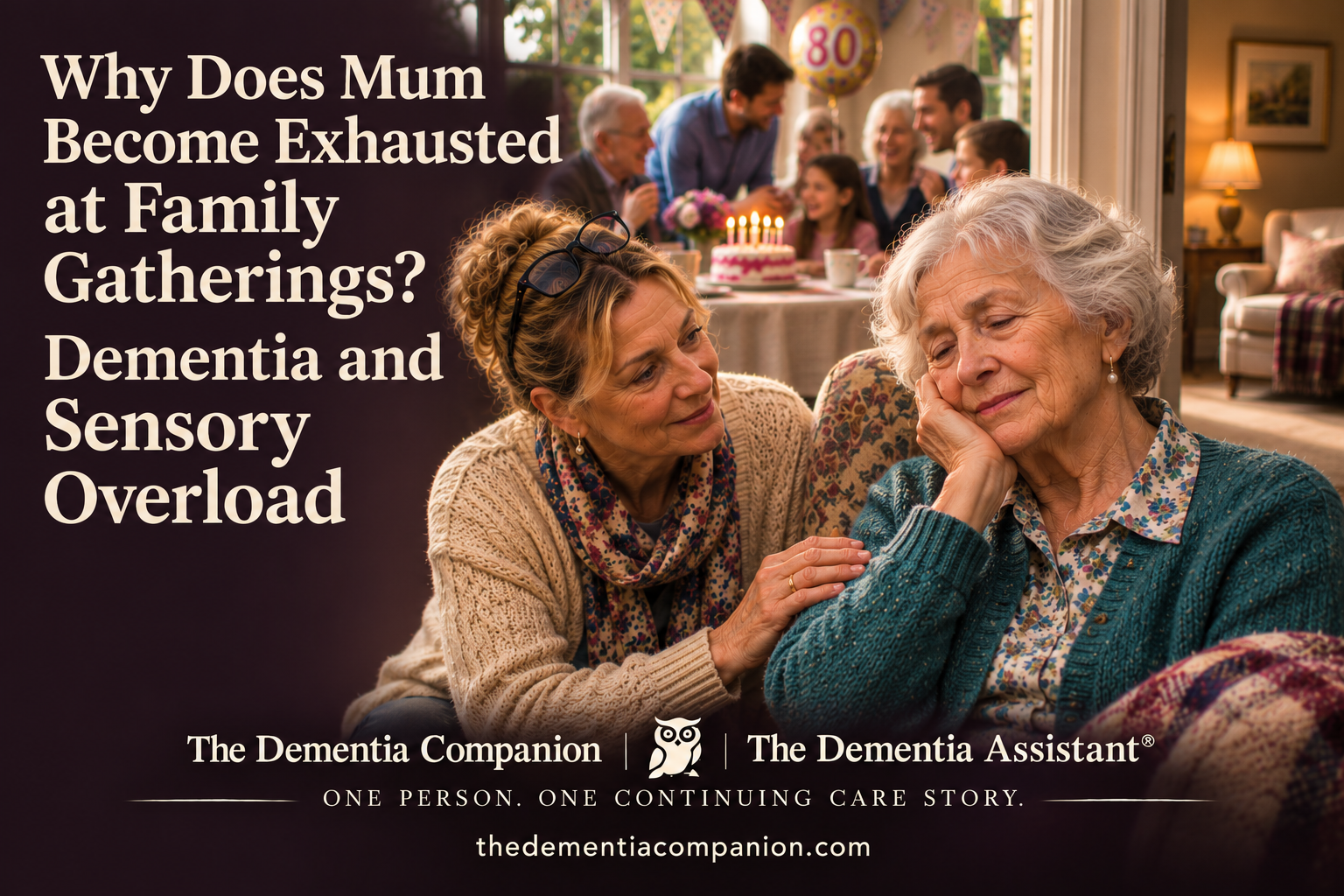
Why Does Mum Become Exhausted at Family Gatherings? Dementia and Sensory Overload
One Person. One Continuing Care Story. | Article 46 of 80
By Louise Donaghy, Dementia Practitioner, Founder of The Dementia Companion and The Dementia Assistant®, and Creator of Hugo Intelligence™.
It’s Mum’s birthday.
The family has gathered.
There’s a cake, balloons, flowers, grandchildren and enough food to feed a small village.
Somebody has put music on.
The children are laughing.
Two conversations are happening across the dining table.
Your brother is telling a story that you’ve all heard approximately seventeen times, although he still insists on providing the full dramatic performance.
And Mum is sitting in the middle of it all.
At first, she’s smiling.
She enjoys seeing everybody.
She laughs when somebody brings out the birthday cake.
She seems pleased with her presents.
But after a while, something changes.
She becomes quieter.
She stops joining the conversation.
When somebody asks her a question, she looks uncertain.
Perhaps she becomes irritable.
Or starts asking when everybody is going home.
You notice her rubbing her forehead.
“Are you all right, Mum?”
“I’m just tired, love.”
It’s only three o’clock.
She hasn’t done anything particularly physical.
So why does she look completely exhausted?
You might wonder whether she’s becoming less sociable.
Perhaps her dementia is getting worse.
Perhaps she doesn’t enjoy family gatherings anymore.
But what if the problem isn’t the family?
What if Mum wants to be there, but the noise, conversation, movement and activity have simply become too much to process?
This can happen when someone living with dementia experiences sensory overload or becomes overwhelmed by the demands of a busy environment.
The answer is to notice what Mum finds tiring, adapt the gathering around her individual needs, offer quiet breaks and give her genuine choice about how long and how much she wants to participate.
Dementia UK recognises that sensory overstimulation can be distressing, especially when someone cannot easily leave the situation or explain how they feel.
Dementia Australia, the Alzheimer’s Association and the Alzheimer Society of Canada also encourage families to simplify celebrations, provide quiet spaces and preserve meaningful connections.
But there’s something particularly important I want families to understand.
Mum can love everybody in the room and still need everybody to be a little quieter.
Those two things are not contradictory.
She may want to see her grandchildren.
Enjoy the birthday cake.
Hear the family news.
And still need to disappear into a peaceful room after twenty minutes.
That doesn’t mean the celebration has failed.
It means we’ve recognised that Mum’s experience of the day may be different from ours.
What is sensory overload in dementia?
Sensory overload happens when the amount or intensity of information coming from the surroundings becomes difficult for a person to manage.
This might involve:
- Several people talking at once.
- Background music or television.
- Bright or flashing lights.
- People constantly moving around.
- Strong cooking smells or perfumes.
- Unfamiliar surroundings.
- Too many questions or choices.
- Physical contact from several people.
- A combination of these things.
Our brains normally help us sort through information.
We can often concentrate on one conversation while other people talk nearby.
We recognise which noises matter.
We shift our attention between activities.
And we interpret what is happening around us.
Dementia can affect some of the abilities involved in attention, sensory processing and understanding an environment.
A busy gathering may therefore require much more effort than it once did.
Imagine trying to follow five conversations
You’re sitting at a dining table.
Your granddaughter is telling you about school.
Somebody else asks whether you’d like more potatoes.
The television is on.
A child drops a toy.
Your son begins explaining tomorrow’s arrangements.
And somebody behind you asks if you remember last Christmas.
Which conversation are you supposed to follow?
Now imagine finding it harder to identify words, process information, remember the subject and decide how to respond.
It’s not difficult to see how the experience might become exhausting.
Not everybody experiences overload in the same way
Some people enjoy lively surroundings and continue to do so after a dementia diagnosis.
Others become overwhelmed by particular sounds, environments or activities.
Some are more comfortable earlier in the day.
Others enjoy smaller gatherings.
And some people may prefer a short visit with one familiar person rather than a large family celebration.
The diagnosis doesn’t tell us which environment Mum will enjoy. Mum does.
Why does Mum seem fine when we arrive but exhausted an hour later?
Sometimes a person can manage a busy environment for a while before becoming tired.
At the beginning, Mum may be able to follow conversations and enjoy the occasion.
As the demands continue, she may become increasingly fatigued.
She might find it harder to concentrate.
More difficult to respond.
Or less comfortable with the activity around her.
But we should not assume that sensory overload explains every episode of tiredness.
Physical health, poor sleep, medication effects, pain, anxiety and other conditions may also contribute.
Socialising requires effort
Even an enjoyable conversation involves listening, understanding, remembering and responding.
When these processes become more demanding, social interaction may feel tiring.
This doesn’t mean people living with dementia should stop socialising.
Quite the opposite.
Meaningful social connection can remain an important part of wellbeing.
The challenge is finding a way to make those experiences enjoyable and manageable.
Busy environments can magnify hearing difficulties
Perhaps Mum has hearing loss as well as dementia.
In a quiet room, she follows conversation comfortably.
At a crowded table, she struggles to distinguish one voice from another.
She may spend enormous effort trying to work out what everybody is saying.
If she’s missing parts of the conversation, she may eventually stop participating.
A hearing assessment and suitable communication adjustments may help.
Visual demands can also contribute
Decorations, moving people, patterned surfaces, changes in lighting and unfamiliar surroundings may create additional difficulties for somebody with visual perception changes.
Perhaps Mum is trying to understand where people are sitting.
Who is approaching.
Where the doorway is.
Or what has been placed in front of her.
If she struggles with visual processing, the room may feel much more complicated than it appears to everybody else.
Changes in routine can add to the pressure
Perhaps Mum usually has lunch at twelve.
She enjoys an afternoon rest.
And likes a familiar routine.
But today the family arrives at eleven.
Lunch is delayed.
The cake comes out at three.
And everybody expects her to remain sociable until the evening.
Even without sensory overload, this change may be tiring.
Sometimes the best celebration is the one that fits into Mum’s day, rather than requiring Mum to fit into everybody else’s.
What are the signs that Mum is becoming overwhelmed?
The signs can be subtle.
Some people become visibly distressed.
Others become unusually quiet.
There is no single behaviour that proves sensory overload.
But changes from Mum’s usual presentation may provide important clues.
She stops following the conversation
Perhaps she previously answered questions comfortably.
Now she appears unsure what people are discussing.
She may smile politely without responding.
Or ask repeatedly what is happening.
She becomes quieter or withdrawn
Mum may stop talking.
Look down at the table.
Move away from the group.
Or appear less interested in an activity she was enjoying earlier.
This might reflect tiredness or feeling overwhelmed.
But it can have other explanations too.
She becomes irritable
Perhaps somebody asks whether she’d like another drink.
Mum snaps:
“I’ve already told you!”
Or tells the grandchildren to be quiet.
It’s easy to assume she’s being difficult.
But she may simply have reached the point where another question feels like too much.
She looks physically uncomfortable
You might notice her rubbing her forehead.
Covering her ears.
Closing her eyes.
Changing position repeatedly.
Or looking towards the door.
These may suggest discomfort, although they do not establish its cause.
She becomes restless or wants to leave
Perhaps Mum starts asking to go home.
Or repeatedly stands up.
She might begin searching for her handbag.
She may be communicating that the situation no longer feels comfortable.
She appears unusually tired afterwards
Perhaps she sleeps for much of the afternoon after a family gathering.
A busy day may contribute to fatigue.
But if sleepiness is new, marked or accompanied by other changes, arrange an appropriate health review rather than assuming the cause is overstimulation.
Does sensory overload mean Mum’s dementia is getting worse?
Not necessarily.
Becoming tired in busy surroundings does not, by itself, establish dementia progression.
The person’s surroundings, hearing, vision, physical health and daily routine may all influence how they respond.
Perhaps she is simply more comfortable in quiet settings.
Perhaps a recent illness has affected her stamina.
Perhaps she’s sleeping poorly.
Or perhaps her sensory or cognitive abilities have changed.
If the difficulty is becoming more frequent or affecting everyday life, discuss the changes with an appropriate healthcare professional.
When should we seek urgent help?
Sudden confusion, markedly reduced alertness or an abrupt change from Mum’s usual abilities requires urgent medical assessment.
In the UK, NHS advice is to seek emergency assessment for sudden confusion, including calling 999 or attending A&E.
Sudden weakness, facial drooping, speech difficulties, collapse or severe breathing problems also require emergency help.
Elsewhere, use the appropriate local urgent or emergency care arrangements.
Do not assume that a sudden deterioration after a busy day is simply sensory overload.
How can we plan a dementia-friendly family gathering?
The answer isn’t to create a completely silent house where nobody is allowed to enjoy themselves.
That would be a rather unusual birthday party.
It’s about making the occasion manageable and meaningful for the person.
- Ask Mum what she wants
Would she like a gathering?
Who would she enjoy seeing?
Would she prefer a quiet lunch?
A short afternoon visit?
Or perhaps several small visits across the week?
If Mum can express her preferences, involve her in the planning.
Don’t assume that a large celebration is automatically what she wants.
And don’t assume that because she has dementia, she would prefer everybody to stay away.
- Consider the timing
When does Mum usually feel most comfortable?
Perhaps mornings are easier.
Perhaps she enjoys lunch but becomes tired later in the afternoon.
Perhaps evenings are particularly difficult.
Plan around her individual routine where possible.
The Alzheimer’s Association and Dementia UK recommend adapting celebrations to the person’s needs rather than expecting them to maintain previous traditions unchanged.
- Reduce the number of people at one time
If a gathering of twenty is too much, perhaps smaller groups would be more enjoyable.
You might arrange several visits.
Or invite a few particularly important people for the main part of the day.
This isn’t about deciding which relatives matter most.
It’s about finding an arrangement Mum can comfortably enjoy.
- Create a quiet place
A peaceful room away from the main activity may help.
Perhaps Mum can sit with one familiar person.
Listen to music she enjoys.
Look out at the garden.
Or simply rest.
Make sure the environment is safe and appropriate to her supervision and mobility needs.
A quiet space should be an invitation, not a place where Mum is sent because other people find her behaviour inconvenient.
- Plan for a shorter visit
It may be better to enjoy forty comfortable minutes than struggle through four exhausting hours.
Consider an arrangement where Mum can leave when she chooses or when her needs indicate that rest would be helpful.
The celebration can continue for other guests.
Mum doesn’t need to remain until the last balloon comes down.
- Keep meals manageable
If Mum enjoys family lunch, try to preserve that experience.
But a crowded buffet may be difficult to navigate.
She might prefer sitting at a familiar place with a manageable portion.
Consider any swallowing, dietary or other clinically assessed needs.
And avoid putting pressure on her to eat simply because everybody else is having another helping.
- Let somebody familiar provide support
Perhaps Mum feels comfortable beside her daughter.
Perhaps her husband helps her understand what’s happening.
Perhaps she prefers another familiar relative.
Agree beforehand who can help her find a quiet place, communicate her wishes or leave when she wants.
But remember that this person may need support too.
The whole responsibility should not automatically fall on the same exhausted family member.
What should I tell relatives before the gathering?
This is where a little preparation can save considerable misunderstanding.
Perhaps a cousin hasn’t seen Mum for a year.
They don’t know what has changed.
They approach enthusiastically and ask six questions before Mum has even taken her coat off.
They’re trying to be friendly.
But it might be overwhelming.
Keep the message respectful
With Mum’s permission where appropriate, you might explain:
“Mum is looking forward to seeing everybody, but she sometimes finds lots of conversation tiring. It helps if we speak one at a time and give her the chance to rest.”
Or:
“She enjoys family company, but we may keep the visit shorter this year.”
Or:
“Please give Mum time to answer. There’s no need to test what she remembers.”
These are practical explanations.
They don’t need to include every detail of Mum’s diagnosis or health history.
Ask relatives not to quiz her
Questions such as:
“Do you remember me?”
“What’s my name?”
“Do you remember last Christmas?”
may make the interaction feel like an examination.
Instead, encourage natural introductions.
“Hello, Auntie Jean. It’s Michael. It’s lovely to see you.”
And talk about something meaningful.
Avoid everybody speaking at once
One conversation at a time may be easier to follow.
Encourage people to face Mum when speaking.
Reduce background noise if it helps.
And allow time for her responses.
Don’t make Mum the centre of attention all day
Some people enjoy being celebrated.
Others dislike everybody watching them.
Ask what feels right for the individual.
A birthday should still be Mum’s birthday, not a public demonstration of how well she’s managing dementia.
What if Mum becomes upset during the celebration?
First, consider what she may be experiencing.
Is the room too noisy?
Is she tired?
Hungry?
Thirsty?
In pain?
Does she need the toilet?
Has an unfamiliar person approached?
Is somebody touching her unexpectedly?
Has the activity become confusing?
These are possibilities, not diagnoses.
Reduce demands
If appropriate, turn down the music.
Move away from the busiest part of the room.
Stop asking questions for a moment.
Offer reassurance.
You might say:
“There’s quite a lot going on, Mum.”
“Would you like to sit somewhere quieter?”
Or simply:
“Shall we have a little break?”
Don’t force her to stay
If Mum wants to leave and can make that decision, respect it.
If she requires support or supervision, arrange an appropriate safe response.
Don’t try to persuade her to endure distress just because other relatives have travelled a long way.
Avoid arguing about the behaviour
If she says the gathering is too noisy, don’t tell her it isn’t.
If she says she’s tired, don’t insist that she hasn’t done anything.
If she no longer wants to join in, don’t treat it as ingratitude.
The celebration is supposed to be enjoyable for Mum too.
What if Mum says she doesn’t want to attend?
Listen to her.
Perhaps she’s tired.
Perhaps crowds have become uncomfortable.
Perhaps she doesn’t like the venue.
Perhaps she is anxious about seeing unfamiliar people.
Or perhaps she simply doesn’t feel like going.
Not every refusal is a symptom.
Adults are allowed to decline invitations.
Offer an alternative
Would she enjoy a quieter visit?
A small meal with close family?
A familiar relative coming to see her at home?
Or perhaps joining for just the birthday cake?
Only offer alternatives that are genuinely possible.
Respect the difference between encouragement and pressure
Sometimes gentle encouragement helps someone enjoy an activity they’ve become uncertain about.
But repeatedly insisting that they attend against their wishes can create distress.
The aim is to help the person participate in meaningful life on terms that respect their choices.
How can we include grandchildren without overwhelming Mum?
Children can bring enormous joy.
They can also bring noise, excitement and quite remarkable amounts of movement.
Sometimes all within the space of thirty seconds.
That doesn’t mean children should be kept away.
It means helping everybody enjoy the relationship.
Explain things in an age-appropriate way
You might tell a child:
“Grandma really loves seeing you, but sometimes lots of noise makes her tired. Let’s give her a little quiet time too.”
Encourage natural interaction.
Reading a story together.
Showing Grandma a drawing.
Listening to music.
Looking through photographs.
Or sitting beside her while she watches an activity.
Don’t make the child responsible for managing dementia
Children should not feel responsible for keeping Grandma calm or preventing distress.
Adults should provide appropriate support and supervision.
And both the child and the person living with dementia should be comfortable with the interaction.
Keep the relationship, adapt the activity
Perhaps Grandma previously enjoyed energetic games.
Now she prefers watching the grandchildren play in the garden.
That can still be meaningful.
The way people spend time together may change, but the relationship can remain important.
What about weddings, funerals and major family events?
These occasions may be particularly meaningful.
They can also involve long journeys, unfamiliar venues, emotional conversations and changes in routine.
Weddings
Consider whether Mum would prefer attending the ceremony, the meal or another part of the day.
Would a quieter seat help?
Can she leave early if needed?
Is there somewhere comfortable to rest?
What are her wishes about photographs and being included?
Funerals
A funeral can be emotionally significant.
Mum may wish to attend and have every right to be involved in appropriate decisions.
But the ceremony, travel and emotional demands may be difficult.
Discuss suitable support and alternatives without automatically excluding her.
Christmas, Eid, Diwali, Hanukkah and other celebrations
Different families have different traditions.
Some gatherings include music, shared meals, worship or large groups.
Others are quieter.
Ask which traditions matter most to the individual.
Sometimes a brief, meaningful part of the celebration is more enjoyable than attempting to recreate the entire event as it was years ago.
Culture and faith matter, but we should never assume what a particular person values.
Birthdays and anniversaries
Perhaps Mum wants a party.
Perhaps she would rather enjoy tea with a few favourite people.
Let her preferences guide the plan.
The number of guests is not a measure of how loved she is.
What if Mum becomes exhausted after the gathering?
Some people need more rest after a demanding social occasion.
Allow suitable recovery time.
Consider whether the gathering was longer or busier than she found comfortable.
If helpful, reflect on what worked well and what could be different next time.
Perhaps she enjoyed the first half-hour.
Perhaps the quiet room helped.
Perhaps sitting beside one familiar person made the experience easier.
But don’t automatically assume a marked change in sleepiness is harmless.
If she becomes unusually difficult to wake, suddenly confused or acutely unwell, seek urgent medical assessment.
If fatigue is persistent, increasing or associated with other symptoms, arrange a clinical review.
Can sensory overload cause sundowning?
Busy days and overstimulation may contribute to evening distress for some people living with dementia.
However, sundowning is a description of a pattern of increased confusion or distress later in the day, not an explanation for every evening change.
Pain, unmet needs, poor sleep, illness and environmental factors should also be considered.
If Mum becomes unsettled after a family gathering, explore what happened throughout the day.
Was she tired?
Did she miss her normal rest?
Was lunch delayed?
Did she become overwhelmed?
Did the evening routine change?
Persistent or worsening distress deserves professional assessment.
Our separate article on sundowning explores those situations in greater depth.
Should we avoid family gatherings altogether?
Not automatically.
Social connection can be meaningful and enjoyable for people living with dementia.
Family gatherings may provide affection, belonging and familiar experiences.
Some people continue enjoying large celebrations.
Others prefer smaller occasions.
And some may no longer find particular activities comfortable.
The aim is not to remove the person from family life.
It is to make family life accessible to them.
Think quality, not duration
A quiet twenty-minute conversation with a granddaughter may be far more enjoyable than a whole afternoon in a crowded dining room.
A short visit that ends comfortably can be a success.
Preserve choice
Mum may want to attend.
Or stay home.
Or participate briefly.
Or leave when she feels tired.
Her wishes and communication needs should guide what happens.
Adapt instead of excluding
Perhaps the Christmas meal can be held earlier.
Perhaps the birthday gathering can be smaller.
Perhaps a quieter space can be arranged.
Perhaps one relative can visit separately.
Inclusion isn’t simply inviting somebody. It’s helping them participate in a way that feels right for them.
What if Mum seems socially confident in public but struggles afterwards?
This can be confusing for families.
Perhaps Mum smiles, chats and appears comfortable during a gathering.
Relatives say:
“She seems absolutely fine!”
But later, she is exhausted or unsettled.
The family member providing everyday care may see the part others don’t.
It can help to record both experiences.
Mum enjoyed seeing her sister.
She participated in conversation.
And she needed significant rest afterwards.
These observations can all be true.
But don’t automatically conclude that she was deliberately hiding difficulties or that the exhaustion proves progression.
Look at the wider pattern and seek clinical advice where needed.
How do we know whether the problem is sensory overload or something medical?
Families should not be expected to make that distinction alone.
Some signs of overload may overlap with pain, infection, hearing problems, depression, fatigue or medication effects.
Look for changes from Mum’s usual pattern
Does she become uncomfortable only in particularly busy places?
Does she settle when the environment becomes quieter?
Has she recently started a new medicine?
Has her hearing or vision changed?
Is she sleeping poorly?
Has she become unwell?
These observations may help a clinician.
They cannot prove the cause.
Seek professional assessment for significant changes
NICE recommends exploring possible clinical and environmental reasons for distress in dementia before considering treatment.
This means that a new behaviour should not automatically be labelled as part of dementia without considering other explanations.
Not everything that happens to someone with dementia is caused by dementia.
That is one of the most important principles families and professionals can remember.
A practical plan for Mum’s next family celebration
Let’s imagine another birthday is coming up.
This time, the family decides to make the day a little different.
Mum is asked what she’d enjoy.
She says she would love to see the grandchildren.
But she doesn’t want a big evening party.
So the family arranges a small lunch.
The table is set in a quieter room.
The television stays off.
Her daughter explains to everyone that Mum may prefer shorter conversations.
There’s somewhere comfortable for her to rest.
The grandchildren show her their drawings.
Mum helps choose the birthday cake.
They sing together.
And after a while, she says she’s tired.
Nobody argues.
Nobody tells her she’s missing the best part.
Nobody insists that she stay until the presents are opened.
Instead, they help her rest.
The rest of the family continues celebrating.
And Mum has enjoyed being part of the day.
This is a fictional example.
It isn’t a guaranteed formula.
But it shows what can happen when we measure a celebration by the person’s experience rather than how closely it resembles previous years.
What should we record in Mum’s continuing care plan?
Imagine different family members are involved.
Her daughter notices that Mum becomes uncomfortable when several people talk at once.
Her son discovers that she enjoys quieter conversations.
A grandchild realises that sharing photographs works better than asking lots of questions.
A home carer notices that she becomes tired after outings.
A dementia nurse recommends reviewing her current support needs.
Each person may know something useful.
Bringing relevant observations together can help everyone understand what Mum enjoys and where support is needed.
A fictional care-plan example
Person: Margaret, aged 82.
What matters to Margaret: Spending time with her children and grandchildren, celebrating birthdays, listening to familiar music and taking part in family traditions.
Communication preferences: Prefers face-to-face conversation with one person speaking at a time.
Usual routine: Enjoys lunch around midday and often rests during the afternoon.
Observed difficulties: Becomes noticeably tired during large, noisy gatherings and struggles to follow several conversations.
What Margaret says: “There’s too much going on,” or “I’d like a little quiet.”
What helps: Smaller gatherings, familiar people, quieter rooms, an agreed opportunity to rest and visits planned at comfortable times.
What hasn’t helped: Repeated questions, loud background television and being encouraged to stay after saying she feels tired.
Strengths: Enjoys conversation, chooses activities and takes pleasure in family celebrations when the environment is comfortable.
Relevant health considerations: Hearing, vision, pain, medication and other clinical concerns to be reviewed as appropriate.
Review: Update following new observations or professional advice.
These examples are fictional.
But consider how much more useful this is than writing:
“Margaret becomes difficult at parties.”
One statement labels a behaviour.
The other helps the next person understand Margaret’s experience.
Meet Hugo Intelligence™: understanding the person behind the exhaustion
This is exactly the sort of family situation that inspired Hugo Intelligence™.
Because families often don’t know why something is happening.
Perhaps Mum enjoyed seeing everybody.
But afterwards she was exhausted.
Perhaps she became upset halfway through lunch.
Perhaps she’s started refusing invitations.
And the family is left wondering what they’ve done wrong.
Hugo Intelligence™ is the conversational, person-centred guidance system within The Dementia Assistant®, powered by Person-Centred Intelligence®.
Hugo stands for:
H — Human
U — Understanding
G — Guidance
O — One person at a time
And yes, Hugo is still our lovely little owl.
Although even he might need a peaceful perch after a family gathering involving twenty relatives, three dogs and somebody who insists on playing party games.
Begin with the question you actually have
You might say:
“Hugo, Mum has dementia and she used to love family parties. Now she becomes exhausted after half an hour and sometimes gets upset. She wants to see everybody, but it seems too much. What can we do?”
Hugo can explain general information about sensory overload, fatigue and environmental demands.
He can help you explore possible factors.
He can suggest respectful ways of asking Mum what she prefers.
And he can help you prepare practical questions for the family or an appropriate healthcare professional.
Hugo can continue the conversation
You might then explain:
“Mum has hearing loss.”
“She gets tired after lunch.”
“She loves seeing her grandchildren.”
“She struggles when everybody talks at once.”
“She becomes unsettled during evening gatherings.”
“She refuses to go to restaurants now.”
“How can we plan her birthday differently?”
Hugo can continue the educational conversation as new information is provided.
He can help families think through alternative arrangements without assuming that one approach will suit everybody.
Hugo can help explore useful follow-up questions
For example:
“When does Mum usually feel most comfortable?”
“What kind of family contact does she enjoy?”
“Does she prefer smaller groups?”
“Has her hearing or eyesight been assessed?”
“Is she able to leave an event when she wants?”
“What happened before she became tired?”
“Did she seem comfortable during a quieter part of the day?”
“Does anything suggest a new health concern?”
These questions can help families organise their understanding.
They do not diagnose sensory overload.
General Hugo: guidance without a care plan
Anyone can ask Hugo general dementia questions without first creating or selecting an individual care plan.
For example:
“How can I make a family birthday party easier for somebody with Alzheimer’s disease?”
Hugo can offer general educational guidance and practical considerations.
Personalised Hugo: using the individual care plan you explicitly select
Now imagine Margaret’s family has created her individual care plan.
It includes her meaningful relationships, routines, communication preferences, interests, sensory needs and previous observations.
When the user explicitly selects Margaret’s individual care plan, Hugo can use relevant information recorded in that plan to offer more personalised educational guidance.
For example:
“Hugo, using Margaret’s care plan, help us plan a family birthday lunch that reflects her routine, hearing needs and enjoyment of spending time with her grandchildren.”
Hugo can consider the relevant information in that selected plan.
He may help organise a family-friendly checklist or suggest questions worth discussing.
Hugo does not automatically access every care plan in an account.
The individual person’s plan must be selected by the user.
Families supporting more than one person can maintain separate care plans.
And Hugo’s guidance should be reviewed against relevant professional advice where health, consent, safeguarding or safety is involved.
The Care Planning Centre™ and guided Talk to Hugo
The Care Planning Centre™ helps people living with dementia and their families create, review and maintain individual person-centred care plans.
Through guided Talk to Hugo conversations, users can explore questions in everyday language.
For example:
“What does Mum enjoy doing with family?”
“Does she prefer morning or afternoon visits?”
“What makes social occasions tiring?”
“What helps her feel comfortable?”
“How does she communicate that she needs a break?”
“Who are the important people in her life?”
“What professional advice should be included?”
Relevant information can be organised into the appropriate sections of the care plan, with the user reviewing what is recorded.
The platform also supports care-plan reviews, suggestions for missing information and help improving professional wording.
The purpose is to preserve the person’s choices, strengths and needs in a form that is useful as care arrangements change.
Daily notes: recognising patterns without turning Mum into a project
The Dementia Assistant® includes daily notes.
These can help families record relevant observations over time.
For example:
Monday: Margaret enjoyed a quiet visit with her sister for approximately forty minutes. She remained comfortable and engaged.
Wednesday: Margaret became tired during a busy family lunch. She said the room was noisy and chose to rest in a quieter area.
Friday: Margaret enjoyed looking at photographs with her granddaughter. Family noted that a smaller gathering appeared more comfortable.
Sunday: Margaret attended a short birthday visit earlier in the day. She chose to leave after the cake and appeared pleased to have participated.
These are fictional examples.
They don’t establish a clinical cause.
But they may help the family understand which arrangements Margaret prefers.
Save conversations and relevant care information
Hugo conversations can be saved, categorised and revisited.
Families may also organise relevant documents and professional recommendations.
Applicable care-information exports include PDF, Word, CSV and JSON.
These features can help preserve useful information as circumstances change.
Saved AI conversations are not verified clinical records or professional instructions.
Family Circle: helping everybody understand Mum’s preferences
Family gatherings often involve several relatives.
And everybody has their own idea of what would make the day special.
One wants a big celebration.
Another thinks Mum should stay home.
Somebody wants to book a restaurant.
Another suggests bringing all the grandchildren.
A third insists that Mum loved parties and should keep doing everything she once did.
But what does Mum want now?
Family Circle supports appropriate communication between authorised relatives.
This can help families share relevant observations and coordinate suitable arrangements.
Perhaps they agree that Mum enjoys smaller gatherings.
Or that she prefers an earlier lunch.
Or that a familiar person should help her find somewhere quiet when she needs a break.
But Family Circle should never become a family committee that overrides the person’s wishes.
Consent, privacy, permissions and lawful decision-making arrangements remain important.
Not every relative automatically needs access to every health detail.
Life Story and Memory & Moments: celebrating the person, not the diagnosis
Perhaps Mum has always loved Christmas.
Perhaps she enjoys Irish music.
Perhaps she adores birthdays.
Perhaps she spent years preparing enormous family lunches.
Perhaps she loved hosting everybody, making sure nobody went hungry and sending guests home with enough leftovers to survive a fortnight.
Those experiences matter.
They tell us something about who Mum is.
But we should not assume that because she enjoyed large gatherings twenty years ago, she must enjoy them in exactly the same way today.
Life Story and Memory & Moments help preserve meaningful relationships, traditions, experiences, photographs and personal history.
This information may help families adapt celebrations in ways that still feel familiar and important.
Perhaps Mum no longer wants to cook the entire Christmas lunch.
But she enjoys choosing the dessert.
Perhaps she no longer likes a crowded dining room.
But she loves hearing the grandchildren sing.
Perhaps she prefers looking through old birthday photographs with one familiar relative.
These are still meaningful forms of participation.
The tradition can change while the feeling of belonging remains.
Multilingual support: making gatherings more comfortable across languages
Family gatherings can involve several languages, particularly when relatives live across different countries.
Perhaps Mum prefers Welsh, Irish, Hindi, Spanish or another language.
Perhaps some grandchildren speak English while others use a different language at home.
Perhaps the person finds it harder to follow conversations when several languages are being spoken.
The Dementia Assistant® offers 12 interface languages, alongside dictation and translation capabilities spanning 201 languages.
These tools can help families communicate, record relevant care information and preserve language preferences.
Not every feature is available in all 201 languages.
Important medical, legal and safety-critical information must be professionally verified where necessary.
Professional interpreting may be needed for important clinical discussions.
Some people living with dementia experience changes in language use, but this varies.
Never assume everybody returns to their childhood language.
Ask what the person understands and prefers.
And remember that familiar words, voices and expressions can be meaningful parts of family connection.
Dementia Academy™, crisis guidance and the Carer Wellbeing Hub
The Dementia Assistant® includes educational resources through the Dementia Academy™.
These help families and professionals explore dementia, person-centred communication and practical support.
The platform also includes educational crisis guidance to help families recognise when urgent or additional professional assistance may be required.
Hugo is not an emergency response service.
He cannot monitor somebody’s health in real time, diagnose a medical problem or provide physical supervision.
What about the person organising everything?
Let’s not forget the carer.
Perhaps you’ve prepared the food.
Arranged the visits.
Explained Mum’s needs to everybody.
Kept an eye on her throughout the day.
Helped her rest.
And somehow tried to enjoy the celebration yourself.
That’s a lot to manage.
You might be exhausted before the first guest has even arrived.
The Carer Wellbeing Hub recognises the emotional and practical pressures of caring.
But digital guidance isn’t a substitute for practical support.
Ask relatives to share responsibilities.
Agree who will organise the food.
Who can help Mum if she wants a break.
Who can tidy up.
And who can make sure the person providing everyday care gets to enjoy a little of the occasion too.
A family celebration should not depend on one exhausted person keeping everybody else happy.
Ask Hugo: 17 questions families ask about dementia and sensory overload
- Why does Mum with dementia get so tired at family gatherings?
Busy gatherings can place demands on attention, communication and sensory processing. Noise, unfamiliar surroundings and changes in routine may contribute to fatigue. Other health factors can also cause tiredness, so significant changes deserve assessment.
- What is sensory overload in dementia?
Sensory overload describes a situation where sounds, sights, activity or other sensations become difficult to manage. Some people living with dementia may become distressed or exhausted in busy environments.
- How can I tell whether Mum is overwhelmed?
Possible signs include becoming unusually quiet, irritable, restless, withdrawn or distressed. She may ask to leave or seek somewhere quiet. These signs are not specific to sensory overload and should be considered in context.
- Should we stop inviting Mum to family celebrations?
Not automatically. Meaningful social contact can remain important. Ask what she enjoys and consider smaller, shorter or quieter gatherings that reflect her wishes.
- Is a small family gathering better than a big party?
For some people, yes. Smaller gatherings may be easier to follow and enjoy. Others continue to love larger occasions. The best arrangement depends on the individual.
- What time of day is best for a person with dementia to attend a celebration?
Choose a time when the person usually feels most comfortable and alert. Some prefer mornings or early afternoons, while others have different routines.
- Why does Mum become angry when everybody is talking?
She may be struggling with competing conversations, feeling tired or experiencing another unmet need. Reduce demands, listen to her concerns and consider possible medical or environmental causes.
- How can I help Mum enjoy seeing her grandchildren?
Try activities they can comfortably share, such as looking at drawings, listening to music or spending time together in a small group. Respect both Mum’s and the children’s preferences.
- Should we have a quiet room at family parties?
A safe, comfortable quiet space may help someone rest when the gathering becomes tiring. It should be offered as a choice, with appropriate supervision or assistance if needed.
- Can hearing loss make family gatherings more difficult?
Yes. Background conversations and noise may make speech harder to follow. Appropriate hearing assessment and communication adjustments may help.
- Can bright lights or decorations overwhelm someone with dementia?
Some people find intense visual stimulation, glare or complicated surroundings difficult to interpret. Environmental changes should reflect the individual’s responses and preferences.
- Does sensory overload cause sundowning?
A busy or tiring day may contribute to evening distress for some people, but sundowning is not explained by one cause. Pain, illness, sleep, routine and other factors should also be considered.
- What if Mum says she doesn’t want to attend?
Take her wishes seriously. Explore whether she would enjoy a shorter visit or alternative arrangement, but don’t automatically pressure her to participate.
- What if Mum seems fine at the party but exhausted afterwards?
She may have found the experience tiring despite enjoying it. Record what happened and consider adjusting future events. Persistent or marked fatigue warrants clinical advice.
- When should we seek medical help?
Seek urgent help for sudden confusion, reduced responsiveness or other acute symptoms. Arrange a clinical review for new or persistent distress, fatigue or changes in functioning.
- Can Hugo help us plan a dementia-friendly family celebration?
Yes. Hugo can provide general educational guidance and practical ideas. When a user explicitly selects an individual care plan, Hugo can consider relevant recorded routines and preferences to offer more personalised suggestions. He cannot assess medical fitness or replace professional advice.
- How can we make sure Mum’s sensory preferences are understood by everybody supporting her?
The Dementia Assistant® supports individual care plans, daily notes, saved Hugo conversations, document organisation and appropriate Family Circle updates. Relevant information can be shared with authorised people, respecting wishes, consent and privacy.
One Person. One Continuing Care Story.
Different professionals. Different services. One person. One continuing story.
Imagine Margaret’s journey.
She begins experiencing memory difficulties.
Her family notices that she no longer enjoys busy restaurants.
Her GP becomes involved.
She attends a memory clinic.
A dementia diagnosis is made.
Her daughter notices that large family gatherings have become tiring.
A hearing assessment identifies communication needs.
An occupational therapist considers environmental adjustments.
A visiting carer learns that Margaret enjoys small groups and quieter surroundings.
Later, perhaps Margaret has a hospital admission.
Another team meets her.
Or she moves into a residential care setting.
Different professionals.
Different care environments.
Different records.
But Margaret is still Margaret.
The woman who loves birthdays.
Who enjoys family photographs.
Who adores her grandchildren.
Who prefers an early lunch.
Who likes familiar music.
And who sometimes finds busy gatherings exhausting.
The family’s own continuing care plan
This is the principle behind The Dementia Assistant®.
A person living with dementia, and their family where appropriate, can maintain their own continuing person-centred care information.
It can begin when memory concerns first appear.
It can develop through GP appointments, memory assessments and diagnosis.
And it can continue through home care, hospital admissions, rehabilitation, residential care and palliative or end-of-life support where relevant.
Sensory needs and meaningful relationships belong within the story
Margaret’s plan should not simply say:
“Gets agitated at parties.”
It should explain:
What she enjoys.
Who she likes spending time with.
Which environments feel comfortable.
What becomes tiring.
How she communicates that she needs a break.
What has helped.
What hasn’t helped.
And which professional recommendations apply.
One person. One individual care plan.
Margaret’s preferences and abilities may change.
Perhaps she still enjoys birthday lunches but no longer likes evening gatherings.
Perhaps she becomes more comfortable with suitable hearing support.
Perhaps she needs additional help participating in a social occasion.
The care plan should develop with her.
It should preserve her strengths, wishes and identity rather than simply listing difficulties.
The family-held record complements professional care
The Dementia Assistant® does not replace professional medical records, clinical assessments, statutory care plans, safeguarding procedures or a care provider’s own responsibilities.
It complements them.
The person or family can maintain their own continuing information independently of any single provider and share appropriate details with professionals when relevant.
Consent, privacy, permissions and lawful authority remain central.
Different professionals. Different services. One person. One continuing story.
Because Margaret’s next care worker should not have to wait until she becomes distressed at a crowded Christmas party to discover that she finds large gatherings difficult.
And the family shouldn’t have to explain her preferences from the beginning every time someone new becomes involved.
A gentle invitation to meet Hugo
If Mum becomes tired or distressed during family gatherings, you may not know how to balance her need for connection with her need for quiet.
You might be worried about excluding her.
Or concerned that she is no longer enjoying the things she once loved.
You can begin by asking Hugo.
Explain what happens.
Explore possible reasons for sensory overload or fatigue.
Ask about practical adjustments.
Prepare questions for appropriate professionals.
And when you explicitly select Mum’s individual care plan, Hugo can use relevant recorded information to explore approaches that reflect her preferences, routines and relationships.
The Dementia Companion is our public educational home for practical dementia articles, family guidance and Ask Hugo resources.
https://thedementiacompanion.com/
The Dementia Assistant® is our interactive platform where families can continue conversations with Hugo Intelligence™, create and maintain person-centred care plans, save and categorise guidance, record daily notes, organise documents, preserve Life Story and Memory & Moments information, and communicate appropriately through Family Circle.
The platform also includes multilingual capabilities, the Dementia Academy™, educational crisis guidance and the Carer Wellbeing Hub.
All subscriptions include a 30-day complimentary trial.
The UK Family subscription costs £4.99 per month after the trial.
Other subscription options and international prices are available through the platform.
Meet Hugo and explore The Dementia Assistant®:
https://thedementiaassistant.com/
Hugo provides educational guidance, not medical diagnosis, emergency intervention, live monitoring, statutory assessments or legally binding decisions.
One final thought
I want you to picture Mum at that family birthday again.
The cake has been brought out.
Everybody has sung.
The grandchildren have given her their cards.
She’s laughed at your brother’s terrible joke.
And now she’s tired.
Perhaps years ago she would have been the last person to leave the party.
She might have cooked the food, organised the seating and sent everybody home with leftovers.
But today, she wants to rest.
That doesn’t make the celebration any less meaningful.
She has still been part of the family.
She’s still loved.
Still included.
Still important.
And perhaps the kindest thing we can do is stop expecting her to enjoy a special occasion in exactly the same way she always has.
The decorations can change.
The number of guests can change.
The time of day can change.
Even the birthday cake can change, although I would suggest proceeding carefully with that particular decision.
But the love doesn’t have to change.
Sometimes the most meaningful family celebration isn’t the biggest or the longest. It’s the one where the person feels comfortable enough to enjoy being there.
So let’s keep Mum included.
Keep her wishes at the centre.
Give her permission to rest without making her feel she’s spoiling anybody’s day.
And remember that being surrounded by people who love you should feel comforting, not overwhelming.
One person.
One continuing care story.
With love,
Louise, Hugo and Charlie ❤️🦉✨
Louise Donaghy
Founder & CEO of The Dementia Assistant®
Created and powered by Person-Centred Intelligence®
Creator of Hugo Intelligence™
⸻
Continue exploring with The Dementia Companion
The Dementia Companion
https://thedementiacompanion.com/
Ask Hugo: Practical Dementia Questions
https://thedementiacompanion.com/ask-hugo/
Inside The Dementia Assistant®
https://thedementiacompanion.com/inside-the-app/
The Dementia Companion Wellbeing Hub
https://thedementiacompanion.com/wellbeing-hub
Meet Hugo and explore The Dementia Assistant®
https://thedementiaassistant.com/
Related reading in our One Person. One Continuing Care Story series includes Dementia and Hearing Loss, Dementia and Vision Problems, Sundowning in Dementia, and Mum Has Dementia but Insists Nothing Is Wrong.
References and authoritative guidance
1. Dementia UK. What is it like to live with dementia? Includes personal experiences of sensory overload.
https://www.dementiauk.org/information-and-support/about-dementia/what-is-it-like-to-live-with-dementia/
2. Dementia UK. Managing distress in a person living with dementia. Explains possible sensory, physical and environmental contributors to distress.
https://www.dementiauk.org/information-and-support/health-advice/coping-with-distress/
3. Dementia UK. Twelve tips for Christmas. Practical guidance on reducing overstimulation, smaller gatherings and familiar routines.
https://www.dementiauk.org/information-and-support/living-with-dementia/twelve-tips-for-christmas/
4. Alzheimer’s Society, UK. How to support a person with dementia at Christmas. Advice on quieter spaces, manageable gatherings and communication.
https://www.alzheimers.org.uk/blog/how-support-dementia-christmas
5. Alzheimer’s Society, UK. How to communicate with a person with dementia. Includes reducing background noise and adjusting conversation.
https://www.alzheimers.org.uk/about-dementia/stages-and-symptoms/dementia-symptoms/how-to-communicate-dementia
6. Alzheimer’s Society, UK. Tips for keeping active and involved when you have dementia.
https://www.alzheimers.org.uk/get-support/living-with-dementia/keeping-active-dementia-practical-tips
7. NICE, UK. Dementia: assessment, management and support, NG97. Recommendations for assessing clinical and environmental causes of distress and offering person-centred interventions.
https://www.nice.org.uk/guidance/ng97/chapter/recommendations
8. Alzheimer’s Association, USA. The holidays and Alzheimer’s. Guidance on creating comfortable celebrations and offering quiet spaces.
https://www.alz.org/help-support/caregiving/holidays
9. National Institute on Aging, USA. Holiday hints for Alzheimer’s caregivers. Practical information about adapting activities and family gatherings.
https://www.nia.nih.gov/health/holiday-hints-alzheimers-caregivers
10. Alzheimer Society of Canada. Holidays and special occasions. Supports early planning, familiar environments and participation without overwhelming the person.
https://alzheimer.ca/en/help-information/i-have-friend-or-family-member-who-lives-dementia/holidays-special-occasions
11. Alzheimer Society of Canada. Tips to reduce holiday stress.
https://alzheimer.ca/en/whats-happening/news/tips-reduce-holiday-stress
12. Dementia Australia. Special occasions. Advice on making family events manageable and meaningful.
https://www.dementia.org.au/living-dementia/staying-connected/special-occasions
13. Dementia Australia. Five tips to make holiday celebrations dementia-friendly.
https://www.dementia.org.au/news/five-tips-make-your-holiday-celebrations-dementia-friendly
14. Dementia Australia. Activities for people with dementia. Guidance on meaningful activities and adapting participation.
https://www.dementia.org.au/living-dementia/staying-connected/activities-people-dementia
15. Alzheimer Society of Ireland. Day to Day Living. Includes practical suggestions for celebrations and keeping the person involved.
https://alzheimer.ie/living-with-dementia/i-am-a-carer-family-member/day-to-day-living/
16. NHS, UK. Sudden confusion (delirium). Emergency advice for acute confusion.
https://www.nhs.uk/symptoms/confusion/
17. Dementia UK. Understanding dementia and hearing loss. Explains the effect of noise and hearing difficulties on communication.
https://www.dementiauk.org/information-and-support/health-advice/dementia-and-difficulty-with-sounds/
18. Dementia Support, UK. Managing Social Gatherings with Dementia. Practical advice about seating, routine and social fatigue.
https://www.dementiasupport.org.uk/post/social-gatherings-and-dementia
Editorial and safety note: This article provides general educational information, not an individual diagnosis of sensory overload or a medical assessment. Fatigue and distress can have several causes. New or worsening symptoms require appropriate clinical assessment; sudden confusion or other emergency symptoms require urgent or emergency care. All illustrative family scenarios are fictional.
You May Also Find Helpful
Need help with your own situation? Ask Hugo.
One Person. One Continuing Care Story. The Dementia Companion is where you discover guidance. Inside The Dementia Assistant®, talk with Hugo, save and categorise conversations, record daily notes and involve authorised supporters in a continuing care plan centred around the person.
Ask Hugo About This · Start Your Continuing Care Plan — Families · Continuing Care Planning — Professionals
Personal guidance requires the appropriate account and subscription access. Care-plan information is used only with authorised access and the required consent and selection steps. All subscription plans include a 30-day complimentary trial.