Who Coordinates Dementia Care When Several Services Are Involved?
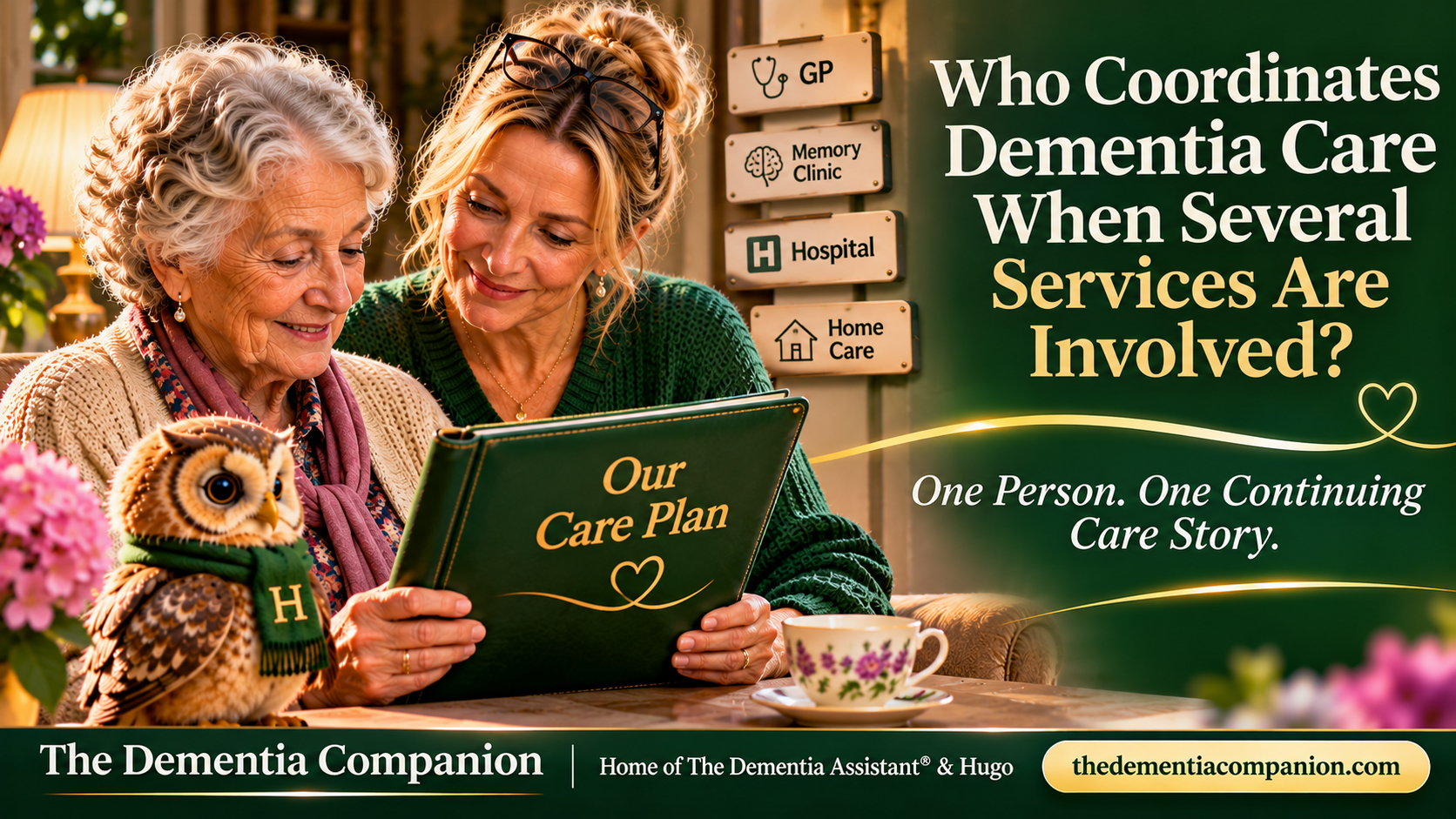
Who Coordinates Dementia Care When Several Services Are Involved?
The GP has one record. The hospital has another. The memory clinic has its own. But who is keeping the whole picture together?
By Louise Donaghy, Dementia Practitioner, Founder of The Dementia Companion and The Dementia Assistant®, and Creator of Hugo Intelligence™
There’s a moment in dementia care when you realise you’ve accidentally acquired a second job.
Nobody advertised it.
You certainly didn’t apply.
And the pay is dreadful.
But somehow you’ve become the family appointment secretary, medication information finder, hospital letter organiser, GP telephone operator and unofficial coordinator of several different services.
All while trying to remain somebody’s daughter, son, husband, wife or friend.
You ring the GP.
The GP asks whether you’ve spoken to the memory clinic.
The memory clinic suggests contacting social services.
Social services ask what the hospital recommended.
The hospital says the discharge information was sent to the GP.
And somewhere in the middle of all this, Mum is sitting in her favourite chair wondering whether anyone would like a cup of tea.
So who is actually responsible for coordinating dementia care when several services are involved?
In England, NICE recommends that people living with dementia have a single named health or social care professional responsible for coordinating their care. This person should help organise appropriate support and ensure the care plan is reviewed as needs change.
But there is another important part of the picture.
The person living with dementia and their family should also have the opportunity to maintain their own continuing care information.
Not because the family should replace professional coordination.
But because the person’s life and wishes don’t belong to one organisation.
And that is the principle behind One Person. One Continuing Care Story.
Who is responsible for coordinating dementia care?
Dementia care can involve several services, each with different responsibilities.
The GP may manage general health concerns and prescriptions.
The memory clinic may assess cognitive changes and provide specialist follow-up.
A dementia nurse may offer support with complex needs.
Social care services may assess practical support requirements.
A care agency may provide assistance at home.
Hospitals may become involved when the person needs treatment for another illness.
All these services may contribute to good care.
But somebody also needs to consider how their work fits together.
NICE guidance recommends that a person living with dementia should have a named professional responsible for coordinating their care.
That professional might be a GP, community nurse, social worker, dementia specialist or another appropriate practitioner, depending on local arrangements.
Their role may include helping the person access services, developing and reviewing care plans, supporting communication and identifying changing needs.
The family should be able to ask who is coordinating the care and how to contact them.
This is not an unreasonable request.
It is an important part of understanding the support arrangements.
What if nobody has told us who the care coordinator is?
Start by asking the GP practice or memory service.
You might say:
“Mum has dementia and several services are now involved. Could you tell us who is responsible for coordinating her care and who we should contact when her needs change?”
Ask whether there is an agreed care and support plan.
Ask who reviews it.
And ask what happens when another service becomes involved.
If there is no clear named contact, ask how care coordination is arranged locally and request help identifying the appropriate service.
Availability and arrangements may differ across the UK.
In England, the NICE recommendation provides a useful basis for that conversation.
Why does dementia care become so fragmented?
Often, it isn’t because nobody cares.
Many professionals are working under considerable pressure and doing their best within the responsibilities of their particular service.
The difficulty is that different organisations have different roles, different record systems and different information.
A hospital may know why Mum was admitted last month.
The GP may know her current prescriptions.
The memory clinic may have information about her diagnosis.
The home care provider may know which daily tasks she receives support with.
But no individual record necessarily captures every detail about Mum’s life.
Her favourite activities.
How she prefers to communicate.
What helps when she’s worried.
The things she can still do independently.
The changes her daughter noticed last weekend.
Or what Mum herself wants to happen next.
These details can be important in understanding the person.
And families are frequently the ones trying to keep them together.
The difficulty isn’t simply having different records. It’s making sure the right information reaches the right people, when it is needed.
Does the family have to coordinate everything?
No.
And this is something I feel strongly about.
Family members often provide extraordinary amounts of practical and emotional support.
They notice changes.
They accompany loved ones to appointments.
They help explain preferences and routines.
They advocate when something doesn’t feel right.
But they should not be expected to replace professional care coordination.
A daughter should not have to become a medical administrator simply because her mother has dementia.
A husband should not be expected to understand every part of health and social care legislation to obtain support for his wife.
And a family should not have to solve every communication gap between organisations by themselves.
Families deserve professional support as well as practical tools.
Their knowledge should be respected.
Their involvement should be welcomed where appropriate.
And their own wellbeing matters too.
What should a dementia care coordinator actually do?
The specific responsibilities depend on the professional role and local services.
However, coordinated dementia care should help address several important areas.
Understanding the person’s needs and wishes
A professional care plan should be based on the person’s actual circumstances.
Not simply their diagnosis.
It should consider strengths, preferences, communication needs, health, daily life and the support the person wants.
Helping services work together
Where appropriate, the coordinator may help ensure relevant professionals communicate and support arrangements are reviewed.
For example, if someone returns home from hospital with additional needs, appropriate follow-up may be required.
Reviewing the care plan
A dementia care plan should be reviewed when circumstances change and at appropriate intervals.
What worked six months ago might not be right today.
Equally, a temporary difficulty following an illness should not automatically be assumed to represent permanent loss of independence.
Helping the person and family find support
A coordinator may help with referrals, information about local services and identifying further assessments.
But families should be given clear information about who is responsible for particular actions.
If a referral is promised, ask who is making it and when you should expect to hear.
Because “someone will be in touch” is not always the most reassuring sentence in the English language.
What should we do when different professionals give conflicting information?
This can happen.
Perhaps one professional suggests additional support at home.
Another believes the person is managing well.
Or there are different opinions about what assistance is required.
Try not to turn this into a competition over who is right.
Instead, ask for clarification.
You might say:
“We’ve been given different information about Mum’s support needs. Could we arrange for the relevant professionals to review the situation and agree what happens next?”
If there is a named care coordinator, contact them.
Keep a factual note of what each professional has advised, including dates and any written instructions.
Ask for the agreed outcome to be recorded.
If the disagreement involves medication, urgent symptoms or immediate safety, seek clarification directly from the responsible healthcare professionals without delay.
A family-held care plan can help you organise information, but it must not become a substitute for professional clinical decisions.
Why should the person living with dementia have their own care plan?
Imagine Mum sees six different services over the next year.
Each service has an appropriate professional record.
But Mum’s life doesn’t restart with each appointment.
She is still the same woman.
With the same history.
The same relationships.
The same favourite morning routine.
The same preferences about how she wants to be treated.
And the same right to be involved in decisions as far as possible.
A family-held dementia care plan can provide one continuing place to maintain important information about her life.
It can include:
- Her preferences, wishes and routines.
- Her strengths and abilities.
- Relevant diagnoses and health information.
- Current professional contacts.
- Important documents and reports.
- Daily observations.
- Appointment questions.
- Changes in support needs.
- Communication and language preferences.
- What helps her feel comfortable and understood.
This information can continue to be maintained when the professionals around her change.
Not because the family’s records replace professional care plans.
They don’t.
But because Mum and her family deserve a continuing record of their own.
What if Mum wants to control who sees her information?
Then her wishes matter.
A dementia diagnosis does not automatically remove someone’s ability to make decisions.
Capacity depends on the specific decision and circumstances.
The person should be supported to participate in decisions about their care and personal information as far as possible.
That includes deciding who they want involved and what information can appropriately be shared.
A family member providing care may hold valuable information, but that does not automatically mean they are entitled to every confidential medical record.
NHS guidance recognises the contribution unpaid carers make while also emphasising privacy, consent and appropriate information sharing.
The Dementia Assistant® is designed to allow the person or family to maintain their own care information and use sharing features with appropriate permissions.
The guiding principle is simple.
The information is about a person.
That person’s wishes must remain central.
Why is a family-held care record useful when services change?
Let’s imagine a new home care agency is starting.
The previous provider has its own records.
The new provider must carry out its own appropriate assessments and create the professional documentation it requires.
But Mum and her family may already have an organised record of important personal information.
Her routines.
Her communication preferences.
What helps when she’s distressed.
Her interests.
The activities she wants to continue doing independently.
This can help inform the new team’s understanding, with appropriate consent and professional review.
The same principle applies when Mum attends a different clinic, enters hospital or receives new community support.
Different professionals. Different services. One person. One continuing story.
A family’s own record can preserve continuity without pretending that every organisation shares the same computer system.
How can The Dementia Assistant® help families coordinate their own information?
This is where I wanted to create something different.
Not another collection of dementia leaflets.
And not a system that belongs exclusively to a care agency.
The Dementia Assistant® was created to give people living with dementia and their families their own continuing place for care information and support.
Within The Dementia Assistant®, families can:
- Create and maintain personalised dementia care plans.
- Use Hugo Intelligence™ for guided care planning.
- Record daily notes and observations.
- Organise medical letters and relevant documents.
- Preserve Life Story, routines and preferences.
- Prepare information for appointments.
- Use Family Circle to support appropriate family updates.
- Save and categorise conversations with Hugo.
- Access multilingual guidance, dictation and translation.
- Explore dementia learning and practical resources.
The person or family can maintain their own information as professional services change, subject to their account and access arrangements.
This doesn’t replace professional care coordination.
And it doesn’t automatically connect the records of different organisations.
Instead, it gives families their own organised information to help them prepare for conversations and share relevant details appropriately.
That distinction is important.
Because families need support, not another unrealistic promise that technology will solve every problem.
Meet Hugo Intelligence™: When you don’t know who to ask
Sometimes the most exhausting part of dementia care is not knowing where to begin.
Perhaps the memory clinic has recommended something you don’t understand.
Perhaps a care agency has raised a concern.
Perhaps a GP appointment has left you with more questions than answers.
And perhaps you are sitting at home wondering who is supposed to be sorting everything out.
You might ask:
“Hugo, Mum has a GP, memory clinic and home care agency involved. How do I organise the information?”
Or:
“Hugo, the hospital and care agency have given us different advice. How do I prepare questions for them?”
Or even:
“Hugo, I feel like I’m spending all my time chasing appointments and paperwork. Where do I start?”
Hugo Intelligence™ is designed for natural, supportive conversations about dementia care.
You can ask questions, explain your concerns and explore possible approaches without judgement.
Hugo can help you think through which information may be useful, prepare questions and understand general dementia guidance.
He doesn’t replace a care coordinator, diagnose medical problems or make decisions for the person.
But he can be another practical tool in the family’s support system.
Hugo can provide more personalised guidance using a selected care plan
You can ask Hugo general dementia questions without selecting a care plan.
However, when you choose a person’s care plan within The Dementia Assistant®, Hugo can use relevant recorded information about their routines, preferences and circumstances to provide more individualised suggestions.
For example, if Mum prefers information in simple steps and becomes worried by unfamiliar appointments, you can explore ways to prepare her for an upcoming review.
The guidance can consider the person rather than simply the condition.
This is the principle behind Person-Centred Intelligence®.
Save, organise and revisit Hugo conversations
Families may have one question today and another next week.
Perhaps you want to revisit a conversation about coordinating appointments.
Or return to guidance about communicating with care providers.
Or organise discussions about different aspects of Mum’s support.
Within The Dementia Assistant®, you can save, categorise and revisit Hugo conversations.
This gives families a way to maintain continuity in the guidance they explore.
Not another question lost in a long conversation.
Not another document you can’t find.
A place to return to what you’ve discussed.
Saved AI conversations remain educational guidance and do not replace professional records or confirmed clinical instructions.
Multilingual dementia care: One story across different languages
There is another part of care coordination that families sometimes find particularly difficult.
Language.
Perhaps Mum feels more comfortable communicating in Welsh.
Perhaps her first language is Hindi, Irish or Spanish.
Perhaps one relative lives abroad and another speaks a different language.
Or perhaps the person living with dementia finds it difficult to express certain feelings in English.
Language is part of identity, and some people living with dementia may experience changes in how they use different languages.
This varies between individuals.
But the person’s preferred language should be understood and respected.
The Dementia Assistant® supports 12 interface languages and provides dictation and translation capabilities spanning 201 languages.
These features can help families record observations, organise information and communicate across language barriers.
They may also make it easier for people to dictate care notes rather than type them.
Hugo’s conversational approach gives families another way to express questions naturally.
Not every feature is available in every supported language, and important clinical translations need to be checked for accuracy.
For medical assessments, consent discussions and treatment decisions, qualified professional interpreters should be used when necessary.
But families should not have to abandon their familiar language simply because they’re trying to organise dementia care.
One person. One continuing care story. Across languages and across services.
What if several relatives are involved in Mum’s care?
This is where things can become interesting.
Your sister arranges the GP appointments.
Your brother visits at weekends.
You organise the care agency.
Your cousin lives abroad.
And somebody has made a family WhatsApp group that now contains approximately eight thousand messages, three appointment photographs and a video of a dancing cat.
Everybody wants to help.
But nobody necessarily has the latest information.
A little organisation can make an enormous difference.
Start by agreeing which relatives are involved, what responsibilities they have and how important updates will be communicated.
Involve Mum in those decisions as far as possible.
Share only information that is appropriate and necessary.
The Dementia Assistant® includes Family Circle features to support relevant family communication, subject to permissions and the person’s wishes.
The aim isn’t to make everyone responsible for everything.
It’s to help families work together without losing sight of the person at the centre.
How do we prepare for a meeting involving several care professionals?
Sometimes a meeting is arranged to review a person’s care needs.
There may be a GP, social worker, nurse, therapist or care provider involved.
That can feel intimidating, especially if you’re unsure what everyone does.
Before the meeting, ask what it is intended to achieve.
If the person living with dementia wishes, help them prepare their own questions and priorities.
Then consider bringing:
- An up-to-date summary of the person’s wishes and preferences.
- Relevant changes in daily life or support needs.
- A current professional medication list, if relevant.
- Important letters or care documents.
- Questions about unresolved concerns.
- Details of any support arrangements that aren’t working.
- Information about what the person can still manage independently.
During the meeting, ask who will carry out each agreed action and when.
Afterwards, request a clear record of decisions and follow-up responsibilities.
You can update the family’s own care information with confirmed outcomes.
The purpose is not to replace the professional care plan.
It is to help ensure the person and family understand what’s been agreed.
When should families seek additional support?
If care arrangements are unsafe, essential support is missing or a serious concern is being passed between organisations without resolution, don’t simply keep adding notes.
Contact the relevant responsible professional or service.
Ask for the concern to be escalated or for a care review where appropriate.
If you believe someone is experiencing abuse or neglect, use the appropriate adult safeguarding arrangements.
For urgent medical concerns, seek prompt clinical advice.
A family-held care record can help you provide factual information.
But it should never delay reporting a serious concern.
And if caring responsibilities are affecting your own wellbeing, ask about support for unpaid carers.
A carer’s assessment may be available through the relevant local services, with arrangements differing across UK nations.
Families shouldn’t have to reach breaking point before asking for help.
A practical dementia care coordination checklist
If several services are involved, consider the following:
- [ ] Who is Mum’s named professional care coordinator?
- [ ] Does she have an agreed professional care and support plan?
- [ ] Who is responsible for reviewing that plan?
- [ ] Which services are currently involved?
- [ ] What is each service responsible for?
- [ ] Who should we contact when needs change?
- [ ] Are any referrals or appointments outstanding?
- [ ] Is the current medication information accurate?
- [ ] Have Mum’s communication needs and preferences been recorded?
- [ ] Is her independence being supported wherever possible?
- [ ] Does Mum understand and agree with the arrangements as far as possible?
- [ ] Are family members involved appropriately, with her wishes respected?
- [ ] Are any concerns about safety or unmet needs unresolved?
- [ ] Can relevant information be organised within the family’s own care plan?
- [ ] Do we know what will happen next?
You don’t have to solve every question today.
Start by identifying the main professional contact.
Then make sure the person’s wishes are understood.
The rest can be approached one manageable step at a time.
The system may have many records. The person has one life.
This is the part I want people to remember.
A woman living with dementia may encounter numerous professionals during her care journey.
Each service has important responsibilities.
Each may keep its own records.
Each may see a different part of her needs.
But Mum isn’t ten different people.
She is one person.
With one history.
One identity.
Her own preferences, strengths, relationships, memories and wishes.
The professionals around her may change.
Her support needs may change.
The places where she receives care may change.
But her story deserves continuity.
That is why I believe the person living with dementia and their family should have their own continuing care information.
Not so they have to coordinate every service themselves.
But so the person doesn’t become lost between them.
⸻
Ask Hugo: Coordinating Dementia Care
Hugo, who is responsible for coordinating Mum’s dementia care?
Hugo 🦉: In England, NICE recommends that people living with dementia have a named health or social care professional responsible for coordinating their care.
Ask Mum’s GP or memory service who this person is and how to contact them.
Arrangements may vary across the UK.
Your family can also maintain its own care information, but that doesn’t replace professional coordination.
What if we haven’t been given a named care coordinator?
Hugo 🦉: Contact the GP practice or memory service and ask how Mum’s care is being coordinated.
Explain which services are involved and where you need clarification.
Ask who reviews the care plan and who should be contacted when Mum’s needs change.
Can The Dementia Assistant® help us keep information from different services together?
Hugo 🦉: Yes. The Dementia Assistant® provides personalised care planning, daily notes and document organisation.
You can maintain your own record of relevant information, appointments and observations.
Professional records remain separate, but your family-held information can continue as different services become involved.
Can Hugo help us prepare for a meeting with several professionals?
Hugo 🦉: I can help you organise questions and consider what information may be relevant to discuss.
When you select Mum’s care plan, I can use relevant recorded information to provide more personalised suggestions.
I don’t replace a professional care coordinator or make clinical decisions.
Can I save and organise our conversations?
Hugo 🦉: Yes. You can save, categorise and revisit our conversations within The Dementia Assistant®.
This allows you to return to important guidance as Mum’s circumstances change.
Can Hugo help if our family speaks several languages?
Hugo 🦉: The Dementia Assistant® supports 12 interface languages and provides dictation and translation capabilities spanning 201 languages.
These features can help families organise information and communicate across language barriers.
Important medical information should always be checked for accuracy, with qualified interpreters used where needed.
Can several family members keep up with Mum’s care?
Hugo 🦉: Family Circle features can help appropriately involved relatives share relevant updates.
Mum’s wishes, privacy and access permissions should guide what is shared.
Does Mum lose control of her care plan because she has dementia?
Hugo 🦉: No. A dementia diagnosis does not automatically remove someone’s ability to make decisions.
Mum should be supported to express her wishes and participate in decisions as far as possible.
Her care plan should reflect her voice, not simply the views of everyone around her.
Is The Dementia Assistant® only for professional care organisations?
Hugo 🦉: No. People living with dementia and their families can have their own account and maintain their own continuing care information.
Professionals and organisations may also use the platform, but the family doesn’t need to belong to a care company to use it.
How much does The Dementia Assistant® cost?
Hugo 🦉: The Family subscription is £4.99 per month.
All subscriptions include a 30-day complimentary trial.
You can explore Hugo Intelligence™, personalised care plans, daily notes, Family Circle, saved conversations and multilingual support.
⸻
One Person. One Continuing Care Story.
When someone is diagnosed with dementia, their journey may involve GPs, memory clinics, dementia nurses, hospitals, home care agencies and other professionals.
Each service may keep its own records.
Families often find themselves repeating the same information, explaining the same routines and trying to make sure important details aren’t lost between appointments.
But dementia care shouldn’t feel fragmented across ten different organisations.
The Dementia Assistant® was created to put the person living with dementia and their family at the centre of their own continuing care information.
From the first concerns about memory, through diagnosis, changing needs and later-life care, the person or family can build and maintain their own person-centred care plan.
A place to record what matters.
A place to preserve wishes, strengths and routines.
A place to organise medical information, documents and daily observations.
A place to prepare for appointments and appropriately share relevant details.
And with Hugo Intelligence™, a place to have natural conversations, save and revisit guidance, explore personalised approaches and benefit from multilingual tools.
The Dementia Assistant® doesn’t replace professional medical records, care plans or care coordinators.
It gives the person and family their own organised information alongside professional care.
Different professionals. Different services. One person. One continuing story.
Meet Hugo and The Dementia Assistant®
Created by dementia practitioner Louise Donaghy and powered by Person-Centred Intelligence®, The Dementia Assistant® brings together:
- Hugo Intelligence™ for conversational, person-centred dementia guidance.
- Guided, personalised care planning.
- Family-held continuing care information.
- Daily notes and observations.
- Document organisation.
- Saved and categorised Hugo conversations.
- Life Story, Memory & Moments and Family Circle.
- Multilingual support, dictation and translation.
- Dementia education and practical resources.
Every subscription includes a 30-day complimentary trial.
Explore The Dementia Assistant®:
https://thedementiaassistant.com/
The Dementia Companion, home of The Dementia Assistant® and Hugo 🦉
https://thedementiacompanion.com/
Louise and Hugo ❤️🦉
Louise Donaghy
Founder & CEO of The Dementia Assistant®
Created and powered by Person-Centred Intelligence®
Creator of Hugo Intelligence™
⸻
References and Further Reading
- NICE: Dementia, Assessment, Management and Support (NG97)
National guidance recommending a named professional to coordinate dementia care, alongside person-centred care planning and ongoing support.
https://www.nice.org.uk/guidance/ng97/chapter/recommendations
- NICE: Dementia Quality Standard, Coordinating Care (QS184)
Explains the importance of having a named practitioner responsible for coordinating health and social care.
https://www.nice.org.uk/guidance/qs184/chapter/quality-statement-4-coordinating-care
- GOV.UK: After a Diagnosis of Dementia, What to Expect From Health and Care Services
Official England guidance about care planning, professional contacts and post-diagnostic support.
- NHS: Dementia, Social Services and the NHS
Information about healthcare responsibilities, care needs assessments and accessing social support.
https://www.nhs.uk/conditions/dementia/care-and-support/social-services-and-the-nhs/
- NHS: Help and Support for People With Dementia
Practical information about dementia care plans, support services and help available to families.
https://www.nhs.uk/conditions/dementia/care-and-support/help-and-support/
- NHS England Digital: Sharing Information With Unpaid Carers
Guidance about confidentiality, recognising the contribution of unpaid carers and appropriately sharing information.
- Dementia UK: After a Diagnosis of Dementia, Next Steps Checklist
Practical guidance about post-diagnostic arrangements, care planning and support for people living with dementia and their families.
⸻
Important information: This article provides general educational guidance and does not replace medical, legal, safeguarding or professional care-coordination advice. NICE recommendations and health and social care arrangements should be interpreted in the context of the relevant UK nation and local services.
Reviewed: 20 November 2026
You May Also Find Helpful
Need help with your own situation? Ask Hugo.
One Person. One Continuing Care Story. The Dementia Companion is where you discover guidance. Inside The Dementia Assistant®, talk with Hugo, save and categorise conversations, record daily notes and involve authorised supporters in a continuing care plan centred around the person.
Ask Hugo About This · Start Your Continuing Care Plan — Families · Continuing Care Planning — Professionals
Personal guidance requires the appropriate account and subscription access. Care-plan information is used only with authorised access and the required consent and selection steps. All subscription plans include a 30-day complimentary trial.