Mum Wants to Stay at Home With Dementia. What Support Can Help?
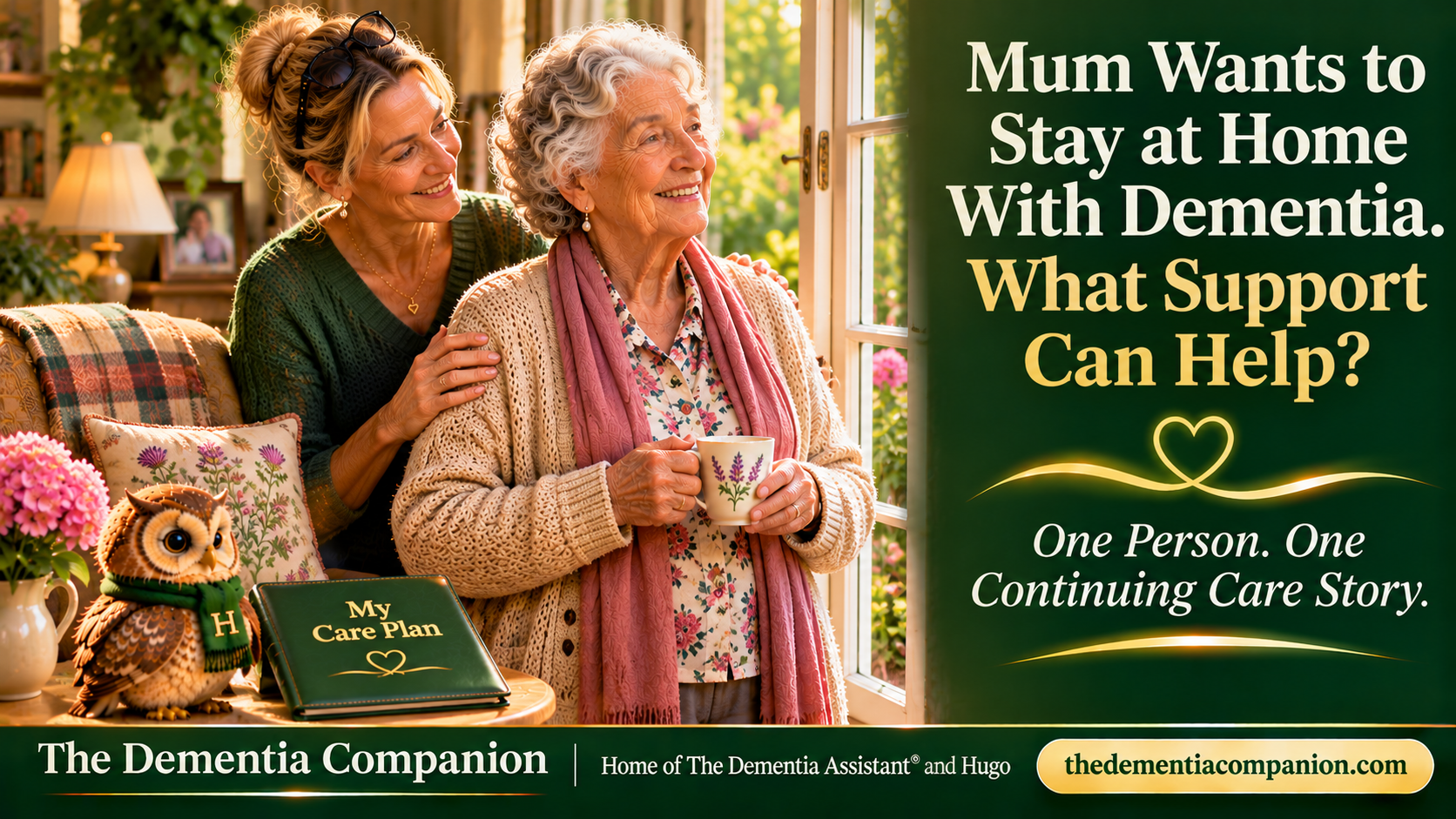
She knows every creaky floorboard, every photograph on the mantelpiece and exactly how she likes her tea. So when Mum says she wants to stay at home, perhaps the first question shouldn’t be whether she can. Perhaps it should be what support would help her.
By Louise Donaghy, Dementia Practitioner, Founder of The Dementia Companion and The Dementia Assistant®, and Creator of Hugo Intelligence™
“I’m not leaving my home.”
Mum says it quite firmly.
She’s sitting in her favourite chair, looking out towards the garden she’s spent years looking after.
She’s lived here for forty years.
She knows where everything belongs.
Including the good biscuits that she insists nobody else has discovered.
And now, because she’s been diagnosed with dementia, people have started discussing whether she can continue living there.
Her daughter is worried.
Her son thinks she should move closer to family.
Somebody has suggested a care home.
And Mum has made her position perfectly clear.
She’s staying put.
But underneath the family’s concerns is a very real question.
Can someone with dementia continue living safely and independently at home?
Yes, many people can, sometimes for years, with appropriate support.
A dementia diagnosis does not automatically mean someone must leave their home, stop making decisions or give up familiar routines.
The important thing is to understand the person’s individual abilities, wishes, support needs and any risks that require assessment.
For some people, a few practical adjustments are enough.
Others may benefit from professional home care, equipment, rehabilitation or more regular support.
And as circumstances change, the arrangements may need reviewing.
The aim isn’t to keep someone at home at any cost. It’s to understand how they can live well, safely and with dignity in the place they want to be, for as long as that remains an appropriate option.
Because home is rarely just an address.
And Mum deserves to remain at the centre of decisions about hers.
Can someone with dementia live at home independently?
Absolutely, depending on their circumstances.
Many people living with dementia continue managing familiar activities, maintaining relationships, enjoying hobbies and making everyday decisions.
Some live with a partner.
Some live alone.
Others receive help from family, friends or professional carers.
The level of support needed varies enormously.
A person with early dementia may still manage most daily activities independently.
Another person may need help with medication arrangements, meals or personal care.
Someone else may benefit from regular professional support while continuing to make many of their own choices.
The NHS explains that people living with dementia can remain independent for longer with suitable support, equipment and adjustments to their environment.
But independence shouldn’t be confused with doing absolutely everything without help.
Independence can also mean choosing how you live and receiving the support necessary to maintain those choices.
Mum may need assistance preparing dinner.
That doesn’t mean she cannot choose what she eats.
She may need someone to accompany her shopping.
That doesn’t mean she should lose the pleasure of choosing her own clothes.
She may welcome help with household tasks.
That doesn’t mean somebody else gets to rearrange her entire kitchen.
And believe me, some mothers have very strong opinions about where the mugs belong.
Quite right too.
Start with what matters to Mum, not simply what worries the family
When families begin considering dementia support at home, the conversation often focuses on problems.
Is Mum forgetting appointments?
Can she manage the cooker?
Is she taking her medication correctly?
Will she answer the door to a stranger?
These concerns may be important.
But they are only part of the picture.
Before deciding what support might help, ask Mum what matters most to her.
Perhaps she wants to continue:
- Living in her own home.
- Walking in the garden.
- Preparing her breakfast.
- Visiting a favourite café.
- Seeing friends and neighbours.
- Choosing how her day is organised.
- Spending time with her pets.
- Making her own decisions wherever possible.
Then ask where she would welcome assistance.
You might say:
“Mum, I know staying at home matters to you. Is there anything that’s becoming more difficult that we could make a little easier?”
Or:
“What would help you feel comfortable and confident here?”
Try not to begin by announcing everything the family believes she can no longer manage.
She may see things differently.
And her perspective deserves to be heard.
Person-centred dementia care begins with the individual, not a list of services.
What support can help someone with dementia stay at home?
There isn’t one package of support that suits everybody.
The most helpful arrangements depend on the person’s abilities, preferences, health, home environment and circumstances.
Here are seven areas worth exploring.
- A little help with everyday routines
Sometimes the first useful adjustment is very small.
Perhaps Mum benefits from a familiar calendar.
Perhaps she prefers a reminder about appointments.
Perhaps organising clothes the night before makes mornings easier.
Perhaps a written shopping list helps her continue visiting the local shop.
The NHS recommends practical adjustments that can make everyday tasks more manageable.
But remember that not every person wants reminders everywhere.
A house covered in labels and instructions can feel overwhelming or intrusive.
Start with something Mum actually finds helpful.
Ask whether she wants to try it.
And don’t introduce ten changes on the same afternoon.
Even without dementia, most of us would find it rather unsettling to return home and discover somebody had reorganised the entire house.
- Professional home care
Home care, sometimes called domiciliary care, involves paid support provided in the person’s own home.
Depending on assessed needs and the service arranged, carers may assist with:
- Washing and dressing.
- Getting ready in the morning.
- Meals and drinks.
- Agreed medication support.
- Household routines.
- Companionship.
- Getting out and about.
- Other appropriate everyday activities.
Support might involve occasional visits, daily visits or more extensive arrangements.
Some families also explore live-in care, although this requires careful consideration of the person’s needs, costs and the actual level of support provided.
Having a carer visit doesn’t mean Mum has surrendered her independence.
A good carer should work with her.
Not simply arrive, take over and complete a list of tasks.
The right support should allow Mum to remain involved in her own daily life.
- Occupational therapy and home adaptations
An occupational therapist can assess how someone manages everyday activities and consider practical adjustments that may help.
This might involve:
- Improving access around the home.
- Considering suitable bathroom equipment.
- Reviewing furniture or seating.
- Identifying potential trip hazards.
- Exploring appropriate kitchen adaptations.
- Advising on aids for daily living.
Some changes are simple.
Better lighting.
A clearer route between rooms.
More accessible storage.
Other changes may require specialist assessment.
It’s important not to purchase equipment simply because a website says every person with dementia needs it.
The person’s abilities, preferences and the layout of their home matter.
And familiar surroundings can be reassuring, so major changes should be considered carefully.
The best adaptation is one that helps Mum use her home, not one that makes it feel unfamiliar.
- Assistive technology and reminders
Technology can sometimes help someone maintain independence.
Depending on their abilities and preferences, options may include:
- Simple reminder devices.
- Large, easy-to-read clocks.
- Calendar displays.
- Personal alarms.
- Appropriate telecare systems.
- Medication reminder arrangements agreed with professionals.
- Communication devices.
- Equipment that supports everyday activities.
But technology needs to suit the individual.
A complicated device may create more frustration than it solves.
A personal alarm may be helpful for one person but unsuitable for someone who cannot recognise when or how to use it.
And monitoring technology raises important questions about privacy, consent and dignity.
An app, alarm or sensor should never be treated as a complete replacement for the human support a person actually needs.
Ask what problem the technology is intended to solve.
Then consider whether Mum wants it and can use it reliably.
- Health and rehabilitation support
Living with dementia doesn’t mean other health needs disappear.
Mum may also need support with:
- Mobility or balance.
- Pain.
- Hearing or vision.
- Nutrition and hydration.
- Medication reviews.
- Other long-term conditions.
- Rehabilitation following illness.
Her GP may be able to arrange relevant assessments or referrals.
Depending on the circumstances, physiotherapy, occupational therapy, community nursing, dietetic or speech and language therapy support may be appropriate.
And if Mum develops new symptoms, don’t assume they’re caused by dementia.
Pain, infection, medication effects and other medical problems may affect how someone manages at home.
A new or sudden change deserves appropriate assessment.
- Companionship, activities and community support
This is particularly important.
A person’s life should not become a timetable of medication, meals and personal care.
Mum might enjoy:
- A weekly social group.
- Gardening.
- Walking.
- Visiting friends.
- Community activities.
- Music.
- A familiar hobby.
- A regular coffee with somebody she likes.
Meaningful activities and relationships can support wellbeing and connection.
Some people welcome dementia-specific groups.
Others prefer continuing ordinary community activities.
Neither is automatically better.
Ask Mum what she enjoys.
And remember that companionship isn’t simply about keeping someone occupied.
It’s about human connection.
A lovely afternoon discussing the garden may be far more meaningful than an activity somebody else has decided she ought to enjoy.
- Support for the family carer
Sometimes the support Mum needs also depends on the wellbeing of the people around her.
Perhaps Dad is managing most of her care.
Perhaps her daughter visits every morning.
Perhaps a son manages appointments while working full time.
And everyone insists they’re fine.
Until they’re not.
A carer’s assessment, additional home support, respite arrangements or practical help may make the situation more sustainable.
Supporting Mum to remain at home shouldn’t mean expecting one exhausted family member to provide unlimited care.
The person’s wellbeing matters.
And so does the wellbeing of the people supporting them.
How can we make Mum’s home more dementia-friendly?
A dementia-friendly home doesn’t need to look like a hospital.
In fact, I would strongly argue that it shouldn’t.
Home should still feel like home.
The NHS and Alzheimer’s Society recommend considering practical adaptations that support everyday functioning.
These might include:
Good lighting
Help make important areas easier to see, particularly stairs, bathrooms and hallways.
Clear routes
Reduce unnecessary clutter and address obvious trip hazards, while respecting familiar belongings.
Useful contrast
In some circumstances, making switches, toilet seats or everyday items easier to distinguish from their surroundings can help.
Familiar objects
Keep meaningful possessions, photographs and furniture arrangements wherever practical.
Accessible everyday items
Arrange frequently used things so Mum can find and reach them comfortably.
Appropriate safety equipment
Ask professionals about equipment where particular risks have been identified.
The important thing is to consider Mum’s individual needs.
For example, removing a rug may reduce a trip hazard.
But moving every piece of furniture overnight might leave someone feeling disorientated.
A thoughtful assessment is better than making changes based on assumptions.
And remember to involve Mum.
It’s her home.
What if Mum lives alone with dementia?
Living alone with dementia does not automatically mean somebody is unsafe.
Some people continue living alone successfully with suitable support.
Others may need increasing assistance as circumstances change.
Start by looking at the person’s actual abilities and support arrangements.
Does Mum manage meals?
Does she have reliable access to help?
Can she communicate concerns?
Are appointments and medication arrangements working?
Does she enjoy social contact?
Have there been difficulties with safety or everyday activities?
If concerns arise, ask for a professional assessment rather than deciding solely on the basis of the diagnosis.
Alzheimer’s Society and Dementia UK both provide specific guidance for people living alone with dementia.
And please remember that support should not become unwanted surveillance.
The person should remain involved in decisions about visitors, monitoring and sharing information wherever possible.
Living alone and being lonely are not the same thing.
Mum may cherish her privacy.
Equally, she may welcome companionship.
Ask her.
How do we arrange a dementia care needs assessment?
If Mum needs additional support at home, a care needs assessment is a sensible starting point.
In England, contact the adult social care department of the local council where Mum lives.
The assessment is free and considers her daily needs, wellbeing and support requirements.
It is separate from the financial assessment that may determine whether she needs to contribute towards chargeable care.
The assessor should explore what Mum can manage, what support she wants, what help she already receives and what would improve her wellbeing.
You can prepare a few examples of everyday difficulties.
But include her strengths too.
If Mum usually manages her breakfast, say so.
If she needs help with her evening routine, explain that.
If Dad provides assistance that is becoming difficult for him, make sure that is understood.
A care needs assessment is not about proving that Mum can’t manage anything. It’s about understanding what support is actually needed.
What about Scotland, Wales and Northern Ireland?
Support arrangements differ across the UK.
England: Contact local authority adult social care for a needs assessment. Home care charges may depend on a financial assessment, although some NHS or reablement services may be provided without charge under the relevant rules.
Scotland: Contact the local council’s social work department. Free personal and nursing care is available to adults assessed as eligible, but other support and accommodation-related services may have different charging arrangements.
Wales: Contact the local authority’s social services department. Assessments and care support operate under Welsh legislation, with separate charging arrangements.
Northern Ireland: Contact the relevant Health and Social Care Trust, which assesses and arranges health and social care support. Services and charging arrangements differ from those in Great Britain.
Families should always check current local eligibility, availability and funding arrangements.
Does having dementia mean Mum will have to pay for home care?
Not automatically.
But it doesn’t mean every home care service will be free either.
In England, the care needs assessment is free.
If the council identifies eligible care and support needs, it may carry out a financial assessment to establish contributions towards chargeable services.
Someone who does not qualify for council funding may need to arrange and pay for care themselves.
However, certain NHS services and some time-limited support arrangements can be provided without charge.
For people with significant, complex health needs, NHS Continuing Healthcare may be relevant in England, subject to the applicable assessment and eligibility criteria.
Other UK nations have different arrangements.
Don’t assume that a diagnosis alone determines funding.
And don’t assume paying privately means the family should skip a needs assessment.
Understanding the person’s needs should come before deciding how to arrange and fund the support.
How do we choose a good dementia home carer?
This is about much more than finding someone who has an available morning slot.
A good care arrangement should recognise Mum as an individual.
Ask the provider about:
- Dementia training and experience.
- Person-centred care planning.
- Continuity of care workers where possible.
- Supporting independence and choice.
- Communication and language needs.
- Consent and dignity.
- Medication support procedures.
- Safeguarding and complaints.
- How care needs are reviewed.
- What happens when a regular carer is unavailable.
And ask Mum what matters to her.
Perhaps she would prefer a female carer for personal care.
Perhaps she wants somebody who enjoys conversation.
Perhaps she needs a little more time in the morning.
Perhaps she wants to keep making her own breakfast.
A dementia diagnosis doesn’t remove those preferences.
Where possible, a gentle introductory visit may help the person and carer build familiarity.
And regulated care providers must complete their own appropriate assessments and professional records.
A family-held care plan can help them understand Mum, but it doesn’t replace those responsibilities.
What if Mum refuses help at home?
This can be difficult.
Perhaps Mum says:
“I don’t need anybody coming in here.”
Before assuming she’s being unreasonable, consider what the arrangement might feel like from her perspective.
A stranger is coming into her home.
They may be asking about personal things.
They may want to change familiar routines.
And everybody seems to be discussing what she needs without asking what she wants.
I’d probably have a few questions myself.
Try understanding the concern.
“Mum, is it the idea of somebody coming in that worries you, or is there something about the help itself?”
She might prefer a different time.
A shorter visit.
A particular carer.
Or support with something she actually wants help doing.
Don’t assume refusal is caused by dementia.
A dementia diagnosis does not automatically remove decision-making capacity.
If essential needs remain unmet and there are significant safety or capacity concerns, seek advice from appropriate health or social care professionals.
Avoid routinely using pressure or deception to overcome the person’s objections.
The aim is to build support around Mum, not make Mum surrender control to receive it.
When is living at home no longer meeting someone’s needs?
This deserves a thoughtful answer.
Because families sometimes fear that asking the question means they’ve given up.
It doesn’t.
A person’s support arrangements may need reviewing when:
- Essential care needs are repeatedly unmet.
- There are serious or recurring safety concerns.
- The person is experiencing frequent distress without adequate support.
- Mobility or physical health needs have changed.
- Necessary night-time support isn’t available.
- Current services cannot provide the assistance required.
- The person no longer wants the existing arrangement.
- The main family carer is becoming unable to continue safely.
These concerns don’t automatically mean the answer is residential care.
They mean the existing arrangements need assessment and potentially changing.
Sometimes additional home support is appropriate.
Sometimes equipment, rehabilitation or changes to the care package can help.
And sometimes a different care setting may be the most suitable option.
That decision should involve the person as far as possible, their wishes, professional assessments and the relevant legal framework.
Remaining at home should never be treated as a test of how much a family loves someone.
Good care is about the person receiving appropriate support, wherever that support is provided.
Why should Mum have her own continuing dementia care plan?
Now we come to something I feel particularly strongly about.
Imagine Mum starts with a little help at home.
Later, she needs a care needs assessment.
A GP reviews her medication.
An occupational therapist suggests equipment.
A new home carer begins visiting.
Perhaps she has a hospital admission.
Each professional service has its own records and responsibilities.
But Mum doesn’t become a different person every time another professional walks through the door.
Her preferences remain important.
Her routines remain familiar.
Her life story doesn’t change.
And the family shouldn’t have to begin explaining everything from scratch with every new service.
This is the principle behind One Person. One Continuing Care Story.
A family-held dementia care plan can help preserve:
- Mum’s wishes and preferences.
- Her strengths and abilities.
- Important routines and relationships.
- Communication and language preferences.
- Relevant health information.
- Current professional contacts.
- Daily observations.
- Care arrangements.
- Important documents.
- Changes in support needs.
- Questions for appointments and care reviews.
The Dementia Assistant® was created to give people living with dementia and their families their own continuing place for this information.
Not a record belonging exclusively to a care agency.
Not a plan that automatically ends when one provider stops visiting.
But information the person or family can maintain as circumstances change, subject to the person’s wishes and the platform’s access arrangements.
Professional records remain separate.
The family-held plan complements them.
Different professionals. Different services. One person. One continuing story.
Meet Hugo Intelligence™: When you want to help Mum stay at home but don’t know where to begin
Sometimes families don’t need another long list of everything that might happen.
They need help thinking through what’s happening now.
Perhaps Mum is finding the mornings difficult.
Perhaps Dad is exhausted.
Perhaps the family disagrees about what support is needed.
Or perhaps Mum keeps saying she wants to remain at home and you’re worried about how to make that possible.
You might ask:
“Hugo, Mum has dementia and wants to stay at home. What support should we explore first?”
Or:
“Hugo, Dad is caring for Mum but he’s becoming exhausted. How can we arrange more support without making Mum feel she’s losing control?”
Or:
“Hugo, Mum doesn’t want a home carer. How can we introduce the idea gently?”
Hugo Intelligence™ provides natural, conversational, person-centred dementia guidance within The Dementia Assistant®.
You can explain your concerns in ordinary language.
Ask follow-up questions.
Explore practical approaches.
And work through situations without judgement.
Sometimes you simply want to say:
“Hugo, I’m worried about Mum.”
That’s enough to begin a conversation.
Hugo can help you consider communication approaches, organise questions, understand general care options and prepare for professional discussions.
He cannot determine whether someone is medically safe to remain at home, carry out a statutory assessment or replace qualified professionals.
But he can help families explore the next sensible step.
Hugo can use Mum’s selected care plan
You can ask Hugo general dementia questions without selecting a care plan.
When you select Mum’s care plan, Hugo can use relevant recorded information about her preferences, routines, strengths and circumstances to provide more individualised suggestions.
Perhaps Mum loves her garden.
Perhaps she values choosing her own clothes.
Perhaps she prefers quiet mornings.
Perhaps she becomes uncomfortable when unfamiliar people arrive.
Those details can help you explore practical support that reflects what matters to her.
Not simply generic advice for someone with dementia.
That’s the purpose of Person-Centred Intelligence®. One person at a time.
The guidance should still be reviewed and professional advice sought when needed.
Save and organise your Hugo conversations
Perhaps you ask Hugo about home care today.
Next week, you want to explore equipment.
Later, you need to prepare questions for an assessment.
Within The Dementia Assistant®, you can save, categorise and organise Hugo conversations.
That means you can return to useful discussions without beginning again each time.
Your saved conversations can provide continuity in the questions you’re exploring.
They are not substitutes for medical advice or professional care plans.
But they can help families keep their thinking and guidance organised.
Hugo can help when questions arrive late at night
Sometimes the worrying starts when everybody else has gone to bed.
Perhaps you’re thinking about whether Mum needs more help.
Perhaps you’re concerned about her independence.
Or perhaps you want to prepare for a meeting the following morning.
Hugo offers a place to explore non-urgent dementia questions without needing to wait until someone else is available to talk.
But he isn’t an emergency service.
If Mum suddenly becomes confused, develops serious symptoms or is in immediate danger, seek urgent medical assistance.
In the UK, call 999 for life-threatening emergencies or sudden confusion. Use the appropriate urgent medical service for other time-sensitive concerns.
Hugo provides guidance alongside professional care, not in place of it.
Hugo’s multilingual support: Home is also about language and identity
This matters enormously.
Home isn’t simply somewhere a person lives.
It’s also the familiar language they speak.
The conversations they enjoy.
The culture they recognise.
Perhaps Mum grew up speaking Welsh.
Perhaps Dad prefers Irish, Hindi, French or Spanish.
Perhaps relatives live in different countries.
And perhaps someone living with dementia finds it easier to explain their feelings in the language they grew up using.
Some people living with dementia experience changes in how they use different languages, although this varies considerably between individuals.
We should never assume someone automatically returns to a childhood language.
But we should understand their preferences.
The Dementia Assistant® supports 12 interface languages and provides dictation and translation capabilities spanning 201 languages.
These tools can help families record observations, organise care information and communicate across language barriers.
Hugo’s conversational approach gives people another way to explore questions naturally.
Not every feature is available in all 201 languages.
Important clinical information, medication instructions and consent discussions must be checked for accuracy, with qualified interpreting support used when needed.
And the person’s language preferences should remain part of their own care plan.
Because person-centred dementia care should respect the language in which someone feels most at home.
How can Family Circle help when relatives live far away?
Perhaps Mum’s daughter visits regularly.
Her son lives abroad.
Another family member helps with shopping.
And someone else attends medical appointments.
Everybody wants to support her.
But information can become scattered.
One person knows the latest appointment.
Another has the updated care arrangements.
Someone else has a photograph of a document buried somewhere in a family message.
The Dementia Assistant® includes Family Circle features to support appropriate family updates and communication.
Families can organise relevant information while respecting the person’s wishes, privacy and access permissions.
But sharing information should never become an excuse to monitor every detail of Mum’s life.
Not everyone needs access to everything.
The goal is to support the person and help the family work together.
What if the person caring for Mum is becoming exhausted?
Then this needs attention too.
Perhaps Dad is managing beautifully most of the time.
But he’s tired.
He’s cancelling his own appointments.
He rarely goes out.
And he’s becoming increasingly worried about leaving Mum alone.
Or perhaps you’re the person providing most of the support.
Working.
Managing your own family.
Organising care visits.
Answering telephone calls.
Trying to remember everything.
And still being told how wonderfully you’re coping.
Which is lovely.
But sometimes you’d rather somebody came and did the washing.
Family carers deserve appropriate support.
In England, unpaid carers can request a free carer’s assessment through the local council.
Other UK nations have their own assessment arrangements.
It may also be helpful to explore respite, replacement care, practical help and relevant community services.
Helping Mum stay at home should never depend on somebody else becoming completely exhausted.
A sustainable care arrangement needs to consider everyone involved.
A practical dementia care at home checklist
If Mum wants to remain at home, begin with these questions:
- [ ] Have we asked what Mum wants and what matters most to her?
- [ ] What does she currently manage independently?
- [ ] Where would she welcome additional help?
- [ ] Are there any immediate health or safety concerns?
- [ ] Would a care needs assessment be useful?
- [ ] Could occupational therapy or home adaptations help?
- [ ] Are communication and language preferences understood?
- [ ] Could simple reminders or suitable technology make everyday life easier?
- [ ] Does Mum want companionship or additional social activities?
- [ ] Are medication arrangements safe and professionally reviewed where necessary?
- [ ] Would professional home care help?
- [ ] Does Mum have a say in who provides support and when?
- [ ] Are family caring responsibilities realistic and sustainable?
- [ ] Does the current care plan reflect Mum’s wishes and strengths?
- [ ] Are important documents and professional contacts organised?
- [ ] Does the family know whom to contact when needs change?
- [ ] Are her privacy and independence being respected?
- [ ] Is there a plan to review arrangements when circumstances change?
You don’t have to answer every question today.
Start with Mum’s priorities.
Then address any urgent issues.
And build the right support around her, one manageable step at a time.
Home is more than four walls
I want to finish with something I think families understand deeply.
When Mum says she wants to stay at home, she may not simply be talking about a building.
She may be talking about the sound of the kettle in her own kitchen.
The photographs she’s looked at for years.
The view from her favourite chair.
The neighbours who know her.
The garden she’s cared for.
The dog who believes every visitor has arrived specifically to see him.
And the freedom to decide how she wants to spend her day.
All those things matter.
Of course, needs may change.
Support arrangements may need reviewing.
And sometimes a different living arrangement may eventually become appropriate.
But we should never begin by assuming that dementia has made somebody’s home, preferences or independence irrelevant.
Good dementia care should explore what support helps the person continue living the life they want.
And if Mum wants to stay at home, perhaps our first question should be:
“What would help you keep doing the things that matter to you?”
Because the diagnosis is only one part of her story.
The rest still belongs to Mum.
⸻
Ask Hugo: Staying at Home With Dementia
Hugo, Mum has dementia and wants to stay at home. Can she?
Hugo 🦉: Many people living with dementia continue living at home with suitable support.
The important thing is to consider Mum’s abilities, wishes, health and any support she needs.
A care needs assessment may help identify practical options.
I can help you organise questions, but I cannot determine whether living at home is medically or practically safe for an individual.
What support can help someone with dementia remain independent?
Hugo 🦉: Depending on the person’s circumstances, support may include practical reminders, home adaptations, occupational therapy, professional home care, companionship or suitable assistive technology.
Begin with what the person wants to continue doing and where they welcome help.
Does a dementia diagnosis mean Mum needs a carer?
Hugo 🦉: Not automatically.
Some people continue managing many everyday activities independently.
Others benefit from specific support.
A professional assessment can help identify needs while preserving independence.
Can Hugo help us create a dementia care plan for Mum at home?
Hugo 🦉: Yes. The Dementia Assistant® includes guided, person-centred care planning.
I can help you explore questions about Mum’s routines, preferences, abilities, support needs and what matters to her.
The person or family can maintain their own continuing care information.
Can Hugo use Mum’s own care plan?
Hugo 🦉: Yes, when you select Mum’s individual care plan.
I can use relevant recorded information to provide more personalised suggestions.
Without a selected plan, I can still provide general dementia guidance.
What if Mum refuses professional home care?
Hugo 🦉: Start by understanding her concerns.
Perhaps she feels independent, dislikes strangers or wants a different arrangement.
Explore her preferences and choices.
If essential care needs are unmet or there are significant safety concerns, seek appropriate professional support.
Can I save our conversations about Mum’s care?
Hugo 🦉: Yes. You can save, categorise and revisit Hugo conversations within The Dementia Assistant®.
This can help you return to guidance as Mum’s needs or arrangements change.
Can Hugo help our family in different languages?
Hugo 🦉: The Dementia Assistant® provides 12 interface languages and dictation and translation capabilities spanning 201 languages.
These can help families record and organise care information.
Important clinical and legal information should always be checked for accuracy.
Can Family Circle help relatives living abroad?
Hugo 🦉: Family Circle can support appropriate sharing of relevant updates with involved relatives.
Mum’s wishes, privacy and access permissions should guide what information is shared.
What if Dad is exhausted caring for Mum at home?
Hugo 🦉: His wellbeing matters too.
A carer’s assessment, additional support at home or respite arrangements may help.
In England, unpaid carers can request a free carer’s assessment through their local council.
Can Hugo tell us whether Mum is safe living alone?
Hugo 🦉: No. That requires an individual professional assessment when safety is in question.
I can help you organise observations and prepare questions, but I cannot assess Mum’s home, health or ability to live alone safely.
How much does The Dementia Assistant® cost?
Hugo 🦉: The Family subscription is £4.99 per month.
Every subscription includes a 30-day complimentary trial.
You can explore Hugo Intelligence™, personalised care planning, daily notes, saved conversations, Family Circle and multilingual support.
⸻
One Person. One Continuing Care Story.
When someone living with dementia wants to remain at home, different services may become involved.
The GP.
The memory clinic.
Adult social care.
Home carers.
Occupational therapists.
Community nurses.
Perhaps hospitals and specialist teams.
Each has important responsibilities and professional records.
But the person living with dementia and their family should also have their own continuing place for the information that matters.
A place to preserve wishes and preferences.
A place to record strengths, routines and important relationships.
A place to organise relevant health information, daily observations and documents.
A place to prepare for appointments and care reviews.
And with Hugo Intelligence™, a place to have natural conversations, save guidance, explore personalised approaches and access multilingual support.
The Dementia Assistant® was created to help people living with dementia and their families maintain their own continuing care information, independently of any one professional provider.
It doesn’t replace professional medical records, social care assessments or clinical decisions.
It complements them.
Different professionals. Different services. One person. One continuing story.
Would You Like Hugo to Help Mum Explore the Support She Needs at Home?
If Mum wants to remain in her own home, begin with what matters to her.
Tell Hugo about her routines.
The things she enjoys.
What she manages independently.
And where she might welcome a little support.
The Dementia Assistant® brings together:
- Hugo Intelligence™ for conversational, person-centred dementia guidance.
- Guided Care Planning Centre™ for individual care plans.
- Family-held continuing care information.
- Daily notes and observations.
- Relevant documents and appointment information.
- Saved and categorised Hugo conversations.
- Family Circle, Life Story and Memory & Moments.
- Multilingual support, dictation and translation.
- Dementia education and practical resources.
Created by dementia practitioner Louise Donaghy and powered by Person-Centred Intelligence®, The Dementia Assistant® helps families maintain their own continuing care story as life changes.
Every subscription includes a 30-day complimentary trial.
Explore The Dementia Assistant®:
https://thedementiaassistant.com/
The Dementia Companion, home of The Dementia Assistant® and Hugo 🦉
https://thedementiacompanion.com/
Louise and Hugo ❤️🦉
Louise Donaghy
Founder & CEO of The Dementia Assistant®
Created and powered by Person-Centred Intelligence®
Creator of Hugo Intelligence™
⸻
References and Further Reading
- NHS: Staying Independent With Dementia
Official guidance about living at home, maintaining independence, practical support and telecare.
https://www.nhs.uk/conditions/dementia/living-with-dementia/staying-independent/
- NHS: How to Make Your Home Dementia-Friendly
Practical recommendations for adapting the home while preserving familiarity and independence.
https://www.nhs.uk/conditions/dementia/living-with-dementia/home-environment/
- Dementia UK: Finding Help and Support at Home
Information about professional home care, different support arrangements and accessing assistance.
- Dementia UK: Living Alone With Dementia
Guidance about maintaining independence, assessing needs and exploring support for people who live alone.
https://www.dementiauk.org/information-and-support/living-with-dementia/living-alone-with-dementia/
- Alzheimer’s Society: Living Alone as a Person With Dementia
Advice about organisation, remaining connected and maintaining independence.
https://www.alzheimers.org.uk/get-support/living-with-dementia/person-living-alone
- Alzheimer’s Society: What Equipment Can Improve the Home of a Person With Dementia?
Guidance about aids, equipment and adaptations that may help someone live at home.
- NHS: Getting a Care Needs Assessment
Official information about accessing adult social care assessments in England.
- NHS: Help at Home From a Paid Carer
Information about professional care at home and choosing a suitable service.
https://www.nhs.uk/social-care-and-support/care-services-equipment-and-care-homes/homecare/
- NICE: Dementia, Assessment, Management and Support (NG97)
National guidance on person-centred dementia care, independence, care coordination and ongoing support.
https://www.nice.org.uk/guidance/ng97/chapter/recommendations
- NHS: Carer’s Assessments
Information about support assessments for unpaid carers in England.
https://www.nhs.uk/social-care-and-support/support-and-benefits-for-carers/carer-assessments/
- MyGov Scotland: Care You Can Get at Home
Official Scottish guidance about personal care, practical support and services for maintaining independence at home.
https://www.mygov.scot/care-for-yourself-at-home
- Age Cymru: How to Find Help at Home
Information about Welsh home care services and local authority support.
https://www.agecymru.wales/information-advice/care/find-care-support/how-to-find-help-at-home/
- NI Direct: Staying Independent With Dementia
Official Northern Ireland guidance about living at home with dementia and requesting support through Health and Social Care Trusts.
https://www.nidirect.gov.uk/articles/staying-independent-dementia
- NHS: Sudden Confusion (Delirium)
Guidance about why sudden confusion requires immediate medical assessment.
https://www.nhs.uk/symptoms/confusion/
⸻
Important information: This article provides general educational guidance and does not replace medical assessments, professional care advice, legal advice or statutory social care assessments. Services, eligibility, charging and legal arrangements vary across UK nations and internationally. Sudden confusion and serious acute symptoms need immediate medical attention.
Reviewed: 21 November 2026
You May Also Find Helpful
Need help with your own situation? Ask Hugo.
One Person. One Continuing Care Story. The Dementia Companion is where you discover guidance. Inside The Dementia Assistant®, talk with Hugo, save and categorise conversations, record daily notes and involve authorised supporters in a continuing care plan centred around the person.
Ask Hugo About This · Start Your Continuing Care Plan — Families · Continuing Care Planning — Professionals
Personal guidance requires the appropriate account and subscription access. Care-plan information is used only with authorised access and the required consent and selection steps. All subscription plans include a 30-day complimentary trial.