Mum Seems Fine at the GP but Struggles at Home. How Do I Get Her Needs Heard?
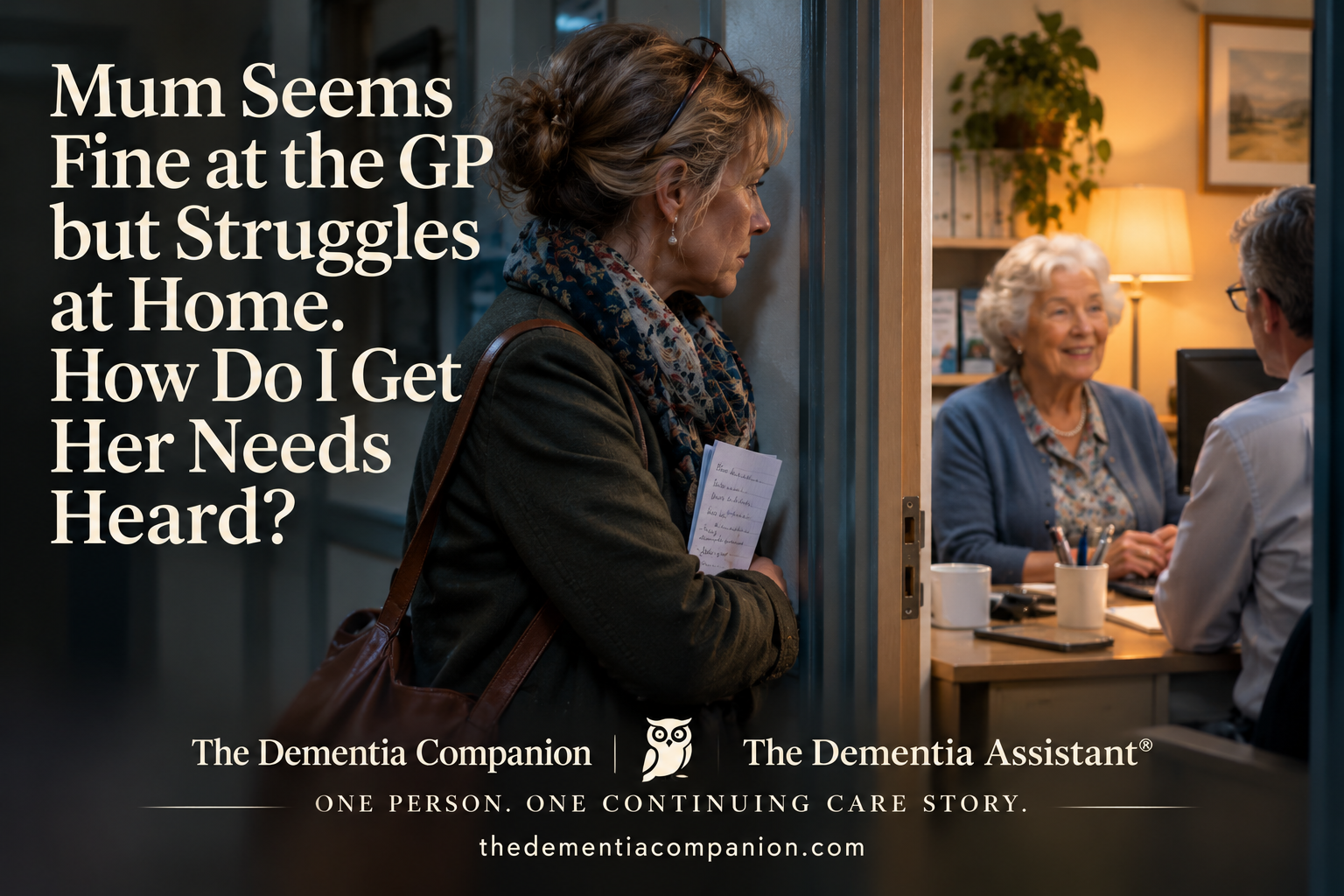
Mum Seems Fine at the GP but Struggles at Home. How Do I Get Her Needs Heard?
One Person. One Continuing Care Story. | Article 29 of 40
By Louise Donaghy, Dementia Practitioner, Founder of The Dementia Companion and The Dementia Assistant®, and Creator of Hugo Intelligence™.
You have been worrying about Mum for weeks.
Perhaps months.
You’ve noticed that she’s forgetting appointments, struggling with medication, becoming confused about familiar routines or finding everyday tasks increasingly difficult.
You may have discovered unpaid bills, spoiled food in the fridge or a kitchen that looks as though somebody started five different jobs and finished precisely none of them.
You’ve helped her get washed, reassured her when she’s frightened and answered the same question more times than you can remember.
Finally, you get an appointment with the GP.
You think, “Thank goodness. Somebody is finally going to see what I’m seeing.”
Then Mum walks into the consulting room.
She smiles.
She introduces herself beautifully.
She tells the doctor she’s absolutely fine.
She’s eating well, sleeping well, managing everything and has no complaints whatsoever.
She even remembers to ask how the doctor is keeping.
And before you know it, she’s chatting away about the weather, the grandchildren and somebody down the road who apparently still hasn’t cut their hedge.
The doctor smiles.
Mum smiles.
And you’re sitting beside her thinking:
Are we talking about the same woman I’ve been supporting at home?
You leave the appointment feeling confused, upset and perhaps even a little foolish.
Because you know what happens when Mum gets home.
And you know that the cheerful, confident woman in the consulting room is only part of the picture.
So what can you do when someone with dementia appears perfectly capable during a medical appointment but is struggling with everyday life at home?
The most important step is to share specific, factual examples of what is happening outside the consultation room.
Keep a record of changes, explain how they affect daily life, and ask the healthcare professional to consider the person’s usual functioning over time, rather than relying only on how they appear during one brief appointment.
You can do this respectfully, without speaking over Mum, embarrassing her or treating her account as unimportant.
And please remember something.
Mum may genuinely be having a good moment during that appointment. That does not mean the difficulties you see at home aren’t real.
Both experiences can be true.
Why does Mum seem fine at the doctor’s appointment but struggle at home?
There are several possible explanations.
And understanding them can help families approach the situation with less frustration.
A short conversation is different from managing an entire day
Think about what a typical medical appointment involves.
Mum arrives somewhere organised.
She is greeted by somebody who explains what to do.
The doctor asks questions.
She answers.
Perhaps she recognises the surgery and knows what is expected of her.
The conversation may last only ten or fifteen minutes.
Compare that with everything involved in managing a day at home.
Remembering medication.
Preparing meals.
Operating appliances.
Managing finances.
Answering telephone calls.
Keeping track of appointments.
Choosing suitable clothing.
Responding when something unexpected happens.
These tasks require different combinations of memory, attention, planning, judgement and problem-solving.
Some may be much harder than participating in a familiar social conversation.
A person can retain strong conversational abilities while experiencing difficulties with more complex everyday activities.
This is why clinical assessments should consider how someone functions in daily life, not simply whether they can hold a pleasant conversation.
Mum may be using familiar social skills
Some people can continue to use well-established social habits even when other abilities have changed.
They may greet people confidently.
They may smile, make jokes and offer familiar answers.
If somebody asks:
“How are you?”
Mum may respond:
“Oh, I’m very well, thank you.”
That may be a response she has given thousands of times throughout her life.
It doesn’t necessarily tell the doctor whether she can remember to eat lunch or take medication correctly.
And we shouldn’t assume she’s deliberately concealing anything.
She may genuinely feel well in that moment.
Some people appear to mask their difficulties
You may hear the term showtiming used in dementia discussions.
It describes situations where someone appears more capable or composed during a social interaction than the difficulties they experience elsewhere might suggest.
The term has been discussed by people living with dementia themselves, including in Alzheimer’s Society publications.
But it is not a diagnosis, and it should not become a convenient label for every difference between home and clinic.
Sometimes a person may consciously try to maintain appearances.
Sometimes they may be drawing on familiar social skills.
Sometimes the structured environment makes the task easier.
And sometimes they are simply having a better period of functioning.
We cannot know precisely what is happening without understanding the individual.
Mum may not recognise the extent of her difficulties
Some people living with dementia have difficulty recognising changes in their own abilities.
This can sometimes involve reduced awareness of particular difficulties, known clinically as anosognosia.
That is different from deliberately denying a problem.
Mum may sincerely believe she is managing everything.
Imagine being told that you have forgotten something when you have no memory of forgetting it.
From your perspective, the accusation might seem completely unreasonable.
That does not mean every person with dementia lacks insight.
Many people are keenly aware of changes and may find them frightening or embarrassing.
Again, we must understand the individual rather than make assumptions.
Does appearing well at an appointment mean Mum doesn’t have dementia?
No.
A person appearing confident, sociable or capable during one appointment does not rule out dementia.
Equally, family concerns alone do not establish a dementia diagnosis.
Memory problems and changes in everyday functioning can have several causes.
Some may be treatable.
Depending on the circumstances, clinicians may need to consider medication effects, depression, sleep difficulties, sensory problems, thyroid disorders, vitamin deficiencies, infection or other health conditions.
A proper assessment considers more than a brief impression.
The National Institute for Health and Care Excellence (NICE) recommends taking a history of cognitive, behavioural and psychological symptoms and their impact on everyday life.
Where possible, that history should include information from someone who knows the person well.
This is a particularly important point.
Your knowledge of everyday changes can be clinically relevant information.
It should be considered alongside Mum’s own account, professional observations, appropriate investigations and assessment findings.
The aim is not to prove Mum wrong.
It is to give the healthcare professional a fuller picture.
What should I tell the GP or memory clinic?
The best information is usually specific.
Not:
“Mum’s dementia is getting terrible.”
Or:
“She can’t do anything anymore.”
Those statements may express understandable frustration, but they don’t tell a professional exactly what has changed.
Instead, describe what you observed.
Give examples of everyday difficulties
For instance:
“On Tuesday, Mum asked whether she’d taken her morning tablets. The tablets were still in the organiser, but she believed she’d already taken them.”
Or:
“Over the past two weeks, Mum has telephoned me most evenings because she doesn’t recognise the time and thinks she has missed an appointment.”
Or:
“Mum has prepared food but forgotten to turn off the cooker twice this month.”
These details give a professional something specific to explore.
Explain what is different from Mum’s usual abilities
This is often more useful than comparing Mum with other people of her age.
You might say:
“Six months ago, Mum managed her own appointments. She now needs reminders and help keeping track of them.”
Or:
“She has always been very organised with money, but recently she has paid the same bill twice and cannot understand why.”
A change from an individual’s previous abilities can be important.
Include what Mum can still do
This is equally important.
If Mum continues to dress independently, enjoy social activities, prepare some meals and make everyday decisions, that deserves recognition.
A useful clinical history should not be a catalogue of failures.
It should describe abilities, difficulties and the support that helps.
You might say:
“Mum is still very confident socially and enjoys meeting friends. She manages her personal care but needs increasing support with medication and appointments.”
That is a much more balanced description.
It respects Mum and helps the professional understand the situation.
Keep a record before the appointment
Families often arrive at appointments with a dozen important things they intended to mention.
Then somebody asks the first question.
The conversation changes direction.
Mum starts talking about her childhood.
And by the time everyone gets outside, you realise you’ve forgotten the three things you most needed to discuss.
It happens.
A little preparation can make an enormous difference.
What should I write down?
For each relevant change, record:
- The date or approximate period when it happened.
- What Mum said or did.
- What the situation involved.
- Whether it was unusual for her.
- How it affected everyday life.
- What help she needed.
- Whether it has happened before.
- Any immediate safety concerns.
- What you did and whether it helped.
Try to separate observation from interpretation.
Instead of: “Mum was being stubborn about her medication.”
Write: “Mum declined her morning tablets. She said she had already taken them. The medication organiser still contained the scheduled dose. Advice was requested from the appropriate professional.”
This is factual, respectful and useful.
Do not make medication changes yourself or give additional doses based on assumptions.
If you are unsure what was taken, seek appropriate medical or pharmacy advice.
A fictional example of a useful appointment summary
Person: Margaret, aged 79
Reason for appointment: Changes in memory and everyday functioning.
Current strengths: Margaret continues to enjoy social visits, dresses independently and manages familiar conversations.
Changes noticed: Over approximately four months, increasing difficulty remembering appointments, following cooking routines and recognising whether medication has been taken.
Examples: Missed two appointments despite reminders. Left a saucepan unattended on two occasions. Required assistance checking medication on several days.
Effects on everyday life: Daughter now provides more support with appointments, meals and medication-related routines.
Other relevant information: Margaret says she is managing well. She becomes upset when difficulties are discussed in front of unfamiliar people.
Family request: Please consider these changes as part of the assessment and advise whether further clinical review, medication support or occupational therapy assessment is appropriate.
Notice that the summary doesn’t try to diagnose Margaret.
It simply presents the information.
That is exactly what a family should aim to do.
How can I raise concerns without embarrassing Mum?
This is where person-centred communication becomes particularly important.
Mum may have always valued independence.
She might have been the person everybody turned to when something went wrong.
Suddenly, her daughter is discussing difficulties she would never have wanted strangers to know about.
That can feel exposing.
Even when the concerns are genuine.
Talk with Mum before the appointment
Where possible, discuss what you would both like the doctor to know.
You might say:
“Mum, I’d like us to make sure the doctor understands how things are going at home. Is there anything you’d particularly like us to ask?”
Or:
“I’ve noticed a few things have become more tiring for you. Would it be all right if we talked about those together?”
Give Mum opportunities to describe her experience.
She may be worried about something you haven’t considered.
Perhaps she struggles with sleep.
Perhaps she is frightened of forgetting things.
Perhaps she has been pretending everything is manageable because she doesn’t want anyone to worry.
We should not assume that the family’s concerns are the only concerns that matter.
Avoid contradicting every answer
Imagine the doctor asks:
“Are you managing your meals?”
Mum replies:
“Yes, perfectly well.”
You immediately say:
“No, you’re not! I have to come round every day because you keep forgetting!”
Even when factually accurate, the delivery may leave Mum feeling humiliated.
A gentler approach might be:
“Mum still enjoys choosing and preparing her meals. We’ve noticed that she’s recently needed a bit more help with the cooking. Could we talk about that?”
Both perspectives can be included.
You are not contradicting Mum’s value as a person.
You are describing a change in support needs.
Ask Mum what she wants you to share
You might agree beforehand:
“I’ll explain the appointment difficulties, and you can tell the doctor how you’ve been feeling.”
Or:
“Would you prefer to explain first, and I can fill in anything we’ve forgotten?”
This supports participation wherever possible.
The aim should never be to make the person disappear from their own appointment.
Can I write to the doctor before the appointment?
Yes, families can often submit information or raise concerns through an appropriate practice or clinic communication route.
Arrangements vary between services.
A short, factual letter or secure message can be particularly helpful when talking openly in front of Mum would cause distress.
For example:
Subject: Relevant observations for Margaret’s forthcoming appointment
“Dear Doctor,
I am writing to share some observations ahead of my mother’s appointment.
Over the past three months, we have noticed changes in her ability to manage medication, appointments and some daily routines.
Mum often presents confidently in conversation, and I am concerned that these everyday difficulties may not be apparent during a short consultation.
I appreciate that her own views are important, and I would be grateful if these observations could be considered as part of her assessment.
I have included a short factual summary of the changes and their impact.
Thank you for your time.”
This is not a complaint about Mum.
It is information that may help the professional understand her circumstances.
Where possible, involve Mum in deciding what to submit.
Do not assume a message will be read before the appointment. Ask the practice how they prefer to receive relevant information.
If there is an urgent risk, use the appropriate urgent care route instead of relying on a routine message.
Can I speak privately to Mum’s doctor?
This is a question many families find difficult.
There is an important distinction between providing information to a healthcare professional and receiving confidential information about a patient.
In Great Britain, General Medical Council guidance explains that clinicians should not refuse to listen to concerns from someone close to the patient simply on the grounds of confidentiality.
However, listening does not automatically give the relative access to the person’s medical information.
The healthcare professional must also respect the patient’s wishes, privacy and applicable confidentiality requirements.
Importantly, a clinician cannot necessarily promise to keep family-supplied information secret from the patient. Information that influences care may become relevant to the medical record or future discussions.
If you need to raise something sensitive, explain that concern before sharing the details and ask how it will be handled.
You might say:
“I have some observations that Mum finds upsetting to discuss. Could you explain the best way to share them while respecting her privacy?”
Arrangements differ internationally.
Where possible, ask Mum’s permission for the clinician to involve you.
If she wishes to speak alone, that preference deserves respect.
If decision-making capacity is in question, professionals must follow the relevant legal framework and assess the particular decision rather than assuming that dementia removes all decision-making rights.
Being a daughter, son, spouse or sibling does not automatically provide authority to receive all confidential information or make medical decisions.
What if the doctor says Mum seems fine?
First, try not to assume that the professional has dismissed your concerns.
A doctor may be considering several possible explanations.
They may need further history, investigations or another appointment.
But if you feel that important information has not been considered, it is reasonable to ask for clarification.
You might say:
“I understand that Mum has communicated well today. Could we also review the changes we’ve recorded in her everyday functioning?”
Or:
“What would you recommend as the next step, given these concerns at home?”
Useful questions include:
- Could another health condition be contributing?
- Would further cognitive or functional assessment be appropriate?
- Is a memory clinic or specialist referral indicated?
- Could medication, sleep, pain, hearing or vision be affecting her abilities?
- Would an occupational therapy assessment help?
- What changes should prompt another review?
- How can we submit additional observations?
- When should we arrange a follow-up appointment?
If concerns persist, consider asking for another appointment or a second clinical opinion through the relevant healthcare system.
The aim is not to win an argument with the doctor.
It is to ensure that Mum receives appropriate assessment and support.
What if Mum performs well on a memory test?
A good performance on a brief cognitive screening test does not automatically settle every concern.
Cognitive tests assess particular abilities under particular conditions.
They do not reproduce every task involved in living independently.
Assessment may also be influenced by factors such as education, language, sensory difficulties and health.
The NHS explains that memory tests, investigations and other assessments contribute to a broader diagnostic picture.
No single screening result should be interpreted in isolation.
If Mum’s daily functioning has changed significantly, ask how those observations will be considered alongside the test results.
It may be appropriate for the clinician to seek further history, investigate other causes or arrange specialist assessment.
Equally, a low test score does not automatically establish a diagnosis.
The person’s entire presentation matters.
What if Mum becomes upset because I’ve told the doctor things she doesn’t remember?
This can be heartbreaking.
Mum may feel betrayed.
She might say:
“Why are you telling people I can’t manage?”
Or:
“There’s nothing wrong with me. You just want to take over!”
Try not to respond by listing everything that has gone wrong.
That usually doesn’t make the conversation easier.
Instead, acknowledge how the situation feels.
You might say:
“Mum, I know that was difficult to hear.”
“I don’t want to take over your life.”
“I want us to understand what support might make things easier.”
Or:
“I know how important your independence is. It’s important to me too.”
And mean it.
If possible, discuss decisions with Mum when she is comfortable and not overwhelmed.
She may need time to understand or consider what has been said.
Some people benefit from written explanations.
Others prefer information to be repeated gently over several conversations.
If Mum has difficulty processing information, adapt the communication.
Do not treat disagreement as automatic evidence that she lacks capacity.
Could Mum’s difficulties be worse at certain times of day?
Yes, some people experience variation in their abilities or symptoms.
Tiredness, poor sleep, pain, sensory difficulties, environmental demands and the effects of illness or medication can all be relevant, depending on the individual.
Certain dementia conditions can also involve fluctuations in attention or cognition.
But a good appointment in the morning and a difficult evening do not, by themselves, identify a particular dementia type.
Consider keeping a record of when difficulties occur.
For example:
“Morning: Mum prepared breakfast with minimal help.”
“Late afternoon: Mum became uncertain about where she was and needed repeated reassurance.”
“Evening: Mum struggled to follow her usual bedtime routine.”
These observations may help the clinician explore patterns.
They should not be used to make an unsupported diagnosis.
When should I seek urgent medical help?
A gradually developing problem with memory or daily functioning should be assessed through an appropriate healthcare pathway.
However, sudden changes are different.
If Mum becomes suddenly confused, unusually drowsy, significantly disorientated or dramatically different from her usual self, seek urgent medical assessment.
Sudden confusion may be caused by delirium or another acute medical condition.
In the UK, NHS guidance advises calling 999 or attending A&E for sudden confusion.
Elsewhere, follow local emergency medical guidance.
New severe weakness, stroke-like symptoms, serious breathing difficulties, collapse or immediate danger also require appropriate emergency action.
Do not wait for an ordinary memory clinic appointment when there is an acute medical concern.
And do not assume that dementia explains every new symptom.
A new health problem deserves proper attention, even when a person already has a dementia diagnosis.
UK, USA, Canada, Australia and Ireland: how families can prepare
Although healthcare arrangements differ, the principle of giving professionals an accurate history is widely relevant.
United Kingdom
A GP is often the first point of contact for memory concerns.
Depending on the person’s circumstances, further assessments or referral to specialist services may be appropriate.
Alzheimer’s Society provides a dementia symptoms checklist and guidance on preparing for appointments.
NICE recommends considering information from somebody who knows the person well during assessment.
Healthcare and social care pathways vary across England, Scotland, Wales and Northern Ireland.
Consent, capacity and legal decision-making arrangements also differ between UK nations.
United States
Families may begin with a primary care physician, geriatrician, neurologist or memory specialist.
The Alzheimer’s Association provides guidance on working with doctors and discussing concerns.
The US National Institute on Aging recognises the importance of information from people who have regular contact with someone being assessed.
Healthcare access, insurance, privacy law and decision-making arrangements vary.
Canada
Families can speak with a family doctor or appropriate healthcare provider.
The Alzheimer Society of Canada offers resources for preparing for assessment and communicating concerns.
Services, referral arrangements and relevant laws differ between provinces and territories.
Australia
A GP can help assess symptoms and arrange further investigations or referrals where appropriate.
Dementia Australia encourages people to prepare information about changes and questions before appointments.
Families can seek advice about additional assessments when concerns remain unresolved.
Healthcare pathways and legal arrangements vary by state and territory.
Republic of Ireland
Families may start with their GP and seek assessment through appropriate healthcare services.
The HSE and Alzheimer Society of Ireland provide information about dementia assessment and support.
Consent, healthcare access and decision-making requirements must follow Irish law.
Across all countries
The person’s preferences and rights remain central.
If a family member needs to contribute observations, ask the healthcare service for the appropriate process.
If language barriers exist, request suitable professional interpreting support.
Do not assume that a relative translating informally is always appropriate for sensitive clinical discussions.
How can the family’s continuing care plan help professionals see the full picture?
Let me give you another example.
This one is fictional, but the situation will be familiar to many families.
Margaret is seventy-nine.
She has recently started experiencing memory difficulties.
Her daughter notices that she is forgetting appointments and struggling to manage medication.
Margaret attends the GP.
She chats confidently.
She remembers the doctor’s name.
She says she is perfectly well.
The GP considers the information available during the appointment.
But what if the family had maintained a record of the past three months?
What if the doctor could see a carefully organised summary of changes in Margaret’s everyday life?
Not simply:
“Mum’s memory is getting worse.”
But:
“Margaret previously managed her appointments independently. She now requires reminders and assistance.”
“She remains confident in social conversations but sometimes struggles to follow unfamiliar instructions.”
“She has become distressed when discussing changes in front of others.”
“She prefers information to be explained slowly and appreciates written reminders.”
Suddenly, the professional has a much fuller picture.
And perhaps just as importantly, Margaret is no longer being described only through her difficulties.
Her strengths, preferences and wishes are visible too.
This is exactly why the family’s own continuing care information matters.
Meet Hugo Intelligence™: when you need help explaining what is happening
Hugo Intelligence™ is the conversational, person-centred dementia guidance system within The Dementia Assistant®, powered by Person-Centred Intelligence®.
Hugo stands for:
H — Human
U — Understanding
G — Guidance
O — One person at a time
Hugo is represented by our owl mascot, but he is far more than a character or a simple question-and-answer chatbot.
Hugo provides a conversational environment where people living with dementia, families, carers and professionals can explore concerns naturally.
You might begin with:
“Hugo, Mum seems completely fine whenever we take her to the GP, but at home she’s forgetting medication, getting confused and needing much more help. How do I explain this without embarrassing her?”
Hugo can help you think about the information the professional may need, how to describe changes factually and how to approach the conversation respectfully.
Hugo can ask follow-up questions
You might begin with a broad concern.
Hugo can help you explore relevant details.
For example:
“When did you first notice the changes?”
“Which everyday activities have become difficult?”
“Does Mum need more support than she did a few months ago?”
“Are the difficulties happening every day or only occasionally?”
“How does Mum feel when you discuss them?”
“Has anything changed in her health or medication?”
“What would you most like the doctor to understand?”
This matters because the first question is rarely the whole story.
Families often begin with:
“Something isn’t right.”
Through conversation, they may become better able to explain exactly what they have noticed and what needs professional attention.
Hugo can help you find the words
Sometimes the most difficult part isn’t recognising a problem.
It’s explaining it.
You might ask:
“Hugo, can you help me describe Mum’s difficulties without making her sound incapable?”
Or:
“How can I explain to the doctor that Mum manages some things well but needs support with others?”
Hugo can suggest respectful wording and help structure questions.
It is still the family’s responsibility to check that the account is accurate and fair.
General Hugo: help without selecting a care plan
You can ask general questions about dementia, appointments, communication and care planning without selecting an individual care plan.
Hugo provides educational guidance based on the question and information you choose to share.
Personalised Hugo: using the selected person’s care plan
This is where the experience can become more individual.
Suppose the family has created a care plan for Margaret.
It includes information about her routines, abilities, communication preferences and changes observed over time.
When the user explicitly selects Margaret’s care plan, Hugo can use relevant information from that plan to help provide more personalised guidance.
For example:
“Hugo, using Margaret’s care plan, help me prepare the main concerns we should discuss at her next memory clinic appointment.”
Hugo can consider the relevant recorded information when helping the user organise the discussion.
Hugo does not automatically access every care plan.
The user must select the individual plan they want considered.
Families can maintain separate care plans for different people.
Any AI-generated summary must be reviewed for accuracy before being shared with professionals.
Hugo cannot independently verify an observation, make a diagnosis or decide whether a referral is clinically necessary.
The Care Planning Centre™: building a record the family can maintain
One of the challenges families face is knowing how to create useful care records.
They may have never written a care plan before.
They might not know what professionals need to understand.
And they may feel overwhelmed by paperwork.
The Care Planning Centre™ helps users develop, organise, review and maintain individual person-centred care plans.
Through guided Talk to Hugo conversations, a user can explore relevant information step by step.
For example:
“What can Mum still do independently?”
“What has changed in her normal routine?”
“Which activities are becoming difficult?”
“What kind of support does she prefer?”
“How does she communicate when upset or confused?”
“What is important for professionals to know?”
Relevant information can be organised into appropriate care-plan sections, subject to user review.
The platform also provides support with reviewing plans, identifying gaps and improving the clarity of professional wording.
The person should remain involved in developing their care information as much as possible.
One individual care plan, not a generic dementia template
Margaret’s plan should be about Margaret.
Her personality.
Her strengths.
Her preferences.
Her medical information.
Her cultural identity.
Her meaningful relationships.
Her routines.
What has changed.
And what matters most to her.
Another person living with the same diagnosis may have completely different needs.
That is why Hugo’s approach is built around one person at a time.
Daily notes: showing what happens between appointments
A GP may see Mum for fifteen minutes.
Her family may be supporting her throughout the week.
The observations made between appointments can help build a more complete picture.
The Dementia Assistant® includes daily notes for recording relevant information.
For example:
Monday: Mum needed help understanding an appointment reminder. She became anxious because she believed she had missed it.
Wednesday: Mum independently prepared breakfast but needed assistance organising lunch.
Friday: Mum repeatedly asked whether her medication had been taken. The dose was checked through the agreed medication support arrangements.
Sunday: Mum enjoyed a family visit and participated confidently in conversation.
Notice that the record includes positive abilities as well as difficulties.
This is important.
Families should be able to describe what somebody can still do, what they enjoy and where additional support is needed.
The aim is not to collect evidence against the person.
It is to support understanding.
Saved Hugo conversations and document organisation
Families often return to the same concerns over several months.
Perhaps the first conversation with Hugo is about preparing for an assessment.
Later, they ask about an appointment result.
Then they may need help understanding an occupational therapy recommendation or discussing changing care needs.
Within The Dementia Assistant®, Hugo conversations can be saved, categorised and revisited.
This helps preserve useful guidance and avoid repeatedly beginning from the first question.
Saved conversations are not verified medical records or professional instructions.
The platform also supports organisation of relevant care documents and information.
Applicable exports include PDF, Word, CSV and JSON.
Families can maintain an accessible record and share appropriate information with professionals, subject to the person’s wishes, consent and access arrangements.
The platform complements original clinical records. It does not replace them.
Family Circle: when different relatives see different things
Sometimes the difficulty isn’t only that Mum seems well during an appointment.
It’s that different family members see different versions of her everyday life.
A daughter may visit every morning.
A son may visit at weekends.
A sibling may live overseas.
One relative says:
“Mum was absolutely fine when I saw her.”
Another says:
“She needed help with almost everything yesterday.”
They may both be describing their genuine experiences.
Dementia care should not become a competition about whose observations are correct.
Family Circle supports appropriate updates and communication between involved relatives.
This can help families build a more consistent understanding, especially when support is shared.
Access should always follow appropriate permissions, privacy requirements and the person’s wishes.
Family involvement does not automatically mean unrestricted access to sensitive information.
Life Story and Memory & Moments: helping professionals see more than the difficulties
Imagine a doctor meeting Mum for the first time.
They see an older woman attending a memory appointment.
But what do they know about her?
Perhaps she worked as a teacher for forty years.
Perhaps she speaks several languages.
Perhaps she raised four children.
Perhaps she has always disliked being rushed.
Perhaps she becomes anxious around unfamiliar people but relaxes when she understands what is happening.
Her history may help professionals understand how she communicates and what support she prefers.
Life Story and Memory & Moments within The Dementia Assistant® help families preserve meaningful personal information.
Important relationships, familiar routines, achievements, cultural identity, interests and valued memories can all contribute to understanding the individual.
The purpose isn’t to overwhelm a busy clinician with somebody’s entire family history.
It’s to make relevant personal information available when it can improve communication, care and dignity.
A person is more than their diagnosis.
And a medical appointment should never be the only opportunity for their story to be understood.
Multilingual support: when language changes what professionals see
Language can make a significant difference during an assessment.
A person may communicate confidently in one language but find another more difficult.
They may have spent years speaking English while feeling more comfortable using a different language in particular situations.
Some people with dementia experience changes in language abilities, but this varies widely between individuals.
We should never assume that everybody returns to a childhood language.
The Dementia Assistant® provides 12 interface languages, with dictation and translation capabilities spanning 201 languages.
This can help families record information, communicate across different countries and preserve relevant details in the person’s preferred language.
It may also be useful when family members need to share observations with relatives who speak different languages.
Not every platform feature is available in all 201 languages.
Translation can introduce errors or lose important context.
For medical appointments, medication information, legal discussions or assessments, professional interpreting and verification should be arranged when appropriate.
A person’s language, cultural background and communication preferences should be respected throughout their care.
Dementia Academy™, crisis guidance and Carer Wellbeing Hub
The Dementia Assistant® includes wider educational and wellbeing support.
The Dementia Academy™ provides learning resources covering dementia understanding, person-centred approaches and practical care topics.
Educational crisis guidance helps families explore when they may need urgent or additional professional support.
Hugo is not an emergency service and cannot provide real-time clinical assessment or intervention.
The Carer Wellbeing Hub recognises that the person supporting somebody with dementia may also be exhausted, anxious or overwhelmed.
And being unable to get a professional to understand what you’ve been seeing at home can be particularly draining.
You may spend weeks preparing for an appointment, only to leave feeling that the most important concerns were never discussed.
You might begin to question yourself.
But you deserve support too.
Ask for another appointment when needed.
Seek advice from dementia support organisations.
Share responsibilities where possible.
And remember that you are allowed to ask professionals to explain their reasoning, next steps and available support.
You should not have to carry the whole situation without guidance.
Ask Hugo: 17 questions families ask when Mum seems fine at the doctor’s appointment
- Why does Mum with dementia seem normal at the GP but struggle at home?
A short, structured conversation may place different demands on a person than managing a whole day independently. Familiar social abilities may remain strong even when other tasks are difficult. Some people also experience fluctuations or reduced awareness of changes. A clinical assessment should consider everyday functioning over time.
- What is showtiming in dementia?
Showtiming is an informal term used to describe situations where a person appears more composed or capable socially than their wider difficulties might suggest. It is not a diagnosis, does not prove deliberate concealment and should not replace individual assessment.
- Does appearing normal during an appointment mean Mum doesn’t have dementia?
No. Appearance during a single appointment cannot rule out dementia. Equally, reported difficulties do not establish the diagnosis. Clinicians consider history, functional changes, cognitive assessment and other relevant investigations.
- How do I tell the doctor what really happens at home?
Prepare a short factual summary of specific incidents, dates, changes from Mum’s usual abilities and the support she now needs. Include her strengths and preferences. Ask that the information be considered alongside Mum’s account.
- Can I send the GP a letter before Mum’s appointment?
Often, yes. Ask the practice how it accepts relevant information. Keep the message concise, respectful and factual. Where possible, involve Mum. Do not assume the clinician will have read it before the appointment, and use urgent care pathways for urgent concerns.
- Can I speak to the doctor without Mum being present?
You can ask how to communicate concerns privately. Confidentiality rules determine what the doctor can disclose in return, and information you supply may need to be discussed with the patient. Seek Mum’s consent where possible and respect her preferences and rights.
- What if Mum says she’s managing perfectly well?
Listen respectfully. She may genuinely believe she is managing or may be describing a good moment. You can gently explain the additional support she receives without accusing her of being dishonest.
- What if Mum becomes angry when I explain her difficulties?
Acknowledge that the discussion may feel upsetting or threatening to her independence. Avoid arguments about memory. Explain that the goal is to understand what support may help and involve her in decisions wherever possible.
- What if the doctor dismisses my concerns?
Ask how the reported changes have been considered and what follow-up is appropriate. Provide examples, request clarification and consider another appointment or second opinion where concerns remain unresolved.
- Can someone pass a memory test and still have difficulties with everyday life?
Yes. Brief screening tests do not measure every aspect of daily functioning. Clinicians may need to consider additional information, functional assessment and other investigations. No single test result tells the whole story.
- What changes are most useful to record before an appointment?
Record changes in memory, communication, daily routines, medication-related activities, sleep, behaviour, mobility, safety and support needs when relevant. Include dates, specific observations and what has changed from the person’s usual functioning.
- What if the family disagrees about how Mum is managing?
Different relatives may see different situations. Encourage factual observations rather than arguments about who is right. Compare what happens at different times and discuss any significant concerns with appropriate professionals.
- Should I record Mum on video to prove she’s struggling?
Do not assume filming is necessary or appropriate. Respect her privacy, dignity, consent and applicable laws. Written observations are often a better starting point. Ask the clinician whether any additional information would be helpful before considering recording.
- Could there be another reason for Mum’s difficulties?
Yes. Medication effects, illness, depression, poor sleep, sensory difficulties and other health conditions can affect cognition or daily functioning. A healthcare professional should assess possible causes rather than assuming dementia explains everything.
- What should I do if Mum suddenly becomes much more confused?
Seek urgent medical assessment. Sudden confusion may indicate delirium or another serious condition. Do not wait for a routine memory clinic appointment.
- Can Hugo help me prepare for Mum’s GP or memory clinic appointment?
Yes. Hugo can help you organise factual observations, consider questions for professionals and explore respectful ways of describing concerns. When you explicitly select Mum’s individual care plan, Hugo can use relevant recorded information to offer more personalised educational guidance. Any AI-generated summary must be checked for accuracy.
- How can we keep all this information together as Mum’s care changes?
The Dementia Assistant® allows families to maintain a continuing individual care plan, daily notes, saved Hugo conversations and organised documents. Family Circle can support appropriate communication between involved relatives. Information may be shared with professionals subject to consent, privacy and permissions, complementing rather than replacing clinical records.
One Person. One Continuing Care Story.
Different professionals. Different services. One person. One continuing story.
I want you to imagine something.
Mum attends her first GP appointment because the family has noticed memory changes.
The GP creates a professional record.
Later, she attends a memory clinic.
The clinic has its own assessments.
Perhaps a diagnosis is made.
A dementia nurse becomes involved.
An occupational therapist assesses Mum’s abilities at home.
A care agency begins providing support.
There may eventually be hospital admissions, rehabilitation, residential care or palliative and end-of-life care.
Different professionals become involved.
Different organisations maintain their own records.
But Mum is still the same person.
She has the same life history.
The same meaningful relationships.
The same preferences that should be respected.
Her abilities and needs may change, but her identity and dignity remain important.
Yet at every transition, families can find themselves starting again.
Explaining what has changed.
Explaining what Mum needs.
Explaining what helps her.
Explaining why she seemed perfectly capable during a short appointment but needed considerable support the following evening.
Why should her continuing story depend entirely on whichever service happens to be involved at that moment?
That question is central to why I created The Dementia Assistant®.
The family should have its own continuing care information
From the first concerns about memory, the person and family can begin maintaining relevant information.
They can record everyday routines, strengths, preferences and observations.
They can add appropriate professional reports and care information.
They can review changes.
They can prepare for appointments.
They can maintain continuity as care arrangements develop.
The information remains within their own care-planning environment rather than existing exclusively across separate provider systems.
Appropriate information can be shared with professionals when needed, respecting the person’s wishes, consent and legal arrangements.
One care plan that develops with the person
The plan is not intended to remain static.
It may begin with memory concerns before any diagnosis.
Later, it can reflect assessment findings and appropriate professional recommendations.
As circumstances change, it can include updated routines, support needs, abilities and preferences.
It may continue through home care, hospital admissions, residential support and end-of-life planning where relevant.
One person. One individual life story. One continuing person-centred care plan.
The family-held plan is not a replacement for formal medical records, statutory assessments or clinical instructions.
Those remain the responsibility of the appropriate professionals and services.
The care plan complements that information.
It helps the individual and family maintain their own coherent understanding as different people and organisations become involved.
The person must never disappear behind the paperwork
This is perhaps the most important part.
A care plan should not simply document everything Mum can no longer do.
It should also preserve what she can do.
What she enjoys.
What she wants.
What matters most.
Who she trusts.
How she prefers to communicate.
What helps her feel safe.
What decisions she wants to make.
Because the purpose of recording her story isn’t to take ownership of her life.
It’s to help ensure that her wishes and identity remain visible throughout her care.
That is what One Person. One Continuing Care Story means.
Not more paperwork for its own sake.
A better connection between the person, their family and the people supporting them.
A gentle invitation to meet Hugo
If you’ve ever left a GP or memory clinic appointment feeling that the doctor saw only a fraction of what happens at home, you will understand why keeping a continuing record can matter.
You don’t have to wait until you have a diagnosis to begin organising your observations.
You can start with the questions you have today.
Ask Hugo how to prepare for an appointment.
Explore how to describe changes respectfully.
Learn more about possible reasons for difficulties.
Build a person-centred care plan.
And continue updating the information as Mum’s needs and circumstances change.
The Dementia Companion is our public home for practical dementia information, educational articles and Ask Hugo resources.
The Dementia Assistant® is the interactive environment where you can continue your conversations with Hugo Intelligence™, develop individual care plans, maintain daily notes, organise relevant documents, preserve Life Story and Memory & Moments information, and communicate appropriately through Family Circle.
It also offers multilingual tools, educational resources and support for carer wellbeing.
Every subscription includes a 30-day complimentary trial.
The UK Family subscription costs £4.99 per month after the trial.
For international subscription prices, please refer to the current options shown through the platform.
Explore The Dementia Companion:
https://thedementiacompanion.com/
Meet Hugo and explore The Dementia Assistant®:
https://thedementiaassistant.com/
Hugo provides educational guidance, not medical diagnosis, prescribing, statutory assessments, emergency intervention or legally binding decisions.
One final thought
The next time Mum walks into a consulting room and charms the socks off everybody, remember something.
That confident smile may be completely genuine.
So may the difficulties she experiences later that evening.
One does not cancel out the other.
A good appointment should make room for both.
For the woman who can still laugh, converse and enjoy life.
And for the woman who may need a little more support than she did before.
You are not there to prove Mum incapable.
You are there to help ensure that her needs, abilities and wishes are properly understood.
Because a person cannot be fully understood through a single appointment.
Their life happens between appointments.
And that is where their continuing story matters most.
With love,
Louise and Hugo ❤️🦉
Louise Donaghy
Founder & CEO of The Dementia Assistant®
Created and powered by Person-Centred Intelligence®
Creator of Hugo Intelligence™
⸻
Continue exploring with The Dementia Companion
Creating a Person-Centred Dementia Care Plan
https://thedementiacompanion.com/ask-hugo/person-centred-dementia-care-plan/
How to Keep Respectful, Useful Dementia Care Records
https://thedementiacompanion.com/ask-hugo/dementia-care-documentation/
Meet Hugo Intelligence™
https://thedementiacompanion.com/meet-hugo/hugo-intelligence/
Explore the Ask Hugo Questions Library
https://thedementiacompanion.com/ask-hugo/
The Dementia Companion
https://thedementiacompanion.com/
References and authoritative guidance
1. NICE, United Kingdom. Dementia: assessment, management and support for people living with dementia and their carers. Guideline NG97. Includes obtaining a history of symptoms and their impact on daily life, with information from someone who knows the person where possible.
https://www.nice.org.uk/guidance/ng97/chapter/recommendations
2. Alzheimer’s Society, UK. Tips for talking to your GP about dementia.
https://www.alzheimers.org.uk/about-dementia/dementia-diagnosis/how-to-get-dementia-diagnosis/tips-for-talking-gp
3. Alzheimer’s Society, UK. Dementia symptoms checklist.
https://www.alzheimers.org.uk/about-dementia/dementia-diagnosis/how-to-get-dementia-diagnosis/dementia-symptoms-checklist
4. Dementia UK. Getting the best out of GP and other health appointments.
https://www.dementiauk.org/information-and-support/specialist-diagnosis-and-support/getting-the-best-out-of-gp-and-other-health-appointments/
5. NHS, UK. Tests for diagnosing dementia.
https://www.nhs.uk/conditions/dementia/symptoms-and-diagnosis/tests/
6. General Medical Council, UK. Using and disclosing patient information for direct care. Guidance on confidentiality, relatives’ concerns and appropriate information-sharing.
https://www.gmc-uk.org/professional-standards/the-professional-standards/confidentiality/using-and-disclosing-patient-information-for-direct-care
7. NHS, UK. Sudden confusion (delirium).
https://www.nhs.uk/symptoms/confusion/
8. Alzheimer’s Association, USA. Working with the doctor.
https://www.alz.org/help-support/caregiving/daily-care/working-with-the-doctor
9. National Institute on Aging, USA. Assessing cognitive impairment in older patients.
https://www.nia.nih.gov/health/health-care-professionals-information/assessing-cognitive-impairment-older-patients
10. Alzheimer Society of Canada. Talking to your doctor about dementia.
https://www.alzheimer.ca/en/about-dementia/do-i-have-dementia/how-get-tested-dementia-tips-individuals-families-friends/talking
11. Dementia Australia. Working with doctors.
https://www.dementia.org.au/living-dementia/staying-healthy/working-doctors
12. Dementia Australia. Dementia testing and diagnosis.
https://www.dementia.org.au/about-dementia/dementia-testing-and-diagnosis
13. Health Service Executive, Republic of Ireland. Alzheimer’s disease diagnosis.
https://www2.hse.ie/mental-health/issues/alzheimers-disease-symptoms/azheimers-disease-diagnosis/
14. Alzheimer Society of Ireland. Diagnosing dementia.
https://alzheimer.ie/about-dementia/i-am-worried/diagnosing-dementia/
15. Alzheimer’s Society, UK. People with dementia may be struggling even when they seem fine: looking beyond the mask. Discussion of the informal term showtiming.
https://dementiaconnect.alzheimers.org.uk/get-support/publications-and-factsheets/dementia-together/dementia-struggling-when-seem-fine-look-beyond-mask
Editorial note: All scenarios in this article are fictional illustrations, not descriptions of identifiable clients. This article provides general educational information. Medical investigations, diagnoses, treatment, information-sharing and legal decisions require appropriate professional assessment and compliance with local law.
You May Also Find Helpful
Need help with your own situation? Ask Hugo.
One Person. One Continuing Care Story. The Dementia Companion is where you discover guidance. Inside The Dementia Assistant®, talk with Hugo, save and categorise conversations, record daily notes and involve authorised supporters in a continuing care plan centred around the person.
Ask Hugo About This · Start Your Continuing Care Plan — Families · Continuing Care Planning — Professionals
Personal guidance requires the appropriate account and subscription access. Care-plan information is used only with authorised access and the required consent and selection steps. All subscription plans include a 30-day complimentary trial.