How Do I Know If Mum's Dementia Care Needs Are Changing?
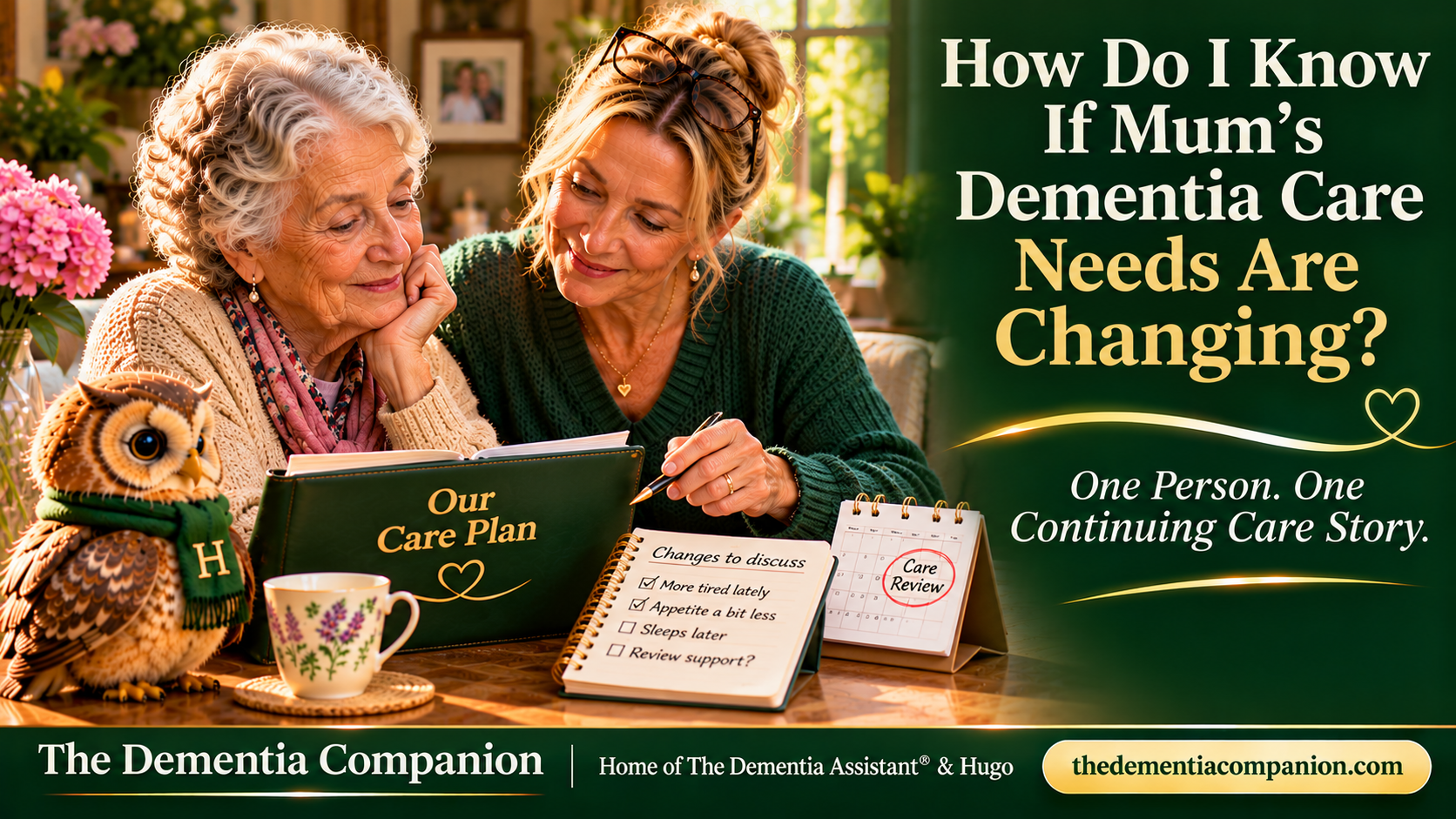
How Do I Know If Mum’s Dementia Care Needs Are Changing?
The little differences you begin to notice, the questions you aren’t quite sure how to ask, and why changing care needs should never mean losing sight of the person.
By Louise Donaghy, Dementia Practitioner, Founder of The Dementia Companion and The Dementia Assistant®, Creator of Hugo Intelligence™
It often begins with something small.
Mum seems a little quieter than usual.
She’s stopped enjoying her morning crossword.
She needed some help getting dressed yesterday, even though she’s normally quite independent.
Or perhaps she’s been asking for more reassurance, sleeping differently or finding an everyday task a little more difficult.
Nothing dramatic.
Nothing that immediately makes you reach for the telephone.
Just something that makes you think:
“That’s not quite like Mum.”
You mention it to your brother.
He says she seemed absolutely fine when he visited.
Your sister thinks it might be the dementia progressing.
And Mum, meanwhile, is wondering why everybody is discussing her as though she’s suddenly turned into a medical mystery.
Perhaps she’s simply tired.
Perhaps something is bothering her.
Or perhaps her support needs really are changing.
So how do you know when someone living with dementia needs more help?
Start by understanding what is normal for that person, listening to their own experience, noticing meaningful changes and considering whether there may be a medical, emotional or environmental explanation.
Some changes may indicate that their dementia care plan needs reviewing.
Others may have a different cause that deserves assessment or treatment.
And importantly, not every change means dementia is progressing.
That’s something I would like every family to remember.
What are the signs that dementia care needs may be changing?
Dementia affects people differently.
Some changes develop gradually.
Others fluctuate.
A person may manage an activity comfortably one day and struggle with it another.
And different types of dementia can affect memory, communication, movement, attention and everyday functioning in different ways.
The most useful question isn’t necessarily:
“What stage of dementia is Mum in?”
It’s:
“What has changed for Mum, compared with how she usually is?”
Changes worth discussing with appropriate professionals may include:
- Finding previously familiar tasks increasingly difficult.
- Needing more assistance with washing, dressing or meals.
- Changes in communication or understanding.
- Greater difficulty managing appointments or other everyday activities.
- Changes in mobility or an increase in falls.
- Changes in eating, drinking or sleeping.
- Persistent distress, anxiety or withdrawal.
- Difficulty continuing activities the person values.
- New concerns about safety or wellbeing.
- Increasing strain on the support arrangements already in place.
These aren’t a checklist for diagnosing dementia progression.
They are reasons to consider what the person is experiencing and whether further assessment or support would be helpful.
And please don’t forget the person’s strengths.
If Mum still enjoys preparing her breakfast, choosing her clothes or walking to the garden, those abilities belong in the picture too.
Good dementia care planning should recognise what the person can do, not simply what has become difficult.
Before assuming dementia is getting worse, what else could be happening?
This is one of the most important questions in dementia care.
A person may already have a dementia diagnosis, but that doesn’t mean every new symptom or difficulty is caused by it.
Perhaps Mum is experiencing pain.
Perhaps she’s constipated.
Perhaps she’s not sleeping well.
Perhaps a medication has recently changed.
Perhaps she’s unwell, has become dehydrated or is struggling to hear conversations.
Or perhaps something in her environment is making everyday life more difficult.
NICE recommends exploring possible clinical and environmental causes when someone living with dementia experiences distress.
That includes considering pain, delirium, discomfort and aspects of the care environment.
Some causes may be treatable or manageable.
Others need further professional investigation.
But we shouldn’t automatically label every change as dementia progression.
Look at the person’s physical comfort
Could Mum be in pain?
Is she having difficulty moving?
Has she mentioned feeling unwell?
Has there been a change in eating or drinking?
Does she seem uncomfortable when sitting, standing or walking?
Sometimes a person may find it difficult to explain what is wrong.
That makes careful observation important, but it doesn’t mean we should guess the cause.
Consider medication and other health conditions
Have any medicines recently been started, stopped or changed?
Has Mum had a recent illness?
Does she have another condition that might affect her wellbeing?
Bring relevant information to the pharmacist, GP or prescribing professional.
Do not stop or alter medication without appropriate advice.
Think about the environment
Has there been a change in routine?
Has a familiar carer left?
Is the house noisier than usual?
Has Mum been attending more appointments?
Is she tired after a particularly busy day?
Sometimes the support around the person needs adapting.
It doesn’t necessarily mean the person has permanently lost an ability.
Ask Mum how she feels
This is easy to overlook when everybody is busy looking for explanations.
Try asking:
“Mum, I’ve noticed you’ve seemed a little tired lately. How have you been feeling?”
Or:
“Is there anything that’s becoming difficult that you’d like some help with?”
She may tell you something you hadn’t considered.
Or she may not have a clear answer.
Either way, her experience deserves attention.
What is the difference between gradual changes and sudden confusion?
This distinction really matters.
Gradual changes in abilities or support needs should be reviewed with appropriate professionals.
But sudden confusion or an abrupt change in someone’s mental state may indicate an acute medical problem.
Sudden confusion needs immediate medical assessment.
Delirium is one possible cause. It can occur alongside dementia and may be associated with illness or other medical factors.
Someone experiencing delirium may become unusually confused, agitated, sleepy, withdrawn or less responsive.
A quiet, withdrawn presentation can be just as important as visible agitation.
The NHS advises calling 999 if someone becomes suddenly confused.
Do not wait several days to see whether the situation improves.
And do not simply record the change in a care diary and assume it can be discussed at the next routine appointment.
If there is a medical emergency or immediate danger, contact emergency services.
Hugo Intelligence™ can provide general educational guidance and help families prepare questions, but he must never replace urgent medical assessment.
How do we recognise changes without monitoring Mum constantly?
This is where I think families deserve a little reassurance.
You don’t need to become an investigator in your own mother’s house.
You don’t need to analyse every sentence.
And you certainly don’t need to produce a daily performance report about whether Mum completed the crossword before eleven o’clock.
Dementia care shouldn’t turn somebody’s life into an ongoing assessment.
The aim is to notice meaningful changes that affect the person’s wellbeing, choices or everyday life.
A useful starting point is to understand Mum’s normal routine.
What is she usually comfortable doing?
What does she enjoy?
How does she normally communicate?
What support does she already receive?
What makes her feel safe and confident?
Then, when something changes, you have a clearer point of comparison.
A person-centred example
Let’s imagine a fictional woman called Margaret.
Margaret has lived with dementia for several years.
She enjoys making breakfast, watching the birds in her garden and choosing her own clothes.
Over a couple of weeks, her daughter notices that Margaret has started asking for help getting dressed.
There are several possible explanations.
Perhaps she is finding clothing choices more confusing.
Perhaps arthritis is making buttons uncomfortable.
Perhaps she’s tired.
Perhaps a change in routine has affected her confidence.
Or perhaps her dementia-related support needs are changing.
The useful response isn’t immediately to take over dressing.
It’s to explore what has changed, involve Margaret and consider whether she needs professional assessment or a small adjustment.
Perhaps easier fastenings would help.
Perhaps having more time in the morning would make a difference.
Perhaps there is a physical problem that needs treatment.
The goal is to understand the difficulty without unnecessarily taking away Margaret’s independence.
What should families record when dementia care needs change?
Sometimes the hardest part is explaining what you’ve noticed.
You know Mum seems different.
But when the GP asks what’s changed, suddenly every example disappears from your mind.
Then, approximately four minutes after leaving the appointment, you remember everything.
Typical.
This is where a short, factual record can help.
Instead of writing:
“Mum is getting worse.”
Try recording:
“Mum has needed help choosing clothes on four mornings this week. She previously managed this independently. She says she feels tired and has complained of sore hands.”
That gives a professional much more useful information.
Try to record:
What changed?
Describe what happened, rather than making a diagnosis.
When did it begin?
Was the change sudden or gradual?
How often has it happened?
Was it one occasion or a repeated concern?
What was happening around the person?
Consider the environment, activities and any relevant circumstances.
How did the person feel?
Include their own words wherever possible.
What helped?
Record things that made the situation more comfortable or manageable.
What needs follow-up?
Note whether professional advice has been sought and what was agreed.
You don’t need pages of information.
A few accurate sentences may be enough.
The NHS also suggests that keeping a short diary can help identify possible patterns when families are trying to understand changes in behaviour.
But remember, a diary helps describe what happened. It doesn’t establish the medical cause.
When should a dementia care plan be reviewed?
A person’s care plan should be reviewed when their needs, wishes or circumstances change.
It shouldn’t remain untouched simply because everybody has become accustomed to the existing arrangements.
NICE guidance emphasises coordinated dementia care, including reviewing care and support plans as the person’s circumstances develop.
A review might be useful when:
- The person begins needing assistance with an activity they previously managed.
- Their health or mobility changes.
- Their communication needs change.
- They want different support.
- Their existing care arrangements are no longer working.
- A family carer’s circumstances change.
- A hospital stay or illness affects daily life.
- The person has new goals, preferences or concerns.
A care plan review doesn’t automatically mean introducing more assistance.
Sometimes it means changing how support is provided.
Sometimes it means making an environment easier to manage.
Sometimes it means reducing help in an area where confidence or ability has improved.
And sometimes additional care really is needed.
Person-centred dementia care planning is about responding to the individual, not simply increasing services according to a diagnosis.
How can we support independence when needs are changing?
One of the greatest mistakes we can make is assuming that needing help with one task means somebody needs help with everything.
Perhaps Mum now finds preparing dinner difficult.
That doesn’t necessarily mean she cannot make breakfast.
Perhaps she needs prompting with an appointment.
That doesn’t mean she cannot choose how to spend her afternoon.
Perhaps she needs assistance washing her hair.
That doesn’t mean she wants somebody deciding what clothes she should wear.
Support should be proportionate to the person’s needs and preferences.
Ask:
“What would you like to continue doing yourself?”
“Would it help if we did this together?”
“Is there a part you’d prefer me to help with?”
And remember that independence doesn’t always mean doing something entirely alone.
Sometimes choosing how something happens is just as important.
Maintaining control over everyday decisions is part of maintaining dignity.
What should we do if Mum needs more help at home?
If changing needs are affecting everyday life, ask whether a professional review or care needs assessment would be helpful.
In England, local authority adult social care services can assess care and support needs.
That assessment can consider practical assistance, equipment, adaptations and other relevant support.
If Mum already receives social care, ask for her existing assessment or care arrangements to be reviewed.
The GP, memory service or named care coordinator may also be able to advise.
In Scotland, Wales and Northern Ireland, assessment arrangements and services differ, so contact the relevant local health or social care service.
You might say:
“Mum’s needs have changed since her last assessment. We’d like her care arrangements reviewed, with her wishes and independence at the centre.”
That’s a reasonable request.
And if the family is currently providing most of the support, explain what is realistically manageable.
You should not have to promise care that you cannot safely provide.
How do we involve Mum in decisions about additional support?
A dementia diagnosis does not automatically remove someone’s ability to make decisions.
Capacity is decision-specific and must be considered under the relevant legal framework.
The person should receive appropriate support to understand choices and express preferences.
If Mum wants to remain involved in preparing her care plan, make that possible.
If she prefers information explained in short conversations, adapt your approach.
If she wants a trusted family member present, respect that preference where appropriate.
And if she doesn’t want everybody discussing her private affairs, remember that her wishes matter too.
A care plan belongs to the person’s story.
Not simply the family’s interpretation of it.
Why should families have their own continuing dementia care plan?
This is one of the most important reasons I created The Dementia Assistant®.
Imagine Mum’s support needs change over several years.
Her GP knows one part of her medical history.
The memory clinic has specialist records.
A care agency has its own professional care plan.
A hospital may become involved.
And community services may provide additional support.
Every service has legitimate reasons to maintain its own records.
But the person living with dementia and their family may still find themselves repeatedly explaining what has changed.
What Mum used to manage.
What she can still do.
What helps her feel comfortable.
How her communication has changed.
What she wants for her future.
And which support arrangements have already been tried.
The Dementia Assistant® gives people living with dementia and their families a place to maintain their own continuing care information.
Not a system that belongs to whichever organisation is currently involved.
Not something that has to be recreated every time a new care provider arrives.
But a person-centred record that can continue developing as the person’s circumstances change.
It doesn’t replace professional medical records or care plans.
It complements them.
Different professionals. Different services. One person. One continuing story.
Meet Hugo Intelligence™: When you’re not sure what a change means
Sometimes families don’t need another article telling them everything that could happen in the future.
They need help thinking about what’s happening now.
Perhaps Mum has become more unsettled.
Perhaps Dad is sleeping differently.
Perhaps a familiar activity has become difficult.
Or perhaps you’re simply worried and don’t know where to begin.
You might ask:
“Hugo, Mum seems more withdrawn lately. What should we consider?”
Or:
“Hugo, Dad is finding dressing more difficult. How can we support him without taking over?”
Or:
“Hugo, I’m worried Mum’s care needs are changing. Can you help me prepare questions for her GP?”
Hugo Intelligence™ offers conversational, person-centred dementia guidance within The Dementia Assistant®.
You can explain the situation in your own words, ask follow-up questions and explore practical approaches without judgement.
Sometimes the first question isn’t particularly organised.
Sometimes it’s simply:
“Hugo, I’m worried about Mum.”
That’s a perfectly reasonable place to begin.
Hugo can help you think through what you’ve noticed, consider possible unmet needs, identify questions worth asking and prepare for professional discussions.
He does not diagnose changes, determine the cause of symptoms or replace clinical assessments.
But he can make it easier to explore the situation in a calm, structured way.
Personalised guidance through Mum’s selected care plan
This is where Hugo’s guidance can become more individualised.
You can ask Hugo general dementia questions without selecting a care plan.
But when you choose Mum’s care plan within The Dementia Assistant®, Hugo can use relevant recorded information about her routines, preferences, abilities and circumstances.
Perhaps Mum’s care plan explains that she usually enjoys a quiet morning.
Perhaps it records that she has always preferred making her own breakfast.
Perhaps you’ve noted that she finds noisy environments uncomfortable.
Those details can help shape suggestions about practical support.
Not simply what might help someone with dementia, but what may be appropriate for Mum as an individual.
Hugo cannot assume the information recorded is complete or medically verified.
The person and family should review the guidance and seek professional advice where necessary.
Save and organise your conversations with Hugo
Sometimes an important question doesn’t have a single answer.
You might ask Hugo about a change today.
Return to the subject next week.
And want to revisit your earlier conversation before a GP appointment.
Within The Dementia Assistant®, you can save, categorise and organise Hugo conversations for later reference.
This means useful guidance doesn’t have to disappear into a collection of unrelated messages.
You can return to discussions, explore new questions and keep information organised.
Saved AI conversations remain educational guidance. They aren’t a substitute for clinical records or professional instructions.
But they can help you keep track of what you’ve been exploring.
When worries arise in the middle of the night
There is something about two o’clock in the morning that can make every worry feel twice as large.
Perhaps Mum had a difficult evening.
Perhaps you are lying awake wondering whether she needs more support.
Or perhaps you simply have a question you didn’t have time to ask earlier.
The Dementia Assistant® offers a place to explore everyday dementia questions without needing to wait for the next family conversation.
You can organise your thoughts and return to saved Hugo guidance.
However, Hugo is not an emergency service or a substitute for out-of-hours healthcare.
Sudden confusion, serious illness, immediate danger or other urgent concerns must be directed to appropriate medical or emergency services.
When the situation isn’t urgent, a supportive conversation may help you prepare for the next practical step.
Hugo’s multilingual dementia support: Recognising change in the person’s own language
This is another area where person-centred dementia care becomes especially important.
Language is part of someone’s identity.
Perhaps Mum grew up speaking Welsh.
Perhaps Dad is most comfortable speaking Irish, Hindi, Spanish or French.
Perhaps the family lives across different countries.
Or perhaps someone living with dementia is finding it harder to communicate in a language they previously used comfortably.
Some people living with dementia experience changes in how they use different languages, although this varies between individuals.
We should never assume someone will automatically return to a childhood language.
But we should ask what language they prefer and what helps them communicate.
The Dementia Assistant® supports 12 interface languages and offers dictation and translation capabilities spanning 201 languages.
These tools can help families record observations, organise care information and communicate across language barriers.
Dictation may be particularly helpful when someone finds speaking easier than typing.
And multilingual support can help preserve the person’s communication preferences within their care plan.
Not every function is available in all 201 languages.
Important clinical, legal and medication information should always be checked for translation accuracy, and qualified interpreting support should be used when appropriate.
Because recognising someone’s changing needs begins with understanding how they express themselves.
How does Family Circle help when care needs change?
When Mum’s circumstances change, several relatives may want to help.
Perhaps one attends medical appointments.
Another visits regularly.
A third lives abroad.
And somebody inevitably has an outdated version of the latest arrangements.
Family communication can become complicated very quickly.
The Dementia Assistant® includes Family Circle features to support appropriate updates and communication.
Families can organise relevant information while respecting the person’s wishes, privacy and access permissions.
The aim isn’t to allow everybody to monitor everything Mum does.
It is to help appropriately involved relatives understand what matters and communicate more effectively.
And if new professional services become involved, the person’s family-held care information can continue alongside them.
What if I feel overwhelmed by Mum’s changing needs?
I want to include this because it matters.
Sometimes it’s not just Mum’s needs that have changed.
Perhaps you’ve started visiting more often.
Perhaps you’re organising additional appointments.
Perhaps you’re managing paperwork, medication questions, shopping and family updates.
Perhaps you’re tired before the day has even started.
And perhaps everybody keeps telling you how wonderfully you’re coping.
Which is lovely.
Except occasionally you’d rather somebody did the shopping.
The wellbeing of the person providing care matters too.
If your caring responsibilities are increasing, ask about a carer’s assessment and available support.
In England, unpaid carers can request a carer’s assessment through their local council.
Other UK nations have their own arrangements.
Dementia UK also provides specialist advice for carers through its Admiral Nurse services.
You don’t have to wait until you’re completely exhausted.
Good dementia care should support the person living with dementia and the people around them.
A practical checklist: Is Mum’s dementia care plan still meeting her needs?
Use these questions as a starting point, not a test.
- [ ] Have we asked Mum how she feels about her current support?
- [ ] Have we noticed meaningful changes from her usual abilities?
- [ ] Are the changes gradual, sudden or fluctuating?
- [ ] Have possible physical health concerns been discussed with an appropriate professional?
- [ ] Have medication-related concerns been checked?
- [ ] Are her preferred routines and activities being supported?
- [ ] Can she still make everyday choices wherever possible?
- [ ] Are communication and language needs understood?
- [ ] Do her current care arrangements reflect what she wants and needs?
- [ ] Is additional professional assessment or support required?
- [ ] Is her family-held care information up to date?
- [ ] Are the right people receiving relevant information with appropriate permission?
- [ ] Is the main family carer receiving sufficient support?
- [ ] Do we know who to contact if circumstances change again?
If several of these questions raise concerns, don’t assume everything must be solved at once.
Begin with any immediate medical or safety issues.
Then work through the remaining questions with the person and appropriate professionals.
The aim is to make care fit the person as their circumstances change.
Sometimes the care needs changing. Sometimes the approach does.
I want to finish with something that has always mattered to me in dementia care.
A person is not a collection of symptoms.
Mum is still Mum.
She may need more help with certain things.
She may want different routines.
She may have days when things feel harder.
But she may also continue enjoying her favourite music, telling familiar stories, laughing with her grandchildren and making her own choices.
Perhaps she still makes an excellent cup of tea.
Although, according to Dad, she’s never made it quite strong enough.
Some family arguments apparently survive everything.
Those ordinary details matter.
Because recognising changing care needs isn’t about finding everything someone can no longer do.
It’s about understanding what they need to keep living a life that feels like their own.
And sometimes the most important change is not in the person at all.
It’s in the way we support them.
⸻
Ask Hugo: Your Questions About Changing Dementia Care Needs
Hugo, how do I know whether Mum’s dementia is getting worse?
Hugo 🦉: Start by looking at what’s different from Mum’s usual abilities, routines and wellbeing.
Consider whether changes are gradual or sudden, and whether other factors such as pain, illness, medication or the environment might be involved.
I can help you organise observations and prepare questions, but I cannot determine whether dementia is progressing. Seek professional assessment where appropriate.
What if Mum suddenly becomes much more confused?
Hugo 🦉: Sudden confusion requires immediate medical assessment.
Do not automatically assume it’s dementia progression.
Follow NHS emergency advice, including calling 999 for sudden confusion.
I’m not a substitute for urgent medical care.
Can Hugo help me understand changes in Mum’s daily routine?
Hugo 🦉: Yes. You can explain what you’ve noticed and explore person-centred questions about routines, comfort and support.
When you select Mum’s care plan, I can use relevant recorded information to provide more individualised suggestions.
Can we update Mum’s care plan as her needs change?
Hugo 🦉: Yes. The Dementia Assistant® allows families to develop and update personalised care plans.
You can keep information about strengths, preferences, routines, relevant health needs and everyday observations organised as circumstances change.
Professional care plans and clinical assessments remain separate.
Can I save our conversations about Mum’s changing needs?
Hugo 🦉: Yes. You can save, categorise and revisit your conversations within The Dementia Assistant®.
That allows you to return to useful guidance and continue exploring questions over time.
Can Hugo help in the middle of the night?
Hugo 🦉: You can use The Dementia Assistant® to explore non-urgent dementia questions and revisit saved guidance.
But I cannot provide emergency medical assessment or replace out-of-hours healthcare.
If someone is suddenly confused, seriously unwell or in immediate danger, contact the appropriate medical or emergency service.
Can I use Hugo in different languages?
Hugo 🦉: The Dementia Assistant® supports 12 interface languages and dictation and translation capabilities spanning 201 languages.
These tools can help multilingual families organise and communicate care information.
Not every feature is available in all languages, and important clinical translations should be checked.
Can Family Circle help relatives understand changes in Mum’s care?
Hugo 🦉: Family Circle can help appropriately involved relatives share relevant updates.
Mum’s wishes, privacy and access permissions should guide what information is shared.
Can Hugo help us prepare for a care needs assessment?
Hugo 🦉: Yes. I can help you organise questions and consider what information may be relevant about Mum’s everyday activities, strengths, preferences and support needs.
The actual assessment and decisions about professional support remain the responsibility of the appropriate services.
Does The Dementia Assistant® replace Mum’s professional care plan?
Hugo 🦉: No.
The Dementia Assistant® gives the person and family their own continuing care information, which can complement professional plans and clinical records.
It helps you maintain relevant information as services change, without replacing professional responsibilities.
How much does The Dementia Assistant® cost?
Hugo 🦉: The Family subscription is £4.99 per month, approximately the price of a cup of coffee.
Every subscription includes a 30-day complimentary trial.
You can explore personalised care planning, daily notes, conversational guidance, saved Hugo conversations, Family Circle and multilingual support.
⸻
One Person. One Continuing Care Story.
When someone is living with dementia, their support needs may change over time.
Different professionals may become involved.
GPs.
Memory clinics.
Dementia nurses.
Hospitals.
Home care providers.
Community services.
Each may maintain its own professional records.
But the person living with dementia and their family should also have their own continuing place for the information that matters.
A place to preserve the person’s wishes.
A place to record strengths, routines and preferences.
A place to organise relevant health information and daily observations.
A place to prepare for appointments.
A place to maintain care information as needs change.
And with Hugo Intelligence™, a place to have supportive conversations, save and organise guidance, explore personalised approaches and benefit from multilingual tools.
The Dementia Assistant® was created to put the person living with dementia and their family at the centre of their own continuing care information.
Not to replace healthcare professionals.
Not to replace their clinical records.
But to help preserve the person’s care story as circumstances and services change.
Different professionals. Different services. One person. One continuing story.
Would You Like Hugo to Help You Review Mum’s Care Plan?
If you’ve noticed changes in Mum’s daily life and you’re unsure where to begin, Hugo can help you organise your observations, think through the questions you want to ask and review relevant information in her selected care plan.
Within The Dementia Assistant®, you can explore:
- Hugo Intelligence™ for conversational, person-centred dementia guidance.
- Guided care plan creation and ongoing reviews.
- Family-held continuing care plans.
- Daily notes and observations.
- Document and appointment organisation.
- Saved and categorised Hugo conversations.
- Life Story, Memory & Moments and Family Circle.
- Multilingual support, dictation and translation.
- Dementia education and practical resources.
Created by dementia practitioner Louise Donaghy and powered by Person-Centred Intelligence®, The Dementia Assistant® is designed to support people living with dementia and their families throughout the care journey.
Every subscription includes a 30-day complimentary trial.
Explore The Dementia Assistant®:
https://thedementiaassistant.com/
The Dementia Companion, home of The Dementia Assistant® and Hugo 🦉
https://thedementiacompanion.com/
Louise and Hugo ❤️🦉
Louise Donaghy
Founder & CEO of The Dementia Assistant®
Created and powered by Person-Centred Intelligence®
Creator of Hugo Intelligence™
⸻
Continue Exploring Dementia Care and Support
Person-Centred Dementia Care
Learn why meaningful dementia care begins with the person’s preferences, identity and strengths.
https://thedementiacompanion.com/dementia-care/
Ask Hugo: Everyday Dementia Questions
Explore practical dementia questions, including communication, changes in behaviour and person-centred care planning.
https://thedementiacompanion.com/ask-hugo/
Supporting a Parent With Dementia
Practical guidance for families balancing independence, communication and everyday support.
https://thedementiacompanion.com/articles/how-to-support-a-parent-with-dementia/
The Dementia Companion Wellbeing Hub
Support for family carers navigating worry, exhaustion, changing responsibilities and the emotional demands of dementia care.
https://thedementiacompanion.com/wellbeing-hub
⸻
References and Further Reading
- NICE: Dementia, Assessment, Management and Support (NG97)
National guidance on person-centred dementia care, changes in needs, care planning, support coordination and assessment of possible causes of distress.
https://www.nice.org.uk/guidance/ng97/chapter/recommendations
- NHS: Symptoms of Dementia
Information about how dementia can affect memory, communication, movement, behaviour and daily activities.
https://www.nhs.uk/conditions/dementia/symptoms-and-diagnosis/symptoms/
- Dementia UK: Signs and Symptoms of Dementia
Guidance about the different ways dementia can affect people and why sudden changes should not automatically be attributed to dementia.
https://www.dementiauk.org/information-and-support/about-dementia/signs-and-symptoms-of-dementia/
- NHS: Coping With Dementia Behaviour Changes
Information about possible underlying causes of changes in behaviour and how observations may help identify patterns.
https://www.nhs.uk/conditions/dementia/living-with-dementia/behaviour/
- NICE: Managing Distress in Dementia (QS184)
Recommendations about checking for clinical and environmental causes of distress, including pain, discomfort and delirium.
https://www.nice.org.uk/guidance/qs184/chapter/quality-statement-6-managing-distress
- NHS: Sudden Confusion (Delirium)
Official guidance explaining why sudden confusion requires immediate medical assessment.
https://www.nhs.uk/symptoms/confusion/
- Dementia UK: Delirium and Dementia
Information about recognising delirium, including sudden changes in mental state and behaviour.
https://www.dementiauk.org/information-and-support/health-advice/delirium/
- NHS: Getting a Care Needs Assessment
Information about requesting an assessment for practical care and support needs in England.
- NHS: Carer’s Assessments
Information about support available to unpaid carers in England.
https://www.nhs.uk/social-care-and-support/support-and-benefits-for-carers/carer-assessments/
- Alzheimer’s Society: The Care Needs Assessment
Guidance about preparing for assessments, recognising changing needs and recording daily support requirements.
https://www.alzheimers.org.uk/get-support/legal-financial/dementia-care-needs-assessment
⸻
Important information: This article provides general educational guidance and does not replace medical assessment, clinical advice, safeguarding procedures or professional care planning. Sudden confusion requires immediate medical assessment. Care services, assessment arrangements and legislation vary across the four UK nations.
Reviewed: 21 November 2026
You May Also Find Helpful
Need help with your own situation? Ask Hugo.
One Person. One Continuing Care Story. The Dementia Companion is where you discover guidance. Inside The Dementia Assistant®, talk with Hugo, save and categorise conversations, record daily notes and involve authorised supporters in a continuing care plan centred around the person.
Ask Hugo About This · Start Your Continuing Care Plan — Families · Continuing Care Planning — Professionals
Personal guidance requires the appropriate account and subscription access. Care-plan information is used only with authorised access and the required consent and selection steps. All subscription plans include a 30-day complimentary trial.