When Someone with Dementia Does Not Recognise You
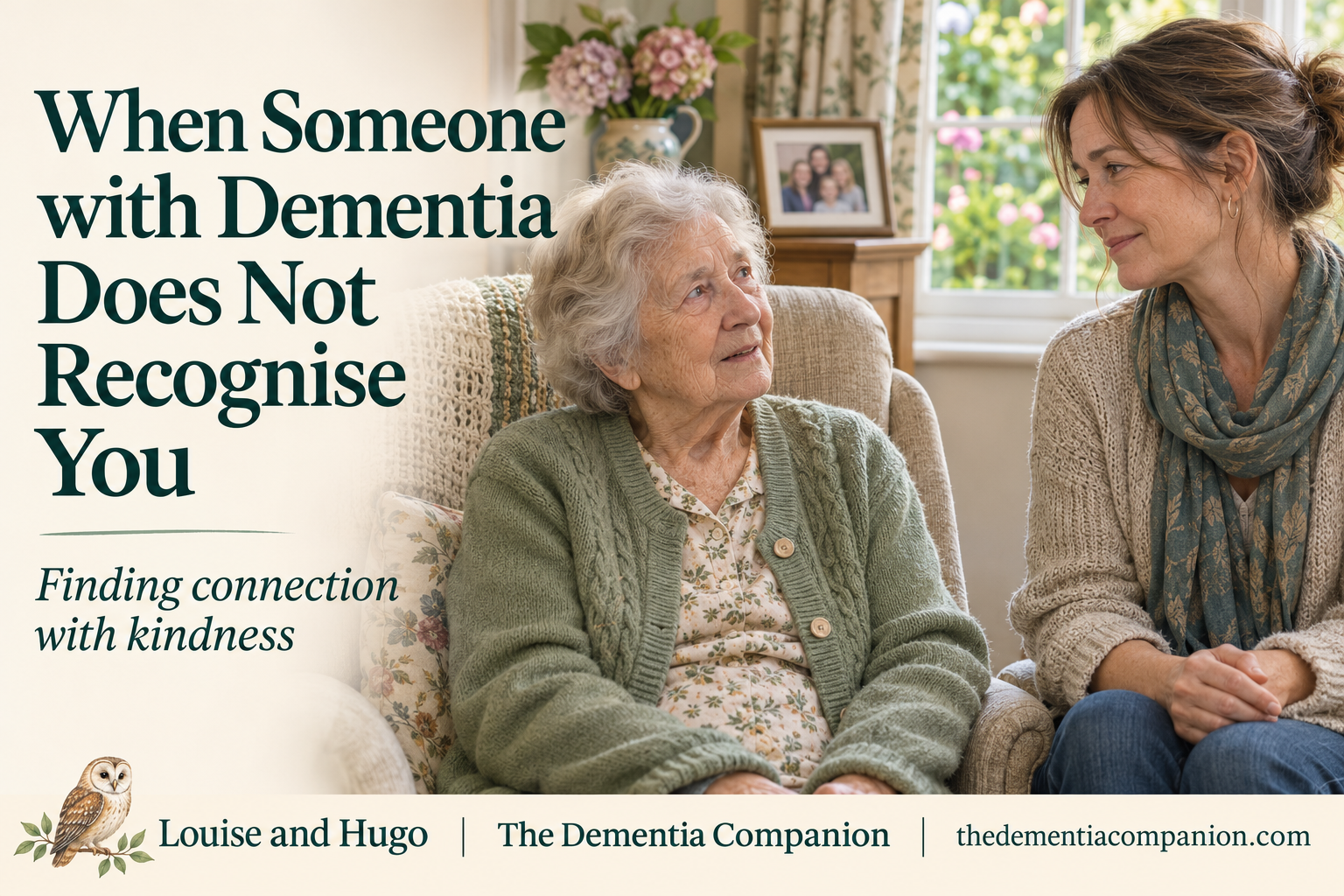
When Someone with Dementia Does Not Recognise You
By Louise Donaghy, Founder of The Dementia Assistant® and The Dementia Companion, Creator of Hugo Intelligence™.
“Who are you?”
When someone you love has dementia, those three words can hurt more than you ever imagined.
Perhaps your mum no longer recognises you as her daughter. Your husband asks when his wife is coming home, while you are sitting beside him. Your dad calls you by his brother’s name, and you are left wondering whether to correct him, go along with it or have a little cry in the kitchen.
If this is happening to you, try introducing yourself gently, avoid testing their memory and focus on helping them feel comfortable in your company. You do not have to persuade them who you are before you can share a meaningful moment.
However, a sudden change in recognition or confusion needs immediate medical attention, even when someone already has dementia.
There is practical help for these moments. And there is room for your feelings too.
Why this can feel so painful
You are not simply hoping someone will remember your name.
You are hoping they will recognise the relationship behind it. The years together. The childhood cuddles. The family holidays. The arguments about who packed the car, which apparently required a level of engineering expertise nobody else possessed.
When a parent with dementia does not recognise you, it can feel as though your place in their life has slipped away. When it is your partner, you may feel desperately lonely beside the person who has shared so much of your life.
Knowing that dementia is responsible does not automatically make it less painful.
Dementia can affect memory and the brain’s ability to identify familiar faces. A person might see you clearly but struggle to connect your face with your name or relationship. They may also mistake you for someone else because of changes in how they interpret what they see. It is not always simply a forgotten name. (Alzheimer’s Society)
Not recognising you is not a deliberate rejection. It does not measure how much you have mattered.
You may understand that perfectly and still feel devastated. Both things can be true.
Try to give your feelings somewhere to go. Speak to someone you trust, a counsellor or a carer support group. If another trusted person can stay with your loved one, taking a few minutes to gather yourself is reasonable.
There is no prize for being the family member who never cries. And frankly, the application process sounds exhausting.
How to introduce yourself gently
When someone with dementia asks who you are, it is natural to reply:
“Don’t you know me?”
You may be hoping that a little prompting will bring recognition back. But it can leave the person feeling tested, embarrassed or worried.
Offer the answer instead of asking them to find it:
“Hello, Mum. It’s Sarah, your daughter. It’s lovely to see you.”
“Hello, I’m James. I’ve come to spend some time with you.”
“Hi, it’s Anne. Would you like some company?”
Keep the introduction short and allow time for a response. Brief explanations can be easier to manage than a detailed account of names, relationships and previous visits. (Alzheimer’s Association)
You do not need to deliver the entire family tree before sitting down.
Approach where they can see you. Use your usual warm voice and give them room to decide whether they want you closer.
“Would it be all right if I sat here?”
That small question gives them a choice at a moment when much may feel uncertain.
What if they think you are someone else?
Try a gentle introduction once:
“It’s Lucy. I’m glad to see you.”
If repeated corrections are making things worse, pause the explanations. You can respond to their feelings or conversation without pretending to be the person they have named.
If your mum mistakes you for her sister and talks about their childhood kitchen, you might say:
“What was it like?”
Or:
“That sounds like somewhere you remember well.”
If saying “I’m your husband” frightens them, avoid repeatedly insisting. Try:
“My name’s David. I can give you some space.”
A hug may be comforting when someone knows you. It may feel alarming if they believe you are a stranger. Ask before touching them, respect their response and let another trusted person help if your presence is upsetting them.
You are allowed to step back with kindness.
Finding connection without a name
When someone with dementia forgets who you are, it is easy to make recognition the goal of every visit.
Will they know me today? Will the photographs help? What if I mention our wedding?
Those hopes are understandable. But they can place a great deal of pressure on both of you.
A person may still respond to a familiar voice or feel comfortable with someone close to them, even when they cannot identify the relationship. This is possible, rather than something any family should feel they must achieve. (Alzheimer’s Society)
Try beginning with what they enjoy now.
Perhaps you can listen to familiar music, watch the birds, fold towels together or talk about the football. Perhaps they would enjoy hearing about the dog’s latest misdemeanour. Dogs are wonderfully generous providers of conversation material, usually at somebody else’s expense.
You can offer a photograph without turning it into a memory test:
“That’s us at the seaside. Look at the size of those ice creams.”
That gives you something to share. It does not require them to remember the year, the location and everyone’s full name.
If the photograph causes frustration, put it away. The album has no feelings to hurt.
Humour can still belong in your relationship. A familiar joke, a playful comment about your own terrible singing or a shared laugh at the weather can make room for ordinary companionship.
Let the humour be something you enjoy together. Their confusion should never be the punchline.
Pay attention to comfort rather than performance. Do they seem more settled when you speak less? Would they prefer music, quiet or a shorter visit?
Sometimes connection is a conversation. Sometimes it is sitting nearby without asking anything of them.
And sometimes there is no obvious response at all.
That does not mean you have done something wrong. You cannot make recognition happen through determination, perfect wording or the correct selection of biscuits.
Your presence can be offered with love without requiring proof that it has been recognised.
When a change needs medical attention
An established pattern of not recognising family is different from a sudden change.
If the difficulty has developed gradually, discuss it with their doctor or dementia care team, especially if it is becoming distressing. Difficulties with eyesight or hearing also deserve attention. (Alzheimer’s Society)
If they normally recognise you but suddenly do not, or they become noticeably more confused over hours or days, do not assume it is dementia progressing.
Other changes may include difficulty paying attention, new hallucinations, agitation, or becoming unusually quiet, withdrawn or sleepy. Delirium can involve quieter changes as well as obvious restlessness. (NICE)
Sudden confusion can be caused by illness, medication effects or other urgent medical problems.
In the UK, NHS advice is to go to A&E or call 999 if someone suddenly becomes confused. Outside the UK, seek emergency medical help through your local service. (NHS)
While waiting, offer calm reassurance and avoid lots of questions. Explain to the medical team what is different from the person’s usual behaviour, when it began and which medicines they take. (NHS)
For the ongoing, familiar moments, remember that you need support too. It can be hard to find gentle words when your own heart is hurting.
Would it help to think through what to say in your situation?
On The Dementia Assistant®, you can ask Hugo for person-centred guidance based on the situation you describe.
You could start with:
“My mum has dementia and sometimes thinks I’m her sister. Correcting her upsets her. Can you help me find a gentle way to respond?”
Or:
“My husband doesn’t always recognise me. How can I make our time together feel more comfortable?”
You do not need professional language or a perfectly organised question. Start with what happened and what is worrying you.
Hugo offers guidance and support, not diagnosis or emergency care. For sudden confusion, seek medical help immediately.
And for today, perhaps your opening words can simply be:
“Hello, I’m Sarah. It’s lovely to spend some time with you.”
Louise and Hugo ❤️🦉
The Dementia Companion, home of The Dementia Assistant® and Hugo 🦉
https://thedementiacompanion.com/
Not sure what to say? Ask Hugo.
You May Also Find Helpful
- Why Does Mum Become Exhausted at Family Gatherings? Dementia and Sensory Overload
- Mum Keeps Asking for Her Mother Who Died Years Ago. What Should I Say?
- Mum with Dementia Follows Me Everywhere and Panics When I Leave. What Can I Do?
- Mum Keeps Checking the Front Door or Trying to Leave. What Is She Looking For?
Need help with your own situation? Ask Hugo.
One Person. One Continuing Care Story. The Dementia Companion is where you discover guidance. Inside The Dementia Assistant®, talk with Hugo, save and categorise conversations, record daily notes and involve authorised supporters in a continuing care plan centred around the person.
Ask Hugo About This · Start Your Continuing Care Plan — Families · Continuing Care Planning — Professionals
Personal guidance requires the appropriate account and subscription access. Care-plan information is used only with authorised access and the required consent and selection steps. All subscription plans include a 30-day complimentary trial.