What If Mum Doesn't Want Everyone Knowing About Her Dementia?
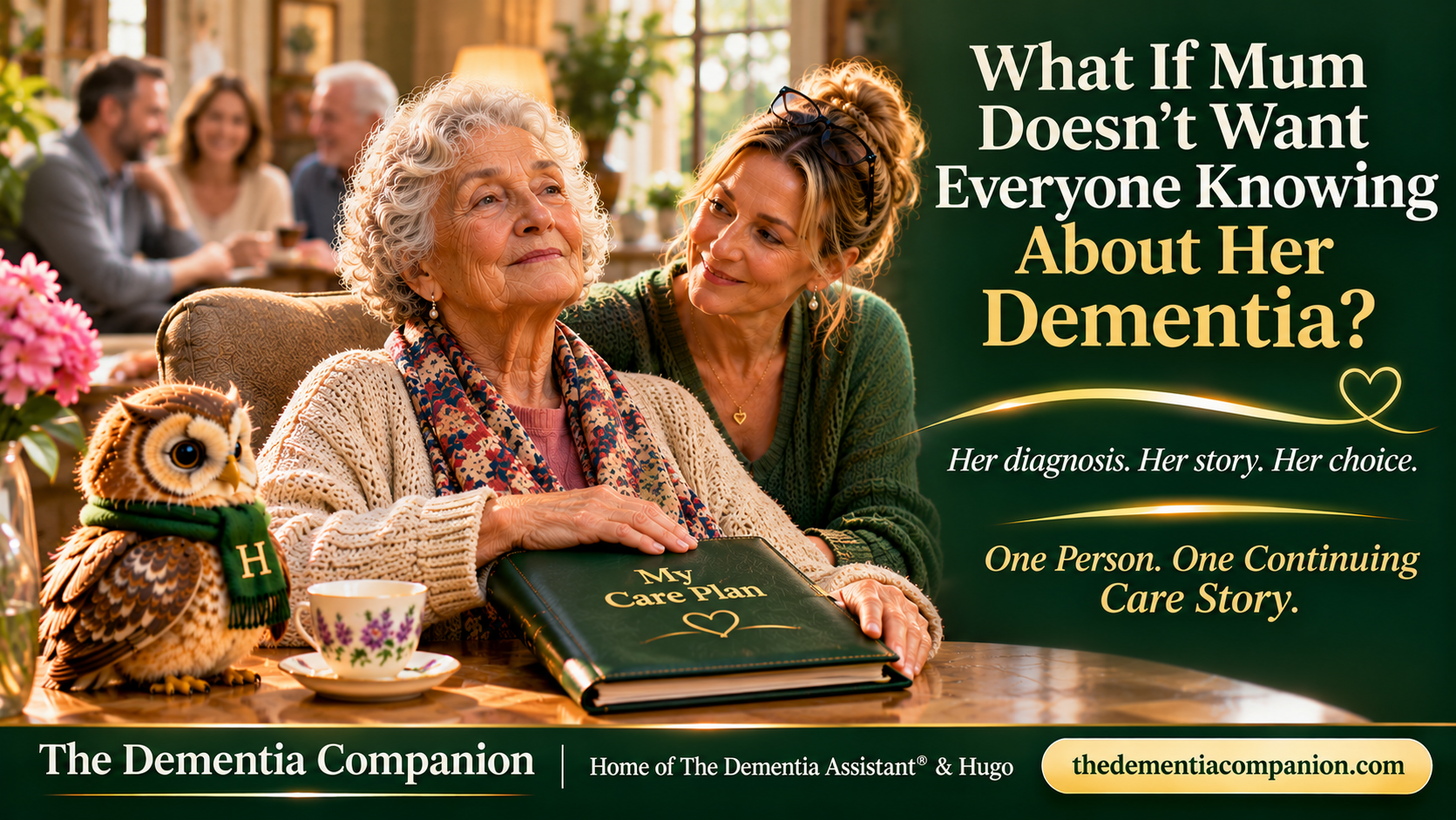
What If Mum Doesn’t Want Everyone Knowing About Her Dementia?
Her diagnosis. Her story. Her choice. Because loving somebody doesn’t automatically give everybody the right to know everything about them.
By Louise Donaghy, Dementia Practitioner, Founder of The Dementia Companion and The Dementia Assistant®, Creator of Hugo Intelligence™
“Don’t go telling everybody.”
Five little words.
Sometimes spoken very quietly after a dementia diagnosis.
Perhaps Mum has just returned from the memory clinic.
Perhaps she’s still trying to understand what the doctor told her.
Perhaps she’s frightened of how people will react.
Or perhaps she’s simply a private person who has spent eighty years minding her own business and would quite like everybody else to continue minding theirs.
Fair enough, really.
But then the family questions begin.
Should we tell her sister?
What about the neighbours?
Does the GP need to know?
What happens if she needs a carer?
Should we explain things to the grandchildren?
And what about your brother, who has already mentioned putting an announcement in the family WhatsApp group?
Before long, a conversation about Mum’s diagnosis can turn into a debate about who has the right to know.
If someone living with dementia doesn’t want their diagnosis shared, start by respecting their wishes, understanding their reasons and discussing what information may genuinely need to be shared for their care and safety.
A dementia diagnosis does not automatically remove someone’s right to privacy or their ability to make decisions.
And having a family-held care plan should never mean opening their entire life to everyone who happens to be related to them.
One person. One continuing care story. But still that person’s story.
Does someone with dementia have the right to keep their diagnosis private?
Yes. People living with dementia retain rights to privacy, dignity and involvement in decisions about their personal information.
A diagnosis does not automatically mean a person lacks mental capacity.
In England and Wales, the Mental Capacity Act 2005 establishes that adults must be presumed to have capacity unless it is established otherwise for the particular decision.
Scotland and Northern Ireland have different legal frameworks.
The important principle is that someone should be supported to make their own decisions wherever possible.
That includes decisions about who they want to tell, what they want to share and who should be involved in their care.
There may be circumstances where professionals are legally permitted or required to share relevant information without consent, including certain safeguarding or best-interests situations.
But those exceptions should not be confused with a family simply deciding that everybody ought to know.
Having dementia doesn’t make somebody’s private life public property.
Why might Mum not want people knowing about her dementia?
There may be several reasons.
Perhaps she’s worried people will treat her differently.
Perhaps she fears losing her independence.
Perhaps she doesn’t want every forgotten word to become evidence that she’s getting worse.
Perhaps she remembers how dementia was discussed when she was younger and is frightened of the stigma.
Or perhaps she simply wants time to come to terms with the diagnosis herself.
We should never assume we know what somebody is feeling.
Try asking gently:
“Mum, I understand you don’t want everybody knowing. Is there something in particular you’re worried about?”
Then listen.
She may have a perfectly clear reason.
And even if you disagree, that doesn’t make her feelings unimportant.
The fear of being treated differently
Imagine visiting your favourite café.
You’ve been going there for twenty years.
The staff know your order.
You have your usual table.
Then suddenly somebody tells everyone you’ve been diagnosed with dementia.
And now people start speaking to you very slowly, asking whether you’re all right every three minutes, and looking at your daughter whenever you try to answer a question.
You might not appreciate that either.
A dementia diagnosis shouldn’t become an excuse for treating someone as though their personality has disappeared.
The person remains the person.
And their right to ordinary social relationships matters.
Should we tell other family members about Mum’s dementia?
Not automatically.
Begin by asking Mum who she would like involved.
Perhaps she wants her daughter and husband to know, but isn’t ready to tell the wider family.
Perhaps she wants one trusted relative to help with appointments.
Perhaps she wants to explain the diagnosis herself.
Or perhaps she would like someone alongside her when she tells others.
Where possible, support her preferences.
You might say:
“Would you like to tell your sister yourself, or would you prefer me to be with you?”
Or:
“Is there anybody you’d like me to speak to on your behalf?”
It can also help to discuss what information she is comfortable sharing.
There is a difference between saying:
“Mum has asked us to help with her appointments.”
And giving somebody a detailed account of her medical history.
Not every relative needs the same information.
What if family members become upset about being excluded?
This can happen.
A sibling may say:
“Why wasn’t I told?”
Another might feel hurt that someone else was trusted first.
But the person’s diagnosis isn’t a family announcement that everyone is automatically entitled to receive.
You can acknowledge a relative’s feelings without disregarding Mum’s wishes.
For example:
“I understand you want to help. We’re trying to respect what Mum feels comfortable sharing at the moment.”
And remember that information-sharing preferences can change.
Mum may want more people involved later.
She may also decide that some details should remain private.
Her choices deserve to be revisited respectfully, not overridden because someone feels left out.
What information should carers and healthcare professionals know?
This is where privacy and safe care need to work together.
Healthcare professionals may need relevant information to assess and treat the person appropriately.
Care providers may need to understand the person’s communication needs, mobility, relevant health conditions, medication support and other information necessary for safe care.
But sharing information for care purposes doesn’t mean giving every professional every detail of someone’s personal life.
Information should be relevant, appropriate and handled according to applicable confidentiality and data-protection requirements.
For example, a new home carer might need to know that Mum prefers people to explain what they’re doing before assisting her.
They may need information about her mobility or swallowing needs.
But they may not need to know about a disagreement she had with her sister thirty years ago.
Unless, of course, that disagreement is somehow relevant to the support being provided.
And let’s face it, some family arguments are better left in 1987.
Person-centred care means understanding the individual while respecting the boundaries they want to maintain.
Can the GP tell family members about Mum’s diagnosis?
Healthcare professionals have confidentiality responsibilities.
They should normally obtain appropriate consent before disclosing confidential information to family members or unpaid carers, unless another lawful basis or relevant exception applies.
The situation may be different if the person lacks capacity for the particular decision or there are safeguarding or other legal considerations.
NHS England’s guidance on sharing information with unpaid carers recognises that relatives may need relevant information to support someone’s care, while also emphasising consent, confidentiality and the person’s best interests.
It’s also worth understanding an important distinction.
A professional may be able to listen to concerns from a family member without being permitted to disclose the person’s confidential medical information in return.
For example, you can tell the GP that you’ve noticed a significant change in Mum’s wellbeing.
That doesn’t automatically entitle you to receive her full medical history.
If Mum wants somebody involved in appointments, ask the practice how her preferences and any necessary permissions can be recorded.
What if Mum wants help but doesn’t want everyone involved?
That’s entirely possible.
She might want her daughter to accompany her to appointments.
Her son to help with shopping.
A neighbour to visit for coffee.
And another relative to remain completely uninvolved in her health information.
Those preferences should be considered wherever possible.
The solution isn’t necessarily choosing one family member to control everything.
It’s understanding what Mum wants and what each person genuinely needs to know.
You might agree:
- Who Mum wants contacted about appointments.
- Who may help organise practical support.
- Which relatives she wants to receive updates.
- What information can be shared with care professionals.
- What should remain private.
- How those preferences can be reviewed if circumstances change.
These decisions can form part of her continuing person-centred care information.
The important thing is to distinguish supporting someone from taking control of their life.
Does a power of attorney mean someone can share everything?
Not necessarily.
Powers of attorney have specific legal requirements and limits.
In England and Wales, a registered health and welfare lasting power of attorney generally allows an attorney to make relevant decisions only when the person lacks capacity to make the particular decision themselves.
A property and financial affairs lasting power of attorney has a different scope.
Scotland and Northern Ireland have different legal arrangements.
An attorney must act within their legal authority and the applicable decision-making framework.
Being appointed as an attorney does not give someone an unrestricted right to share every personal detail with the extended family.
Where there is uncertainty, seek qualified legal advice.
And don’t assume that the existence of dementia automatically activates every type of decision-making authority.
The person’s rights do not disappear because somebody else has a document in a drawer.
How do we create a dementia care plan without losing Mum’s privacy?
This is something I believe families need to think about from the beginning.
A care plan can be extremely useful.
It can preserve a person’s routines, preferences, strengths, medical information and everyday observations.
It can help families prepare for appointments.
It can help new carers understand the person.
And it can provide continuity when professionals and services change.
But that doesn’t mean every detail should be shared with everybody.
A family-held care plan should be developed with the person’s involvement wherever possible.
Consider:
What information do we actually need to record?
Avoid collecting sensitive details simply because there’s somewhere to put them.
Who should be able to see it?
Different relatives and professionals may have different legitimate reasons for receiving information.
What would Mum prefer to keep private?
Her personal history, relationships, concerns and choices deserve respect.
How will information be kept accurate?
Outdated or misleading records can create difficulties.
What happens if her preferences change?
Information-sharing arrangements may need reviewing.
What happens when a new service becomes involved?
Share relevant information appropriately, rather than automatically transferring everything.
The aim is to preserve continuity without removing control.
One Person. One Continuing Care Story, but whose story is it?
This question goes right to the heart of why I created The Dementia Assistant®.
When someone is living with dementia, their journey may involve several services.
The GP has records.
The memory clinic has records.
The hospital has records.
A home care provider may have another care plan.
And different organisations may hold different pieces of information.
But the person living with dementia and their family should also have the opportunity to maintain their own continuing care information.
A place to preserve the person’s wishes.
Their routines.
Their strengths.
Their preferred language.
Their important relationships.
Their medical information and everyday observations where appropriate.
And their preferences about who should be involved.
The Dementia Assistant® is designed to give the person and their family their own care-planning environment, independent of any one care provider.
That doesn’t mean everyone in the family automatically receives access.
Information-sharing decisions still need to respect the person’s wishes, the platform’s available permissions and applicable legal requirements.
Nor does the system replace professional clinical records or formal legal arrangements.
It gives the person and family another way to maintain their own continuing information.
Your life. Your care plan. Your information.
Those words mean something.
They mean the person should remain at the centre of decisions about their care story.
Meet Hugo Intelligence™: A place to ask questions without judgement
Sometimes families have questions they aren’t comfortable asking anybody else.
Perhaps Mum has asked you not to tell her brother about the diagnosis.
Perhaps you disagree with that decision.
Perhaps you’re worried about what information a care worker needs.
Or perhaps you’re the person living with dementia and you simply want to understand your choices.
You might ask:
“Hugo, I’ve been diagnosed with dementia. Do I have to tell everybody?”
Or:
“Hugo, Mum doesn’t want her brother knowing about her diagnosis. How can we respect her wishes?”
Or:
“Hugo, what information should we share with a new carer?”
Hugo Intelligence™ offers natural, conversational, person-centred dementia guidance within The Dementia Assistant®.
You can explain your concerns, ask follow-up questions and explore possible approaches without judgement.
You don’t have to begin with a perfectly worded question.
Hugo can help you understand general information, consider communication approaches and prepare questions for professionals.
He cannot determine someone’s legal capacity, make confidential disclosure decisions on their behalf or replace qualified legal and clinical advice.
But he can help you approach a sensitive situation with greater understanding.
Save, organise and revisit your Hugo conversations
Not every question needs to be resolved in one sitting.
You might want to explore how to talk about a diagnosis today.
Return to a discussion about family involvement later.
And revisit questions about sharing care information when a new professional becomes involved.
Within The Dementia Assistant®, you can save, categorise and organise your Hugo conversations.
This helps keep useful discussions available for later reference.
But there is an important privacy consideration.
A supportive conversation should never be confused with a guarantee that information has no privacy or access implications.
Users should understand the platform’s privacy settings, who may have access to their account or shared information, and what they choose to record.
Sensitive information should be handled thoughtfully.
You should be able to explore your questions without feeling pressured to disclose unnecessary personal details.
Hugo’s personalised guidance through a selected care plan
Hugo can answer general dementia questions without a selected care plan.
When you choose a particular person’s care plan, he can use relevant information recorded about their preferences, routines and circumstances to provide more individualised suggestions.
For example, if Mum’s care plan records that she prefers discussing sensitive matters privately, that preference can be relevant when exploring how to arrange family conversations.
This is person-centred guidance.
It doesn’t grant Hugo or a family member unrestricted authority over the person’s information.
Personalisation should support the person’s choices, not override them.
Multilingual dementia support: Privacy and dignity in your own language
There is another important consideration when families discuss a dementia diagnosis.
Language.
Perhaps Mum prefers communicating in Welsh.
Perhaps she grew up speaking Irish.
Perhaps another family member speaks Hindi, Spanish or French.
Or perhaps the person living with dementia feels more comfortable discussing emotional subjects in their first language.
Dementia may affect language use differently between individuals.
We shouldn’t assume someone will return to a childhood language.
But we should ask which language they prefer and what helps them communicate.
The Dementia Assistant® supports 12 interface languages and provides dictation and translation capabilities spanning 201 languages.
These tools can make dementia information, care records and family communication more accessible across language barriers.
Hugo’s conversational approach also gives users a way to explore questions naturally.
However, not every feature is available in all 201 languages.
Important clinical, legal and consent-related information must be checked for accuracy, with qualified interpreters used where appropriate.
And translation should never be used as an excuse to share somebody’s personal information more widely than they want.
Privacy, dignity and choice matter in every language.
How can Family Circle support communication while respecting privacy?
When several relatives are involved in supporting someone with dementia, communication can become complicated.
One person attends appointments.
Another helps with shopping.
A third lives abroad.
Everyone may want updates.
But that doesn’t mean everybody needs access to every detail.
The Dementia Assistant® includes Family Circle features to support appropriate sharing of family updates.
The important word is appropriate.
Families should consider what the person wants shared, who is involved and what information is genuinely useful.
For example, a relative providing transport may need to know the time and location of an appointment.
They may not need access to an unrelated, sensitive conversation.
A family member helping with meals may need to understand dietary preferences and relevant safety instructions.
They may not need the person’s complete medical history.
Use the sharing options available within the platform and check permissions carefully.
Don’t assume that a digital family group creates automatic consent.
The goal is communication with dignity.
Not unlimited access.
What if Mum changes her mind about sharing information?
People’s wishes can change.
Perhaps Mum doesn’t want anybody beyond her immediate family to know about her diagnosis at first.
Several months later, she may decide she would like a trusted friend to understand what’s happening.
Or she may want a relative who previously received updates to stop being involved.
Where she can make the relevant decision, her current wishes should be respected, subject to any applicable legal requirements.
Ask regularly, without turning every conversation into an interrogation.
“Are you still comfortable with the people we’ve agreed to keep informed?”
“Is there anything you’d rather we didn’t share?”
“Would you like to change who helps with your appointments?”
A care plan should be reviewed as life changes.
And a person’s preferences about privacy can be part of that review.
What if Mum cannot make a particular information-sharing decision?
This needs careful handling.
Dementia does not mean someone lacks capacity for every decision.
Capacity may fluctuate and is assessed for the particular decision at the relevant time.
If someone cannot make a specific decision even with appropriate support, professionals and legally authorised decision-makers must follow the applicable decision-making law.
In England and Wales, that may involve the Mental Capacity Act and best-interests principles.
Scotland and Northern Ireland have different arrangements.
Information may sometimes need to be shared without the person’s consent when there is a lawful justification, such as necessary care, safeguarding or other legal requirements.
Such decisions should be proportionate and properly considered.
They are not a reason for families to disregard the person’s known wishes.
When uncertain, ask the responsible professional for guidance.
A practical dementia privacy checklist for families
Before sharing personal information, ask:
- [ ] Has the person been involved in the decision as far as possible?
- [ ] Do we understand what they want kept private?
- [ ] Who genuinely needs the information?
- [ ] Are we sharing only what is relevant?
- [ ] Is appropriate consent or other lawful authority in place?
- [ ] Have we checked the accuracy of the information?
- [ ] Are the sharing arrangements secure?
- [ ] Does the recipient understand the information is confidential?
- [ ] Are we respecting preferred communication methods and language?
- [ ] Does the person want to review the arrangements?
- [ ] Do we need professional advice about capacity, safeguarding or legal authority?
This is not about making everyday family life more complicated.
It’s about remembering that a diagnosis doesn’t remove someone’s dignity.
Mum is still Mum, not everybody’s business
There is something I would like families to remember.
Before dementia, Mum had private thoughts.
Private conversations.
Relationships she chose to share.
Things she preferred to keep to herself.
Perhaps she never wanted the neighbours knowing her business.
Perhaps she has always been fiercely independent.
Perhaps she has strong opinions about people discussing her life over the garden fence.
And perhaps she’s absolutely right to have those opinions.
A dementia diagnosis doesn’t suddenly make every personal detail available for general family discussion.
Of course, appropriate information sometimes needs to be shared to provide safe care.
But that should happen thoughtfully, respectfully and with the person’s involvement wherever possible.
We don’t protect somebody’s dignity by taking away their voice.
We protect it by listening.
By asking.
By respecting their boundaries.
And by remembering that the person is still the person.
⸻
Ask Hugo: Dementia, Privacy and Sharing Information
Hugo, Mum doesn’t want the family knowing she has dementia. What should we do?
Hugo 🦉: Begin by listening to Mum’s reasons.
Ask who she feels comfortable telling and whether there is anybody she would like involved in her care.
A dementia diagnosis doesn’t automatically remove her right to make decisions about her personal information.
If there are legal, safeguarding or capacity concerns, seek appropriate professional guidance.
Does everyone in the family have a right to know about Mum’s dementia?
Hugo 🦉: No. Being related to somebody doesn’t automatically create a right to their confidential health information.
The person’s wishes, decision-making capacity and relevant legal requirements all matter.
Can Mum have her own dementia care plan?
Hugo 🦉: Yes. The Dementia Assistant® is designed to help people living with dementia and their families maintain their own continuing care information.
The care plan can include the person’s preferences, strengths, routines, relevant health details and wishes about support.
Does everyone in Family Circle need to see everything?
Hugo 🦉: Not everyone necessarily needs the same information.
Use the access and sharing arrangements available within The Dementia Assistant® appropriately, and consider Mum’s wishes and privacy.
Never assume that joining a family group means someone should receive all sensitive details.
Can Hugo help me understand how to discuss a diagnosis with relatives?
Hugo 🦉: Yes. You can explain the situation to me and explore respectful approaches to communication.
I can help you prepare questions and consider possible wording, but I cannot make legal disclosure decisions for your family.
Can I save my conversations with Hugo?
Hugo 🦉: Yes. You can save, categorise and organise conversations within The Dementia Assistant®.
Review privacy and access settings carefully when recording sensitive personal information.
Can Hugo provide guidance based on Mum’s care plan?
Hugo 🦉: Yes, when you select Mum’s care plan.
I can use relevant recorded information to provide more individualised guidance, while the person’s wishes and appropriate permissions remain important.
Without a selected plan, I can provide general dementia information.
What if our family speaks different languages?
Hugo 🦉: The Dementia Assistant® supports 12 interface languages and dictation and translation capabilities spanning 201 languages.
These tools can help with multilingual communication and information organisation.
Important clinical, legal and consent-related translations should be professionally checked where necessary.
What if Mum can’t make a particular decision about sharing information?
Hugo 🦉: Capacity is decision-specific and should not be assumed absent simply because someone has dementia.
If Mum cannot make a particular decision with appropriate support, relevant professionals and authorised decision-makers must follow the applicable legal framework.
I can explain general principles, but I cannot assess capacity or determine legal authority.
Does Hugo replace legal or professional advice?
Hugo 🦉: No. I can help you explore questions about dementia, communication and person-centred care.
For legal authority, confidentiality disputes, safeguarding or capacity assessments, seek appropriately qualified professional advice.
How much does The Dementia Assistant® cost?
Hugo 🦉: The Family subscription is £4.99 per month.
All subscriptions include a 30-day complimentary trial, allowing you to explore person-centred care planning, conversational guidance, saved conversations, multilingual tools and Family Circle.
⸻
One Person. One Continuing Care Story.
When someone is diagnosed with dementia, their journey may involve GPs, memory clinics, dementia nurses, hospitals, home care agencies and other professionals.
Each service may maintain its own records.
But the person living with dementia and their family should also have the opportunity to maintain their own continuing care information.
A place to preserve wishes, routines and strengths.
A place to organise relevant documents and observations.
A place to prepare information for professional appointments.
A place to support appropriate family communication.
And with Hugo Intelligence™, a place to explore dementia questions naturally, save conversations and benefit from personalised, multilingual support.
The Dementia Assistant® was created to help keep the person and their family at the centre of their own continuing care information.
It does not replace professional clinical records, legal decision-making arrangements or healthcare responsibilities.
And it doesn’t mean every family member automatically receives access to every detail.
Because the person living with dementia should remain visible, respected and heard throughout their care journey.
Different professionals. Different services. One person. One continuing story.
Meet Hugo and The Dementia Assistant®
Created by dementia practitioner Louise Donaghy and powered by Person-Centred Intelligence®, The Dementia Assistant® brings together:
- Hugo Intelligence™ for conversational, person-centred dementia guidance.
- Personalised family-held care plans.
- Guided care plan creation.
- Saved and categorised Hugo conversations.
- Daily notes and relevant observations.
- Document organisation.
- Family Circle for appropriate updates.
- Life Story and Memory & Moments.
- Multilingual support, dictation and translation.
- Dementia learning and practical resources.
Every subscription includes a 30-day complimentary trial.
Explore The Dementia Assistant®:
https://thedementiaassistant.com/
The Dementia Companion, home of The Dementia Assistant® and Hugo 🦉
https://thedementiacompanion.com/
Louise and Hugo ❤️🦉
Louise Donaghy
Founder & CEO of The Dementia Assistant®
Created and powered by Person-Centred Intelligence®
Creator of Hugo Intelligence™
⸻
References and Further Reading
- NICE: Dementia, Assessment, Management and Support (NG97)
Guidance on involving people living with dementia in decisions about their care, discussing preferences for sharing information and supporting person-centred planning.
https://www.nice.org.uk/guidance/ng97/chapter/recommendations
- NHS England Digital: Sharing Information With Unpaid Carers
Official guidance about confidentiality, consent and appropriate information sharing with family members and carers.
- NHS: Consent to Treatment, Assessing Capacity
Explains mental capacity, decision-making and the importance of assessing capacity for the particular decision.
https://www.nhs.uk/tests-and-treatments/consent-to-treatment/capacity/
- GOV.UK: Making Decisions About Health, Welfare or Finances
Official guidance on applying the Mental Capacity Act framework in England and Wales.
- General Medical Council: Using and Disclosing Patient Information for Direct Care
Professional standards concerning patient confidentiality, information sharing and involvement of authorised relatives and carers.
- NHS England Digital: A Guide to Confidentiality in Health and Social Care
Explains responsibilities for protecting confidential information while sharing relevant information for safe and effective care.
- NICE: Decision-Making and Mental Capacity (NG108)
Recommendations on supported decision-making, capacity and respecting the person’s wishes.
https://www.nice.org.uk/guidance/ng108/chapter/recommendations
⸻
Important information: This article provides general educational guidance and does not replace legal, medical, safeguarding or professional confidentiality advice. Decision-making legislation differs between England and Wales, Scotland and Northern Ireland.
Reviewed: 21 November 2026
You May Also Find Helpful
Need help with your own situation? Ask Hugo.
One Person. One Continuing Care Story. The Dementia Companion is where you discover guidance. Inside The Dementia Assistant®, talk with Hugo, save and categorise conversations, record daily notes and involve authorised supporters in a continuing care plan centred around the person.
Ask Hugo About This · Start Your Continuing Care Plan — Families · Continuing Care Planning — Professionals
Personal guidance requires the appropriate account and subscription access. Care-plan information is used only with authorised access and the required consent and selection steps. All subscription plans include a 30-day complimentary trial.