Dementia and Vision Problems: When Familiar Things Start Looking Different
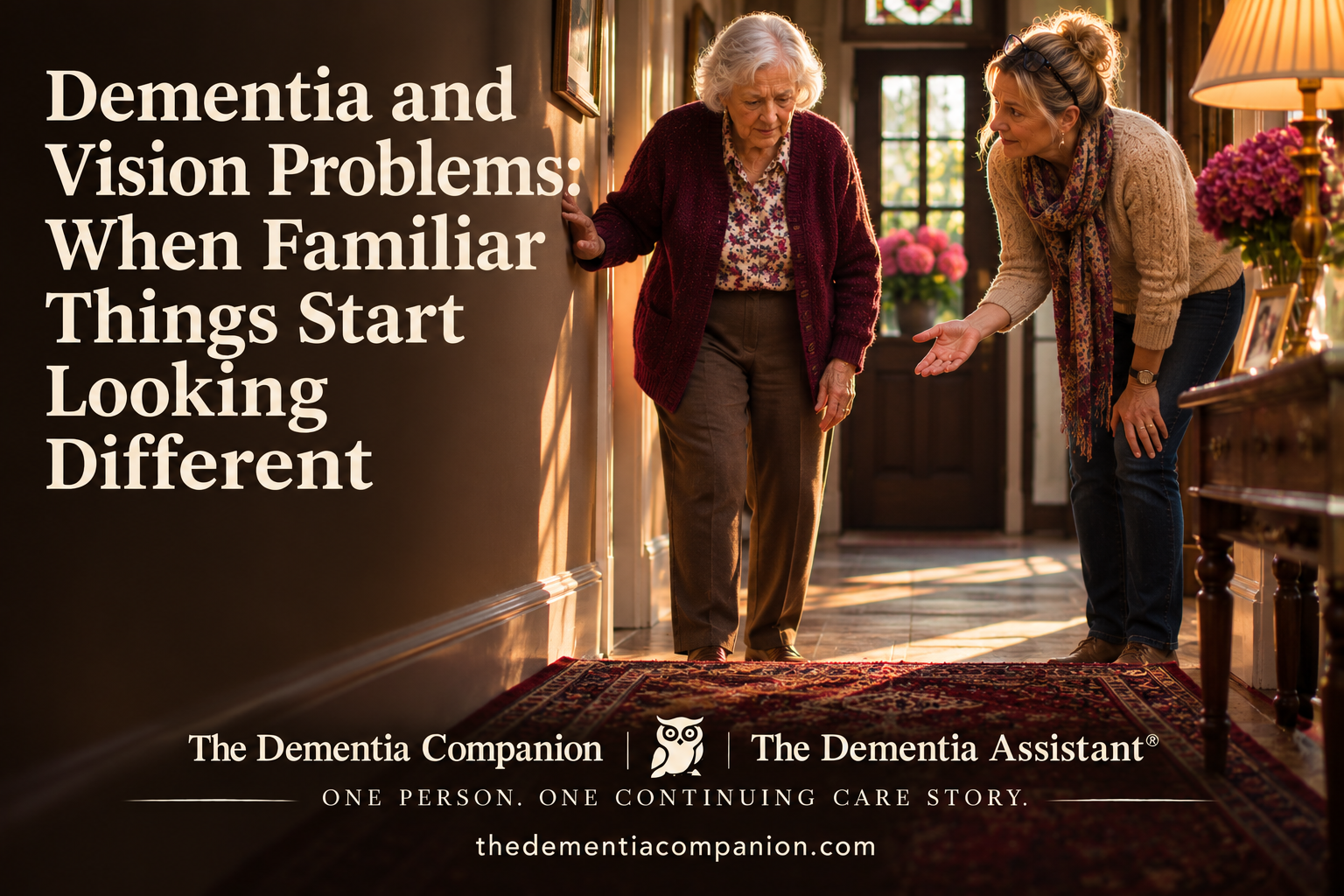
Dementia and Vision Problems: When Familiar Things Start Looking Different
One Person. One Continuing Care Story. | Article 45 of 80
By Louise Donaghy, Dementia Practitioner, Founder of The Dementia Companion and The Dementia Assistant®, and Creator of Hugo Intelligence™.
“Mum, what’s wrong?”
She’s standing in the hallway, looking down at the floor.
“There’s a hole there.”
You look.
It’s the rug.
The same rug that’s been in the hallway for twenty years.
“Mum, it’s just your rug.”
“No, love. I can’t step over that.”
You explain that the floor is perfectly safe.
You even walk across it to demonstrate.
But Mum won’t move.
You begin to wonder whether she’s frightened of falling.
Perhaps she’s confused.
Perhaps she’s imagining things.
And then you notice that she’s gripping the doorframe, looking genuinely worried.
To you, it’s an ordinary rug.
But perhaps Mum is seeing something quite different.
Now, I have always thought that a patterned carpet can be a questionable decorating decision. Some of the ones from the seventies deserve an explanation all of their own.
But for somebody living with dementia, a dark pattern on the floor can become more than a fashion offence.
It may look like a hole.
A step.
An obstacle.
Or something they cannot safely cross.
And here’s the important part.
Mum may be responding perfectly reasonably to what she believes she can see.
So when someone living with dementia begins struggling with familiar surroundings, what is actually happening?
Dementia can affect how the brain interprets visual information, even when the eyes themselves are healthy. But ordinary eye conditions, including cataracts, glaucoma and changes in eyesight, can also occur alongside dementia.
Both possibilities deserve attention.
The first step is to check for eye problems, understand what Mum is experiencing and consider how her surroundings could be made easier to interpret.
Because a person who stops at a doorway may not be refusing to walk.
A person who leaves food on their plate may not have lost their appetite.
And somebody who reaches past a cup may not simply be clumsy.
Sometimes the world they are looking at no longer makes sense in quite the same way.
Can dementia affect eyesight?
Yes, although it is important to understand what we mean.
Our eyes collect visual information.
Our brain then processes that information, helping us recognise objects, identify faces, judge distances and understand the space around us.
Dementia can affect some of those brain functions.
This means that a person may struggle to interpret what they see even when an eye examination shows that their eyes are functioning reasonably well.
However, dementia can also occur alongside physical eye conditions.
The two must not be confused.
Problems involving the eyes
These may include:
- Cataracts.
- Glaucoma.
- Age-related macular degeneration.
- Diabetic eye disease.
- Changes requiring different glasses.
- Other eye conditions affecting sight.
An optometrist or relevant eye specialist can assess these concerns.
Some conditions can be treated, while others require ongoing management.
Problems involving visual processing
These occur when the brain has difficulty making sense of the information received through the eyes.
For example, someone may:
- Misjudge distance or depth.
- Struggle to recognise a familiar object.
- Find patterns confusing.
- Misinterpret shadows.
- Have difficulty locating something against a similar-coloured background.
- Struggle to navigate familiar surroundings.
Some people experience both physical sight loss and visual processing difficulties.
Having dementia should never mean that treatable eye problems are overlooked.
Why might Mum think a rug is a hole in the floor?
Let’s return to that hallway.
Imagine a pale floor with a dark rug in the middle.
You recognise the contrast immediately.
You understand that the rug is lying flat.
Your brain interprets the pattern correctly.
But Mum may perceive the dark area as a significant change in floor level.
Perhaps she sees a hole.
Or a deep step.
Or something she might fall into.
Alzheimer’s Society and Dementia Australia describe how changes in perception can make dark mats, floor patterns and contrasting surfaces difficult to interpret.
It may be a visual misperception
A misperception occurs when something real is present but is interpreted incorrectly.
For example:
A dark rug is seen as a hole.
A coat hanging on a door looks like a person.
A reflection appears to be somebody standing nearby.
A patterned floor resembles an uneven surface.
The object exists.
But the brain interprets it differently.
Why arguing may not help
Imagine Mum believes there’s a hole in the floor.
You say:
“Don’t be silly, Mum. It’s only a rug.”
But from her perspective, the danger may appear real.
Being told she’s wrong doesn’t necessarily change what she sees.
And it may make her feel embarrassed or frightened.
Try saying:
“That looks difficult to cross, Mum.”
“Let’s have a look together.”
“Would you prefer to go another way?”
If the rug appears to be causing the difficulty, consider whether it can be safely removed.
Do not force Mum to step onto something she believes is dangerous.
The aim is to understand the difficulty and make the environment easier, not win an argument about what the floor really looks like.
Is a visual misperception the same as a hallucination?
No.
These experiences can look similar, but they are different.
Visual misperception
Something is present but is misinterpreted.
For example, Mum sees a coat hanging on a chair and believes it’s a person.
Visual hallucination
A person sees something that is not actually present.
For example, Mum describes seeing an animal in the room when there is no animal or visual object accounting for what she sees.
Misidentification
A person may incorrectly identify a familiar person, object or place.
For example, they may believe their reflection is another person.
These experiences can overlap and require individual assessment.
Visual hallucinations can occur in some types of dementia, particularly dementia with Lewy bodies, but they may also relate to other health conditions, medicines or sight loss.
Do not assume every visual change is a hallucination.
And do not assume every hallucination is caused by dementia.
If Mum is frightened, respond to her distress without automatically confirming an unverified perception.
If the experience is new, increasing or causing significant distress, seek professional advice.
This article concentrates on visual perception and everyday surroundings. Our separate article on hallucinations explores that subject in greater detail.
Why does Mum suddenly struggle with steps and stairs?
Judging depth and distance involves several visual and cognitive abilities.
Dementia may affect some people’s ability to recognise where a step begins or ends.
Perhaps Mum stands at the top of the stairs and hesitates.
Perhaps she lifts her foot too high.
Perhaps she misjudges the edge of a step.
Or seems uncertain about where to place her foot.
This is sometimes related to changes in visuospatial processing, which helps us understand where objects are in relation to one another.
But physical eye problems, pain, reduced strength, balance problems and medication effects may also contribute.
Don’t assume hesitation is stubbornness
If Mum stops at the stairs, don’t automatically encourage her to hurry.
Ask whether something feels difficult.
Observe the situation.
Does she appear unable to identify the edge?
Is the lighting poor?
Is the surface shiny?
Does she feel frightened?
Is she experiencing dizziness or pain?
Ask for appropriate assessment
A professional assessment may involve an optometrist, GP, physiotherapist or occupational therapist, depending on the difficulties.
If Mum is at risk of falling, don’t improvise unsafe stair arrangements.
Follow professional mobility and home-safety advice.
Why might Mum reach for a cup and miss it?
This is another situation families may notice.
Mum reaches towards her tea.
Her hand passes beside the cup.
She tries again.
Perhaps she knocks it over.
You might assume she’s becoming clumsy.
But reaching accurately involves visual information, spatial awareness and movement coordination.
Someone may have difficulty judging exactly where the object is.
Physical problems with coordination or strength can also contribute.
What can help?
Try making the cup easier to distinguish from its surroundings.
A plain, clearly contrasting cup may be easier to identify against a suitable table surface.
Keep the table relatively uncluttered.
Allow time.
Ask whether Mum would like assistance.
And use a stable, suitable cup rather than automatically replacing everything with specialist equipment.
The best adjustments are individual.
If this is a new or persistent difficulty, arrange clinical assessment.
A change in everyday ability deserves investigation before being dismissed as another part of dementia.
Why can plates, food and table settings become confusing?
Imagine a white plate on a white tablecloth.
On the plate is a pale meal.
To somebody with changes in contrast sensitivity or visual perception, the boundaries between these objects may become difficult to identify.
Mum may struggle to see where the food ends and the plate begins.
She may leave food untouched.
Or find it difficult to locate utensils.
Perhaps the family assumes she’s losing her appetite.
But the visual presentation may be part of the problem.
Try suitable contrast
A plate that contrasts clearly with the table may help.
So might a cup that stands out against the worktop.
Simple, uncluttered place settings may be easier to interpret than busy patterns.
Avoid assuming that red plates, brightly coloured equipment or one particular colour combination works for everybody.
Ask Mum what she can see comfortably.
If eating difficulties continue, consider other possible causes, including pain, dental problems, swallowing difficulties and illness.
Seek appropriate assessment.
Don’t take over unnecessarily
If Mum can eat independently with suitable adjustments, support that ability.
Perhaps repositioning the plate or changing the table setting is enough.
Small environmental changes can sometimes preserve an important piece of independence.
Can dementia make familiar objects difficult to recognise?
Yes.
Some people experience difficulty identifying objects even when they can see their shape and colour.
For example, Mum may look at a toothbrush without recognising what it’s for.
She may see a familiar item but struggle to identify it.
Or have difficulty understanding a crowded collection of objects.
This can sometimes involve visual agnosia, although that term describes a specific neurological difficulty and should not be applied without appropriate assessment.
What might families notice?
Mum struggles to find her toothbrush among several toiletries.
She can’t identify the correct kitchen utensil.
She searches for something that is directly in front of her.
She becomes uncertain about what an unfamiliar-looking object is.
These difficulties may have several explanations.
Memory, visual processing, eyesight, attention and changes in the environment can all contribute.
Offer support without testing her
You might say:
“Here’s your toothbrush, Mum.”
Or:
“Shall I put the cup beside you?”
Avoid repeatedly asking:
“Don’t you know what that is?”
That can turn an ordinary activity into an upsetting test.
The aim is to support understanding and independence, not demonstrate what Mum can no longer recognise.
What is posterior cortical atrophy?
Posterior cortical atrophy, often called PCA, is a less common progressive neurological syndrome affecting areas towards the back of the brain.
It is frequently associated with atypical Alzheimer’s disease.
Unlike the typical early presentation of Alzheimer’s, where memory difficulties are often prominent, PCA may begin with significant problems involving vision and visual processing.
A person may have difficulty reading, locating objects, judging distance or navigating surroundings.
Sometimes an individual attends several eye appointments before neurological difficulties are recognised.
Does struggling with vision mean Mum has PCA?
No.
Most people experiencing changes in vision do not have posterior cortical atrophy.
Many other eye and neurological conditions can cause similar difficulties.
But if someone has persistent, unexplained problems with visual processing, particularly when an eye examination doesn’t explain them, a GP or specialist may consider whether further assessment is appropriate.
Never diagnose PCA based on a family observation or an AI conversation.
Can Lewy body dementia affect what someone sees?
Yes.
Dementia with Lewy bodies can involve visual hallucinations and changes in perception.
Some people may also experience fluctuations in attention and alertness.
But not everybody with Lewy body dementia experiences the same symptoms.
And visual problems alone do not establish the diagnosis.
A person may also have a separate eye condition.
If visual changes are concerning, the individual should receive appropriate professional assessment.
The clinician should be aware of the person’s dementia diagnosis, medication and other symptoms.
Should someone with dementia still have regular eye tests?
Yes.
Regular eye care remains important.
The RNIB emphasises that eye conditions may be overlooked when somebody has dementia because their symptoms can be mistaken for part of the condition.
An eye test can identify problems that may be treatable or manageable.
Even if dementia affects visual processing, the person may also benefit from updated glasses or treatment for an eye condition.
What if Mum struggles to cooperate with an eye test?
Tell the optometrist in advance.
Explain the communication difficulties.
Ask whether additional time or an adapted assessment is available.
Some professionals can assess vision using different methods where standard testing is difficult.
If Mum cannot easily attend an appointment, ask whether a domiciliary eye examination is available and whether she meets the relevant eligibility criteria.
Don’t assume that someone cannot have their eyes assessed simply because they have dementia.
What about existing glasses?
Check that Mum has the correct glasses.
Are they clean?
Are they comfortable?
Does she have separate pairs for reading and distance?
Has her prescription changed?
If she uses bifocals or varifocals and has difficulty judging steps, ask an optometrist whether her lenses could be contributing to the problem.
Do not independently change prescribed visual aids.
When are changes in eyesight urgent?
This is particularly important.
Sudden loss of vision, severe eye pain, new flashes or floaters, or a shadow or curtain across vision may indicate an urgent eye problem.
Follow the appropriate emergency or urgent eye-care pathway.
In the UK, NHS guidance advises immediate emergency care for sudden inability to see or severe eye pain, and urgent assessment for certain other new visual symptoms.
A retinal detachment is one example of a condition requiring urgent treatment.
Watch for stroke symptoms
Sudden visual changes alongside facial weakness, arm weakness, speech difficulties or other stroke symptoms require emergency assistance.
In the UK, call 999.
Elsewhere, use the relevant emergency number.
Sudden confusion also needs urgent assessment
If Mum suddenly becomes markedly more confused, less alert or significantly different from usual, don’t assume this is dementia progression.
Delirium or another acute medical condition may be involved.
Seek urgent medical care.
Visual changes should never automatically be dismissed as dementia simply because the person already has a diagnosis.
How can we make the home easier for Mum to understand?
This is where practical environmental adjustments may help.
But the word may is important.
No single home design works for every person.
And some changes can make things worse if introduced without considering the individual’s preferences, abilities and mobility needs.
Start by looking at where Mum is actually experiencing difficulty.
- Review lighting
Good, even lighting can make objects and pathways easier to identify.
Consider whether some areas are too dark.
Whether strong reflections are creating glare.
Whether shadows make steps difficult to interpret.
Or whether Mum struggles more as daylight fades.
Avoid creating harsh pools of light and shadow.
Consider suitable night-time lighting where appropriate.
- Review floor coverings
Loose rugs and mats may create physical trip hazards.
Strongly contrasting or heavily patterned flooring may also be visually confusing.
A dark mat on a pale floor may be perceived as a hole.
A shiny floor may appear wet.
If a particular rug repeatedly causes Mum distress, consider whether it can be safely removed.
But do not change large areas of the home without considering mobility, familiarity and professional advice.
- Use contrast thoughtfully
Contrast can help someone identify important objects.
For example:
A toilet seat that is clearly distinguishable from its surroundings.
A handrail that is easy to see.
A plate that stands out against the table.
A door handle that contrasts with the door.
But large, abrupt colour changes in flooring can sometimes create visual confusion.
Contrast should help identify important objects, not make the environment appear full of obstacles.
- Reduce visual clutter
A busy worktop may make one important object hard to find.
Perhaps Mum struggles to locate her kettle among several appliances.
Or her toothbrush among numerous toiletries.
Consider keeping familiar, commonly used objects easy to see.
But don’t remove possessions that matter to Mum without discussing the change.
Her home should still feel like hers.
- Keep familiar arrangements
Moving furniture around may create additional difficulties.
Try to preserve useful, familiar layouts.
When changes are necessary for safety, involve Mum where possible and help her understand the new arrangement.
- Consider signs and visual cues
Simple labels or photographs may help some people.
Others may find them confusing.
Try suitable options rather than assuming every person needs the same signs.
And remember that changes in eyesight or visual processing may affect whether written labels are actually useful.
Should we change all the colours in Mum’s house?
Probably not.
At least, not without a good reason.
I’ve seen families become so enthusiastic about making a home dementia-friendly that the person could come back from the shops and wonder whether they’ve walked into somebody else’s house.
The aim isn’t to redesign Mum’s home into a clinical demonstration.
It is to make particular activities easier and safer.
Start with the problem.
Perhaps she can’t find the toilet seat.
Perhaps her plate disappears visually against the table.
Perhaps a patterned rug frightens her.
Consider a targeted adjustment.
Ask whether it helps.
And remember that familiarity, personal style and dignity matter.
Mum may still love her curtains, favourite armchair and family photographs.
A dementia-friendly home should still feel like the person’s home.
What if Mum is frightened by mirrors or reflections?
Sometimes a person may misidentify their reflection as another individual.
Or a reflection may appear unfamiliar or frightening.
This can be particularly unsettling when the person does not recognise what they are seeing.
Begin by understanding the experience.
Does Mum believe somebody else is in the room?
Does she become frightened at a particular time?
Does a reflection appear only under certain lighting?
Could an eye or medical problem be contributing?
If the mirror is causing significant distress, consider whether changing its position or temporarily covering it would be appropriate, while respecting Mum’s preferences and the practical purpose of the mirror.
Don’t automatically remove every mirror.
Some people enjoy using mirrors and need them for everyday activities.
The individual response should guide the approach.
Can visual perception problems increase the risk of falls?
They can contribute.
If someone has difficulty judging steps, identifying obstacles or understanding changes in floor level, moving around may become more difficult.
But falls have many possible causes.
Pain.
Weakness.
Balance problems.
Medication effects.
Footwear.
Illness.
Environmental hazards.
And more.
A falls assessment may need to consider these factors together.
An occupational therapist may assess the environment.
A physiotherapist may assess mobility and balance.
An optometrist or eye specialist may assess sight.
Don’t simply tell Mum to be careful
That isn’t always enough.
If the floor looks dangerous to her, she may need an environmental adjustment.
If she cannot judge the edge of a step, she may need professional mobility support.
If she has an untreated eye condition, she may need appropriate treatment.
The person should not be expected to compensate for a problem that could be better addressed through assessment or suitable support.
What if Mum is struggling to recognise people’s faces?
This can be deeply upsetting for families.
But recognising a person involves more than eyesight.
It also involves visual processing, memory, context and other cognitive abilities.
Some people may have difficulty recognising familiar faces.
Others may recognise a person’s voice but not their appearance.
Changes in vision can also make recognition more difficult.
Introduce yourself gently
Try:
“Hello, Mum. It’s Sarah.”
“It’s lovely to see you.”
“Would you like me to sit with you?”
Avoid asking her to prove that she recognises you.
Look for other forms of connection
Perhaps she responds to your voice.
A familiar greeting.
A shared activity.
Or a particular song.
But don’t assume any approach will work for everyone.
Follow her comfort and preferences.
Recognition isn’t the only way a relationship can remain meaningful.
Should Mum still drive if she’s having visual perception problems?
Concerns about visual processing, depth perception, judgement or sight can have significant implications for driving.
Driving safety requires more than passing a basic reading or eyesight test.
The person must also be able to interpret traffic, judge distance and respond appropriately.
Rules differ by country and jurisdiction.
In Great Britain, dementia diagnosis and medical fitness to drive must be considered under DVLA requirements.
Northern Ireland has a separate licensing authority.
The USA, Canada, Australia and Ireland have their own rules.
If there are concerns about driving safety, seek prompt advice from the person’s clinician and relevant licensing authority.
Do not rely on a family judgement or Hugo to declare somebody safe to drive.
How should carers support Mum in hospital or residential care?
Visual perception difficulties may become especially challenging in unfamiliar environments.
Imagine Mum entering a hospital bathroom.
The lighting is different.
The toilet blends into the walls.
The floor is shiny.
There are unfamiliar signs.
Perhaps she struggles to recognise the layout.
A worker might think she is refusing to use the bathroom.
But perhaps she cannot confidently identify where things are.
Explain what helps
Tell the care team:
“Mum can become frightened by dark patterns on the floor.”
“She needs time to judge steps.”
“She understands the layout better when the lighting is even.”
“She uses glasses.”
“Please approach calmly and explain where things are.”
These details may help staff approach her with greater understanding.
Ask about reasonable adjustments
Depending on the setting and needs, this may involve suitable lighting, access to glasses, communication adjustments, clear navigation or support from occupational therapy and eye-care professionals.
The provider remains responsible for its own assessments, safe environment and professional care arrangements.
The family can provide useful information, but should not be expected to redesign the care setting.
How can we prepare for an eye or memory clinic appointment?
A short record of the actual difficulties can be valuable.
Instead of saying:
“Mum’s vision is strange.”
You might explain:
“Mum recently stopped crossing a dark hallway rug because she said it looked like a hole.”
Or:
“She’s started reaching past cups and has difficulty finding objects on a patterned tablecloth.”
Or:
“She can read some large print but struggles to identify familiar objects.”
These details give the clinician something useful to investigate.
Questions worth asking
- Could an eye condition be contributing?
- Does Mum need an optometry or ophthalmology assessment?
- Could visual processing or visuospatial changes be involved?
- Do her current glasses remain suitable?
- Would occupational therapy help?
- What changes at home may improve safety?
- Are there symptoms that should prompt urgent review?
- What should the family record before the next appointment?
The goal is to help professionals see the full picture.
Not to arrive with a diagnosis already decided.
International guidance: where can families seek help?
United Kingdom
Speak with an optometrist or appropriate eye-care service about changes in vision.
A GP, memory service or specialist can consider whether neurological visual processing difficulties need assessment.
RNIB and Alzheimer’s Society provide information about dementia, sight loss and practical adaptations.
NICE guidance emphasises considering sensory impairments during dementia assessment.
Emergency and urgent eye-care pathways depend on symptoms and local arrangements.
United States
An optometrist or ophthalmologist can assess physical eye conditions.
The Alzheimer’s Association and National Institute on Aging provide guidance on visual changes, depth perception and making the home safer.
Relevant neurology and rehabilitation services may be involved when visual processing difficulties are suspected.
Insurance and access arrangements vary.
Canada
Families can approach their healthcare provider or local optometry services.
The Alzheimer Society of Canada provides information about changes in visual and spatial perception.
Services, assessments and funding vary by province and territory.
Australia
Dementia Australia offers detailed guidance on dementia-friendly environments, lighting, contrast and visual perception.
An optometrist, GP or appropriate specialist can help assess eye problems.
Occupational therapy may be relevant for practical environmental changes.
Access and funding arrangements vary.
Republic of Ireland
Families can speak with their GP, optometrist or appropriate eye-care service.
The Alzheimer Society of Ireland provides dementia support and information.
Assessment pathways and eligibility for services depend on individual circumstances.
Wherever you live
The essential questions are:
Is there a problem with the eyes, a change in how the brain interprets what is seen, or both?
And:
What would make the person’s environment easier to understand without unnecessarily taking away independence?
What should families include in the continuing care plan?
Imagine Mum has several people supporting her.
Her daughter notices that she hesitates at patterned flooring.
Her son discovers that she manages better with clear, uncluttered surfaces.
A visiting carer notices difficulty finding the toilet.
An optometrist reviews her eyesight.
An occupational therapist recommends practical changes.
Each person holds a different part of the picture.
But if the information remains separate, every new carer may have to discover the difficulties again.
A fictional care-plan example
Person: Margaret, aged 82.
Relevant condition: Alzheimer’s disease, with visual perception difficulties requiring ongoing professional review.
Strengths: Enjoys familiar surroundings, chooses her clothing and participates in household activities.
Vision: Wears prescribed glasses. Eye examinations and relevant professional recommendations recorded separately.
Observed difficulties: Hesitates near dark patterned floor coverings and sometimes struggles to locate pale objects against pale backgrounds.
What Margaret says: “It looks like a hole,” when approaching a particular hallway rug.
What helps: Clear pathways, suitable lighting, less visual clutter, appropriate contrast and calm explanations.
What hasn’t helped: Being rushed, being told she is imagining things or having objects moved without explanation.
Safety concerns: Difficulties judging steps and obstacles, requiring appropriate assessment.
Professional recommendations: Relevant eye-care, occupational therapy and mobility guidance.
Review arrangements: Update when visual abilities, support needs or professional recommendations change.
This example is fictional.
But look at the difference between this and writing:
“Margaret is confused about the floor.”
The second description is vague.
The first tells the next person what Margaret experiences and how they may be able to help.
That is what person-centred information should do.
Meet Hugo Intelligence™: understanding the world through Mum’s experience
This is exactly the sort of everyday concern that inspired Hugo Intelligence™.
Because families often don’t know why something is happening.
They simply know that Mum has changed.
Perhaps she no longer trusts the stairs.
Perhaps she struggles to recognise objects.
Perhaps she is frightened of a rug that’s been in the hallway for years.
And the family is left wondering whether it is dementia, eyesight or something else.
Hugo Intelligence™ is the conversational, person-centred guidance system within The Dementia Assistant®, powered by Person-Centred Intelligence®.
Hugo represents:
H — Human
U — Understanding
G — Guidance
O — One person at a time
And yes, he’s still our lovely little owl.
Although I suspect that even Hugo would raise an eyebrow at some of the carpets we used to consider fashionable.
Begin with the question you actually have
You might say:
“Hugo, Mum has dementia and she’s suddenly frightened of a dark rug in the hallway. She says it’s a hole. She also seems to struggle with steps. What could be happening?”
Hugo can explain general information about visual misperceptions, eyesight and visual processing.
He can help families consider the circumstances.
He can suggest practical questions for an optometrist, GP or occupational therapist.
And he can help organise observations about what Mum is experiencing.
Hugo can ask follow-up questions
For example:
“Has Mum had her eyesight checked recently?”
“Does she use glasses?”
“Is this difficulty new?”
“Does it happen in particular lighting?”
“Is the flooring patterned or shiny?”
“Has Mum had any falls?”
“Does she experience visual hallucinations?”
“Have there been medication or health changes?”
“What helps her feel comfortable?”
These questions can help build a clearer description of the problem.
They do not establish a diagnosis.
Continuing conversations
The family may begin by discussing the rug.
Later, they might ask:
“How can we make the bathroom easier for Mum to recognise?”
“What should we ask an occupational therapist?”
“How can we explain these difficulties to a new carer?”
“What information should go into Mum’s care plan?”
“What changes should prompt another eye test?”
Hugo can continue the educational conversation as the family’s needs evolve.
He cannot examine the eyes, diagnose posterior cortical atrophy, assess visual fields, determine fall risk or replace clinical care.
General Hugo: guidance without a care plan
Anyone can ask Hugo general questions without first creating or selecting an individual plan.
For example:
“Can dementia make a dark rug look like a hole?”
Hugo can provide general guidance about visual perception and possible environmental adjustments.
Personalised Hugo: using the individual care plan explicitly selected
Now imagine the family has created Margaret’s individual care plan.
It contains her communication preferences, home routines, relevant abilities, visual difficulties and professional recommendations.
When the user explicitly selects Margaret’s individual care plan, Hugo can use relevant information recorded in that plan to offer more personalised educational guidance.
For example:
“Hugo, using Margaret’s care plan, help us prepare a practical guide for her new care workers about the visual difficulties she experiences at home.”
Hugo can consider the relevant recorded details.
He can help organise what Margaret finds difficult and what has helped previously.
Hugo does not automatically access every care plan in an account.
The user must select the individual person’s plan.
Families supporting several people can maintain separate plans.
And Hugo’s suggestions must be checked against relevant clinical and professional guidance.
The Care Planning Centre™ and guided Talk to Hugo
The Care Planning Centre™ helps people living with dementia and their families develop, review and maintain individual person-centred care information.
Through guided Talk to Hugo conversations, families can explore questions such as:
“What does Mum manage independently?”
“Which parts of the home seem confusing?”
“Does lighting make a difference?”
“What does Mum say she sees?”
“What helps her feel safe?”
“Which professionals have assessed her?”
“What should a new care worker understand?”
Relevant information can be organised into appropriate care-plan sections, with the user reviewing what is recorded.
The platform also supports care-plan reviews, gap suggestions and assistance with clearer professional wording.
The purpose is not to turn the family into an eye specialist.
It is to help preserve useful, respectful information about the person.
Daily notes: noticing the patterns that matter
The Dementia Assistant® includes daily notes.
Families can record relevant observations over time.
For example:
Monday: Margaret stopped before crossing the hallway rug. She said it looked like a hole. Family reassured her and used an alternative clear route.
Wednesday: Margaret struggled to locate her cup on a patterned tablecloth. She identified it more comfortably when it was placed on a plain contrasting surface.
Friday: Margaret appeared uncertain at the stairs. Family contacted the relevant professional service for assessment.
Sunday: Following professional advice, family reviewed lighting and floor coverings. Margaret appeared more comfortable in the hallway.
These are fictional examples.
They do not diagnose the cause.
But they can help families and professionals understand what happens, when it happens and what has changed.
Saved Hugo conversations
Families can save, categorise and revisit Hugo conversations.
Perhaps they begin with visual perception.
Later, they discuss falls, an eye appointment or adapting a care setting.
Saved conversations help preserve continuity in educational guidance.
They are not verified clinical records or professional instructions.
Documents and exports
The platform also supports organisation of relevant care information and documents.
Applicable export formats include PDF, Word, CSV and JSON.
Families can maintain their own continuing information and share appropriate details with authorised professionals, respecting the person’s wishes, privacy, consent and permissions.
The family’s record complements professional clinical information.
It does not replace it.
Family Circle: helping everyone see the same pattern
Different relatives may notice different things.
One sees Mum struggling with patterned flooring.
Another notices that she cannot find objects on a cluttered table.
A third discovers that she manages better in brighter, evenly lit rooms.
Family Circle supports appropriate communication between authorised relatives.
This can help the family develop a more consistent understanding of Mum’s needs.
It does not automatically provide everybody with access to all personal information.
Consent, privacy and permissions remain essential.
And Family Circle cannot replace professional assessment or physical support when someone is at risk.
Life Story and Memory & Moments: preserving the familiar world
Perhaps Mum has always loved her home.
The ornaments she’s collected.
The family photographs.
The garden she has spent years caring for.
The chair she’s sat in every evening.
The way she arranges the table for Sunday lunch.
These things matter.
Life Story and Memory & Moments help preserve meaningful relationships, experiences, routines and personal history.
This information may help carers understand why particular belongings and arrangements are important.
It can also remind families that environmental changes should be made thoughtfully.
Mum’s home should not lose every familiar object in the name of safety.
The aim is to support her ability to enjoy her surroundings.
Person-centred care should preserve the life being lived, not simply remove every possible difficulty from the room.
Multilingual support: describing what Mum sees
Visual experiences can be difficult to explain.
Sometimes Mum may use unusual words because she cannot easily describe what she is seeing.
For multilingual families, the challenge may be greater.
Perhaps she prefers Welsh, Irish, Hindi, Spanish or another language.
Perhaps relatives live in different countries and need to understand relevant care information.
The Dementia Assistant® offers 12 interface languages, with dictation and translation capabilities spanning 201 languages.
These tools can support communication and the organisation of care information across languages.
Not every feature is available in all 201 languages.
Medical descriptions, consent, legal matters, medication information and safety-critical translations must be professionally verified where necessary.
Professional interpreting may be appropriate for important assessments.
Some people living with dementia experience changes in language use, but this varies.
Never assume everybody returns to a childhood language.
Ask what the person understands and prefers.
Understanding how Mum describes the world is part of understanding her experience of it.
Dementia Academy™, crisis guidance and the Carer Wellbeing Hub
The Dementia Assistant® includes educational resources through the Dementia Academy™.
These support understanding of dementia, communication and person-centred care.
The platform also includes educational crisis guidance to help families recognise situations requiring urgent or additional professional assistance.
Hugo is not an emergency service.
He cannot assess an eye injury, diagnose sudden sight loss or provide live medical intervention.
And what about the family?
It can be frightening to watch somebody you love become uncertain in their own home.
Perhaps you’ve known that house your whole life.
You remember Mum walking confidently through every room.
Now she hesitates at a doorway.
You want to help.
But you’re not sure what she sees.
And perhaps you find yourself becoming impatient because the obstacle looks so ordinary to you.
These feelings deserve understanding.
The Carer Wellbeing Hub recognises the emotional pressure of caring.
But families also need practical help.
Ask about eye assessments.
Seek occupational therapy when appropriate.
Share observations with healthcare professionals.
And be clear about what you can safely manage.
You don’t have to solve complex visual and neurological problems on your own.
Ask Hugo: 17 questions families ask about dementia and vision problems
- Can dementia change the way someone sees things?
Yes. Dementia can affect how the brain processes visual information. This may lead to difficulties recognising objects, judging distances, interpreting patterns or understanding surroundings. Eye conditions can also contribute.
- Why does Mum think a dark rug is a hole?
She may be misinterpreting the dark area as a change in floor level. This is a possible visual misperception. Consider whether the rug can be safely removed and seek assessment if the difficulty is new or persistent.
- Can someone have visual perception problems even with healthy eyes?
Yes. The brain interprets information received through the eyes. Dementia-related changes can affect this processing even when the eyes themselves are relatively healthy.
- Is visual misperception the same as hallucination?
No. A misperception involves interpreting something real incorrectly. A hallucination involves perceiving something that is not present. Both require appropriate consideration, especially when new or distressing.
- Why is Mum frightened of steps and stairs?
She may have difficulty judging depth or recognising edges. Poor eyesight, balance problems, pain and other conditions may also contribute. Seek appropriate assessment and avoid unsafe mobility assistance.
- Why does Mum reach for a cup and miss it?
Visual-spatial difficulties may affect her ability to judge an object’s location. Other movement or health problems may also contribute. A new difficulty should be discussed with an appropriate clinician.
- Can vision problems make someone with dementia refuse food?
They may contribute if food, plates or utensils are difficult to distinguish. However, reduced eating can have many causes, including pain, illness or swallowing difficulties. Seek professional advice when needed.
- Should Mum still have regular eye tests?
Yes. People living with dementia can also develop treatable or manageable eye conditions. Ask an optometrist about appropriate testing, including adapted assessments where necessary.
- Can cataracts make dementia seem worse?
Sight loss from cataracts may make communication, navigation and everyday tasks more difficult. This can complicate how cognitive abilities appear. Eye assessment can help establish whether treatment is appropriate.
- What is posterior cortical atrophy?
Posterior cortical atrophy is a rare progressive neurological syndrome that can affect visual processing and spatial awareness. It is often associated with atypical Alzheimer’s disease. It requires specialist diagnosis.
- Can Lewy body dementia cause visual problems?
Yes. Visual hallucinations and changes in perception can occur in dementia with Lewy bodies. However, visual symptoms alone cannot establish the diagnosis.
- What changes make a home easier for someone with visual perception problems?
Appropriate lighting, reduced glare, uncluttered pathways, safe flooring and thoughtful contrast may help. Adjustments should reflect the person’s abilities, preferences and professional recommendations.
- Should I remove all rugs and mirrors?
Not automatically. Some rugs are trip hazards or visually confusing, but changes should be individually considered. Mirrors can be useful or distressing depending on the person. Seek professional advice when safety concerns exist.
- Can visual perception difficulties increase falls risk?
They may contribute, particularly when the person struggles to judge steps or obstacles. Falls can have several causes and may require a multidisciplinary assessment.
- When are vision problems an emergency?
Sudden vision loss, severe eye pain, new concerning flashes or floaters, or sudden visual changes with stroke symptoms require urgent or emergency care according to local guidance.
- Can Hugo help us understand Mum’s visual difficulties?
Yes. Hugo can provide general educational information and help families organise observations and professional questions. When the user’s selected individual care plan is available, Hugo can consider relevant recorded information for more personalised guidance. He cannot diagnose eye disease or neurological conditions.
- How can we keep Mum’s visual and environmental needs connected across care services?
The Dementia Assistant® supports individual care plans, daily notes, saved Hugo conversations, document organisation and appropriate Family Circle updates. Relevant information can be shared with authorised professionals, subject to wishes, consent and privacy.
One Person. One Continuing Care Story.
Different professionals. Different services. One person. One continuing story.
Imagine Margaret’s journey.
She begins experiencing memory difficulties.
Her family notices that she sometimes struggles to recognise familiar objects.
She attends her GP.
A memory clinic becomes involved.
A dementia diagnosis is made.
Later, Margaret begins hesitating at patterned flooring.
An optometrist checks her eyesight.
An occupational therapist considers her home environment.
A physiotherapist becomes involved because of mobility concerns.
A professional carer learns that Margaret prefers clear pathways and gentle explanations.
Then perhaps Margaret has a hospital admission.
Another team meets her.
Another assessment begins.
Another care plan is written.
But Margaret is still Margaret.
The woman who loves gardening.
Who chooses her own clothes.
Who likes to sit in the sunshine.
Who has particular ways of doing things.
Who sometimes finds dark flooring frightening.
And who deserves to be understood rather than dismissed as confused.
The family’s own continuing care plan
This is the principle behind The Dementia Assistant®.
A person living with dementia, and their family where appropriate, can maintain their own continuing person-centred care information.
It can begin with the first memory concerns.
It can develop through GP appointments, memory assessments and diagnosis.
And it can continue through home care, hospital admissions, rehabilitation, residential care and palliative or end-of-life support when relevant.
Visual needs belong within the person’s continuing information
Margaret’s care plan should not simply state:
“Has dementia. Poor perception.”
It should explain what she experiences.
Which situations are difficult.
What she can still manage.
What environmental changes help.
Which professional recommendations apply.
How she communicates concern.
And what brings her comfort.
One person. One individual care plan.
Margaret’s abilities may change.
Her vision may change.
Her professional care arrangements may change.
Her home environment may need adapting.
The family’s continuing information can be reviewed to reflect those changes.
But Margaret’s identity, dignity and preferences remain central.
The family-held record complements professional records
The Dementia Assistant® does not replace optometry assessments, medical records, occupational therapy reports, professional care plans or safeguarding procedures.
It complements them.
The person or family can maintain their own continuing information independently of any single provider.
Relevant details may be shared with professionals when appropriate, respecting the person’s wishes, consent, privacy and permissions.
Different professionals. Different services. One person. One continuing story.
Because the next person caring for Margaret should not need to wait until she’s frightened by the hallway floor before discovering that it has been difficult for her for months.
A gentle invitation to meet Hugo
If Mum has begun seeing familiar things differently, it can be frightening.
Perhaps you’re worried that her dementia is changing.
Or that an eye condition is being overlooked.
You may not know where to begin.
You can start by asking Hugo.
Describe what Mum says she sees.
Explore general information about vision and dementia.
Ask about changes that might help at home.
Prepare questions for an eye-care professional.
And when you explicitly select Mum’s individual care plan, Hugo can use relevant recorded information to help make the conversation more person-centred.
The Dementia Companion is our public educational home for practical dementia articles, family guidance and Ask Hugo resources.
https://thedementiacompanion.com/
The Dementia Assistant® is our interactive platform where families can continue conversations with Hugo Intelligence™, create and maintain individual person-centred care plans, save and categorise guidance, record daily notes, organise documents, preserve Life Story and Memory & Moments information, and communicate appropriately through Family Circle.
The platform also includes multilingual capabilities, the Dementia Academy™, educational crisis guidance and the Carer Wellbeing Hub.
All subscriptions include a 30-day complimentary trial.
The UK Family subscription costs £4.99 per month after the trial.
International subscription prices are available through the platform.
Meet Hugo and explore The Dementia Assistant®:
https://thedementiaassistant.com/
Hugo provides educational guidance, not medical diagnosis, eye examinations, neurological assessments, individual falls assessments, emergency intervention or legally binding decisions.
One final thought
I want you to imagine walking through your own home.
The place where you’ve lived for years.
Where you know every doorway.
Every chair.
Every step.
Every familiar object.
Now imagine that some of those things no longer look quite right.
The rug resembles a hole.
The floor seems uneven.
The cup is difficult to find.
A familiar doorway suddenly feels uncertain.
Wouldn’t you hesitate?
Wouldn’t you want somebody to understand why?
And wouldn’t it be upsetting if the people around you kept insisting there was nothing wrong?
This is why person-centred dementia care matters.
We cannot always know exactly what somebody is seeing.
But we can listen.
Observe.
Seek proper eye and medical assessments.
Make thoughtful changes.
And avoid dismissing their experience simply because we see the world differently.
Perhaps Mum doesn’t need another explanation that the rug is flat.
Perhaps she needs somebody to understand that, to her, it doesn’t appear that way.
Good dementia care isn’t only about helping somebody understand our world. Sometimes it’s about making the effort to understand theirs.
One person.
One continuing care story.
With love,
Louise, Hugo and Charlie ❤️🦉✨
Louise Donaghy
Founder & CEO of The Dementia Assistant®
Created and powered by Person-Centred Intelligence®
Creator of Hugo Intelligence™
⸻
Continue exploring with The Dementia Companion
The Dementia Companion
https://thedementiacompanion.com/
Ask Hugo: Practical Dementia Questions
https://thedementiacompanion.com/ask-hugo/
The Dementia Assistant®
https://thedementiaassistant.com/
Related articles in our continuing-care series include Dementia and Hearing Loss, Mum Keeps Falling, Hallucinations in Dementia and When Someone with Dementia Does Not Recognise You.
References and authoritative guidance
1. Alzheimer’s Society, UK. How can dementia change a person’s perception? Explains visual processing, misperception and the distinction between eyesight and brain interpretation.
https://www.alzheimers.org.uk/about-dementia/stages-and-symptoms/how-dementia-changes-perception
2. Alzheimer’s Society, UK. Supporting someone with vision and perception problems. Includes practical examples of dark rugs and other visual difficulties.
https://www.alzheimers.org.uk/get-support/publications-and-factsheets/dementia-together/support-person-dementia-vision-perception-problems
3. Alzheimer’s Society, UK. Sight and hearing loss with dementia.
https://www.alzheimers.org.uk/about-dementia/stages-and-symptoms/sight-hearing-loss
4. Alzheimer’s Society, UK. Posterior cortical atrophy.
https://www.alzheimers.org.uk/about-dementia/types-dementia/posterior-cortical-atrophy
5. Dementia UK. Changes in perception and hallucinations in dementia.
https://www.dementiauk.org/information-and-support/health-advice/changes-in-perception-and-hallucinations-in-dementia/
6. RNIB, UK. Dementia and sight loss.
https://www.rnib.org.uk/your-eyes/navigating-sight-loss/dementia-and-sight-loss/
7. RNIB, UK. Having an eye examination at home.
https://www.rnib.org.uk/your-eyes/eye-tests-explained/having-an-eye-examination-at-home/
8. NICE. Dementia: assessment, management and support, NG97. Includes assessment of sensory impairment.
https://www.nice.org.uk/guidance/ng97/chapter/recommendations
9. NHS. How to make your home dementia-friendly.
https://www.nhs.uk/conditions/dementia/living-with-dementia/home-environment/
10. NHS. Vision loss.
https://www.nhs.uk/conditions/vision-loss/
11. NHS. Detached retina.
https://www.nhs.uk/conditions/detached-retina-retinal-detachment/
12. NHS. Symptoms of a stroke.
https://www.nhs.uk/conditions/stroke/symptoms/
13. Alzheimer’s Association, USA. 10 Early Signs and Symptoms of Alzheimer’s and Dementia. Includes problems understanding visual images and spatial relationships.
https://www.alz.org/alzheimers-dementia/10_signs
14. National Institute on Aging, USA. Home Safety Checklist for Alzheimer’s Disease.
https://www.nia.nih.gov/health/safety/home-safety-checklist-alzheimers-disease
15. National Institute on Aging, USA. Aging and Your Eyes.
https://www.nia.nih.gov/health/aging-and-your-eyes
16. Alzheimer Society of Canada. Managing changes in your abilities. Includes changes in visual and spatial perception.
https://www.alzheimer.ca/en/help-information/im-living-dementia/managing-changes-your-abilities
17. Alzheimer Society of Ontario, Canada. Meal time. Includes visual and spatial challenges affecting meals.
https://alzheimer.ca/on/en/meal-time
18. Dementia Australia. At Home with Dementia. Practical advice about lighting, contrast, glare and visual interpretation.
https://www.dementia.org.au/get-support/home-dementia
19. Dementia Australia. Tips to create a dementia-friendly home.
https://www.dementia.org.au/living-dementia/home-life/creating-dementia-friendly-home
20. Healthdirect Australia. Living well with dementia after diagnosis. Includes recommendations for regular vision checks.
https://www.healthdirect.gov.au/conditions/dementia/living-with-dementia-after-diagnosis
21. Alzheimer Society of Ireland. First Steps After Diagnosis. Dementia information and support pathways.
https://alzheimer.ie/living-with-dementia/i-have-dementia/first-steps-after-diagnosis/
Editorial and safety note: This article provides general educational guidance, not an individual diagnosis or visual assessment. Physical eye conditions and brain-related visual processing difficulties may coexist. Sudden changes in eyesight, severe eye pain, acute confusion or stroke-like symptoms require appropriate urgent or emergency assessment. Home adaptations and mobility assistance should reflect individual needs and professional recommendations. All illustrative family scenarios are fictional.
You May Also Find Helpful
Need help with your own situation? Ask Hugo.
One Person. One Continuing Care Story. The Dementia Companion is where you discover guidance. Inside The Dementia Assistant®, talk with Hugo, save and categorise conversations, record daily notes and involve authorised supporters in a continuing care plan centred around the person.
Ask Hugo About This · Start Your Continuing Care Plan — Families · Continuing Care Planning — Professionals
Personal guidance requires the appropriate account and subscription access. Care-plan information is used only with authorised access and the required consent and selection steps. All subscription plans include a 30-day complimentary trial.