Mum Has Stopped Enjoying Her Hobbies. How Can We Help Her Stay Connected?
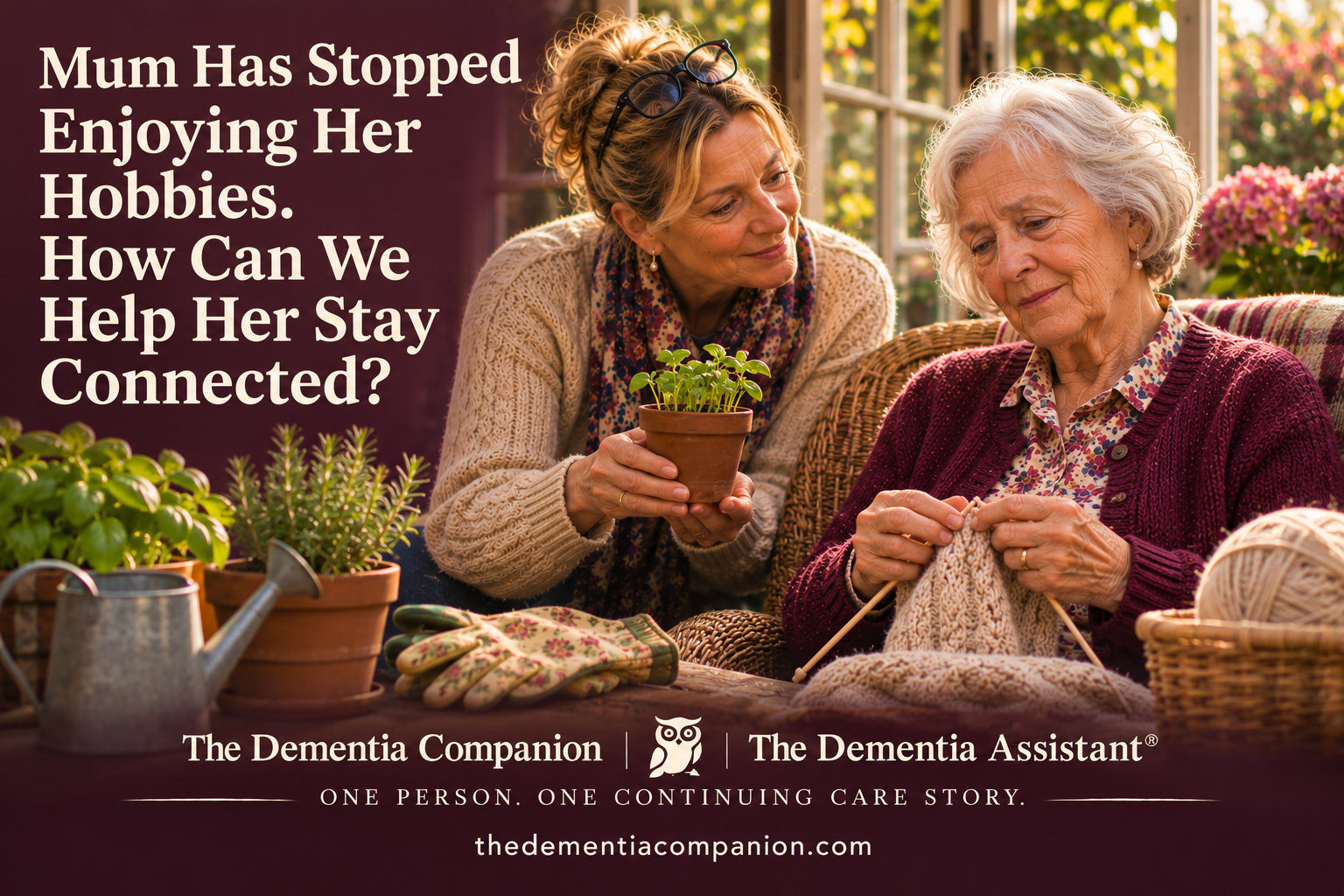
Mum Has Stopped Enjoying Her Hobbies. How Can We Help Her Stay Connected?
One Person. One Continuing Care Story. | Article 47 of 80
By Louise Donaghy, Dementia Practitioner, Founder of The Dementia Companion and The Dementia Assistant®, and Creator of Hugo Intelligence™.
Mum has always loved her garden.
Rain or shine, she’d be outside tending her roses, pottering around the flowerbeds or explaining why somebody had planted the daffodils in completely the wrong place.
She knew the name of every plant.
She could grow things that the rest of us would have given up on weeks earlier.
And she had very strong opinions about pruning.
Very strong opinions.
But lately, things have changed.
The gardening gloves haven’t moved from the shelf.
The watering can is sitting untouched.
And when you ask whether she’d like to go outside, she shrugs.
“Not today, love.”
You try again the following afternoon.
“Shall we do a little gardening, Mum?”
“No, I can’t be bothered.”
Then you notice her knitting beside the chair.
That’s been untouched too.
The book she was reading hasn’t moved.
She no longer seems interested in the things that once brought her so much happiness.
And something about that feels particularly sad.
Because these weren’t just hobbies.
They were part of Mum.
The things she enjoyed.
The things she was good at.
The things that gave her pleasure, independence and a sense of purpose.
You begin wondering whether she’s losing interest in life.
Whether she’s depressed.
Whether her dementia is progressing.
Or whether she simply cannot remember how to do the things she once loved.
So what should families do when someone living with dementia stops enjoying their usual hobbies?
Start by understanding what has changed rather than assuming the person no longer cares. Dementia can affect motivation, memory, planning, confidence and the ability to begin activities. Depression, pain, illness, fatigue and sensory difficulties can also contribute.
Some people continue enjoying familiar hobbies with small adaptations.
Others discover different ways of participating.
Some find pleasure in entirely new interests.
And sometimes, the person simply doesn’t want to do the activity anymore.
That choice deserves respect too.
The aim should never be to keep Mum occupied simply because we think she ought to be doing something.
The aim is to help her experience enjoyment, choice, connection and purpose in ways that remain meaningful to her.
Because Mum doesn’t have to knit another jumper, bake another cake or win another gardening competition to remain the woman who loved doing those things.
And if she wants to sit in the sunshine and admire the flowers instead of planting them, perhaps that’s a perfectly good way of enjoying her garden.
Why does someone with dementia lose interest in hobbies?
There isn’t one explanation.
Dementia affects people differently, and a change in hobbies may involve several factors.
Perhaps Mum wants to knit but can no longer remember the sequence.
Perhaps she becomes tired during activities that previously felt straightforward.
Perhaps she has lost confidence after making mistakes.
Perhaps she finds it difficult to get started without somebody providing a gentle invitation.
Or perhaps she is experiencing apathy or depression.
These possibilities need to be explored individually.
She may find familiar tasks more complicated
Think about knitting.
You need to choose the wool.
Find the needles.
Remember the pattern.
Keep track of the stitches.
Recognise where you stopped.
And coordinate your hands.
For an experienced knitter, much of that may once have felt automatic.
But dementia can affect memory, planning, sequencing and attention.
Mum may still love knitting.
She may simply find the process more difficult.
She may be frightened of making mistakes
Imagine someone who once baked beautiful cakes.
Now they struggle to follow the recipe.
They forget which ingredient comes next.
Perhaps they leave something out.
A family member steps in to correct them.
Then another mistake happens.
Eventually, baking may begin to feel less enjoyable and more like an examination.
Mum might say she doesn’t want to bother.
But underneath that response could be embarrassment or loss of confidence.
She may have difficulty initiating activities
Sometimes the person still enjoys an activity once they begin.
But getting started is difficult.
They may sit quietly despite having things around them they usually like.
This can happen when dementia affects motivation or the ability to plan and initiate action.
The person isn’t necessarily being lazy.
And telling them to make more effort may not help.
Physical health may have changed
Perhaps Mum’s arthritis makes knitting painful.
Her eyesight makes reading difficult.
She’s tired after a recent illness.
Her hearing affects enjoyment of group activities.
Or she cannot manage the garden because her balance has changed.
These difficulties may need treatment, adaptations or professional support.
She may simply prefer something different now
We also need to remember that preferences can change throughout life.
People are allowed to stop enjoying a hobby.
Even a lifelong one.
Not every change is a symptom requiring intervention.
The question is whether Mum is comfortable with the change or whether something is preventing her from doing what she still wants to do.
Ask what matters to Mum now, not only what mattered twenty years ago.
What is apathy in dementia?
Apathy is a loss of motivation, initiative or interest.
Alzheimer’s Society explains that apathy can occur in dementia because of changes affecting motivation and behaviour.
Someone experiencing apathy may have difficulty beginning activities or showing interest in things they previously enjoyed.
They may spend long periods sitting without initiating anything.
But that doesn’t necessarily mean they’re unhappy.
And it certainly doesn’t mean they’re being deliberately uncooperative.
What might apathy look like?
Perhaps Mum no longer suggests going for a walk.
She doesn’t start knitting unless someone sets it out.
She stops telephoning friends.
She sits in her chair even though familiar activities are available.
Or she appears uninterested when somebody suggests an outing.
Apathy may affect several parts of everyday life.
But these observations alone cannot establish that she has apathy.
A clinician should consider the wider situation.
Why encouragement doesn’t always work
Families may say:
“Come on, Mum, you need to do something!”
“You can’t sit there all day!”
“You used to love this!”
But if Mum is finding it difficult to initiate an activity, more pressure may simply create frustration.
A gentler approach might be:
“Mum, I’m going to put these flowers in a vase. Would you like to choose where they go?”
Or:
“I’ve brought some seedlings. Shall we sit outside and have a look?”
She may respond better when the activity feels manageable and the first step is clear.
And if she doesn’t want to join in, that needs respecting.
The invitation matters. So does the person’s right to say no.
Is Mum experiencing apathy or depression?
This is an important distinction.
Apathy and depression can sometimes look similar.
Both may involve reduced activity and loss of interest.
But they aren’t the same condition.
Someone with apathy may have little motivation to begin an activity without necessarily feeling persistently sad.
Someone experiencing depression may have low mood, hopelessness, loss of pleasure, changes in sleep or appetite, and other symptoms.
The two can also occur together.
What should families look for?
Consider whether Mum seems distressed by the changes.
Has she become persistently sad?
Does she express hopelessness?
Has her appetite or sleep changed?
Has she withdrawn from relationships?
Does she still experience enjoyment when something familiar happens?
Has there been a recent bereavement or significant life change?
These are observations to discuss with a clinician, not a way of diagnosing depression at home.
Why a medical review matters
Depression can occur alongside dementia and may be treatable.
Pain, illness, medication effects and other health problems can also contribute to withdrawal or fatigue.
If Mum has lost interest in most activities, especially when the change is new or increasing, seek a GP or appropriate healthcare review.
If she expresses thoughts of suicide or self-harm, seek urgent professional help through the relevant crisis or emergency services.
And if Mum becomes suddenly confused, significantly less alert or acutely unwell, seek urgent medical assessment.
Don’t assume that losing interest in everyday life is simply an inevitable part of dementia.
Does losing a hobby mean Mum’s dementia is getting worse?
Not necessarily.
A decline in the ability to manage familiar activities can occur as dementia changes.
But it isn’t enough by itself to establish progression.
Perhaps Mum needs updated glasses.
Perhaps her arthritis has become painful.
Perhaps she is recovering from an infection.
Perhaps she has lost confidence.
Or perhaps an activity that once required little effort now needs some adaptation.
Consider what has changed and when.
A clinical review may be appropriate, particularly if the change is significant, persistent or accompanied by other symptoms.
And remember that a person can experience difficulty with one activity while continuing to manage many others.
One lost ability doesn’t define the whole person.
How can I help Mum enjoy her hobbies again?
Begin with her own wishes.
This sounds simple, but families can sometimes become so determined to preserve a favourite hobby that the person has very little say in what happens next.
Ask:
“Would you like to try some gardening today?”
“Would you rather sit outside?”
“Shall we put some music on?”
Or:
“Is there something else you’d enjoy?”
Allow time for her response.
Notice what she chooses.
And don’t assume that silence automatically means agreement.
Make the beginning easy
Sometimes an invitation works better when the activity is already accessible.
For example, instead of asking Mum to find her gardening tools, choose the plants and decide where to begin, you could bring two suitable pots to the table.
“Mum, I’ve got these little plants. Which one shall we put here?”
That reduces the number of steps.
But Mum can still make a meaningful choice.
Offer support without taking over
Perhaps she can choose the flowers.
Hold the pot.
Feel the leaves.
Or decide where the plant belongs.
You can help with tasks she finds difficult while leaving her involved in the parts she wants to manage.
Follow her interest
If Mum begins talking about the flowers rather than planting them, enjoy the conversation.
If she wants to look at the garden instead, that’s fine.
If she decides she’d rather have a cup of tea, that’s fine too.
The activity doesn’t have to finish the way you planned.
Sometimes the most valuable part of a hobby is the pleasure it brings, not the finished result.
How can we adapt gardening for someone with dementia?
Gardening can involve movement, familiar smells, colour, fresh air and a sense of achievement.
But not everybody wants or can manage the same tasks.
If Mum still enjoys active gardening
Consider whether she can continue suitable tasks with appropriate support.
Perhaps she can plant flowers, water pots or tend a raised bed.
If mobility or balance has changed, ask an occupational therapist or other appropriate professional about safe adaptations.
If physical gardening has become difficult
She may still enjoy:
- Choosing plants.
- Arranging flowers.
- Watering a manageable indoor pot.
- Looking at gardening photographs or books.
- Sitting outside among familiar plants.
- Advising somebody else about where flowers should go.
And let’s not underestimate that last one.
Some experienced gardeners are quite happy to supervise while everybody else does the digging.
Consider safety
Avoid exposing Mum to hazards she cannot safely manage, such as sharp tools, hazardous gardening products, unsafe lifting or falls risks.
Use professional advice when mobility, coordination or judgement may affect safety.
But don’t assume she must be excluded from gardening altogether.
The aim is suitable participation.
What if Mum used to love knitting but can’t follow the pattern anymore?
Perhaps she has knitted for fifty years.
Baby blankets.
Cardigans.
Scarves.
Christmas jumpers.
And occasionally something that started as a jumper but ended up resembling a very ambitious tea cosy.
Now she struggles with the pattern.
Perhaps she loses count of her stitches.
Or forgets what she was making.
You might be tempted to show her how to do it again.
But consider whether the whole task needs to remain the same.
Simplify where appropriate
Perhaps she enjoys knitting a straightforward section without following a complicated pattern.
Perhaps she prefers handling familiar wool and choosing colours.
Maybe she enjoys helping select materials while someone else completes the project.
Or perhaps knitting no longer appeals to her.
Watch for frustration
If Mum becomes upset when she makes a mistake, consider stopping or changing the activity.
Avoid repeatedly correcting her stitches.
The aim isn’t to produce a perfect cardigan.
It’s to preserve enjoyment where possible.
Respect dignity
Don’t automatically replace an adult hobby with a children’s activity.
If Mum has always enjoyed sophisticated craftwork, consider adaptations that preserve her tastes and identity.
And ask what she thinks.
Can Mum still help with baking and cooking?
Possibly, depending on her abilities and the risks involved.
Cooking can be deeply meaningful.
It may involve familiar routines, smells, taste, family traditions and the satisfaction of contributing to a meal.
But dementia may affect sequencing, attention, judgement or safe appliance use.
Begin with the individual task
Perhaps Mum can safely mix ingredients.
Choose between recipes.
Decorate a cake.
Help prepare fruit.
Or explain how she used to make a family favourite.
If she has difficulty with hot ovens, knives, gas or other hazards, those tasks may require different support or arrangements.
Preserve choice
Ask whether she’d like to join in.
Let her choose what she’s comfortable doing.
Don’t automatically take over everything.
Make the experience pleasant
Perhaps the cake turns out differently from usual.
Perhaps you end up with six spoonfuls of flour where the recipe suggested four.
Some adjustments are needed for food safety and dietary requirements, but not every difference needs correcting.
The purpose is shared enjoyment, not winning The Great British Bake Off.
If cooking is no longer safe or enjoyable, Mum may still enjoy choosing the recipe, smelling familiar ingredients or sharing the finished food.
What if Mum can no longer read the books she loves?
This can be particularly upsetting for somebody who has always enjoyed reading.
Perhaps Mum used to read several novels a week.
Now she loses track of the story.
Finds the print difficult to see.
Or struggles to concentrate.
Before assuming dementia is the only cause, consider whether eyesight or another health issue needs reviewing.
Explore suitable alternatives
Perhaps Mum would enjoy shorter stories.
Magazine articles on subjects she loves.
An audiobook.
Listening to somebody read aloud.
Poetry.
Or looking through beautifully illustrated books.
A familiar book may still bring comfort even when she no longer follows every detail.
But don’t assume that simpler material must mean childish material.
Choose subjects that reflect her interests and preferences.
Don’t test comprehension
Avoid asking:
“Do you remember what happened in the last chapter?”
Unless Mum enjoys discussing the story that way.
A conversation about a favourite character or picture may be more enjoyable.
And sometimes simply listening together is enough.
What about music, dancing and singing?
Music can remain meaningful for many people living with dementia.
A familiar melody may provide enjoyment, comfort or an opportunity for connection.
Some people enjoy singing.
Others enjoy listening quietly.
Some like dancing or moving to music.
But not every person enjoys the same music.
And not every familiar song brings a happy memory.
Ask what Mum likes
Perhaps she enjoys classical music.
Traditional Irish songs.
Jazz.
A favourite film soundtrack.
Or the music she danced to when she was young.
Choose according to her preferences.
Keep the volume comfortable
Someone with hearing loss or sensory sensitivities may find loud music uncomfortable.
Observe her response and adjust where appropriate.
Don’t make music a memory test
Instead of:
“Mum, do you remember this song?”
You might simply say:
“I thought you might enjoy this.”
Then listen together.
If she wants to sing, wonderful.
If she wants to listen, equally wonderful.
And if she tells you to turn it off because she’s never liked that singer, you’ve received a perfectly useful piece of person-centred feedback.
Avoid promises
Music is not a cure for dementia.
It may support enjoyment and connection for some individuals, but responses vary.
The person’s experience should guide what happens.
What if Dad used to love football, fishing or woodworking?
Meaningful activities shouldn’t be limited to knitting, baking and looking at photographs.
People have different interests.
Some love sport.
Some enjoy mechanics.
Others enjoy fishing, carpentry, computers, photography, painting, walking, volunteering or discussing politics.
A person diagnosed with dementia doesn’t need to be given a generic list of activities supposedly suitable for their age.
Football
Perhaps Dad can still watch matches.
Discuss a favourite team.
Look at photographs of memorable games.
Or attend a match with suitable support if he wants to and the arrangements are appropriate.
Fishing
Maybe he enjoys a familiar waterside walk.
Watching others fish.
Talking about favourite places.
Or participating in suitable aspects of the activity with appropriate support.
Consider water safety, mobility and supervision needs.
Woodworking
Perhaps he can still choose designs or materials.
Identify different woods.
Or participate in low-risk tasks after an appropriate safety assessment.
Tools, blades and machinery require particular caution.
Don’t assume it is safe to continue hazardous tasks without assessment simply because Dad once performed them expertly.
Volunteering and community activities
Some people, including those with young-onset dementia, value continuing to contribute through work-like activities or volunteering.
Suitable roles may help preserve purpose and social connection.
But participation should reflect the person’s wishes, abilities and the organisation’s responsibilities.
A meaningful activity is one that matters to the individual, not one chosen because it appears on a dementia activity worksheet.
Can somebody with dementia learn a new hobby?
Sometimes, yes.
Learning and adapting abilities vary.
A dementia diagnosis doesn’t automatically mean somebody can never try something new.
Perhaps Mum has never painted before but enjoys experimenting with colours.
Perhaps she discovers that she likes birdwatching.
Or finds pleasure in a community choir.
Some activities may be easier to learn than others, and additional support may be needed.
The important thing is to choose something that interests the person.
Start without pressure
A brief, enjoyable introduction is often more helpful than demanding an hour of concentrated activity.
Give Mum time.
Offer support.
Allow her to decide whether she wants to continue.
And don’t treat the experience as evidence that she is improving or declining cognitively.
It can simply be something she enjoys.
What if Mum refuses every activity I suggest?
First, consider how the suggestions are being made.
Perhaps Mum has been offered several choices in quick succession.
Perhaps she is tired.
Perhaps she dislikes being told she needs stimulating activities.
Perhaps she genuinely wants to sit quietly.
Or perhaps apathy, depression or another health problem is contributing.
Avoid making every day a timetable
You don’t need to organise Mum from breakfast until bedtime.
Rest, quiet reflection and simply being comfortable are legitimate parts of life.
A person shouldn’t have to earn their rest by completing an activity first.
Try a natural invitation
Instead of:
“Right, Mum, it’s time for your cognitive stimulation activity.”
Try:
“I’m putting some flowers in a vase. Would you like to choose a few?”
Or:
“I fancy sitting in the garden for a little while. Would you like to join me?”
One sounds like an appointment.
The other sounds like ordinary life.
Accept the answer
If Mum says no, consider whether she’s comfortable and whether there’s a concern that needs addressing.
If not, respect her choice.
And perhaps try something different another time, if she wants.
Encouragement is not the same as pressure.
How can we tell whether an activity is actually enjoyable?
This is where observation matters.
Sometimes Mum may struggle to explain whether she likes an activity.
But she may still communicate through words, expression, engagement and choices.
Possible signs of enjoyment include:
Smiling.
Relaxing.
Joining in voluntarily.
Talking about the activity.
Choosing to continue.
Or showing interest in particular parts.
But not everybody expresses enjoyment visibly.
A quiet person may be perfectly content.
And smiling doesn’t automatically mean they want to continue.
Ask where possible
“Are you enjoying this?”
“Would you like to carry on?”
“Shall we have a break?”
Follow the answer and the person’s responses.
Notice signs of discomfort
Perhaps Mum becomes frustrated.
Pushes the materials away.
Looks tired.
Or repeatedly attempts to leave.
Stop and consider what she may need.
The activity may be too complicated, tiring or simply unwanted.
Measure the experience, not the performance
A finished painting isn’t necessarily evidence of a good afternoon.
An unfinished painting isn’t evidence of failure.
Perhaps Mum enjoyed choosing the colours.
Perhaps she loved talking with her daughter.
Perhaps she simply enjoyed sitting beside somebody she trusts.
The value is in the person’s experience, not the number of tasks completed.
How can we support hobbies in advanced dementia?
As dementia progresses, some people have significant difficulties with movement, communication, attention or everyday activities.
But meaningful experiences may still be possible.
What matters is tailoring the approach to the individual.
Perhaps Mum enjoys listening to familiar music.
Feeling a comfortable fabric.
Watching the garden.
Sitting beside someone she loves.
Looking at familiar photographs.
Or being offered a favourite scent or object, where safe and appropriate.
Avoid treating sensory experiences as compulsory
Some people enjoy touch.
Others dislike it.
Some find particular sounds calming.
Others become overwhelmed.
Some enjoy familiar photographs.
Others may find them confusing or upsetting.
Ask where possible.
Observe the person’s response.
Adapt or stop when necessary.
Consider physical comfort
Pain, positioning, fatigue, hearing, vision and other health needs may affect participation.
Seek appropriate professional support when needed.
Preserve adulthood
Even when someone can no longer complete a complex task, they’re still an adult.
Use respectful language.
Offer age-appropriate experiences.
And maintain their dignity.
A person’s abilities may change. Their right to meaningful choice and connection does not disappear.
What if Mum lives in a care home and doesn’t join the activities?
This deserves attention.
Sometimes relatives visit and discover that Mum hasn’t participated in the organised activities.
They may feel disappointed.
Perhaps there was a music session.
An art group.
A quiz.
Or afternoon entertainment.
But Mum stayed in her room.
Before assuming this is a problem, ask why.
Does Mum enjoy the activities offered?
Perhaps she has never liked quizzes.
Perhaps she prefers gardening to painting.
Perhaps she dislikes large groups.
Or the session takes place at a time when she normally rests.
Does she need help to participate?
Perhaps she would enjoy the activity if somebody helped her get there.
Perhaps she needs hearing support.
A quieter environment.
Or an individual introduction.
Is there a health concern?
A sudden loss of interest may require medical review.
Pain, depression, illness or medication effects may contribute.
Ask for person-centred engagement
Instead of simply asking how many activities Mum attends, ask:
“What does Mum enjoy?”
“How are her personal interests reflected in the care plan?”
“What opportunities does she have for meaningful choice?”
“Can familiar activities be adapted?”
NICE recommends activities tailored to the person’s preferences.
A care-home programme should not be judged solely by how full the activities calendar looks.
The best activity is not always the one that attracts the biggest group. Sometimes it’s the quiet moment that makes one person feel like themselves.
What professional help might make hobbies easier?
Depending on Mum’s difficulties, different professionals may be relevant.
GP or dementia specialist
A clinical review may help investigate loss of interest, apathy, depression, medication effects or another health problem.
Occupational therapist
An occupational therapist can assess difficulties with everyday activities and consider suitable adaptations, equipment or ways to support participation.
Physiotherapist
A physiotherapist may assess mobility and physical abilities where those affect participation.
Optometrist or audiologist
Vision and hearing difficulties may make previously enjoyable activities difficult or tiring.
Speech and language therapist
Communication difficulties may affect some activities and relationships. A therapist may provide relevant assessment and support where indicated.
Community groups and dementia services
Depending on the area, there may be dementia cafés, choirs, exercise programmes, arts groups, day services or other community opportunities.
Some people enjoy groups specifically designed for people living with dementia.
Others prefer activities in the wider community.
The person’s wishes should guide the choice.
Where can families find meaningful activity support internationally?
United Kingdom
The NHS, Alzheimer’s Society and Dementia UK provide guidance about maintaining meaningful activities.
Alzheimer’s Society offers ideas for activities at home and in the community.
Singing for the Brain and local dementia cafés may be available in some areas.
The person may also benefit from suitable occupational therapy or other professional assessment.
United States
The Alzheimer’s Association provides advice on adapting everyday activities and creating a balanced routine.
The National Institute on Aging also offers practical information for families supporting someone with Alzheimer’s disease.
Local Alzheimer’s Association chapters and community programmes may provide further opportunities.
Canada
The Alzheimer Society of Canada provides information about finding suitable activities and adjusting them to the person’s abilities.
Local programmes and access arrangements differ between provinces and territories.
Australia
Dementia Australia offers practical guidance on enjoyable activities, interests, creativity and maintaining social connection.
Healthdirect Australia provides general information about continuing hobbies after a dementia diagnosis.
Republic of Ireland
The Alzheimer Society of Ireland offers resources on activities, creative engagement and meaningful participation at home.
Its local services and activity programmes may provide additional support, depending on availability and eligibility.
Across every country
The most useful question remains:
What does this person enjoy, and what support would make that experience possible today?
A practical way to plan Mum’s next enjoyable activity
Let’s return to Mum’s garden.
You arrive on Tuesday afternoon.
Instead of saying:
“Mum, you really should get back to gardening.”
You bring a small pot of herbs.
Perhaps rosemary or basil.
You put it on the table.
“Mum, I thought you might like this. Where do you think we should put it?”
She looks at the plant.
Touches the leaves.
Smiles.
“That needs more sunlight.”
You laugh.
Of course it does.
Mum has been telling you where to put plants for most of your life.
You sit together.
She talks about the garden.
Perhaps she helps choose a pot.
Perhaps she doesn’t.
Maybe you both go outside.
Or maybe you stay at the table and enjoy the smell of fresh herbs.
The activity lasts fifteen minutes.
Nothing remarkable happens.
No project is completed.
No spectacular improvement in memory occurs.
But Mum has been involved in something familiar and meaningful.
She’s made a choice.
Shared knowledge.
And enjoyed spending time with you.
This is a fictional example.
And it won’t suit everybody.
But it shows something important.
Sometimes adapting a hobby means preserving what the person loved about it, rather than insisting they complete every task the way they once did.
What should families record in Mum’s continuing care plan?
Imagine several people supporting Mum.
Her daughter knows Mum used to love gardening.
Her son knows she enjoys talking about flowers but no longer likes bending down.
A professional carer discovers she enjoys arranging flowers at the kitchen table.
An occupational therapist recommends suitable adaptations.
A granddaughter notices that Mum likes looking through gardening books.
Each person has learnt something useful.
But what happens when a new carer begins?
Or Mum goes into hospital?
Or she moves to another care setting?
Without a continuing record, those details can easily become lost.
A fictional care-plan example
Person: Margaret, aged 82.
What matters to Margaret: Gardening, knitting, family meals and spending time with her grandchildren.
Personal history: Margaret previously maintained a large garden and enjoyed growing roses, herbs and vegetables.
Current strengths: Recognises familiar plants, enjoys choosing flowers, expresses preferences and participates in simple activities when comfortable.
Current difficulties: Finds complex knitting patterns difficult and becomes tired during physically demanding gardening.
What Margaret says: “I still love my garden, but I don’t want to do all that digging.”
What helps: Short, familiar activities, clear invitations, a comfortable seated position and opportunities to make choices.
What hasn’t helped: Being repeatedly corrected, being rushed or being expected to complete a complicated task.
Relevant health considerations: Arthritis, vision, fatigue, mood and other concerns to be reviewed by appropriate professionals.
Meaningful alternatives: Looking through gardening photographs, arranging flowers, choosing plants and spending time outdoors.
Review arrangements: Update if Margaret’s abilities, preferences or professional recommendations change.
This is a fictional example.
But notice the difference.
Instead of writing:
“Margaret no longer does activities.”
We have preserved the woman behind the observation.
Her interests.
Her choices.
Her abilities.
Her changing needs.
And what still brings meaning to her day.
Meet Hugo Intelligence™: helping families rediscover what matters to Mum
This is exactly the sort of everyday situation that inspired Hugo Intelligence™.
Because a family might begin with a question about gardening.
But underneath it may be a much deeper worry.
Mum seems less interested.
Less confident.
Less connected.
And the family feels as though another piece of her personality is disappearing.
Hugo Intelligence™ is the conversational, person-centred guidance system within The Dementia Assistant®, powered by Person-Centred Intelligence®.
Hugo stands for:
H — Human
U — Understanding
G — Guidance
O — One person at a time
And yes, he’s still our wonderful little owl.
Although I’m fairly certain he’d appoint himself chief supervisor of any gardening project.
Begin with the question you actually have
You might say:
“Hugo, Mum has Alzheimer’s and she used to love gardening and knitting. Now she just sits in her chair and says she can’t be bothered. I’m worried she’s losing interest in everything. How can I help?”
Hugo can explain general information about apathy, depression and changes in everyday abilities.
He can help families consider possible reasons for Mum’s withdrawal.
Suggest respectful ways of offering meaningful activities.
And help prepare observations and questions for a healthcare professional.
Hugo can ask follow-up questions
For example:
“What activities has Mum enjoyed throughout her life?”
“What does she say when you suggest them?”
“Does she seem sad or distressed?”
“Does she enjoy the activity once she begins?”
“Has her physical health changed?”
“Does pain or fatigue affect her participation?”
“Are the activities too complicated or tiring?”
“What does she still enjoy?”
“Has the change happened gradually or suddenly?”
These questions may help organise the family’s understanding.
They cannot diagnose the cause.
Continuing conversations
The family may begin by discussing gardening.
Later, they might ask:
“How can we adapt knitting if Mum can’t follow the pattern?”
“What questions should I ask the GP about apathy?”
“How can we help a new care worker understand Mum’s interests?”
“What activities could Mum enjoy with her grandchildren?”
“How should we record what works in her care plan?”
Hugo can continue the conversation as the family’s needs change.
He cannot diagnose depression or apathy, prescribe treatment, determine physical safety or replace professional assessment.
General Hugo: guidance without a care plan
Anyone can ask Hugo general dementia questions without first creating or selecting an individual care plan.
For example:
“What activities can help someone with dementia stay connected to hobbies they used to enjoy?”
Hugo can provide general educational guidance and practical considerations.
Personalised Hugo: using the explicitly selected individual care plan
Now imagine Margaret’s family has created her individual care plan.
It includes her Life Story, preferred activities, routines, health considerations, communication needs and previous observations.
When the user explicitly selects Margaret’s individual care plan, Hugo can use relevant information recorded in that selected plan to offer more personalised educational guidance.
For example:
“Hugo, using Margaret’s care plan, help us think of meaningful activities that reflect her love of gardening, her arthritis and her preference for quiet afternoons.”
Hugo can consider the relevant recorded information when helping the family explore possibilities.
Hugo does not automatically access every care plan in an account.
The individual person’s care plan must be selected by the user.
Families supporting more than one person can maintain separate plans.
This helps keep educational guidance relevant to the correct individual.
The Care Planning Centre™ and guided Talk to Hugo
The Care Planning Centre™ helps people living with dementia and their families create, review and maintain individual person-centred care information.
Through guided Talk to Hugo conversations, users can explore questions such as:
“What has Mum always enjoyed?”
“What does she enjoy now?”
“Which activities make her feel confident?”
“What has become difficult?”
“What support does she welcome?”
“Does she prefer company or time alone?”
“What professional recommendations should be recorded?”
Relevant information can be organised into appropriate care-plan sections, with the user reviewing what is recorded.
The platform also supports care-plan reviews, suggestions for missing information and clearer professional wording.
The purpose is to preserve a continuing understanding of the person.
Not simply maintain a list of tasks.
Daily notes: recording enjoyment as well as difficulties
The Dementia Assistant® includes daily notes.
These can help families record meaningful observations over time.
For example:
Monday: Margaret declined knitting. She said the pattern was confusing. Family did not press her to continue.
Wednesday: Margaret enjoyed choosing flowers for a vase and talking about her garden.
Friday: Margaret appeared tired and declined an outdoor activity. Family noted the change and discussed her recent loss of interest with the GP.
Sunday: Margaret enjoyed sitting outside with her granddaughter and identifying familiar plants.
These examples are fictional.
They do not establish a medical cause.
But they help the family understand what Margaret still enjoys.
Saved and categorised Hugo conversations
Families can save, categorise and revisit Hugo conversations.
They might begin with questions about apathy.
Later, they may explore meaningful activities, communication, mobility or carer wellbeing.
Saved conversations support continuity in educational guidance.
They are not verified medical records or professional treatment instructions.
Document organisation and exports
The Dementia Assistant® also supports the organisation of appropriate care documents and information.
Applicable exports include PDF, Word, CSV and JSON.
The family can maintain relevant information and share it with authorised professionals where appropriate.
Privacy, consent, permissions and applicable law remain essential.
Family Circle: helping everybody understand what Mum still enjoys
Different family members may know different sides of Mum.
Her daughter remembers the gardening.
Her son remembers that she loved dancing.
Her granddaughter knows which songs make her smile.
A professional carer discovers she enjoys helping choose flowers.
Family Circle helps authorised relatives share relevant information and updates.
This can support more consistent, person-centred care.
But the goal isn’t to create a timetable in which every family member is responsible for making Mum complete an activity.
It’s to preserve opportunities for connection and meaningful choice.
Access to personal information must respect Mum’s wishes, consent, privacy and relevant permissions.
Life Story and Memory & Moments: remembering the person behind the hobby
This may be the most important part of the whole article.
A hobby is rarely just a task.
It can represent decades of experience.
Pride.
Skill.
Friendship.
Routine.
Achievement.
And identity.
Perhaps Mum learnt to knit from her own mother.
Perhaps her father taught her to garden.
Perhaps she used to dance every Saturday night.
Perhaps she ran a bakery.
Perhaps she travelled the world taking photographs.
Those details matter.
Life Story and Memory & Moments help families preserve meaningful personal history, experiences, relationships and preferences.
This information can support a more thoughtful approach to everyday life.
A former gardener may enjoy choosing plants.
A former musician may enjoy listening to a particular instrument.
A retired mechanic may enjoy talking about engines.
A person who loved travelling may enjoy discussing places or looking at photographs.
But be careful.
A person’s history is an invitation to understand them, not permission to assume what they want today.
Mum may have loved knitting for fifty years. She is still allowed to decide she doesn’t fancy knitting this afternoon.
Multilingual support: preserving culture, identity and familiar activities
Hobbies and meaningful activities can be closely connected to language and culture.
Perhaps Mum enjoys songs in Welsh.
Traditional Irish music.
A familiar recipe from childhood.
Gardening customs from another country.
Or a community activity conducted in her preferred language.
The Dementia Assistant® offers 12 interface languages, with dictation and translation capabilities spanning 201 languages.
These tools can help families communicate and organise relevant information across languages.
Not every feature is available in all 201 languages.
Important medical, legal and safety-critical information requires appropriate professional verification where necessary.
Professional interpreting may be needed for significant clinical conversations.
Some people living with dementia experience changes in language use, but this varies.
Never assume everybody returns to a childhood language.
Ask what the person understands and prefers.
Culture and language can be part of what makes an activity meaningful, but the individual remains more important than any assumption about their background.
Dementia Academy™, crisis guidance and the Carer Wellbeing Hub
The Dementia Assistant® includes educational resources through the Dementia Academy™.
These support understanding of dementia, communication and person-centred approaches.
The platform also includes educational crisis guidance to help families recognise situations requiring urgent or additional professional support.
Hugo is not an emergency response service.
He cannot diagnose depression, provide live clinical monitoring or replace a medical assessment.
And what about the family carer?
Sometimes supporting meaningful activities can become another pressure.
You may spend hours looking for things Mum might enjoy.
Buying equipment.
Arranging outings.
Finding classes.
Trying to motivate her.
And feeling disappointed when she doesn’t want to participate.
You might begin to feel as though every quiet afternoon is something you’ve failed to fix.
But caring isn’t a competition to see how many activities you can fit into a day.
The Carer Wellbeing Hub recognises the emotional pressures families experience.
Practical support also matters.
Ask other relatives to share responsibilities where possible.
Explore appropriate local services.
Seek professional advice if Mum’s loss of interest concerns you.
And remember that simply spending comfortable time together can be valuable.
You don’t have to organise an activity every minute to be providing meaningful companionship.
Ask Hugo: 17 questions families ask when someone with dementia loses interest in hobbies
- Why has Mum with dementia stopped enjoying her hobbies?
Dementia can affect motivation, memory, planning and confidence. Physical health, pain, depression, fatigue or sensory difficulties may also contribute. Explore the individual circumstances rather than assuming one cause.
- Is losing interest in hobbies a sign that dementia is progressing?
It can occur as dementia changes, but loss of interest alone does not establish progression. Other treatable or manageable factors may be involved. Significant changes should be discussed with an appropriate clinician.
- What is apathy in dementia?
Apathy is a loss of motivation, initiative or interest. It can occur with dementia-related brain changes. It isn’t necessarily laziness or deliberate refusal, and professional assessment may help distinguish it from other problems.
- What’s the difference between apathy and depression?
Both may involve reduced activity and interest. Depression can also involve persistent low mood, hopelessness and other emotional or physical symptoms. They may coexist, so a healthcare professional should assess concerning changes.
- Should I keep encouraging Mum to do activities?
Gentle invitations may be helpful, but repeated pressure can create distress. Offer meaningful choices, adapt tasks and respect Mum’s wishes.
- Can someone with dementia still enjoy gardening?
Yes, many people continue enjoying gardening with suitable adjustments. The activity might involve planting, watering, choosing flowers or simply enjoying the garden, depending on the individual’s abilities and preferences.
- What if Mum can’t follow her knitting pattern anymore?
Consider whether a simpler activity or different form of participation would be enjoyable. Avoid repeatedly correcting mistakes. She may prefer choosing wool, knitting a simple section or trying something else.
- Can Mum still help with cooking?
Possibly, depending on her abilities and the risks involved. She might enjoy choosing ingredients or participating in suitable tasks. Hot appliances, sharp tools and other hazards require appropriate safety consideration.
- What activities are suitable for someone with advanced dementia?
Some people enjoy familiar music, photographs, comfortable sensory experiences, gentle interaction or time outdoors. Activities must reflect the individual’s preferences, communication needs and physical comfort.
- What if Mum refuses everything I suggest?
Consider whether the activity is tiring, unwanted, difficult or poorly timed. Explore possible health concerns and respect her choice. A person is allowed to enjoy quiet time.
- Should activities be based on hobbies Mum enjoyed years ago?
Personal history can provide useful ideas, but it shouldn’t dictate every choice. Ask what she enjoys now and remain open to new interests.
- Can music help someone with dementia feel connected?
Music can provide enjoyment and connection for some individuals. Responses vary, and familiar songs are not always comforting. Follow the person’s preferences and don’t use music as a memory test.
- Can people with young-onset dementia continue working or volunteering?
Some people continue meaningful employment, volunteering or community activities with suitable adjustments and support. Opportunities depend on their abilities, wishes, circumstances and applicable safety requirements.
- When should we seek medical advice about loss of interest?
Arrange an assessment if withdrawal is new, persistent, worsening or associated with low mood, poor intake, pain, major fatigue or other health changes. Sudden confusion or acute illness requires urgent medical care.
- How can a care home provide more meaningful activities?
Staff should learn the person’s interests, strengths, preferences and current abilities. NICE recommends offering activities tailored to the individual. Participation should remain a choice, not a requirement.
- Can Hugo help us find activities that reflect Mum’s interests?
Yes. Hugo can offer general educational guidance and activity considerations. When the user explicitly selects Mum’s individual care plan, Hugo can consider relevant recorded preferences and needs to provide more personalised suggestions. He cannot diagnose apathy or depression.
- How can we preserve Mum’s hobbies and interests as care services change?
The Dementia Assistant® supports individual care plans, Life Story, Memory & Moments, daily notes, document organisation, saved Hugo conversations and appropriate Family Circle updates. Relevant information can be shared with authorised professionals, respecting the person’s wishes, privacy and consent.
One Person. One Continuing Care Story.
Different professionals. Different services. One person. One continuing story.
Imagine Margaret’s journey.
She first begins experiencing memory difficulties.
Her daughter notices that she has stopped knitting.
A GP assessment takes place.
Later, she attends a memory clinic.
A dementia diagnosis is made.
Over time, Margaret begins needing more support.
Perhaps a home carer becomes involved.
An occupational therapist considers adaptations.
A dementia specialist reviews changes in motivation.
Perhaps Margaret has a hospital admission.
Later, she moves into residential care.
Different professionals.
Different records.
Different services.
But Margaret remains Margaret.
The woman who loved gardening.
Who knitted jumpers for her grandchildren.
Who enjoyed a cup of tea in the sunshine.
Who could tell you the difference between several varieties of rose.
Who liked things done properly.
And who still deserves opportunities to enjoy life on her own terms.
The family’s own continuing care plan
This is the principle behind The Dementia Assistant®.
A person living with dementia, and their family where appropriate, can maintain their own continuing person-centred care information.
It can begin with the earliest memory concerns.
It can develop through GP appointments, memory assessments and diagnosis.
And it can continue through home care, hospital admissions, rehabilitation, residential care and palliative or end-of-life support when relevant.
Meaningful activities belong within the person’s care story
Margaret’s plan shouldn’t simply say:
“Doesn’t participate in activities.”
It should explain:
What Margaret has enjoyed throughout her life.
What she enjoys now.
Which abilities she retains.
Which activities have become difficult.
What support she welcomes.
Which adaptations have helped.
What she prefers not to do.
And which professional recommendations apply.
One person. One individual care plan.
Margaret’s abilities and preferences may change.
Perhaps she no longer enjoys knitting.
But she still loves choosing flowers.
Perhaps she begins enjoying music.
Or prefers quiet visits with her grandchildren.
The plan should change with her.
It should preserve meaningful choices without trapping her in the hobbies she enjoyed years ago.
The family-held record complements professional care
The Dementia Assistant® does not replace GP records, professional assessments, clinical treatment plans, statutory care plans or safeguarding procedures.
It complements them.
The person or family can maintain their own continuing information independently of any single provider.
Relevant details can be shared appropriately with professionals, respecting wishes, consent, privacy, permissions and applicable law.
Different professionals. Different services. One person. One continuing story.
Because the next person supporting Margaret shouldn’t need to spend weeks discovering that she used to love gardening.
And they shouldn’t assume that because she can no longer dig the flowerbeds, gardening has nothing left to offer her.
The person is so much more than the tasks they can complete.
Their interests, relationships and identity deserve to remain part of every stage of care.
A gentle invitation to meet Hugo
If Mum has stopped enjoying the things she once loved, it can be upsetting.
Perhaps you’re worried that she’s becoming depressed.
Or that her dementia is progressing.
Perhaps you simply miss seeing her smile when she talks about something that matters to her.
You can begin by asking Hugo.
Describe what you’ve noticed.
Explore possible reasons for the change.
Ask about ways to adapt familiar activities.
Prepare questions for the GP or dementia specialist.
And when you explicitly select Mum’s individual care plan, Hugo can use relevant recorded information to help explore more person-centred possibilities.
The Dementia Companion is our public educational home for practical dementia articles, family guidance and Ask Hugo resources.
https://thedementiacompanion.com/
The Dementia Assistant® is our interactive platform where families can continue conversations with Hugo Intelligence™, create and maintain individual care plans, save and categorise guidance, record daily notes, organise documents, preserve Life Story and Memory & Moments information, and communicate appropriately through Family Circle.
The platform also includes multilingual capabilities, the Dementia Academy™, educational crisis guidance and the Carer Wellbeing Hub.
All subscriptions include a 30-day complimentary trial.
The UK Family subscription costs £4.99 per month after the trial.
Other subscription options and international prices are available through the platform.
Meet Hugo and explore The Dementia Assistant®:
https://thedementiaassistant.com/
Hugo provides educational guidance, not medical diagnosis, mental health assessment, medication prescribing, emergency intervention, individual activity safety assessments or legally binding decisions.
One final thought
I want to take you back to Mum’s garden.
The flowers are still there.
The pots are still lined up along the wall.
Her gardening gloves are still hanging beside the door.
But Mum doesn’t want to do the gardening she once loved.
Perhaps she no longer can.
Perhaps she’s tired.
Perhaps she has lost confidence.
Or perhaps she’s simply ready for a different way of enjoying her afternoons.
One day, you bring a little plant to the table.
You ask where she thinks it should go.
Mum looks at it.
Then looks towards the window.
“That needs more sunshine, love.”
And there she is.
Not necessarily remembering every plant.
Not completing all the jobs she once managed.
But sharing something familiar.
Making a choice.
Being part of an ordinary moment.
Perhaps the garden doesn’t have to look exactly as it did before.
Perhaps Mum doesn’t have to do every task herself.
Perhaps the activity can become simpler.
Quieter.
Shorter.
Or completely different.
Because meaningful activity isn’t about keeping somebody busy. It’s about helping them remain connected to the things that make life feel like their own.
And sometimes that connection comes through a conversation.
A familiar song.
A flower.
A photograph.
Or simply sitting together in the sunshine.
Mum is still Mum.
Her interests may change.
Her abilities may change.
But her need for enjoyment, choice, purpose and connection deserves to remain part of her life.
One Person. One Continuing Care Story.
With love,
Louise, Hugo and Charlie ❤️🦉✨
Louise Donaghy
Founder & CEO of The Dementia Assistant®
Created and powered by Person-Centred Intelligence®
Creator of Hugo Intelligence™
⸻
Continue exploring with The Dementia Companion
The Dementia Companion
https://thedementiacompanion.com/
Ask Hugo: Practical Dementia Questions
https://thedementiacompanion.com/ask-hugo/
The Dementia Assistant®
https://thedementiaassistant.com/
Related reading in our One Person. One Continuing Care Story series includes Why Does Mum Become Exhausted at Family Gatherings?, Dementia and Hearing Loss, Dementia and Vision Problems and Mum Has Dementia but Insists Nothing Is Wrong.
References and authoritative guidance
1. NICE, UK. Dementia: assessment, management and support for people living with dementia and their carers, NG97. Recommends activities tailored to the person’s preferences and consideration of clinical and environmental causes of distress.
https://www.nice.org.uk/guidance/ng97/chapter/recommendations
2. Alzheimer’s Society, UK. Apathy and dementia. Explains loss of motivation, differences from depression and supportive approaches.
https://www.alzheimers.org.uk/about-dementia/stages-and-symptoms/apathy-dementia
3. Alzheimer’s Society, UK. Depression and dementia. Includes loss of interest, mood changes and the importance of assessment.
https://www.alzheimers.org.uk/about-dementia/stages-and-symptoms/depression-dementia
4. Alzheimer’s Society, UK. Activity ideas for people with dementia. Practical suggestions for meaningful hobbies and everyday activities.
https://www.alzheimers.org.uk/get-support/living-with-dementia/activity-ideas-dementia
5. Alzheimer’s Society, UK. Tips for keeping active and involved when you have dementia.
https://www.alzheimers.org.uk/get-support/living-with-dementia/keeping-active-dementia-practical-tips
6. Dementia UK. Meaningful activities for a person with dementia. Explains individual interests, adapting activities and preserving identity.
https://www.dementiauk.org/news/meaningful-activities-for-a-person-with-dementia/
7. Dementia UK. How dementia can affect relationships and roles. Includes changes in hobbies, apathy, confidence and independence.
https://www.dementiauk.org/information-and-support/looking-after-yourself-as-a-carer/changing-relationships-and-roles/
8. NHS, UK. Activities for people with dementia. Includes physical, social and creative activities.
https://www.nhs.uk/conditions/dementia/living-with-dementia/activities/
9. NHS, UK. Coping with dementia behaviour changes. Includes loss of confidence, reduced interest and the importance of considering depression.
https://www.nhs.uk/conditions/dementia/living-with-dementia/behaviour/
10. Alzheimer’s Association, USA. Activities. Guidance on maintaining familiar interests and adapting participation.
https://www.alz.org/help-support/caregiving/daily-care/activities
11. Alzheimer’s Association, USA. Depression. Includes loss of interest in activities and the importance of professional assessment.
https://www.alz.org/help-support/caregiving/stages-behaviors/depression
12. National Institute on Aging, USA. Adapting Activities for People With Alzheimer’s Disease. Suggestions for meaningful engagement and adjustments.
https://www.nia.nih.gov/health/alzheimers-caregiving/activities-do-family-member-or-friend-who-has-alzheimers-disease
13. Alzheimer Society of Canada. Finding suitable activities. Guidance on matching activities to abilities and interests.
https://alzheimer.ca/en/help-information/im-caring-person-living-dementia/providing-day-day-care/finding-suitable
14. Alzheimer Society of Canada. Changes in mood and personality. Includes apathy and withdrawal from activities.
https://alzheimer.ca/en/help-information/im-caring-person-living-dementia/understanding-symptoms/changes-mood-personality
15. Dementia Australia. Activities for people with dementia. Creative, physical and social activity guidance.
https://www.dementia.org.au/living-dementia/staying-connected/activities-people-dementia
16. Healthdirect Australia. Living well with dementia after diagnosis. Includes continuing hobbies with suitable changes and support.
https://www.healthdirect.gov.au/conditions/dementia/living-with-dementia-after-diagnosis
17. Alzheimer Society of Ireland. Activities. Practical ideas for creative, social and meaningful engagement.
https://alzheimer.ie/living-with-dementia/i-am-a-carer-family-member/activities/
18. NICE, UK. Dementia quality standard: Managing distress. Includes personalised activities and consideration of unmet needs.
https://www.nice.org.uk/guidance/qs184/chapter/quality-statement-6-managing-distress
19. Dementia UK. Managing distress in a person living with dementia. Guidance on environmental, physical and personal factors influencing engagement.
https://www.dementiauk.org/information-and-support/health-advice/coping-with-distress/
Editorial and safety note: This article provides general educational information, not an individual assessment of dementia progression, apathy, depression or activity safety. Loss of interest can have several causes. New, persistent or worsening changes deserve appropriate clinical assessment, while acute confusion and other emergency symptoms require urgent care. Activities should reflect the person’s wishes, abilities and safety needs. All illustrative family situations are fictional.
You May Also Find Helpful
Need help with your own situation? Ask Hugo.
One Person. One Continuing Care Story. The Dementia Companion is where you discover guidance. Inside The Dementia Assistant®, talk with Hugo, save and categorise conversations, record daily notes and involve authorised supporters in a continuing care plan centred around the person.
Ask Hugo About This · Start Your Continuing Care Plan — Families · Continuing Care Planning — Professionals
Personal guidance requires the appropriate account and subscription access. Care-plan information is used only with authorised access and the required consent and selection steps. All subscription plans include a 30-day complimentary trial.