Mum with Dementia Won’t Let Home Carers In. What Can I Do?
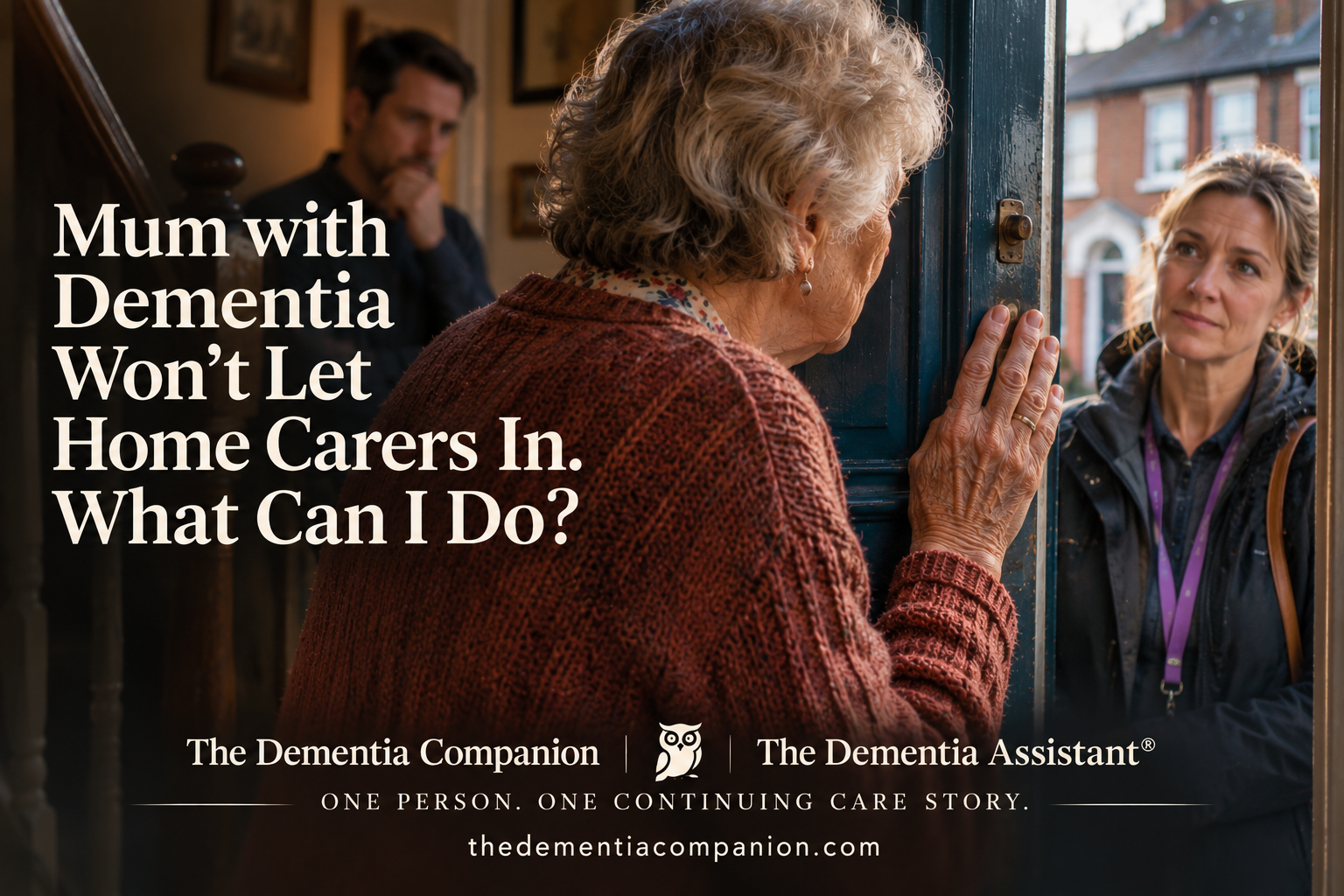
Mum with Dementia Won’t Let Home Carers In. What Can I Do?
One Person. One Continuing Care Story. | Article 34 of 40
By Louise Donaghy, Dementia Practitioner, Founder of The Dementia Companion and The Dementia Assistant®, and Creator of Hugo Intelligence™.
It’s 8.45 on a Tuesday morning.
You’ve arranged for a lovely home carer to visit Mum.
You’ve spoken to the agency, explained Mum’s needs, checked the arrangements and convinced yourself that this is finally going to make life a little easier.
The carer arrives.
She smiles warmly.
“Good morning! I’ve come to give you a little help today.”
Mum looks at her.
Then she looks at you.
Then she looks back at the carer.
“I don’t need any help, thank you.”
You try explaining.
“Mum, we talked about this. She’s coming to help you with your breakfast and a few things around the house.”
Mum folds her arms.
“I’ve managed perfectly well for eighty years. I don’t need strangers coming into my home telling me what to do.”
And with that, the door closes.
The poor carer is standing outside.
You’re standing inside.
Mum has gone to put the kettle on, and you’re wondering whether you’ve just paid for somebody to admire her front garden.
It would almost be funny if the situation weren’t so worrying.
Because you know Mum needs more support.
Perhaps she’s forgetting meals.
Perhaps she’s struggling with medication.
Perhaps personal care has become difficult.
Or perhaps you’re simply exhausted from trying to manage everything yourself.
You’ve finally arranged some help.
And Mum doesn’t want it.
So what can you do when someone living with dementia refuses home carers or won’t let them into the house?
The first step is to understand why the person is refusing.
They may not recognise that they need support. They may feel frightened by unfamiliar people, want to protect their privacy, dislike the way care is being offered or have genuine concerns about the person arriving.
Rather than automatically insisting, try introducing support gradually, giving the person meaningful choices, building familiarity and working with a dementia-experienced care provider.
But respecting someone’s wishes does not mean ignoring serious unmet needs or immediate danger.
If refusal of essential support is placing the person’s health or safety at risk, professional assessment and care planning may be needed.
And there is something I want families to understand from the beginning.
Mum isn’t refusing to make your life difficult. She may be trying to protect the life, independence and home that still belong to her.
Understanding that changes how we approach the whole situation.
Why does someone with dementia refuse home carers?
There are several possible explanations.
We should never assume that everyone refusing care is experiencing the same thing.
Mum may genuinely believe she doesn’t need help
Imagine somebody telling you that you need assistance with washing, dressing or preparing breakfast.
You know you’ve been doing those things for decades.
You remember bringing up children, managing a household and looking after everybody else.
Why on earth would you need a stranger to help you now?
Some people living with dementia experience reduced awareness of changes in their abilities.
This is sometimes described as anosognosia.
It is not necessarily deliberate denial or stubbornness.
The person may genuinely be unable to recognise particular difficulties.
However, not everybody with dementia experiences this.
And somebody refusing help may fully understand the offer and simply not want that particular arrangement.
Both possibilities deserve respect.
A stranger entering the home may feel frightening
Home is personal.
It is where we feel familiar, comfortable and in control.
Mum may not understand why an unfamiliar person has arrived.
She may not recognise their uniform.
She may wonder whether they are supposed to be there.
She may feel threatened when somebody starts opening cupboards or asking questions.
Even the most cheerful, well-intentioned care worker can feel intrusive if the person hasn’t had time to understand who they are.
Mum may be protecting her dignity
Personal care can be especially sensitive.
Imagine somebody you’ve only just met offering to help you undress.
Even if you genuinely need assistance, accepting that help may feel uncomfortable.
Mum may have strong preferences about modesty, privacy, gender, culture or how personal care is provided.
These preferences deserve serious consideration.
Refusal may be a response to the way care is being offered rather than a refusal of all support.
The visit may be happening at the wrong time
Perhaps Mum has always enjoyed sleeping late.
Now somebody arrives at seven in the morning and expects her to get washed and dressed.
Perhaps she likes to sit quietly with her tea before doing anything else.
Perhaps she’s tired, hungry or uncomfortable.
Care arrangements that ignore established routines can create unnecessary resistance.
Whenever possible, care should fit the person rather than expecting the person to fit the timetable.
She may have had a bad experience
This is particularly important.
Not every complaint about care should be dismissed as confusion.
Perhaps a previous worker rushed her.
Perhaps someone was impatient.
Perhaps an unfamiliar person entered without properly introducing themselves.
Perhaps her privacy was not respected.
Or perhaps something genuinely inappropriate happened.
Listen carefully.
Take concerns seriously.
Where there are signs of poor care, neglect, abuse or exploitation, follow the appropriate complaints and safeguarding procedures.
Never assume that dementia makes somebody’s concerns unreliable.
Stop trying to win the argument. Start understanding the concern.
I know that sounds easier than it feels.
You’ve arranged the visit.
You’ve spent hours organising everything.
You’ve probably explained the situation to three different people.
And now Mum is refusing to cooperate.
But consider what Mum is experiencing.
From her perspective, she may be perfectly comfortable in her own home when suddenly somebody announces that she needs a professional carer.
That could feel upsetting, humiliating or frightening.
Instead of arguing about whether Mum needs help, begin with what matters to her.
You might say:
“Mum, I know how important it is for you to do things yourself.”
“I don’t want anybody coming in and taking over.”
“Would you tell me what worries you about having someone visit?”
Then listen.
She might say:
“I don’t want strangers in my house.”
“I don’t need someone washing me.”
“They’ll move all my things.”
“I don’t want to spend money on that.”
Or simply:
“I don’t like her.”
The answer may tell you something important about what needs to change.
You do not have to agree with every conclusion to take the feeling seriously.
What should I say when Mum refuses the carer at the door?
When emotions are rising, simple words are often better than a detailed explanation.
If Mum says, “I don’t need anybody looking after me”
Try:
“I know you’re used to doing things yourself, Mum.”
“We want you to keep doing as much as you can.”
“Perhaps we could see whether there’s anything you’d actually like a hand with.”
Avoid launching into a list of everything she’s been struggling to manage.
That can feel like an accusation rather than an offer of support.
If Mum says, “I don’t know this woman”
You might say:
“That’s understandable. You haven’t had a chance to get to know her yet.”
“Would you like me to stay while you meet?”
“Perhaps we could all have a cup of tea together.”
The first visit doesn’t necessarily need to involve personal care.
A short introduction might be more appropriate.
If Mum says, “I don’t want strangers touching my things”
Try:
“Your things are important to you.”
“Nobody should be moving them without discussing it with you.”
“Let’s make sure anybody helping understands how you like things done.”
Then make sure the care provider genuinely follows those preferences.
If Mum says, “Send her away”
Pause and assess the situation.
If there is no immediate danger and Mum does not consent to the visit, forcing the interaction is unlikely to build trust.
You could say:
“All right, Mum. I can see you’re not comfortable. We’ll talk about what would work better.”
Then speak with the provider about what happened and what needs reviewing.
The carer should not simply force entry or provide unwanted intimate care because a family member has arranged the appointment.
Consent, decision-making ability, safeguarding and legal authority require proper consideration.
Introduce the person before introducing the care
This is one of the most useful approaches families can explore.
Instead of beginning with everything Mum needs help doing, begin by helping her become familiar with the person offering support.
Make the first meeting relaxed
Where circumstances allow, arrange for a prospective carer to meet Mum without immediately expecting intimate or demanding tasks.
Perhaps they could sit together for a short conversation.
Maybe Mum would enjoy showing somebody her garden.
Perhaps they could talk about a familiar interest.
The aim is not to trick Mum into accepting care.
It is to give her a genuine opportunity to meet somebody and decide how she feels.
Let Mum participate in choosing the carer
Ask about her preferences.
Would she feel more comfortable with a woman or a man?
Does she prefer someone who speaks a particular language?
Does she enjoy conversation or prefer quieter company?
Would she like a familiar family member present during initial visits?
These choices may affect whether she feels respected and secure.
They should be considered alongside practical availability and assessed care needs.
Ask for consistent carers where possible
Imagine a different stranger arriving every morning.
Each one introduces themselves.
Each one asks similar questions.
Each one approaches the routine differently.
For somebody experiencing memory difficulties, that can be unsettling.
A smaller, familiar group of carers may help relationships develop.
The Alzheimer Society of Alberta and Northwest Territories specifically highlights the value of giving new home care workers personal information that helps them connect with the individual.
It won’t always be possible to guarantee the same carer.
But consistency is worth discussing with the provider.
Start with something Mum actually welcomes
Sometimes a person refuses “care” because of what that word represents to them.
But they may appreciate practical support with a meaningful activity.
Perhaps Mum enjoys gardening but finds carrying heavy watering cans difficult.
Perhaps she welcomes company while preparing lunch.
Perhaps she would appreciate help going shopping.
Perhaps she wants somebody to accompany her on a walk.
If these are appropriate, agreed activities, they can provide an opportunity to build familiarity.
The point isn’t to disguise essential personal care as a visit from a friend.
Be truthful about who the person is and why they’re visiting.
But care does not have to begin with the most intimate task.
It can begin with connection.
And once Mum feels comfortable with the person, you may be able to discuss other support she would welcome.
This is particularly relevant when care is not urgently required and there is time to build trust.
What if Mum will let the carer in but refuses washing or dressing?
This is a different situation.
It may overlap with refusing personal care, but the important distinction is that Mum has accepted the person into her home.
Now we need to understand the specific task she doesn’t want help with.
Perhaps she feels embarrassed.
Perhaps the bathroom is cold.
Perhaps the water temperature is uncomfortable.
Perhaps she’s in pain.
Perhaps she prefers washing in the evening.
Or perhaps she dislikes somebody standing over her and giving instructions.
Ask what she would prefer.
Could she wash parts of her body independently?
Could privacy be increased?
Would a different time be better?
Could the carer explain each step and ask permission before providing assistance?
Mum should retain as much control as possible.
Never assume that agreeing to a home care visit means agreeing to every activity the worker proposes.
Consent to being visited is not blanket consent to personal care.
Where essential care continues to be refused and health risks develop, seek professional assessment and an individual care plan.
What if Mum refuses help from family too?
Sometimes families assume Mum will accept help from them because they have known her all their lives.
But family relationships can make personal care more complicated.
Mum may feel uncomfortable allowing her daughter to help with washing.
She may not want her son involved in intimate care.
She may be particularly protective of her independence around family members.
For some people, a carefully introduced professional carer is actually easier to accept.
For others, the opposite is true.
The answer depends on the person.
Listen to what Mum says and observe what happens.
If both family and professional support are being refused, consider whether there are physical, emotional, communication or decision-making factors requiring further assessment.
What if Mum keeps saying she’s perfectly capable?
She may be expressing confidence in abilities that are still important to her.
And she may genuinely manage some tasks extremely well.
Perhaps she can dress independently but needs help organising medication.
Perhaps she prepares breakfast safely but struggles with shopping.
Perhaps she enjoys conversation and social visits but forgets appointments.
Needing help with one task does not mean losing independence in every part of life.
Try describing support in specific terms.
Rather than:
“Mum needs full-time supervision.”
You might say:
“Mum continues to manage her morning routine. She needs help checking medication arrangements and preparing some meals.”
This is more accurate and respectful.
It also helps professionals identify what assistance is actually required.
Should I tell Mum the carer is a cleaner or a friend?
This is something families sometimes consider when a person refuses care.
But automatically misleading somebody creates problems.
If you introduce a professional carer as a friend, Mum may feel betrayed when the person begins providing intimate care or carrying out tasks she did not agree to.
There may also be serious consent and safeguarding concerns.
A better approach is to describe the visit in clear, truthful and accessible language.
For example:
“This is Helen. She’s coming to help us with lunch and a few things around the house.”
Or:
“Helen is a care worker. We’ve arranged for you to meet her and see whether you’d like her help.”
The precise explanation should reflect the person’s communication needs and the actual arrangement.
Avoid unnecessary clinical language, but don’t invent a false identity.
Compassionate communication should support trust, not undermine it.
How do I choose a home care provider who understands dementia?
Not every care provider has the same experience, staffing arrangements or approach.
Ask questions before arranging support.
Useful questions for a home care agency
- What dementia-specific training and practical experience do your workers have?
- Can Mum meet a potential carer before regular visits begin?
- Can you offer familiar, consistent workers where possible?
- How do staff respond when someone declines a task?
- How will Mum’s privacy, preferences and dignity be respected?
- Can visits be arranged around her established routines?
- How are missed or refused visits recorded and followed up?
- What happens if the regular carer is absent?
- Who should the family contact when concerns arise?
- How are changes in need, incidents and safeguarding concerns escalated?
- How is Mum involved in creating and reviewing her professional care plan?
The Alzheimer’s Association recommends assessing training, suitability, references and how prospective providers interact with the person living with dementia.
Families should also check relevant registration, licensing and inspection requirements in their country.
A good provider should want to understand Mum as a person, not simply arrive with a list of tasks to complete.
What if a carer keeps being turned away?
One unsuccessful visit does not necessarily mean home care can never work.
But repeated refusal should not become a routine where the worker arrives, is turned away and the family is billed without anybody reviewing the arrangement.
Ask the care provider to discuss what is happening.
Consider:
- Does Mum recognise the worker?
- Is the visit at a difficult time?
- Has the worker had enough time to build rapport?
- Is there a language or communication barrier?
- Is Mum frightened or uncomfortable?
- Are the tasks inappropriate or poorly explained?
- Does she have legitimate concerns about care quality?
- Is another type of support needed?
- Are serious care needs being left unmet?
Agree a review plan.
Record whether essential tasks were completed, deferred or refused.
A visit being recorded as “completed” should never conceal the fact that important care was not delivered.
And if a worker has been turned away because Mum is distressed, the response should include appropriate follow-up rather than blame.
Does dementia mean Mum no longer has the right to refuse care?
No. A dementia diagnosis does not automatically remove a person’s right to make decisions or refuse support.
This distinction is vital.
Decision-making ability must be considered in relation to the particular decision and the support the person needs to understand it.
Someone may be able to decide who enters their home while needing help with more complex financial arrangements.
Another person may require significant support to understand the consequences of refusing essential care.
A decision that professionals or family members consider unwise is not, by itself, proof that the person lacks capacity.
England and Wales
The Mental Capacity Act 2005 establishes principles for supporting people to make decisions.
Capacity is decision-specific.
Where someone lacks capacity for a particular decision, the relevant legal framework includes best-interests decision-making and considering less restrictive alternatives.
Proper legal authority and professional processes matter.
A family member cannot simply declare that Mum lacks capacity because she refuses a carer.
Scotland
Scotland has a separate framework, including the Adults with Incapacity (Scotland) Act 2000.
Decisions must follow the applicable principles, including considering the person’s present and past wishes.
Northern Ireland
Northern Ireland has a separate legal framework, including provisions of the Mental Capacity Act (Northern Ireland) 2016 introduced in phases.
The law must be checked for the particular decision and circumstances.
Republic of Ireland
The Assisted Decision-Making (Capacity) Act 2015, as amended, provides a framework for supporting decision-making.
The Decision Support Service provides information about decision-support arrangements.
Being a relative or “next of kin” does not automatically provide legal authority to consent to health or social care services for another adult.
United States, Canada and Australia
Rules about consent, capacity, substitute decision-making and care services differ by state, province or territory.
Families should seek appropriate local professional or legal guidance.
Never treat a diagnosis as permission to force care, restrain somebody or allow entry into their home without appropriate authority.
Where there are serious risks and uncertainty about capacity or consent, involve the appropriate healthcare, social care and safeguarding professionals.
What if refusing care puts Mum in danger?
This is where the situation becomes more serious.
Perhaps Mum is repeatedly missing essential medication.
Perhaps she is not eating or drinking adequately.
Perhaps she is falling.
Perhaps she is unable to manage hygiene needs and is developing skin problems.
Or perhaps there is nobody available to provide essential care safely.
The response should depend on the actual risk and urgency.
If the situation is urgent
Seek immediate medical or emergency assistance if Mum is seriously unwell or in immediate danger.
Sudden confusion, collapse, severe dehydration, serious injury or another acute medical problem must not be dismissed as ordinary dementia-related resistance.
In the UK, NHS guidance advises emergency assessment for sudden confusion.
Elsewhere, use the relevant urgent or emergency medical service.
If needs are persistently unmet
Contact the GP, memory service, social worker or appropriate care coordinator.
Explain the specific unmet needs and the consequences.
Ask for a care needs review and an assessment of decision-making capacity where there is a genuine, decision-specific concern.
If neglect, abuse or serious self-neglect is suspected, seek advice from the relevant adult safeguarding service.
Do not wait until a crisis develops simply because arranging help has been difficult.
What if there is no safe care arrangement?
A professional review may need to consider alternative forms of support.
This could involve a different provider, additional community services, reassessment of home care, rehabilitation or consideration of other living arrangements where necessary.
No single option is automatically appropriate.
The person’s wishes, rights, assessed needs and legal framework remain central.
What if I cannot continue providing all the care myself?
I want to say something important to family carers.
There is a difference between loving somebody and being able to provide every hour of support they require.
You may be working.
You may have children.
You may have health problems of your own.
You may be exhausted from interrupted sleep, constant appointments and never-ending responsibilities.
Perhaps you have been providing support for years.
And now Mum refuses everybody except you.
That is an enormous emotional burden.
You might feel that if you insist on outside help, you are letting her down.
But one person cannot necessarily provide safe, sustainable care indefinitely.
Tell the professionals involved what you can realistically manage.
If you cannot provide essential support, be clear about that.
In England, families can request a carer’s assessment through the local council, separately from the assessment of the person receiving care.
Support arrangements differ by country and jurisdiction.
You are entitled to seek advice and assistance.
Supporting Mum’s independence should not require you to lose your own wellbeing.
The person’s needs and the family carer’s capacity both matter when planning safe care.
Where can families get help internationally?
United Kingdom
A GP, memory service, dementia specialist or relevant social care service can help explore changes in needs and support arrangements.
In England, contact the local council’s adult social care service about a care needs assessment and, where appropriate, a carer’s assessment.
Funding, service availability and legal arrangements differ across England, Scotland, Wales and Northern Ireland.
Alzheimer’s Society and Dementia UK provide information about home care, decision-making and supporting someone who does not recognise their need for help.
United States
Families may consult the person’s healthcare professional, an appropriate social worker, local ageing services or dementia support organisation.
The Alzheimer’s Association provides guidance about in-home care and choosing care providers.
Medicare, Medicaid, private insurance and state programmes have different eligibility and coverage arrangements.
Consent and decision-making laws also differ between states.
Canada
Families can approach their healthcare provider and relevant provincial or territorial home and community care services.
Local Alzheimer Societies provide advice about dementia care and accessing support.
Eligibility, funding and service arrangements differ across provinces and territories.
Australia
A GP, relevant aged care assessment service or Dementia Australia can help families explore care options.
The Australian Government’s Support at Home programme began on 1 November 2025, replacing the former Home Care Packages and Short-Term Restorative Care programmes.
Access and contributions depend on individual circumstances and current eligibility arrangements.
Decision-making and safeguarding requirements vary across jurisdictions.
Republic of Ireland
Families can approach their GP, HSE services and the Alzheimer Society of Ireland.
Home support and dementia-specific home care services may be available, depending on eligibility and location.
Decision-making and consent must follow Irish law.
Everywhere
The first question should be:
What kind of support would help this particular person live as safely, comfortably and independently as possible?
Then the professionals and family can work together to explore how that support may be provided with the person’s participation, rights and preferences respected.
How the family’s own care plan can make home carers more welcome
Imagine a care worker arriving at Margaret’s house.
She knows Margaret has Alzheimer’s disease.
She knows she needs support with meals and personal care.
But that is almost everything she knows.
She doesn’t know that Margaret dislikes being rushed.
She doesn’t know that Margaret has always preferred getting washed after breakfast.
She doesn’t know that Margaret used to work as a florist.
She doesn’t know that Margaret becomes frightened when strangers enter without explaining who they are.
She doesn’t know that Margaret prefers to be called Maggie.
And she certainly doesn’t know that Maggie would happily spend half an hour discussing roses before agreeing to anything else.
Now imagine that the family has prepared a person-centred care plan.
The next worker can begin with a much better understanding.
Not because a document guarantees trust.
But because understanding the individual helps people approach care more respectfully.
What might the family record?
Preferred name: Maggie.
Personal history: Former florist, loves gardening, enjoys discussing family and familiar places.
Strengths: Independently chooses clothing, prepares simple drinks and enjoys participating in household activities.
Communication preferences: Prefers a calm introduction, time to process information and being asked before tasks begin.
Privacy: Strong preference for modesty and same-gender support with personal care where possible.
Daily routine: Usually enjoys breakfast before washing and dressing.
Concerns about care: Becomes anxious when unfamiliar people enter or touch her belongings.
What helps: Familiar carers, explaining the visit, talking about gardening and offering genuine choices.
What has not helped: Arriving unexpectedly, giving several instructions at once or attempting personal care before she is comfortable.
Professional recommendations: Relevant care assessment findings and agreed support arrangements.
Review needs: Monitor whether essential tasks are being completed and whether the approach remains appropriate.
This example is fictional.
But notice something.
It tells the next worker much more than simply saying:
“Maggie has dementia and can be difficult with carers.”
The second description labels the person.
The first helps someone understand her.
Meet Hugo Intelligence™: understanding the person before the problem
This is why I created Hugo Intelligence™.
Not to replace the people providing care.
And certainly not to tell families that technology can solve every difficult human situation.
Hugo is the conversational, person-centred guidance system within The Dementia Assistant®, powered by Person-Centred Intelligence®.
His name represents the principles behind his approach:
H — Human
U — Understanding
G — Guidance
O — One person at a time
Hugo is represented by our owl mascot.
But he isn’t simply a character or a conventional chatbot offering the same answer to everybody.
Hugo is designed to help people explore dementia-related concerns through natural, supportive conversations.
Start with an ordinary question
You might say:
“Hugo, Mum needs home carers, but she keeps refusing to let them in. She says she doesn’t need any help. I’m exhausted and I don’t know what to do.”
Hugo can provide general educational information about possible reasons for refusing support, person-centred communication and questions to discuss with appropriate professionals.
He can help you explore the situation without assuming he knows what Mum is experiencing.
Hugo can ask follow-up questions
The conversation might explore:
“What does Mum say when the carer arrives?”
“Does she recognise the person?”
“Is there a particular task she doesn’t want help with?”
“Has she had an upsetting experience?”
“What time does the visit happen?”
“Does she have preferences about privacy or who supports her?”
“What activities does she still enjoy?”
“Are essential needs being left unmet?”
“What has the care provider already tried?”
These questions help families move beyond the label of “refusing care”.
They encourage us to consider the individual’s experience.
Hugo’s continuing conversations
A family might begin by discussing the refused visits.
Later, they could return to ask:
“How could we introduce a new carer more gently?”
“What words could we use to explain the visit?”
“How should we document what happened?”
“What questions should we ask the care agency?”
“What should we tell the social worker?”
Within The Dementia Assistant®, conversations can be saved, categorised and revisited.
This allows families to return to useful guidance and continue exploring related concerns.
Saved AI conversations are not verified clinical records or legally binding instructions.
General Hugo and personalised Hugo
General Hugo
Users can ask general dementia questions without selecting a care plan.
Hugo provides educational guidance based on the information shared during the conversation.
Personalised Hugo
When the user explicitly selects an individual’s care plan, Hugo can use relevant information recorded in that plan to help offer more personalised educational guidance.
For example:
“Hugo, using Maggie’s care plan, how could we introduce a morning carer in a way that respects her privacy, routines and love of independence?”
Hugo can consider the relevant information from the selected plan.
That may include Maggie’s preferred name, established routines, meaningful activities and previous reactions to care.
Hugo does not automatically access every care plan in an account.
The user must select the individual person’s plan.
Families supporting more than one person can maintain separate care plans.
Hugo cannot determine legal capacity, authorise care against a person’s wishes, investigate safeguarding allegations or replace clinical and social care professionals.
The Care Planning Centre™ and guided Talk to Hugo
The Care Planning Centre™ helps families develop and maintain individual person-centred care information.
Through guided Talk to Hugo conversations, users can explore relevant questions step by step.
For example:
“What are Mum’s usual morning routines?”
“What help does she welcome?”
“What makes her uncomfortable?”
“How does she prefer people to introduce themselves?”
“Which activities remain important?”
“What have professionals recommended?”
“How should a new carer approach her?”
Relevant information can be organised into appropriate parts of the individual’s care plan, subject to user review.
The platform also includes care-plan review tools, gap suggestions and help with making care information clearer.
This matters because many families have never written a care plan.
They know the person they love.
But they may not know how to make that knowledge useful to somebody arriving for the first time.
The Care Planning Centre™ helps bridge that gap.
The plan should reflect the person’s strengths, history, preferences, choices and changing needs.
It should never become a document that reduces somebody to what they can no longer do.
Daily notes: what actually happened during the care visit?
Daily notes can help preserve factual information about care arrangements.
For example:
“Tuesday, 9 am. Maggie declined the scheduled home care visit. She said she did not recognise the worker and did not want anyone entering the house. The worker did not provide personal care. The family contacted the agency to arrange a review. A short introductory visit with a familiar relative present was requested.”
That is more useful than:
“Mum was difficult again.”
The first describes what happened, what Maggie communicated and what action was taken.
The second tells us very little about her needs.
Record what worked too
Perhaps the next visit goes differently.
“Thursday, 10.30 am. Maggie met the same worker with her daughter present. They spoke about gardening. Maggie agreed to have a cup of tea together. No personal care was attempted. Maggie appeared comfortable during the visit.”
That information can help the team understand which approaches are more acceptable.
Daily notes should remain factual and respectful.
They do not replace the care provider’s formal records, incident reporting or professional responsibilities.
Saved conversations, document organisation and exports
A family may have several conversations with Hugo about arranging care.
They may also receive assessments, professional recommendations and updates from different organisations.
The Dementia Assistant® provides tools for organising relevant information.
Hugo conversations can be saved and categorised.
Care documents and information can be organised.
Applicable exports include PDF, Word, CSV and JSON formats.
Families can maintain their own information and share appropriate records with professionals when needed.
Information sharing must follow the person’s wishes, privacy, consent and access permissions.
The family-held record complements professional care records.
It does not replace them.
Family Circle: when relatives disagree about accepting carers
This situation can create considerable family tension.
One daughter may believe Mum urgently needs daily care.
A son may say:
“She was absolutely fine when I visited.”
Another relative may think the family is taking away her independence.
And someone else may be worrying about how the care will be funded.
All these concerns can become emotionally charged.
Family Circle supports appropriate communication between involved relatives.
It can help families exchange relevant updates and maintain a more consistent understanding.
But the purpose is not to outvote Mum.
Her wishes, rights, consent and decision-making arrangements remain central.
Family members should not automatically have unrestricted access to every piece of information.
Where significant disagreements arise, an independent professional assessment or advocacy service may help.
Life Story and Memory & Moments: the person behind the front door
Think about the first thing a new home carer sees.
A front door.
A name.
A list of scheduled tasks.
Perhaps a care assessment.
But behind that door is somebody who has lived an entire life.
Perhaps she was a nurse.
A teacher.
A mother who raised five children.
An artist.
A business owner.
A woman who worked all her life and took enormous pride in managing her own home.
Perhaps she has always valued privacy.
Perhaps she has never liked strangers.
Perhaps she loves music, animals, gardening or talking about her childhood.
Those details matter.
The Life Story and Memory & Moments features within The Dementia Assistant® help families preserve meaningful relationships, experiences, preferences and personal history.
This can help the people supporting Mum understand her more fully.
It’s not about trying to make her remember everything.
It’s about ensuring the people around her don’t forget who she is.
Multilingual support: being understood in your own home
Sometimes a person living with dementia is uncomfortable with unfamiliar carers because communication itself has become difficult.
Perhaps Mum prefers speaking Welsh.
Perhaps she grew up speaking Irish, Hindi, Spanish or another language.
Perhaps she has difficulty understanding a strong unfamiliar accent.
Perhaps she needs additional processing time or has hearing difficulties.
Language and cultural identity should be considered when arranging care.
The Dementia Assistant® offers 12 interface languages, with dictation and translation capabilities spanning 201 languages.
These tools can help families communicate across languages, record information and preserve relevant details.
They can also help relatives living in different countries stay connected with appropriate care information.
Not every feature is available in all 201 languages.
Important medical, legal, medication and safety information must be verified professionally where necessary.
Professional interpreters should be used when appropriate for consent, assessment and other high-stakes discussions.
Some people living with dementia experience changes in their language abilities, but this varies.
Never assume everybody returns to a childhood language.
Ask the person what works best.
Being understood is not a luxury in dementia care. It is part of dignity and trust.
Dementia Academy™, crisis guidance and the Carer Wellbeing Hub
The Dementia Assistant® includes education and learning resources through the Dementia Academy™.
These support understanding of dementia, communication and person-centred approaches.
The platform also includes educational crisis guidance to help families recognise situations requiring urgent or additional professional support.
Hugo is not an emergency service and cannot provide physical supervision or emergency intervention.
Supporting the family carer
And what about you?
The person trying to organise everything?
Perhaps you’ve made twenty phone calls to arrange help.
You’ve filled in the forms.
You’ve explained the situation repeatedly.
You’ve taken time off work to attend the introductory visit.
And now the carer has been turned away.
You may feel frustrated.
You may feel guilty.
You may even feel a little resentful, then immediately feel dreadful for admitting it.
These emotions deserve understanding.
The Carer Wellbeing Hub recognises the pressures families experience.
But practical support matters too.
If you’re overwhelmed, seek a carers’ assessment or other relevant support in your country.
Ask about respite.
Tell professionals what you can realistically manage.
And remember that you are not required to become an entire care service simply because you love somebody.
Ask Hugo: 17 questions families ask when someone refuses home carers
- Why does Mum with dementia refuse home carers?
She may feel frightened, value her independence, dislike unfamiliar visitors, have specific privacy concerns or not recognise her need for help. She may also have experienced care she didn’t like. Explore her reasons instead of assuming refusal is caused by dementia alone.
- What should I do when Mum won’t open the door to her carer?
Check whether there is an immediate safety concern. If she is safe but declines entry, avoid confrontation or forcing access. Contact the care provider to review the visit, the approach and what support remains unmet.
- How can I introduce a new home carer gently?
Where practical, arrange a short introductory meeting with someone familiar present. Let Mum participate in choosing the worker, explain the visit truthfully and begin with an activity she welcomes. A trusting relationship may take time.
- Should we use the same carer every day?
Consistent carers can be helpful because familiarity may reduce uncertainty. Ask the agency about continuity, predictable schedules and a small regular team. This may not always be possible, but it is worth discussing.
- What if Mum says she doesn’t need any help?
Listen respectfully. She may genuinely feel independent or may have difficulty recognising particular changes. Discuss specific tasks she would welcome help with rather than arguing about whether she is capable.
- Can dementia affect someone’s awareness that they need care?
Yes. Some people experience reduced awareness of certain difficulties, sometimes called anosognosia. However, not everyone with dementia experiences this. A refusal should not automatically be attributed to lack of insight.
- What if Mum is frightened of strangers?
Try to understand what makes the visit feel unsafe. Familiar introductions, clear identification, predictable timing, gentle communication and respecting personal boundaries may help. If fear is new or severe, consider professional assessment.
- Should I tell Mum the carer is just a friend?
Avoid inventing a false identity as the default approach. Explain clearly and kindly who the person is and what they are there to do. Trust and informed participation matter, especially when personal care is involved.
- What if Mum accepts company but refuses washing?
Consent to one activity is not consent to another. Explore privacy, discomfort, timing, pain and how assistance is offered. Involve Mum in choosing an acceptable approach and seek professional guidance if essential care remains unmet.
- Can we force carers to enter if Mum has dementia?
A dementia diagnosis does not automatically authorise forced entry or care. Consent, decision-specific capacity, legal authority and safeguarding procedures must be considered. Seek appropriate professional advice if serious risks exist.
- Does Mum have the right to refuse home care?
A person with capacity for the particular decision can generally refuse offered support, subject to the relevant law and circumstances. Where capacity is in doubt, proper assessment and applicable supported or substitute decision-making processes are required.
- What if Mum has complained that the carer was rude or rough?
Take the complaint seriously. Record what she says without leading questions. Contact the provider and use appropriate complaints or safeguarding procedures if there are concerns about poor care, neglect or abuse.
- What if Mum refuses all help and lives alone?
Ask for an assessment of her health, daily living needs and safety. Consider whether essential tasks are being missed and what alternatives may be available. Persistent serious risks require professional involvement rather than simply continuing unsuccessful visits.
- What if family members disagree about whether Mum needs carers?
Discuss factual observations, Mum’s wishes and professional assessment findings. Avoid turning her support into a family argument. An independent care assessment or advocacy service may help where disagreement persists.
- What should I tell the home care agency?
Explain Mum’s preferences, routines, communication needs, abilities, concerns and any relevant professional recommendations. Ask how they will introduce workers, respond to refused visits and review care that is not being delivered.
- Can Hugo help us find an approach suited to Mum?
Yes. Hugo can provide general educational guidance and help explore possible reasons for refusal. When the user explicitly selects Mum’s care plan, Hugo can use relevant information from that plan to offer more personalised suggestions. Legal and clinical decisions still require appropriate professionals.
- How can we keep Mum’s care arrangements connected when providers change?
The Dementia Assistant® supports individual care plans, daily notes, document organisation, saved Hugo conversations and Family Circle. Families can maintain relevant information and share it appropriately with authorised professionals, so each new service can better understand the person.
One Person. One Continuing Care Story.
Different professionals. Different services. One person. One continuing story.
Imagine Mum begins needing support at home.
First, her daughter arranges a few visits.
Then an agency becomes involved.
Perhaps a social worker completes a care assessment.
A dementia nurse makes recommendations.
A different care company begins providing support.
Mum is admitted to hospital.
She returns home with new needs.
Another assessment takes place.
Another care plan is created.
Another team arrives.
And the family is asked to explain Mum’s routines, preferences and needs all over again.
But Mum is still the same person.
The woman who likes her tea in a particular cup.
Who wants to get dressed before breakfast, or perhaps afterwards.
Who hates being rushed.
Who has her own sense of humour.
Who wants people to knock before entering.
Who has a lifetime of experiences that shape what feels comfortable, familiar and safe.
Why should that understanding disappear whenever another professional becomes involved?
One person. One individual care plan.
This is the principle behind The Dementia Assistant®.
People living with dementia and their families, where appropriate, can maintain their own continuing person-centred care information.
It can begin when memory concerns first appear.
It can develop through GP appointments, assessments and diagnosis.
It can continue during everyday life, home care, hospital admissions and rehabilitation.
And it can be maintained as the person’s needs change, including residential, palliative and end-of-life care if those become relevant.
The person’s own care information remains connected within their family-held care-planning environment.
The family shouldn’t have to begin again every time
When a new home carer arrives, relevant information about Mum’s routines and preferences may help them approach her more respectfully.
When a hospital team becomes involved, the family can provide appropriate information about communication, abilities and support needs.
When care arrangements change, the family can review its own continuing record.
The person or family can share information with appropriate professionals, subject to wishes, consent, privacy and legal authority.
This does not replace the professional’s own records, assessments or responsibilities.
The family-held care plan complements those records.
It provides an additional, continuing source of information that the person and family can maintain independently of any single provider.
Care planning should preserve the whole person
Mum’s plan should not simply say:
“Refuses care.”
It should help others understand:
What matters to her.
What she can still do.
What makes her feel secure.
How she prefers people to communicate.
Why privacy is important.
Which relationships she values.
What support she welcomes.
What needs reviewing.
And what professionals have recommended.
As her needs change, the plan should change too.
But her identity, dignity and rights remain central.
Different professionals. Different services. One person. One continuing story.
That is not simply a slogan.
It is the reason The Dementia Assistant® exists.
A gentle invitation to meet Hugo
If Mum is refusing home carers, you may feel as though every attempt to help is making things harder.
You want her to remain independent.
You want her to be safe.
You want her to feel respected.
And you desperately need some support yourself.
You can begin by asking Hugo.
Describe what happened when the carer arrived.
Explain what Mum said.
Explore what might be behind her refusal.
Ask for compassionate words to use.
Prepare questions for the care agency, GP or social worker.
And, when you choose to create and explicitly select Mum’s individual care plan, Hugo can use relevant information from that plan to help explore approaches that better reflect her circumstances.
The Dementia Companion is our public educational home for dementia articles, practical guidance and Ask Hugo resources.
The Dementia Assistant® is the interactive environment where families can continue their conversations with Hugo Intelligence™, create and maintain individual care plans, save discussions, record daily notes, organise documents and preserve meaningful personal information through Life Story and Memory & Moments.
The platform also includes Family Circle, multilingual capabilities, the Dementia Academy™, educational crisis guidance and the Carer Wellbeing Hub.
Every subscription includes a 30-day complimentary trial.
The UK Family subscription is £4.99 per month after the trial.
International subscription prices are available through the platform.
Explore practical dementia education:
https://thedementiacompanion.com/
Meet Hugo and explore The Dementia Assistant®:
https://thedementiaassistant.com/
Hugo provides educational guidance, not medical diagnosis, medication prescribing, emergency intervention, capacity determinations, statutory assessments, safeguarding investigations or legally binding decisions.
One final thought
The next time Mum refuses to let a home carer through the door, try to see the situation from both sides of that doorway.
On one side stands a family desperate to arrange help.
On the other stands a person who may be frightened of losing control over her own life.
Neither experience should be dismissed.
And perhaps the most important question isn’t:
“How do we make Mum accept care?”
Perhaps it is:
“How do we arrange support that Mum can understand, trust and participate in?”
Sometimes that begins with a conversation.
Sometimes with a familiar face.
Sometimes with changing the time of a visit.
Sometimes with recognising that a particular worker or arrangement isn’t right.
And sometimes it requires professional assessment because serious needs cannot safely be left unmet.
But throughout it all, Mum remains a person with wishes, rights, preferences and a lifetime of experiences.
A person whose home still matters.
Whose independence deserves respect.
Whose voice should not disappear from the conversation.
And whose continuing care story should help every new person understand a little more of who she is.
Because good dementia care doesn’t begin when somebody gets through the front door.
It begins when the person behind that door feels understood.
With love,
Louise and Hugo ❤️🦉
Louise Donaghy
Founder & CEO of The Dementia Assistant®
Created and powered by Person-Centred Intelligence®
Creator of Hugo Intelligence™
⸻
Continue exploring with The Dementia Companion
These confirmed resources explore person-centred communication, family support and care planning.
Ask Hugo: practical dementia questions
https://thedementiacompanion.com/ask-hugo/
Communication and daily care workbooks
https://thedementiacompanion.com/workbooks/
Dementia care training for families and carers
https://thedementiacompanion.com/dementia-training/
Inside The Dementia Assistant®
https://thedementiacompanion.com/inside-the-app/
The Dementia Companion
https://thedementiacompanion.com/
References and authoritative guidance
1. Alzheimer’s Society, UK. Support and care when a person won’t accept their dementia diagnosis. Includes approaches to accepting help at home and discussing concerns with social care services.
https://www.alzheimers.org.uk/get-support/help-dementia-care/support-care-when-person-wont-accept-their-dementia-diagnosis
2. Alzheimer’s Society, UK. How to offer help to someone with dementia who doesn’t want it.
https://www.alzheimers.org.uk/blog/how-offer-help-someone-dementia-who-doesnt-want-it
3. Dementia UK. Managing distress in a person living with dementia.
https://www.dementiauk.org/information-and-support/health-advice/coping-with-distress/
4. NICE, UK. Dementia: assessment, management and support for people living with dementia and their carers, NG97.
https://www.nice.org.uk/guidance/ng97/chapter/recommendations
5. NICE, UK. Decision-making and mental capacity, NG108.
https://www.nice.org.uk/guidance/ng108/chapter/recommendations
6. NHS, England. Getting a care needs assessment.
https://www.nhs.uk/social-care-and-support/help-from-social-services-and-charities/getting-a-needs-assessment/
7. NHS, England. Carer’s assessments.
https://www.nhs.uk/social-care-and-support/support-and-benefits-for-carers/carer-assessments/
8. NHS, UK. Mental Capacity Act.
https://www.nhs.uk/social-care-and-support/making-decisions-for-someone-else/mental-capacity-act/
9. Scottish Government. Adults with Incapacity (Scotland) Act 2000: principles.
https://www.gov.scot/publications/adults-with-incapacity-act-principles/
10. Alzheimer’s Association, USA. In-home care.
https://www.alz.org/help-support/caregiving/care-options/in-home-care
11. Alzheimer’s Association, USA. Choosing care providers.
https://www.alz.org/help-support/caregiving/care-options/choosing-care-providers
12. Alzheimer Society of Alberta and Northwest Territories, Canada. Frequently asked questions. Includes advice on helping new home care workers connect through life history, preferences and routines.
https://www.alzheimer.ca/ab/en/about-dementia/what-dementia/common-questions-about-dementia/frequently-asked-questions
13. Alzheimer Society of British Columbia and Yukon, Canada. Accessing home support and care services in BC.
https://www.alzheimer.ca/bc/en/accessing-home-support-care-services-bc
14. Australian Government Department of Health, Disability and Ageing. Support at Home programme.
https://www.health.gov.au/our-work/support-at-home
15. Dementia Australia. Anxiety. Includes practical person-centred support and consideration of possible triggers.
https://www.dementia.org.au/living-dementia/mood-and-behaviour-changes/anxiety
16. Alzheimer Society of Ireland. Home care services.
https://alzheimer.ie/service/home-care-services/
17. Decision Support Service, Republic of Ireland. Role of the service under the Assisted Decision-Making (Capacity) Act 2015.
https://www.decisionsupportservice.ie/about-us/what-we-do
18. NHS, UK. Sudden confusion (delirium).
https://www.nhs.uk/symptoms/confusion/
Editorial and safety note: This article provides general educational guidance. Dementia does not automatically remove decision-making rights or authorise care without consent. Decisions about capacity, personal care, safeguarding and serious risk require appropriate professional assessment and locally applicable legal processes. All family examples are fictional and do not describe identifiable clients.
You May Also Find Helpful
Need help with your own situation? Ask Hugo.
One Person. One Continuing Care Story. The Dementia Companion is where you discover guidance. Inside The Dementia Assistant®, talk with Hugo, save and categorise conversations, record daily notes and involve authorised supporters in a continuing care plan centred around the person.
Ask Hugo About This · Start Your Continuing Care Plan — Families · Continuing Care Planning — Professionals
Personal guidance requires the appropriate account and subscription access. Care-plan information is used only with authorised access and the required consent and selection steps. All subscription plans include a 30-day complimentary trial.