Mum with Dementia Keeps Falling. What Should I Do?
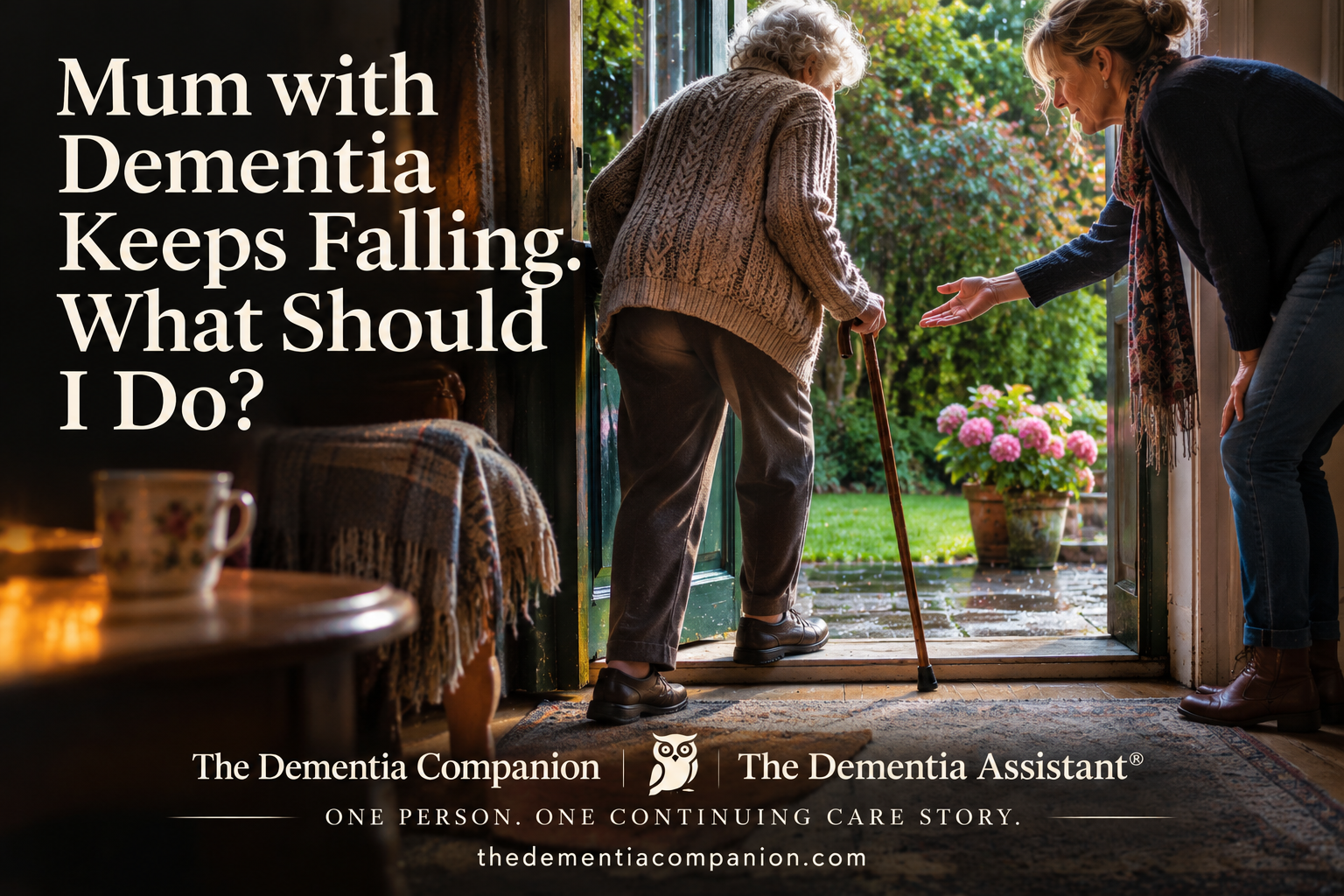
Mum with Dementia Keeps Falling. What Should I Do?
One Person. One Continuing Care Story. | Article 31 of 40
By Louise Donaghy, Dementia Practitioner, Founder of The Dementia Companion and The Dementia Assistant®, and Creator of Hugo Intelligence™.
It’s a sound you never want to hear.
A sudden thud from the other room.
You rush through the doorway and find Mum sitting on the floor.
She’s looking rather surprised.
“Oh, I’m all right,” she tells you.
She might even seem more annoyed about the fuss than the fall itself.
You ask what happened.
She isn’t quite sure.
Perhaps she tripped over the rug.
Perhaps she became dizzy.
Perhaps she was trying to reach something.
Or perhaps she simply doesn’t remember falling.
You check that she’s all right and arrange the appropriate help.
Eventually, everybody settles down.
But you don’t.
Because this isn’t the first time.
Last week, she stumbled getting out of her chair.
A few days earlier, she nearly fell in the bathroom.
And now you’re finding yourself watching every step she takes.
You worry when she goes upstairs.
You worry when she gets out of bed.
You worry when she insists on walking into the garden.
And when Mum tells you to stop fussing because she’s perfectly capable of walking across her own living room, you find yourself caught between two fears.
You’re frightened she’ll fall again. But you’re equally frightened of taking away her independence.
So what should you do when someone living with dementia keeps falling?
Repeated falls need a proper medical and falls-risk assessment. There may be several contributing causes, including balance difficulties, medication effects, changes in vision, low blood pressure, illness or hazards around the home. Some of these risks can be reduced.
If Mum has fallen and may be seriously injured, she needs urgent or emergency medical help.
Once any immediate danger has been addressed, the next step is to understand what is contributing to the falls and develop an individual plan that supports safe movement rather than unnecessarily restricting it.
Because the answer isn’t automatically to tell Mum to sit down and stay there.
Movement, confidence, meaningful activity and independence remain important parts of living well with dementia.
The challenge is finding the safest practical way for Mum to continue enjoying them.
Why does someone with dementia keep falling?
Dementia can affect several abilities involved in walking, moving and responding to the environment.
But it is important to understand something from the beginning.
Not every fall is caused by dementia.
People living with dementia can develop the same illnesses, physical difficulties and medication side effects as anybody else.
When someone begins falling, we should look for possible causes rather than automatically assuming their dementia has progressed.
Changes in balance and coordination
Some types of dementia can affect movement, balance and coordination.
A person may become less steady when turning, standing up or moving around obstacles.
They may find it harder to adjust their position if they lose balance.
In some conditions, including dementia with Lewy bodies and Parkinson’s disease dementia, movement difficulties can be particularly relevant.
However, the pattern varies between individuals.
A healthcare professional should assess new or worsening problems with walking.
Changes in visual perception
Imagine walking across a familiar room but having difficulty judging where a step begins.
Or seeing a dark mat and interpreting it as a hole.
Dementia can affect how some people process visual information, even when their eyesight is otherwise relatively good.
The person may misjudge distances, struggle with changes in flooring or become uncertain around patterned surfaces.
Ordinary eye problems can also contribute.
A vision assessment and appropriate environmental changes may help.
Difficulties concentrating while moving
Walking through a busy environment requires attention.
Mum may be trying to follow a conversation, look for her handbag and walk through a doorway at the same time.
For some people, dividing attention between tasks becomes more difficult.
Reducing distractions and allowing more time may help.
But we should not assume Mum needs silence every time she walks.
The approach should reflect her actual abilities and preferences.
Muscle weakness or reduced activity
If someone has become less active, their muscles may become weaker.
This can affect balance, walking and confidence.
A person who spends increasing amounts of time sitting may find it harder to stand or walk comfortably.
This is one reason appropriate physical activity can be so valuable.
A physiotherapist can help assess suitable exercises and support.
Low blood pressure or dizziness
Some people experience a drop in blood pressure when moving from sitting or lying down to standing.
This is sometimes called postural or orthostatic hypotension.
It can cause dizziness, light-headedness or faintness.
Other conditions can also cause dizziness.
If Mum repeatedly falls shortly after standing, tell her healthcare professional.
It may be an important clue.
Medication effects
Some medicines can contribute to falls by causing drowsiness, dizziness, low blood pressure or impaired balance.
A medication review may be appropriate, particularly if difficulties began after a new prescription or dose adjustment.
Never stop or alter prescribed medicines without advice from the appropriate prescriber.
Pain, illness and other medical conditions
Arthritis, foot problems, poor vision, dehydration, infection and other health issues may contribute to reduced mobility or falls.
A sudden change in walking or confusion may indicate an acute illness or another serious condition.
That requires prompt medical attention.
The important point is that repeated falls deserve investigation.
They should not simply be accepted as an inevitable part of ageing or dementia.
What should I do immediately after Mum falls?
First, stay calm and assess the situation.
Your instinct may be to get Mum off the floor as quickly as possible.
But moving someone who may be injured can make things worse.
Check whether she may be injured
Speak calmly.
Ask whether she is in pain.
Look for obvious injuries, unusual limb positions, bleeding or signs that she may have struck her head.
Consider whether she lost consciousness, appears unusually confused or cannot move normally.
In the UK, call 999 if Mum may have injured her head, neck, back or hip, or cannot get up after a fall.
Also seek emergency help for symptoms suggesting a stroke, serious injury, collapse, seizure or another life-threatening condition.
Do not attempt to lift somebody who may have a serious injury.
Keep her comfortable and warm while help is arranged.
What if Mum hit her head?
Head injuries deserve particular care.
Symptoms can sometimes develop after the initial accident.
If Mum has hit her head, follow the appropriate urgent medical guidance.
If she takes blood-thinning medication, or has a condition affecting blood clotting, seek urgent medical advice after a head injury even if she initially appears well.
In the UK, NHS 111 can advise in appropriate circumstances. Emergency symptoms require 999.
If Mum cannot reliably explain what happened, or you are unsure whether she has injured her head, tell the healthcare professional.
Do not assume that her usual confusion means an injury can be safely ignored.
What if she seems uninjured?
If Mum is alert, appears uninjured and can move comfortably, take time to assess whether she can get up safely.
NHS guidance describes a gradual method using stable furniture, but this is only appropriate when the person is not injured and can safely follow and perform the movements.
Do not pull Mum up by her arms.
Do not attempt an unsafe manual lift.
If you are uncertain, seek assistance.
Once she is safe, arrange an appropriate medical review, even if there is no obvious injury.
A fall may be a warning that something has changed.
When is a fall an emergency?
Seek immediate emergency assistance when there may be serious injury or a life-threatening condition.
Examples include:
- A possible head, neck, back or hip injury.
- Loss of consciousness or difficulty waking.
- Severe pain, deformity or suspected fracture.
- New weakness, facial drooping or speech difficulties suggesting stroke.
- Seizure or serious breathing difficulty.
- Inability to get up after a fall.
- A sudden, significant change in alertness or neurological function.
Emergency arrangements differ internationally.
United Kingdom: 999 or 112.
United States and Canada: 911.
Australia: 000.
Republic of Ireland: 999 or 112.
Elsewhere, use the relevant local emergency number.
If Mum may be injured but there is no obvious immediate emergency, seek timely advice through the appropriate urgent healthcare service.
In the UK, NHS 111 can help with non-life-threatening concerns.
If a person has fallen, arranging a follow-up assessment is important even when they appear to have recovered.
Hugo cannot assess an injury, summon emergency services or determine whether someone is safe to move.
Why does Mum keep falling in the same place?
This is a particularly useful question.
If falls repeatedly occur in a particular place, the environment or activity may be contributing.
Falls beside the bed
Perhaps Mum gets up during the night.
She may be disorientated, sleepy or rushing to the toilet.
The lighting may be poor.
Her slippers might not fit properly.
Or she may experience dizziness when standing.
Consider the bed height, route to the bathroom, lighting and relevant medical factors.
A professional assessment can help identify suitable changes.
Falls in the bathroom
Bathrooms can be difficult environments.
Wet surfaces, confined spaces, changes in floor level and getting in or out of a bath can all create risks.
Appropriate grab rails, non-slip surfaces, suitable seating or other adaptations may help.
An occupational therapist can advise on the individual circumstances.
Avoid improvising equipment that isn’t designed to support a person’s weight.
Falls on the stairs
Check whether Mum can recognise the edge of each step.
Consider lighting, handrails, footwear, depth perception and her physical abilities.
Do not assume that simply telling her to hold the bannister will be enough.
If stairs have become a repeated hazard, request an appropriate assessment.
Falls outdoors
Perhaps Mum enjoys gardening or visiting neighbours.
Uneven paving, steps, wet leaves and changes in surface height may create difficulties.
Rather than immediately banning her favourite activities, explore safer ways to continue them.
That might involve repairing a path, using appropriate footwear, providing suitable mobility support or arranging companionship.
The aim is to make meaningful activities safer wherever possible, rather than automatically removing them.
What should I say when Mum insists she doesn’t need help?
This is often where families struggle.
Mum may have walked independently for eighty years.
Now her daughter is hovering beside her like an anxious traffic controller.
You mean well.
But Mum may feel watched, embarrassed or controlled.
She may say:
“Would you stop following me everywhere?”
Or:
“I can walk perfectly well, thank you!”
And perhaps she’s right about many activities.
She may still be capable of doing a great deal independently.
The challenge is identifying where support is genuinely necessary.
Avoid turning safety into criticism
Instead of:
“Mum, you’re going to fall again if you keep doing that.”
Try:
“That step looks a bit awkward. Would you like me beside you?”
Or:
“Shall we walk down to the garden together?”
If she becomes irritated:
“I know you like doing things yourself, Mum. I don’t want to take that away.”
You can also explain practical concerns without exaggerating.
“I’ve noticed you’ve been unsteady when getting out of that chair. I’d like us to see whether something could make it easier.”
Let Mum participate in decisions
Ask what she finds difficult.
Perhaps she dislikes a particular walking frame.
Perhaps she feels safer holding a rail.
Perhaps her shoes are uncomfortable.
Perhaps she is frightened of falling but doesn’t want to admit it.
A person-centred approach means taking her experience seriously.
Where possible, offer genuine choices and involve her in assessments and decisions.
How can I make Mum’s home safer?
Home safety is one important part of falls prevention.
It is not the only part.
The NHS, Dementia UK and Alzheimer Society of Canada recommend considering the home environment alongside health, mobility and individual abilities.
Check walking routes
Look at the places Mum uses most frequently.
Her route from the bedroom to the bathroom.
The kitchen.
The sitting room.
The front door.
The garden.
Consider loose rugs, trailing wires, clutter, uneven flooring and furniture that obstructs movement.
But avoid changing everything at once.
A familiar room that suddenly looks completely different may be confusing.
Where possible, involve Mum and introduce changes thoughtfully.
Improve lighting
Good lighting can make steps, doorways and obstacles easier to identify.
Night lighting may help someone find the bathroom safely.
Pay particular attention to dark corridors, changes in floor level and stairs.
Some people with dementia find strong reflections or confusing shadows unsettling, so consider individual visual needs.
Check footwear
Poorly fitting slippers are a surprisingly common concern.
Footwear that slips off, catches on flooring or provides inadequate grip may increase fall risk.
Ask a suitable professional about footwear if Mum has foot pain, swelling, balance problems or changes in walking.
Comfort matters too.
Mum is unlikely to enjoy wearing shoes that feel like medieval punishment devices, regardless of how sensible everybody insists they are.
Consider grab rails and appropriate equipment
Some people benefit from grab rails, toilet supports, shower equipment or mobility aids.
However, equipment needs to suit the individual and be correctly fitted.
An occupational therapist or physiotherapist can advise.
Do not buy an unfamiliar walking aid and assume Mum will automatically know how to use it.
A poorly adjusted aid may create additional difficulties.
Look beyond the home
Falls may also happen in gardens, shops, healthcare settings or during community activities.
Consider what support makes those activities safer.
The goal is to preserve participation in ordinary life wherever possible.
Can exercise help prevent falls in dementia?
Appropriate physical activity can be an important part of falls prevention.
The NICE falls guideline, updated in April 2025, recommends individualised assessment and management, including suitable falls-prevention exercise programmes where indicated.
Exercises may address strength, balance and functional movement.
But activities need to reflect the person’s health, ability, interests and level of risk.
Someone who enjoys gardening might benefit from exercises that support standing, balance and movement.
Another person may enjoy supervised walking.
Someone else may prefer structured sessions with a physiotherapist.
Do not introduce challenging balance exercises without appropriate advice when falls are already occurring.
And don’t assume that sitting still is always safer in the long term.
Reduced activity can contribute to weakness, loss of confidence and further mobility problems.
The right type of movement, with suitable support, can help preserve independence.
What if Mum becomes frightened of walking after a fall?
A fall can affect much more than physical health.
It can damage confidence.
Perhaps Mum begins refusing to go outside.
Perhaps she no longer wants to walk to the bathroom alone.
Perhaps she insists on holding someone’s arm even when she previously walked independently.
Fear of falling is understandable.
But avoiding activity altogether can create further difficulties.
Start by acknowledging her concern.
You might say:
“That was frightening, Mum. I understand why you’re worried.”
“Would you like us to practise walking together?”
“Shall we ask the physiotherapist what might help you feel steadier?”
Give her time.
Don’t force her to prove that she can manage.
And don’t treat her anxiety as a nuisance.
The aim is to rebuild confidence gradually, using an appropriate plan.
What if Mum is falling but refuses a walking frame?
A walking aid can represent a difficult emotional change.
To the family, it may represent safety.
To Mum, it may represent losing independence.
She may dislike the appearance of the equipment.
She may find it awkward.
She may not understand how to use it.
Or it may genuinely be unsuitable.
Rather than arguing, explore the reasons.
You could say:
“Is it uncomfortable?”
“Would you like us to ask whether something else would suit you better?”
“Could we try using it with the physiotherapist?”
Different aids suit different mobility needs.
A professional can assess what is appropriate and provide training.
The goal is not simply to get Mum to accept a particular piece of equipment.
It is to help her move as confidently and safely as possible.
Can medication make falls worse?
Yes, some medicines can contribute to dizziness, drowsiness, balance difficulties or changes in blood pressure.
This may be particularly relevant when several medicines are being taken.
If Mum has started falling, ask the GP, prescribing clinician or pharmacist whether a medication review would be appropriate.
Mention any recent changes.
Describe when the falls occur.
And make sure the professional knows about all relevant medicines, including over-the-counter products.
Never stop, reduce or change medication independently because you suspect it is causing falls.
Professional review is important.
Could repeated falls mean Mum’s dementia is getting worse?
Possibly, but not necessarily.
Falls alone cannot establish dementia progression.
A change in mobility may relate to physical illness, medication, blood pressure, vision, pain, muscle weakness or environmental factors.
Some dementia conditions can involve movement and balance problems.
But the individual pattern needs assessment.
If Mum’s walking has changed significantly, arrange a clinical review.
If the change is sudden, seek urgent medical advice.
Sudden confusion, weakness or loss of coordination should never simply be dismissed as dementia.
Should I stop Mum walking around the house?
Not automatically.
Restricting movement without considering the person’s needs can affect wellbeing, confidence and physical ability.
The safer approach is to assess the risk and identify what support may allow movement to continue.
Could furniture be rearranged?
Would a physiotherapy programme help?
Does Mum need assistance at certain times?
Would better footwear or lighting make a difference?
Does she need a mobility assessment?
Are there particular activities that now require supervision?
If serious risks remain, more substantial changes may be necessary.
But those decisions should be individualised, proportionate and consistent with the person’s wishes, rights and applicable law.
Safety matters. But so does having a life worth enjoying.
What if Mum lives alone and keeps falling?
This needs particular attention.
A person may fall and be unable to reach a telephone.
They may become disorientated.
They may not remember how to ask for help.
And a fall may go unnoticed for some time.
If Mum is repeatedly falling while living alone, arrange a prompt review of her health, mobility, home environment and care arrangements.
Could a personal alarm help?
Some personal alarms allow the person to request assistance.
Other devices may include automatic fall detection.
These can be useful for some people.
But no system detects every fall or guarantees that help will arrive.
Mum must also be comfortable wearing or using the equipment, and the family needs to understand what happens when an alert is activated.
Consider who receives the alert, how emergency services access the property and whether somebody is available to respond.
Privacy, consent and the person’s preferences remain important.
What about additional support?
Depending on the assessed needs, families might consider scheduled visits, help with particular activities, appropriate mobility equipment or other home support.
Repeated serious falls may mean that living arrangements need reviewing.
That does not automatically mean Mum must move into residential care.
But it does mean the risks and available support must be assessed realistically.
What should I record after a fall?
This is where good information becomes invaluable.
Imagine Mum falls on Monday.
Her daughter finds her sitting beside the bed.
On Wednesday, her son notices that she’s unusually unsteady.
On Friday, a visiting carer sees that she’s struggling to get up from her favourite chair.
If each incident is considered separately, the pattern may not be obvious.
But when the information is brought together, it may help identify changes that need professional assessment.
Useful details to record
After immediate safety and medical needs have been addressed, document:
- Date and approximate time.
- Where the fall happened.
- What Mum was doing beforehand, if known.
- Whether the fall was witnessed.
- What Mum reported.
- Any pain, dizziness or unusual symptoms.
- Whether she may have struck her head.
- Any visible injury.
- Whether medical advice was sought.
- What immediate action was taken.
- Any subsequent professional recommendations.
- Whether the care plan needs reviewing.
Record near misses as well as actual falls when they are relevant.
A fictional example
“Monday, 8.15 am. Margaret was found sitting on the bedroom floor beside her bed. The fall was unwitnessed. She could not explain what happened. She reported hip pain and could not stand. Emergency services were contacted. The family provided her medication information and relevant medical history.”
This is much more useful than:
“Mum fell again because she isn’t careful.”
The first account records facts.
The second makes an unsupported judgement.
And it risks blaming Mum for something that may have a medical explanation.
Meet Hugo Intelligence™: understanding the person behind the fall
This is precisely the sort of situation families can explore with Hugo Intelligence™.
Hugo is the conversational, person-centred dementia guidance system within The Dementia Assistant®, powered by Person-Centred Intelligence®.
Hugo stands for:
H — Human
U — Understanding
G — Guidance
O — One person at a time
Hugo is represented by our owl mascot.
But his purpose is not to provide another generic chatbot answer.
It’s to help families and professionals explore dementia-related concerns through natural, practical conversations that keep the individual at the centre.
Begin with an ordinary question
You might simply say:
“Hugo, Mum has fallen three times in the past month. She’s frightened of using her walking frame, and I don’t want to take away her independence. What should we do?”
Hugo can help you explore general information about falls, possible contributing factors, practical observations and questions to raise with healthcare professionals.
He can also help you consider respectful ways to discuss safety with Mum.
Hugo can continue the conversation
You don’t need to explain everything perfectly in your first message.
You might continue:
“She usually falls when getting up.”
“She has recently started taking a new medicine.”
“She’s frightened of falling again.”
“She loves going into the garden.”
“What should we ask the GP?”
“How could we include this in her care plan?”
Hugo can respond to follow-up questions and help you organise your thinking.
He may prompt you to consider relevant details, such as whether falls have been witnessed, when they occur or whether Mum has experienced a significant health change.
Hugo cannot determine the cause of the falls or assess whether Mum is injured.
An actual or suspected emergency requires appropriate emergency services, not an AI conversation.
General Hugo: guidance without a care plan
A user can ask general questions about dementia, falls, mobility, communication and care planning without selecting an individual care plan.
For example:
“What should a family consider when someone with Alzheimer’s keeps falling at home?”
Hugo can provide educational guidance and explain why professional assessment matters.
Personalised Hugo: guidance using Mum’s selected care plan
This is an important distinction.
Suppose the family has created an individual care plan for Margaret.
It includes her mobility, routines, preferences, health information and relevant professional recommendations.
When the user explicitly selects Margaret’s care plan, Hugo can use relevant information recorded in that particular plan to help offer more personalised educational guidance.
For example:
“Hugo, using Margaret’s care plan, help us explore how she could continue enjoying her garden while following the physiotherapist’s mobility recommendations.”
Hugo can consider the relevant information available in the selected plan.
Hugo does not automatically access every care plan in the account.
The individual plan must be selected.
Families supporting more than one person can maintain separate plans.
Hugo’s suggestions must be reviewed against relevant professional advice, particularly where falls, mobility equipment and safety are concerned.
The Care Planning Centre™: one individual plan that changes with Mum
The Care Planning Centre™ helps families develop, review and maintain person-centred care information.
Through guided Talk to Hugo conversations, users can explore relevant questions step by step.
For example:
“What can Mum still do independently?”
“Which activities does she enjoy?”
“What difficulties have we noticed?”
“How does she prefer to be supported?”
“What mobility equipment has been recommended?”
“What does the physiotherapist want us to practise?”
“What should a visiting carer know?”
Relevant information can be organised into appropriate care-plan sections, with the user reviewing what is recorded.
The platform also offers care-plan review tools, gap suggestions and help improving professional wording.
This matters because families should not need professional care-planning experience to begin documenting what is important.
The plan should preserve strengths
If Mum enjoys gardening, record that.
If she can safely walk around part of the house, record that.
If she needs help with steps but manages level surfaces, record that too.
A care plan should not simply say:
“High falls risk.”
It should explain what the person can do, where difficulties arise, what support is helpful and which professional recommendations must be followed.
As circumstances change, the plan can be reviewed.
The person is not static. Their care information should not be static either.
Daily notes: recognising patterns over time
The Dementia Assistant® includes daily notes.
These help families record relevant observations between appointments.
For example:
Monday: Margaret became unsteady when standing from her chair. No fall occurred. She reported dizziness. Family arranged a medical review.
Wednesday: Margaret enjoyed a supported walk in the garden. She used her prescribed mobility aid and appeared comfortable.
Friday: Margaret stumbled at the bathroom doorway. No injury occurred. The family requested an occupational therapy review of the environment.
These examples are fictional.
But they show how factual observations can help describe changing needs.
Daily notes are not a substitute for professional incident reports or assessments.
Their purpose is to help preserve the family’s continuing picture.
Saved Hugo conversations, documents and exports
A family may begin by asking Hugo about falls prevention.
Later, they may ask about supporting mobility confidence.
Then they may want help preparing questions for a physiotherapist or understanding general information about care-plan reviews.
Hugo conversations can be saved, categorised and revisited.
This helps provide continuity in the family’s questions and guidance.
Saved AI conversations are not verified clinical records or professional instructions.
The Dementia Assistant® also includes document organisation and applicable exports, including PDF, Word, CSV and JSON.
Families can maintain relevant information and share appropriate records with professionals when needed, subject to the person’s wishes, consent and access permissions.
The family-held record complements, but does not replace, formal professional records.
Family Circle: keeping everybody informed about Mum’s mobility
Sometimes different relatives see different things.
A daughter may visit daily.
A son may see Mum only at weekends.
Another relative may live overseas.
A professional carer may support her in the mornings.
One person notices that Mum is struggling to stand.
Another knows that she has started using a new walking aid.
A third is unaware that she recently fell.
Without appropriate communication, family members may have very different understandings of her current needs.
Family Circle can support relevant updates between authorised relatives.
This helps people remain connected around Mum’s care.
But sharing should always respect the person’s wishes, consent, privacy and permissions.
Not every family member automatically needs access to every detail.
Life Story and Memory & Moments: protecting what makes movement meaningful
Sometimes we focus so much on preventing falls that we forget why somebody wants to move in the first place.
Perhaps Mum has always loved gardening.
Perhaps she enjoys walking to the local shop.
Perhaps she wants to feed the birds.
Perhaps she has spent decades tending roses that she planted with her husband.
Those activities aren’t just exercise.
They’re part of her identity.
The Life Story and Memory & Moments features within The Dementia Assistant® help preserve meaningful personal information.
Family history.
Relationships.
Favourite places.
Hobbies.
Achievements.
Cultural identity.
Personal routines.
This can help families and professionals understand why particular activities matter.
When an activity becomes risky, knowing its emotional importance may help everyone look for safer alternatives.
Perhaps Mum can still enjoy the garden from an accessible path.
Perhaps she can work with raised planters.
Perhaps she can have somebody accompany her.
And sometimes a cherished activity may need to change more substantially.
But the decision should begin with understanding the person.
Not simply removing the activity.
Multilingual support: preserving the person’s preferred language
Some families support relatives across different languages and countries.
Mum may prefer discussing mobility concerns in one language.
Her daughter may speak another.
A son living overseas may need to understand professional recommendations.
The Dementia Assistant® provides 12 interface languages, alongside dictation and translation capabilities spanning 201 languages.
These tools can support communication, note-taking and sharing relevant information across languages.
Not every platform feature is available in all 201 languages.
And important medical, medication, legal and mobility instructions must be accurately verified, with professional interpreting where necessary.
Some people living with dementia experience changes in their language use.
This varies between individuals.
Do not assume everybody returns to their childhood language.
Ask about the person’s preferred language, cultural identity and communication needs.
Being understood is part of feeling safe.
Dementia Academy™, crisis guidance and the Carer Wellbeing Hub
The Dementia Assistant® includes educational resources through the Dementia Academy™.
These support learning about dementia, person-centred care and practical family concerns.
The platform also includes educational crisis guidance to help users recognise situations requiring urgent or additional professional support.
Hugo does not provide emergency intervention, physical supervision or real-time falls monitoring.
And what about the family carer?
Repeated falls can leave families constantly on edge.
You may become frightened every time you hear Mum walking upstairs.
You may stop sleeping properly because you’re listening for movement.
You might find yourself becoming impatient, not because you’re angry with Mum, but because you’re frightened something terrible will happen.
That emotional strain matters.
The Carer Wellbeing Hub recognises the pressures of caring and provides supportive resources.
Families should also seek appropriate practical help, respite and professional support when needed.
You cannot prevent every accident through worry alone.
And you shouldn’t be expected to manage serious mobility risks without appropriate assessment and assistance.
Ask Hugo: 17 questions families ask about dementia and repeated falls
- Why does Mum with dementia keep falling?
Several factors may contribute, including balance changes, dizziness, medication effects, poor eyesight, muscle weakness or hazards around the home. Dementia can affect movement and perception, but repeated falls require individual medical assessment rather than assumptions.
- Does falling more often mean Mum’s dementia is progressing?
Not necessarily. Falls may be related to other health problems, medication, reduced strength or environmental risks. A significant change should be assessed by an appropriate healthcare professional.
- What should I do immediately after Mum falls?
Check for possible injury and do not rush to move her. Call emergency services if she may have injured her head, neck, back or hip, cannot get up or has other serious symptoms. Seek appropriate medical advice even when no major injury is obvious.
- What if Mum hits her head but seems perfectly fine?
A head injury still needs careful consideration. Seek urgent medical advice, particularly if she takes blood-thinning medication, has uncertain injury circumstances or develops symptoms. Severe symptoms require emergency assistance.
- Can dementia cause balance problems?
Yes, some types of dementia can affect coordination, movement, perception and balance. However, other medical and physical factors may also contribute. A professional assessment can help identify relevant causes.
- What if Mum falls when standing up?
Tell her healthcare professional. A fall occurring after standing may be associated with dizziness or blood pressure changes, among other possibilities. A clinician may assess postural blood pressure and review relevant medicines.
- Can medication increase the risk of falling?
Some medicines can cause dizziness, drowsiness or other effects that increase fall risk. Ask the prescriber or pharmacist for a medication review. Never make changes independently.
- Should Mum stop walking if she keeps falling?
Not automatically. Appropriate movement can help maintain strength and confidence. The safest approach depends on her abilities and risks. Seek professional advice about activity, mobility aids and supervision.
- Should I buy Mum a walking frame?
A walking frame may help some people but is not suitable for everybody. Ask a physiotherapist or appropriately qualified professional to assess the type, fit and safe use of any mobility aid.
- What if Mum refuses to use her walking aid?
Explore why. It may be uncomfortable, confusing, difficult to manoeuvre or emotionally unwelcome. Discuss alternatives with the relevant professional and involve Mum in decisions where possible.
- How can I make the bathroom safer?
Consider wet floors, lighting, access to the toilet, shower arrangements and appropriate grab rails. An occupational therapist can assess the bathroom and recommend suitable adaptations.
- What if Mum becomes frightened of walking after a fall?
Acknowledge her fear and avoid pressuring her. Ask a physiotherapist about a suitable programme to rebuild confidence, strength and balance while managing risk.
- Are fall detection alarms reliable for someone with dementia?
They may offer useful support, but no alarm detects every fall or replaces human assessment. Consider whether the person can use the device, who receives alerts and how help will reach them.
- Can Mum continue living alone if she falls regularly?
That requires an individual assessment of the severity of the falls, health, mobility, ability to summon help and available support. Repeated serious falls need prompt professional attention.
- What should I record about a fall?
Record the time, place, circumstances, possible injury, symptoms, action taken and professional advice. Include whether the fall was witnessed and what the person reported. Keep notes factual and respectful.
- Can Hugo use Mum’s care plan to help us understand her mobility support needs?
Hugo can provide general educational guidance. When the user explicitly selects Mum’s individual care plan, Hugo can use relevant recorded information to help explore more personalised support questions. He cannot diagnose causes of falls or replace a professional mobility assessment.
- How can our family keep Mum’s falls information together?
The Dementia Assistant® supports individual care plans, daily notes, saved Hugo conversations and organised documents. Family Circle can help authorised relatives exchange relevant updates. Information can be shared appropriately with professionals, subject to the person’s wishes, consent and permissions.
One Person. One Continuing Care Story.
Different professionals. Different services. One person. One continuing story.
Imagine Mum experiences her first fall.
Her daughter contacts the GP.
The GP arranges an assessment.
A physiotherapist becomes involved.
An occupational therapist visits the house.
Perhaps Mum begins using a walking aid.
A few months later, she falls again and attends hospital.
Later, a care agency begins providing support.
At another stage, she may require rehabilitation, residential care or more extensive support.
Each professional may have their own system.
Each service may maintain separate records.
Each organisation may carry out another assessment.
But Mum remains the same person throughout that journey.
She still has her own life history.
Her preferences.
Her routines.
Her strengths.
Her relationships.
Her fears.
And the things she wants to continue doing.
Those details should remain connected even when the professionals and services around her change.
Why should families have to explain everything again?
One professional may know that Mum becomes dizzy when standing.
Another may know that she is frightened of walking alone.
A physiotherapist may recommend a particular mobility aid.
The family may know that Mum is happiest when she can spend time in the garden.
A hospital team may see only the immediate injury.
All these pieces of information can matter.
But if they remain scattered across different systems, the person’s full story may be difficult to see.
This is why I created The Dementia Assistant®.
The family maintains its own continuing care information
The person living with dementia and their family, where appropriate, can begin maintaining relevant care information from the earliest memory concerns.
The plan can continue through:
Initial concerns.
GP and primary care appointments.
Memory assessments.
Diagnosis.
Everyday life with dementia.
Changes in mobility and independence.
Home care.
Hospital admissions.
Rehabilitation.
Residential care.
Palliative and end-of-life support.
The information can be reviewed and updated as circumstances change.
Appropriate information can be shared with professionals when needed, subject to consent, privacy, access permissions and applicable law.
One person. One continuing care plan.
Mum’s plan should not simply list falls.
It should explain the whole person.
What she enjoys.
What she can still do.
What has changed.
What support helps.
Which professional recommendations apply.
What makes her feel confident.
And what she wants for her own life.
The family-held plan complements professional records.
It does not replace clinical assessments, statutory care plans, treatment instructions or legally authorised decisions.
The aim is continuity, not duplication for its own sake.
A care plan should change when the person’s needs change.
But it should always remain centred on the person.
One individual life story. One continuing person-centred care plan.
Different professionals may become involved.
Different services may provide support.
But the person should not have to lose the connection to their own history and preferences every time care changes hands.
That’s what One Person. One Continuing Care Story means.
A gentle invitation to meet Hugo
If Mum has started falling, you may be frightened, exhausted and uncertain about what to do next.
You may be trying to balance her wishes with serious safety concerns.
You might need help preparing questions for the GP.
Or understanding what information to take to a falls clinic or occupational therapist.
You can begin by asking Hugo.
Explain what has happened.
Ask general questions about mobility and falls.
Explore compassionate ways to discuss safety with Mum.
Organise the observations you want to share with professionals.
And, when you choose to create and explicitly select Mum’s own care plan, Hugo can help you explore her individual circumstances using relevant information from that plan.
The Dementia Companion is our public educational home for articles, practical information and Ask Hugo resources.
The Dementia Assistant® is the interactive platform where families can continue conversations with Hugo Intelligence™, create person-centred care plans, record daily notes, organise documents, preserve Life Story and Memory & Moments information, and stay connected through Family Circle.
It also includes multilingual capabilities, learning resources and support for carer wellbeing.
All subscriptions include a 30-day complimentary trial.
The UK Family subscription is £4.99 per month after the trial.
International pricing is available through the relevant subscription options.
Explore practical dementia guidance:
https://thedementiacompanion.com/
Meet Hugo and explore The Dementia Assistant®:
https://thedementiaassistant.com/
Hugo provides educational guidance, not medical diagnosis, prescribing, emergency intervention, physical supervision, mobility assessment, statutory assessments or legally binding decisions.
One final thought
There is something particularly difficult about watching somebody who once moved through life with complete confidence become frightened of taking a few steps.
Perhaps Mum walked miles every day.
Perhaps she loved dancing.
Perhaps she spent years gardening, travelling or looking after everybody else.
Now she may need help getting out of a chair.
And that change can be painful for everyone.
But needing support doesn’t mean her independence has disappeared altogether.
Sometimes independence means making a decision.
Sometimes it means continuing an activity with help.
Sometimes it means having somebody walk beside you rather than telling you to stay where you are.
And sometimes it means recognising that a particular activity is no longer safe and finding another way to preserve what matters.
Good dementia care isn’t about eliminating every possible risk by eliminating the person’s life.
It’s about understanding the risks, seeking the right professional support and preserving dignity, choice and meaningful activity wherever possible.
So if Mum still wants to walk into her garden, let’s begin by understanding why that matters to her.
Then let’s work out how she can enjoy it as safely as possible.
Because the person is still there.
Her wishes still matter.
And her continuing story deserves to move forward with her.
With love,
Louise and Hugo ❤️🦉
Louise Donaghy
Founder & CEO of The Dementia Assistant®
Created and powered by Person-Centred Intelligence®
Creator of Hugo Intelligence™
⸻
Continue exploring with The Dementia Companion
How to Support a Parent With Dementia
https://thedementiacompanion.com/articles/how-to-support-a-parent-with-dementia/
Person-Centred Dementia Care
https://thedementiacompanion.com/dementia-care/
Explore the Ask Hugo Question Library
https://thedementiacompanion.com/ask-hugo/
Meet Hugo Intelligence™
https://thedementiacompanion.com/meet-hugo/hugo-intelligence/
Inside The Dementia Assistant®
https://thedementiacompanion.com/inside-the-app/
The Dementia Companion
https://thedementiacompanion.com/
References and authoritative guidance
1. National Institute for Health and Care Excellence (UK). Falls: assessment and prevention in older people and in people aged 50 and over at higher risk. NG249, published April 2025.
https://www.nice.org.uk/guidance/ng249/chapter/Recommendations
2. Dementia UK. Dementia and falls. Practical information about causes, mobility, home safety, professionals and supporting someone after a fall.
https://www.dementiauk.org/information-and-support/health-advice/dementia-and-falls/
3. NHS (UK). Falls. What to do after a fall, when to seek help, falls prevention and assessment.
https://www.nhs.uk/conditions/falls/
4. NHS (UK). Head injury and concussion. Emergency signs and when to obtain urgent advice, including for people taking blood-thinning medicines.
https://www.nhs.uk/conditions/head-injury-and-concussion/
5. NHS (UK). Sudden confusion, delirium.
https://www.nhs.uk/symptoms/confusion/
6. NHS inform (Scotland). What to do if you fall.
https://www.nhsinform.scot/healthy-living/preventing-falls/dealing-with-a-fall/what-to-do-if-you-fall/
7. Centers for Disease Control and Prevention (USA). Preventing falls and hip fractures in older adults.
https://www.cdc.gov/falls/prevention/
8. Centers for Disease Control and Prevention (USA). STEADI: Older adult fall prevention, resources for patients and caregivers.
https://www.cdc.gov/steadi/patient-resources/
9. Alzheimer Society of Canada. Living safely and independently. Includes home adaptations, fall alerts and maintaining independence with dementia.
https://www.alzheimer.ca/en/help-support/im-living-dementia/living-well-dementia/living-safely-independently
10. Alzheimer Society of Prince Edward Island (Canada). Fall Prevention Month. Information about falls, confidence and prevention strategies for people living with dementia.
https://alzheimer.ca/pei/en/fallprevention
11. Healthdirect (Australia). Older people and falls: causes, treatments and prevention.
https://www.healthdirect.gov.au/accidents-and-injuries/falls
12. Health Service Executive (Republic of Ireland). Preventing falls: indoor exercises for older people.
https://www.hse.ie/living-well/exercise/exercise-at-home/overview/
13. Health Service Executive (Republic of Ireland). Increasing physical activity, including balance activities for people at risk of falls.
https://www.hse.ie/living-well/exercise/increase-activity/
14. National Institute for Health and Care Excellence (UK). Dementia: assessment, management and support for people living with dementia and their carers. NG97.
https://www.nice.org.uk/guidance/ng97/chapter/Recommendations
This article provides general educational information, not an individual falls assessment, diagnosis or emergency plan. Serious injuries, repeated falls and sudden changes require appropriate professional assessment. Medical, social care and legal arrangements vary by jurisdiction. All illustrative family examples are fictional.
You May Also Find Helpful
Need help with your own situation? Ask Hugo.
One Person. One Continuing Care Story. The Dementia Companion is where you discover guidance. Inside The Dementia Assistant®, talk with Hugo, save and categorise conversations, record daily notes and involve authorised supporters in a continuing care plan centred around the person.
Ask Hugo About This · Start Your Continuing Care Plan — Families · Continuing Care Planning — Professionals
Personal guidance requires the appropriate account and subscription access. Care-plan information is used only with authorised access and the required consent and selection steps. All subscription plans include a 30-day complimentary trial.