Mum Has Dementia but Insists Nothing Is Wrong. What Can We Do?
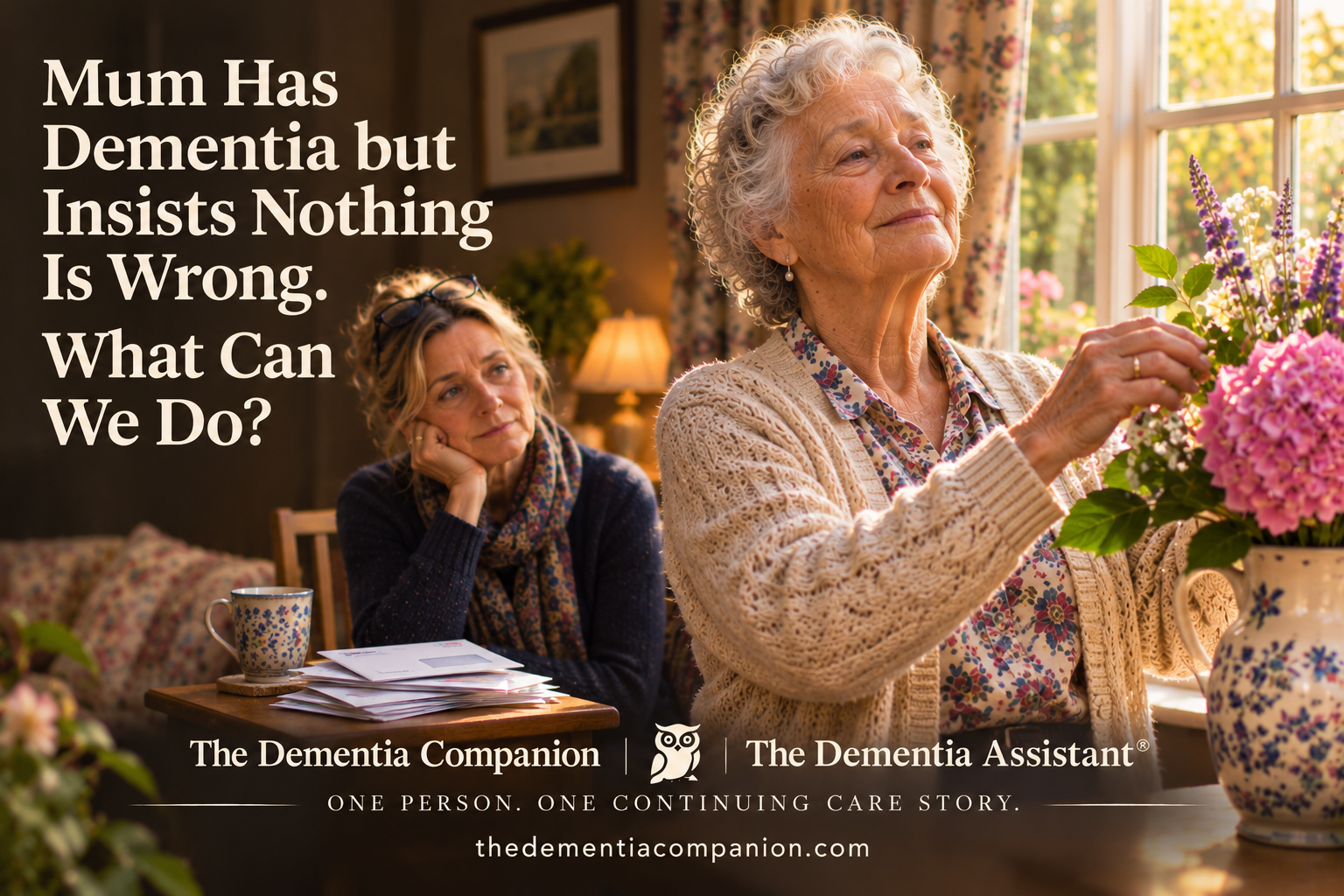
Mum Has Dementia but Insists Nothing Is Wrong. What Can We Do?
One Person. One Continuing Care Story. | Article 42 of 80
By Louise Donaghy, Dementia Practitioner, Founder of The Dementia Companion and The Dementia Assistant®, and Creator of Hugo Intelligence™.
“Mum, have you taken your tablets?”
“Of course I have.”
You look at the medication organiser.
They’re still there.
“Mum, they’re still in the box.”
“Well, somebody must have put them back.”
You try again.
“The doctor did say you might need a little help remembering things.”
Mum looks at you as though you’ve just suggested she move to the moon.
“There’s absolutely nothing wrong with my memory!”
And then comes the sentence you’ve heard approximately four hundred times.
“I’m getting older, love. We all forget things.”
You’re standing in the kitchen, wondering how to explain that forgetting where you’ve put your glasses isn’t quite the same as forgetting you’ve already eaten breakfast, taken medication or had an important appointment.
But Mum isn’t having any of it.
She tells you she’s perfectly capable.
She reminds you that she’s managed her own house for sixty years.
And before long, you’re having another argument neither of you wanted.
Perhaps you go home feeling frustrated.
Perhaps Mum is upset because she believes you’re treating her like a child.
And perhaps you’re wondering whether she’ll ever understand that she has dementia.
So what can you do when Mum has dementia but insists nothing is wrong?
First, understand that there may be more than one explanation.
Some people find a dementia diagnosis frightening or difficult to accept. Others experience changes in the brain that affect their ability to recognise their own difficulties. This is called lack of insight, sometimes known as anosognosia.
The most helpful approach is not to keep trying to prove Mum has dementia. Instead, focus on the specific difficulties that need support, listen to her perspective, protect her independence and seek professional help when health or safety concerns arise.
If Mum is experiencing anosognosia, she may genuinely believe she’s managing perfectly well.
And repeatedly presenting evidence may not change that belief.
It may simply leave both of you more distressed.
That doesn’t mean ignoring serious problems.
It means finding a more compassionate and practical way of addressing them.
Because there is something I want families to remember.
Mum’s understanding of her difficulties may be different from yours. But her dignity, feelings and rights are no less important.
Why does Mum insist nothing is wrong when she has dementia?
Imagine you’ve spent your whole life being independent.
You worked.
Raised children.
Managed a household.
Paid bills.
Organised appointments.
Looked after everybody else.
Now the people you brought up are telling you that you need help with things you’ve done for decades.
From your perspective, perhaps everything feels reasonably normal.
But your daughter keeps asking whether you’ve remembered things.
Your son wants to check your medication.
Somebody has suggested having a professional carer visit.
And everybody seems strangely interested in whether you’ve had breakfast.
You might become irritated too.
For somebody living with dementia, there can be several reasons for this disagreement.
Mum may be frightened by the diagnosis
Some people recognise that their memory or abilities have changed but find the diagnosis emotionally difficult.
They may worry about losing independence.
Being treated differently.
Having to stop driving.
Needing care.
Or what the future might bring.
There can also be considerable stigma surrounding dementia.
Sometimes saying “I’m fine” is a way of protecting yourself from a frightening conversation.
She may not remember the diagnosis
For some people, memory difficulties mean they cannot reliably recall being told they have dementia.
A family member might explain the diagnosis one day.
But the person may not remember the conversation the next.
Repeating it may feel to them like hearing distressing information for the first time.
That does not necessarily mean they are deliberately denying the diagnosis.
Mum may genuinely lack awareness of some difficulties
This is where anosognosia becomes relevant.
A person may be unable to recognise particular changes in their abilities.
They may genuinely believe that they continue managing an activity independently.
This is not necessarily stubbornness.
And it isn’t something a family can simply correct through more detailed explanations.
She may still be managing many things well
This matters too.
Perhaps Mum continues to dress herself.
Choose her meals.
Enjoy gardening.
Recognise her family.
And maintain her usual conversations.
She may genuinely be independent in several areas.
But she may need support with more complicated tasks.
Needing help with medication doesn’t automatically mean needing help with every part of life.
A person-centred approach recognises both difficulties and remaining abilities.
What is anosognosia in dementia?
Anosognosia is a neurological lack of awareness of an illness or impairment.
In dementia, it can affect someone’s ability to recognise changes in memory, behaviour, judgement or everyday functioning.
Alzheimer’s Society explains that lack of insight can be related to changes affecting areas of the brain involved in self-awareness.
It may occur in different types of dementia and can be particularly relevant in some forms, including frontotemporal dementia.
What might anosognosia look like?
A person may:
- Insist they haven’t forgotten appointments despite repeated difficulties.
- Believe they manage medication independently when doses are being missed.
- Say they cook every day even though somebody else has gradually taken over.
- Underestimate changes in driving ability.
- Disagree that they need assistance with particular daily activities.
- Reject an explanation of difficulties they cannot recognise themselves.
These examples do not establish anosognosia.
They are possible reasons for seeking professional assessment.
Awareness may vary between activities
Mum might recognise that she sometimes forgets words.
But she may not recognise that she struggles to organise medication.
She may acknowledge difficulty using her telephone but insist that her finances are completely straightforward.
This uneven awareness can be confusing for families.
It may appear as though she’s deliberately admitting some things and hiding others.
But the explanation may be more complicated.
Can you make someone recognise their dementia?
Sometimes people become more accepting of a diagnosis over time.
But neurological lack of insight may not improve simply because family members present more evidence.
You cannot assume that a person will eventually agree if you argue persuasively enough.
The aim should be to understand and respond to their actual needs.
A diagnosis can explain some difficulties. It doesn’t mean every conversation has to become an attempt to make the person accept that diagnosis.
What’s the difference between denial and anosognosia?
These terms are sometimes used interchangeably, but they are not the same.
Denial is a psychological response in which a person may find it difficult to acknowledge something frightening or uncomfortable.
They may recognise some changes but be reluctant to accept what those changes could mean.
Anosognosia involves an impaired ability to recognise particular difficulties because of neurological changes.
Someone experiencing anosognosia may genuinely not perceive the problem that others can see.
The distinction isn’t always obvious in everyday life.
And the two experiences may overlap.
Why does the difference matter?
Because it affects how we communicate.
If Mum is frightened about her future, she may benefit from time, reassurance and sensitive conversations.
If she is unable to recognise particular difficulties, repeated explanations may not help.
In either situation, arguing is unlikely to create trust.
A dementia specialist can help assess what may be contributing.
But families don’t need to diagnose anosognosia themselves before beginning to communicate more gently.
Why doesn’t showing Mum the evidence help?
This is a familiar experience.
You show Mum the unpaid bill.
She says she’s already dealt with it.
You show her the unopened medication.
She insists she’s taken it.
You explain that she missed her appointment.
She says nobody told her.
You begin gathering more examples.
A list of things she’s forgotten.
Problems she’s had.
Mistakes she’s made.
Before you know it, you’re presenting a case that would make a courtroom solicitor proud.
Except Mum doesn’t feel helped.
She feels criticised.
Or frightened.
Or convinced that everybody is against her.
Consider what the argument is trying to achieve
Are you trying to ensure medication is taken safely?
Arrange a medical appointment?
Introduce practical help?
Or convince Mum that her understanding of herself is wrong?
These are not necessarily the same goal.
You may be able to address an immediate practical need without winning the argument about dementia.
Stop turning every difficulty into a memory test
Avoid saying:
“See, Mum? That’s what I’ve been telling you.”
Or:
“You forgot again.”
Or:
“You can’t remember because you’ve got Alzheimer’s.”
The factual explanation may be correct.
But it may not help Mum understand or accept the support.
You could try:
“Shall we have a look at the medication together?”
“There’s a letter here we need to deal with. Would you like a hand?”
“I know how important doing things yourself is to you.”
The focus shifts from proving a deficit to finding a workable solution.
What should I say when Mum insists she’s perfectly fine?
Use natural language.
Speak to her as the adult she is.
And listen carefully to what she says.
If Mum says, “There’s nothing wrong with me”
You might say:
“I’m glad you’re feeling well, Mum.”
“I know you’re used to managing things yourself.”
“Would you mind if we looked at this one thing together?”
You don’t have to agree that no problems exist.
You’re choosing not to begin another argument.
If Mum says, “You’re treating me like a child”
Try:
“I don’t want you to feel that way.”
“You’ve always been independent, and that matters.”
“Tell me how you’d prefer us to help.”
Then listen to the answer.
If Mum says, “I don’t need carers”
You might say:
“I know you want to keep doing things your way.”
“Let’s talk about what help you would actually find useful.”
But be truthful about any professional support being proposed.
Don’t invent an identity for a care worker or pretend essential care is something different.
If Mum says, “The doctor doesn’t know what he’s talking about”
You could try:
“It sounds as though you weren’t comfortable with what the doctor said.”
“What worried you most?”
“Would you like us to talk to them again and ask some questions?”
This approach leaves space for Mum’s perspective.
If Mum becomes angry
Consider ending the discussion for the moment if there is no immediate risk.
“We don’t need to sort everything out right now.”
“Let’s have a cup of tea.”
“We can come back to this.”
Not every problem needs to be solved during one conversation.
Sometimes protecting the relationship is more helpful than securing agreement.
Should I keep reminding Mum that she has dementia?
Not automatically.
Alzheimer’s Society advises considering whether repeating the diagnosis is actually necessary or helpful.
If Mum is experiencing lack of insight, continually reminding her may not achieve the understanding you’re hoping for.
If she finds the term upsetting, you can often discuss specific needs without insisting that she uses the word dementia.
For example:
“Would it help to have appointments written on a calendar?”
Rather than:
“You need a calendar because you have dementia.”
However, this is not a reason to conceal a diagnosis, deny access to information or prevent someone from participating in their healthcare.
Mum has rights to information and appropriate involvement in decisions.
If she asks directly about her diagnosis, respond truthfully and sensitively, adapting the explanation to her needs and preferences.
Kind communication is not the same as misleading somebody.
How can we offer help when Mum doesn’t believe she needs it?
Begin with the practical task rather than an argument about ability.
Focus on what Mum wants to achieve
Perhaps she wants to keep living independently.
Continue gardening.
Go shopping.
Visit friends.
Or remain involved in family life.
Ask what would make those activities easier.
Support may be more welcome when it helps her continue doing something meaningful.
Introduce suitable support gradually
Where there is no urgent safety concern, allow time for Mum to become familiar with proposed changes.
Perhaps she would welcome help with shopping before considering personal care support.
Perhaps an introductory meeting with a home care worker could help.
Perhaps a family member could accompany her to an appointment.
But don’t use gradual introduction as a way to bypass consent.
Give meaningful choices
Would Mum prefer a morning or afternoon visit?
Would she like a family member to be present initially?
Does she have preferences about the person helping her?
Can she continue managing some parts of the task independently?
The answer should reflect what matters to her.
Preserve strengths
If Mum can prepare a simple breakfast safely, don’t automatically take over.
If she enjoys folding laundry, let her participate.
If she can choose her clothes, respect her choices.
If she needs help with a complex task, provide support for that particular task.
Good care doesn’t start by taking away everything somebody can still do.
What if Mum refuses to attend a memory clinic or see the GP?
If Mum has not yet received a diagnosis, she may not understand why an assessment is being suggested.
Or she may feel frightened about what the appointment could mean.
Try asking what worries her.
Perhaps she thinks the appointment will lead to losing her driving licence.
Perhaps she fears being sent into residential care.
Perhaps she simply doesn’t believe anything has changed.
Explain the purpose without making threats
You might say:
“I’ve noticed you’ve been finding a few things more tiring lately. I’d feel happier if we had a general health check.”
Or:
“Some memory and concentration changes can have different causes. It would be useful to ask the doctor.”
This should be a truthful description of the purpose of seeking assessment, not a false explanation designed to trick someone into attending.
Share factual concerns with the GP
In the UK, family members can generally provide information about their concerns to a GP even when the GP cannot disclose the patient’s confidential information in return.
You might describe:
When the change began.
Specific difficulties.
What Mum manages independently.
Any recent illness or medication changes.
Safety concerns.
What Mum says about the situation.
Ask how best to proceed within the appropriate confidentiality and consent arrangements.
A professional may suggest a suitable assessment pathway.
Avoid assuming dementia explains everything
Changes in memory, judgement or behaviour can have other causes.
A clinical assessment may identify treatable problems or contributing conditions.
If Mum suddenly becomes markedly more confused, seek urgent medical advice rather than waiting for a routine memory appointment.
What if Mum refuses medication because she says she’s not ill?
This can create significant concern.
Mum may genuinely not understand why medication has been prescribed.
She may forget the explanation.
Or she may have concerns about side effects.
Begin by asking what she thinks the medication is for and why she doesn’t want it.
Do not assume lack of insight is the only reason.
Speak with the appropriate professional
Contact the prescriber or pharmacist.
Explain what has been happening.
Ask whether the medicine, formulation, timing or support arrangements need review.
Don’t independently change the dose.
Don’t stop prescribed treatment without appropriate guidance.
And don’t secretly hide medication in food as a family workaround.
Covert administration involves specific legal, consent and professional requirements and must never be improvised.
Medication safety requires proper clinical guidance, not an argument about whether Mum accepts her diagnosis.
What if Mum insists she can still drive?
Driving is different from many other everyday disagreements because the consequences can affect other people.
Don’t assume that every person with dementia must immediately stop driving.
But a diagnosis may trigger legal notification obligations and the need for an assessment under the relevant jurisdiction.
United Kingdom
Requirements differ between UK nations and licensing authorities.
In Great Britain, drivers diagnosed with dementia must notify the DVLA.
In Northern Ireland, the DVA is the relevant licensing authority.
Medical fitness to drive must be considered through the appropriate process.
Other countries
Requirements vary between states, provinces and territories.
Families should consult the appropriate official driver licensing authority and healthcare professional.
If Mum doesn’t recognise the concern
Try to avoid a shouting match over her driving ability.
Explain the relevant legal requirements and the need for appropriate medical advice.
If you believe there is an immediate risk of unsafe driving, seek urgent advice from the appropriate professional or authority.
Do not rely on Hugo to determine whether she is medically or legally fit to drive.
Does refusing to acknowledge dementia mean Mum lacks mental capacity?
No.
This distinction is essential.
Lack of insight into a diagnosis is not the same thing as lacking legal capacity to make every decision.
Capacity must be considered for the particular decision, at the relevant time, under the applicable legal framework.
Mum may be able to choose her daily activities independently.
She may need support understanding a complex financial decision.
Or there may be a genuine concern about her ability to understand the implications of refusing essential care.
Those questions require individual consideration.
England and Wales
The Mental Capacity Act 2005 provides important principles.
Adults must be presumed to have capacity unless established otherwise.
They should receive appropriate support to make decisions.
A decision considered unwise does not, by itself, establish lack of capacity.
Capacity is decision-specific.
Where someone lacks capacity for a particular decision, the relevant legal requirements, including best-interests principles and less restrictive alternatives, must be considered.
A relative cannot simply declare that Mum lacks capacity because she doesn’t agree with them.
Scotland
Scotland has a separate framework, including the Adults with Incapacity (Scotland) Act 2000.
Relevant decisions must follow Scottish law and consider the person’s wishes and statutory principles.
Northern Ireland
Northern Ireland has separate legal arrangements, including provisions of the Mental Capacity Act (Northern Ireland) 2016 introduced in phases.
Families should obtain guidance about the law applicable to the particular decision.
Republic of Ireland
Ireland’s Assisted Decision-Making (Capacity) Act 2015, as amended, emphasises supported decision-making and the person’s will and preferences.
The Decision Support Service provides official guidance.
United States, Canada and Australia
Capacity, consent, guardianship, substitute decision-making and safeguarding rules vary by state, province or territory.
Seek appropriately qualified local advice.
Mum’s rights do not disappear because she cannot recognise every difficulty associated with dementia.
What if Mum’s lack of insight is putting her in danger?
This is when professional help becomes particularly important.
Perhaps she’s repeatedly missing essential medication.
Perhaps she cannot manage food safely.
Perhaps she’s experiencing significant falls.
Perhaps she’s becoming lost.
Or perhaps she’s unable to recognise a serious health problem.
The response should reflect the actual risk.
Identify the immediate concern
What is happening?
How frequently?
What could go wrong?
What support is currently available?
What has already been tried?
Is the risk immediate or developing?
These questions help establish what needs attention.
Seek a care needs review
Contact the appropriate healthcare or social care professional.
In England, the local council’s adult social care service can assess care and support needs.
Other UK nations and countries have different arrangements.
If there are genuine questions about Mum’s ability to make a particular decision, ask for an appropriate capacity assessment.
Seek urgent or emergency help when necessary
If Mum becomes suddenly confused, collapses, develops stroke-like symptoms or is otherwise seriously unwell, seek immediate emergency assistance.
Sudden confusion may be caused by delirium or another medical emergency and should not automatically be attributed to existing dementia.
If neglect, abuse or serious self-neglect is suspected, contact the relevant safeguarding service.
Respecting Mum’s independence does not mean leaving serious unmet needs unaddressed.
But it also doesn’t mean automatically overriding her choices whenever the family is worried.
The correct response requires proportionate assessment and lawful support.
What if Mum seems perfectly fine when the doctor sees her?
This is something many families recognise.
Mum attends an appointment.
She smiles.
Chats politely.
Answers familiar questions.
Perhaps discusses the weather and remembers a story from decades ago.
The doctor sees someone who appears comfortable during a short consultation.
Meanwhile, the family has been dealing with missed medication, unpaid bills or difficulties at home.
Both experiences can be genuine.
A person may have significant strengths in conversation while experiencing difficulties with more complex everyday tasks.
Share the fuller picture
Explain what happens outside the appointment.
Give relevant examples.
What can Mum manage?
What does she find difficult?
When do the problems occur?
What support is already being provided?
Has anything changed?
Ask the clinician how family observations can be considered, subject to confidentiality and appropriate permissions.
The aim is not to contradict Mum for the sake of winning an argument.
It is to ensure that any assessment reflects her everyday circumstances.
What if other family members say Mum is absolutely fine?
Perhaps your brother visits on Sunday afternoons.
Mum has had lunch.
She’s dressed nicely.
She enjoys chatting.
They laugh together.
He comes away saying:
“I don’t know what you’re worrying about. Mum seems perfectly fine.”
Meanwhile, you’ve spent the morning helping her find her medication and sorting an overdue bill.
This disagreement can create enormous frustration.
But try to avoid turning it into a competition over who knows Mum best.
Compare factual observations
One person might describe:
“Mum was cheerful and enjoyed our conversation.”
Another might explain:
“She needed support organising breakfast and medication earlier that morning.”
Both observations may be accurate.
And both are important.
A person-centred care record can help the family recognise strengths alongside areas where support is needed.
Consider a professional review
If the family disagrees about significant safety or care needs, a professional assessment may help.
The focus should remain on Mum.
Not on proving that one relative is right.
How can I protect my relationship with Mum when we disagree constantly?
This is perhaps the part I feel most strongly about.
Because repeated arguments can gradually change a relationship.
The daughter who once visited for tea becomes the person who checks medication.
The son who used to enjoy gardening with Mum becomes the person insisting she attend appointments.
Every visit becomes a list of concerns.
And Mum begins to associate the people she loves with being corrected.
That is a painful situation for everyone.
Make room for ordinary moments
If it’s safe and appropriate, enjoy the activities you always shared.
Have a cup of tea.
Look at the garden.
Listen to music.
Talk about something other than dementia.
Laugh together.
You don’t need to turn every visit into an assessment.
Choose which discussions actually matter
Some things need addressing.
Medication safety.
Significant financial risks.
Medical appointments.
Serious changes in health.
Other things may not require immediate correction.
If Mum calls Wednesday Thursday, does it matter?
If she remembers a family event differently, must you prove the details?
Sometimes the kindest response is to focus on the meaning of the conversation rather than the exact facts.
Remember who Mum was before the diagnosis
She was a person with a lifetime of abilities, experiences and preferences.
She remains that person.
Dementia may change parts of her functioning.
But it should never reduce her to a collection of mistakes.
Try to protect the relationship while addressing the care needs. Both matter.
What should we record when Mum doesn’t recognise her difficulties?
A factual continuing care record can help.
Not a list of everything Mum gets wrong.
Not an evidence file designed to prove she has dementia.
But a balanced description of the person’s abilities, preferences, support needs and changes.
A fictional example
Person: Joan, aged 79.
Relevant diagnosis: Alzheimer’s disease, confirmed by her healthcare team.
Usual strengths: Enjoys gardening, chooses her clothes, prepares simple drinks and remains sociable with familiar people.
Current concern: Joan does not appear to recognise recent difficulties organising medication or appointments.
What Joan says: “I manage everything myself. I don’t need reminders.”
Observed difficulties: Family found scheduled medication doses still in the organiser on several occasions. Two appointments were missed during the past month.
What helps: Calm discussion of one practical task at a time. Joan prefers being asked whether she would like assistance rather than being told she is unable to manage.
What hasn’t helped: Repeatedly reminding Joan of her diagnosis during disagreements.
Professional actions: Medication concerns shared with the appropriate clinician. Family requesting review of support arrangements.
Review date: Following the relevant professional assessment.
This example is fictional.
Notice that it does not simply say:
“Joan is in denial and refuses everything.”
That would tell us very little about how to support her.
Instead, the record explains what the family has observed, how Joan experiences the situation and what professionals need to review.
Meet Hugo Intelligence™: helping families understand the difference between what they see and what Mum experiences
This is exactly the sort of family situation that inspired Hugo Intelligence™.
Because sometimes the question isn’t simply about dementia.
It’s about a relationship.
A conversation.
An argument that keeps happening.
And the worry that something important is being missed.
Hugo Intelligence™ is the conversational, person-centred guidance system within The Dementia Assistant®, powered by Person-Centred Intelligence®.
His name represents:
H — Human
U — Understanding
G — Guidance
O — One person at a time
And yes, Hugo is our little owl.
Although I sometimes suspect he’d need quite a large cup of tea to get through some family discussions.
Begin with the question you actually have
You might say:
“Hugo, Mum has been diagnosed with Alzheimer’s, but she insists there’s nothing wrong. She gets angry whenever I mention her medication or memory. How can I help her without upsetting her?”
Hugo can explain general information about denial, lack of insight and anosognosia.
He can help you explore why the disagreement may be happening.
He can suggest compassionate communication approaches.
And he can help you prepare questions for the GP, dementia specialist or care team.
He cannot determine whether Mum has anosognosia or assess her capacity.
Hugo can continue the conversation
You might then explain:
“Mum remembers some things very well.”
“She doesn’t recognise that she’s missed medication.”
“She refuses to discuss the diagnosis.”
“My brother thinks she’s fine.”
“She gets upset whenever I mention carers.”
“How can I explain this to the doctor?”
Hugo can follow the developing conversation.
He can help organise factual observations.
Suggest gentler wording.
Explore possible unmet needs.
And explain when professional help may be necessary.
General Hugo: support without creating a care plan
A family can ask Hugo general questions without creating or selecting an individual care plan.
For example:
“What is anosognosia in dementia, and how should families respond?”
Hugo can provide general educational information and relevant considerations.
Personalised Hugo: using an explicitly selected individual care plan
Now imagine Joan’s family has created her individual care plan.
It includes her routines, strengths, communication preferences, relevant health information and the difficulties she’s been experiencing.
When the user explicitly selects Joan’s care plan, Hugo can use relevant recorded information to provide more personalised educational guidance.
For example:
“Hugo, using Joan’s care plan, help me find a respectful way to discuss medication support that protects her independence.”
Hugo can consider Joan’s recorded preferences and the relevant support needs.
Hugo does not automatically access every care plan in an account.
The user must select the individual person’s plan.
Families supporting more than one person can maintain separate care plans.
And Hugo’s guidance must not replace professional clinical, legal or safeguarding decisions.
The Care Planning Centre™: understanding what the person can do, not simply what they cannot
The Care Planning Centre™ helps people living with dementia and their families create and maintain individual person-centred care plans.
Through guided Talk to Hugo conversations, users can explore relevant care-planning questions.
For example:
“What can Mum still manage independently?”
“Which activities does she enjoy?”
“How does she prefer people to offer help?”
“What does she find upsetting?”
“Which difficulties have been observed?”
“What have healthcare professionals recommended?”
“What should another person supporting her know?”
Relevant information can be organised into appropriate sections of the care plan, subject to user review.
The platform also supports care-plan reviews, gap suggestions and assistance with clearer professional wording.
The plan should not become an argument
The purpose of the care plan isn’t to make Mum admit that she’s lost certain abilities.
It is to help the person and those supporting her understand the care arrangements that may be needed.
Her preferences should be included.
Her strengths should be recognised.
Her rights should be respected.
And where there is uncertainty about consent or decision-making capacity, appropriate professionals must address that uncertainty.
Daily notes: documenting what happens without labelling Mum
The Dementia Assistant® includes daily notes.
These can help families recognise patterns and prepare useful information for professional reviews.
For example:
Monday: Joan said she had taken her morning medication. The scheduled dose remained in the organiser. Family contacted the relevant professional for advice.
Wednesday: Joan enjoyed gardening and chose her lunch independently. She became distressed when the conversation focused repeatedly on her diagnosis.
Friday: Joan accepted help organising an appointment when offered a choice of dates. She appeared comfortable with the arrangement.
These are fictional examples.
They demonstrate something important.
A person can experience difficulties in one area while maintaining meaningful abilities in another.
A care plan should reflect that balance.
Saved and categorised Hugo conversations
Hugo conversations can be saved, categorised and revisited.
The family might begin with questions about anosognosia.
Later, they may explore arranging support or preparing for a care review.
Saved conversations help preserve the continuity of educational discussions.
They are not verified clinical records or legal determinations.
Document organisation and exports
The platform provides tools for organising relevant care information and documents.
Applicable exports include PDF, Word, CSV and JSON.
Families can maintain their own information and share appropriate records with professionals, subject to consent, privacy, permissions and applicable law.
The family-held record complements professional documentation.
It does not replace it.
Family Circle: when everybody sees a different side of Mum
This is one of the situations where Family Circle may be particularly useful.
Different relatives may observe different abilities.
One sees Mum managing a pleasant conversation.
Another helps with medication.
Another notices she’s becoming overwhelmed by paperwork.
Family Circle supports appropriate sharing of relevant information between authorised relatives.
This can help the family develop a more balanced picture.
But the goal is not to form a committee to overrule Mum.
Her wishes, privacy and decision-making rights remain central.
Not every relative needs access to every detail.
And sharing information through a digital platform does not replace formal professional communication or safeguarding processes.
Life Story and Memory & Moments: remembering who Mum is beyond the disagreements
Think about the woman in front of you.
Perhaps she spent forty years working as a nurse.
Perhaps she brought up four children.
Perhaps she travelled the world.
Perhaps she has always loved gardening.
Perhaps she has a wonderfully stubborn streak that existed long before dementia entered her life.
These experiences are part of her identity.
And they can help us understand why accepting support may feel difficult.
A person who spent a lifetime caring for others may find it particularly uncomfortable when others begin organising her life.
Someone who values privacy may dislike unfamiliar people entering the home.
Someone who has always managed the family finances may feel frightened by suggestions that another person should take responsibility.
Life Story and Memory & Moments help families preserve meaningful personal history, relationships and preferences.
This information may help professionals approach Mum in ways that reflect who she is.
But personal history should never be used to stereotype somebody or predict every response.
The individual still gets to have preferences today.
Multilingual support: understanding the person in the language they prefer
Sometimes a person may struggle to understand information because of the language or way it is presented.
Perhaps Mum prefers Welsh.
Irish.
Hindi.
Spanish.
Or another language.
Perhaps her family lives across several countries.
Perhaps she needs more time to process unfamiliar medical terminology.
The Dementia Assistant® offers 12 interface languages, with dictation and translation capabilities spanning 201 languages.
These tools can help families communicate and organise care information across languages.
Not every feature is available in all 201 languages.
For medical diagnosis, consent, legal decisions, medication and safety-critical information, professional interpreting or verification may be necessary.
Some people living with dementia experience changes in language use, but this varies.
Never assume everyone returns to a childhood language.
Ask what works best for the individual.
Being understood is part of preserving someone’s independence and dignity.
Dementia Academy™, crisis guidance and the Carer Wellbeing Hub
The Dementia Assistant® includes educational resources through the Dementia Academy™.
These help families and professionals explore dementia, communication and person-centred support.
The platform also includes educational crisis guidance to help users recognise when additional or urgent professional support may be needed.
Hugo cannot provide emergency intervention or determine an individual’s clinical or legal capacity.
And what about the person doing the worrying?
This is a difficult part of caring.
You’re trying to protect Mum.
She’s insisting she doesn’t need protection.
You’re worried about medication, appointments or safety.
She thinks you’re interfering.
And every attempt to help seems to end in another disagreement.
It’s exhausting.
You may feel frustrated.
Then guilty for feeling frustrated.
Then worried that you should have done something differently.
The Carer Wellbeing Hub recognises the emotional pressures of caring.
But practical human support matters too.
Speak with a dementia specialist or appropriate healthcare professional.
Ask about carers’ support.
Consider whether a professional care needs assessment would help.
And be clear about what you can realistically manage.
Mum may not recognise every difficulty, but that doesn’t mean the family has to manage every difficulty alone.
Ask Hugo: 17 questions families ask when someone with dementia insists nothing is wrong
- Why does Mum with dementia insist nothing is wrong?
She may find the diagnosis difficult to accept, forget the conversation or experience neurological lack of insight, sometimes called anosognosia. Some people also recognise certain changes but not others. The explanation depends on the individual.
- What is anosognosia in dementia?
Anosognosia is an impaired awareness of a condition or particular difficulties, associated with neurological changes. Someone may genuinely be unable to recognise changes that are apparent to others.
- Is anosognosia the same as denial?
No. Denial is a psychological response to something difficult or frightening. Anosognosia involves impaired awareness associated with brain changes. The two can be difficult to distinguish without professional assessment.
- Can I convince Mum that she has Alzheimer’s?
Repeatedly presenting evidence may not help and can create distress. Focus on listening, discussing specific needs and obtaining appropriate professional support rather than attempting to win an argument.
- Should I remind Mum every day that she has dementia?
Not automatically. Consider whether repeating the diagnosis is necessary or helpful. You can often discuss practical support without repeatedly naming the condition. Remain truthful and respect her right to appropriate information.
- Why does Mum get angry when I offer help?
She may feel criticised, frightened or concerned about losing independence. She may also be unable to recognise the difficulty you are describing. Explore what she wants and how she prefers support to be offered.
- Does lack of insight mean Mum has lost mental capacity?
No. Lack of insight does not automatically establish lack of legal capacity for every decision. Capacity is decision-specific and must be considered under the applicable legal framework.
- What if Mum refuses to take medication because she says she isn’t ill?
Ask about her concerns and contact the prescriber or pharmacist for advice. Do not independently stop, change or secretly administer medication. Seek appropriate clinical guidance if essential treatment is being missed.
- Can someone with anosognosia still live independently?
Possibly. The answer depends on the person’s abilities, support needs, environment and assessed risks. Anosognosia alone does not determine whether someone can live at home.
- What if Mum refuses to attend a memory clinic?
Explore her concerns and explain the purpose of the assessment truthfully. Consider asking the GP for guidance and sharing factual observations through appropriate channels.
- What if Mum seems fine at the GP but struggles at home?
A short appointment may not reveal every everyday difficulty. Share relevant, specific observations with the clinician, while recognising Mum’s strengths and respecting confidentiality.
- Can lack of insight happen with frontotemporal dementia?
Yes. Reduced awareness of certain difficulties can be particularly relevant in some types of frontotemporal dementia, although it can occur in other dementias too.
- What if Mum insists she can still drive?
Follow the relevant driver licensing and medical fitness rules in your jurisdiction. Seek professional guidance about safety and legal requirements. Do not rely on family arguments or an AI assistant to determine fitness to drive.
- How can I introduce support without upsetting Mum?
Begin with a task she values, offer genuine choices and respect her preferences. Gradual introductions may help where suitable. Do not mislead her about who is providing care or bypass consent.
- What should I do if lack of insight creates serious safety risks?
Seek an appropriate healthcare or social care assessment. Describe specific concerns and unmet needs. Serious safeguarding or immediate medical risks require prompt professional help.
- Can Hugo help us communicate with Mum without arguing?
Yes. Hugo can offer general educational guidance about denial, anosognosia and person-centred communication. When you explicitly select Mum’s care plan, he can consider relevant recorded preferences for more personalised suggestions. He cannot diagnose anosognosia or determine capacity.
- How can we keep Mum’s support needs connected when she doesn’t recognise them herself?
The Dementia Assistant® supports individual care plans, factual daily notes, saved and categorised Hugo conversations, document organisation and appropriate family updates. Relevant information can be shared with authorised professionals, respecting Mum’s privacy, wishes and legal rights.
One Person. One Continuing Care Story.
Different professionals. Different services. One person. One continuing story.
Imagine Joan’s journey.
She begins having difficulty remembering appointments.
Her daughter becomes concerned.
Joan says there is nothing wrong.
A GP arranges an assessment.
A memory clinic becomes involved.
Eventually, dementia is diagnosed.
Joan doesn’t recognise all the difficulties her family describes.
But she continues enjoying gardening, choosing her own clothes and spending time with her grandchildren.
Over time, her support needs may change.
Perhaps home carers become involved.
Perhaps she needs help with medication.
Perhaps there’s a hospital admission.
A different care team takes over.
Later, she may require rehabilitation or residential support.
Different professionals.
Different records.
Different assessments.
But Joan remains the same person.
The woman who loves flowers.
Who values privacy.
Who dislikes being rushed.
Who has spent a lifetime making her own decisions.
And who may not see her difficulties in the same way as the people supporting her.
The family’s continuing care information should preserve both perspectives
This is central to The Dementia Assistant®.
A person living with dementia, and their family where appropriate, can maintain their own continuing person-centred care information.
It can begin with the first memory concerns.
It can develop through GP appointments, memory assessments and diagnosis.
And it can continue through changing care needs, home support, hospital admissions, rehabilitation, residential care and palliative or end-of-life care where relevant.
One person. One individual care plan.
Joan’s plan should not simply say:
“Has dementia. Doesn’t accept diagnosis. Refuses help.”
It should explain:
What Joan can still manage.
What she enjoys.
What she finds difficult.
What she says about her situation.
What family members have observed.
What professional assessments have established.
Which support arrangements have been agreed.
And what helps her feel respected.
This creates a more balanced record.
The plan should change as Joan’s needs change
Perhaps she accepts some support but continues to decline other arrangements.
Perhaps her abilities fluctuate.
Perhaps an illness temporarily affects her functioning.
Perhaps a professional review identifies a new need.
The family-held plan can be reviewed and updated appropriately.
It should never trap somebody in a description that no longer reflects their abilities.
The family-held record complements professional care
The Dementia Assistant® does not replace professional clinical records, statutory care plans, formal capacity assessments, safeguarding procedures or legal decisions.
It complements them.
The person or family can maintain their own continuing information and share relevant details with appropriate professionals, subject to wishes, consent, access permissions and applicable law.
The person should not have to start a new story every time another service becomes involved.
And that includes the person who cannot always recognise changes in their own needs.
Because whether Joan agrees with her diagnosis or not, she is still Joan.
She still has a history.
Preferences.
Relationships.
Abilities.
Wishes.
And rights.
Different professionals. Different services. One person. One continuing story.
A gentle invitation to meet Hugo
If Mum insists nothing is wrong, you may be feeling as though you’re having the same conversation every day.
You want to help.
But the more you explain, the more upset everybody becomes.
You can begin by asking Hugo.
Describe what’s happening.
Explore the difference between denial and anosognosia.
Ask for gentler ways to explain practical concerns.
Prepare questions for the GP or dementia specialist.
And when you create and explicitly select Mum’s individual care plan, Hugo can use relevant recorded information to help explore approaches that reflect her particular strengths, preferences and support needs.
The Dementia Companion is our public educational home for dementia articles, practical guidance and Ask Hugo resources.
https://thedementiacompanion.com/
The Dementia Assistant® is our interactive platform where families can continue conversations with Hugo Intelligence™, create and maintain individual care plans, save and categorise conversations, record daily notes, organise documents, preserve Life Story and Memory & Moments information, and communicate appropriately through Family Circle.
The platform also includes multilingual capabilities, the Dementia Academy™, educational crisis guidance and the Carer Wellbeing Hub.
Every subscription includes a 30-day complimentary trial.
The UK Family subscription is £4.99 per month after the trial.
International subscription prices are available through the platform.
Meet Hugo and explore The Dementia Assistant®:
https://thedementiaassistant.com/
Hugo provides educational guidance, not medical diagnosis, formal assessment of anosognosia, medication prescribing, emergency intervention, statutory assessments or legally binding decisions.
One final thought
I want you to think about what Mum might be experiencing.
She’s spent a lifetime being independent.
Making decisions.
Solving problems.
Helping other people.
And now the people she loves are telling her she’s struggling with things she believes she can still manage.
Perhaps she’s frightened.
Perhaps she doesn’t recognise what’s changed.
Perhaps she genuinely believes everything is fine.
And perhaps you are standing beside her, desperately worried, wondering how to make her understand.
But sometimes the most important change isn’t getting Mum to agree with us.
Sometimes it’s changing how we respond to her.
Listening more carefully.
Arguing a little less.
Recognising her strengths.
Addressing practical difficulties.
Seeking help when it matters.
And remembering that the person behind the diagnosis deserves dignity, whether or not she can describe that diagnosis herself.
You may not always be able to change Mum’s understanding.
But you can keep working towards support that protects her health, choices and quality of life.
Because good dementia care isn’t about winning an argument.
It’s about understanding the person and finding a compassionate way forward.
One person.
One continuing care story.
With love,
Louise and Hugo ❤️🦉
Louise Donaghy
Founder & CEO of The Dementia Assistant®
Created and powered by Person-Centred Intelligence®
Creator of Hugo Intelligence™
⸻
Continue exploring with The Dementia Companion
The Dementia Companion: Practical family guidance
https://thedementiacompanion.com/
Ask Hugo
https://thedementiacompanion.com/ask-hugo/
The Dementia Assistant®: Individual care planning and continuing guidance
https://thedementiaassistant.com/
Related reading in our continuing-care series includes Mum Seems Fine at the GP but Struggles at Home, Mum Won’t Let Home Carers In, Mum Keeps Forgetting Bills and How Do I Know When Mum Needs a Care Home?
References and authoritative guidance
1. Alzheimer’s Society, UK. Understanding denial and lack of insight.
https://www.alzheimers.org.uk/get-support/help-dementia-care/understanding-denial-lack-of-insight
2. Alzheimer’s Society, UK. What is the difference between denial and lack of insight?
https://www.alzheimers.org.uk/get-support/help-dementia-care/what-difference-between-denial-and-lack-insight
3. Alzheimer’s Society, UK. Coping with denial and lack of insight with dementia.
https://www.alzheimers.org.uk/get-support/help-dementia-care/coping-denial-lack-of-insight
4. Alzheimer’s Society, UK. Support and care when a person won’t accept their dementia diagnosis.
https://www.alzheimers.org.uk/get-support/help-dementia-care/support-care-when-person-wont-accept-their-dementia-diagnosis
5. Dementia UK. Understanding denial and lack of insight.
https://www.dementiauk.org/information-and-support/living-with-dementia/understanding-denial-and-lack-of-insight/
6. Dementia UK. Mental capacity and decision-making for people with dementia.
https://www.dementiauk.org/information-and-support/financial-and-legal-support/mental-capacity-and-decision-making/
7. NICE, UK. Dementia: assessment, management and support for people living with dementia and their carers, NG97.
https://www.nice.org.uk/guidance/ng97/chapter/recommendations
8. NICE, UK. Decision-making and mental capacity, NG108.
https://www.nice.org.uk/guidance/ng108/chapter/recommendations
9. NHS, UK. Mental Capacity Act.
https://www.nhs.uk/social-care-and-support/making-decisions-for-someone-else/mental-capacity-act/
10. NHS, UK. Sudden confusion (delirium).
https://www.nhs.uk/symptoms/confusion/
11. Alzheimer’s Association, USA. Anosognosia.
https://www.alz.org/alzheimers-dementia/what-is-dementia/related_conditions/anosognosia
12. Alzheimer Society of Canada. National dementia guidelines: Meeting content for the disclosure process. Includes recognition of anosognosia and person-centred disclosure.
https://www.alzheimer.ca/en/help-support/im-healthcare-provider/national-dementia-guidelines/meeting-content
13. Dementia Australia. Coping with your diagnosis.
https://www.dementia.org.au/living-dementia/what-next-after-your-diagnosis/coping-your-diagnosis
14. Australian Government Department of Health, Disability and Ageing. Dementia diagnosis, management and support.
https://www.health.gov.au/topics/dementia/diagnosis-management-and-support
15. Decision Support Service, Republic of Ireland. Code of Practice for Supporting Decision-Making and Assessing Capacity.
https://www.decisionsupportservice.ie/resources/codes-practice/code-practice-supporting-decision-making-and-assessing-capacity
16. GOV.UK. Managing a health and welfare Lasting Power of Attorney.
https://www.gov.uk/manage-lasting-power-attorney/health-welfare
Editorial and safety note: This article provides general educational guidance, not an assessment of anosognosia, mental capacity or an individual’s need for care. A dementia diagnosis, lack of insight or disagreement does not automatically remove decision-making rights. New or worsening symptoms require appropriate healthcare assessment; sudden confusion or other emergency symptoms require urgent care. Legal arrangements differ by jurisdiction. All family scenarios are fictional.
You May Also Find Helpful
Need help with your own situation? Ask Hugo.
One Person. One Continuing Care Story. The Dementia Companion is where you discover guidance. Inside The Dementia Assistant®, talk with Hugo, save and categorise conversations, record daily notes and involve authorised supporters in a continuing care plan centred around the person.
Ask Hugo About This · Start Your Continuing Care Plan — Families · Continuing Care Planning — Professionals
Personal guidance requires the appropriate account and subscription access. Care-plan information is used only with authorised access and the required consent and selection steps. All subscription plans include a 30-day complimentary trial.