How to Respond to Repetitive Questions in Dementia
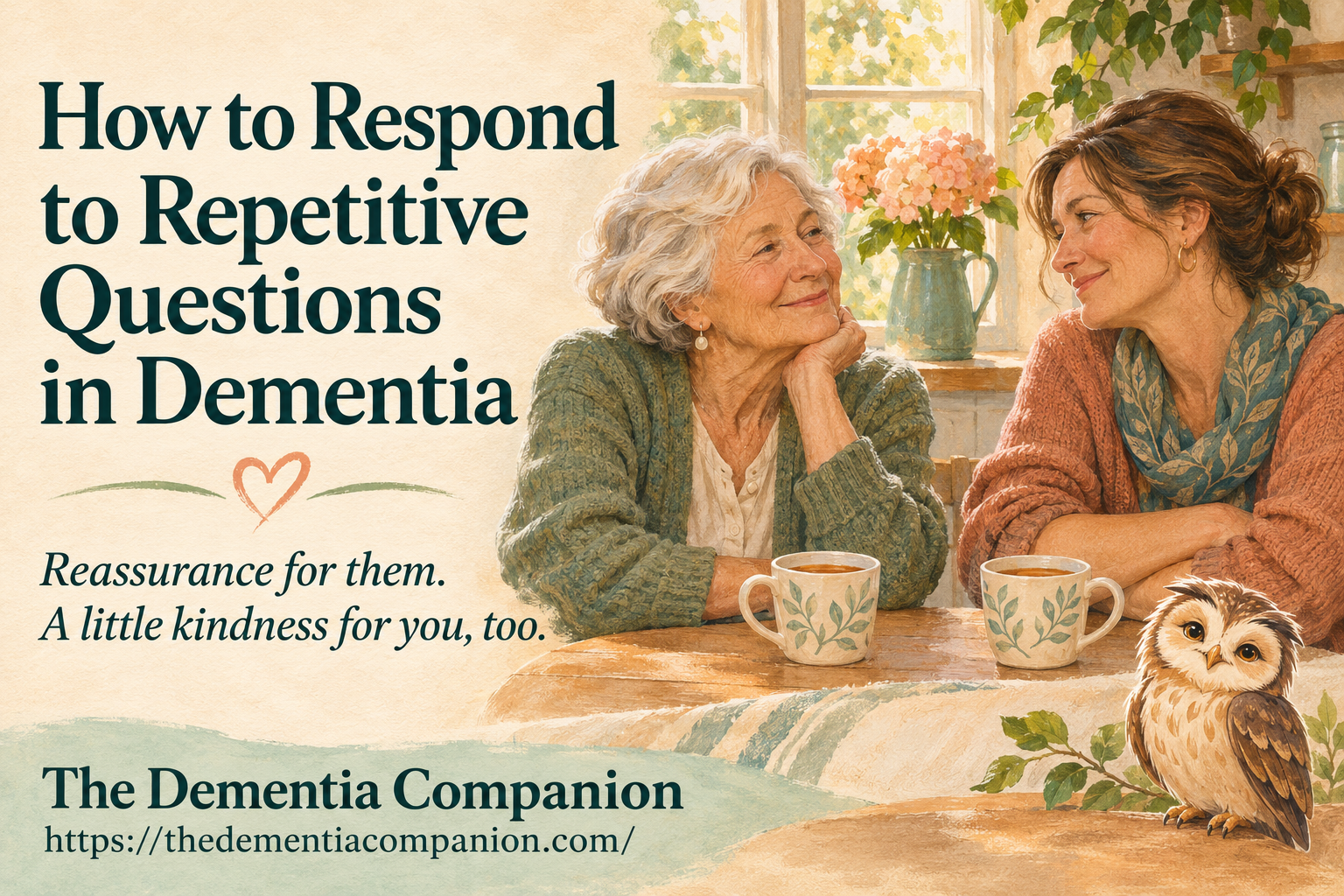
How to Respond to Repetitive Questions in Dementia
By Louise Donaghy, Founder of The Dementia Assistant® and The Dementia Companion
“What time are we leaving?”
“At two, Mum.”
A little later…
“What time are we leaving?”
“At two.”
And then, just as you sit down with that cup of tea you have already reheated twice…
“Are we going somewhere today?”
You love this person. You want to be kind. But you are tired, you have things to do, and you can feel your patience quietly collecting its coat and heading towards the door.
If that sounds familiar, take a breath. Feeling frustrated does not mean you love someone any less.
A helpful starting point is to give a short, calm answer, offer reassurance and consider whether something is worrying them. A simple reminder may help too. But the person answering needs care and breathing space as much as the person asking.
And “just be patient” is rather easy advice to give when you are not the one answering the question all afternoon.
Why might someone repeat a question?
Dementia can affect the ability to remember a recent conversation. Someone may forget the answer you gave, or even that they asked the question.
For you, this might be the twelfth time. For them, it may feel like the first.
Sometimes uncertainty or anxiety is involved too. The person may be trying to understand what is happening, check that they have not forgotten something important, or feel reassured that someone is there to help. (alzheimers.org.uk)
That does not mean every repeated question has a hidden meaning. Sometimes they simply want to know what time lunch is.
We do not need to turn every conversation into a detective investigation. There is enough to do without adding a magnifying glass to the washing basket.
But it can help to notice what is happening around the question. Does it come up before an appointment? When you leave the room? When the house gets busy?
Try approaching it with curiosity:
“What might make this moment feel a little easier for them?”
That is a gentler place to start than:
“How do I make them stop asking?”
Am I answering the question or the worry behind it?
Sometimes we give perfectly accurate information, but the person remains unsettled.
The time has been explained. The calendar has been consulted. The appointment letter has practically had its own presentation.
And still the question comes.
They may need the answer and reassurance about what that answer means for them. Alzheimer’s Society highlights that repeated questions can reflect a need for comfort or security, rather than information alone. (alzheimers.org.uk)
These fictional everyday examples show what that might sound like.
“What time is my appointment?”
A straightforward answer might be:
“Half past ten.”
If they seem worried about getting there, you could add:
“It’s at half past ten. I’m coming with you, and I’ll help you get ready.”
“Is Sarah coming?”
If Sarah is expected, try:
“Yes, Sarah is coming after lunch. You’re looking forward to seeing her, aren’t you?”
You are answering without making them feel awkward for asking. Only promise a visit if it is actually arranged.
“Where’s my handbag?”
If you know where it is:
“Your bag is here beside your chair. Shall we put it where you can see it?”
That offers something concrete they can check.
You do not need a long speech. Keep your tone adult, warm and natural. Avoid turning the conversation into a memory test with “What did I just tell you?” or pointing out how many times they have asked. That can leave the person embarrassed or upset. (dementiaconnect.alzheimers.org.uk)
After answering, you might invite them into something they enjoy:
“Shall we listen to some music while we wait?”
Offer it as company, without rushing past a worry they are still trying to express.
And if they ask again, it does not mean you got it wrong. A kind response can still be worthwhile even when the question returns.
Which reminders might help?
For someone who can still comfortably read and understand them, simple written reminders can make information easier to find. Clocks, calendars and photographs may also help if they remain familiar and meaningful. (alz.org)
Think small and clear:
- A card saying, “Sarah is visiting today after lunch.”
- A note saying, “Louise is coming with you to the appointment.”
- An easy-to-read clock near their usual chair.
- One clear calendar with today’s plans.
Choose something together where possible. Keep it accurate, easy to see and free of unnecessary detail.
We are aiming for a helpful little reminder. The kitchen does not need to become an airport departures board.
You could say:
“I’ve written it here so we can check it together.”
That feels very different from:
“It’s on the board. I’ve already told you.”
Let their response guide you. If a reminder makes them more worried, prompts constant checking or leaves them feeling tested, put it aside and try a simpler approach.
An aid should earn its place by being helpful. Nobody has failed because a whiteboard did not work.
Sometimes sitting beside someone and answering gently is more useful than adding another note.
How can I manage my own frustration?
First, please give yourself permission to admit that this is hard.
You can understand dementia, care deeply about the person and still find repetition exhausting.
Love does not come with unlimited energy, uninterrupted sleep or a magical ability to stay cheerful while the washing machine beeps and your tea develops its own weather system.
Try making the next difficult moment a little more manageable.
Keep an answer ready.
A short phrase such as “We’re leaving after lunch, and I’m coming with you” may be easier to repeat than rebuilding the whole explanation each time.
Pause before your voice gets there first.
Unclench your jaw. Drop your shoulders. Take a slow breath. You do not have to produce an answer at lightning speed.
Take a brief break when it is safe.
If the person can safely be left for a moment, step away for a drink of water or a little quiet. If they need supervision, ask someone to take over. A pause should protect both of you.
Ask for specific help.
“Can you sit with Mum from three until four on Wednesday?” gives someone a clear way to help. If family support is limited, speak with your GP or a dementia support service about how you are coping and what help may be available. The NHS advises carers to seek support when behaviour changes become difficult to manage. (nhs.uk)
If you snap, repair the moment.
You might say:
“I’m sorry I sounded cross. You haven’t done anything wrong. I’m feeling tired. Let’s start again.”
You do not need to give a lengthy explanation or ask them to comfort you. Just return to kindness.
And leave room for humour when it feels welcome. A shared giggle about your cold tea or your terrible singing can bring a little lightness. Keep the joke somewhere you can both enjoy it, rather than making their memory difficulty the punchline.
If the questioning becomes increasingly distressing, seek advice from their GP or dementia team. If someone becomes suddenly confused, or abruptly much more confused than usual, seek immediate medical help. In the UK, NHS advice is to go to A&E or call 999 for sudden confusion. (nhs.uk)
Above all, I would like you to remember this:
The person asking deserves reassurance. The person answering deserves support.
There will be moments when you find the words, and moments when you need someone else to take a turn. Both belong in an honest conversation about caring.
You do not have to be endlessly patient to be loving. You are a person in this relationship too. ❤️
If you would like help thinking through a situation in your own family, you can ask Hugo within The Dementia Assistant®. Sometimes it helps to have somewhere to begin when the words are hard to find.
Louise and Hugo ❤️🦉
The Dementia Companion, home of The Dementia Assistant® and Hugo 🦉
https://thedementiacompanion.com/
You May Also Find Helpful
Need help with your own situation? Ask Hugo.
One Person. One Continuing Care Story. The Dementia Companion is where you discover guidance. Inside The Dementia Assistant®, talk with Hugo, save and categorise conversations, record daily notes and involve authorised supporters in a continuing care plan centred around the person.
Ask Hugo About This · Start Your Continuing Care Plan — Families · Continuing Care Planning — Professionals
Personal guidance requires the appropriate account and subscription access. Care-plan information is used only with authorised access and the required consent and selection steps. All subscription plans include a 30-day complimentary trial.