How Do We Share Caring Responsibilities Without Family Arguments?
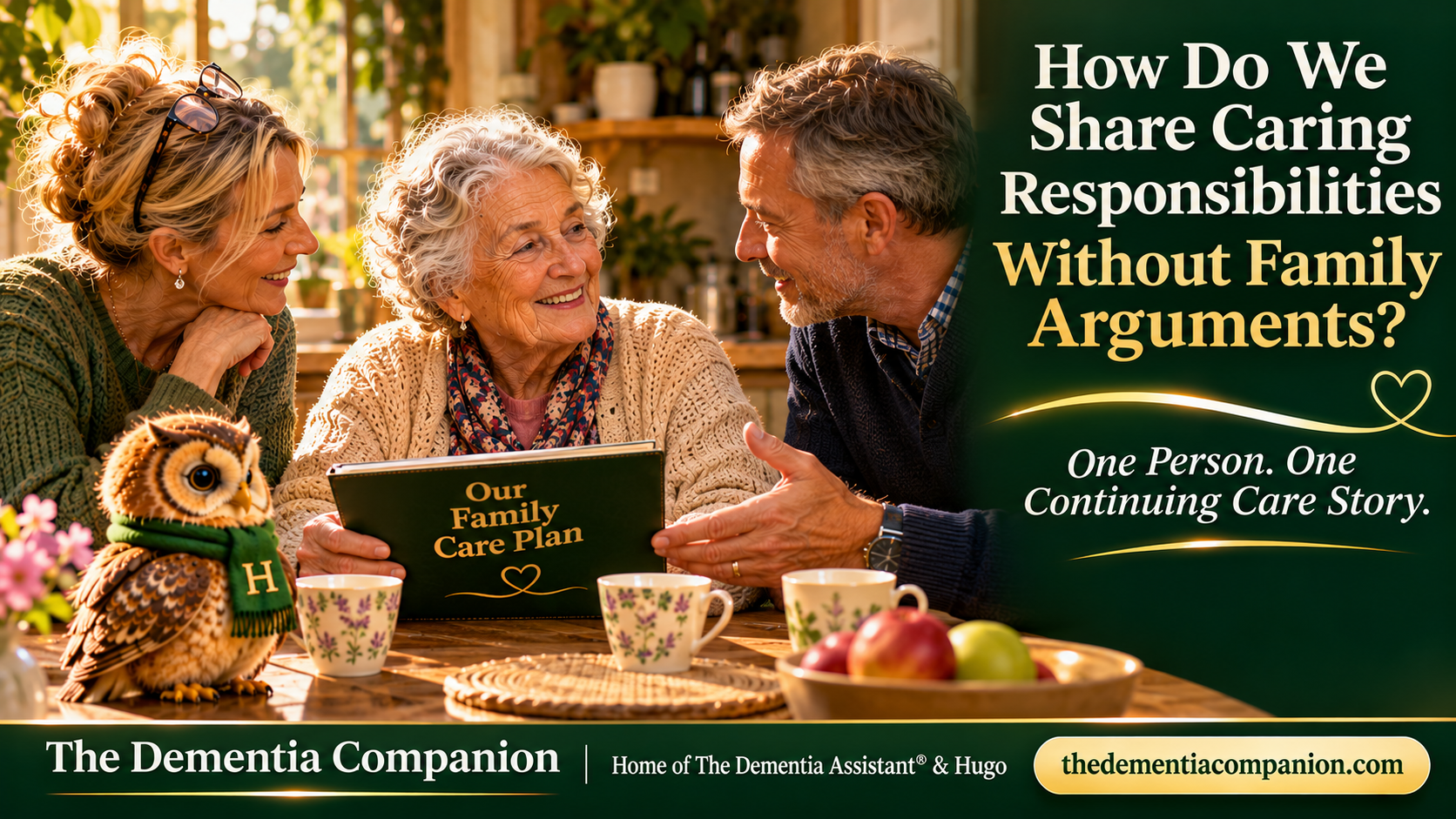
How Do We Share Caring Responsibilities Without Family Arguments?
When everybody loves Mum, but nobody agrees about who should be doing what.
By Louise Donaghy, Dementia Practitioner, Founder of The Dementia Companion and The Dementia Assistant®, and Creator of Hugo Intelligence™
There’s a sentence I suspect many family carers have said at least once.
“It’s all right. I’ll sort it.”
And you do.
You sort the GP appointment.
You collect the prescription.
You ring the memory clinic.
You organise the shopping, check the fridge, deal with the paperwork and make sure Mum has everything she needs.
Then your brother rings on Sunday afternoon.
“How’s Mum?”
You explain everything that’s happened.
And he says:
“Have you thought about getting her out a bit more?”
Lovely idea.
You briefly consider inviting him to organise that himself.
Preferably while you’re enjoying a week somewhere warm with absolutely no telephone signal.
Of course, not every family is like this. Some share responsibilities beautifully, and some relatives face genuine limitations because of distance, work, health or their own caring commitments.
But when someone is living with dementia, family disagreements about care can develop even when everybody genuinely wants the best for the person.
One relative may feel overwhelmed.
Another may not understand how much support is needed.
Someone may disagree with a decision.
And sometimes the person living with dementia ends up listening to everybody discuss their life as though they aren’t sitting right there.
So how do families share the responsibilities without damaging their relationships?
Start with the person, agree who can realistically help, make responsibilities clear, keep appropriate information together and review arrangements as needs change.
And remember something important.
Fair doesn’t always mean everybody doing exactly the same amount. It means responsibilities are realistic, understood and not silently falling on one exhausted person.
Why do families argue about dementia care?
Family disagreements often begin long before anyone raises their voice.
They begin with different expectations.
One sibling lives nearby and sees the daily changes.
Another lives several hours away and visits once a month.
A third may be balancing work, children and their own health.
And everyone may have a slightly different understanding of what’s happening.
The relative who visits occasionally might see Mum enjoying lunch, chatting happily and making jokes.
The person who visits every day may also know about the difficult mornings, forgotten appointments and sleepless nights.
Both experiences can be genuine.
But neither necessarily gives the whole picture.
Alzheimer’s Society recognises that disagreements can develop when family members understand or accept dementia differently.
Dementia UK also explains that a diagnosis can change family roles and relationships.
Sometimes the arguments aren’t really about who collected the shopping.
They’re about worry, grief, guilt, exhaustion and the frightening feeling that life is changing.
Understanding that doesn’t excuse unkind behaviour.
But it can help us approach difficult conversations more constructively.
First, remember whose care we’re discussing
Before deciding who should do what, ask:
What does Mum want?
What support does she welcome?
What would she prefer to continue doing independently?
Who does she want involved?
What information is she happy for family members to receive?
Does she want everybody discussing her private affairs?
A dementia diagnosis does not automatically remove someone’s ability to make decisions.
Capacity depends on the specific decision and circumstances, and people should receive appropriate support to make their own choices.
Sometimes families become so focused on organising care that they unintentionally start organising the person.
Mum may suddenly find herself with a timetable of visits, a new shopping rota and several people making decisions about her kitchen.
All without anybody asking whether she actually wanted the kitchen reorganised.
Good dementia care should protect the person’s independence, dignity and preferences.
A family care plan should reflect Mum’s wishes, not simply provide a schedule for everybody else.
How do we divide dementia caring responsibilities fairly?
Begin by writing down what actually needs doing.
Not everything that might become necessary in five years.
What needs attention now?
Perhaps that includes:
- GP and memory clinic appointments.
- Shopping and meals.
- Transport.
- Medication-related support agreed with professionals.
- Practical household tasks.
- Companionship and social activities.
- Paperwork and correspondence.
- Checking whether existing support arrangements are working.
- Helping organise professional care.
Then ask family members what they can realistically contribute.
One person may be comfortable organising appointments.
Another may be able to manage shopping.
Someone living further away might help with telephone calls or administrative tasks.
Another relative might provide regular companionship.
A person who cannot contribute much time may be able to help arrange an agreed service, subject to the family’s financial and legal circumstances.
The aim is not to make everyone identical.
It’s to create a realistic plan.
And that includes recognising that some tasks require professional care rather than family assistance.
Don’t assign a job without someone’s agreement
It’s tempting to announce:
“Right, you’re doing Tuesdays.”
But family members have their own circumstances too.
Ask what is genuinely possible.
Someone might agree to collect prescriptions once a fortnight but not be able to provide daily personal care.
Someone else might help with transport but not be available during working hours.
A realistic agreement is more useful than an enthusiastic promise that falls apart after three days.
And if one person cannot contribute, the solution shouldn’t automatically be for the main carer to do even more.
It may be time to explore additional support.
What if one family member is doing nearly everything?
This is often where resentment develops.
The person doing most of the caring may not complain at first.
They simply keep going.
They organise one more appointment.
They stay an extra hour.
They cancel another personal arrangement.
Then another.
And eventually a seemingly innocent question about whether Mum has enough milk becomes the final straw.
It’s rarely about the milk.
It’s about exhaustion.
If you’re the person doing most of the caring, try explaining the actual workload rather than waiting until frustration takes over.
For example:
“I’m currently managing Mum’s appointments, shopping and most of her daily support. I’m struggling to keep up, and we need to agree what help is realistically available.”
This isn’t an accusation.
It’s information.
You might find it useful to write down the tasks and approximate time involved over a typical week.
Not to keep score.
But to make the workload visible.
Dementia UK and NHS guidance recognise the importance of carers’ wellbeing and seeking practical support.
The person receiving care matters, and so does the wellbeing of the person providing it.
What if my brother or sister doesn’t believe Mum needs help?
This can be particularly upsetting.
Perhaps a relative visits Mum and finds her cheerful, conversational and apparently managing well.
They may struggle to understand why you are worried.
Some people living with dementia can manage particular situations very well while finding others more difficult.
But we must also avoid assuming that every disagreement means someone is refusing to accept the diagnosis.
Different relatives may genuinely have different observations.
Try sharing specific examples rather than arguing about labels.
Instead of:
“You haven’t got a clue what Mum is like now.”
You might say:
“When you visited, Mum was having a lovely afternoon. I’ve also noticed she’s been missing appointments and finding her evening routine more difficult. Could we look at what support might help?”
Where appropriate, encourage the relative to attend a professional review with Mum’s agreement.
A shared understanding is often more useful than winning an argument.
And please don’t turn every family disagreement into a discussion about how badly Mum is doing.
Her strengths deserve to be recognised too.
What should we discuss at a family dementia care meeting?
I know.
The words family meeting can make everybody suddenly discover an urgent appointment elsewhere.
But it doesn’t have to be formal.
Sometimes a quiet conversation around the kitchen table is enough.
If Mum wants to participate, make the discussion accessible and comfortable for her.
You might talk about five things.
- What matters to Mum?
Begin with her wishes, routines, strengths and preferences.
What does she want help with?
What would she prefer to keep doing herself?
- What support is needed now?
Discuss current practical needs without exaggerating or minimising them.
Use factual observations and professional advice where relevant.
- Who can help?
Agree specific responsibilities.
Avoid vague promises such as “I’ll do more”.
Instead, agree what someone can actually do and when.
- What information needs sharing?
Not everybody needs access to Mum’s entire medical history.
Agree what information can be shared, with her wishes and relevant permissions respected.
- When will we review the arrangements?
Care needs can change.
Family circumstances can change too.
Agree to revisit the plan rather than treating the first arrangement as permanent.
And try to finish the conversation before somebody brings up an argument from Christmas 1998.
We are organising Mum’s support.
Not reopening the entire family archive.
How do we keep everyone informed without endless messages?
Ah, the family WhatsApp group.
A wonderful invention.
Until the important appointment reminder disappears somewhere between seventeen photographs, a birthday message and a video of somebody’s dog wearing sunglasses.
Family messaging can be helpful.
But it isn’t always the best place to maintain sensitive, continuing care information.
Different people may have different versions of the latest arrangements.
Someone may miss a message.
An important detail can become buried.
And health information may be shared more widely than the person intended.
A better approach is to keep the agreed care information in one organised place.
That might be a secure folder, a notebook or a suitable digital system.
The important thing is that the person remains involved wherever possible, information is accurate and access is appropriate.
This is one of the reasons I created The Dementia Assistant®.
One Person. One Continuing Care Story.
Mum’s care may involve several family members.
A GP.
A memory clinic.
A dementia nurse.
Perhaps a home care provider.
Maybe a hospital admission or other specialist services later.
Each organisation has its own professional responsibilities and records.
But Mum is still one person.
With one history.
One set of preferences.
Her own wishes, relationships and routines.
A continuing, family-held care plan provides a place to preserve that information as circumstances change.
It can include:
- Mum’s preferences and strengths.
- Her communication and language needs.
- Important professional contacts.
- Daily notes and observations.
- Appointments and relevant documents.
- Agreed family support arrangements.
- Questions for healthcare professionals.
- Changes in care needs.
- Relevant Life Story information.
The Dementia Assistant® allows families and people living with dementia to maintain their own care information independently of a particular care provider.
Professional care plans and clinical records remain separate.
The aim is continuity, not replacing the professionals involved.
Because Mum’s story shouldn’t have to begin again every time someone new joins the team.
How can Family Circle help families stay connected?
Within The Dementia Assistant®, Family Circle provides features for sharing appropriate updates and keeping relatives connected.
This can be particularly useful when family members live in different towns or countries.
One person may be involved in daily support.
Another might attend appointments.
A third may want to stay informed without repeatedly asking the main carer for updates.
Family Circle can support more organised communication, subject to the person’s wishes and appropriate access permissions.
But it shouldn’t become a family surveillance system.
Or a tool for checking whether someone else has done enough.
Its purpose is to support communication around the person receiving care.
Not to give every relative control over every decision.
The person living with dementia should remain at the centre of what is shared and why.
Meet Hugo Intelligence™: When family conversations become difficult
Sometimes a family doesn’t know how to begin a difficult conversation.
Perhaps you’re angry because you’re exhausted.
Perhaps your sister disagrees with a proposed care arrangement.
Perhaps you’re worried about upsetting Mum.
Or perhaps you simply need somewhere to talk through what is happening before you speak with everybody else.
You might ask:
“Hugo, I’m doing most of Mum’s care and I don’t know how to ask my brother for more help.”
Or:
“Hugo, my family disagrees about whether Dad needs support at home. How can we discuss this without arguing?”
Or even:
“Hugo, I’m exhausted and I feel guilty for admitting it.”
Hugo Intelligence™ is designed to offer natural, conversational dementia guidance.
You can explain your concerns, ask follow-up questions and explore possible approaches without judgement.
Hugo can help you think about how to communicate, what questions to ask and how to keep the person’s needs and wishes at the centre.
He cannot resolve family disputes, decide legal authority or replace professional safeguarding, mediation or healthcare services.
But he can provide a supportive place to explore the next conversation.
Personalised guidance through a selected care plan
You can ask Hugo general dementia questions without selecting a care plan.
When you choose Mum’s care plan within The Dementia Assistant®, Hugo can use relevant information recorded about her routines, wishes, communication needs and circumstances to provide more individualised suggestions.
Perhaps Mum prefers speaking with one family member at a time.
Perhaps she becomes overwhelmed when several people ask questions together.
Perhaps she wants to remain involved in everyday decisions.
Those details can help shape a more person-centred approach.
Not simply what the family thinks should happen, but what matters to Mum.
Save and organise your Hugo conversations
Difficult family situations rarely resolve in one conversation.
You might want to explore an issue today.
Revisit the advice next week.
And return to it when family arrangements change.
The Dementia Assistant® allows you to save, categorise and organise your Hugo conversations.
This can help you revisit useful guidance without starting from the beginning every time.
You remain responsible for deciding what personal information to record and share.
Saved conversations are not legal advice or a substitute for professional care documentation.
Hugo’s multilingual support: Families don’t all speak the same language
This is especially important for families spread across different countries.
Perhaps Mum prefers speaking Welsh or Irish.
Perhaps one adult child lives abroad.
Perhaps family members communicate in English, Hindi, Spanish or French.
And perhaps the person living with dementia feels more comfortable expressing themselves in the language they grew up speaking.
Language is part of identity.
It deserves respect.
The Dementia Assistant® supports 12 interface languages and provides dictation and translation capabilities spanning 201 languages.
These tools can help families organise care information, record notes and communicate across language barriers.
Hugo’s conversational approach also allows people to ask questions naturally.
Not every feature is available in every one of the 201 languages, and important medical or legal information should be checked for translation accuracy.
Qualified interpreters remain important for formal clinical and consent discussions where needed.
But multilingual support can help families feel more included.
Especially when distance and language might otherwise make communication harder.
One person. One continuing care story. Across families, countries and languages.
What if family arguments are affecting Mum?
This is where we need to be especially careful.
People living with dementia can be affected by arguments, tension and uncertainty just like anyone else.
And they should not be expected to sit through upsetting disagreements about their own care.
Try to avoid difficult family disputes in front of the person.
But don’t use that as an excuse to exclude them from decisions they can and want to participate in.
There is a difference between protecting someone from unnecessary conflict and taking away their voice.
If conversations become heated, agree to continue them calmly another time.
If important decisions remain disputed, seek appropriate professional guidance.
A GP, dementia specialist, social worker or independent advocate may be able to help, depending on the circumstances.
For significant legal or financial disagreements, qualified advice may be necessary.
And if there are concerns about coercion, exploitation, abuse or neglect, contact the appropriate safeguarding service.
What if there simply aren’t enough family members to help?
Not every family has several available relatives.
Some people live alone.
Some have no nearby family.
Some relatives are estranged or unable to help.
And some families are already stretched to their limits.
The answer isn’t always to divide responsibilities more cleverly.
Sometimes the answer is to seek additional support.
Depending on the person’s needs and where they live, that may involve:
- A care needs assessment.
- A carer’s assessment.
- Community dementia services.
- Professional home care.
- Respite or replacement care.
- Dementia support groups.
- Voluntary organisations.
- Specialist dementia nursing advice.
In England, unpaid carers can request a carer’s assessment through their local council.
Other UK nations have their own assessment and support arrangements.
Dementia UK also offers specialist guidance through its Admiral Nurse services.
Asking for help is not abandoning someone. It is recognising that good care needs to be sustainable.
A simple family dementia care agreement
This doesn’t need to be a legal document.
It can simply be a practical understanding between those involved.
Start with these questions:
- [ ] What does Mum want, and who does she want involved?
- [ ] What support is actually needed now?
- [ ] Which tasks are already being managed?
- [ ] Who is currently doing most of the work?
- [ ] Which responsibilities can realistically be shared?
- [ ] What needs professional support?
- [ ] Who will organise appointments and paperwork?
- [ ] How will relevant updates be communicated?
- [ ] Who is authorised to access particular information?
- [ ] What happens if someone cannot fulfil an agreed responsibility?
- [ ] When will the arrangements be reviewed?
- [ ] Is the main carer receiving enough support?
Keep it flexible.
Review it when circumstances change.
And try not to turn it into a scoreboard.
Caring isn’t a competition.
The aim is to make sure the person receives appropriate support without everybody becoming exhausted or resentful.
You are still a family, not just a care team
Something can happen when dementia becomes part of family life.
Every telephone call becomes an update.
Every visit becomes a task.
Every conversation seems to involve appointments, medication or who is doing what.
And slowly, the ordinary parts of family relationships can become harder to find.
But Mum is still Mum.
Your brother is still your brother, even if his organisational skills leave something to be desired.
And you are still a daughter, son, partner, friend or relative.
You deserve moments that have nothing to do with care arrangements.
Have lunch together.
Tell stories.
Laugh about something ridiculous.
Remember that your relationship is more than the responsibilities you share.
Good dementia care should help preserve family connection, not consume every part of it.
⸻
Ask Hugo: Sharing Dementia Care Responsibilities
Hugo, I’m doing nearly all of Mum’s care. How do I ask my family for help?
Hugo 🦉: Begin by explaining the responsibilities you’re managing and what support you need.
Try to be specific rather than asking generally for more help.
For example, you might ask whether someone can manage a regular appointment, organise shopping or provide companionship at an agreed time.
If family help isn’t enough, it’s reasonable to explore professional support too.
What if my brother doesn’t understand how much care Mum needs?
Hugo 🦉: Different relatives may see different parts of Mum’s life.
Try sharing factual examples of what you’ve noticed while also recognising her strengths.
Where appropriate, involve Mum and ask whether your brother could attend a professional review with her agreement.
Can Hugo help us prepare for a family care discussion?
Hugo 🦉: Yes. I can help you think through the topics to discuss, including Mum’s wishes, current needs, responsibilities and questions that need professional advice.
I can also suggest ways to approach difficult conversations respectfully.
Can Hugo give guidance based on Mum’s own care plan?
Hugo 🦉: Yes, when you select Mum’s care plan.
I can use relevant recorded information to help you explore person-centred approaches based on her preferences, routines and circumstances.
Without a selected plan, I can still offer general dementia guidance.
Can we save our Hugo conversations?
Hugo 🦉: Yes. The Dementia Assistant® allows you to save, organise and categorise our conversations.
You can return to useful guidance as your family’s circumstances change.
Can Family Circle help relatives stay informed?
Hugo 🦉: Family Circle features can support appropriate sharing of care information and updates between involved family members.
Access should always respect the person’s wishes, privacy and permissions.
Does everyone in the family need access to Mum’s care plan?
Hugo 🦉: No. Not everyone necessarily needs access to the same information.
Mum’s wishes, decision-making rights and relevant access arrangements should guide what is shared.
Can Hugo help families who speak different languages?
Hugo 🦉: The Dementia Assistant® provides 12 interface languages and dictation and translation capabilities spanning 201 languages.
These features can help with multilingual care information and communication.
Important medical and legal information should still be checked for accuracy.
What if we cannot agree about an important care decision?
Hugo 🦉: Begin with the person’s wishes and seek appropriate professional advice.
Depending on the issue, support may be available through a GP, social worker, dementia specialist, advocate or qualified legal adviser.
I can help you prepare questions but cannot decide who has legal authority or resolve safeguarding concerns.
How much does The Dementia Assistant® cost?
Hugo 🦉: The Family subscription is £4.99 per month.
All subscriptions include a 30-day complimentary trial.
Families can explore Hugo Intelligence™, personalised care planning, Family Circle, daily notes, saved conversations and multilingual support.
⸻
One Person. One Continuing Care Story.
Dementia care can involve several relatives, healthcare professionals, social care services and care organisations.
Everybody may have a role.
But the person living with dementia should never become lost among everybody else’s responsibilities.
The Dementia Assistant® was created to give the person and their family their own continuing place for care information.
A place to preserve wishes, preferences and routines.
A place to organise notes, appointments and important documents.
A place to support family communication through Family Circle.
A place to record changes and prepare for professional conversations.
And with Hugo Intelligence™, a place to ask questions naturally, save conversations, explore personalised guidance and use multilingual tools.
The Dementia Assistant® doesn’t replace professional care records, clinical judgement or social care assessments.
It helps the person and family maintain their own information as services and family arrangements change.
Different professionals. Different services. One person. One continuing story.
Meet Hugo and The Dementia Assistant®
Created by dementia practitioner Louise Donaghy and powered by Person-Centred Intelligence®, The Dementia Assistant® brings together:
- Hugo Intelligence™ for conversational, person-centred guidance.
- Personalised family-held dementia care plans.
- Guided care plan creation.
- Family Circle for appropriate family updates.
- Daily notes and observations.
- Document organisation.
- Saved and categorised Hugo conversations.
- Life Story and Memory & Moments.
- Multilingual dictation and translation.
- Dementia education and practical resources.
Every subscription includes a 30-day complimentary trial.
Explore The Dementia Assistant®:
https://thedementiaassistant.com/
The Dementia Companion, home of The Dementia Assistant® and Hugo 🦉
https://thedementiacompanion.com/
Louise and Hugo ❤️🦉
Louise Donaghy
Founder & CEO of The Dementia Assistant®
Created and powered by Person-Centred Intelligence®
Creator of Hugo Intelligence™
⸻
References and Further Reading
- NICE: Dementia, Assessment, Management and Support (NG97)
Recommendations about supporting carers, person-centred care, sharing appropriate information and involving people in decisions.
https://www.nice.org.uk/guidance/ng97/chapter/recommendations
- NHS: Dementia and Relationships
Information about the effects of dementia on family relationships and finding appropriate support.
https://www.nhs.uk/conditions/dementia/living-with-dementia/relationships/
- Alzheimer’s Society: When Family, Friends or Carers Are in Denial About Dementia
Guidance about disagreements, different reactions to dementia and difficulties in recognising support needs.
- Dementia UK: How Dementia Can Affect Relationships and Roles
Information about changing family responsibilities, relationships, communication and seeking support.
- Dementia UK: The Carer’s Assessment Explained
Practical guidance about assessing unpaid carers’ needs, including emotional strain and balancing responsibilities.
- NHS: Looking After Someone With Dementia
Information about supporting a person with dementia while also recognising carers’ own wellbeing and support needs.
https://www.nhs.uk/conditions/dementia/living-with-dementia/looking-after-someone/
- NICE: Decision-Making and Mental Capacity (NG108)
Guidance about supporting decision-making and involving the person in decisions about their life and care.
https://www.nice.org.uk/guidance/ng108/chapter/recommendations
- Alzheimer’s Association: Resolving Family Conflicts
Additional guidance on communication, disagreements and reviewing family caring responsibilities.
https://www.alz.org/help-support/caregiving/resolving-family-conflicts
⸻
Important information: This article provides general educational guidance and does not replace medical, legal, safeguarding or individual care advice. Assessment and legal arrangements vary across the four UK nations.
Reviewed: 20 November 2026
You May Also Find Helpful
Need help with your own situation? Ask Hugo.
One Person. One Continuing Care Story. The Dementia Companion is where you discover guidance. Inside The Dementia Assistant®, talk with Hugo, save and categorise conversations, record daily notes and involve authorised supporters in a continuing care plan centred around the person.
Ask Hugo About This · Start Your Continuing Care Plan — Families · Continuing Care Planning — Professionals
Personal guidance requires the appropriate account and subscription access. Care-plan information is used only with authorised access and the required consent and selection steps. All subscription plans include a 30-day complimentary trial.