How Do We Record Mum’s Wishes for Future Dementia Care?
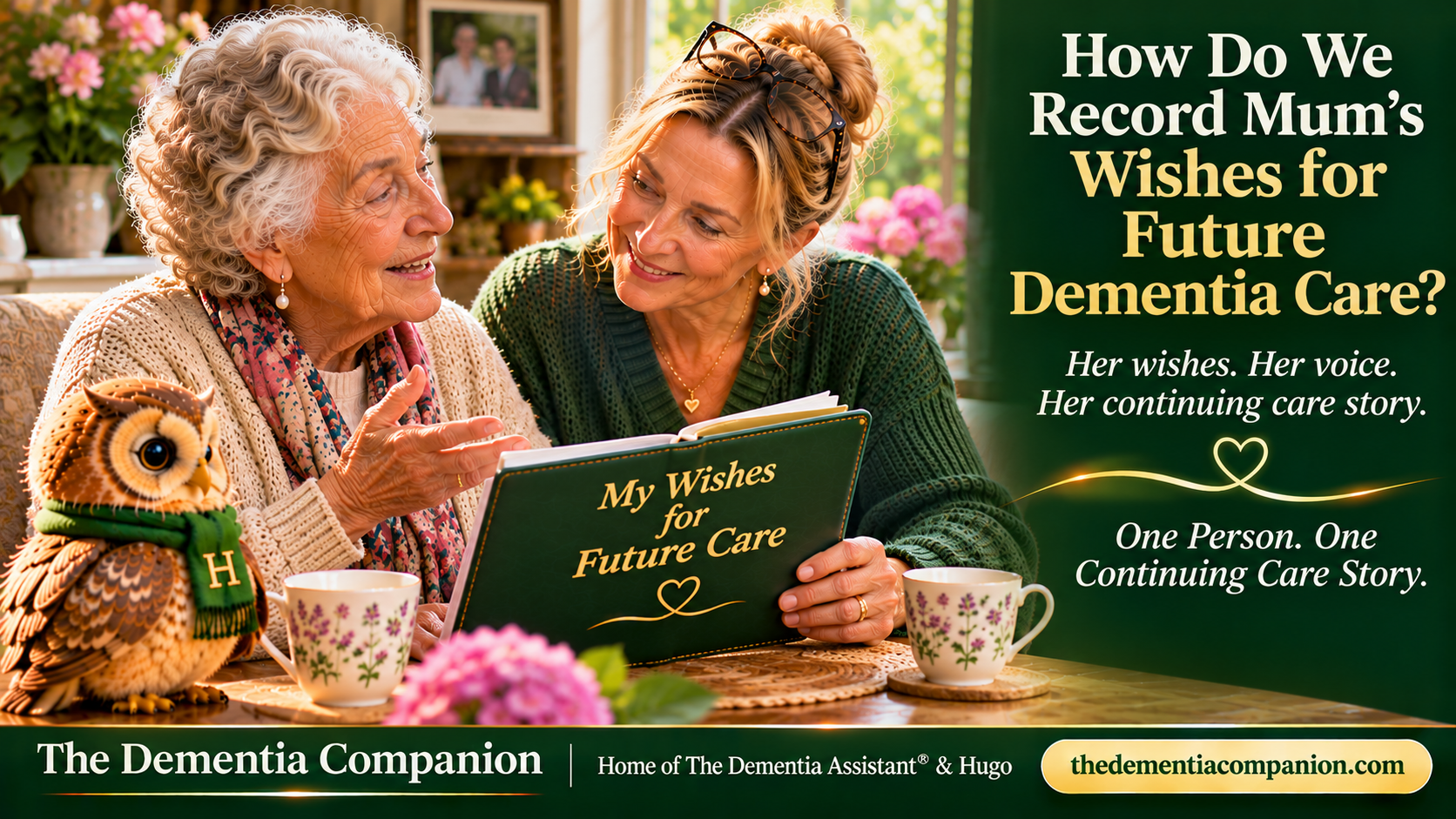
Her wishes. Her voice. Her future. Because a dementia diagnosis should never mean everybody else gets to write the next chapter of her life.
By Louise Donaghy, Dementia Practitioner, Founder of The Dementia Companion and The Dementia Assistant®, Creator of Hugo Intelligence™
“I don’t want anybody making decisions for me.”
Mum says it over a cup of tea.
Perhaps you’ve been discussing whether she might need a little more support at home.
Perhaps the memory clinic has suggested thinking about the future.
Or perhaps somebody has mentioned a care home, and Mum has immediately decided the conversation has gone quite far enough.
“Nobody’s putting me anywhere,” she announces.
And, knowing Mum, that’s probably a statement worth taking seriously.
You reassure her.
Of course her wishes matter.
But later, when you’re home, another question begins bothering you.
How do we make sure they still matter if Mum can’t explain them herself one day?
It’s a question many families face after a dementia diagnosis.
They want to protect the person they love.
They want to respect their independence.
They don’t want to frighten them with conversations about things that may never happen.
But they also don’t want important decisions being made later without knowing what the person would have wanted.
The best way to record someone’s wishes for future dementia care is to begin with a conversation about what matters to them, write down their preferences in their own words where possible, discuss relevant plans with appropriate professionals and review the information as their wishes or circumstances change.
This process is often called advance care planning.
But please don’t let the terminology make it feel more frightening than it needs to be.
Planning ahead isn’t about giving up on living.
It’s about helping someone continue to have a voice in their own life.
And sometimes the first question is as ordinary as:
“Mum, if you ever needed a little more help, what would matter most to you?”
What is advance care planning in dementia?
Advance care planning is a process of discussing and recording a person’s wishes, values and preferences for their future care.
It may include everyday choices, longer-term support arrangements, medical treatment preferences and what matters to the person if they become less able to express decisions themselves.
NICE recommends offering people living with dementia early and ongoing opportunities to discuss advance care planning.
The important words are early and ongoing.
It doesn’t have to happen during one enormous family meeting.
And it doesn’t have to begin with the most difficult medical questions.
It might begin with the person’s preferred routines.
Where they would like to live.
Who they trust.
The things they want to continue doing.
How they would like people to communicate with them.
And which aspects of their independence matter most.
Over time, the person may want to discuss more detailed care and treatment preferences.
They may wish to involve their GP, dementia nurse or other healthcare professionals.
Some people choose to create formal legal documents.
Others begin by writing a simple statement of their wishes.
The purpose is to help future care reflect the person, rather than treating everybody with dementia as though they want the same things.
Does Mum need to plan for the future immediately after diagnosis?
No.
A dementia diagnosis can bring a mixture of emotions.
Relief at finally understanding what has been happening.
Fear about the future.
Anger.
Sadness.
Or a determination to get on with life.
Some people feel ready to discuss future arrangements fairly soon.
Others need time.
And some would rather begin with the practical things affecting them today.
That’s understandable.
We should offer opportunities to plan, not pressure somebody into decisions they aren’t ready to discuss.
However, there is a good reason to introduce the subject gently.
Some people living with dementia may experience changes in their decision-making abilities as the condition progresses.
Discussing wishes while the person can comfortably express them may help preserve their choices for the future.
But a dementia diagnosis does not automatically mean Mum lacks mental capacity.
She may continue making her own decisions about many aspects of her life.
Capacity depends on the specific decision and circumstances, and the relevant legal framework.
The conversation should begin with what she can understand, what she wants and what support would help her express those wishes.
Not with the family assuming they must take control.
How do we start a conversation about future care without frightening Mum?
I wouldn’t recommend beginning over Sunday lunch with:
“Right, Mum. We need to discuss everything that could possibly go wrong over the next ten years.”
That’s enough to put anybody off their roast potatoes.
Instead, choose a relaxed moment.
And ask one question at a time.
You might begin with:
“Mum, if you ever needed more help at home, what would be important to you?”
Or:
“Are there things you’d particularly want people to understand about how you like to be cared for?”
Or even:
“Would you like us to write down some of your preferences, just so we don’t forget them?”
Then listen.
Mum may want to talk about staying at home.
She may want her dog nearby.
She may feel strongly about having a particular family member involved.
Or she may simply say:
“Don’t you dare touch my garden.”
Well, there’s somewhere to start.
You don’t have to disagree, persuade or solve every practical question immediately.
The first job is to understand what she’s telling you.
What if Mum doesn’t want to talk about it?
Respect that.
You might say:
“That’s all right. We don’t have to discuss everything today. If you ever want to talk about what matters to you, I’m happy to listen.”
Some people may prefer talking to a GP, nurse or trusted professional rather than their family.
Others may find writing their thoughts easier.
And some may not want to make particular plans at all.
Advance care planning should be voluntary.
Nobody should be made to feel that having dementia means they must immediately make decisions about every possible future event.
What should we actually record about Mum’s future care wishes?
I would begin with the person, not the paperwork.
There are several useful areas to explore.
- Where Mum would prefer to live
Perhaps Mum wants to remain in her own home for as long as possible.
Perhaps she would consider moving closer to family if her needs changed.
Perhaps she has strong feelings about residential care.
Record what she says.
For example:
“I would prefer to remain at home if my needs can be supported safely and appropriately.”
This is a preference, not a guarantee that every future circumstance can be managed at home.
Professional assessments, available support, safety and the person’s circumstances will still matter.
But knowing her preference can help guide future conversations.
- What independence means to her
This is especially important.
Independence doesn’t mean the same thing to everyone.
For Mum, it may mean choosing her clothes.
Making her own breakfast.
Going into the garden.
Having a say in how her day is organised.
Or being asked before somebody helps with personal care.
You might record:
“I want to continue doing as much for myself as I comfortably can. Please offer help without automatically taking over.”
Those words could make a real difference to how support is provided.
- Her routines and personal preferences
Does she prefer a quiet morning?
Does she like a shower rather than a bath?
Does she have a favourite activity?
Does she enjoy company at mealtimes?
Does she prefer to keep her bedroom private?
These details may sound ordinary.
But they’re part of what makes care personal.
And they may become particularly valuable when unfamiliar professionals begin supporting her.
- Her relationships and the people she trusts
Who does Mum want involved in discussions about her care?
Who would she like professionals to contact?
Who understands her communication preferences?
Are there people she doesn’t want receiving particular information?
Record her wishes appropriately.
But don’t confuse naming a trusted person in a care plan with legally appointing someone to make decisions.
Formal decision-making authority depends on the relevant legal arrangements.
- Her preferred language and communication needs
Perhaps Mum prefers Welsh, Irish, Hindi, Spanish or another language.
Perhaps she needs more time to understand questions.
Perhaps she uses hearing aids.
Perhaps she dislikes people speaking about her rather than directly to her.
These preferences should remain visible as her support needs change.
Language, identity and communication are central to person-centred care.
- Her beliefs, values and cultural preferences
Does religion or spirituality matter to Mum?
Does she have particular cultural traditions?
Are there practices she would want respected?
Does she have views about privacy, dignity or personal care?
Her care preferences should reflect her own beliefs and values, not assumptions made by others.
- What matters if she becomes seriously unwell
Some people wish to discuss future treatment preferences.
They may have views about hospital admission, comfort, medical interventions or end-of-life care.
These conversations can be sensitive and sometimes require clear medical explanations.
They should be supported by appropriately qualified professionals.
A family care plan can help record the questions and wishes the person wants to discuss.
But it cannot replace a legally valid advance decision or a professionally completed treatment plan.
The person should have the opportunity to understand their choices before making them.
What is an advance statement of wishes?
An advance statement is a way of recording someone’s preferences, beliefs, values and wishes for future health or social care.
It might describe:
- Where the person would prefer to receive care.
- How they like their daily routines organised.
- The people they want involved.
- Their religious or cultural wishes.
- Important communication preferences.
- Things that help them feel comfortable.
- What dignity and independence mean to them.
For example:
“I prefer a quiet morning and would like people to explain what is happening before helping me. My family and my garden are very important to me. I would like to stay involved in everyday decisions wherever possible.”
An advance statement is not the same as a legally binding refusal of medical treatment.
In England and Wales, an advance statement is not legally binding, but it must be taken into account when decisions are being made about the person’s care.
It can provide valuable evidence of what the person would have wanted.
Alzheimer’s Society provides guidance on advance statements and recording wishes.
It’s a good idea to discuss the statement with the person’s GP or other relevant professionals and ask how it can be included in their records.
And where possible, let the person’s own words lead.
What is an advance decision to refuse treatment?
This is where the legal distinctions become particularly important.
In England and Wales, an Advance Decision to Refuse Treatment, often shortened to ADRT, allows an adult with the necessary mental capacity to refuse specified medical treatment in particular future circumstances.
If it is valid and applicable, it can be legally binding.
That is very different from a general statement such as:
“I’d prefer to stay at home.”
An ADRT must clearly identify the treatment being refused and the circumstances in which the refusal applies.
There are additional formal requirements when refusing life-sustaining treatment, including written and witnessed documentation and an explicit statement about the risk to life.
An ADRT cannot be used to require clinicians to provide a treatment that is not clinically appropriate.
This is not something Hugo or a family’s digital care plan should generate as though it were automatically legally valid.
If Mum wants to explore an ADRT, encourage her to discuss it with an appropriately qualified healthcare professional and seek legal guidance where necessary.
The relevant rules differ across UK nations.
A conversation about treatment preferences is valuable.
A legally binding decision requires the correct process.
Is an advance care plan the same as lasting power of attorney?
No.
They serve different purposes.
An advance care plan helps record a person’s wishes and preferences.
A lasting power of attorney is a legal arrangement that can authorise another person to make specified decisions in particular circumstances.
In England and Wales, there are two types of LPA:
- Health and welfare.
- Property and financial affairs.
A health and welfare attorney can make relevant decisions only when the person lacks capacity to make the particular decision themselves.
A person must have the necessary capacity to create an LPA.
The legal requirements in Scotland and Northern Ireland are different.
For example, Northern Ireland’s Enduring Power of Attorney arrangements do not confer authority to make health and care treatment decisions.
And simply being someone’s husband, wife, daughter or son does not automatically give them unrestricted decision-making authority.
If Mum wants to explore appointing someone, she should receive the appropriate independent information and professional support.
A digital care plan can record whether legal arrangements exist and where the documents are kept. It cannot create legal authority merely by naming someone.
What about DNACPR and ReSPECT forms?
These are separate from an ordinary family record of wishes.
A DNACPR recommendation concerns whether cardiopulmonary resuscitation should be attempted if a person’s heart or breathing stops.
It does not mean that other appropriate treatment, comfort or care should stop.
A ReSPECT plan is a clinician-led process for recording recommendations about emergency care and treatment, informed by the person’s wishes, priorities and clinical circumstances.
ReSPECT is used in many parts of the UK, but arrangements vary.
These plans are not the same as an ADRT and are not themselves legally binding.
Most importantly, a dementia diagnosis is not, on its own, a reason for a DNACPR recommendation.
If these issues become relevant, discussions should be handled sensitively with the appropriate healthcare professionals.
Families should never feel that planning ahead means automatically agreeing to restrict treatment.
And a family’s own digital care plan must never be presented as an authorised DNACPR or ReSPECT document.
What happens if Mum can no longer make a particular decision?
This is one of the reasons recording wishes early can be valuable.
But we need to distinguish between the person expressing their own decisions now and others trying to understand their wishes later.
In England and Wales, the Mental Capacity Act sets out principles for supporting decision-making.
A person must not be assumed to lack capacity simply because they have dementia.
Capacity is assessed for the particular decision at the relevant time.
If Mum cannot make a specific decision despite appropriate support, relevant professionals and legally authorised decision-makers must follow the applicable law.
Her previously expressed wishes, beliefs and values may be important to that process.
A recorded preference could help others understand:
What mattered to her.
What she wanted to preserve.
What she found unacceptable.
What made her feel safe.
And whom she trusted.
However, a family member cannot create a new legally binding advance decision on Mum’s behalf simply because they know what she used to say.
Where capacity or legal authority is uncertain, seek appropriate professional guidance.
Future planning should preserve the person’s voice, not invent decisions they never made.
What if Mum changes her mind?
Then her current wishes deserve attention.
This is another reason a care plan should be a living document rather than something completed once and put away.
Perhaps Mum previously said she would never consider accepting help at home.
Later, she meets a carer she likes and decides the arrangement is useful.
Perhaps she originally wanted one relative involved in appointments but later prefers somebody else.
Or perhaps her views about where she would like to receive care change.
Preferences can evolve.
Where Mum has the capacity to make the relevant decision, her current choices should be respected.
Formal legal documents may have their own procedures for amendment or cancellation, so seek guidance when appropriate.
For everyday care wishes, record the date and what has changed.
Ask Mum to confirm the information where possible.
And make sure outdated copies are not mistakenly treated as her latest preferences.
How do we record wishes without upsetting the whole family?
Ah, families.
Wonderful people.
Until everybody has a different opinion about what Mum should do.
Your brother thinks Mum should move closer to him.
Your sister thinks she should stay exactly where she is.
Someone else has read three articles about residential care.
And Mum has already informed everybody that she is not moving anywhere.
Before the discussion turns into a family referendum, remember:
This is Mum’s future we’re talking about.
Not the family’s preferred arrangement.
Her wishes should guide the conversation wherever possible.
Try asking:
“Mum, what would matter most to you if you needed more help?”
Then record her answer before everybody starts offering their own.
There may be genuine practical limitations to what can be arranged.
There may also be safety concerns or professional assessments to consider.
But disagreement should not erase the person’s preferences.
Where difficult legal, capacity or care decisions arise, professional guidance or independent advocacy may be appropriate.
Why should future wishes be part of a continuing family-held care plan?
Imagine Mum has discussed her preferences with the memory clinic.
Later, she receives support from a dementia nurse.
Then a home care agency becomes involved.
Perhaps she has a hospital admission.
And eventually another professional needs to understand how she wants to be supported.
Each service may maintain its own records.
But her wishes should not have to disappear every time a new service becomes involved.
A family-held care plan can help preserve:
- Her preferences about daily living.
- What independence means to her.
- Her communication and language needs.
- Her important relationships.
- Her values and beliefs.
- Her wishes about future support.
- Questions she wants to discuss with professionals.
- Details of any existing formal documents and where to find them.
- Dates when her preferences were last reviewed.
The Dementia Assistant® was created to help people living with dementia and their families maintain their own continuing care information.
That information can evolve as circumstances change.
But a family-held plan does not automatically become a statutory care plan, an advance decision or a legally recognised medical document.
Those must be completed and maintained through the appropriate processes.
The family’s record complements professional care.
It does not replace it.
Different professionals. Different services. One person. One continuing story.
Meet Hugo Intelligence™: Making difficult conversations a little easier
Sometimes you know you should discuss the future.
But you don’t know how to begin.
Perhaps Mum becomes upset whenever the subject of additional support arises.
Perhaps Dad wants to plan ahead but doesn’t know which questions matter.
Perhaps you’re worried about saying something that sounds as though you’ve given up hope.
Or perhaps you simply want to explore the subject privately before speaking with your family.
You might ask:
“Hugo, Mum has recently been diagnosed with dementia. How do I talk to her about her future wishes without frightening her?”
Or:
“Hugo, Dad wants to stay independent for as long as possible. What should we include in his care plan?”
Or:
“Hugo, what is the difference between recording care preferences and making a formal advance decision?”
Hugo Intelligence™ offers conversational, person-centred dementia guidance within The Dementia Assistant®.
You can ask questions in your own words.
Explore sensitive topics gradually.
Ask follow-up questions.
And talk through concerns without judgement.
You don’t need to arrive with a perfectly prepared list.
Sometimes the question is simply:
“Hugo, I don’t know how to start this conversation.”
Hugo can help you explore gentle approaches, organise your thoughts and identify questions for relevant professionals.
He cannot assess Mum’s mental capacity, provide definitive legal advice or make binding treatment decisions.
But he can help you prepare to support Mum in expressing her own wishes.
Hugo can use Mum’s selected care plan
You can ask Hugo general dementia questions without selecting a care plan.
When you select Mum’s individual care plan, Hugo can use relevant recorded information about her routines, preferences, communication needs and circumstances to offer more personalised suggestions.
Perhaps Mum has always valued independence.
Perhaps her garden is a huge part of her identity.
Perhaps she prefers quiet conversations rather than family meetings.
Those details may help you explore how to approach planning in a way that suits her.
Not simply future care planning for somebody with dementia, but planning that starts with Mum as an individual.
The family should check the information for accuracy and ensure Mum’s views are represented appropriately.
Save and organise conversations with Hugo
Planning ahead rarely happens in one sitting.
You may begin by discussing everyday wishes.
Later, you might explore family involvement.
Another time, you may want to prepare questions for the GP.
The Dementia Assistant® allows you to save, categorise and organise conversations with Hugo.
You can return to earlier guidance and continue exploring issues as circumstances change.
This helps create continuity in your thinking.
But saved conversations are educational guidance, not legally binding advance decisions or professional treatment instructions.
What if I want to ask Hugo a question late at night?
Some of the most difficult questions seem to arrive when the house is quiet.
Perhaps you’re thinking about something Mum said earlier.
Perhaps you’re worried about whether you’ve understood her wishes.
Perhaps you want to prepare for a conversation the next day.
Hugo provides a place to explore non-urgent questions and revisit saved guidance.
He is not an emergency service or a substitute for healthcare professionals.
But for everyday questions about communication, care planning and preparing for professional discussions, a conversational resource can help you organise your thoughts.
Hugo’s multilingual support: Future wishes in the person’s own language
This deserves particular attention.
Because discussing future care is personal.
Deeply personal.
And the language someone uses can affect how comfortably they express what they feel.
Perhaps Mum grew up speaking Welsh.
Perhaps Dad’s first language is Irish.
Perhaps family members speak English, Hindi, French or Spanish.
Or perhaps the person living with dementia finds certain conversations easier in the language they grew up with.
Some people living with dementia experience changes in how they use different languages, although this varies considerably.
We should never assume somebody automatically returns to a childhood language.
But we should ask what language helps them communicate most comfortably.
The Dementia Assistant® provides 12 interface languages and dictation and translation capabilities spanning 201 languages.
These tools can help families record information, organise care preferences and communicate across language barriers.
Dictation may make it easier for someone to express a thought without typing.
Translation may help appropriately involved relatives understand information.
Hugo’s conversational approach can also support people who prefer asking questions naturally rather than completing complicated forms.
Not every feature is available in all 201 languages.
And important legal documents, clinical instructions and consent-related information must be checked for accuracy.
A qualified interpreter should be used when necessary for important professional discussions.
The person’s wishes shouldn’t become less important because they find it easier to express them in a different language.
How can Family Circle help relatives understand Mum’s wishes?
Perhaps Mum wants her daughter to attend appointments.
Her son helps with practical matters.
Another relative lives abroad.
And different family members have different understandings of what she wants.
The Dementia Assistant® includes Family Circle features for sharing relevant updates with appropriately involved relatives.
This can support communication, provided the person’s wishes and access permissions are respected.
But having a family connection doesn’t automatically mean everyone should see every detail.
Mum may want some information shared widely.
Other information may be deeply private.
Family-held care information should help preserve her choices, not remove them.
What if Mum’s future wishes are difficult to put into words?
Not everybody enjoys writing.
Some people feel overwhelmed by forms.
Others find abstract questions about the future difficult.
You can make things easier by discussing practical situations.
Rather than asking:
“What are your long-term care preferences?”
Try:
“If you needed help getting ready in the morning, how would you like somebody to approach you?”
Or:
“What would make you feel comfortable if someone new was helping at home?”
Or:
“Are there people you’d particularly want involved if you were unwell?”
Use short conversations.
Allow time.
Consider pictures or familiar examples if helpful.
And avoid turning the discussion into a test of memory or understanding.
Where appropriate, speech and language therapy or independent advocacy may help someone communicate their choices.
The goal is not to fill every empty field.
The goal is to understand what Mum wants to tell us.
How often should we review future care wishes?
There’s no single timetable that suits everybody.
But it is sensible to revisit preferences when circumstances or wishes change.
For example:
- After a new care arrangement begins.
- Following a significant hospital admission.
- When the person’s health or support needs change.
- When a trusted contact changes.
- When the person expresses a different preference.
- When formal documents are completed or updated.
You can also ask during a routine care plan review:
“Mum, is this still what you would want?”
Keep the date of the conversation.
Record changes accurately.
And make sure relevant professionals know when important information has been updated.
Formal advance decisions, powers of attorney and clinical emergency plans must be reviewed or amended through the proper processes.
A continuing care story should reflect the person’s wishes as they are understood today, not simply what somebody wrote several years ago.
Does future care planning work the same way across the UK?
The general principle of involving people in their own care is widely recognised, but the legal frameworks differ.
England and Wales: The Mental Capacity Act 2005 provides the principal framework for decision-making when a person lacks capacity for a particular decision. Advance statements, advance decisions to refuse treatment and lasting powers of attorney have distinct roles.
Scotland: Future care planning and anticipatory care planning are supported through NHS Scotland. Decision-making and welfare powers are governed by Scottish legislation, including the Adults with Incapacity (Scotland) Act 2000.
Northern Ireland: Advance statements and advance decisions may help express future wishes, but the legal arrangements differ from England and Wales. In particular, an Enduring Power of Attorney in Northern Ireland does not itself authorise health and welfare treatment decisions.
If the person lives outside the UK, local legislation and healthcare arrangements may be different again.
Don’t use an English template and assume it automatically creates legal rights in another jurisdiction.
Ask the relevant healthcare or legal professional which documents are appropriate where the person lives.
A simple future dementia care wishes checklist
You don’t have to complete everything today.
Begin with what the person feels comfortable discussing.
- [ ] Have we asked what matters most to the person?
- [ ] Have we recorded their wishes in their own words where possible?
- [ ] What would they like to continue doing independently?
- [ ] Where would they prefer to receive care, where practical?
- [ ] What routines and personal preferences matter?
- [ ] Who do they want involved in decisions and updates?
- [ ] What communication and language support do they prefer?
- [ ] Are cultural, spiritual or religious wishes relevant?
- [ ] Have they expressed views about future support arrangements?
- [ ] Are there medical treatment questions they want to discuss with professionals?
- [ ] Do any formal legal or advance care documents already exist?
- [ ] Do relevant professionals know where those documents can be found?
- [ ] Have privacy and information-sharing preferences been considered?
- [ ] Has the person had the opportunity to change or review their wishes?
- [ ] Is their family-held care plan updated appropriately?
Remember, this checklist is a conversation guide.
It isn’t a substitute for a formal advance decision, legal document or professional assessment.
Mum’s future should still have Mum’s voice in it
There’s something I want families to remember.
When somebody is diagnosed with dementia, it can feel as though the conversation changes overnight.
People start talking about what might happen.
What support may be needed.
Where the person might live.
Who might make decisions.
And how the future should be managed.
All important subjects.
But somewhere among the planning, we must make sure we haven’t forgotten to ask Mum.
What does she want?
What matters to her?
What makes her feel safe?
What would she like people to understand?
Perhaps she wants to remain close to her family.
Perhaps she wants her garden.
Perhaps she wants to choose her own clothes for as long as possible.
Perhaps she wants someone to make sure the dog is looked after.
And perhaps, after all the serious questions, she would quite like everybody to stop fussing and put the kettle on.
Fair enough.
Planning for future dementia care isn’t about writing the ending to someone’s story.
It’s about helping ensure their voice remains part of the chapters still to come.
⸻
Ask Hugo: Recording Future Dementia Care Wishes
Hugo, Mum has dementia. Is it too early to discuss her future care wishes?
Hugo 🦉: Not necessarily. Planning ahead can begin with everyday wishes, strengths and preferences.
You don’t need to discuss every possible future situation immediately.
Start with what matters to Mum and let her decide how much she wants to explore.
Can someone with dementia still make their own decisions?
Hugo 🦉: Yes. A dementia diagnosis does not automatically mean somebody lacks mental capacity.
Capacity depends on the particular decision and circumstances.
The person should be supported to understand choices and express their wishes wherever possible.
What is the difference between an advance statement and an advance decision?
Hugo 🦉: An advance statement records general wishes, values and preferences for future care.
An advance decision to refuse treatment is a specific legal arrangement about refusing identified medical treatments in future circumstances.
The legal requirements differ across UK nations.
Seek appropriate professional advice before creating formal treatment documents.
Can Hugo help Mum begin recording her wishes?
Hugo 🦉: Yes. I can help you explore person-centred questions about routines, independence, relationships, communication and what matters to her.
The Dementia Assistant® provides guided care planning where relevant information can be recorded and reviewed.
Formal legal and medical documents must still be completed through the appropriate processes.
Can Hugo use Mum’s existing care plan?
Hugo 🦉: Yes, when you select Mum’s care plan.
I can use relevant recorded information to offer more individualised guidance.
Without a selected plan, I can still discuss general dementia care planning.
Can we save our conversations about future care planning?
Hugo 🦉: Yes. You can save, categorise and revisit conversations within The Dementia Assistant®.
That can help you return to important questions over time.
Remember that a saved AI conversation is not itself a legally binding document.
What if Mum changes her mind?
Hugo 🦉: Her current wishes matter when she has the capacity to make the relevant decision.
You can update everyday care preferences and discuss any changes to formal documents with the appropriate professionals.
Keep records accurate and dated.
Can Hugo help if Mum prefers another language?
Hugo 🦉: The Dementia Assistant® provides 12 interface languages and dictation and translation capabilities spanning 201 languages.
These tools may help families communicate and record preferences.
Important legal, treatment and consent-related information must be checked for accuracy, with qualified interpreters involved where appropriate.
Can Family Circle help relatives understand Mum’s wishes?
Hugo 🦉: Family Circle can support appropriate sharing of relevant care updates.
Mum’s wishes, privacy and access permissions should guide what information is shared and with whom.
Does recording Mum’s wishes give the family legal authority to make decisions?
Hugo 🦉: No. Recording preferences is not the same as granting legal decision-making authority.
Formal powers depend on the applicable law and valid legal arrangements.
A person’s family-held care plan can complement those documents but cannot replace them.
Can Hugo help us create a legally binding advance decision?
Hugo 🦉: I can explain general information and help you prepare questions, but I cannot create or validate a legally binding treatment refusal.
A qualified healthcare professional and, where appropriate, a legal adviser should help with the relevant formal process.
How much does The Dementia Assistant® cost?
Hugo 🦉: The Family subscription is £4.99 per month.
Every subscription includes a 30-day complimentary trial.
You can explore Hugo Intelligence™, guided care planning, saved conversations, Family Circle and multilingual support.
⸻
One Person. One Continuing Care Story.
When someone is living with dementia, their care journey may involve GPs, memory clinics, dementia nurses, hospitals, home care services and other professionals.
Each may maintain its own records.
But the person and family should also have their own continuing place for relevant information.
A place to preserve what matters.
A place to record wishes and preferences.
A place to maintain personal history, routines and strengths.
A place to organise appropriate documents.
A place to revisit and update care information as circumstances change.
And with Hugo Intelligence™, a place to have supportive conversations, save guidance, explore person-centred approaches and benefit from multilingual tools.
The Dementia Assistant® was created to help people living with dementia and their families maintain their own continuing care information, independently of any single care provider.
It does not replace professional clinical records, advance decisions, powers of attorney or other formal care documents.
It complements them.
Different professionals. Different services. One person. One continuing story.
Would You Like Hugo to Help You Begin Recording What Matters to Mum?
You don’t have to start with difficult medical decisions.
You can begin with the person.
Tell Hugo about Mum.
What she enjoys.
What independence means to her.
Which routines matter.
Who she trusts.
And what she would want people to remember about her if her care needs changed.
The Dementia Assistant® brings together:
- Hugo Intelligence™ for natural, person-centred conversations.
- Guided care planning and continuing care records.
- Daily notes and relevant observations.
- Document organisation.
- Saved and categorised Hugo conversations.
- Family Circle, Life Story and Memory & Moments.
- Multilingual guidance, dictation and translation.
- Dementia education and practical resources.
Created by dementia practitioner Louise Donaghy and powered by Person-Centred Intelligence®, The Dementia Assistant® helps families keep the person at the centre of their care story.
Every subscription includes a 30-day complimentary trial.
https://thedementiaassistant.com/
The Dementia Companion, home of The Dementia Assistant® and Hugo 🦉
https://thedementiacompanion.com/
Louise and Hugo ❤️🦉
Louise Donaghy
Founder & CEO of The Dementia Assistant®
Created and powered by Person-Centred Intelligence®
Creator of Hugo Intelligence™
⸻
References and Further Reading
- NICE: Dementia, Assessment, Management and Support (NG97)
Guidance recommending early and ongoing opportunities for advance care planning, person-centred care and support with decisions.
https://www.nice.org.uk/guidance/ng97/chapter/recommendations
- Dementia UK: Advance Care Planning
Practical guidance about discussing and recording future wishes for health, wellbeing and care.
- NHS: Advance Statement About Your Wishes
Explains how to record values, preferences and wishes for future care, and the status of advance statements.
https://www.nhs.uk/tests-and-treatments/end-of-life-care/planning-ahead/advance-statement/
- NHS: Advance Decision to Refuse Treatment
Explains the specific requirements and legal status of advance decisions in England and Wales.
- NHS: Managing Legal Affairs for Someone With Dementia
Guidance about planning ahead, advance statements, advance decisions and legal arrangements.
https://www.nhs.uk/conditions/dementia/care-and-support/legal-issues/
- Alzheimer’s Society: Advance Statements and Dementia
Practical information about recording personal wishes and future care preferences.
https://www.alzheimers.org.uk/get-support/legal-financial/advance-statements-dementia
- GOV.UK: Lasting Power of Attorney
Official information about legal authority and appointing someone to act on your behalf in England and Wales.
https://www.gov.uk/power-of-attorney/overview
- NHS Inform Scotland: Future Care Planning
Scottish guidance about recording future wishes and sharing them with healthcare professionals.
https://www.nhsinform.scot/care-support-and-rights/decisions-about-care/future-care-planning
- Older People’s Commissioner for Wales: Future Care Planning Guide
Welsh guidance about advance statements, treatment decisions, powers of attorney and future wishes.
https://olderpeople.wales/future-care-planning-guide-html/
- Alzheimer’s Society: Planning Ahead When Living With Dementia in Northern Ireland
Explains advance statements, advance decisions and the legal distinctions relevant to Northern Ireland.
https://www.alzheimers.org.uk/get-support/legal-financial/planning-ahead-dementia-northern-ireland
- Resuscitation Council UK: Emergency Treatment Plans and CPR Recommendations
Guidance explaining ReSPECT, DNACPR and their distinction from legally binding advance decisions.
https://www.resus.org.uk/professional-library/faqs/faqs-decision-making-cpr
- Alzheimer’s Society: Making Decisions About End-of-Life Care
Information about respecting the person’s wishes and involving appropriate professionals when planning future care.
https://www.alzheimers.org.uk/get-support/help-dementia-care/end-life-care-making-decisions
⸻
Important information: This article is educational and does not replace qualified medical, legal, mental-capacity or professional care advice. Advance care planning arrangements and legal requirements differ across the UK. A family-held care plan is not a substitute for legally valid advance decisions or formal clinical treatment plans.
Reviewed: 21 November 2026
You May Also Find Helpful
Need help with your own situation? Ask Hugo.
One Person. One Continuing Care Story. The Dementia Companion is where you discover guidance. Inside The Dementia Assistant®, talk with Hugo, save and categorise conversations, record daily notes and involve authorised supporters in a continuing care plan centred around the person.
Ask Hugo About This · Start Your Continuing Care Plan — Families · Continuing Care Planning — Professionals
Personal guidance requires the appropriate account and subscription access. Care-plan information is used only with authorised access and the required consent and selection steps. All subscription plans include a 30-day complimentary trial.