Multilingual Dementia Support: Language, Culture & Care
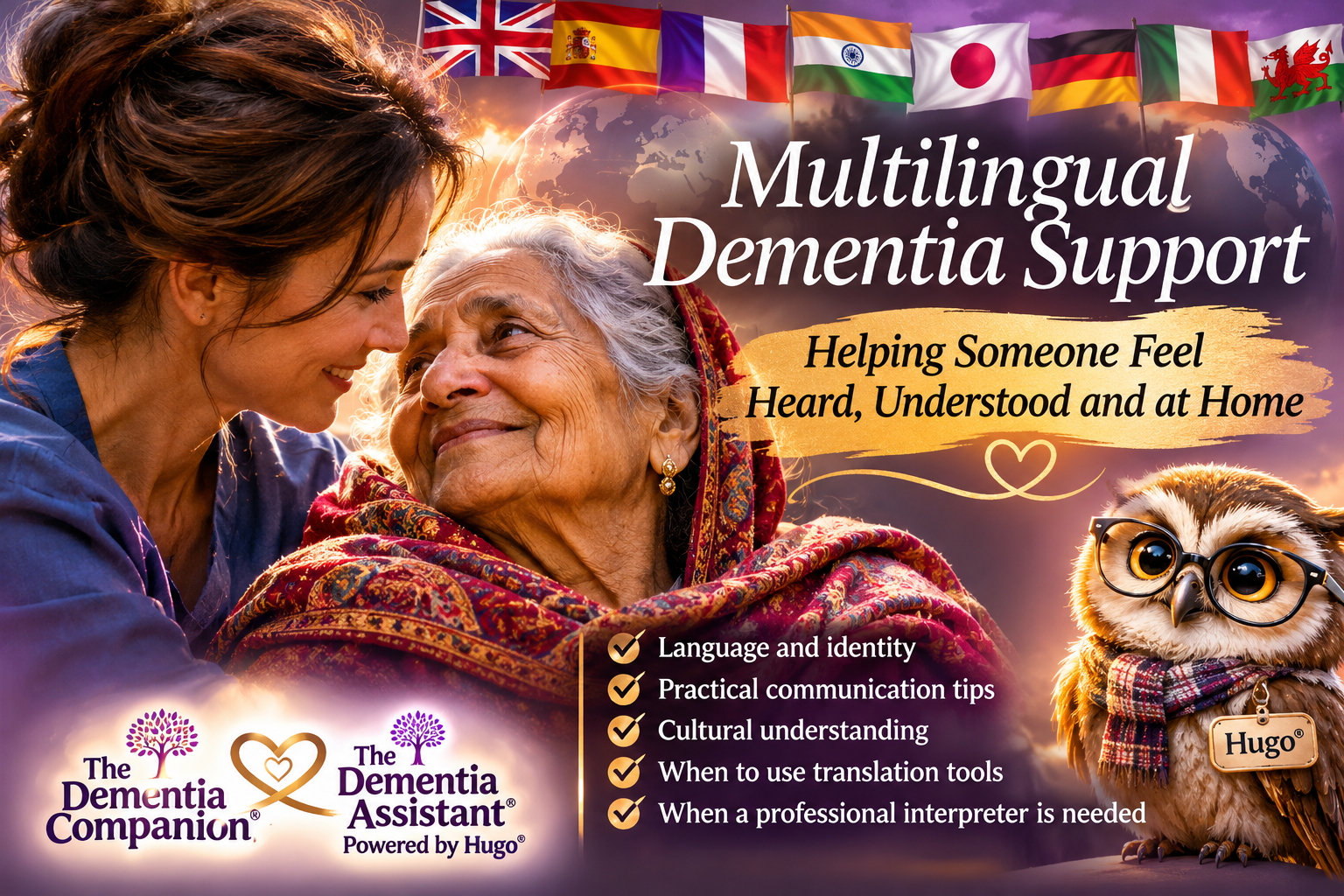
Multilingual Dementia Support: Helping Someone Feel Heard, Understood and at Home
When dementia changes the words, the language of belonging still matters.
By Louise Donaghy, Dementia Practitioner, Founder of The Dementia Companion and The Dementia Assistant®, and Creator of Hugo Intelligence™.
There are moments in dementia care that can break your heart without anybody saying very much at all.
A mother who has spoken English for 50 years suddenly begins speaking the language of her childhood.
A father becomes distressed because his care worker cannot understand what he is trying to say.
A grandmother speaks lovingly to her grandchildren in a language they have never learned.
And somewhere in the middle of it all is a family desperately trying to work out what their loved one needs.
Sometimes we talk about dementia communication as though the answer is simply to speak more slowly, use shorter sentences and maintain eye contact.
Those things can help.
But what happens when you are speaking the wrong language altogether?
Multilingual dementia support means recognising the languages, dialects, familiar expressions and cultural preferences that help an individual communicate and feel connected.
Language is more than a collection of words. It is part of someone’s identity, childhood, relationships, memories and sense of belonging.
When dementia affects communication, those connections deserve just as much attention as medication, meals and personal care.
Why Does Language Matter So Much in Dementia Care?
Imagine waking up somewhere unfamiliar.
People are moving around you. They are talking, smiling and asking questions. Everybody seems perfectly pleasant.
There is just one problem.
You cannot understand what they are saying.
Now imagine someone asking whether you are in pain, whether you want to get dressed or whether you agree to a medical procedure.
You might become frightened. You might withdraw. You might become frustrated.
You might even be described as uncooperative.
But perhaps you simply cannot understand.
For some people living with dementia, this is part of their everyday experience.
Dementia can affect the ability to understand language, find words, follow conversations and express thoughts. These changes vary depending on the individual and the condition involved.
A multilingual person may experience changes in how comfortably they speak, understand or switch between their languages.
That is why person-centred dementia care must include an understanding of someone’s language history.
Not simply what language they speak, but which languages carry meaning for them.
Can Dementia Cause Someone to Return to Their First Language?
Yes. Some bilingual or multilingual people living with dementia begin using an earlier-learned language more frequently, particularly when a language learned later becomes more difficult to use.
However, not everyone returns to their first language, and not everyone experiences language changes in the same way.
Some people continue comfortably using several languages.
Others mix languages within the same conversation.
Some struggle to find words in any language.
A person may understand a language without being able to speak it fluently, or speak familiar phrases without understanding everything being said to them.
Communication can also be affected by tiredness, stress, illness and unfamiliar surroundings.
It would be wrong to assume that someone’s earliest language is automatically their preferred language.
The better question is:
“Which language helps this person feel most comfortable and understood today?”
Where the person finds answering difficult, family members and others who know them well may be able to help.
When Childhood Words Become Familiar Again
Imagine a woman who was born in Italy, moved to England in her twenties and raised her family speaking English.
She has spent most of her adult life living and working in English.
But as dementia changes her communication, Italian becomes increasingly familiar.
Her daughter begins hearing phrases she remembers from childhood.
Perhaps her mother starts asking for her mamma.
Perhaps she sings a familiar Italian lullaby.
Perhaps she uses a regional expression that does not translate particularly well.
Does asking for her mother mean she believes her mother is physically present?
Possibly.
Could it be an expression of longing, reassurance or comfort?
Also possible.
We should be curious about what the words mean to that individual rather than assuming we know.
This is a fictional example illustrating possible changes in multilingual communication.
Language, Culture and Identity: Why Familiar Words Matter
We are all shaped by language.
Our favourite sayings. The expressions our parents used. The songs we learned at school. The way somebody pronounced our name when they were pleased with us.
And, of course, those phrases that make absolutely no sense when translated word for word!
Coming from Northern Ireland, I can assure you that familiar expressions can carry an entire conversation in just a few words.
When supporting someone living with dementia, we should consider:
- Their first and preferred languages.
- Regional dialects and familiar expressions.
- Preferred names and pronunciation.
- Cultural and family traditions.
- Personal beliefs and spiritual practices, where relevant.
- Familiar songs and childhood stories.
- Gestures and preferred forms of greeting.
- Languages spoken with different family members.
- How language preferences may change during the day.
Someone may speak English with friends but prefer Welsh when discussing childhood memories.
Another person may speak Punjabi with family, Hindi with friends and English with healthcare professionals.
These are individual preferences, not rules.
Culturally appropriate dementia care means asking about the person rather than making assumptions based on nationality, ethnicity or appearance.
Two people from the same country may have completely different communication needs.
Being able to speak someone’s language does not automatically mean understanding their culture, experiences or preferences.
The individual must remain at the centre of their own care.
How Can Families Support Someone with Dementia When They Speak Different Languages?
You do not need to become fluent in another language overnight.
Although, if you do manage it, I would dearly love to know your secret!
Sometimes a little preparation makes everyday communication easier.
- Learn the Words That Matter Most
Begin with familiar everyday phrases.
Ask the person, a trusted relative or somebody who knows their dialect to help identify useful words.
For example:
- Hello and good morning.
- Are you comfortable?
- Are you hungry?
- Would you like a drink?
- Are you in pain?
- Would you like to rest?
- Can I help you?
- Thank you.
- I am here with you.
Record the words in the person’s preferred language, including pronunciation where helpful.
Have translations checked by someone who understands the language and dialect.
A phrase that sounds reassuring in one family may sound unusual in another.
- Use Familiar Voices and Sounds
Sometimes it is not only what is said, but who says it.
A familiar voice, favourite song or recording from a family member might offer reassurance.
A telephone conversation with an old friend may bring comfort.
However, these approaches do not suit everybody.
Watch the person’s response.
If the recording causes distress or confusion, stop and try something else.
Connection should always be guided by the individual.
- Slow the Conversation, Not the Person’s Dignity
Allow time for the person to process information.
Speak naturally and calmly.
Use shorter sentences when helpful, without speaking to the person as though they are a child.
And please, do not assume that repeating the same sentence at twice the volume will suddenly translate it!
Unless somebody has a hearing difficulty that requires an adjustment, speaking louder rarely solves a language barrier.
- Use Visual Prompts and Familiar Objects
A cup can help explain an offer of tea.
Clothing choices may be easier to understand when the items are shown.
Photographs, familiar objects and simple written words may also help.
However, gestures can mean different things to different people.
Observe personal preferences and avoid assuming that pointing, touching or direct eye contact will always be welcome.
- Do Not Correct Every Word
If somebody mixes languages within a sentence, the conversation does not need to become a grammar lesson.
Try to understand the meaning.
You might say:
“Can you show me?”
“Is it something you need?”
“Would you like me to sit with you?”
But if the conversation concerns medication, pain, treatment, consent or immediate safety, do not rely on guessing. Seek appropriate professional communication support.
Create a Personalised Dementia Communication Sheet
One of the simplest and most useful things families can do is create a personal communication profile.
This can become part of the person’s care plan and help everyone supporting them understand their preferences.
My Language and Communication Profile
My preferred name:
What I like to be called and how to pronounce it.
My preferred language:
The language or languages I currently find most comfortable.
Other languages I know:
Include how well I understand, speak, read or write them.
My familiar words and expressions:
Meaningful phrases, with checked translations and pronunciation.
How I communicate my needs:
Words, facial expressions, gestures or behaviours that may help others recognise hunger, discomfort, tiredness, worry or pain.
What helps me understand:
Familiar voices, pictures, written words, hearing aids, glasses or additional processing time.
Words or approaches I dislike:
Anything that makes communication harder or distressing.
My cultural and personal preferences:
Important routines, family traditions and beliefs.
People who understand my communication:
Trusted relatives or others who know me well.
When professional interpreting support may be needed:
Important healthcare, legal or consent discussions.
Date reviewed:
Communication needs can change, so this information should be updated.
Create this profile with the person’s involvement wherever possible.
Store it securely and share it only with people appropriately involved in their care.
The purpose is not to label someone permanently. It is to help others understand them better.
When Someone Appears Distressed, Could Language Be Part of the Problem?
Absolutely. It is one possibility worth exploring.
Imagine a care worker approaching a gentleman living with dementia.
She tells him it is time for a shower.
He shakes his head.
She repeats herself.
He becomes upset.
She tries again, a little louder.
By the end of the interaction, he is distressed, and the care record might simply say:
“Refused personal care.”
But what did he actually refuse?
Did he understand the request?
Was he embarrassed?
Was he cold?
Was he experiencing pain?
Would he have preferred a different time or a different care worker?
Was the explanation delivered in a language he could no longer comfortably understand?
Or did he simply not want a shower?
All these possibilities deserve consideration.
Behaviour is communication, and understanding the possible reasons matters more than attaching a label.
A language barrier may contribute to fear, frustration or misunderstanding, but it is not the explanation for every distressed response.
Consider physical comfort, health, environmental factors and the person’s preferences.
Sometimes a different explanation helps.
Sometimes a familiar language helps.
And sometimes the correct response is to respect that the person is saying no.
Person-centred dementia care is not about finding a better way to obtain compliance.
It is about understanding the individual.
Multilingual Dementia Care Planning for Professionals and Organisations
For care homes, domiciliary care teams, hospitals, memory clinics, dementia practitioners and healthcare organisations, multilingual communication should be a routine part of assessment and care planning.
Not something staff think about only when difficulties arise.
Good multilingual dementia care planning should include:
- Recording preferred spoken and written languages.
- Identifying familiar phrases and regional dialects.
- Understanding how the person communicates discomfort.
- Providing appropriate translation and interpreting support.
- Recognising cultural preferences without stereotyping.
- Recording language-related changes sensitively.
- Supporting communication during appointments and transitions between services.
- Reviewing the person’s communication preferences as needs change.
Professionals should also learn about the person beyond the diagnosis.
Perhaps the individual used to teach French.
Perhaps they grew up speaking Welsh.
Perhaps their family communicates in Arabic, while they spent their working life speaking English.
These details can help staff create more meaningful relationships.
What Should a Multilingual Dementia Care Plan Look Like?
Consider this example:
“Maria usually communicates in English during everyday activities but responds more comfortably to familiar Italian phrases when tired. Staff should use a calm voice, allow processing time and offer simple visual prompts where helpful. Her daughter has provided preferred expressions, which have been checked for accuracy. Professional interpreting support should be arranged for significant clinical discussions where needed.”
This example is fictional.
That is more helpful than a care record stating simply:
“Italian speaker.”
The first description offers practical guidance while allowing staff to respond to the individual.
Why This Matters for Larger Care Organisations
Organisations supporting people from diverse linguistic backgrounds need consistency.
Communication preferences should not disappear when someone moves from hospital to a care home, changes care workers or attends a memory clinic.
Appropriate documentation can help teams preserve important information across transitions.
This supports continuity, dignity and more personalised care.
In England, NICE dementia guidance emphasises individualised communication and support. The Care Quality Commission also highlights culturally appropriate care and the importance of understanding people’s language needs.
International organisations should follow the relevant legal, professional, safeguarding and privacy requirements in each country where they operate.
Can AI Translation Tools Help with Dementia Communication?
Yes. Used carefully, technology can provide practical support.
Speech-to-text, automated translation and multilingual digital records may help families and professionals share everyday information.
A relative might describe a familiar routine in their preferred language.
A carer may record a non-urgent observation using a supported dictation tool.
A translated note may help another authorised care team member understand an everyday update.
But technology has limitations.
Automated translation may struggle with:
- Regional dialects and accents.
- Changes in pronunciation or speech.
- Mixed-language conversations.
- Humour, idioms and familiar expressions.
- Cultural references.
- Words with several possible meanings.
- Medical terminology.
- Context, emotion and tone.
A translation can sound completely convincing and still be wrong.
That matters especially when somebody living with dementia may find it difficult to recognise or correct the error.
AI translation should support human understanding, not replace professional judgement or the person’s own voice.
Clinical details, medication information, dates, dosages and important decisions should be checked using appropriate professional processes.
Sensitive personal information should only be entered into systems with suitable privacy and security arrangements.
When Is a Qualified Interpreter Needed?
There is a considerable difference between translating:
“Would you like another cup of tea?”
And explaining the potential risks of a medical procedure.
Qualified professional interpreters should be arranged when a significant language barrier affects important healthcare discussions, diagnoses, treatment decisions, safeguarding or informed consent.
Family members may provide valuable knowledge about familiar words, preferences and personal history.
However, they should not routinely be expected to replace professional interpreters in significant healthcare conversations.
Children should not be placed in the position of interpreting important medical information.
In England, NHS guidance supports access to appropriate professional language interpreting in healthcare.
A dementia diagnosis does not automatically mean that someone lacks the capacity to make decisions.
Decision-making capacity must be considered in relation to the particular decision, with appropriate communication support and the relevant legal requirements.
Different countries have different arrangements, so local guidance must be followed.
How Can We Check Understanding Respectfully?
One of the easiest mistakes is asking:
“Do you understand?”
The person may nod politely.
They may feel embarrassed.
They may say yes because it seems like the expected answer.
Instead, try making communication collaborative.
“I want to make sure I’ve explained that properly. Shall we go through it together?”
Or:
“Would it help if I showed you?”
Offer appropriate visual support, give time and observe the person’s response.
For important healthcare information, professionals can use appropriate interpreting support and a sensitive teach-back approach, where the person explains their understanding in their own words.
This must not become a memory test.
If communication is difficult, change the way information is presented.
The responsibility for making communication accessible should not fall entirely on someone living with dementia.
Hugo Intelligence™: Multilingual Dementia Support Through The Dementia Assistant®
This is one of the reasons I created The Dementia Assistant® and Hugo Intelligence™.
Through my work as a dementia practitioner, I have seen how much information families and professionals are trying to hold together.
The personal history.
The care routines.
The changing needs.
The appointments.
The little everyday observations that can become so important when someone new becomes involved in a person’s care.
Add different languages to that picture and communication can become more complicated.
The Dementia Assistant® was developed using Person-Centred Intelligence®, with the individual at the heart of the guidance and care planning.
Multilingual Guidance with Hugo Intelligence™
Hugo provides person-centred educational dementia guidance using supported languages.
Families and professionals can ask questions about communication changes, cultural preferences and ways to approach everyday challenges.
Speech-to-Text and Translation Support
Supported dictation and translation features can assist with recording care observations and other documentation.
The platform supports multilingual features, although availability varies by interface language, translation function and device.
Translations should be reviewed for accuracy before they are relied upon.
Person-Centred Care Planning
Families can record communication needs, preferred languages, personal history, familiar expressions and other important details within a care plan.
Professionals can use appropriate care information to better understand the person they support.
Daily Care Notes and Observations
Documenting everyday routines, changes in communication and relevant observations can help maintain continuity.
Records can be useful when sharing information with authorised carers and healthcare professionals.
Family Circle and Life Story
Families can preserve important memories, routines, expressions and relationships.
A familiar saying or childhood song may seem like a small detail, but it can carry enormous personal meaning.
Support for Professional Care Teams
Organisations can use structured care planning, documentation and supported multilingual tools as part of their person-centred workflows.
Hugo does not replace qualified interpreters, clinicians, professional assessments or human relationships.
The goal is not to make technology speak for somebody.
It is to help the people around them listen more carefully.
Frequently Asked Questions About Multilingual Dementia Support
Can dementia cause someone to speak their first language again?
Some multilingual people living with dementia increasingly use an earlier-learned language. However, changes vary and this does not happen to everyone.
How can I communicate with someone with dementia who speaks another language?
Find out their current language preferences, learn familiar everyday expressions, allow additional processing time, use suitable visual prompts and seek professional interpreting support when needed.
Does dementia affect bilingual people differently?
Dementia can affect speaking, understanding, word-finding and switching between languages. The pattern depends on the individual and the type and progression of dementia.
Can AI translation help someone with dementia?
AI translation may help with everyday communication and appropriate documentation, but errors are possible. It should not replace qualified professional interpreters during important clinical or consent discussions.
What should a multilingual dementia care plan include?
It should include language preferences, dialects, familiar expressions, communication cues, cultural preferences, practical adjustments and circumstances where professional interpreting support is needed.
Should family members interpret at dementia appointments?
Family members can provide useful personal context, but a suitably qualified professional interpreter should be used when a significant language barrier affects important healthcare discussions.
A Few Words Can Make a World of Difference
You may never speak your mother’s childhood language fluently.
You may never understand every expression your father uses.
And even the most experienced dementia practitioner will occasionally find themselves staring at a sentence and thinking:
“Well, I understood absolutely none of that!”
But connection is not measured by how many words we get right.
Sometimes it is a familiar greeting.
Sometimes it is hearing your name pronounced properly.
Sometimes it is the music that reminds you of home.
And sometimes it is simply sitting beside somebody long enough for them to feel that they have not been forgotten.
When dementia changes communication, the person is still there, with their history, identity, preferences and right to be heard.
We may not always understand every word. But we can always make an effort to understand the person.
More Dementia Support and Resources
Communication is only one part of supporting someone living with dementia.
Whether you’re a family member, friend or care professional, having access to reliable, person-centred guidance can make everyday challenges a little easier.
Explore more dementia support for families and carers through The Dementia Companion, including advice on communication, changing needs and maintaining meaningful connections.
Discover what’s inside The Dementia Assistant®, where Hugo Intelligence™ brings together person-centred guidance, care planning, daily observations, personal histories and multilingual support.
If you’re struggling to understand changes in someone’s communication, visit our Ask Hugo dementia support library for practical information.
Or meet Hugo and explore The Dementia Assistant®, with a 30-day complimentary trial included with every subscription.
Research and Professional References
The following professional resources provide further guidance on dementia communication, person-centred care, culturally appropriate support and interpreting.
- Alzheimer’s Society: Dementia and language
- Alzheimer’s Society: How to communicate with a person with dementia
- NICE NG97: Dementia assessment, management and support
- NICE NG108: Decision-making and mental capacity
- NHS England: Intercultural dementia care guide
- UK Government: Language interpreting and translation
- Care Quality Commission: Examples of culturally appropriate care
- NHS: Communicating with someone with dementia
- American Speech-Language-Hearing Association: Dementia
FAQ questions for Google and AI search
These questions strengthen coverage of the specific problems families search for. Use the answers within the article, or display them in an FAQ section if the publishing system supports it.
Can dementia cause someone to speak their first language again?
Yes. Some multilingual people increasingly use an earlier-learned language as dementia affects communication. However, changes vary and not everyone experiences this.
How can I communicate with someone with dementia who speaks another language?
Find out their preferred language, learn familiar everyday phrases, use appropriate gestures or visual prompts, allow processing time and seek interpreting support when needed.
Does dementia affect bilingual people differently?
Dementia can affect understanding, speaking, word-finding and switching between languages. The pattern depends on the individual and their condition.
Can AI translate conversations for someone with dementia?
Translation technology may assist with everyday communication and documentation, but it can make mistakes. It should not replace qualified interpreters for important clinical or consent discussions.
What should a multilingual dementia care plan include?
It should record preferred languages, familiar phrases, dialects, communication cues, cultural preferences, helpful adjustments and when professional interpreting is required.
Should family members interpret at dementia appointments?
Families can provide helpful personal background, but suitably qualified professional interpreters should be offered for significant healthcare discussions when a language barrier exists.
Ask Hugo: Support That Starts with the Person
If somebody you care for is becoming more comfortable speaking another language, mixing languages or finding communication increasingly difficult, you do not have to work everything out alone.
Ask Hugo about everyday communication challenges, explore possible language barriers and discover ways to build a more personalised understanding of the individual.
Because the person should never have to fit the system.
The system should help us understand the person.
With warmth,
Ask Hugo about everyday communication challenges, explore possible language barriers and discover ways to build a more personalised understanding of the individual\.
Because the person should never have to fit the system\.
The system should help us understand the person\.
With warmth,
Louise and Hugo ❤️🦉
Louise Donaghy
Founder & CEO of The Dementia Assistant®
Created and powered by Person\-Centred Intelligence®
Creator of Hugo Intelligence™
The Dementia Companion, home of The Dementia Assistant® and Hugo 🦉
https://thedementiacompanion\.com/
Hugo provides educational, person\-centred guidance\. It does not diagnose medical conditions or replace qualified interpreters, healthcare professionals or emergency services\.
https://thedementiacompanion.com/
Hugo provides educational, person-centred guidance. It does not diagnose medical conditions or replace qualified interpreters, healthcare professionals or emergency services.
You May Also Find Helpful
Need help with your own situation? Ask Hugo.
One Person. One Continuing Care Story. The Dementia Companion is where you discover guidance. Inside The Dementia Assistant®, talk with Hugo, save and categorise conversations, record daily notes and involve authorised supporters in a continuing care plan centred around the person.
Ask Hugo About This · Start Your Continuing Care Plan — Families · Continuing Care Planning — Professionals
Personal guidance requires the appropriate account and subscription access. Care-plan information is used only with authorised access and the required consent and selection steps. All subscription plans include a 30-day complimentary trial.