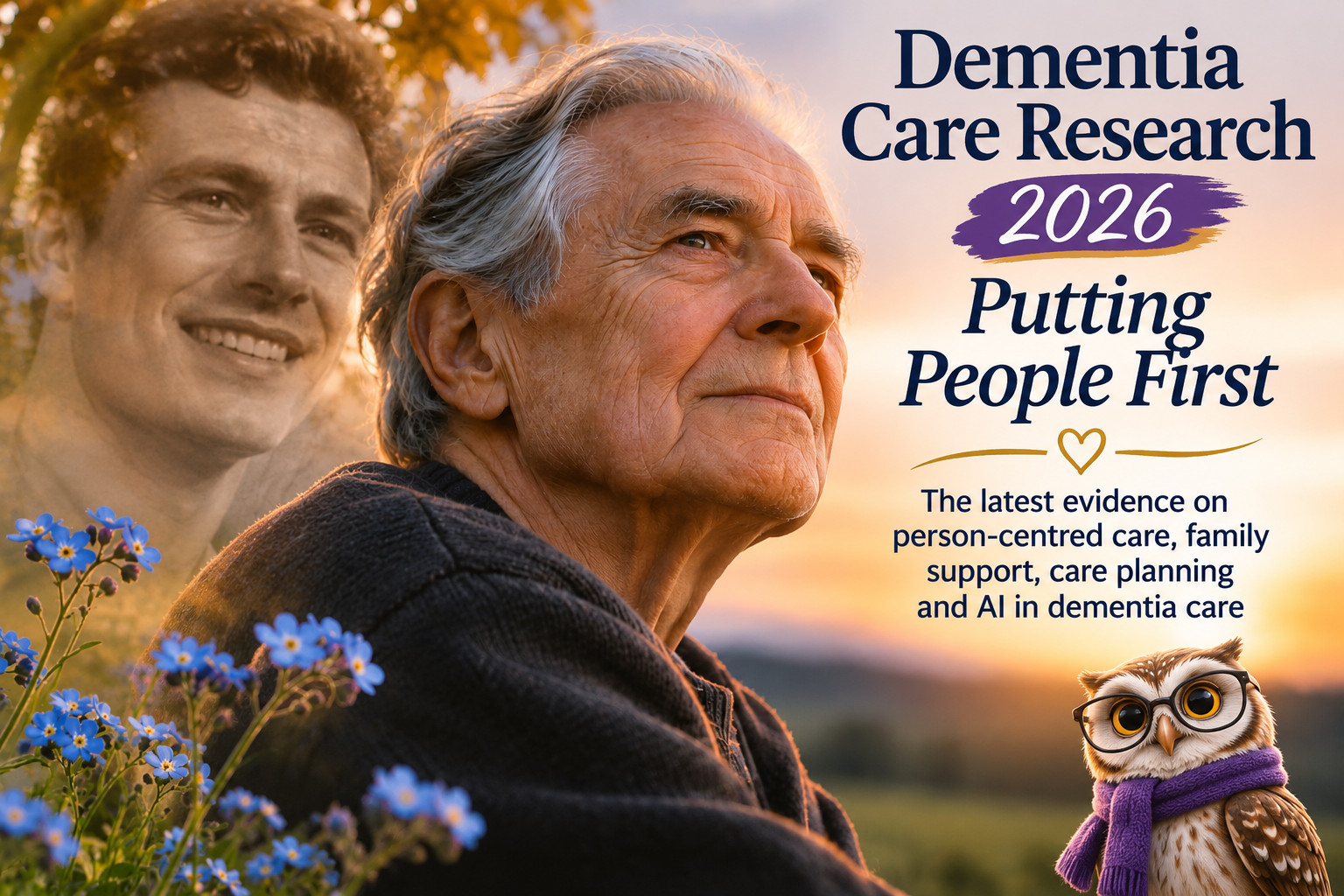
Dementia Care Research 2026: Putting People First
Dementia Care Is About People, Not Just Research: Why We Follow the Science, Listen to Families and Keep Hugo Human
The latest dementia care research, person-centred support, family caregiving and the role of AI in making everyday life a little easier.
By Louise Donaghy, Founder & CEO of The Dementia Assistant®, created and powered by Person-Centred Intelligence®, and Creator of Hugo Intelligence™.
There is an awful lot being said about dementia these days.
New research. New technology. New treatments. Artificial intelligence. Care planning. Early diagnosis. Digital support.
And somewhere in the middle of all these exciting developments is a family standing in the kitchen, wondering why Mum is convinced she needs to go home when she’s been living in the same house for 40 years.
Or a husband who has answered the same question 17 times before breakfast and is beginning to wonder whether it’s acceptable to hide in the garden shed with a cup of tea.
For the record, I understand the temptation. Although I’d recommend taking the tea with you rather than disappearing altogether!
This is the reality of dementia care.
It isn’t lived in research papers, laboratories or conference halls. It’s lived in kitchens, bedrooms, GP surgeries, care homes and the quiet moments when somebody is desperately trying to work out what to do next.
And that is precisely why we follow dementia research so closely at The Dementia Companion and The Dementia Assistant®.
Because scientific evidence matters. But so do the people who have to live with the consequences of getting things right, or getting things wrong.
Why Dementia Research Matters to Me Personally
I’m a dementia practitioner, and I work alongside people living with dementia and their families.
I also understand dementia through my own family’s experiences.
One thing I’ve learned is that no two people experience dementia in exactly the same way.
You can have two people with the same diagnosis, at a similar stage, and their needs, personalities, abilities and experiences can be entirely different.
One person enjoys music and conversation. Another finds too much noise overwhelming.
One enjoys a good laugh and a bit of cheek. Another might appreciate a quieter approach.
One wants help with personal care. Another would very much like you to take your helpful suggestions and disappear until further notice!
And sometimes, tomorrow will be different again.
That’s why I’ve never believed dementia support should simply be a collection of generic instructions.
Person-centred dementia care means understanding the individual, not just managing the diagnosis.
It means recognising their personality, relationships, culture, language, life history, preferences and the things that make them feel safe.
And yes, it means remembering that a person living with dementia still has opinions, preferences and the right to say no.
A diagnosis doesn’t suddenly cancel someone’s personality.
What Does the Latest Dementia Research Actually Tell Us?
Research published during 2025 and 2026 has offered some encouraging findings about personalised dementia communication, support for family carers, care planning and digital dementia-care interventions.
Not every result has been groundbreaking. Some findings have been modest, and others remain preliminary.
That’s important.
I love innovation, but I don’t believe in waving the magic wand of technology over dementia and announcing that everything has been solved.
If it were that simple, we would all have bought the wand years ago.
What matters is understanding which findings have good evidence behind them, what they mean in everyday life and where further research is still needed.
- Person-Centred Communication Is Not an Optional Extra
A 2025 systematic review published in Age and Ageing examined 33 studies exploring personalised communication in dementia care.
The researchers highlighted the importance of understanding the individual, adapting verbal and non-verbal communication, using appropriate communication aids and supporting care professionals with training.
This review reinforces the principles of personalised care, although the quality and design of the included studies varied.
And what does that mean when you’re standing in someone’s living room?
It means the way we communicate matters just as much as the words themselves.
Imagine somebody living with dementia asking:
“Where’s my mother?”
We might know that their mother died many years ago.
But before answering, perhaps we should consider what the question means to the person.
Are they frightened? Lonely? Looking for reassurance? Remembering a time when their mother represented safety?
We cannot assume.
But we can respond with curiosity, kindness and respect.
“You sound as though you’re thinking about your mum. Tell me about her.”
That may open a comforting conversation.
For another person, a different response might be more appropriate. Some people prefer straightforward, gentle honesty.
The important thing is that we respond to the person in front of us, rather than blindly following a dementia communication script.
This is one of the principles guiding Hugo Intelligence™.
When somebody uses Hugo with a selected personal care plan, the aim is for guidance to reflect that individual’s recorded needs and preferences, rather than treating every person living with Alzheimer’s disease or another form of dementia as interchangeable.
- Behaviour in Dementia Is Often Communication, Not Simply a Problem
This is one of the subjects I feel particularly strongly about.
We often hear words such as challenging behaviour, aggression, resistance, agitation and refusal.
But I believe we must be careful not to allow those labels to become the whole story.
Imagine being frightened, uncomfortable, confused or unable to explain yourself clearly.
Now imagine somebody approaching you and insisting that you do something you don’t understand.
You might become upset too.
In dementia care, distress can have many possible explanations, including pain, infection, constipation, medication effects, tiredness, unfamiliar surroundings, sensory difficulties, anxiety or unmet needs.
Sometimes the person is simply expressing a preference.
NICE dementia guideline NG97 recommends a structured assessment of possible clinical and environmental causes before treating distress, including checking for problems such as pain, delirium or inappropriate care.
It also recommends psychosocial and environmental approaches as part of initial and ongoing support.
This is established clinical guidance, not merely an emerging research idea.
So when somebody refuses personal care, becomes unsettled in the evening or repeatedly asks to go home, our first question shouldn’t automatically be:
“How do we stop this behaviour?”
Perhaps a better starting point is:
“What might this person be experiencing, and how can we help?”
That doesn’t mean we can always find an answer.
It certainly doesn’t mean every difficult moment has a simple solution.
But it changes the way we approach the person.
And quite often, that change in attitude is where better care begins.
A sudden change in confusion or behaviour needs particular attention. It should not automatically be dismissed as dementia progression, because acute illness or delirium may require prompt medical assessment.
Can Technology Really Help Family Dementia Carers?
This is where research becomes particularly interesting for those of us developing digital dementia support.
A systematic review and meta-analysis published in the Journal of Medical Internet Research in June 2026 examined 35 randomised controlled trials involving 3,388 informal dementia caregivers.
Researchers found that digital health interventions were associated with small but statistically significant average reductions in caregiver burden and depressive symptoms.
That’s encouraging.
But notice the word small.
The research does not mean that downloading an app will suddenly make caring easy, eliminate exhaustion or replace the support families need from health and social care professionals.
And it certainly doesn’t prove that every dementia app works equally well.
Different interventions were studied, and results varied.
What the research suggests is that well-designed digital support can have a useful role as part of a wider network of support.
I think that’s an important distinction.
A family carer might need information in the middle of the night.
They may need help preparing questions before a memory clinic appointment.
They might want to understand why Dad is becoming unsettled in the evening, how to respond when Mum asks the same question repeatedly, or how to explain dementia to the grandchildren.
They may also need someone to tell them that being exhausted, frustrated or unsure doesn’t make them a terrible person.
It makes them human.
Dementia support should help the carer without losing sight of the person being cared for.
And sometimes the most appropriate advice is not another website, another printable checklist or another clever technological feature.
Sometimes it’s recognising that the family needs actual human help.
Dementia Care Planning: Why Families Shouldn’t Have to Start From Scratch at Every Appointment
One thing I see in dementia care is how much information families are expected to remember and organise.
There are GP appointments, memory clinic assessments, medication changes, care visits, observations about mood and behaviour, hospital letters and conversations with different professionals.
And then comes the familiar question:
“Can you tell me what’s been happening?”
Of course they can.
Provided they’ve brought their diary, the medication list, three appointment letters, several pieces of paper and the scraps of information currently being held together by their exhausted brain!
This is why I believe person-centred dementia care planning needs to be practical, ongoing and accessible to the people involved.
NHS England’s 2026/27 dementia care review guidance reinforces the importance of personalised reviews covering health, medication, social circumstances, carer needs, coordination and future wishes.
That matters because dementia care isn’t something we plan once and put in a filing cabinet.
Needs change.
Preferences change.
What worked last month might not work next week.
And the person living with dementia should remain involved in decisions about their life and care as far as possible.
What Should a Good Person-Centred Dementia Care Plan Include?
A useful dementia care plan should build a picture of the whole person, including:
- Their life story, important relationships, culture and preferred language.
- What matters to them and what helps them feel comfortable.
- Their abilities, strengths, routines and preferences.
- Communication needs, including hearing and visual support.
- Relevant medical information, medicines and professional contacts.
- Mobility, nutrition, sleep and everyday support needs.
- Patterns of distress, possible causes and approaches that have helped.
- The views and support needs of family members or carers.
- Personal wishes, choices and future care preferences where appropriate.
- Changes observed over time, with clear dates and relevant context.
A family-held plan can help prepare for appointments and share important information with consent.
It does not replace a clinician’s assessment or official healthcare records.
But it can help families arrive at an appointment feeling better prepared and less dependent on remembering every detail under pressure.
That is part of the thinking behind the Care Planning Centre™ within The Dementia Assistant®.
Rather than treating care planning as a one-off document, the platform is designed to help families and professionals build and maintain an evolving picture of the person.
Because the information about someone’s life shouldn’t disappear every time they move between services or meet another professional.
Artificial Intelligence and Dementia Care: Exciting, Yes. But Let’s Not Get Carried Away.
Now we come to artificial intelligence.
AI can help us organise information, explain complex subjects and make guidance easier to access.
But the word intelligence in artificial intelligence doesn’t mean we should stop using our own.
A 2026 systematic review examining large language models in Alzheimer’s disease and mild cognitive impairment looked at 11 studies.
The findings raised concerns about clinical reliability, accessibility, insufficient testing for inaccurate or invented information and the lack of prospective clinical validation.
That matters enormously.
Particularly when someone is frightened, vulnerable or looking for answers about a serious health condition.
AI can sound wonderfully confident.
Unfortunately, confidence and correctness aren’t always on speaking terms.
And that’s why AI dementia support must have clear boundaries.
Hugo Intelligence™ is designed to offer person-centred information, practical guidance and support. It is not there to diagnose dementia, independently prescribe treatment or replace qualified healthcare professionals.
We follow developments in dementia research, established clinical guidance, safeguarding, communication and digital technology to inform how we review and develop Hugo.
But following the research is not the same as claiming a product has been clinically proven.
That distinction is important to me.
If evidence is emerging, we should say so.
If a study has limitations, we should acknowledge them.
And if someone needs medical attention, Hugo should direct them towards appropriate professional support, rather than pretending to be the doctor.
Even the cleverest owl needs to know when to stop hooting and call in the humans!
Why We Created The Dementia Companion and The Dementia Assistant®
I wanted to create something that didn’t begin and end with a diagnosis.
Because the journey often begins much earlier.
It may start when someone notices changes in memory, communication or everyday routines.
Then there are questions about assessment, waiting for appointments, understanding a diagnosis, navigating care services and supporting someone as their needs change.
Families need information, but they also need somewhere to return when the next question comes along.
That’s why the two parts of our work have different, complementary roles.
The Dementia Companion: Understanding, Education and Connection
The Dementia Companion is our public home for accessible dementia education, practical articles, family guidance and conversations about what living with dementia really means.
It’s where we explore subjects that families encounter every day, including:
- How to talk to someone with dementia.
- What to say when a person with dementia wants to go home.
- Dementia sundowning and evening distress.
- Responding to repeated questions.
- Dementia refusing personal care.
- Accusations, confusion and changes in recognition.
- Helping children understand dementia.
- Family caregiver wellbeing and emotional support.
We want these subjects discussed with empathy, honesty and a little humanity, rather than making families feel they’ve failed because a textbook suggestion didn’t work on a Tuesday afternoon.
The Dementia Assistant®: Personalised Support With Hugo Intelligence™
The Dementia Assistant® provides an interactive platform where families and professionals can use Hugo Intelligence™ alongside tools for organising and recording care information.
Its features include personalised care planning, daily notes, life story information, family updates, educational resources, multilingual support and practical guidance.
With the appropriate care plan selected, Hugo can use the information made available within that context to help tailor its responses.
The aim is to help users connect general dementia knowledge with the circumstances of an individual person.
Not every family needs every feature.
Not every question requires a complicated answer.
And not every difficult situation can be solved by technology.
But having a place to ask, learn, organise and prepare can be useful.
All subscriptions include a 30-day complimentary trial, allowing families and professionals to explore whether the service suits their needs.
How We Use Dementia Research to Keep Learning
We don’t want The Dementia Companion to become a place where an article is written, published and then forgotten.
And we don’t want Hugo to become a clever collection of answers that never evolves.
Each Friday, we review credible developments across four key areas:
Person-centred dementia care and communication. We look at approaches that help preserve dignity, independence, relationships and the person’s individual identity.
Family caregiver wellbeing and practical support. We examine evidence about education, stress, carer burden, emotional support and strategies families can use in everyday life.
Dementia care planning and clinical guidance. We follow developments relevant to care coordination, assessment, safety, communication and changing needs.
Dementia technology, AI and assistive tools. We consider whether new research might help make support more accessible, accurate, useful or inclusive.
We distinguish established guidance from preliminary findings and look carefully at how strong the evidence is.
We then consider what is relevant to Hugo Intelligence™ and The Dementia Assistant®.
That might mean reviewing how advice is explained, identifying a safety issue worth testing, checking how care planning information is organised or finding an opportunity to improve family education.
It does not mean every newly published study leads to an immediate platform change.
Research has to be understood, evaluated and applied responsibly.
The goal is not to be the loudest voice in dementia technology. It’s to be a useful, responsible and compassionate one.
And What About the Person Living With Dementia?
This is the question I want us to keep asking, no matter how advanced the technology becomes.
How does this benefit the person?
Does it protect their dignity?
Does it respect their choices?
Does it help someone understand them a little better?
Does it support their relationships and individuality?
Can it help a family or practitioner make a more informed decision?
And does it recognise when someone needs real, human support?
Because dementia is not just a medical diagnosis.
It affects relationships, identity, confidence, independence and daily life.
But it doesn’t erase the human being.
There is still humour.
There is still love.
There can still be connection, laughter, affection, frustration, stubbornness and those wonderful moments when someone’s personality shines through.
I never want us to become so fascinated by what dementia takes away that we overlook what remains.
My Final Thoughts: Keep the Research, Keep the Humanity
I believe we are entering an interesting and potentially valuable period for dementia support.
Research is developing.
Technology is advancing.
There are new opportunities to make information accessible and help families feel better prepared.
But none of that should make us forget the simplest principle of person-centred care.
See the person first.
Not the diagnosis.
Not the behaviour.
Not the care plan.
And definitely not the technology.
The person.
If we can bring together good evidence, professional knowledge, lived experience, practical support and genuine compassion, we give ourselves a better chance of making dementia care more understandable and more human.
That’s the standard I want us to keep working towards with Hugo Intelligence™, The Dementia Assistant® and The Dementia Companion.
And if we can manage all that while still allowing families the occasional laugh, a proper cup of tea and permission not to be perfect, I think we’re heading in the right direction.
After all, dementia care is serious.
But the people living with it are still people.
And life, even in its most difficult moments, deserves a little warmth.
With love,
Louise and Hugo ❤️🦉
The Dementia Companion, home of The Dementia Assistant® and Hugo Intelligence™
https://thedementiacompanion.com/
Explore The Dementia Assistant® and its 30-day complimentary trial:
https://thedementiaassistant.com/
⸻
Research and Further Reading
This article draws on published research and established guidance available up to 18 November 2026. Research findings are presented according to their limitations and should not be interpreted as proof that any particular dementia technology or intervention is effective for every individual.
1. Communication strategies for delivering personalised dementia care and support (2025). Age and Ageing. Systematic review of 33 studies.
https://pmc.ncbi.nlm.nih.gov/articles/PMC12078768/
2. Effectiveness of eHealth Interventions in Alleviating Burden on Informal Caregivers of People With Dementia (2026). Journal of Medical Internet Research. Systematic review and meta-analysis of 35 randomised trials.
https://www.jmir.org/2026/1/e78568
3. Generative Large Language Models in the Clinical Management of Alzheimer’s Disease and Mild Cognitive Impairment (2026). Neurological Sciences. Systematic review of 11 studies.
https://pubmed.ncbi.nlm.nih.gov/42440193/
4. NICE Guideline NG97: Dementia: Assessment, Management and Support for People Living With Dementia and Their Carers. Established clinical guidance for England.
https://www.nice.org.uk/guidance/ng97
5. NICE Quality Standard QS184: Managing Distress. Guidance on exploring potential causes of distress in dementia.
https://www.nice.org.uk/guidance/qs184/chapter/quality-statement-6-managing-distress
6. NHS England: Quality and Outcomes Framework Guidance for 2026/27. Includes dementia care-plan review requirements in English general practice.
https://www.england.nhs.uk/publication/quality-and-outcomes-framework-guidance-for-2026-27/
This article provides general educational information, not diagnosis or individual medical advice. Guidance and statutory arrangements may differ between countries. Seek appropriate medical assessment for sudden changes in confusion, health or behaviour.
You May Also Find Helpful
Need help with your own situation? Ask Hugo.
One Person. One Continuing Care Story. The Dementia Companion is where you discover guidance. Inside The Dementia Assistant®, talk with Hugo, save and categorise conversations, record daily notes and involve authorised supporters in a continuing care plan centred around the person.
Ask Hugo About This · Start Your Continuing Care Plan — Families · Continuing Care Planning — Professionals
Personal guidance requires the appropriate account and subscription access. Care-plan information is used only with authorised access and the required consent and selection steps. All subscription plans include a 30-day complimentary trial.