Dementia Behaviour as Communication: What Is It Telling Us?
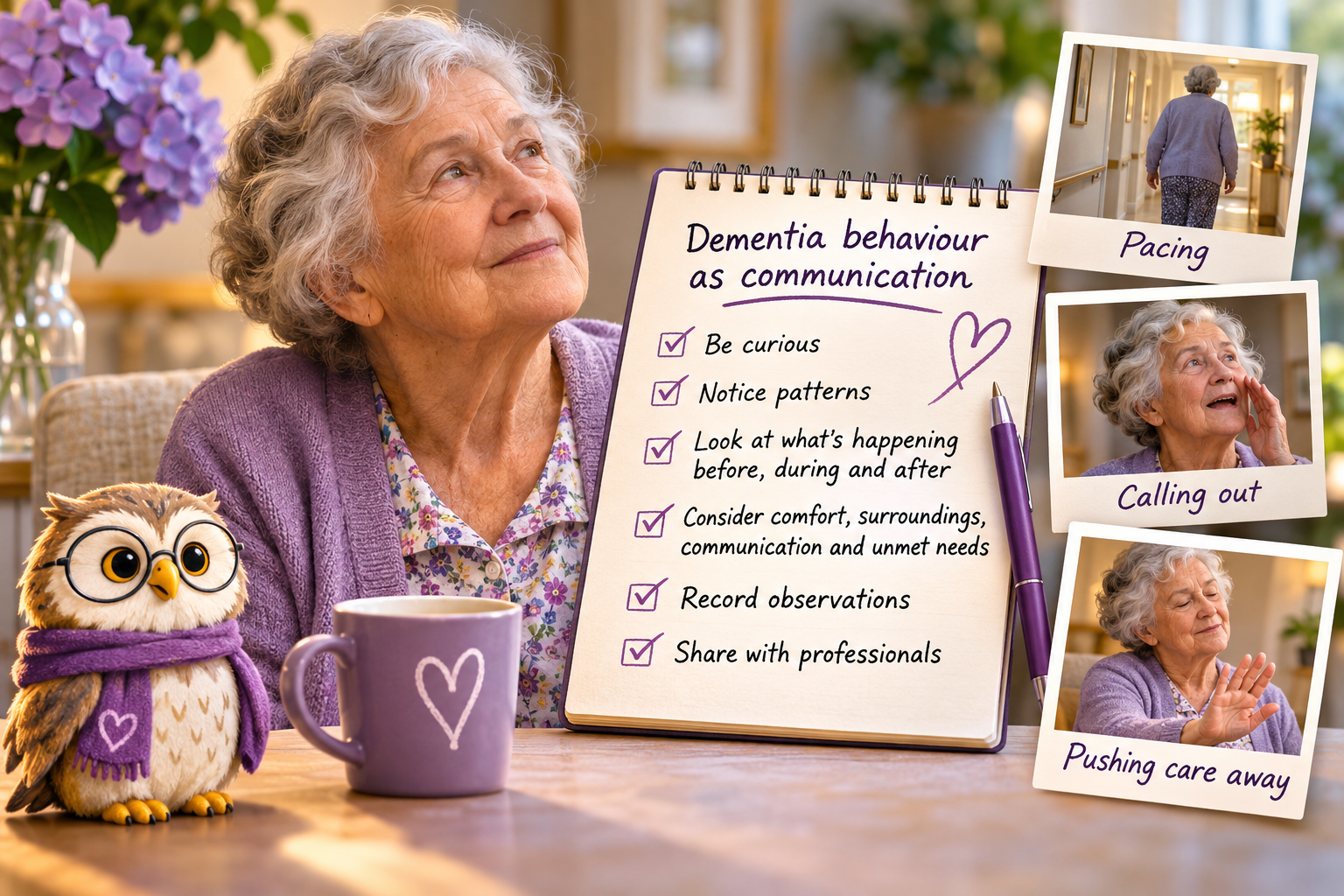
Dementia Behaviour as Communication: What Might This Moment Be Telling Us?
By Louise Donaghy, Founder of The Dementia Assistant® and The Dementia Companion, Creator of Hugo Intelligence™.
Sometimes, the most important thing we can do is stop asking how to change someone’s behaviour and start wondering what they might be experiencing.
Imagine someone you love is walking up and down the hallway for the tenth time that morning.
You’ve offered them a cup of tea. You’ve suggested sitting down. You’ve checked whether they need the toilet. You’ve even put on their favourite television programme.
And still, they’re walking.
Meanwhile, you’ve walked behind them so many times that your step counter thinks you’ve joined a fitness club.
Or perhaps Mum keeps calling your name, even though you’re sitting three feet away.
Maybe Dad pushes your hand away when you’re helping him get dressed, despite accepting exactly the same help yesterday.
It’s exhausting. It can be worrying, upsetting and sometimes frightening.
And when you’re already doing everything you can, it’s perfectly understandable to think, “How do I get this to stop?”
But what if we approached that moment from a slightly different direction?
What if we asked, “What might this behaviour be telling us?”
Not because every behaviour has a hidden meaning. Not because we can magically understand exactly what someone is feeling.
But because dementia can affect how a person communicates, processes information, understands their surroundings and expresses discomfort.
Sometimes, actions tell us something words cannot.
And sometimes, we need to become a little more curious before deciding what those actions mean.
What does dementia behaviour as communication actually mean?
When we talk about dementia behaviour as communication, we’re recognising that a person’s actions, facial expressions, movements, tone of voice and responses may offer clues about their experience.
Someone who cannot easily explain that their back hurts might become restless when sitting.
Someone who struggles to find the words to ask for reassurance might repeatedly call a familiar name.
Someone who feels uncomfortable being helped to wash might turn away, hold onto their clothing or push a hand away.
But here’s something important.
These are possibilities, not translations.
Pacing does not automatically mean anxiety.
Calling out does not always mean loneliness.
Refusing assistance does not necessarily mean fear.
And not every action is a sign of distress.
A person might walk because they’ve always enjoyed walking. They might hum because music brings them pleasure. They might prefer a quiet afternoon alone because that is who they’ve always been.
Dementia doesn’t erase personality, preferences, habits or the right to make choices.
The aim isn’t to analyse every movement as though we’re solving a murder mystery.
Although, let’s be fair, there are moments in dementia care when we’d quite appreciate a detective, a magnifying glass and a very large cup of coffee.
The aim is to remain curious, compassionate and open to more than one explanation.
Alzheimer’s Society recognises that behaviour and body language can be important ways of communicating when spoken language becomes more difficult. Physical health, emotional wellbeing and surroundings can all influence what we see.
Before we respond, can we look at the person rather than the behaviour?
There is a significant difference between saying:
“She’s being difficult about getting dressed.”
And saying:
“She seems uncomfortable when I try to help her put her jumper on.”
The first statement labels the person.
The second describes what is happening and gives us something useful to explore.
Perhaps the jumper is uncomfortable. Perhaps her shoulder is painful. Perhaps she doesn’t understand why someone is touching her.
Or perhaps she simply doesn’t want that jumper.
And yes, she’s absolutely entitled to have an opinion about her wardrobe.
We don’t stop having preferences simply because we develop dementia.
A useful approach is to consider four areas.
- Physical comfort
Could something be uncomfortable or painful?
Consider pain, constipation, hunger, thirst, needing the toilet, tiredness, illness, medication effects or difficulties with mobility.
Look at what the person’s body may be showing you.
Are they holding an arm differently? Wincing when moving? Shifting constantly in their chair? Avoiding pressure on one side?
Pain is particularly important because someone living with dementia may find it difficult to describe where it hurts, how severe it is or whether it has changed.
- Their surroundings
What is happening around them?
A television may be too loud. Several people might be talking at once. The room might be too warm, the lighting unfamiliar or the activity happening too quickly.
Something that feels perfectly ordinary to us may be confusing or overwhelming to someone else.
- Communication
How are we approaching the person?
Are we speaking too quickly? Giving several instructions together? Touching them before explaining what we’re doing?
Have we allowed enough time for a response?
And are we communicating in the language, tone and manner that feels most familiar to them?
Sometimes changing our approach helps more than repeating the same request.
- Their personal needs, choices and history
What matters to this particular person?
Someone who spent their working life walking between rooms may feel comfortable being on the move.
A person who has always valued privacy may dislike assistance with washing.
Someone accustomed to a particular evening routine may feel unsettled when that routine changes.
Their life story matters.
Not because it gives us a definite explanation, but because it helps us ask better questions.
The UK’s NICE dementia guidance recommends assessing possible clinical and environmental reasons for distress, including pain, delirium and inappropriate care, before beginning treatments intended to reduce distress.
Why might someone with dementia pace or keep walking?
Pacing is one of those behaviours that can become particularly tiring for families.
Someone may repeatedly walk between two rooms, follow a family member around the house or appear unable to settle.
It can be tempting to encourage them to sit down.
But sitting down may not be what they need.
They could be looking for someone, following an old routine, experiencing discomfort, feeling uncertain about where they are or simply enjoying movement.
Rather than immediately trying to stop the walking, we might gently explore what is happening.
“Would you like me to walk with you?”
“Are you looking for something?”
“Shall we go into the garden for a little while?”
Sometimes walking together creates an opportunity for connection.
Other times, it gives us a chance to notice something we missed.
Perhaps they’re repeatedly heading towards the bathroom.
Perhaps their shoes are uncomfortable.
Perhaps they’re looking out of the window because they believe it’s time to collect the children from school.
We don’t have to confirm an assumption to acknowledge the person’s experience.
We can ask, listen and respond respectfully.
Safety still matters. If someone is at risk of falling, leaving an unsafe area, becoming exhausted or walking into danger, we need to take appropriate precautions while supporting their freedom and dignity.
The objective shouldn’t automatically be to stop movement.
It should be to understand whether the movement is comfortable, purposeful, distressing or unsafe, and what support might help.
What might repeated calling out be telling us?
“Mum?”
“Yes, darling?”
“Mum?”
“Yes, I’m here.”
“MUM?”
At this point, you may be wondering whether your name has become the only word in the English language.
Repeated calling can test anyone’s patience, particularly when you’re exhausted and trying to manage a dozen other responsibilities.
But before assuming the person is seeking attention, we can consider what they may actually need.
Perhaps they haven’t understood that you’re nearby.
Perhaps they feel uncertain when they cannot see you.
Perhaps they’re experiencing discomfort, or they’ve forgotten the reassurance you offered moments earlier.
Perhaps they want company.
Or perhaps they are trying to communicate something specific but cannot find the words.
Try responding to the person rather than focusing entirely on the repetition.
“I’m here. Would you like me to sit with you for a moment?”
“You sound worried. Is there something you need?”
“Shall we have a cup of tea together?”
A familiar voice, comfortable presence or meaningful activity may help, although no approach works for everyone.
It’s also worth observing when the calling happens.
Does it begin when the room becomes noisy?
Does it happen when someone leaves?
Is it more frequent when the person is tired?
Does it occur alongside signs of pain or physical discomfort?
The pattern may offer more useful information than the repeated words themselves.
And if reassurance isn’t helping, repeating it more loudly is unlikely to provide the missing answer.
Sometimes we need a different approach. Sometimes we need professional advice.
When someone pushes care away, could they be communicating a boundary?
This is particularly important.
Imagine someone reaches towards you, begins removing your clothes and tells you it’s time for a wash.
You haven’t quite understood who they are, why they’re helping or what they intend to do next.
You might pull away too.
And if they continued?
Well, you might become quite determined to make your feelings known.
For a person living with dementia, personal care can involve unfamiliar sensations, confusion, discomfort, loss of privacy or difficulty processing what is happening.
But pushing care away doesn’t automatically mean the person is frightened.
They might be in pain.
The water may be uncomfortable.
They may prefer a different carer.
They may want to do something independently.
Or they may simply be saying, “Not now.”
That response deserves to be taken seriously.
Where it is safe to do so, stop, give the person space and try to understand what happened.
You might say:
“I’m sorry, I think I was going too quickly.”
“Would you like to do this yourself?”
“Would you prefer to try a little later?”
Explain what you’re proposing, offer meaningful choices, protect privacy and support the person to do whatever they can independently.
For intimate care, consent, capacity and best-interest requirements must be considered under the applicable law and professional guidance. Urgent or essential care needs may require additional support rather than simply leaving them unmet.
Importantly, don’t interpret every refusal as a symptom that needs correcting.
Sometimes, the person’s choice is the information we need.
The clues may be in what happened before, during and afterwards
When a situation keeps happening, a brief record can be incredibly useful.
Not pages and pages of paperwork.
Nobody caring for someone with dementia needs another administrative mountain to climb.
Just enough information to help identify patterns.
Professionals may use an approach known as an ABC record: Antecedent, Behaviour and Consequence.
In everyday language, it means looking at what happened before, what actually happened and what followed.
Before: What was happening?
Consider the time, location, activity, people present and any physical or environmental factors.
Had the person just woken up?
Was someone introducing personal care?
Had the television been turned up?
Was the person trying to explain something?
Were they already showing signs of discomfort?
During: What did you actually see?
Describe the action without interpreting its meaning.
Rather than writing:
“Dad was aggressive because he didn’t want his shower.”
Try:
“Dad pulled his arm away, said ‘No’ twice and moved towards the bedroom when I suggested a shower.”
We now have something observable.
We haven’t decided what Dad was thinking.
Afterwards: What changed?
Did the person settle when the activity stopped?
Did they become more comfortable after moving?
Did the distress continue?
Did a different approach help?
Did they explain anything about how they felt?
This information can help us distinguish an occasional difficult moment from a developing pattern.
And just as importantly, it can show us what the person enjoyed, accepted or found reassuring.
A real-world example: the afternoon that suddenly became difficult
The following is a fictional example created to illustrate how observations can help.
Margaret, who lives with dementia, usually enjoys sitting by the window after lunch.
Recently, she’s started getting up repeatedly, walking around the lounge and calling for her daughter.
Her family initially wonders whether she is becoming more anxious.
But rather than settling on that explanation, they begin keeping brief notes.
They notice that Margaret often becomes unsettled after sitting for approximately 20 minutes.
She also shifts her weight, rubs her lower back and seems more comfortable when standing.
Her daughter shares these observations with the GP.
The GP can assess whether pain, another health condition or a different factor may be contributing.
It might be discomfort.
It might be anxiety.
It might be several things happening together.
The family hasn’t diagnosed Margaret. They’ve noticed something worth investigating.
That’s the difference.
Good observation doesn’t require us to have all the answers.
It helps us recognise when we need to ask better questions.
How can families and professionals record useful information?
Whether you’re a husband, daughter, friend, care worker or dementia practitioner, the quality of the information you record can make a difference.
Useful care notes focus on facts rather than judgements.
For example:
Example care record
Date and time: Tuesday, 3:15 pm
What happened before: Mary had been sitting in the lounge watching television. Two visitors arrived and began talking while the television remained on.
What was observed: Mary stood up, walked towards the hallway and called her daughter’s name several times. She appeared tense and declined an invitation to sit.
Response offered: Television turned down. One visitor moved to a quieter room. Mary was offered a choice of sitting together or walking.
What happened afterwards: Mary chose to walk into the garden with her daughter and appeared more settled after approximately ten minutes.
Possible factors to explore: Noise, number of people, need for movement or reassurance. Cause not confirmed.
Follow-up: Continue observing patterns and review if distress persists or increases.
This is far more useful than writing, “Mary was difficult again.”
It also respects Mary as a person.
A record should include the person’s own words where possible, whether something is new, relevant physical symptoms and what helped or did not help.
When sharing information with a GP, dementia nurse or care team, explain the frequency, duration, changes from the person’s usual presentation and any immediate safety concerns.
Care records should be stored securely and shared only with people who have an appropriate reason and authority to access them.
Could a sudden change in behaviour be a medical problem?
Absolutely, and this is one of the most important parts of understanding dementia behaviour as communication.
Not every change is caused by dementia progressing.
Pain, constipation, dehydration, infections, medication effects and other health conditions can contribute to changes in behaviour or distress.
Sudden confusion may be a sign of delirium, a serious medical condition requiring urgent assessment.
Someone may become unusually agitated, withdrawn, drowsy, confused or different from their normal self.
A person who was comfortable yesterday but is suddenly distressed today needs more than an assumption that this is “just the dementia”.
In the UK, seek immediate medical help for sudden confusion. NHS guidance advises calling 999 or attending A&E for someone who suddenly becomes confused. If you’re concerned about a less sudden but significant change, contact their GP promptly or NHS 111 as appropriate.
For readers outside the UK, use the local emergency or urgent medical service.
Never delay necessary medical assessment while trying to identify a behavioural pattern.
NHS and Dementia UK guidance emphasises the importance of recognising delirium and other treatable causes rather than attributing new symptoms automatically to dementia.
Sometimes the answer isn’t to change the person, but to change our approach
This can be one of the most valuable shifts in dementia care.
Instead of asking someone to fit our timetable, perhaps we can adapt the routine.
Instead of insisting they remain seated, perhaps we can support safe movement.
Instead of repeating instructions, perhaps we can simplify our language.
Instead of approaching with another task, perhaps we can spend a moment connecting first.
That doesn’t mean families and professionals can always prevent distress.
They can’t.
Dementia is complex, needs change, and sometimes the reason for an action remains unclear even after careful assessment.
But curiosity helps us avoid making assumptions too quickly.
It allows us to consider the person’s dignity, preferences, physical health and emotional wellbeing.
And it reminds us that support is not simply about getting tasks completed.
It’s about how someone experiences the care they receive.
What about the person doing the caring?
There’s something else we need to acknowledge.
Being curious is much easier when you’ve slept, eaten and had five uninterrupted minutes to yourself.
For many carers, that combination sounds like an exotic holiday package.
When you’ve answered the same question thirty times, been awake half the night and still have meals, medication and appointments to organise, patience can become stretched.
That doesn’t make you uncaring.
It makes you human.
You won’t always get the response right.
You may misinterpret something.
You may become frustrated.
And sometimes you may need to step away briefly, provided the person is safe, and ask someone else to take over.
The important thing isn’t perfection.
It’s recognising what happened, repairing the moment where possible and seeking support before exhaustion becomes overwhelming.
Person-centred care includes the wellbeing of the person providing that care.
Because you matter too.
How can Hugo help us make sense of difficult moments?
Sometimes the most difficult part isn’t responding in the moment.
It’s working out what to do afterwards.
You might be wondering:
“Why does Mum become upset every afternoon?”
“Why does Dad push my hands away when I try to help?”
“How do I explain these changes to the memory clinic?”
“Am I missing something important?”
This is where Hugo Intelligence™ can offer another way to work through what you’ve noticed.
Hugo can help you explore possible explanations without pretending to know what someone is thinking.
Through The Dementia Assistant®, families and professionals can record daily observations, build person-centred care plans, and keep important information together.
This can include:
- Recording patterns in behaviour, mood, comfort and daily routines.
- Adding information about personal preferences, communication and life history.
- Keeping daily care notes that may help identify changes over time.
- Preparing useful summaries to share with healthcare professionals.
- Asking Hugo for guidance informed by a selected person’s care plan, where one has been created.
- Helping families and care teams communicate more consistently.
Hugo doesn’t diagnose illnesses or replace clinical judgement.
What he can do is help you consider the person more fully, organise your observations and prepare better questions for professional support.
Whether you’re at the beginning of a dementia journey or have been walking alongside someone for years, that can make everyday decisions feel a little less overwhelming.
You can explore Hugo and the available dementia support resources through The Dementia Companion:
https://thedementiacompanion.com/
Or visit The Dementia Assistant:
https://thedementiaassistant.com/
All subscriptions include a 30-day complimentary trial.
The most important question may be the one we haven’t asked yet
When someone living with dementia is pacing, calling out, turning away or responding differently from usual, it can be easy to become focused on what is happening.
But behind that moment is still a person.
Someone with a lifetime of experiences, preferences, relationships, habits and feelings.
Someone whose comfort, choices and dignity matter as much today as they did before their diagnosis.
We won’t always know exactly what they are trying to tell us.
And we shouldn’t pretend that we do.
But we can listen beyond the words.
We can observe without judgement.
We can explore possible causes, recognise warning signs and involve healthcare professionals when necessary.
And we can remember that our job isn’t to make every behaviour disappear.
It’s to understand and support the person experiencing that moment, as thoughtfully as we can.
Because sometimes, the smallest change in how we look at a situation can make a meaningful difference to how we respond.
And sometimes, asking “What might this moment be telling us?” is a very good place to begin.
With warmth and understanding,
Louise and Hugo ❤️🦉
The Dementia Companion, home of The Dementia Assistant® and Hugo 🦉
https://thedementiacompanion.com/
Is behaviour a form of communication in dementia?
It can be. Changes in movement, expression, speech or responses may provide clues to someone's needs or experiences, but they do not reveal one certain meaning.
Why does someone with dementia keep pacing?
Possible reasons include a familiar habit, discomfort, a need for movement, uncertainty or an environmental factor. The circumstances and the person's preferences matter.
Why does a person with dementia refuse personal care?
They may be expressing a preference or boundary, experiencing discomfort, finding the approach confusing or wanting more independence. Do not assume one explanation.
How do I record dementia behaviour for a healthcare professional?
Note what happened before, what you observed, the person's own words, what you tried and what happened afterwards. Include any new symptoms or safety concerns.
Can sudden behaviour changes in dementia mean illness?
Yes. Sudden changes can indicate a medical problem, including delirium, and need urgent assessment rather than being assumed to be dementia progression.
Related articles and resources
Dementia Communication Tips: How to Connect With Confidence
Practical communication advice for families and carers.
https://thedementiacompanion.com/articles/dementia-communication-tips/
Dementia and Sundowning: Why It Happens and How to Ease It
Understanding restlessness, confusion and distress later in the day.
https://thedementiacompanion.com/articles/dementia-and-sundowning/
Dementia Care: Person-Centred Support
Understanding the person, their needs, preferences and life history.
https://thedementiacompanion.com/dementia-care/
Ask Hugo: Dementia Questions and Support
Explore everyday dementia questions, including repeated questions and resistance to personal care.
https://thedementiacompanion.com/ask-hugo/
Communication and Connection Workbook
Practical worksheets and communication strategies for families and carers.
https://thedementiacompanion.com/workbook/communication-connection/
The Dementia Companion Wellbeing Hub
Support for the emotional wellbeing of people providing care.
https://thedementiacompanion.com/wellbeing-hub/
Inside The Dementia Assistant®
Discover Hugo, person-centred care planning, daily records and communication support.
https://thedementiacompanion.com/inside-the-app/
The Dementia Assistant®
Access Hugo Intelligence™ and the dementia care support platform.
https://thedementiaassistant.com/
References
- National Institute for Health and Care Excellence (NICE). Dementia: Assessment, Management and Support for People Living with Dementia and Their Carers (NG97).
Clinical recommendations for assessing distress, including possible pain, delirium, environmental factors and inappropriate care.
https://www.nice.org.uk/guidance/ng97/chapter/Recommendations
- NICE. Quality Statement 6: Managing Distress.
Guidance on structured assessment, identifying unmet needs and exploring clinical or environmental reasons for distress before treatment.
https://www.nice.org.uk/guidance/qs184/chapter/quality-statement-6-managing-distress
- Alzheimer’s Society. What Causes Changes in Behaviour in People with Dementia?
Explains how physical health, communication difficulties, emotions and surroundings may contribute to changes in behaviour.
- Alzheimer’s Society. Understanding and Supporting a Person with Dementia.
Explores person-centred understanding, identity, communication, body language and individual needs.
- NHS. Coping with Dementia Behaviour Changes.
Practical advice for carers, including recognising possible medical causes and seeking professional support.
https://www.nhs.uk/conditions/dementia/living-with-dementia/behaviour/
- NHS. Sudden Confusion (Delirium).
Recognising sudden confusion and understanding when emergency medical assessment is necessary.
https://www.nhs.uk/symptoms/confusion/
- Dementia UK. Managing Distress in a Person Living with Dementia.
Explores environmental, physical and emotional factors that may contribute to distress.
https://www.dementiauk.org/information-and-support/health-advice/coping-with-distress/
- Dementia UK. Delirium and Dementia: Symptoms, Causes and Treatment.
Explains why sudden changes should not automatically be attributed to dementia progression.
https://www.dementiauk.org/information-and-support/health-advice/delirium/
Further support and resources
The Dementia Companion
Person-centred dementia information, articles, guidance and family resources.
https://thedementiacompanion.com/
The Dementia Assistant® and Hugo Intelligence™
Person-centred guidance, care plans, daily observations and support for families and professionals.
https://thedementiaassistant.com/
Alzheimer’s Society
Information, practical advice and dementia support.
https://www.alzheimers.org.uk/
Dementia UK
Specialist dementia nursing information and family support.
https://www.dementiauk.org/
NHS Dementia Information
Health advice, symptoms, diagnosis and living with dementia.
https://www.nhs.uk/conditions/dementia/
NICE Dementia Guidelines
Evidence-based recommendations for health and social care professionals.
https://www.nice.org.uk/guidance/ng97
INTERNAL Links for Ask Hugo
1. “person-centred dementia communication”
https://thedementiacompanion.com/articles/dementia-communication-tips/
2. “understanding sundowning and evening distress”
https://thedementiacompanion.com/articles/dementia-and-sundowning/
3. “person-centred dementia care”
https://thedementiacompanion.com/dementia-care/
4. “explore everyday dementia questions with Hugo”
https://thedementiacompanion.com/ask-hugo/
5. “communication and connection workbook”
https://thedementiacompanion.com/workbook/communication-connection/
6. “support for carers’ wellbeing”
https://thedementiacompanion.com/wellbeing-hub/
7. “recording observations and creating person-centred care plans”
https://thedementiacompanion.com/inside-the-app/
8. “ask Hugo for person-centred dementia guidance”
https://thedementiaassistant.com/
You May Also Find Helpful
- Person-Centred Dementia Care Plan: Complete Checklist
- How Do I Know When Mum with Dementia Needs a Care Home?
- Mum with Dementia Follows Me Everywhere and Panics When I Leave. What Can I Do?
- Mum Keeps Checking the Front Door or Trying to Leave. What Is She Looking For?
- Need help with this situation? Ask Hugo
Need help with your own situation? Ask Hugo.
One Person. One Continuing Care Story. The Dementia Companion is where you discover guidance. Inside The Dementia Assistant®, talk with Hugo, save and categorise conversations, record daily notes and involve authorised supporters in a continuing care plan centred around the person.
Ask Hugo About This · Start Your Continuing Care Plan — Families · Continuing Care Planning — Professionals
Personal guidance requires the appropriate account and subscription access. Care-plan information is used only with authorised access and the required consent and selection steps. All subscription plans include a 30-day complimentary trial.