Dementia and Eating Less: What Should Families Watch For?
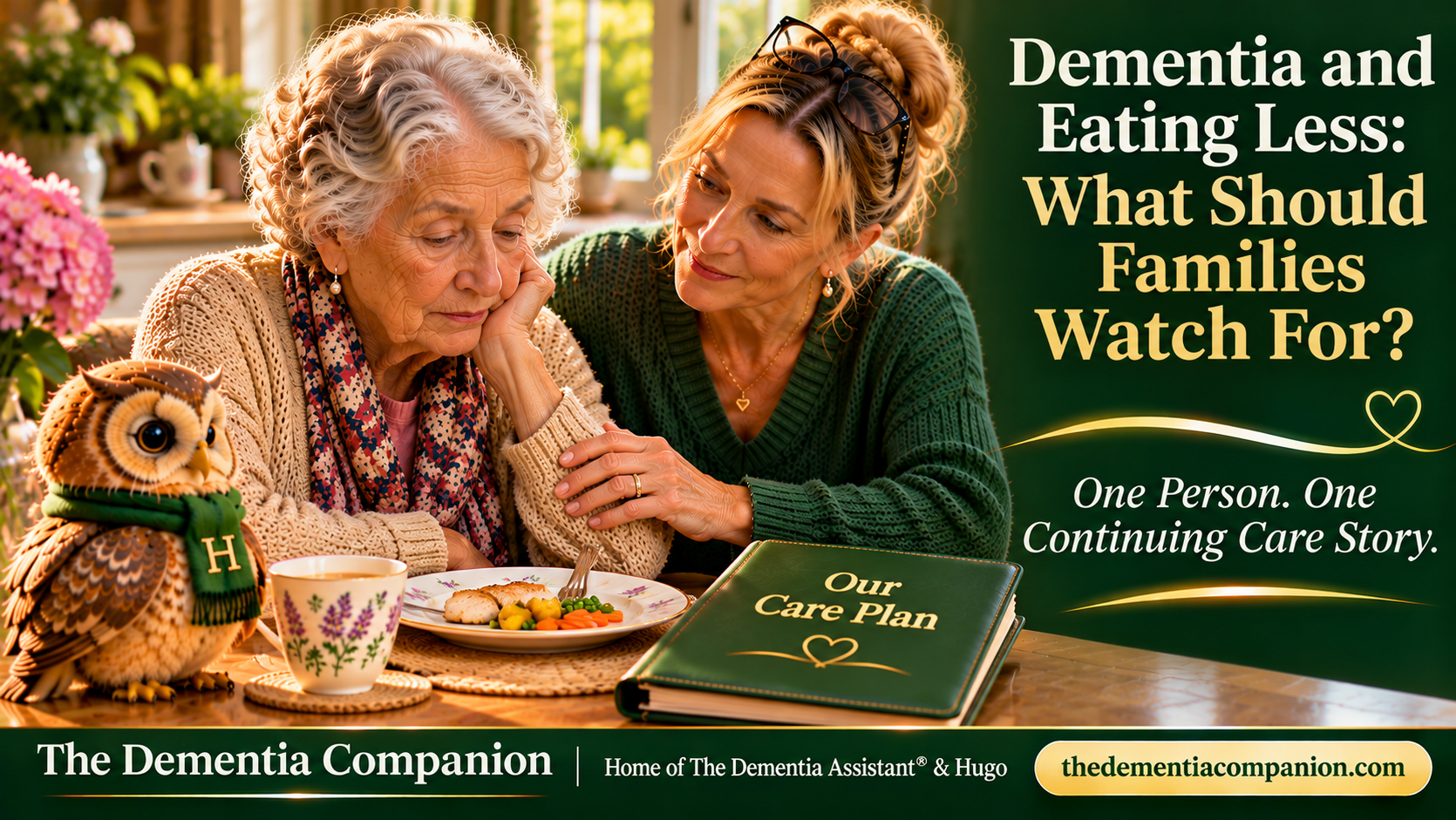
When Mum starts leaving her meals untouched, it’s natural to worry. But before assuming dementia is getting worse, let’s look at what might be happening and how we can help.
By Louise Donaghy, Dementia Practitioner, Founder of The Dementia Companion and The Dementia Assistant®, Creator of Hugo Intelligence™
It usually starts with something you notice at the dinner table.
Mum has always enjoyed her Sunday roast.
She likes her potatoes crispy, her gravy generous and her vegetables cooked just the way she likes them.
You have spent forty-five minutes preparing everything.
You put the plate in front of her.
She looks at it.
Moves a carrot around.
Takes two bites.
Then announces:
“I’m not hungry, darling.”
And there you are, looking at an almost untouched dinner, wondering what on earth has happened.
Yesterday she enjoyed a sandwich.
Last week she asked for seconds.
Now she’s eating less, and you’re beginning to worry.
Is this the dementia?
Could she be unwell?
Is she forgetting to eat?
Should you encourage her?
And how much encouragement becomes too much?
If someone living with dementia starts eating less, the first step is to understand what has changed for that individual. Appetite changes can be associated with dementia, but they may also be caused by pain, dental problems, constipation, illness, medication, low mood, swallowing difficulties or changes in the person’s environment.
Some difficulties can improve with simple adjustments.
Others need professional assessment.
The important thing is not to assume that reduced eating means dementia is inevitably progressing.
And please remember something else.
Mealtimes should still belong to the person, not become a battle between them and everybody worrying about how much they’ve eaten.
Why might someone with dementia start eating less?
There isn’t one explanation that fits everybody.
Dementia can affect how a person recognises hunger, understands food, concentrates during meals or manages the practical steps involved in eating.
But it is equally important to consider other health and wellbeing factors.
The Alzheimer’s Society, Dementia UK and British Dietetic Association all highlight the different reasons people living with dementia may experience eating and drinking difficulties.
These can include:
- Changes in appetite or food preferences.
- Difficulty recognising particular foods.
- Problems concentrating during meals.
- Pain in the mouth or poorly fitting dentures.
- Constipation or other physical discomfort.
- Medication effects.
- Depression, anxiety or emotional distress.
- Fatigue or disrupted sleep.
- Problems preparing or managing meals.
- Chewing or swallowing difficulties.
Sometimes more than one factor is involved.
And sometimes the explanation is much more ordinary.
Perhaps Mum simply doesn’t fancy a large dinner today.
We’ve all had days like that.
The difference is that when somebody is living with dementia, it can be harder to work out whether the change is temporary, part of a wider pattern or a sign that something needs medical attention.
That’s why understanding the person and their usual habits matters so much.
Is Mum eating less because her dementia is getting worse?
Not necessarily.
And I think this is one of the most important messages families need to hear.
Someone living with dementia may experience changes in eating habits as their condition develops.
But a reduced appetite does not, by itself, establish that dementia is progressing.
Imagine Mum normally enjoys breakfast and lunch but has started leaving her evening meal.
Perhaps she becomes tired later in the day.
Perhaps she’s eating more earlier than you realise.
Perhaps sitting through a large evening meal has become uncomfortable.
Or perhaps there’s a health issue that needs investigating.
Instead of immediately asking:
“Is Mum getting worse?”
Try asking:
“What’s different about Mum’s eating, and what might be making it difficult?”
That shift in thinking is important.
It moves us away from assumptions and towards understanding.
And it protects Mum from having every change in her life automatically blamed on dementia.
What physical problems should we check first?
Before changing an entire diet or deciding someone needs more assistance, consider whether eating has become uncomfortable.
Could Mum have a sore mouth or dental problem?
Dental pain, mouth ulcers, poorly fitting dentures and other oral health problems can make eating difficult.
The person may not always be able to explain where the discomfort is.
They might avoid certain foods, chew differently or stop eating partway through a meal.
You might gently ask:
“Mum, is anything hurting when you eat?”
If there’s a concern, arrange an appropriate dental or medical review.
Don’t assume someone has lost interest in food when the problem could be that eating hurts.
Could constipation or another illness be affecting appetite?
Constipation can cause discomfort and reduce someone’s desire to eat.
Other illnesses can also affect appetite, energy and wellbeing.
If Mum seems unwell, has persistent reduced intake or develops new symptoms, seek advice from her GP or another appropriate healthcare professional.
Could medication be contributing?
Some medicines can affect appetite, taste, nausea or digestion.
If eating changes after a prescription is started or adjusted, record the timing and discuss it with the prescriber or pharmacist.
Do not stop or alter medication yourself.
Could Mum be feeling low or anxious?
Emotional wellbeing matters.
Perhaps Mum is lonely.
Perhaps she’s worried about an appointment.
Perhaps she has been feeling unusually withdrawn.
Eating can be affected by mood and emotional distress.
That doesn’t mean we should diagnose depression ourselves.
But it does mean emotional wellbeing deserves consideration alongside physical health.
What if Mum doesn’t recognise the food on her plate?
This can sometimes happen.
A person may struggle to recognise particular foods or understand what is expected at mealtimes.
A busy plate containing several different foods may feel confusing.
Perhaps Mum can see the plate perfectly well but has difficulty distinguishing the food from its surroundings.
Or perhaps she is distracted by the television, people talking and activity around her.
Consider whether the presentation or environment is making things harder.
You might try:
- Serving a smaller, familiar portion.
- Using a plain plate that contrasts with the food.
- Reducing unnecessary distractions.
- Offering one part of the meal at a time if that suits the person.
- Allowing additional time without rushing.
- Sitting together if the person enjoys company.
These are options to explore, not rules that every person with dementia must follow.
Some people enjoy conversation and music during meals.
Others prefer quiet.
The right environment is the one that helps that particular person feel comfortable.
Can familiar foods help someone with dementia eat better?
Sometimes, yes.
Food is much more than nutrition.
It’s memory.
Culture.
Family.
Routine.
Comfort.
And, occasionally, a very strong opinion about whether custard should be served hot or cold.
Perhaps Mum has always loved porridge in the morning.
Perhaps Dad enjoys soup and bread at lunchtime.
Perhaps a favourite dish reminds someone of childhood.
Familiar meals may make eating more inviting.
But preferences can change, and that’s perfectly possible too.
The woman who previously loved roast dinners may now prefer smaller, lighter meals.
The gentleman who never liked sweet foods may develop a preference for them.
Rather than insisting:
“But you’ve always loved this!”
Try asking:
“Would you prefer something else today?”
The person may know exactly what appeals to them.
And if they don’t, offering a manageable choice between suitable options may help.
What can families try when someone with dementia is eating less?
Before making changes, check for medical concerns, particularly weight loss, swallowing problems or significant reductions in food and drink.
If the person is medically stable and there are no swallowing restrictions, some gentle adjustments may help.
Offer smaller meals more often
A large plate can sometimes feel overwhelming.
Perhaps Mum would prefer a smaller lunch with something nourishing later.
Some people find smaller portions or additional snacks easier than three large meals.
If weight loss or poor nutrition is a concern, ask a dietitian about suitable ways to increase nutritional intake.
Don’t assume that giving more food is always the answer.
The person’s health conditions, prescribed diet and nutritional needs matter.
Make eating a pleasant experience
A relaxed mealtime may help.
Sit together if the person likes company.
Allow enough time.
Avoid repeatedly reminding them how much is left on the plate.
And remember that conversation doesn’t have to revolve around eating.
You can talk about the garden, the weather or the neighbour’s latest adventures.
There’s no need to narrate every forkful.
Preserve independence
Perhaps Mum can still eat independently but finds cutting food difficult.
Perhaps she would benefit from a different plate or suitable cutlery.
An occupational therapist may be able to advise about equipment and practical adaptations.
The important thing is to help with what is needed without automatically taking over everything.
Respect the person’s choices
Not every refusal is a problem to be overcome.
Sometimes Mum simply doesn’t want what’s being offered.
Try another suitable option when appropriate.
Avoid pressure, arguments or forcing food into someone’s mouth.
If reduced intake continues, get professional advice rather than allowing the situation to become an ongoing struggle.
Good support should make eating easier and more comfortable, not turn every meal into a negotiation.
What if Mum will only eat sweet foods?
This can be frustrating for families.
Perhaps Mum previously enjoyed a varied diet but now seems much more interested in puddings, biscuits or other sweet foods.
Changes in taste and food preferences can occur with dementia.
But we should also consider the person’s wider health and nutritional needs.
If Mum has diabetes or another condition requiring dietary management, seek individual advice rather than making assumptions.
A dietitian may be able to help the family find nourishing choices that the person enjoys.
And please don’t turn a favourite pudding into a moral failing.
Sometimes it’s possible to work with preferences rather than fight against them.
The goal is a suitable, enjoyable and nutritionally appropriate approach for that individual.
When should we worry about weight loss?
Unintentional weight loss deserves attention.
If Mum’s clothes are becoming noticeably looser, she’s eating less over time or she appears to be losing weight without trying, arrange a GP review.
Weight loss may have several causes.
A healthcare professional may assess her nutrition, medications, general health, oral health and possible swallowing difficulties.
They may recommend a dietitian.
If regular weight monitoring is appropriate, agree how it should be done with the person and relevant professionals.
Don’t make weighing somebody a daily source of anxiety.
And don’t rely entirely on a number.
Consider the person’s overall wellbeing, abilities, appetite and clinical advice.
The aim isn’t to achieve an arbitrary weight. It’s to understand and support the person’s individual health and nutritional needs.
What if Mum is coughing or choking when she eats?
This is especially important.
Some people living with dementia develop swallowing difficulties, known as dysphagia.
Possible warning signs include:
- Coughing or choking during meals.
- Difficulty swallowing food or drinks.
- A wet or gurgly-sounding voice after eating or drinking.
- Holding food in the mouth without swallowing.
- Food remaining in the mouth after a meal.
- Repeated chest infections.
- Meals taking much longer than usual.
- Avoiding food because eating feels difficult.
These signs require medical attention.
Contact the GP promptly and ask about swallowing assessment. If the person has an existing speech and language therapy team, contact them about the change.
NICE recommends considering speech and language therapy when there are concerns about eating and drinking safety.
If swallowing difficulties are new or worsening, seek urgent GP or NHS 111 advice.
If somebody is severely choking and cannot breathe, speak or cough effectively, call 999 immediately and follow emergency first-aid guidance.
Should we start pureeing food or thickening drinks ourselves?
No.
This is a very important point.
Changing food textures or thickening drinks may be necessary for some people, but such changes should follow appropriate professional assessment.
Speech and language therapists can advise about swallowing safety.
Dietitians may help ensure a modified diet remains nutritionally suitable.
Do not assume that softer food or thicker drinks are automatically safer.
And don’t introduce texture changes without considering the person’s assessed needs and preferences.
The aim is safe, comfortable and dignified eating, guided by the appropriate professionals.
What if Mum is drinking less as well?
Drinking deserves just as much attention as food.
Some people living with dementia may forget to drink, have difficulty recognising thirst or find it harder to manage drinks independently.
Others may avoid drinking because they are worried about needing the toilet.
Dehydration can become serious.
Possible signs include:
- Dark yellow urine.
- Urinating less than usual.
- Dry mouth.
- Dizziness.
- Unusual tiredness.
- Feeling generally unwell.
If you suspect dehydration, seek appropriate medical advice.
The NHS recommends urgent GP or NHS 111 advice for concerning dehydration symptoms, such as reduced urine output or rapid breathing.
Sudden confusion requires immediate medical assessment.
Don’t automatically assume new confusion is dementia progression.
You may be able to make drinking easier by offering familiar drinks, keeping them within easy reach and supporting the person according to their preferences.
But if the person has a prescribed fluid restriction or swallowing plan, follow professional guidance.
And remember that drinking should not become another contest.
Mum doesn’t need someone standing over her announcing:
“That’s only three sips!”
She needs support that is appropriate, respectful and safe.
What if Mum is refusing food altogether?
First, try to understand what is happening.
Is she declining one particular meal?
Has she eaten earlier?
Does she feel unwell?
Is something hurting?
Is she worried or distressed?
Is she having difficulty chewing or swallowing?
There is a difference between choosing not to eat a particular meal and being unable to maintain adequate nutrition or hydration.
If Mum repeatedly refuses food, is eating very little, is losing weight or seems unwell, contact her GP.
If she cannot swallow safely, cannot maintain fluids or has signs of significant dehydration, seek urgent medical advice.
Don’t wait several days simply to collect a more complete food diary.
And don’t force food or drink into someone’s mouth.
For someone with more advanced dementia, eating and drinking difficulties may require a sensitive discussion with healthcare professionals about comfort, nutrition, swallowing safety and the person’s wishes.
Those decisions should be individual, carefully assessed and never reduced to a generic rule about dementia.
What should families record when eating habits change?
This is where keeping a short record can be genuinely helpful.
You don’t need to document every pea on the plate.
But a few factual notes may make it easier to explain what has been happening.
Consider recording:
What was offered?
Keep it simple.
What did the person eat or drink?
Use a reasonable description rather than guessing exact quantities.
What did the person say?
Their own words can be valuable.
Were there any difficulties?
For example, pain, coughing, difficulty handling cutlery or apparent discomfort.
What seemed to help?
Perhaps a quieter environment, familiar food or additional time.
Has this happened before?
Record relevant patterns without assuming a cause.
What professional advice was sought?
Include any agreed actions and follow-up.
A fictional example
“Tuesday, lunchtime: Mum chose tomato soup and half a sandwich. She said she wasn’t very hungry. She seemed comfortable and enjoyed having lunch with her daughter. No coughing or swallowing difficulties observed. She declined a larger meal but later asked for yoghurt.”
That’s enough.
It’s factual.
It’s respectful.
And it doesn’t label Mum as difficult because she didn’t finish her plate.
Another entry might say:
“Thursday: Mum coughed repeatedly while drinking and her voice sounded different afterwards. Contacted the GP for urgent advice about swallowing concerns.”
The second entry describes something that needs professional attention.
The record helps explain the situation.
It doesn’t replace the assessment.
Why should food preferences be included in a dementia care plan?
Because food is personal.
Imagine Mum has spent her entire life enjoying traditional meals.
Then a new care provider arrives and offers foods she doesn’t recognise.
Or the hospital doesn’t know she prefers a particular drink.
Or a care worker doesn’t realise that she needs extra time to settle before eating.
These things may matter.
A person-centred care plan can include:
- Favourite foods and drinks.
- Cultural and religious food preferences.
- Preferred mealtimes.
- Food allergies and professionally confirmed dietary requirements.
- Communication needs during meals.
- What the person manages independently.
- Assistance they welcome.
- Relevant swallowing and nutritional instructions from professionals.
- Changes that may need review.
But the care plan should never become a rigid list of demands imposed on the person.
Preferences can change.
So can abilities and support needs.
A good care plan grows with the person.
One Person. One Continuing Care Story, even when eating needs change
This is one of the reasons I created The Dementia Assistant®.
Imagine someone living with dementia receives support from several different services.
The GP has medical records.
A dietitian may have nutritional recommendations.
A speech and language therapist may have a swallowing assessment.
A hospital may have a care plan.
A home care provider may keep mealtime notes.
Each has its own professional responsibilities.
But the person and family may still need their own continuing place to organise relevant information.
A place to record what the person enjoys.
A place to preserve their preferences and wishes.
A place to keep professional reports and instructions together.
A place to record everyday observations.
And a place where that information doesn’t have to begin again every time another organisation becomes involved.
The Dementia Assistant® is designed to help people living with dementia and their families maintain their own person-centred care plans and continuing care information.
It doesn’t replace professional nutritional assessments, swallowing plans or clinical records.
It provides a place to organise relevant information alongside them.
Different professionals. Different services. One person. One continuing story.
Meet Hugo Intelligence™: A conversation about what’s happening, not just another checklist
Sometimes you know something has changed, but you’re struggling to explain it.
Perhaps Mum isn’t finishing meals.
Perhaps Dad is refusing foods he previously enjoyed.
Perhaps you’re worried that you might be making mealtimes stressful.
Or perhaps you’ve been lying awake wondering whether you’re missing something important.
You might ask:
“Hugo, Mum has started eating less. What should we consider before assuming it’s her dementia?”
Or:
“Hugo, Dad becomes upset when we encourage him to finish his dinner. How can we approach mealtimes differently?”
Or:
“Hugo, can you help me organise questions about Mum’s eating and drinking for her GP?”
Hugo Intelligence™ provides natural, conversational, person-centred dementia guidance within The Dementia Assistant®.
You can explain what’s happening in ordinary language.
Ask follow-up questions.
Explore possible approaches.
And think through the next sensible step without judgement.
Sometimes all you know is:
“Hugo, I’m worried about Mum.”
That’s a perfectly reasonable place to begin.
Hugo can help you explore everyday support, possible questions about appetite or comfort, and practical ways to make care more person-centred.
But Hugo cannot assess swallowing safety, diagnose malnutrition or dehydration, prescribe a diet or replace professional healthcare advice.
If there are choking, swallowing or urgent health concerns, contact the appropriate healthcare service first.
Hugo can use the person’s selected care plan
You can ask Hugo general dementia questions without selecting a care plan.
But when you select Mum’s individual care plan, Hugo can use relevant recorded information about her routines, food preferences, communication needs and circumstances to offer more personalised suggestions.
Perhaps Mum has always preferred a substantial lunch rather than an evening meal.
Perhaps she enjoys eating with company.
Perhaps she prefers familiar foods from her childhood.
Those details can help make the guidance more relevant to her.
Not simply a generic answer about dementia.
Guidance that starts with the person.
The information in the plan still needs to be accurate and reviewed appropriately.
And any medical concerns must be addressed by qualified professionals.
Save and organise your Hugo conversations
Perhaps you ask Hugo about eating habits today.
Next week, you want to revisit the discussion before an appointment.
Later, you may have questions about changing routines or family communication.
Within The Dementia Assistant®, you can save, categorise and organise your Hugo conversations for later reference.
That allows you to return to useful guidance without starting the entire conversation again.
Saved Hugo conversations are not clinical records or professional dietary instructions.
But they can help families maintain continuity in the questions they explore.
What if the worry comes at two o’clock in the morning?
Anyone who has cared for someone will recognise how worries can become louder when the house is quiet.
Perhaps Mum ate very little that evening.
Perhaps you’re wondering whether her appetite has changed.
Or perhaps you’re simply struggling to decide what questions to ask tomorrow.
Hugo offers a place to explore non-urgent dementia questions and organise your thoughts.
But Hugo is not an emergency service or an alternative to out-of-hours healthcare.
If someone has serious swallowing difficulties, severe choking, suspected dehydration or another urgent health concern, seek appropriate medical help.
At other times, having somewhere to ask a question and return to the guidance may help make the next conversation more manageable.
Hugo’s multilingual support: Food, culture and the language of home
This is another part of person-centred dementia care that matters enormously.
Food and language are closely connected to culture and identity.
Perhaps Mum grew up speaking Welsh.
Perhaps Dad’s favourite meals come from his childhood in India.
Perhaps a family member speaks Spanish, French, Irish or another language.
Perhaps the person living with dementia finds it easier to describe discomfort or explain food preferences in their familiar language.
Some people living with dementia may experience changes in how they use different languages.
This varies between individuals.
But respecting their preferred language can make communication more comfortable.
The Dementia Assistant® supports 12 interface languages and provides dictation and translation capabilities spanning 201 languages.
These tools can help families record observations, organise care information and communicate across language barriers.
Dictation may make daily notes easier to complete.
Translation may help appropriately involved family members understand information in a more accessible language.
And Hugo’s conversational approach provides another way to explore concerns naturally.
Not every feature is available in all 201 languages.
Important clinical, dietary, swallowing and medication instructions should be checked for accuracy, with qualified interpreters used where necessary.
Person-centred care means respecting not only what someone eats, but the culture, memories and language that make those meals meaningful.
How can Family Circle help when several relatives are involved?
Perhaps one family member prepares Mum’s meals.
Another visits in the evening.
A third lives abroad.
And everyone seems to have slightly different information about how much she’s eating.
That can become confusing.
The Dementia Assistant® includes Family Circle features to support appropriate sharing of relevant care updates.
This can help appropriately involved relatives stay informed while respecting the person’s wishes, privacy and access permissions.
But don’t turn the family into a committee that votes on every spoonful.
The aim is to support Mum.
Not to make her feel observed by an international panel of concerned relatives.
If there is a significant eating or drinking problem, professional assessment remains essential.
What if Mum needs help eating but wants to remain independent?
This is where person-centred support can be particularly important.
Perhaps Mum can manage her own meal if it’s presented differently.
Perhaps she needs assistance cutting food.
Perhaps she wants someone beside her.
Perhaps an occupational therapist could suggest suitable equipment.
Ask what support she welcomes.
Don’t automatically take over.
And don’t assume that somebody who needs assistance one day will need exactly the same help every day.
Abilities may fluctuate.
Preferences may change.
The aim is to provide appropriate support while preserving choice and dignity.
Helping somebody eat should never mean forgetting that the meal still belongs to them.
A practical dementia eating and drinking checklist
If someone you love is eating less, consider:
- [ ] Have we asked how the person feels about eating?
- [ ] Is there pain, illness or another possible physical cause?
- [ ] Have dental or denture concerns been considered?
- [ ] Could medication be contributing?
- [ ] Has there been unintentional weight loss?
- [ ] Is the person eating less at particular times?
- [ ] Are their food preferences changing?
- [ ] Does the environment feel comfortable?
- [ ] Are we supporting independence and personal choice?
- [ ] Have we noticed coughing, choking or other swallowing warning signs?
- [ ] Are they drinking enough for their individual health needs?
- [ ] Does the person need a GP, dietitian or speech and language therapy assessment?
- [ ] Have relevant observations been recorded factually?
- [ ] Does the continuing care plan need updating?
- [ ] Are appropriate family members informed, with the person’s wishes respected?
This isn’t a test.
You don’t have to solve every question in one afternoon.
But if there are urgent health or swallowing concerns, seek medical help without delay.
Sometimes it’s not about the food at all
I want to finish with something I think matters.
When someone starts eating less, families can become understandably anxious.
And before long, every meal begins with:
“You need to eat something.”
Followed by:
“Just a little more.”
Then:
“You’ve hardly touched it.”
And suddenly the table has become a battleground.
Meanwhile Mum is wondering whether she might simply enjoy her cup of tea in peace.
Of course, adequate nutrition and hydration are important.
And persistent difficulties deserve proper attention.
But food is also about pleasure.
Choice.
Culture.
Comfort.
Company.
And connection.
Sometimes the most helpful thing we can do is understand why a meal has become difficult.
Sometimes it’s arranging medical advice.
Sometimes it’s adapting the environment.
Sometimes it’s offering something familiar.
And sometimes it’s sitting beside Mum, enjoying a conversation and remembering that the person is more important than the plate.
Because good dementia care doesn’t begin with what someone has left uneaten.
It begins with understanding the person.
⸻
Ask Hugo: Dementia, Eating Less and Family Care
Hugo, Mum has dementia and is eating less. Should I be worried?
Hugo 🦉: A change in appetite deserves attention, particularly if it’s persistent or accompanied by weight loss, illness or reduced drinking.
There may be several explanations, including physical discomfort, medication effects, changes in preferences or swallowing problems.
I can help you organise questions, but a healthcare professional should assess concerning changes.
Does eating less mean dementia is getting worse?
Hugo 🦉: Not necessarily.
Eating less can happen for many reasons, including causes unrelated to dementia progression.
Try to notice what has changed from the person’s usual habits and seek medical advice when the change is persistent or concerning.
What if Mum keeps refusing her dinner?
Hugo 🦉: Begin by understanding whether Mum dislikes the particular meal, feels unwell, has discomfort or prefers eating at another time.
Avoid arguments or forcing food.
If she repeatedly refuses food or her intake becomes inadequate, contact her GP.
Can Hugo help us make mealtimes more person-centred?
Hugo 🦉: Yes. You can explain the situation and explore practical approaches involving routine, comfort, communication and the person’s preferences.
When you select Mum’s care plan, I can use relevant recorded information to make the suggestions more individualised.
What if Mum coughs or chokes when eating?
Hugo 🦉: Swallowing concerns need professional assessment.
Contact the GP promptly or seek urgent NHS advice for new swallowing problems. A speech and language therapist may be needed.
If Mum is severely choking and cannot breathe, speak or cough effectively, call 999 immediately.
Do not rely on an AI conversation to assess swallowing safety.
Can The Dementia Assistant® help us record changes in eating?
Hugo 🦉: Yes. It provides daily notes, care planning and document organisation.
You can record factual observations, organise relevant professional information and keep Mum’s preferences within her continuing care plan.
Can I save our conversations about Mum’s eating?
Hugo 🦉: Yes. You can save, categorise and revisit Hugo conversations within The Dementia Assistant®.
This can help you return to useful guidance as circumstances change.
Can Hugo help in different languages?
Hugo 🦉: The Dementia Assistant® supports 12 interface languages and dictation and translation capabilities spanning 201 languages.
These can help families organise information and communicate across languages.
Important medical and dietary instructions should always be checked for accuracy.
Can Family Circle help relatives stay informed?
Hugo 🦉: Family Circle supports sharing appropriate care updates with involved relatives.
The person’s wishes, privacy and access permissions should guide what information is shared.
Can Hugo recommend a swallowing-safe diet?
Hugo 🦉: I can explain general information about swallowing difficulties, but I cannot assess individual swallowing safety or prescribe food textures and drink consistencies.
Those decisions require appropriate professional assessment, including speech and language therapy where needed.
How much does The Dementia Assistant® cost?
Hugo 🦉: The Family subscription is £4.99 per month.
Every subscription includes a 30-day complimentary trial.
You can explore person-centred care planning, daily notes, Hugo Intelligence™, saved conversations, Family Circle and multilingual support.
⸻
One Person. One Continuing Care Story.
When someone living with dementia begins eating less, several professionals may become involved.
The GP.
A dentist.
A dietitian.
A speech and language therapist.
Perhaps a hospital or home care provider.
Each service may maintain its own records and professional recommendations.
But the person living with dementia and their family should also have their own continuing place for the information that matters.
A place to preserve food preferences and cultural traditions.
A place to record everyday observations.
A place to organise relevant professional instructions and reports.
A place to maintain the person’s wishes, strengths and routines.
And with Hugo Intelligence™, a place to ask questions naturally, save conversations, explore personalised support and benefit from multilingual tools.
The Dementia Assistant® was created to help people living with dementia and their families maintain their own continuing, person-centred care information.
It doesn’t replace healthcare professionals, nutritional assessments or clinical swallowing plans.
It complements them.
Different professionals. Different services. One person. One continuing story.
Would You Like Hugo to Help You Explore Mum’s Changing Mealtime Needs?
If someone you love is eating less, and urgent medical concerns have been addressed, Hugo can help you organise observations, think about the person’s preferences and prepare questions for the professionals supporting them.
Within The Dementia Assistant®, you can explore:
- Hugo Intelligence™ for conversational, person-centred guidance.
- Guided care plan creation and ongoing updates.
- Family-held continuing care plans.
- Daily notes and observations.
- Organised documents and appointment information.
- Saved and categorised Hugo conversations.
- Family Circle, Life Story and Memory & Moments.
- Multilingual support, dictation and translation.
- Dementia education and practical resources.
Created by dementia practitioner Louise Donaghy and powered by Person-Centred Intelligence®, The Dementia Assistant® is designed to help families keep the person at the centre of their care journey.
Every subscription includes a 30-day complimentary trial.
https://thedementiaassistant.com/
The Dementia Companion, home of The Dementia Assistant® and Hugo 🦉
https://thedementiacompanion.com/
Louise and Hugo ❤️🦉
Louise Donaghy
Founder & CEO of The Dementia Assistant®
Created and powered by Person-Centred Intelligence®
Creator of Hugo Intelligence™
⸻
Continue Exploring Dementia Care and Support
Person-Centred Dementia Care
https://thedementiacompanion.com/dementia-care/
Dementia Support for Families
https://thedementiacompanion.com/dementia-support/
Ask Hugo: Everyday Dementia Questions
https://thedementiacompanion.com/ask-hugo/
⸻
References and Further Reading
- Dementia UK: Eating and Drinking
Practical guidance about dementia-related changes in eating and drinking, maintaining enjoyment and recognising difficulties.
https://www.dementiauk.org/information-and-support/health-advice/eating-and-drinking/
- Alzheimer’s Society: Eating and Drinking
Information about appetite, eating difficulties, individual preferences and practical support.
https://www.alzheimers.org.uk/get-support/living-with-dementia/eating-drinking
- Alzheimer’s Society: Appetite and Dementia
Guidance about reduced appetite and possible contributing factors.
https://www.alzheimers.org.uk/get-support/living-with-dementia/poor-appetite-dementia
- NICE: Dementia, Assessment, Management and Support (NG97)
National guidance on supporting food and drink intake and considering speech and language therapy when swallowing safety is a concern.
https://www.nice.org.uk/guidance/ng97/chapter/recommendations
- British Dietetic Association: Dementia and Diet
Evidence-based advice about nutrition, appetite changes, other possible medical causes and professional nutritional support.
https://www.bda.uk.com/resource/dementia-and-diet.html
- British Dietetic Association: Eating and Drinking Difficulties in Dementia
Detailed guidance about mealtime adaptations, nutrition and the importance of individual swallowing assessments.
https://www.bda.uk.com/resource/eating-and-drinking-difficulties-in-dementia.html
- NHS: Swallowing Problems (Dysphagia)
Information about swallowing warning signs, professional assessments and when to seek urgent medical advice.
https://www.nhs.uk/symptoms/swallowing-problems-dysphagia/
- NHS: Dehydration
Information about recognising dehydration, treatment and when urgent assessment is needed.
https://www.nhs.uk/conditions/dehydration/
- Dementia UK: Hydration and Dementia
Practical advice about maintaining hydration and recognising concerns.
https://www.dementiauk.org/information-and-support/health-advice/hydration/
- British Red Cross: First Aid for Choking
First-aid advice about recognising and responding to choking emergencies.
https://www.redcross.org.uk/first-aid/learn-first-aid/choking
⸻
Important information: This article provides general educational guidance and does not replace medical assessment, professional nutritional advice, swallowing assessments or individual care planning. Sudden confusion, severe choking, significant dehydration and other urgent health concerns require prompt medical attention. Care arrangements differ across the four UK nations and internationally.
Published: 21 November 2026
You May Also Find Helpful
Need help with your own situation? Ask Hugo.
One Person. One Continuing Care Story. The Dementia Companion is where you discover guidance. Inside The Dementia Assistant®, talk with Hugo, save and categorise conversations, record daily notes and involve authorised supporters in a continuing care plan centred around the person.
Ask Hugo About This · Start Your Continuing Care Plan — Families · Continuing Care Planning — Professionals
Personal guidance requires the appropriate account and subscription access. Care-plan information is used only with authorised access and the required consent and selection steps. All subscription plans include a 30-day complimentary trial.