Can We Still Take Mum on Holiday With Dementia? A Practical Family Guide
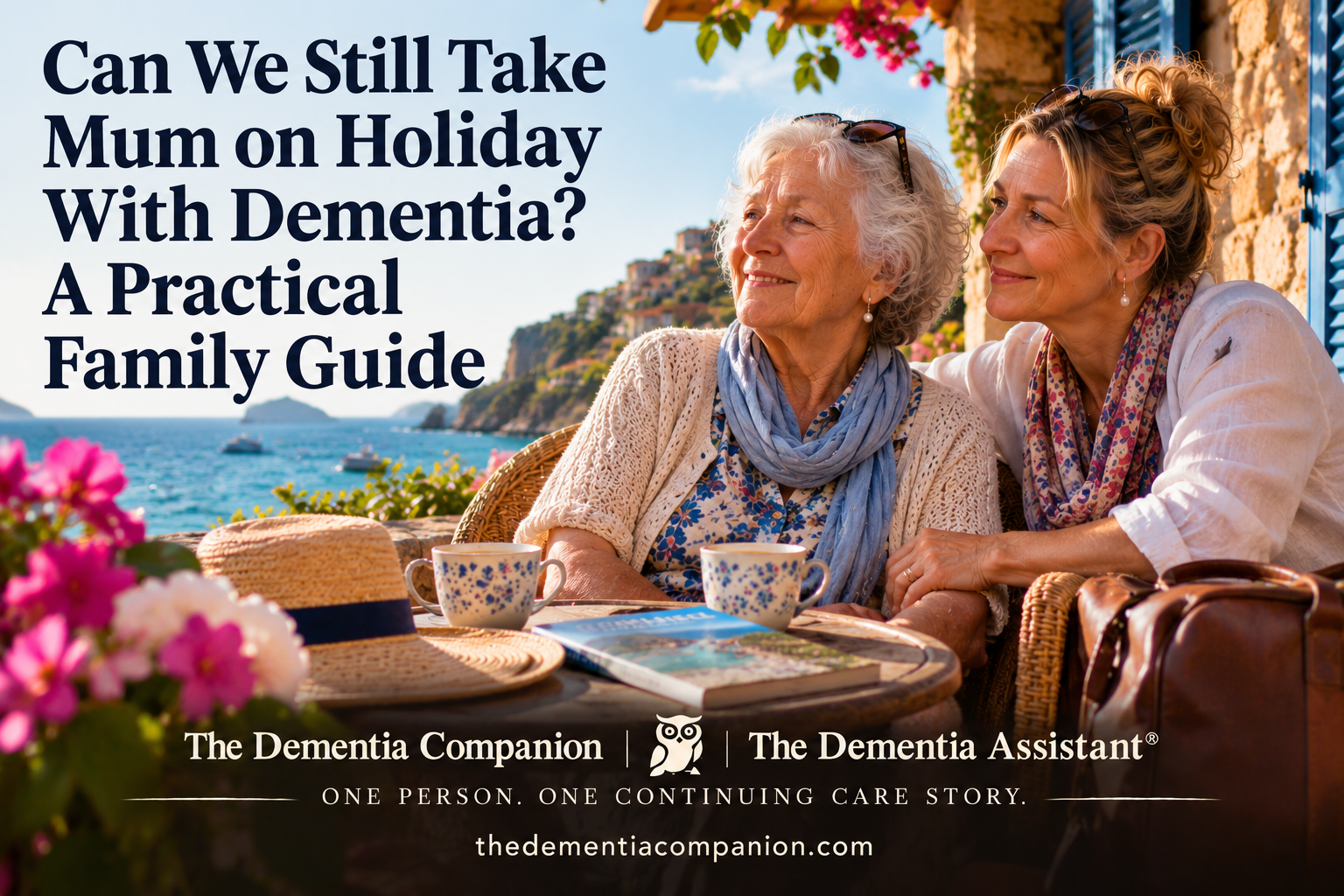
Can We Still Take Mum on Holiday With Dementia? A Practical Family Guide
One Person. One Continuing Care Story. | Article 49 of 80
By Louise Donaghy, Dementia Practitioner, Founder of The Dementia Companion and The Dementia Assistant®, and Creator of Hugo Intelligence™.
Mum has always loved her holidays.
She was the one who packed three weeks before departure.
The passports were checked.
The tickets were printed.
The sun cream was bought.
And everybody was reminded, at least six times, that their suitcase was going to be overweight.
She loved the excitement of going somewhere different.
A little sunshine.
A nice meal.
An afternoon sitting beside the sea.
And the chance to inform the rest of the family that the coffee abroad was never quite as good as the coffee at home.
Then Mum received a dementia diagnosis.
And suddenly, something as ordinary as booking a holiday became complicated.
Can she still fly?
Will she become confused in the hotel?
What if she gets lost?
Will the insurance cover her?
What happens if she becomes distressed?
And what if you take her away and realise you’ve made a terrible mistake?
Perhaps you’ve already decided that holidays are simply too risky.
Or perhaps you’re looking at photographs from previous trips, wondering whether Mum will ever enjoy another one.
So can someone living with dementia still go on holiday?
Yes. Many people living with dementia can continue enjoying holidays with thoughtful planning, suitable support and consideration of their individual needs. A dementia diagnosis alone does not mean travel must stop.
But it would be wrong to suggest that every holiday is suitable for every person.
Some people remain confident and independent travellers.
Others need assistance with unfamiliar places, medication, personal care or everyday decisions.
Some find a short break close to home more enjoyable than travelling abroad.
And for some individuals, particularly when health or support needs are significant, a particular journey may no longer be appropriate.
The important thing is to consider what the person wants, what they can manage and what arrangements would make the experience safe and enjoyable.
Because holidays aren’t simply about travelling somewhere.
They’re about enjoying life.
Spending time together.
Trying something different.
Returning to favourite places.
And sometimes doing absolutely nothing beside a swimming pool.
Which, incidentally, is an activity I believe deserves much greater recognition.
The goal is not to prove that Mum can still go on holiday. It’s to make sure the holiday is something she actually wants and can enjoy.
Does having dementia mean someone should stop travelling?
No.
Alzheimer’s Society, Dementia UK, Dementia Australia and the US Alzheimer’s Association all recognise that travel can remain possible after a dementia diagnosis.
But planning needs to reflect the person.
There is no single dementia stage that automatically determines whether every type of travel is appropriate.
For example, someone living with early-stage dementia might continue enjoying familiar destinations with little additional assistance.
Another person might require a companion who can help with travel arrangements, medication and orientation.
Someone with more extensive care needs may benefit from an accessible short break with appropriate professional support.
And another person may find unfamiliar environments so distressing that travelling away from home is no longer enjoyable.
Ask what Mum wants
Before looking at flights, hotels or brochures, begin with Mum.
“Would you like to go away for a few days?”
“Is there somewhere you’d particularly enjoy visiting?”
“Would you prefer somewhere familiar?”
“How would you feel about staying overnight?”
Her answer matters.
Perhaps she doesn’t want to travel abroad anymore.
Perhaps she would love to visit her sister.
Perhaps she still dreams of sitting beside the sea.
Or perhaps she’s perfectly happy in her own garden.
Having dementia doesn’t automatically mean somebody wants a holiday. And wanting a holiday doesn’t automatically mean it is suitable.
The decision should reflect her wishes, health and abilities.
How do we know whether a holiday is suitable for Mum?
Rather than thinking only about the diagnosis, consider how Mum manages everyday life.
The Alzheimer’s Association recommends considering changes in behaviour and functioning, the complexity of travel and whether the person is likely to cope with unfamiliar environments.
A useful starting point is to ask:
- Does Mum understand and want the proposed trip?
- How does she respond to unfamiliar surroundings?
- Does she need support with personal care, medication, mobility or communication?
- Does she become frightened or lost in unfamiliar places?
- How well does she cope with changes in routine?
- Are there significant health conditions or recent changes requiring medical advice?
- Who can provide the support she needs during the journey and while away?
- What would happen if her needs changed or the trip had to end early?
These questions aren’t a test Mum has to pass.
They’re part of understanding whether the proposed arrangements are appropriate.
Consider recent health changes
Perhaps Mum has recently been admitted to hospital.
Or has experienced repeated falls.
Perhaps her medication has changed.
Perhaps she’s become more confused.
Or needs more assistance with eating, drinking or mobility.
Discuss relevant concerns with her GP or appropriate healthcare professional before booking.
Some conditions may require treatment, additional support or a change in travel plans.
Don’t assume that a familiar smile means everything is manageable
Mum may be perfectly comfortable talking about going on holiday.
But the practical experience of travelling might involve difficulties that aren’t obvious during a conversation at home.
Likewise, someone who needs assistance with everyday activities may still enjoy a well-supported holiday.
The planning should be based on her actual circumstances.
Is a familiar destination better than somewhere new?
For some people, yes.
A familiar destination may feel reassuring.
Perhaps Mum has visited the same seaside town for thirty years.
She knows the promenade.
Remembers the hotel.
Or enjoys sitting in the same café overlooking the harbour.
That familiarity may help her feel comfortable.
But it isn’t guaranteed.
The hotel may have changed.
The surroundings may no longer look familiar.
And Mum’s needs may be different from those on previous visits.
A short break close to home
Sometimes a few days away within easy travelling distance may be the most suitable option.
Perhaps a cottage beside the coast.
A hotel near family.
Or an accessible countryside break.
A shorter journey may offer flexibility if Mum becomes tired or distressed.
An international holiday
Travelling abroad may also be suitable for some people.
But it involves additional considerations.
Passports.
Travel insurance.
Medication rules.
Different languages.
Longer journeys.
Unfamiliar healthcare arrangements.
And possibly different time zones.
These issues don’t automatically make international travel impossible.
They simply need proper planning.
Try a smaller trip first
If Mum hasn’t travelled recently, consider a short outing or overnight stay before committing to a longer holiday.
This may help you understand what she enjoys and what support she needs.
But don’t use the trip as an assessment exercise where Mum feels she’s being tested.
Let it be an enjoyable experience in its own right.
A successful holiday doesn’t have to involve an airport, a passport or a very ambitious itinerary.
Should we book a hotel, apartment or specialist dementia-friendly holiday?
The best accommodation depends on Mum’s preferences and needs.
Some people enjoy hotels.
Others prefer a self-catering apartment where they can maintain familiar routines.
Some may benefit from accessible accommodation or specialist support.
Hotels
Hotels can be convenient because meals, cleaning and other services may be available.
But they can also be busy.
Large corridors.
Several lifts.
Unfamiliar doors.
Noisy restaurants.
And different staff throughout the day.
If Mum struggles with orientation, consider whether a smaller property with a simpler layout would be more comfortable.
Ask about accessibility and any practical support the accommodation can provide.
Self-catering accommodation
A cottage or apartment may offer more privacy and flexibility.
You can often organise meals around familiar routines.
Choose quieter surroundings.
And allow Mum to rest when she wishes.
But somebody still has to arrange shopping, cooking, cleaning and any necessary care.
A self-catering holiday should not accidentally turn one family member into a full-time hotel manager.
Specialist holidays
Some organisations provide accessible holidays or arrangements intended to support people living with dementia and their families.
These may be worth exploring when additional support is needed.
Check exactly what is offered.
Is professional personal care available?
Is nursing support provided?
Are staff appropriately trained?
What happens in an emergency?
What are the accessibility arrangements?
Don’t assume that the phrase dementia-friendly guarantees the service can meet an individual’s needs.
Questions worth asking accommodation providers
Before booking, consider:
Is the bedroom easy to find?
Are there stairs or difficult changes in floor level?
Is the bathroom accessible?
Can Mum use the bed and toilet comfortably?
Are meals available at suitable times?
Is there a quiet space?
Can a support person stay nearby?
What happens if the booking needs to be changed or cancelled?
The answers should reflect Mum’s actual care and mobility needs.
How can we protect Mum’s familiar routines while we’re away?
One of the lovely things about holidays is escaping routine.
But for somebody living with dementia, familiar routines may also provide comfort.
The aim is balance.
Keep important parts of the day recognisable
Perhaps Mum likes breakfast early.
Perhaps she rests after lunch.
Perhaps she prefers a shower in the morning.
Or likes to listen to familiar music in the evening.
You don’t need to recreate every minute of her usual day.
But preserving meaningful routines may make an unfamiliar environment easier.
Bring familiar belongings
Consider whether Mum would like:
Her favourite cardigan.
Her usual toiletries.
A familiar photograph.
Her preferred pillow or comfort item.
Her glasses and hearing aids.
Or familiar music.
These items may help, depending on the person.
But avoid packing half the house simply because it contains familiar objects.
You’ll still need to carry the suitcase.
Allow time to settle
Arriving at a new hotel can be disorientating.
Show Mum the bedroom, bathroom and other important areas.
Give her time to become comfortable.
Avoid rushing straight into a busy excursion.
And don’t assume she will immediately recognise a hotel simply because she stayed there years ago.
What if Mum becomes confused in the hotel?
This is one of the most common family concerns.
Perhaps Mum wakes during the night.
She doesn’t recognise the bedroom.
She cannot find the bathroom.
Or she asks:
“Where are we?”
For some people, unfamiliar surroundings can contribute to disorientation or distress.
Respond calmly
You might say:
“We’re on holiday, Mum. We’re staying here for a few nights.”
“You’re with me.”
“Would you like me to show you the bathroom?”
Keep the explanation simple.
Allow time for her to settle.
Make the room easier to understand
Where suitable, consider a small familiar item beside the bed.
Keep essential belongings in consistent places.
Make sure lighting is appropriate.
Check that the route to the bathroom is clear and safe.
If Mum has mobility or visual perception difficulties, consider professional advice about suitable accommodation arrangements before travelling.
Don’t use unsafe restrictions
The answer isn’t automatically to lock Mum into a bedroom or prevent her from leaving without appropriate lawful authority.
If there is a risk of her becoming lost, discuss suitable supervision, accommodation and safety arrangements in advance.
Her rights, privacy and preferences remain important.
What if Mum wanders away or becomes lost?
This needs careful planning, particularly if Mum has previously become disorientated or lost.
The priority is to understand her individual risks rather than automatically restricting her independence.
Discuss a plan before travelling
Depending on her needs, consider:
Who is travelling with Mum?
Does she require someone to accompany her on outings?
How will the group remain together in busy places?
What should happen if someone becomes separated?
Does she have appropriate identification and emergency contact information?
Who will contact local services if necessary?
Consider an identification card
Some families use a discreet card containing essential contact information.
This may be helpful if the person becomes separated and needs assistance.
The information should be appropriate, accurate and respectful of privacy.
It should not be used to embarrass or label Mum unnecessarily.
What about location tracking?
Location-sharing technology may help in some circumstances, but it is not a guaranteed safety solution.
A phone may be switched off, left behind or lose signal.
Tracking arrangements also raise issues of consent, privacy and lawful authority.
Discuss their suitability rather than installing monitoring automatically because Mum has dementia.
If Mum goes missing
Act promptly.
Search immediate areas where safe and appropriate.
Contact local police or emergency services without unnecessary delay when there is a significant risk.
Do not wait an arbitrary number of hours before reporting a vulnerable missing person.
When travelling internationally, follow the destination’s emergency procedures.
A safety plan should protect Mum without unnecessarily removing the freedom and dignity that make a holiday enjoyable.
Can someone with dementia still travel by car?
For some people, travelling by car may be a comfortable option.
It can offer flexibility.
You can stop for breaks.
Carry familiar belongings.
And change plans more easily than with some other forms of transport.
Alzheimer’s Society recognises these potential advantages.
Plan regular breaks
Consider opportunities for Mum to use the toilet, stretch and rest.
Take account of mobility, hydration and any relevant medical needs.
Avoid exhausting travel days
A long drive followed immediately by a busy evening may be too much.
You might prefer a shorter journey or an overnight stop.
What if Mum wants to drive?
A dementia diagnosis and visual, cognitive or physical difficulties may affect legal fitness-to-drive requirements.
Rules vary by country and jurisdiction.
The appropriate licensing and medical advice must be followed.
Do not assume that being an experienced driver means driving remains safe.
And don’t rely on Hugo to determine whether Mum can legally or medically drive.
What about travelling by train, coach or aeroplane?
Different types of transport create different challenges.
Train travel
A train may allow more movement than a car or aircraft.
But stations, platform changes and crowded carriages can be difficult.
Consider whether assistance is available and how luggage will be managed.
Coach travel
A coach holiday may offer an organised itinerary.
However, the person may need to manage steps, scheduled stops and a group timetable.
Ask what support is available and whether the journey suits Mum’s needs.
Air travel
Flying may be possible, but airports can be particularly demanding.
Security checks.
Queues.
Announcements.
Crowded departure lounges.
Gate changes.
And unfamiliar procedures.
Contact the airline and airport about available assistance before travelling.
Explain the practical support needs rather than assuming staff will understand everything from the diagnosis alone.
Hidden disabilities
Some airports and transport providers offer arrangements for passengers with non-visible disabilities.
Availability and the type of assistance vary.
Check the specific provider’s current arrangements.
We’ll explore flying with dementia in much greater detail in our next dedicated article.
For now, the important principle is to plan support in advance rather than hoping everything will work itself out on departure day.
What should we do about Mum’s medication before going away?
Medication planning is essential.
Travel can disrupt routines.
Different meal times, long journeys and changes in time zone may affect when medicines are taken.
Some medicines also require particular storage conditions.
Ask the appropriate professional before travelling
A GP, prescriber or pharmacist can advise on:
Whether Mum has enough medication.
How medicines should be stored.
What to do about time-zone changes.
Whether any documentation is necessary.
Whether a medicine requires special arrangements during travel.
And what to do if a dose is missed.
Do not independently alter doses or medication schedules.
Carry an accurate medication list
Include the current names, doses and instructions, as supplied or confirmed by the appropriate healthcare professional.
Keep relevant contact information accessible.
Check international medicine rules
Countries may have different rules about importing medicines.
Some medicines require additional documentation or permissions.
UK government advice explains that medicines containing controlled drugs can have specific restrictions.
Check both the departure and destination country’s requirements well before travelling.
Keep medicines properly labelled
Official UK travel health guidance recommends keeping medicines in their original labelled packaging and carrying appropriate prescription information.
Check the relevant transport and customs requirements.
Avoid transferring medicines into unlabelled containers simply for convenience.
What if Mum needs medication support?
If somebody assists Mum with medication at home, decide how that agreed support will continue during the holiday.
Don’t assume that a hotel, airline employee or holiday companion can provide professional medication assistance.
Clarify the arrangements before departure.
A holiday should not involve guessing medication doses because the routine has changed.
Do we need special travel insurance for dementia?
Travel insurance is an especially important consideration.
A dementia diagnosis may affect the terms, exclusions or cost of a policy.
The person may also have other medical conditions that must be declared.
Be accurate about medical conditions
UK government guidance advises travellers to declare relevant pre-existing medical conditions and ongoing or pending investigations when arranging insurance.
Failing to disclose information required by the insurer can affect coverage.
The insurer may ask about Mum’s diagnosis, treatment, health or care needs.
Answer accurately.
Check what the policy actually covers
Ask about:
Emergency medical treatment.
Pre-existing conditions.
Cancellation and curtailment.
Medical repatriation.
Additional assistance.
Whether a companion’s circumstances are covered.
And any relevant exclusions.
Obtain confirmation of the terms.
Don’t assume that because an insurer accepts a booking, every possible dementia-related event is covered.
What about GHIC or EHIC?
For eligible UK travellers, a UK Global Health Insurance Card or valid UK European Health Insurance Card can provide access to certain medically necessary state healthcare in countries where the scheme applies.
The exact arrangements depend on the country.
A GHIC or EHIC does not replace travel insurance.
It does not provide general coverage for private treatment, cancellation, repatriation or every expense abroad.
Check current official guidance before travelling.
Travellers outside the UK
Insurance and public healthcare arrangements differ internationally.
US, Canadian, Australian and Irish travellers should check their own coverage, including international emergency care and any relevant pre-existing-condition exclusions.
Travel insurance is not the most exciting part of booking a holiday, but discovering you haven’t got suitable cover during a medical emergency is considerably less exciting.
Do we need a doctor’s letter or a medical review before travelling?
Not every person living with dementia automatically needs a medical certificate for every journey.
However, a professional review may be sensible when there are significant health concerns, recent changes or uncertainty about whether the planned trip is appropriate.
Ask about any relevant fitness-to-travel issues.
This may be especially important after recent illness, hospital treatment or major medication changes.
A doctor’s letter
Depending on the circumstances, travel providers or destination authorities may require medical documentation.
A letter might explain relevant health needs or prescribed medicines.
But it should contain only appropriate, accurate information.
And it does not automatically guarantee travel acceptance or insurance coverage.
Check with the provider and relevant authorities.
What if Mum becomes ill while we’re abroad?
Even carefully planned holidays can be interrupted by illness.
Know how to obtain medical assistance at the destination.
Keep insurance information accessible.
Know the local emergency number.
And have appropriate clinical and medication information available.
Do not automatically blame dementia
If Mum suddenly becomes confused, significantly drowsy, acutely unwell or develops new neurological symptoms, seek urgent medical assessment.
Sudden confusion may indicate delirium or another serious condition.
Dementia does not remove the possibility of infections, injuries, strokes or other illnesses.
If medical treatment is needed
Contact the appropriate local medical service.
Inform the insurer according to policy requirements.
Provide relevant clinical information to the treating professionals.
Seek appropriate language interpretation if necessary.
Don’t rely on an unverified AI translation to make critical treatment decisions.
Follow medical advice
If a clinician recommends treatment, observation or changes to travel arrangements, follow appropriate professional guidance.
A planned excursion or return flight is not more important than Mum’s health.
Can holidays make dementia symptoms worse?
An unfamiliar environment may temporarily increase confusion, anxiety or distress for some people living with dementia.
Poor sleep, fatigue and disrupted routines can contribute.
But this does not mean that every holiday accelerates dementia progression.
Nor can a family determine progression simply because Mum struggled in an unfamiliar hotel.
Watch the pattern
Was she more comfortable after settling in?
Did the difficulty occur when tired?
Was there too much noise?
Were meals or medication routines disrupted?
Was there an illness or another possible medical cause?
These observations may help with planning and any necessary professional review.
After returning home
Some people need rest after travelling.
Allow time to settle back into familiar routines.
If changes persist or are significant, seek appropriate healthcare advice.
And remember that a holiday doesn’t have to go perfectly to have included meaningful moments.
What if Mum refuses to leave the hotel?
Perhaps you’ve booked a lovely excursion.
The weather is beautiful.
You’ve organised transport.
And Mum announces:
“I’m not going anywhere.”
That can feel frustrating.
Especially when you’ve spent a small fortune arranging the day.
But ask what is happening.
Is she tired?
Does she feel unwell?
Is she frightened of unfamiliar surroundings?
Is the outing too complicated?
Or does she simply want to sit on the balcony?
Respect the answer
If Mum doesn’t want to join an activity, don’t automatically pressure her.
Discuss alternatives where appropriate.
Perhaps she would prefer a shorter outing.
Or a quiet lunch.
Or an afternoon by the pool.
But don’t leave her without necessary support or supervision merely because other family members want to continue.
Allow the holiday to change
One of the most useful travel skills is flexibility.
Plans can change.
Excursions can be missed.
And sometimes the highlight of the trip is simply sitting together with a beautiful view.
The holiday should serve the person. The person should not have to serve the itinerary.
What if we’re travelling with grandchildren or a large family group?
A family holiday may offer wonderful opportunities for connection.
But several generations can have very different expectations.
The grandchildren may want water parks.
The adults may want sightseeing.
Mum may want a quiet breakfast and an afternoon rest.
And somebody will inevitably want to spend two hours choosing where to eat.
Agree on realistic plans
Not everybody needs to do every activity together.
Perhaps Mum joins the family for breakfast and a relaxed evening meal.
Other relatives can enjoy their own activities at different times.
Consider care responsibilities
Who is providing support when Mum needs assistance?
Does somebody need to remain with her?
Can another family member take over for a while?
Are professional services required?
Agree on responsibilities rather than assuming one person will manage everything.
Protect the grandchildren’s experience
Children can enjoy time with Grandma without becoming responsible for her safety or care.
Adults should provide appropriate supervision and explain dementia in a suitable way.
Preserve ordinary family moments
Perhaps Mum enjoys watching the children play.
Sharing an ice cream.
Looking at holiday photographs.
Or taking a short walk with her granddaughter.
These moments can be meaningful without a packed schedule.
What if the main family carer needs a holiday too?
This deserves particular attention.
Sometimes a person takes their partner or parent with dementia on holiday because they desperately need a break.
But then they discover that they’ve simply moved their caring responsibilities to a hotel.
Now they’re providing personal care in an unfamiliar bathroom.
Managing medication in a different time zone.
Finding suitable food.
Preventing distress.
And trying to relax while worrying about what might happen next.
That’s not necessarily a holiday for the carer.
Be realistic
Will the carer have time to rest?
Is additional support needed?
Could professional assistance be arranged appropriately?
Would another trusted adult be able to share responsibilities?
Are suitable respite options available?
A separate break may sometimes be better
Some carers may prefer a break of their own while the person living with dementia receives suitable support elsewhere.
That doesn’t mean abandoning them.
It means recognising that both people have needs.
The appropriate arrangement depends on the individual’s circumstances, preferences and available services.
The person living with dementia deserves enjoyable experiences. So does the person providing care.
What if travelling away is no longer suitable?
Sometimes a proposed holiday simply isn’t right.
Perhaps Mum becomes very distressed in unfamiliar environments.
Perhaps she requires complex medical care.
Perhaps travelling would be exhausting.
Or perhaps she no longer wants to go.
It’s disappointing when something that once brought pleasure becomes difficult.
But that doesn’t mean enjoyment has to disappear.
Bring a little holiday feeling closer to home
Perhaps Mum would enjoy:
A day beside the sea.
Lunch in a favourite village.
A short visit to a beautiful garden.
A picnic.
A visit from relatives.
A familiar meal from a country she loves.
Or sitting outside on a sunny afternoon.
These options are not substitutes that will suit everybody.
They’re possibilities to explore.
Don’t assume smaller means less meaningful
A wonderful afternoon with someone you love can matter just as much as a week abroad.
You don’t have to travel hundreds of miles to create a memory worth keeping.
A practical holiday checklist for families
Before leaving, make sure the important arrangements are clear.
The person: Does Mum want to travel, and do the plans reflect her present abilities and preferences?
The destination: Is the location, journey and accommodation suitable for her mobility, communication and support needs?
Health: Have relevant medical concerns and fitness-to-travel questions been discussed with an appropriate professional?
Medication: Are supplies, schedules, storage and any international permissions properly arranged?
Insurance: Have relevant health conditions been declared and the policy terms checked?
Documents: Are passports, travel details, prescriptions and relevant contact information available?
Support: Who is responsible for any necessary personal care, mobility assistance and other support?
Emergency arrangements: Does the family know how to obtain local medical and emergency assistance?
Routine: Have the most important familiar daily arrangements been considered?
Flexibility: Can activities be shortened, changed or cancelled without creating a crisis?
The carer: Has their own wellbeing and need for rest been considered?
And perhaps the most important question:
Will Mum actually enjoy this holiday?
Because the purpose isn’t simply to travel.
It’s to enjoy being there.
A fictional family holiday: Margaret’s seaside break
Let’s imagine Margaret is 82 and living with Alzheimer’s disease.
She has always loved visiting the coast.
Her daughter is considering taking her away for three nights.
Margaret still enjoys outings and conversations.
But she becomes tired in busy environments and needs support managing her medication.
The family chooses a familiar seaside town rather than a complicated international journey.
They book accessible accommodation close to the promenade.
The daughter checks the bathroom arrangements and discusses medication with the appropriate professional.
They arrange the necessary support.
Margaret helps choose what to pack.
On arrival, her daughter allows time to settle into the room.
The following morning, they have breakfast overlooking the sea.
Margaret enjoys walking a short distance with appropriate assistance.
They stop for tea.
Then she says she’s tired.
Instead of insisting they continue sightseeing, they return to the accommodation.
In the afternoon, Margaret sits on the balcony.
She looks towards the water.
“It’s lovely here, isn’t it?”
Her daughter smiles.
“It is, Mum.”
They don’t visit every attraction.
They don’t fill every hour.
But Margaret enjoys being away.
And her daughter enjoys spending time with her.
This is a fictional example.
Real holiday planning must reflect the person’s individual needs and appropriate professional advice.
But it illustrates something worth remembering.
A good holiday isn’t measured by how much you manage to fit into it.
Sometimes it’s measured by how comfortable and happy the person feels.
International considerations: UK, USA, Canada, Australia and Ireland
The general principles of person-centred holiday planning apply internationally, but healthcare, insurance, medication and travel requirements differ.
United Kingdom
Alzheimer’s Society and Dementia UK provide guidance on holidays, suitable transport, accommodation and preparing to travel.
For overseas travel, check GOV.UK destination advice, relevant medicine rules and suitable insurance.
Eligible travellers may use a GHIC or valid EHIC for specified state healthcare in participating countries, but these cards do not replace insurance.
Healthcare and social care arrangements vary across England, Scotland, Wales and Northern Ireland.
United States
The Alzheimer’s Association offers advice about travelling with dementia, including journey planning, accompanying support and preparing important documents.
For air travel, the US Department of Transportation explains the rights of passengers with disabilities.
Health insurance and overseas medical coverage need individual checking.
Canada
The Alzheimer Society of Canada provides advice on travel planning and transport.
Healthcare and insurance arrangements vary between provinces and territories.
Families should check whether their provincial coverage and additional insurance meet the needs of the trip.
Australia
Dementia Australia provides practical advice about travelling with dementia.
Families may wish to consult appropriate healthcare professionals before major journeys, particularly when health or care needs are changing.
Insurance, medicine and destination requirements must be checked individually.
Republic of Ireland
The Alzheimer Society of Ireland provides information about holiday planning and flying with someone living with dementia.
Irish travellers should check the applicable healthcare arrangements, travel insurance and destination requirements.
Across every country
Do not assume that one country’s insurance, medication, consent or emergency arrangements apply everywhere.
Verify the requirements for the actual destination and the person’s circumstances.
What should go into Mum’s continuing care plan before travelling?
Now imagine Mum has several people involved in her support.
Her daughter knows that Mum becomes tired after lunch.
Her son knows she struggles with unfamiliar bathrooms.
Her home carer understands her personal care preferences.
Her pharmacist has the current medication information.
Her GP knows about recent changes in health.
And Mum knows which places she would actually like to visit.
All these details may be relevant.
But they’re not always held together.
This is where a family-held, person-centred record may help.
A fictional holiday-planning entry
Person: Margaret, aged 82.
Holiday preference: Enjoys seaside breaks, quiet cafés, short outings and time outdoors.
Travel preference: Comfortable travelling by car with regular breaks.
Communication: Prefers simple explanations and time to settle in unfamiliar surroundings.
Usual routine: Early breakfast, midday meal, afternoon rest and familiar evening routine.
Mobility: Requires assistance as documented in her current professional care information.
Medication: Current verified medication information and professional instructions kept separately and accessible.
What helps: Familiar belongings, calm introductions, simple accommodation layouts and flexible plans.
What causes difficulty: Large crowds, complicated journeys, long days without rest and unfamiliar bathroom layouts.
Support arrangements: Named relatives and relevant professional support according to the agreed plan.
Emergency arrangements: Appropriate local contacts, insurance information and verified medical details.
Review: Update after the holiday or whenever Margaret’s needs change.
This example is fictional.
It doesn’t replace a professional travel assessment, medication record or insurance documents.
But it shows how relevant information can be organised around the person.
Meet Hugo Intelligence™: your holiday-planning companion
And this is where our wonderful little owl enters the holiday planning.
Although I should clarify that Hugo won’t be physically carrying the suitcases.
I suspect he’d object to the luggage allowance. 🦉
Hugo Intelligence™ is the conversational, person-centred guidance system within The Dementia Assistant®, powered by Person-Centred Intelligence®.
Hugo represents:
H — Human
U — Understanding
G — Guidance
O — One person at a time
Hugo helps families explore dementia-related concerns through natural, continuing conversations.
Begin with an ordinary question
You might say:
“Hugo, Mum has Alzheimer’s and we’d love to take her on holiday. She still enjoys going out, but unfamiliar places can make her anxious. How can we decide what would suit her?”
Hugo can explain general information about travelling with dementia.
He can help you consider the practical arrangements.
Suggest questions to ask healthcare professionals.
And help you explore how Mum’s preferences and current abilities might influence the plan.
Hugo can ask follow-up questions
For example:
“Does Mum want to travel?”
“Has she stayed away from home recently?”
“Does she become disorientated in unfamiliar surroundings?”
“Does she need assistance with personal care?”
“Does she manage medication independently?”
“Are there mobility or sensory difficulties?”
“Will the holiday involve long journeys?”
“What sort of activities does she enjoy?”
“Who will provide support?”
These questions help families organise their thinking.
They do not determine medical fitness to travel.
Continue the conversation as plans develop
Perhaps you return to Hugo later.
“We’ve decided to go somewhere close to home.”
“Can you help us prepare questions for the accommodation provider?”
“How might we make the room feel more familiar?”
“What should we include in Mum’s care information?”
“We’re worried about her becoming overwhelmed.”
“What should we ask the GP before booking?”
Hugo can continue providing general educational guidance as circumstances change.
He cannot book or guarantee travel arrangements, verify insurance cover, determine medication rules, provide live emergency monitoring or establish whether a particular journey is medically safe.
General Hugo: guidance without selecting a care plan
Anyone can ask Hugo a general dementia question without creating or selecting an individual care plan.
For example:
“What should a family consider before taking someone with dementia on holiday?”
Hugo can provide general educational information.
Personalised Hugo: using the individual care plan you explicitly select
Now imagine Margaret’s family has created her individual care plan.
It contains relevant information about her communication preferences, routines, mobility, interests and support needs.
When the user explicitly selects Margaret’s individual care plan, Hugo can use relevant information recorded in that selected plan to offer more personalised educational guidance.
For example:
“Hugo, using Margaret’s care plan, help us prepare a holiday planning checklist that reflects her preferred routine, mobility needs and enjoyment of quiet seaside breaks.”
Hugo can consider relevant recorded information while helping organise the questions and possible arrangements.
Hugo does not automatically access every care plan in an account.
The user must select the individual person’s plan.
Families supporting several people can maintain separate care plans.
And all important clinical, legal, medication and insurance information must be checked through appropriate professional or official sources.
The Care Planning Centre™ and guided Talk to Hugo
The Care Planning Centre™ helps people living with dementia and their families create, review and maintain individual person-centred care information.
Through guided Talk to Hugo conversations, families can explore questions such as:
“What does Mum enjoy about holidays?”
“Which routines make her comfortable?”
“What assistance does she need when away from home?”
“How does she communicate when she feels overwhelmed?”
“What would help her settle somewhere unfamiliar?”
“Which professional recommendations should be recorded?”
Relevant information can be organised into the appropriate sections of the care plan, with the user reviewing what is recorded.
The platform also offers care-plan reviews, suggestions for missing information and help with clearer professional wording.
The care plan should preserve enjoyment as well as need
Perhaps Mum loves the seaside.
Enjoys sitting outside.
Prefers small cafés.
And dislikes crowded restaurants.
These preferences can be as important to the experience as the arrangements for medication or mobility.
A person-centred holiday plan should consider what makes the trip worth taking.
Not simply how to prevent something going wrong.
Daily notes: recognising what Mum enjoyed
The Dementia Assistant® includes daily notes.
Families can record meaningful observations during or after a holiday.
For example:
Monday: Margaret arrived at the seaside accommodation and spent time settling into the room. She enjoyed sitting on the balcony.
Tuesday: Margaret joined a short walk with appropriate support. She became tired after lunch and chose to rest.
Wednesday: Margaret enjoyed visiting a quiet café but found the busy restaurant in the evening uncomfortable.
Thursday: Margaret said she had enjoyed the sea views and appeared pleased to be returning home.
These examples are fictional.
They do not establish a clinical conclusion.
But they may help the family understand what worked and what they might adapt next time.
Saved Hugo conversations and documents
Families can save and categorise Hugo conversations.
They can also organise relevant care information and documents.
Applicable exports include PDF, Word, CSV and JSON.
Sensitive information must be handled appropriately.
Do not place passport numbers, banking details, insurance credentials or other unnecessary confidential information into general AI conversations.
Important professional documents should remain available in their original authoritative form.
Family Circle: keeping relatives connected during a holiday
Perhaps one family member is travelling with Mum.
Another remains at home.
Someone else lives overseas.
And relatives want to know that the holiday is going well.
Family Circle supports appropriate information sharing between authorised family members.
This may help everyone stay informed about relevant arrangements and updates.
But it does not replace emergency communication, professional care or direct contact when something urgent happens.
The person’s wishes, consent, privacy and permissions remain central.
A holiday does not mean that every relative automatically needs access to every detail.
Life Story and Memory & Moments: holidays are part of the person
This is perhaps my favourite part.
Think about what holidays have meant throughout Mum’s life.
Perhaps she spent summers in a seaside caravan.
Perhaps she lived abroad.
Perhaps she travelled with her husband.
Perhaps she always loved a particular beach.
Or has photographs from journeys taken long before dementia entered her life.
These experiences can be part of her identity.
Life Story and Memory & Moments help families preserve meaningful places, experiences, relationships and personal history.
Perhaps Mum would enjoy revisiting a familiar destination.
Perhaps she loves looking at old holiday photographs.
Perhaps she wants to make new memories with her grandchildren.
But don’t assume that because she once loved travelling somewhere, she must return there now.
Her present wishes still matter.
Record the moment without testing memory
You might take a photograph of Mum enjoying a lovely view, if she agrees.
Later, you could look at it together.
But avoid turning the experience into:
“Mum, do you remember where we went?”
The photograph doesn’t need to prove what she remembers.
It can simply preserve a meaningful moment.
A holiday doesn’t have to create a memory someone can later recall in detail to have been enjoyable at the time.
Multilingual support: travelling across languages
Holidays often involve unfamiliar languages.
A person may prefer a particular language when they are tired or anxious.
Family members may speak different languages.
And important care information may need to be understood by professionals abroad.
The Dementia Assistant® offers 12 interface languages, with dictation and translation capabilities spanning 201 languages.
These tools can support communication and the organisation of care information across languages.
Not every feature is available in all 201 languages.
And important medical, medication, consent, insurance or legal information must be professionally verified where necessary.
Professional interpreting may be needed for important clinical discussions.
Some people living with dementia experience changes in language use, but this varies.
Never assume everybody returns to a childhood language.
Ask what the person understands and prefers.
Language should help someone remain included in their holiday, not become another reason they feel excluded.
Dementia Academy™, crisis guidance and the Carer Wellbeing Hub
The Dementia Assistant® includes educational resources through the Dementia Academy™.
These support understanding of dementia, communication and person-centred care.
The platform also includes educational crisis guidance to help families recognise situations requiring urgent or additional professional assistance.
Hugo is not an emergency response service.
He cannot supervise Mum in person, summon local emergency assistance automatically or replace appropriate travel and healthcare arrangements.
And what about the family carer?
Perhaps you’ve organised the accommodation.
Checked the medicines.
Booked the transport.
Contacted the insurer.
Packed the bags.
And spent most of the holiday making sure Mum is comfortable.
That’s a great deal of responsibility.
The Carer Wellbeing Hub recognises the emotional and practical demands of caring.
But digital support cannot replace practical human help.
Share responsibilities where possible.
Ask relatives to assist.
Arrange appropriate professional support if needed.
And remember that you are allowed to enjoy the holiday too.
A holiday should not require one person to be on duty every minute while everybody else relaxes.
Ask Hugo: 17 questions families ask about travelling with dementia
- Can someone with dementia still go on holiday?
Yes. Many people living with dementia continue travelling. The suitability of a holiday depends on the person’s wishes, abilities, health, support needs and the demands of the proposed journey.
- Is it safe to take Mum with Alzheimer’s abroad?
It may be, depending on her individual circumstances. Consider clinical advice where appropriate, travel complexity, supervision needs, medication, insurance, accommodation and access to healthcare.
- Is a familiar destination better for someone with dementia?
It may feel more comfortable for some people, but familiarity is not guaranteed. The environment and the person’s current needs should be considered.
- Should we try a short holiday before booking a longer trip?
A shorter trip may help families explore what works. It should be an enjoyable experience rather than a test of the person’s abilities.
- What type of accommodation is best?
Choose accommodation that suits the person’s mobility, communication, personal care and comfort needs. A hotel, apartment or specialist service may be appropriate depending on individual circumstances.
- Can someone with dementia fly?
Yes, some people can. Contact the airline and airport about appropriate assistance, and consider health, mobility, supervision and the demands of the journey.
- Do we need to tell the travel insurer about dementia?
Disclose relevant medical information accurately according to the insurer’s requirements. Check exclusions, emergency treatment, cancellation and repatriation cover.
- Does a GHIC or EHIC replace travel insurance?
No. Eligible cards provide access to certain state healthcare in participating countries, but they do not replace comprehensive travel insurance.
- What should we do about medication when crossing time zones?
Ask a prescriber or pharmacist for individual guidance before travelling. Do not independently change doses or timing. Check destination medicine rules and documentation requirements.
- What if Mum becomes confused in the hotel?
Respond calmly, explain the surroundings simply, support orientation and consider familiar routines. New or severe confusion may require medical assessment.
- What if Mum becomes lost while on holiday?
Have an appropriate safety and contact plan. Act promptly if she goes missing and involve local emergency or police services according to the circumstances.
- Should we install a location tracker?
Consider the person’s wishes, consent, privacy, safety needs and applicable law. Tracking is not automatically appropriate and cannot guarantee safety.
- What if Mum refuses to go on an excursion?
Respect her wishes and explore what may be contributing. Consider a quieter or shorter alternative if she wants one. Do not leave necessary care or supervision unmet.
- Can a person with advanced dementia go on holiday?
Some may enjoy a suitably supported break, while others have health or care needs that make certain travel arrangements inappropriate. Individual professional assessment may be particularly important.
- How do we make sure the carer gets a break too?
Plan realistic responsibilities, share support where possible and consider suitable professional or respite arrangements. A holiday should take account of both people’s wellbeing.
- Can Hugo help us plan a dementia-friendly holiday?
Yes. Hugo can provide general educational guidance and help organise questions. When an individual care plan is explicitly selected, he can consider relevant recorded preferences and needs to help prepare a more personalised planning checklist. He cannot certify medical fitness or verify insurance coverage.
- How can Mum’s continuing care plan help when travelling?
The Dementia Assistant® supports individual care plans, daily notes, document organisation, saved Hugo conversations and appropriate Family Circle updates. Relevant information can help the family plan and communicate needs, while professional instructions, privacy and consent remain essential.
One Person. One Continuing Care Story.
Different professionals. Different services. One person. One continuing story.
Imagine Margaret’s journey.
She begins experiencing memory difficulties.
Her GP arranges an assessment.
She attends a memory clinic.
A dementia diagnosis is made.
The family begins learning how to support her.
Over time, home carers become involved.
Perhaps she needs assistance with medication.
Perhaps she has a hospital admission.
A physiotherapist assesses her mobility.
An occupational therapist considers everyday support.
And one day, her daughter asks:
“Do you think Mum could still enjoy a holiday?”
A new set of questions begins.
But Margaret remains Margaret.
The woman who loves the sea.
Who enjoys quiet cafés.
Who likes having breakfast early.
Who prefers familiar routines.
Who has travelled throughout her life.
And who still deserves opportunities for enjoyment.
Her continuing care story belongs to her
This is the principle behind The Dementia Assistant®.
A person living with dementia, and their family where appropriate, can maintain their own continuing person-centred care information.
It can begin with the earliest memory concerns.
Develop through GP appointments, memory assessments and diagnosis.
And continue through home care, hospital admissions, rehabilitation, residential care and palliative or end-of-life support where relevant.
Holidays are part of ordinary life
A care plan should not only describe medication, appointments and personal care.
It should also preserve the things that make life meaningful.
Favourite places.
Relationships.
Activities.
Preferences.
Routines.
And the experiences the person still wants to enjoy.
Perhaps Margaret wants to visit the coast.
Perhaps she enjoys spending time with family abroad.
Perhaps she prefers staying close to home.
Those choices matter.
One individual care plan
Margaret’s plan can reflect her needs and preferences as they change.
Her abilities may be different next year.
She may prefer shorter holidays.
Or need more support.
The plan should reflect her present circumstances, not simply repeat information from the day she was diagnosed.
The family’s own information complements professional care
The Dementia Assistant® does not replace medical records, professional assessments, travel insurance documents, medication instructions, safeguarding procedures or statutory care plans.
It complements them.
Relevant information can be maintained independently of any single provider and shared appropriately, respecting the person’s wishes, privacy, consent, permissions and applicable law.
Different professionals. Different services. One person. One continuing story.
Because the person who enjoys sitting beside the sea is the same person who attends the memory clinic.
The same person who receives support at home.
And the same person whose preferences deserve to be understood wherever they go.
A gentle invitation to meet Hugo
If you’re considering a holiday with someone living with dementia, you may have a hundred questions.
Perhaps you’re worried about travel.
Medication.
Accommodation.
Confusion.
Or whether the person will enjoy being away from home.
You can begin by asking Hugo.
Explain the circumstances.
Explore general travel considerations.
Prepare questions for healthcare professionals.
Think about suitable routines and support.
And, when you explicitly select the person’s individual care plan, Hugo can use relevant recorded information to help explore more person-centred arrangements.
The Dementia Companion is our public educational home for practical dementia articles, family guidance and Ask Hugo resources.
https://thedementiacompanion.com/
The Dementia Assistant® is our interactive platform where families can continue conversations with Hugo Intelligence™, create and maintain individual care plans, save and categorise guidance, record daily notes, organise documents, preserve Life Story and Memory & Moments information, and communicate appropriately through Family Circle.
The platform also includes multilingual capabilities, the Dementia Academy™, educational crisis guidance and the Carer Wellbeing Hub.
Every subscription includes a 30-day complimentary trial.
The UK Family subscription costs £4.99 per month after the trial.
Other subscriptions and international prices are available through the platform.
Meet Hugo and explore The Dementia Assistant®:
https://thedementiaassistant.com/
Hugo provides educational guidance, not medical diagnosis, fitness-to-travel certification, medication prescribing, insurance verification, live emergency intervention, statutory assessments or legally binding decisions.
One final thought
I want to take you back to Mum sitting beside the sea.
The sun is shining.
There’s a gentle breeze.
A little boat is moving across the water.
You have a cup of tea.
Mum has managed to locate a pastry approximately the size of her handbag.
And she’s looking rather pleased with herself.
Perhaps you’ve travelled hundreds of miles to get here.
Or perhaps you’re only an hour from home.
Perhaps this is the same seaside town she visited as a young woman.
Or somewhere completely new.
It doesn’t really matter.
For a moment, you’re simply together.
Not discussing medication.
Not filling in forms.
Not worrying about the next appointment.
Just enjoying the view.
And perhaps Mum says:
“Isn’t this lovely?”
You smile.
“It really is.”
Of course, dementia may make some holidays more difficult.
Some trips need additional planning.
Others need to be adapted.
And sometimes a particular journey may no longer be suitable.
We should never ignore those realities.
But neither should we automatically take away the possibility of enjoyment because someone has received a diagnosis.
Dementia may change how we travel. It doesn’t automatically remove the desire to see the world, enjoy familiar places or spend beautiful moments together.
And sometimes the best holiday doesn’t involve doing very much at all.
Just sitting beside somebody you love.
Watching the sea.
And enjoying the sunshine.
One Person. One Continuing Care Story.
With love,
Louise, Hugo and Charlie ❤️🦉✨
Louise Donaghy
Founder & CEO of The Dementia Assistant®
Created and powered by Person-Centred Intelligence®
Creator of Hugo Intelligence™
⸻
Continue exploring with The Dementia Companion
The Dementia Companion
https://thedementiacompanion.com/
Ask Hugo
https://thedementiacompanion.com/ask-hugo/
The Dementia Assistant®
https://thedementiaassistant.com/
Related reading in our One Person. One Continuing Care Story series includes:
- Why Does Mum Become Exhausted at Family Gatherings?
- Dementia and Vision Problems: When Familiar Things Start Looking Different.
- Mum Can’t Use Her Mobile Phone Anymore.
- Mum Has Stopped Enjoying Her Hobbies.
- Dementia and Music: Why Do Familiar Songs Bring Back Such Strong Feelings?
References and authoritative guidance
1. Alzheimer’s Society, UK. Holidays and dementia: Things to consider.
https://www.alzheimers.org.uk/get-support/living-with-dementia/holidays-and-travelling
2. Alzheimer’s Society, UK. Transport and travelling tips when someone has dementia.
https://www.alzheimers.org.uk/get-support/living-with-dementia/transport-travelling-tips-dementia
3. Alzheimer’s Society, UK. Preparing and packing for a holiday.
https://www.alzheimers.org.uk/get-support/living-with-dementia/holiday-packing-advice
4. Alzheimer’s Society, UK. Holidays: Tips for during and after the holiday.
https://www.alzheimers.org.uk/get-support/living-with-dementia/holidays-dementia-settling-in
5. Dementia UK. Supporting a person with dementia to go on holiday.
https://www.dementiauk.org/information-and-support/living-with-dementia/holiday/
6. GOV.UK. Foreign travel insurance.
https://www.gov.uk/guidance/foreign-travel-insurance
7. NHS. Applying for a UK Global Health Insurance Card or European Health Insurance Card.
https://www.nhs.uk/using-the-nhs/healthcare-abroad/apply-for-a-free-uk-global-health-insurance-card-ghic/
8. NHS Business Services Authority. Where you can use a GHIC or EHIC.
https://www.nhsbsa.nhs.uk/get-healthcare-cover-travelling-abroad/where-you-can-use-your-card
9. GOV.UK. Take medicine in or out of the UK.
https://www.gov.uk/take-medicine-in-or-out-uk
10. TravelHealthPro. Medicines and travel.
https://travelhealthpro.org.uk/factsheet/43/travelling-with-medicine
11. Alzheimer’s Association, USA. Traveling with Alzheimer’s or another dementia.
https://www.alz.org/help-support/caregiving/safety/traveling
12. US Department of Transportation. About the Air Carrier Access Act.
https://www.transportation.gov/airconsumer/passengers-disabilities
13. Alzheimer Society of Canada. Driving and transportation, including travelling with dementia.
https://alzheimer.ca/en/help-information/im-caring-person-living-dementia/providing-day-day-care/driving-transportation
14. Alzheimer Society of British Columbia and Yukon. Travel tips to support someone living with dementia.
https://alzheimer.ca/bc/en/whats-happening/news/travel-tips-support-someone-with-dementia
15. Dementia Australia. Travelling with dementia.
https://www.dementia.org.au/living-dementia/staying-connected/travelling-dementia
16. Better Health Channel, Victoria, Australia. Dementia: Driving and travelling.
https://www.betterhealth.vic.gov.au/health/conditionsandtreatments/dementia-driving-and-travelling
17. Alzheimer Society of Ireland. Day to day living, including holiday guidance.
https://alzheimer.ie/living-with-dementia/i-am-a-carer-family-member/day-to-day-living/
18. Alzheimer Society of Ireland. Top 10 Travel Tips for People with Dementia and Their Families.
https://alzheimer.ie/wp-content/uploads/2023/01/Top-10-Travel-Tips-for-People-with-Dementia-and-their-Families-Factsheet.pdf
19. NHS. Sudden confusion (delirium).
https://www.nhs.uk/symptoms/confusion/
Editorial and safety note: This article provides general educational guidance, not an individual assessment of fitness to travel, medication suitability, capacity, insurance eligibility or legal authority. Travel arrangements should reflect the person’s wishes, current health, support needs and any relevant professional recommendations. Medication, insurance, accessibility, healthcare and legal requirements vary by jurisdiction and destination. All family examples are fictional.
You May Also Find Helpful
Need help with your own situation? Ask Hugo.
One Person. One Continuing Care Story. The Dementia Companion is where you discover guidance. Inside The Dementia Assistant®, talk with Hugo, save and categorise conversations, record daily notes and involve authorised supporters in a continuing care plan centred around the person.
Ask Hugo About This · Start Your Continuing Care Plan — Families · Continuing Care Planning — Professionals
Personal guidance requires the appropriate account and subscription access. Care-plan information is used only with authorised access and the required consent and selection steps. All subscription plans include a 30-day complimentary trial.