What Should Be in a Dementia Emergency Information Folder?
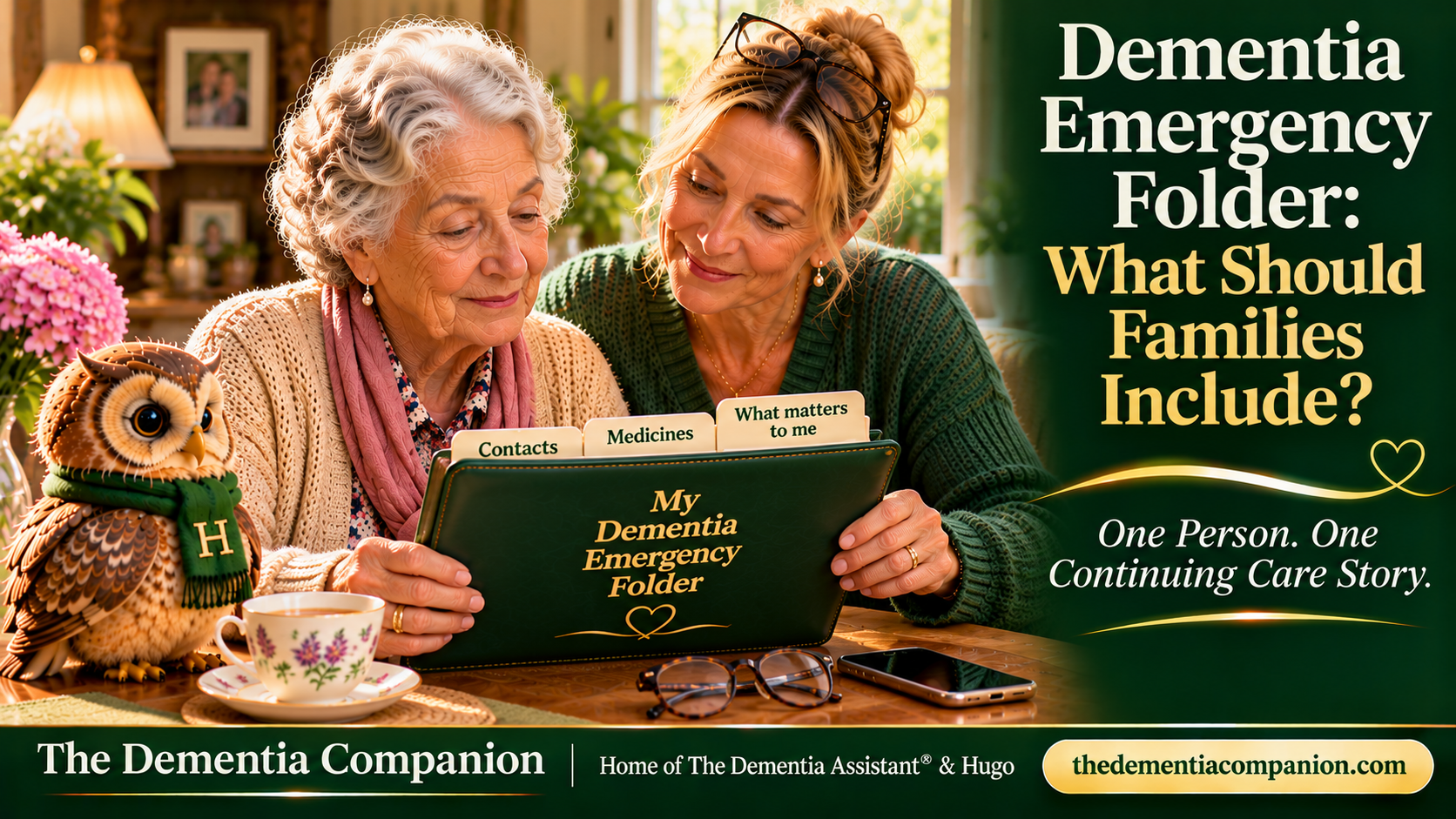
The GP has one record, the hospital has another, and Mum’s medication list is apparently somewhere very safe. Here’s how to prepare for an emergency without losing sight of the person.
By Louise Donaghy, Dementia Practitioner, Founder of The Dementia Companion and The Dementia Assistant®, Creator of Hugo Intelligence™
It usually happens when you least expect it.
Mum has been feeling reasonably well.
You’ve had a lovely afternoon together.
The kettle has barely cooled down.
Then suddenly something happens.
Perhaps Mum becomes unwell.
Perhaps she has a fall.
Perhaps an ambulance needs to be called.
Or perhaps you, the person who normally provides her support, have an emergency of your own.
And within minutes, somebody asks:
“What medication is Mum taking?”
“Does she have any allergies?”
“Who is her GP?”
“Has she got an advance care plan?”
“Who should we contact?”
You know the answers.
Well, most of them.
The medication list is probably in the kitchen drawer.
Unless your brother took it to the last appointment.
The hospital letter is somewhere upstairs.
And the telephone number you need is saved under a name that made perfect sense when you entered it six months ago.
Suddenly, your house resembles the opening scenes of a detective programme.
Except nobody is enjoying the mystery.
A dementia emergency information folder is a simple way to keep the person’s essential contacts, health information, medication details, communication needs, care arrangements and relevant documents together, so they can be found quickly when needed.
It can be a physical folder, a secure digital record or a combination of both.
It doesn’t need to be enormous.
It doesn’t need to contain every document the person has ever received.
And it certainly doesn’t replace professional medical records.
But having important information organised can help families explain what matters when another professional or service becomes involved.
Most importantly, the person living with dementia should be involved in preparing it wherever possible.
Because this isn’t just an emergency folder.
It’s information about their life, their health, their wishes and the support they want.
What is a dementia emergency information folder?
A dementia emergency information folder is a collection of essential information that may be useful if someone living with dementia becomes unwell, needs hospital treatment, experiences an unexpected change in care or temporarily loses access to their usual support.
Think of it as the important information you would want to find quickly.
Not the entire history of Mum’s life from 1943 onwards.
Although, knowing some mums, they could probably provide a fairly comprehensive account.
The folder might include:
- Important contact details.
- Relevant diagnoses and health conditions.
- A current medication list and allergies.
- Communication and language preferences.
- The person’s usual abilities and routines.
- Existing care and support arrangements.
- Relevant advance care documents, if they exist.
- Information needed if the usual family carer becomes unavailable.
Dementia UK recommends keeping essential information about the person together so it can be found quickly if they become unwell.
Alzheimer’s Society also recommends preparing personal information that helps hospital staff understand someone living with dementia.
But a folder should never be treated as a substitute for calling emergency services or seeking medical assessment.
When somebody needs urgent help, get the help first. The paperwork comes afterwards.
What should go on the first page of a dementia emergency folder?
I would start with a single-page summary.
Something clear.
Easy to read.
And useful to a person who has never met Mum before.
It could include:
The person’s identity
Their full name, preferred name and date of birth.
An NHS or other relevant health identifier may be included where known and appropriate.
Emergency contacts
The people Mum wants contacted, including their relationship to her and telephone numbers.
Important health information
Relevant diagnoses, significant medical conditions and allergies.
Medication information
Where to find the current, professionally confirmed medication list.
Communication preferences
How Mum prefers to be addressed, her preferred language and any hearing, sight or communication difficulties.
Usual abilities
What Mum normally manages independently and where she receives assistance.
Important professional contacts
Her GP, relevant specialist services and current care providers.
Other relevant documents
Where to find any existing advance care, emergency treatment or legal documents.
Date checked
When the information was last reviewed.
Keep this first page concise.
If emergency professionals need further information, the remaining sections can provide more detail.
And remember that some sensitive information should be held securely rather than displayed openly.
The aim is to make relevant information accessible to the right people without unnecessarily exposing the person’s private life.
What medical information should families include?
A useful emergency folder should provide an accurate overview of relevant health information.
This might include:
- Confirmed dementia diagnosis, where applicable.
- Other significant health conditions.
- Important allergies and known adverse medication reactions.
- Recent hospital discharge summaries.
- Relevant professional assessments.
- Current care instructions.
- Details of medical devices or essential equipment.
- Any important risks already identified by professionals.
But please avoid turning the folder into your own version of a medical diagnosis.
For example, if Mum has recently been more tired, record that observation separately rather than adding a new condition to her health summary.
If you are unsure whether information is accurate, ask the relevant healthcare professional.
A family-held record should reflect confirmed health details and clearly distinguish them from everyday observations.
Good information is accurate information, not simply more information.
Why is an up-to-date medication list so important?
Medication information can become confusing very quickly.
Mum may have prescriptions from her GP.
A hospital may have changed something during a recent admission.
A specialist may have recommended another treatment.
And the kitchen cupboard may still contain an old packet that looks suspiciously similar to the current one.
A little organisation helps.
Keep an accurate, current list that includes:
- The full name of each prescribed medicine.
- Strength and prescribed dose.
- Timing and directions for use.
- Relevant allergies and known adverse reactions.
- Important instructions from the prescriber or pharmacist.
- Non-prescription medicines and supplements being taken.
Ask the GP practice or pharmacist for an updated list if necessary.
NICE recommends that people and their carers, where appropriate, receive accurate information about medicines, particularly when care transfers between settings.
Do not use an old family list to decide what medication someone should take.
If records disagree, ask the prescriber or pharmacist to clarify.
And don’t make medication changes based on advice from Hugo or an AI conversation.
Hugo can help you prepare questions.
He cannot authorise prescriptions.
Why should the emergency folder include Mum’s usual abilities?
This is one of the most useful things a family can explain.
Imagine Mum arrives at hospital after becoming suddenly unwell.
She’s unusually quiet.
She’s finding it difficult to follow conversations.
And she’s struggling with something she normally manages independently.
How will the hospital know this is different from her usual abilities?
A short description of her normal routine can help.
For example:
“Mum normally walks independently around her home, prepares her breakfast and enjoys conversations with family. She usually recognises familiar people and can express her preferences when given time.”
That information gives professionals useful context.
It doesn’t diagnose what has happened.
But it may help explain how her current presentation differs from her usual self.
This matters because sudden confusion or an abrupt change in alertness may indicate an acute medical problem, including delirium.
It should not automatically be assumed to be dementia progression.
The NHS advises calling 999 for sudden confusion.
The important message is simple.
When something changes suddenly, tell the professionals what is different.
What should staff know about Mum as a person?
Now we come to something I feel particularly strongly about.
An emergency folder should never be only about illness.
It should also help someone understand the person receiving care.
Perhaps Mum prefers to be called Margaret rather than Maggie.
Perhaps she becomes uncomfortable when several people speak at once.
Perhaps she needs extra time to answer questions.
Perhaps she prefers somebody to explain what is happening before beginning personal care.
Perhaps she finds a familiar photograph reassuring.
Perhaps she enjoys talking about her grandchildren.
These details may help unfamiliar professionals communicate more effectively.
Alzheimer’s Society provides a resource called This is me, which helps record personal information for hospital and other care settings.
It can be used alongside the family’s own records.
What might a person-centred introduction say?
For example:
“My name is Margaret, but I prefer to be called Maggie. I enjoy gardening and talking about my grandchildren. Please speak directly to me, explain what is happening and give me time to answer. I wear hearing aids and find noisy environments difficult.”
That’s a much better introduction than:
“Elderly female with dementia.”
The diagnosis matters.
But it doesn’t tell somebody who Maggie is.
One person. One continuing care story.
And that story begins with the person, not the paperwork.
Should we include Mum’s preferred language?
Absolutely.
Language is part of identity.
And it can make a significant difference to how comfortable somebody feels when they are frightened, unwell or surrounded by unfamiliar people.
Perhaps Mum prefers Welsh.
Perhaps she grew up speaking Irish.
Perhaps another family member communicates in Hindi, Spanish, French or another language.
Some people living with dementia experience changes in how easily they use different languages, although this varies between individuals.
Record the person’s preferred language and any communication support they need.
For example:
“Mum is comfortable speaking English but prefers Welsh when tired or distressed. Please arrange appropriate interpretation if needed.”
Healthcare services should arrange qualified interpreters where necessary for important clinical discussions.
A family member or AI translation tool should not automatically replace professional interpreting for consent, treatment decisions or complex medical information.
The Dementia Assistant® provides multilingual capabilities that can help families organise care information, but clinical instructions still need appropriate professional verification.
Understanding someone’s language preferences is part of understanding the person.
Should an emergency folder contain advance care plans or legal documents?
It may be helpful to record whether relevant documents already exist and where they can be found.
For example:
- An advance care plan or advance statement.
- An advance decision to refuse treatment, where applicable.
- A ReSPECT or other emergency treatment plan.
- A Do Not Attempt Cardiopulmonary Resuscitation (DNACPR) form, if one has been made.
- A relevant power of attorney or other legal authority.
- Details of the professionals responsible for those arrangements.
But there are important distinctions.
A DNACPR decision concerns cardiopulmonary resuscitation. It does not mean somebody should receive no other treatment or care.
A ReSPECT plan records recommendations about emergency care and treatment and is not used in every local service.
Advance decisions have particular legal requirements, which vary according to the type of document and the relevant UK jurisdiction.
A dementia diagnosis must never, by itself, be treated as justification for a DNACPR decision.
And an informal family note is not a substitute for a legally valid document or professionally completed emergency treatment plan.
If Mum has relevant documents, ask the appropriate healthcare or legal professionals how they should be recorded, updated and made available.
Don’t invent an emergency treatment decision simply because there’s a section in the folder for one.
The person’s wishes should be explored respectfully, not turned into decisions they never made.
What if the usual family carer suddenly becomes unavailable?
This is the part of emergency planning that families sometimes forget.
We spend so much time thinking about what might happen to Mum that we forget something could happen to the person supporting her.
Perhaps Dad provides most of her care.
Then Dad becomes unwell.
Perhaps you usually visit every morning.
But you unexpectedly need hospital treatment yourself.
Or perhaps a family member is delayed and cannot provide the support they had arranged.
Who would step in?
Carers UK recommends preparing a contingency plan so that appropriate support can continue when a regular carer becomes unexpectedly unavailable.
A family emergency plan might include:
Who to contact first
Name a person who has agreed to help, with an alternative contact where possible.
What support is essential
Identify the daily assistance that cannot safely be missed.
Who normally provides that support
Record relevant care providers, agreed schedules and professional contacts.
What the replacement carer needs to know
Include communication preferences, routines, relevant health information and appropriate care instructions.
What happens if nobody in the family is available
Keep contact details for the relevant local care or social care service and any agreed emergency arrangements.
Discuss the plan with the people involved.
Don’t assume somebody will automatically be available simply because they’re related.
And don’t assign complex personal or medical care tasks to someone who isn’t able or appropriately trained to provide them.
An emergency plan works best when the people named in it actually know they’re part of the plan.
What if Mum goes missing or becomes lost?
Not everyone living with dementia experiences difficulties finding their way around.
And dementia should never automatically mean somebody loses the freedom to go outside.
But if a person has previously become lost or may be at risk of going missing, families can consider additional preparation.
The Herbert Protocol is a recognised UK police initiative designed to help locate people living with dementia who go missing.
It allows relevant details to be recorded in advance.
Depending on the scheme and local arrangements, this may include:
- The person’s identity and a recent photograph.
- Important health information.
- Familiar places they may visit.
- Previous addresses or meaningful locations.
- Communication needs.
- Emergency contacts.
The Herbert Protocol does not replace reporting someone missing.
If the person goes missing and there is immediate danger, call 999. Contact the police promptly when someone is missing and you are concerned for their safety; do not wait 24 hours.
Ask the local police service about current arrangements for completing and storing the relevant information.
A copy of the necessary details, or information about where they are securely held, may be included in the family’s emergency planning.
The aim is to support safety while respecting the person’s independence and dignity.
Should our dementia emergency folder be paper or digital?
Both can have advantages.
A physical folder
A paper folder can be easy to locate during an unexpected hospital visit.
You don’t need to remember a password.
You don’t need an internet connection.
And you can quickly find important contacts or a current medication list.
But paper records can become outdated, misplaced or seen by people who shouldn’t have access.
A digital care record
A digital record may be easier to update, organise and keep available to authorised users.
Documents can be stored together.
Daily observations can be added.
Care information can continue as professional services change.
But don’t assume emergency responders will automatically be able to access the person’s digital account.
There may be internet problems, login restrictions or uncertainty about who has permission.
My preferred practical approach
Use a short, up-to-date paper emergency summary alongside securely maintained digital care information, if that works for the person.
Keep the paper folder somewhere that appropriate people know how to find.
Respect privacy.
Avoid displaying unnecessary sensitive information.
And make sure the digital record has an appropriate way to retrieve relevant documents.
You can also consider providing a concise care passport when someone attends hospital.
The important thing is not whether the folder is clever. It’s whether the right information can actually be found when needed.
Where should families keep the emergency folder?
Choose a place that is practical for the person and the people they have agreed should help.
It might be a clearly identified folder in a familiar location.
But remember that health information is sensitive.
Don’t leave detailed documents openly accessible to visitors or share unrestricted copies with the entire family.
Avoid putting banking passwords, account login details or unrelated financial information into an emergency folder.
If someone needs legal or financial documents, keep those securely and record where authorised people can find them.
With Mum’s involvement where possible, agree who needs access to the emergency information and how they can obtain it.
Some families use an emergency information scheme such as Lions’ Message in a Bottle, but arrangements and availability can vary locally.
The aim is straightforward.
Easy for the right people to find. Protected from people who don’t need to see it.
How often should a dementia emergency information folder be updated?
There isn’t a single update schedule that fits every family.
But I would recommend checking the information whenever something important changes.
For example:
- A medication is started, stopped or altered.
- There is a new allergy or confirmed health concern.
- The person moves home.
- An emergency contact changes.
- A care agency or key professional changes.
- The person’s mobility or communication needs change.
- A hospital admission results in new instructions.
- Relevant legal or advance care documents are completed or updated.
It’s also sensible to review the folder periodically even when life is relatively settled.
Put the date of the last review on the front page.
And if a document has been replaced, make sure an old version doesn’t remain in circulation as though it were current.
The folder should reflect the person’s life today.
Not the life they were living eighteen months ago.
How can The Dementia Assistant® help families organise emergency information?
This is one of the reasons I created The Dementia Assistant®.
When someone is living with dementia, their care may involve several different services over time.
The GP.
The memory clinic.
The hospital.
Community nurses.
Home care providers.
Specialist services.
Each organisation has its own appropriate professional records.
But families may still find themselves gathering and repeating the same information.
The person’s routines.
Their current support needs.
Important documents.
Professional contacts.
Changes in everyday life.
The details that help others understand the individual.
The Dementia Assistant® was created to give people living with dementia and their families their own continuing place for care information.
Within the platform, families can maintain personalised care plans, organise relevant documents, record daily notes and preserve Life Story information.
They can keep important details available for future reference and prepare information for professional conversations.
The platform also offers document export features, which can be helpful when preparing relevant information for sharing.
But this is not an automatic connection to NHS, ambulance or other emergency service systems.
Clinical professionals must still obtain and verify the information they need.
The Dementia Assistant® complements professional records. It doesn’t replace them.
Meet Hugo Intelligence™: Helping families prepare before something happens
Sometimes the hardest part of emergency planning is knowing where to start.
Perhaps you’ve never prepared an emergency folder.
Perhaps Mum has several medical conditions.
Perhaps Dad provides most of the care and nobody else knows the daily routine.
Or perhaps you’re worried about missing something important.
You might ask:
“Hugo, Mum has dementia and I want to prepare an emergency information folder. Where should we begin?”
Or:
“Hugo, Dad is Mum’s main carer. What information should we organise in case he becomes unwell?”
Or:
“Hugo, can you help me prepare a person-centred summary of Mum’s needs for a hospital visit?”
Hugo Intelligence™ offers natural, conversational, person-centred dementia guidance within The Dementia Assistant®.
You can explain the situation in ordinary language.
Ask follow-up questions.
Explore practical planning questions.
And work through concerns without feeling judged.
Hugo can help you think about what information may be useful, identify questions for relevant professionals and explore person-centred approaches.
He cannot assess an emergency, make clinical decisions, verify prescriptions or create legal authority where none exists.
But he can help families prepare thoughtfully before urgent circumstances arise.
Hugo can use the person’s selected care plan
You can ask Hugo general dementia questions without selecting a care plan.
When you choose Mum’s individual care plan, Hugo can use relevant recorded information about her routines, strengths, preferences and circumstances to offer more personalised guidance.
For example, perhaps Mum’s care plan explains that she prefers to be called Maggie.
Perhaps she becomes distressed by unfamiliar surroundings.
Perhaps she needs additional time to understand questions.
Those details may help when discussing how to prepare relevant communication information for hospital staff.
Not simply an emergency folder for someone with dementia. An emergency folder that reflects Mum as an individual.
The family should still check the accuracy of any information before using it.
Save and organise your Hugo conversations
Emergency planning often happens gradually.
You might ask Hugo about medical information today.
Return to questions about communication next week.
Then revisit a conversation about carer contingency planning.
Within The Dementia Assistant®, you can save, categorise and organise Hugo conversations for later reference.
That means useful guidance doesn’t have to disappear into a long list of unrelated messages.
You can return to previous discussions and continue exploring the questions that matter.
Saved Hugo conversations are educational guidance, not verified clinical instructions or legally binding documents.
But they can help families maintain continuity in their preparation.
What if you need help at two o’clock in the morning?
Anyone supporting someone with dementia will recognise the feeling of remembering an important question just as the rest of the world seems to be asleep.
Perhaps you’re wondering whether you’ve included the right details in Mum’s care plan.
Perhaps you want to organise questions before tomorrow’s appointment.
Or perhaps you’re concerned that the family hasn’t agreed who would help in an emergency.
Hugo can provide a place to explore non-urgent planning questions and return to saved conversations.
But he is not an emergency response service or a substitute for out-of-hours healthcare.
In the UK, call 999 for life-threatening emergencies or sudden confusion. For urgent, non-life-threatening medical advice, NHS 111 operates in England, Scotland and Wales. In Northern Ireland, contact the appropriate GP out-of-hours or urgent care service.
If someone needs urgent medical assistance, seek it immediately. Don’t wait for an AI conversation.
Hugo’s multilingual support: Emergency information that respects the person’s language
Language can become especially important when someone is frightened or unwell.
Perhaps Mum prefers Welsh.
Perhaps Dad’s familiar language is Irish.
Perhaps family members speak Hindi, Spanish, French or another language.
Or perhaps someone living with dementia has difficulty explaining discomfort in English.
The Dementia Assistant® supports 12 interface languages and provides dictation and translation capabilities spanning 201 languages.
These tools can help families record observations, organise information and communicate across language barriers.
Dictation may make it easier to add notes.
Translation may help appropriately involved relatives understand the person’s care information.
And Hugo’s conversational approach allows families to ask questions naturally.
Not every feature is available in all 201 languages.
Important emergency, medication, consent and other clinical information must be checked for accuracy.
Qualified professional interpreters remain essential when needed for important healthcare decisions.
One person’s continuing care story should respect the language in which they feel most comfortable expressing themselves.
Can Family Circle help when relatives live in different places?
Absolutely.
Families are not always conveniently located five minutes from one another.
One relative may live nearby.
Another might be several hours away.
A third may live in another country.
And when something unexpected happens, everyone understandably wants accurate information.
The Dementia Assistant® includes Family Circle features to support relevant family updates and communication, subject to appropriate access permissions.
But not every relative needs access to every document.
The person’s wishes and privacy must remain central.
Agree who needs to be contacted in an emergency and who is authorised to receive information.
And remember that Family Circle is a communication and support feature, not a substitute for contacting emergency services or the responsible professionals.
A practical dementia emergency information checklist
You can use this list to build your own folder.
Start with the essentials and add other information gradually.
Essential personal information
- [ ] Full name, preferred name and date of birth.
- [ ] Relevant NHS or health identifier, if known.
- [ ] Emergency contacts and agreed alternative contacts.
- [ ] GP and relevant specialist contact details.
- [ ] Preferred language and communication needs.
- [ ] Current key health information.
- [ ] Allergies and important adverse reactions.
- [ ] Location of the current medication list.
Person-centred care information
- [ ] Usual abilities and independence.
- [ ] Important routines and preferences.
- [ ] What helps the person feel comfortable.
- [ ] Relevant mobility or personal care needs.
- [ ] Sensory and communication aids.
- [ ] Eating, drinking and swallowing instructions where professionally assessed.
- [ ] The person’s wishes about who should be involved.
Professional and legal information
- [ ] Relevant current professional care plans.
- [ ] Important recent hospital or specialist documents.
- [ ] Current professional treatment instructions.
- [ ] Existing advance care or emergency treatment documents, if applicable.
- [ ] Details of relevant legal authority, if any.
- [ ] Information about where original documents are securely held.
Family and contingency arrangements
- [ ] Who normally provides support.
- [ ] Backup contact who has agreed to help.
- [ ] Current care provider details.
- [ ] Essential support that cannot safely be missed.
- [ ] Relevant emergency or contingency plan.
- [ ] Herbert Protocol information, if appropriate.
- [ ] Date the folder was last checked.
You don’t need everything completed this afternoon.
Begin with one page.
Then build from there.
Start with one page, not a filing cabinet
I want to finish with something that might make this feel a little more manageable.
An emergency folder sounds terribly official.
It sounds as though you should own a label maker, colour-coded dividers and a particularly impressive collection of plastic wallets.
And if you do, wonderful.
I’m sure they’re beautiful.
But you don’t need to build an administrative department in the spare bedroom.
Start with Mum.
Ask what she wants people to know.
Write down the important contacts.
Get the medication information checked.
Record how she normally communicates.
Make sure somebody knows where the information is kept.
And then put the folder away.
Go and have that cup of tea.
Take Mum into the garden.
Watch something together.
Laugh about something ridiculous.
Because the purpose of preparing for an emergency isn’t to spend every day worrying about one.
It’s to help protect the person’s safety, dignity, choices and continuing care when life doesn’t go quite according to plan.
And to give families a little more confidence that important information won’t disappear at the very moment they need it.
⸻
Ask Hugo: Dementia Emergency Information Questions
Hugo, what should I put in Mum’s dementia emergency folder?
Hugo 🦉: Start with Mum’s identity, emergency contacts, relevant health information, current medication details, allergies, communication needs and usual abilities.
Add relevant professional documents and information about her support arrangements.
Keep the information accurate, secure and easy for authorised people to find.
Can Hugo help me prepare the folder?
Hugo 🦉: Yes. I can help you explore what information may be useful and organise questions about the different sections.
The Dementia Assistant® also provides care planning, daily notes and document organisation.
Always check medical and legal information with the appropriate professionals.
Can Hugo use Mum’s own care plan?
Hugo 🦉: Yes, when you select Mum’s care plan.
I can use relevant recorded information about her preferences, routines and needs to provide more person-centred suggestions.
Without a selected plan, I can still offer general dementia guidance.
Can I save our conversations with Hugo?
Hugo 🦉: Yes. You can save, categorise and organise our conversations within The Dementia Assistant®.
That allows you to revisit information and continue preparing gradually.
What if Dad is Mum’s main carer and he suddenly becomes ill?
Hugo 🦉: It’s important to have an agreed contingency plan.
Consider who can help, what support Mum needs and which local professional services should be contacted.
Carers UK offers guidance on preparing emergency plans for unpaid carers.
Should we include Mum’s power of attorney documents?
Hugo 🦉: If relevant legal arrangements exist, it may be useful to record where the documents can be found.
Different documents provide different forms of authority.
I can explain general principles, but qualified legal advice may be needed to understand their scope.
Should we include DNACPR or ReSPECT information?
Hugo 🦉: Only if relevant professional decisions or plans already exist.
These documents have specific meanings and must not be created or interpreted casually.
A dementia diagnosis alone is not a reason for a DNACPR decision.
Ask the healthcare team how any existing documents should be recorded and made available.
Can the folder help if Mum goes missing?
Hugo 🦉: A relevant Herbert Protocol record may help police locate a person living with dementia who goes missing.
Ask your local police service about current arrangements.
If someone goes missing, contact the police promptly. Call 999 if there is immediate danger.
Can Hugo help if our family speaks different languages?
Hugo 🦉: The Dementia Assistant® supports 12 interface languages and dictation and translation capabilities spanning 201 languages.
These tools can help families organise and communicate information across languages.
Important clinical and emergency information must be checked for accuracy.
Can Family Circle help keep the family informed?
Hugo 🦉: Family Circle can support appropriate sharing of relevant updates with involved relatives.
The person’s wishes, privacy and access permissions should guide what is shared.
Can Hugo help during a medical emergency?
Hugo 🦉: I am not an emergency service and cannot assess an urgent medical situation.
If someone is seriously unwell, suddenly confused or in immediate danger, contact the appropriate medical or emergency service.
I can help with non-urgent preparation and general educational questions.
How much does The Dementia Assistant® cost?
Hugo 🦉: The Family subscription is £4.99 per month.
Every subscription includes a 30-day complimentary trial.
You can explore Hugo Intelligence™, person-centred care planning, daily notes, document organisation, saved conversations, Family Circle and multilingual support.
⸻
One Person. One Continuing Care Story.
When someone living with dementia needs emergency care, different professionals and organisations may become involved.
Ambulance services.
Hospitals.
GPs.
Community nurses.
Care providers.
And perhaps other specialist teams.
Each has important responsibilities and professional records.
But the person living with dementia and their family should also have their own continuing place for information.
A place to preserve wishes and preferences.
A place to organise relevant health documents.
A place to maintain important contacts.
A place to record routines and communication needs.
A place to prepare for unexpected changes.
And with Hugo Intelligence™, a place to have supportive conversations, save guidance, explore personalised approaches and use multilingual tools.
The Dementia Assistant® was created to help people living with dementia and their families maintain their own continuing care information, independently of any one care provider.
It doesn’t replace emergency services, professional medical records or clinical decision-making.
It complements them.
Different professionals. Different services. One person. One continuing story.
Would You Like Hugo to Help You Get Started?
If you’ve been meaning to organise Mum’s important care information but don’t know where to begin, ask Hugo to help you think through the essential sections.
Within The Dementia Assistant®, you can use:
- Hugo Intelligence™ for natural, person-centred conversations.
- Guided care planning and ongoing updates.
- Family-held continuing care plans.
- Daily notes and observations.
- Relevant documents and care information.
- Saved and categorised Hugo conversations.
- Family Circle, Life Story and Memory & Moments.
- Multilingual dictation and translation.
- Dementia learning and practical resources.
Created by dementia practitioner Louise Donaghy and powered by Person-Centred Intelligence®, The Dementia Assistant® helps families keep the person at the centre of their continuing care story.
Every subscription includes a 30-day complimentary trial.
https://thedementiaassistant.com/
The Dementia Companion, home of The Dementia Assistant® and Hugo 🦉
https://thedementiacompanion.com/
Louise and Hugo ❤️🦉
Louise Donaghy
Founder & CEO of The Dementia Assistant®
Created and powered by Person-Centred Intelligence®
Creator of Hugo Intelligence™
⸻
Continue Exploring Dementia Care and Support
Ask Hugo: Everyday Dementia Questions
https://thedementiacompanion.com/ask-hugo/
Inside The Dementia Assistant®
https://thedementiacompanion.com/inside-the-app/
⸻
References and Further Reading
- Dementia UK: Caring for Someone With Dementia From a Distance
Includes advice on keeping important care information together, relevant documents and planning for unexpected changes.
- Alzheimer’s Society: This Is Me
A personal information resource for helping professionals understand the person living with dementia.
https://www.alzheimers.org.uk/get-support/publications-factsheets/this-is-me
- Alzheimer’s Society: Preparing for a Hospital Stay
Information about preparing relevant details, medicines, communication aids and personal information for hospital care.
https://www.alzheimers.org.uk/get-support/help-dementia-care/going-into-hospital
- Carers UK: Creating a Contingency Plan
Guidance about planning for unexpected situations when a regular carer becomes unavailable.
https://www.carersuk.org/help-and-advice/practical-support/creating-a-contingency-plan
- NHS: When to Call 999
Official guidance about life-threatening emergencies and obtaining immediate medical assistance.
https://www.nhs.uk/nhs-services/urgent-and-emergency-care-services/when-to-call-999/
- NHS: Sudden Confusion (Delirium)
Explains why sudden confusion requires immediate medical assessment.
https://www.nhs.uk/symptoms/confusion/
- NICE: Medicines Optimisation (NG5)
Professional recommendations about accurate medication lists and medicines reconciliation.
https://www.nice.org.uk/guidance/ng5/chapter/recommendations
- NHS: DNACPR Decisions
Information about what DNACPR decisions mean and why they must not be based simply on a dementia diagnosis.
- Resuscitation Council UK: Emergency Treatment Plans and CPR Decisions
Information about ReSPECT, emergency treatment recommendations and DNACPR decisions.
https://www.resus.org.uk/professional-library/faqs/faqs-decision-making-cpr
- Dementia UK: The Herbert Protocol
Information about preparing relevant details to assist police if a person living with dementia goes missing.
https://www.dementiauk.org/information-and-support/living-with-dementia/herbert-protocol/
- NHS: Managing Legal Affairs for Someone With Dementia
Information about advance planning, powers of attorney and recording future wishes.
https://www.nhs.uk/conditions/dementia/care-and-support/legal-issues/
- NHS England: Health and Care Passport
Guidance about recording personal health needs, preferred communication and information that helps professionals understand the individual.
https://www.england.nhs.uk/long-read/health-and-care-passport-plain-english/
⸻
Important information: This article provides general educational guidance and does not replace emergency services, medical assessment, legal advice or professional care planning. Information-sharing arrangements, emergency care documentation and relevant legislation differ across UK nations. In a medical emergency, seek immediate help rather than relying on a family-held folder or AI system.
Reviewed: 21 November 2026
You May Also Find Helpful
Need help with your own situation? Ask Hugo.
One Person. One Continuing Care Story. The Dementia Companion is where you discover guidance. Inside The Dementia Assistant®, talk with Hugo, save and categorise conversations, record daily notes and involve authorised supporters in a continuing care plan centred around the person.
Ask Hugo About This · Start Your Continuing Care Plan — Families · Continuing Care Planning — Professionals
Personal guidance requires the appropriate account and subscription access. Care-plan information is used only with authorised access and the required consent and selection steps. All subscription plans include a 30-day complimentary trial.