Can Mum Still Drive After a Dementia Diagnosis? What Families Need to Know
Can Mum Still Drive After a Dementia Diagnosis? What Families Need to Know
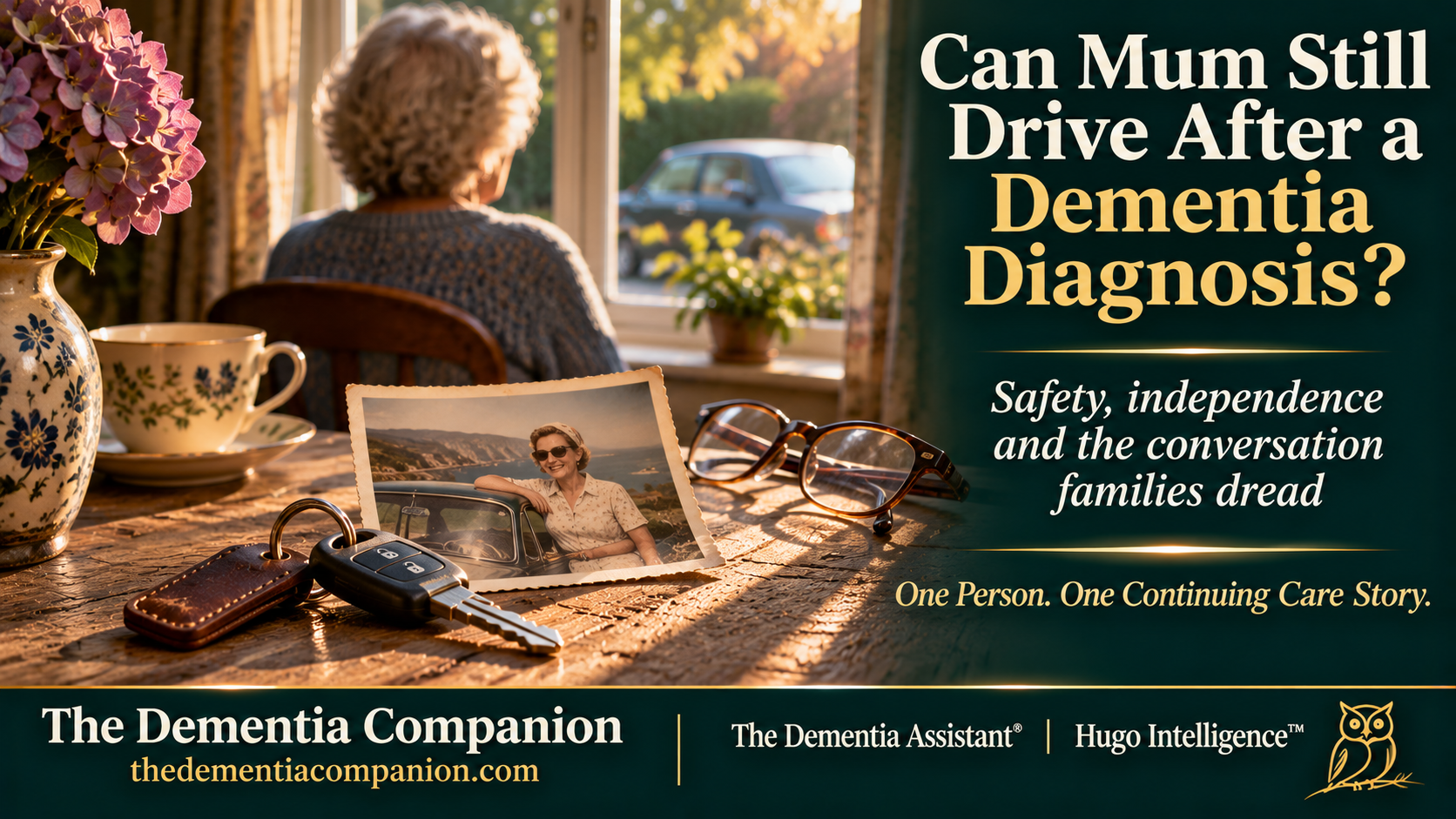
The car keys are on the kitchen table. Mum says she’s perfectly capable of driving. You’re worried about her safety. And nobody wants to be the person who takes away something that means so much to her.
By Louise Donaghy, Dementia Practitioner, Founder of The Dementia Companion and The Dementia Assistant®, Creator of Hugo Intelligence™
“I’ve been driving for fifty years!”
Mum says it quite firmly.
And she’s right.
She’s driven children to school.
Taken the family on holidays.
Collected grandchildren.
Navigated unfamiliar towns long before anybody invented a satnav.
And, according to Dad, she’s spent approximately forty years telling him he’s taken the wrong turning.
Now she’s been diagnosed with dementia.
And somebody has mentioned that she might need to stop driving.
Mum is furious.
Her daughter is worried.
Her son thinks the car keys should disappear.
And Dad, who hasn’t driven much himself lately, is wondering how on earth they’re going to get to the supermarket.
Suddenly, a dementia diagnosis has created a family argument that nobody wanted.
But underneath it is a much more difficult question.
Can someone with dementia still drive safely after a diagnosis?
The answer depends on the person’s abilities, the effects of their dementia, the medical assessment and the driving laws where they live.
In Great Britain, a dementia diagnosis must be reported to the Driver and Vehicle Licensing Agency (DVLA). Northern Ireland has a separate Driver & Vehicle Agency (DVA).
A diagnosis does not automatically mean someone must surrender their licence immediately, but they must follow the relevant legal and medical requirements.
In the United States, driving rules and reporting requirements vary by state.
Other countries have their own assessment and licensing arrangements.
The important thing is that driving safety must be assessed individually, while recognising that being able to drive is often deeply connected to a person’s identity, independence and freedom.
And that is where I would like this conversation to begin.
Not with somebody snatching the keys.
Not with everybody arguing about what Mum can no longer do.
But with understanding what driving means to her, recognising any genuine safety concerns and finding a way forward that respects both her dignity and the safety of other people.
Because dementia care should never be about unnecessarily taking away someone’s independence.
But neither should we ignore a serious risk simply because the conversation is difficult.
Does a dementia diagnosis mean someone must stop driving immediately?
Not always.
And this is an important distinction.
Some people living with dementia may continue driving safely for a period after diagnosis, depending on their symptoms, medical advice and the licensing authority’s decision.
Others may already have difficulties that make driving unsafe.
Dementia affects people differently.
The type of dementia, which abilities are affected and how the condition progresses can all influence driving.
For example, some people may initially experience relatively mild memory difficulties while retaining other abilities needed for driving.
Others may experience difficulties with attention, spatial awareness, judgement, reaction time or understanding changing road conditions.
These difficulties can affect driving even when a person still remembers familiar routes.
Having driven safely for fifty years doesn’t guarantee that somebody can drive safely today.
But equally, receiving a diagnosis should not automatically be treated as proof that the person has lost every relevant ability.
The correct approach is to follow the legal requirements and obtain the appropriate assessment.
In the UK, the DVLA or DVA determines whether the driver meets the licensing standards.
In the USA and other countries, the appropriate state, provincial or national licensing authority applies its own rules.
If the person’s doctor has advised them not to drive, or there is a serious immediate safety concern, they should not continue driving while waiting for a decision.
What does UK law say about driving with dementia?
The UK has an important distinction between Great Britain and Northern Ireland.
England, Scotland and Wales
If someone has been diagnosed with dementia, they must notify the DVLA.
This is a legal requirement.
They must also inform their motor insurance provider.
The DVLA may seek information from the person’s doctor or specialist.
In some cases, it may request a practical driving assessment.
Depending on the evidence, the DVLA may decide that the person can continue driving, sometimes with a shorter-term licence and further reviews.
Or it may determine that the person is no longer medically fit to drive.
It is the DVLA’s responsibility to make the licensing decision, not the family’s responsibility to decide whether a licence remains valid.
However, families and healthcare professionals should raise relevant safety concerns.
And a person must not continue driving against medical advice or after a licensing decision requiring them to stop.
The official starting point is:
https://www.gov.uk/dementia-and-driving
Northern Ireland
In Northern Ireland, the relevant organisation is the Driver & Vehicle Agency, known as the DVA.
A person diagnosed with dementia must notify the DVA and their motor insurance company.
The DVA may request medical information or a driving assessment before making a decision.
Families should use Northern Ireland’s own procedures rather than assuming the DVLA arrangements apply.
Official guidance:
https://www.nidirect.gov.uk/articles/staying-independent-dementia
What if Mum hasn’t told the DVLA or DVA?
Don’t ignore it.
If Mum has received a dementia diagnosis and hasn’t notified the appropriate authority, help her understand the requirement and arrange for the notification to be made.
If she is confused about the process, ask her GP or dementia specialist for guidance.
Do not assume that the GP has automatically completed the notification for her.
And remember that failing to notify the licensing authority can have legal consequences.
Being open about the diagnosis is part of protecting Mum, her insurance position and the safety of other road users.
Can Mum continue driving while the DVLA is reviewing her case?
This depends on the circumstances.
A notification does not always mean the person must immediately stop driving while the DVLA considers their case.
However, they must meet the relevant legal requirements, follow medical advice and have valid insurance.
If a clinician has advised Mum not to drive, she should stop.
If her licence has been revoked or she has been told she must not drive, she cannot simply continue because she feels confident.
And if there’s evidence that her driving is unsafe, the family should not treat the pending assessment as permission to take risks.
Ask the doctor and the licensing authority to clarify what applies.
Never interpret a delay in paperwork as proof that somebody is safe to drive.
What are the warning signs that someone with dementia may no longer be driving safely?
This is where families often begin noticing changes.
Perhaps Mum has always been a confident driver.
But recently, something feels different.
She becomes anxious at roundabouts.
She misses familiar turns.
She has difficulty parking.
Or she seems uncertain when another driver behaves unexpectedly.
The US National Institute on Aging and Alzheimer’s Association identify several signs that may indicate driving is becoming unsafe.
These include:
- Getting lost on familiar routes.
- Becoming confused at junctions.
- Difficulty following road signs or traffic signals.
- Problems judging distances or speed.
- Delayed responses to hazards.
- Unexpected or unsafe lane changes.
- Difficulty parking or manoeuvring.
- New dents, scrapes or unexplained vehicle damage.
- Near misses or collisions.
- Becoming unusually anxious, confused or angry while driving.
- Difficulty responding to unexpected traffic situations.
Not every individual difficulty proves that dementia is the cause.
Vision problems, medication effects, physical illness and other conditions can also affect driving.
But concerns deserve appropriate assessment.
What if Mum only drives to the local supermarket?
This is a common argument.
“But she only goes to the shops.”
“She knows the roads.”
“She’s never had an accident.”
Those things may be reassuring.
But familiar routes can still contain unexpected hazards.
A child steps into the road.
Traffic lights fail.
A cyclist appears.
Another driver makes a mistake.
Driving safely requires more than remembering how to reach a destination.
It requires recognising and responding appropriately to changing situations.
Driving close to home does not automatically make unsafe driving safe.
If there are concerns, ask for a professional assessment rather than relying solely on how familiar the journey is.
What if Mum says she’s a perfectly good driver?
She may genuinely believe she is.
And she may be right that she still has some abilities needed for driving.
But dementia can sometimes affect insight into difficulties.
That means a person may not fully recognise that their judgement, reactions or attention have changed.
Equally, families can become anxious after a diagnosis and begin interpreting every small mistake as evidence that driving is unsafe.
Neither assumption is particularly helpful.
Try to bring the discussion back to specific observations.
Instead of saying:
“Mum, you can’t drive because you’ve got dementia.”
You might say:
“Mum, I’ve noticed you’ve been finding some junctions more difficult recently. Could we ask the doctor about a driving assessment so we understand what’s happening?”
Or:
“I know driving matters to you. I want us to make sure you’re safe and that we’re following the right rules.”
This approach recognises Mum’s perspective without dismissing the concern.
It also makes the discussion about safety and evidence rather than winning a family argument.
How do I talk to Mum about stopping driving without upsetting her?
This may be one of the hardest conversations after a dementia diagnosis.
Because driving is rarely just about transport.
For many people, it’s about freedom.
Going where they want.
When they want.
Without asking permission.
Imagine Mum has been driving since she was seventeen.
She bought her first little car with money she’d saved from work.
She remembers driving to the seaside.
Taking the children on holiday.
Visiting friends.
And being able to pop to the shops whenever she fancied.
Now somebody is discussing whether she should hand over the keys.
Of course she might be upset.
She isn’t simply thinking about the car.
She may be thinking about what losing it represents.
Start with what driving means to her
You might say:
“Mum, I know how much being able to drive means to you.”
Then listen.
Perhaps she worries about becoming dependent.
Perhaps she doesn’t want to inconvenience anybody.
Perhaps she fears she’ll be stuck indoors.
Perhaps she’s worried about losing contact with friends.
Those concerns deserve attention.
Explain the actual concern
Avoid vague statements such as:
“You’re not safe anymore.”
Instead, describe relevant observations calmly.
“I was worried when we missed that junction and nearly turned into the wrong lane.”
Or:
“You seemed quite frightened when the traffic became busy. I’d like us to get some professional advice.”
Be accurate.
Don’t exaggerate.
And don’t invent examples to make the argument stronger.
Involve the appropriate professional
Sometimes hearing the information from a doctor or driving assessment specialist may make the discussion easier.
The family shouldn’t have to become the judge, jury and licensing authority.
Let the appropriate professionals assess the person’s fitness to drive.
Talk about what Mum will still be able to do
If driving needs to stop, don’t make the entire conversation about what she’s losing.
Talk about the places she wants to continue visiting.
The people she wants to see.
The activities that matter.
And how the family can help preserve those things.
Stopping driving should not automatically mean stopping living independently.
What if Mum becomes angry when we mention her car keys?
Anger may reflect several different experiences.
Fear of losing independence.
Frustration.
Feeling criticised.
Confusion about why the conversation is happening.
Or distress because people appear to be making decisions without involving her.
Try not to turn the discussion into an argument.
You might say:
“I know this is upsetting, Mum. We don’t have to discuss everything at once.”
Or:
“I understand that your car is important. We want you to keep doing the things you enjoy, and we need to make sure everyone is safe.”
If she becomes distressed, consider whether the conversation can safely be paused.
But if there’s an immediate danger that she will drive unsafely, the family should not simply postpone action.
Seek appropriate professional or emergency help.
Recognising Mum’s feelings doesn’t mean ignoring a serious safety concern.
Should I hide Mum’s car keys?
This is a question families sometimes ask when they’re frightened.
And I understand why.
Perhaps Mum has been told she must stop driving.
But she keeps picking up the keys.
Or perhaps the family has noticed serious driving difficulties and is worried she may go out alone.
The first step is to establish the legal and medical position.
Has the licensing authority made a decision?
Has the doctor advised her not to drive?
Is there evidence of immediate danger?
Try to involve Mum respectfully in arrangements wherever possible.
If she has been told she must stop driving, help her understand that decision and arrange alternatives.
If she cannot understand or follow the restriction and is attempting to drive, seek urgent advice about safe, lawful ways to prevent harm.
Depending on the circumstances, families may need guidance from healthcare professionals, the licensing authority or police.
Secretly removing keys should not become the default approach to dementia care.
It can damage trust, create distress and fail to address the person’s underlying concern.
But protecting someone from an imminent danger may require immediate practical action.
Always consider what is necessary, proportionate and lawful.
And remember that removing keys is not a substitute for establishing the proper driving and care arrangements.
What if Dad keeps asking to drive after his licence has been taken away?
This can be upsetting.
Perhaps Dad doesn’t remember the licensing decision.
Perhaps he remembers driving perfectly well for decades.
Perhaps he believes the car is still his responsibility.
And perhaps he becomes frustrated when he cannot find the keys.
Avoid repeatedly turning the situation into a confrontation.
You might say:
“Dad, the car isn’t available for you to drive now. I can take you where you need to go.”
Or:
“Where were you wanting to go? Let’s see how we can arrange it.”
If he’s worried about getting to work or completing a familiar responsibility, acknowledge what matters to him.
Perhaps:
“You’re thinking about getting everything organised. What is it you need to do?”
The person may need reassurance, a practical alternative or professional support to understand the change.
The aim isn’t to win the argument about the car. It’s to understand what Dad is trying to achieve and help him do it safely.
Can a driving assessment help us make the decision?
Yes.
Depending on the country and circumstances, a specialist driving assessment may help establish whether someone meets the required standard.
In Great Britain, the DVLA may request an on-road assessment as part of its licensing decision.
In Northern Ireland, the DVA has its own arrangements.
In the United States, occupational therapy driving rehabilitation specialists may assess relevant cognitive, physical and practical driving abilities.
But a private assessment doesn’t automatically override the legal authority responsible for issuing or maintaining a licence.
In Australia, driver licensing authorities may consider specialist medical information and practical assessment when determining whether a conditional licence is appropriate.
Ask the person’s clinician or licensing authority about the correct process.
What happens during an assessment?
Depending on the service, it may explore:
- Attention and concentration.
- Understanding of road situations.
- Visual and spatial abilities.
- Reaction and decision-making.
- Physical abilities relevant to driving.
- Practical performance behind the wheel.
The exact process varies.
Families shouldn’t attempt to create their own driving test by deliberately placing the person in difficult traffic situations.
If you already believe the person’s driving is dangerous, do not put yourself or others at risk to collect evidence.
A professional driving assessment is about understanding safety, not proving a family member wrong.
What happens when Mum really does have to stop driving?
This is where the conversation needs to become practical.
If Mum can no longer drive legally or safely, how will she continue living the life she enjoys?
Don’t simply take away the car and assume everything else will sort itself out.
Ask what journeys matter most to her.
Perhaps she wants to continue:
- Going to the supermarket.
- Visiting friends.
- Attending appointments.
- Going to church or another place of worship.
- Visiting the hairdresser.
- Meeting somebody for coffee.
- Attending a social group.
- Getting out into the countryside.
- Visiting grandchildren.
Then explore transport options.
These might include public transport, taxis, community transport schemes, volunteer drivers, family journeys or accessible transport services.
Availability, eligibility and cost vary by location.
Could the family organise a regular outing?
Perhaps Mum always drives to the supermarket on Thursday mornings.
Could that continue as a regular outing with someone else driving?
Perhaps she enjoys visiting the garden centre.
Could you make it part of your routine together?
Perhaps a friend could accompany her to a weekly group.
The practical arrangement matters.
But so does preserving choice.
Mum should still be able to say where she’d like to go, even when someone else is driving.
What about people who live alone?
Losing access to a car may have an especially significant impact on someone who lives alone.
They may rely on driving for shopping, social activities and appointments.
That makes planning alternative transport particularly important.
Consider discussing community resources, accessible transport and practical support with local services.
And remember that stopping driving is not automatically a reason to move house or lose control over everyday decisions.
What if Mum feels she’s lost her independence?
Please take that seriously.
For many people, giving up driving can feel like losing part of their identity.
They may experience sadness.
Anger.
Anxiety.
Frustration.
Or embarrassment about needing assistance.
These emotions deserve understanding.
Avoid saying:
“It’s only a car.”
Because to Mum, it may represent decades of freedom.
Instead, try:
“I know you’re going to miss driving. Let’s work out how we can keep you doing the things that matter.”
Ask her what worries her most.
Perhaps it’s being unable to visit friends.
Perhaps it’s relying on a family member.
Perhaps she fears becoming isolated.
Those are practical problems that may have practical solutions.
And if the loss is affecting her emotional wellbeing significantly, seek appropriate professional support.
Protecting safety should go hand in hand with protecting independence, connection and a sense of purpose.
What are the dementia driving laws in the United States?
For families in the USA, the rules depend on the state.
There is no single nationwide dementia notification or licensing process equivalent to the UK’s DVLA arrangements.
State departments of motor vehicles or other licensing agencies set relevant procedures.
Some states require certain medical conditions to be reported by specified professionals.
Others have different reporting, review or assessment arrangements.
A family should check the rules in the state where the person’s licence was issued and where they live.
The US Alzheimer’s Association recommends discussing driving early and considering a comprehensive evaluation by a driving rehabilitation specialist.
The National Institute on Aging also identifies warning signs that may suggest driving is unsafe.
These include difficulties with familiar routes, traffic decisions, vehicle control and unexpected road situations.
What should an American family do?
Begin with the person’s healthcare professional.
Explain any specific driving concerns.
Ask whether a specialist driving evaluation is appropriate.
Contact the relevant state DMV or licensing authority for the reporting and review requirements.
And if the person has been instructed not to drive, make sure the restriction is followed.
A clinical recommendation, family observation and legal licensing decision may have different roles.
All three can be relevant.
Official family guidance:
https://www.alz.org/help-support/caregiving/safety/dementia-driving
https://www.nia.nih.gov/driving-alzheimers
What about dementia and driving in Canada?
Canada has provincial and territorial driving rules.
Medical reporting responsibilities and licensing requirements vary.
The Alzheimer Society of Canada explains that doctors in most provinces have legal obligations to report medical conditions that may create serious road safety risks.
However, families should not assume that the same procedure applies in every province.
The person may need medical review and, depending on the location, an assessment of fitness to drive.
Ask the provincial or territorial licensing authority about the current requirements.
The Alzheimer Society of Canada also provides resources to help families recognise safety concerns and prepare for the transition away from driving.
Can someone with dementia still drive in Australia?
Australia has national medical fitness-to-drive guidance, but individual states and territories administer driver licensing.
Under the Austroads medical standards, a dementia diagnosis is incompatible with an unconditional private driving licence.
However, a conditional licence may be considered by the relevant licensing authority following appropriate specialist assessment and review.
This distinction matters.
A family shouldn’t assume that someone can continue driving without notifying the authority.
And they shouldn’t assume a conditional licence will automatically be granted.
Drivers have legal responsibilities to report medical conditions affecting safe driving, with the detailed process depending on their state or territory.
A doctor and the relevant driver licensing authority should explain what is required.
Official guidance:
https://www.healthdirect.gov.au/conditions/dementia/dementia-and-driving
What about driving with dementia in the Republic of Ireland?
In the Republic of Ireland, medical fitness-to-drive arrangements are overseen through the Road Safety Authority and National Driver Licence Service, known as the NDLS.
People with relevant medical conditions that affect their driving must follow the notification and medical reporting requirements.
A person diagnosed with dementia should discuss their driving with their doctor and follow the applicable NDLS procedures.
Medical reports and licensing decisions may be required.
Ireland has updated its medical fitness-to-drive guidance in 2026, so families should consult the current official information.
https://www.rsa.ie/services/licensed-drivers/medical-fitness
https://www.ndls.ie/medical-fitness
What if the family lives in another country?
The principles remain important internationally.
Driving may involve memory, attention, judgement, perception and the ability to respond safely to hazards.
But laws about reporting medical conditions, clinical assessment, driver licensing and insurance differ.
Families should contact the appropriate licensing authority and healthcare professional in the country or region where the person lives.
Don’t assume that a UK decision applies in the USA, or that an American medical assessment establishes legal permission to drive elsewhere.
If a family member is moving countries or intends to drive abroad, check the licensing and insurance requirements for that journey.
What should families record when driving becomes a concern?
This is where a short, factual record can be valuable.
Perhaps Mum has become anxious when driving.
Perhaps she’s taken an unfamiliar route home.
Perhaps there has been a collision or near miss.
Or perhaps a professional has recommended an assessment.
Try to record what happened without exaggerating or inventing an explanation.
Relevant information may include:
- The date and circumstances.
- What was actually observed.
- Whether there was an incident, near miss or safety concern.
- Any changes in vision, attention or other relevant abilities.
- What Mum said about the experience.
- Whether medical advice was sought.
- Whether DVLA, DVA or another licensing authority was notified.
- The outcome of any professional driving assessment.
- Any current restrictions or licensing decisions.
- What alternative transport arrangements have been explored.
A fictional example
“Wednesday, approximately 11.15am: Mum was driving home from the supermarket with her daughter as a passenger. At a familiar junction, Mum appeared uncertain about which lane to use and stopped abruptly. No collision occurred. Mum said the traffic had become confusing. Daughter discussed the incident with Mum and requested advice from her GP about driving safety.”
This is a factual observation.
It does not diagnose dementia progression.
It does not establish the full cause of the difficulty.
But it gives a clinician useful context.
If a serious incident occurs, follow the applicable emergency, insurance and reporting requirements.
Good family documentation should help professionals understand the situation, not replace their assessment.
Why should transport and driving decisions be included in a person-centred care plan?
Because driving is part of the person’s everyday life.
It can affect independence, relationships and participation in the community.
Imagine Mum has always visited her sister on Fridays.
She attends a social group every Tuesday.
She enjoys visiting the garden centre.
And she drives herself to appointments.
Then her driving circumstances change.
What happens to those activities?
Who will help her travel?
What does she want to continue doing?
What transport arrangements have been agreed?
And how will different people supporting her know what matters?
A person-centred care plan can record:
- What driving has meant to the person.
- Their wishes and concerns.
- Relevant medical and licensing decisions.
- Activities they want to continue.
- Alternative transport arrangements.
- People who have agreed to help.
- Important community connections.
- Changes in mobility or support needs.
- Questions for relevant professional reviews.
The care plan should not simply say “Mum no longer drives.”
It should help explain how Mum will continue living the life she wants without driving.
That is a very different way of looking at support.
And it is exactly where One Person. One Continuing Care Story becomes meaningful.
Meet Hugo Intelligence™: When the conversation about driving becomes difficult
Sometimes families don’t know where to begin.
Perhaps Mum has recently been diagnosed.
Perhaps you’re uncertain about the reporting requirements.
Perhaps Dad has been advised to stop driving but refuses to accept the decision.
Or perhaps you’re trying to explain your concerns without upsetting the person you love.
You might ask:
“Hugo, Mum has just been diagnosed with dementia. What are the rules about driving where we live?”
Or:
“Hugo, Dad has been told not to drive, but he keeps asking for the car keys. How can I respond compassionately?”
Or:
“Hugo, my mother is devastated about giving up driving. How can we help her remain independent?”
Hugo Intelligence™ provides natural, conversational, person-centred dementia guidance within The Dementia Assistant®.
You can explain what’s happening in your own words.
Ask follow-up questions.
Explore practical options.
And prepare for conversations with healthcare professionals or the relevant licensing authority.
Hugo can help you understand general information about dementia and driving, organise questions and explore communication approaches.
But he cannot assess driving fitness, authorise somebody to continue driving, interpret an individual licensing decision conclusively or replace official legal requirements.
Driving safety decisions must remain with appropriately qualified professionals and the relevant licensing authorities.
Hugo’s conversational intelligence: A space to explore difficult questions
One of the things I wanted Hugo to offer families was somewhere they could begin without having to know the correct terminology.
Perhaps Mum has been diagnosed with dementia.
You’re worried about her driving.
But you’re not sure whether to speak to the GP, contact the licensing authority or begin by discussing it with Mum.
You could start with:
“Hugo, I’m worried about Mum driving, and I don’t want to take away her independence.”
Then explore the situation gradually.
What has changed?
What concerns have been noticed?
What does the law require where she lives?
Which professional could assess the situation?
And how could the family approach the conversation respectfully?
You might then ask:
“Hugo, can you help me find the right words to talk to Mum about an assessment?”
Or:
“What questions should I prepare for the memory clinic?”
Or:
“How can we help Mum continue visiting her friends if driving stops?”
Hugo allows you to explore connected questions through conversation.
The aim isn’t simply to tell families what somebody can no longer do. It’s to help them consider what support might preserve the person’s independence while respecting the law and protecting safety.
Hugo’s personalised guidance through Mum’s selected care plan
You can ask Hugo general dementia questions without selecting a care plan.
But when you choose Mum’s individual care plan within The Dementia Assistant®, Hugo can use relevant information about her routines, preferences, abilities, relationships and support arrangements.
Perhaps Mum’s plan explains that she values independence enormously.
Perhaps she lives in a rural community.
Perhaps her weekly social group is an important part of her life.
Perhaps she finds unfamiliar transport difficult.
Or perhaps the family has recorded that she’s anxious about becoming dependent on others.
Those details may help Hugo provide more personalised suggestions about discussing the change and planning alternative transport.
Instead of asking:
“How do I help somebody stop driving?”
You might ask:
“Hugo, Mum has been told to stop driving. Her weekly visits to friends are very important to her. How can we help preserve those routines?”
This is what person-centred guidance should do.
Recognise the individual.
Understand the circumstances.
And explore practical next steps.
Hugo does not automatically access every person’s care plan.
The user selects the relevant individual plan when they want Hugo to use that information.
And Hugo’s suggestions cannot override professional driving assessments or licensing decisions.
That’s Person-Centred Intelligence®. One person at a time.
Hugo and the Care Planning Centre™: Keeping decisions and everyday life connected
When someone is diagnosed with dementia, driving may be only one of several areas where support changes.
Perhaps the GP becomes involved.
The memory clinic provides advice.
A driving assessor completes an assessment.
The licensing authority issues a decision.
And the family begins making new transport arrangements.
Each organisation may maintain its own records.
But the person and family need to understand how those decisions affect everyday life.
The Dementia Assistant® includes the Care Planning Centre™, where families can maintain their own continuing person-centred care information.
Through guided care planning and Talk to Hugo, they can explore relevant questions and organise information about:
- The person’s wishes and independence.
- Their familiar routines.
- Important activities and relationships.
- Communication preferences.
- Relevant professional contacts.
- Care and support arrangements.
- Changes in everyday abilities.
- Practical transport support.
- Future appointments and care reviews.
The family can review the information and update their plan as circumstances change.
The plan does not replace the DVLA, DMV or another official licensing record.
Nor does it establish legal permission to drive.
It helps preserve the person’s continuing care information alongside the professional decisions that affect their life.
Save and organise your Hugo conversations
Perhaps today you’re asking about how to discuss driving with Mum.
Next week, you’re preparing for a professional assessment.
Later, you want to explore how to support Mum emotionally after she has stopped driving.
Within The Dementia Assistant®, you can save, categorise and revisit Hugo conversations.
This allows you to return to useful guidance and continue exploring relevant questions.
You don’t have to begin every discussion from the start.
But remember that saved conversations are educational guidance.
They are not medical certificates, legal decisions or driving assessments.
Keep any official licensing letters, medical reports and professional instructions appropriately organised.
The care plan preserves the person’s information. Saved Hugo conversations help preserve continuity in the questions you’re exploring.
Hugo’s multilingual dementia support: Driving, independence and language
This is another important part of our international approach.
Perhaps Mum lives in the UK but prefers speaking Welsh.
Perhaps Dad lives in the USA and is more comfortable speaking Spanish.
Perhaps the family lives across England, Ireland, Canada and Australia.
Or perhaps a person living with dementia finds it easier to discuss difficult subjects in the language they grew up speaking.
Language is part of identity.
And conversations about independence can be emotional.
The Dementia Assistant® supports 12 interface languages and provides dictation and translation capabilities spanning 201 languages.
These tools can help families record observations, organise care information and communicate across language barriers.
Hugo’s conversational approach also provides a way to explore concerns naturally.
Dictation can make it easier to record information without typing.
Translation may help appropriately involved relatives understand relevant care arrangements.
Not every feature is available in all 201 languages.
And important legal, licensing, insurance and medical information must always be checked against official documents.
Where formal interpreting is necessary, use qualified professional support.
One person’s continuing care story should not become fragmented because their family speaks different languages or lives in different countries.
Hugo and Family Circle: Helping everyone understand the driving decision
Sometimes family members have very different opinions.
Mum’s daughter is worried about her driving.
Her son thinks she is perfectly fine.
Her husband wants her to remain independent.
And another relative lives abroad and hasn’t seen the difficulties firsthand.
This can create tension.
The Dementia Assistant® includes Family Circle features to support appropriate updates and communication between involved relatives.
Families can organise relevant information about changes in support needs and practical arrangements, subject to the person’s wishes, privacy and access permissions.
But the purpose isn’t to create a family vote about whether Mum should hold a driving licence.
The licensing authority has that responsibility.
And not every family member needs access to every sensitive detail.
Family Circle should help relatives understand and support the person.
Not make decisions over their head.
Mum should remain involved in conversations about her independence wherever possible.
Hugo and the Carer Wellbeing Hub: When the family is struggling with the decision
Sometimes the hardest part isn’t finding out what the law says.
It’s living with the emotional consequences.
Perhaps Mum blames you for involving the GP.
Perhaps Dad is angry because he can no longer drive.
Perhaps you feel guilty every time you see the car sitting on the driveway.
Or perhaps you’ve become responsible for every appointment, shopping trip and outing.
Those feelings deserve attention too.
The Dementia Assistant® includes the Carer Wellbeing Hub, alongside Hugo’s conversational guidance and practical learning resources.
Families can explore questions about communication, emotional wellbeing, changing responsibilities and finding appropriate support.
The platform doesn’t replace counselling, medical care, safeguarding or professional advice.
But it provides another way to explore the challenges of supporting someone living with dementia.
Helping Mum maintain her independence shouldn’t mean forgetting the needs of the people supporting her.
A practical dementia and driving checklist for families
If someone you love has been diagnosed with dementia and still drives, consider:
- [ ] Have we asked how the person feels about driving?
- [ ] Do we understand what driving means to their independence?
- [ ] Have we discussed the diagnosis with the appropriate healthcare professional?
- [ ] Do we know which licensing authority is responsible?
- [ ] Has the required medical notification been made?
- [ ] Has the motor insurer been informed where required?
- [ ] Have we followed any medical advice about stopping driving?
- [ ] Are there specific driving concerns or incidents that need professional review?
- [ ] Would a specialist driving assessment be appropriate?
- [ ] Have we avoided putting anyone at risk simply to test their driving?
- [ ] Does the person understand the licensing decision as far as possible?
- [ ] Are there practical arrangements to prevent unsafe or unlawful driving?
- [ ] Have we discussed alternative transport?
- [ ] Can the person continue visiting important places and people?
- [ ] Have their wishes and concerns been recorded?
- [ ] Does their family-held care plan reflect the current arrangements?
- [ ] Are relevant family members appropriately informed?
- [ ] Do we know whom to contact if the person continues attempting to drive unsafely?
You don’t have to settle every family disagreement in one afternoon.
But don’t delay action when there’s a genuine risk to road safety.
The goal is to protect the person, the public and the independence that can still be preserved.
Mum is more than the car keys on the table
I want to finish with something I think families will recognise.
When somebody has driven for most of their adult life, handing over the keys can feel enormous.
It’s not simply losing a way of getting to the shops.
It’s losing the freedom to decide, at a moment’s notice, to go somewhere.
It’s remembering all the roads they’ve travelled.
The holidays.
The family days out.
The early mornings.
The unexpected adventures.
And perhaps those wonderful occasions when Mum insisted she knew a shortcut.
Which, forty-five minutes later, turned out to be a scenic tour of three neighbouring counties.
Those memories matter.
The independence matters.
And Mum’s feelings about losing the ability to drive deserve respect.
But so does her safety.
And the safety of everyone else on the road.
Sometimes the correct decision is that a person can continue driving under the appropriate conditions.
Sometimes the assessment shows that driving must stop.
And sometimes the hardest part is helping the person understand and adjust to that change.
Whatever happens, Mum should never be reduced to a licence that has been renewed or revoked.
She’s still the woman who enjoys visiting friends.
Who likes choosing her own shopping.
Who loves getting out into the countryside.
Who has places she wants to go.
And who deserves to remain involved in how her days are organised.
Perhaps she won’t always be the person behind the steering wheel.
But she should still have a say in where the journey takes her.
Because good dementia care isn’t simply about knowing when someone must stop driving.
It’s about helping them continue living with independence, dignity, connection and choice.
One person.
One continuing care story.
And many more meaningful journeys still to make.
⸻
Ask Hugo: Your Questions About Dementia and Driving
Hugo, Mum has just been diagnosed with dementia. Can she still drive?
Hugo 🦉: A diagnosis doesn’t automatically mean everybody must stop driving immediately in every country.
However, dementia may affect abilities needed for safe driving.
In Great Britain, the DVLA must be notified. Northern Ireland has its own DVA process.
Other countries have different requirements.
I can explain general guidance, but I cannot determine whether Mum is safe or legally permitted to drive.
Do we have to tell the DVLA about Mum’s diagnosis?
Hugo 🦉: Yes. In England, Scotland and Wales, someone diagnosed with dementia must notify the DVLA.
They must also inform their motor insurer.
In Northern Ireland, notify the DVA and insurer.
Follow medical advice and the relevant licensing authority’s instructions.
Can Mum drive while the DVLA considers her case?
Hugo 🦉: That depends on her circumstances, including medical advice, licence status, insurance and applicable legal requirements.
Notification alone does not always require an immediate stop.
But she must not drive if she’s been instructed not to or is otherwise unfit to drive.
Ask her doctor and the licensing authority for clarification.
What signs suggest Mum’s driving may be unsafe?
Hugo 🦉: Possible concerns include getting lost on familiar routes, difficulty at junctions, delayed responses, unusual vehicle damage, near misses or confusion in traffic.
These concerns deserve professional assessment.
I cannot diagnose their cause or assess driving ability.
How do I talk to Mum about giving up driving?
Hugo 🦉: Begin by recognising what driving means to her.
Explain specific concerns calmly and involve the appropriate professionals.
Avoid making the conversation a personal argument about whether Mum is capable.
Explore how she can continue doing the things she enjoys using alternative transport.
What if Dad has been told to stop driving but keeps asking for his keys?
Hugo 🦉: Try to understand what Dad is hoping to do.
Acknowledge the importance of driving to him.
Explain the current arrangements simply and offer safe alternatives.
If there’s a risk that he will drive unlawfully or unsafely, seek appropriate professional or emergency help.
Should we hide the car keys?
Hugo 🦉: Hiding keys shouldn’t automatically be the first response.
Consider the person’s rights, the licensing decision and any immediate safety risks.
If someone is about to drive when doing so would create serious danger, appropriate immediate protective action and professional advice may be needed.
Can Hugo help us prepare for a driving assessment?
Hugo 🦉: Yes. I can help you organise factual observations and questions for the relevant healthcare professional or assessment service.
The actual assessment must be completed through the appropriate professional and licensing processes.
Can Hugo help us create a care plan around Mum’s changing transport needs?
Hugo 🦉: Yes. The Dementia Assistant® includes the Care Planning Centre™, where families can maintain individual, person-centred care plans.
You can record important routines, independence goals, practical transport arrangements and relevant professional information.
Can Hugo use Mum’s existing care plan?
Hugo 🦉: Yes, when you select Mum’s individual care plan.
I can use relevant recorded information to make my guidance more personalised.
Without a selected plan, I can still provide general dementia information.
Can I save our conversations about Mum’s driving?
Hugo 🦉: Yes. You can save, categorise and revisit conversations within The Dementia Assistant®.
This may help you prepare for appointments and continue exploring practical questions.
Official driving decisions must still be kept and followed separately.
Does Hugo understand driving rules in the USA?
Hugo 🦉: I can explain general dementia-driving guidance, but the laws and medical reporting requirements vary by state.
Check the relevant state DMV or licensing authority and consult the person’s healthcare professional.
I cannot establish an individual’s legal entitlement to drive.
Can Hugo support families internationally?
Hugo 🦉: Yes. I can help families explore general dementia questions across different countries.
The Dementia Assistant® supports 12 interface languages and dictation and translation capabilities spanning 201 languages.
But local driving laws and medical assessments must always be verified with the relevant authority.
Can Family Circle help relatives understand changes to transport arrangements?
Hugo 🦉: Family Circle can support appropriate updates with involved relatives.
The person’s wishes, privacy and access permissions should guide what is shared.
Can Hugo help when Mum feels she’s lost her independence?
Hugo 🦉: We can explore ways to support her emotional wellbeing and preserve activities that matter to her.
That may involve planning transport, maintaining social connections and finding new ways to support choice.
The Carer Wellbeing Hub also provides resources for families navigating difficult changes.
Can Hugo authorise Mum to continue driving?
Hugo 🦉: No. I cannot assess driving fitness, issue a medical certificate or authorise anyone to drive.
Those decisions belong to the appropriate professionals and licensing authority.
How much does The Dementia Assistant® cost?
Hugo 🦉: The Family subscription is £4.99 per month in the UK.
Every subscription includes a 30-day complimentary trial.
You can explore Hugo Intelligence™, the Care Planning Centre™, saved conversations, daily notes, Family Circle, Life Story, Memory & Moments, multilingual support and carer wellbeing resources.
For international pricing, check the current subscription options shown on the platform.
⸻
One Person. One Continuing Care Story.
When someone living with dementia faces a decision about driving, several people and services may become involved.
The GP.
The memory clinic.
A dementia specialist.
A driving assessor.
The licensing authority.
Perhaps an occupational therapist.
And the family members trying to work out what happens next.
Each organisation may maintain its own records.
But Mum is still one person.
Her independence matters.
Her wishes matter.
Her routines matter.
Her relationships matter.
And the life she wants to continue living matters.
The Dementia Assistant® was created to put the person living with dementia and their family at the centre of their own continuing care information.
A place to preserve the person’s life story.
Their strengths.
Their familiar routines.
Their communication preferences.
Their wishes.
Their relevant medical information.
Their daily observations.
Their care arrangements.
And the practical changes that may affect their independence.
Hugo Intelligence™ can provide conversational, person-centred dementia guidance.
The Care Planning Centre™ can help the family maintain their own continuing care information.
Daily notes can help record relevant changes.
Saved Hugo conversations allow families to revisit guidance.
Family Circle can support appropriate communication.
Life Story and Memory & Moments can preserve identity and meaningful experiences.
And multilingual tools can support people who speak different languages or live in different countries.
If Mum can no longer drive, that change can become part of her continuing care story.
Not simply a note that she has surrendered her licence.
But a record of what matters to her, how she wants to remain involved in everyday life and what support will help her continue doing the things she enjoys.
The Dementia Assistant® doesn’t replace medical records, licensing authorities, driving assessments or professional care plans.
It complements them.
The person and family can maintain their own information and share relevant details appropriately as services and circumstances change.
From the first concerns about memory.
Through diagnosis.
Through changing abilities and support needs.
And throughout the continuing dementia journey.
Different professionals. Different services. One person. One continuing story.
Because the person living with dementia should never become lost between services.
And losing the ability to drive should never mean losing the right to be heard.
Would You Like Hugo to Help You Support Mum Through Changes to Her Independence?
If Mum has been diagnosed with dementia and driving has become a difficult subject, you don’t have to begin with a complicated form.
You can begin with a conversation.
Tell Hugo about Mum.
What driving means to her.
What she’s worried about.
What the family has noticed.
Which professional advice has been received.
And what activities she wants to continue enjoying.
Hugo can help you explore relevant questions, prepare for professional conversations and think about person-centred ways to preserve independence.
Within The Dementia Assistant®, families can use:
- Hugo Intelligence™: Natural, conversational dementia guidance with practical follow-up questions.
- Care Planning Centre™: Guided creation and review of individual, person-centred care plans.
- Talk to Hugo: Conversational help exploring care-planning information.
- Family-held continuing care plans: Information maintained independently of any single care provider.
- Daily notes and observations: Record meaningful changes factually and respectfully.
- Saved and categorised Hugo conversations: Return to useful discussions as circumstances change.
- Family Circle: Support appropriate communication with involved relatives.
- Life Story and Memory & Moments: Preserve the person’s identity, interests, relationships and personal history.
- Multilingual support: 12 interface languages and dictation and translation capabilities spanning 201 languages.
- Dementia Academy™: Practical education and learning resources.
- Carer Wellbeing Hub: Support for the emotional and practical needs of family carers.
- Crisis Support: Educational guidance about recognising urgent concerns and accessing professional help.
Created by dementia practitioner Louise Donaghy and powered by Person-Centred Intelligence®, The Dementia Assistant® helps families keep the person at the centre of their continuing care story.
Every subscription includes a 30-day complimentary trial.
Explore The Dementia Assistant®:
https://thedementiaassistant.com/
The Dementia Companion, home of The Dementia Assistant® and Hugo 🦉
https://thedementiacompanion.com/
Louise and Hugo ❤️🦉
Louise Donaghy
Founder & CEO of The Dementia Assistant®
Created and powered by Person-Centred Intelligence®
Creator of Hugo Intelligence™
⸻
Continue Exploring Dementia Care and Support
Ask Hugo: Everyday Dementia Questions
https://thedementiacompanion.com/ask-hugo/
How to Support a Parent With Dementia
https://thedementiacompanion.com/articles/how-to-support-a-parent-with-dementia/
Dementia Support for Families
https://thedementiacompanion.com/dementia-support/
Person-Centred Dementia Care
https://thedementiacompanion.com/dementia-care/
Meet Hugo Intelligence™
https://thedementiacompanion.com/meet-hugo/hugo-intelligence/
Inside The Dementia Assistant®
https://thedementiacompanion.com/inside-the-app/
⸻
Authoritative References and Further Reading
United Kingdom
- GOV.UK: Dementia and Driving
Official notification requirements for drivers diagnosed with dementia in Great Britain.
https://www.gov.uk/dementia-and-driving
- GOV.UK: What Happens After You Tell DVLA
Explains the medical review and licensing process.
https://www.gov.uk/driving-medical-conditions/what-happens-after-you-tell-dvla
- Alzheimer’s Society: How to Keep Driving After a Dementia Diagnosis
Guidance on notification, assessments and possible continued driving.
https://www.alzheimers.org.uk/get-support/living-with-dementia/keep-driving-dementia-diagnosis
- Alzheimer’s Society: The Law on Driving and Dementia
Explains legal requirements and what happens when driving is no longer permitted.
https://www.alzheimers.org.uk/get-support/staying-independent/driving-dementia-law
- Alzheimer’s Society: Giving Up Driving After a Dementia Diagnosis
Practical advice about emotional adjustment, transport and independence.
https://www.alzheimers.org.uk/get-support/living-with-dementia/giving-up-driving
- NHS: What to Do After a Dementia Diagnosis
Includes guidance about notifying the driving authority and motor insurer.
https://www.nhs.uk/conditions/dementia/symptoms-and-diagnosis/just-been-diagnosed/
- NI Direct: Staying Independent With Dementia
Northern Ireland’s DVA and motor-insurance notification requirements.
https://www.nidirect.gov.uk/articles/staying-independent-dementia
- GOV.UK: Assessing Fitness to Drive, Guidance for Medical Professionals
Detailed information about medical fitness and professional responsibilities.
https://www.gov.uk/guidance/general-information-assessing-fitness-to-drive
United States
- Alzheimer’s Association: Dementia and Driving
Advice on driving safety, specialist assessment, family communication and alternative transport.
https://www.alz.org/help-support/caregiving/safety/dementia-driving
- National Institute on Aging: Driving Safety and Alzheimer’s Disease
US government information about warning signs and assessing driving safety.
https://www.nia.nih.gov/driving-alzheimers
International
- Alzheimer Society of Canada: Driving With Dementia
Provincial reporting responsibilities, safety and planning for life after driving.
- Austroads: Assessing Fitness to Drive, Dementia
Australian medical fitness standards, including conditional licensing considerations.
- Healthdirect Australia: Dementia and Driving
Practical guidance on medical assessment and state or territory differences.
https://www.healthdirect.gov.au/conditions/dementia/dementia-and-driving
- Road Safety Authority Ireland: Medical Fitness to Drive
Current Irish medical fitness-to-drive guidance and responsibilities.
https://www.rsa.ie/services/licensed-drivers/medical-fitness
- National Driver Licence Service Ireland: Medical Fitness
Official information about notifying relevant medical conditions and medical reports.
https://www.ndls.ie/medical-fitness
⸻
Important information: This article provides general educational guidance and does not replace medical driving assessments, licensing decisions, legal advice or professional care planning. Driving rules vary between countries, states, provinces and territories. A person must follow their healthcare professional’s advice and the relevant licensing authority’s requirements. If somebody is driving unlawfully or creating an immediate danger, seek appropriate local professional or emergency assistance.
Reviewed: 21 November 2026
You May Also Find Helpful
Need help with your own situation? Ask Hugo.
One Person. One Continuing Care Story. The Dementia Companion is where you discover guidance. Inside The Dementia Assistant®, talk with Hugo, save and categorise conversations, record daily notes and involve authorised supporters in a continuing care plan centred around the person.
Ask Hugo About This · Start Your Continuing Care Plan — Families · Continuing Care Planning — Professionals
Personal guidance requires the appropriate account and subscription access. Care-plan information is used only with authorised access and the required consent and selection steps. All subscription plans include a 30-day complimentary trial.