What Should Families Record After a Fall When Someone Has Dementia?
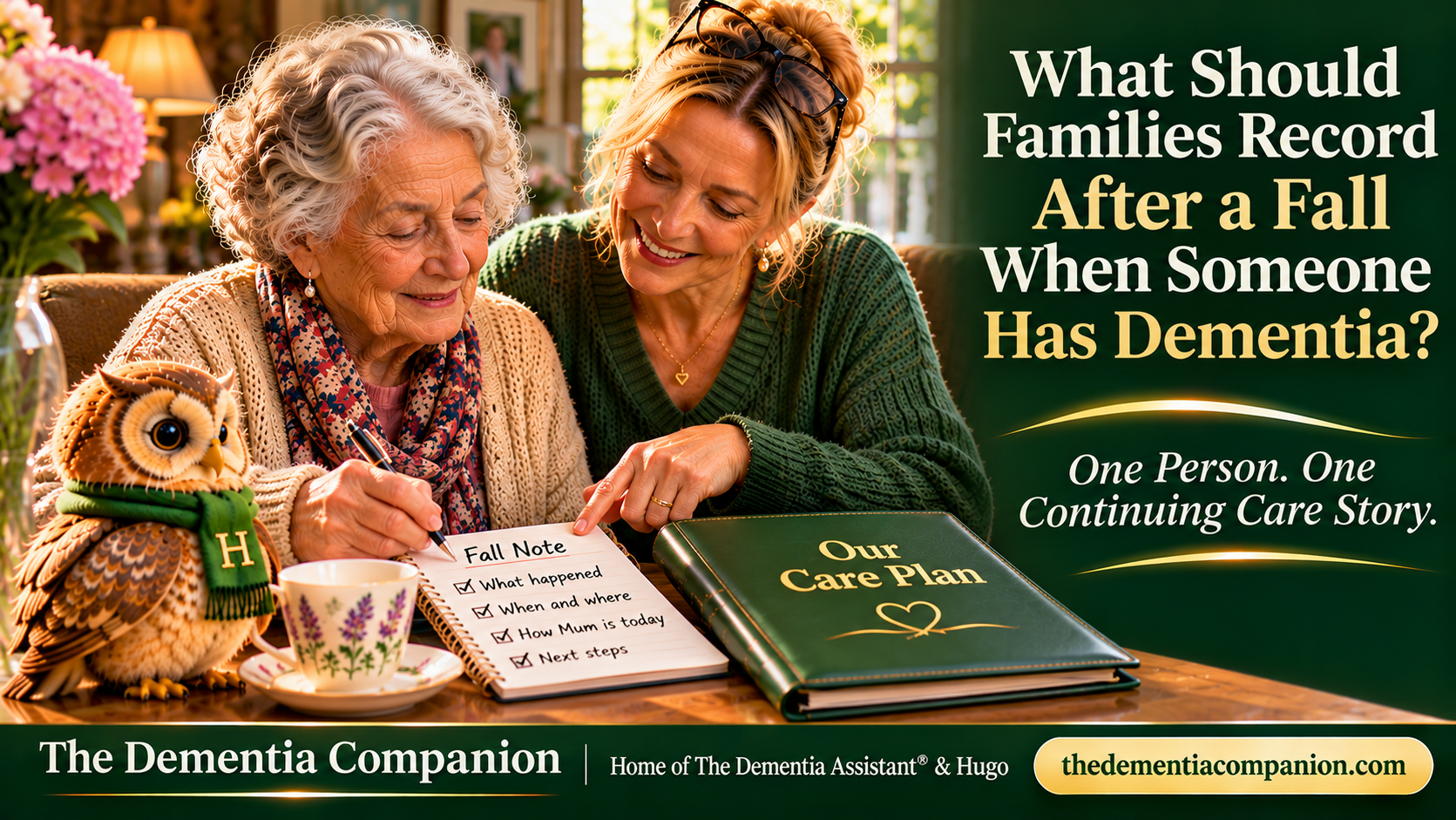
What happened, what to look out for, what to tell the GP and why a fall should never mean automatically taking away someone’s independence.
By Louise Donaghy, Dementia Practitioner, Founder of The Dementia Companion and The Dementia Assistant®, Creator of Hugo Intelligence™
There’s a sound that can make your heart stop for a moment.
A sudden thud from the next room.
You rush in and find Mum sitting on the floor.
She’s looking rather surprised.
You’re trying not to panic.
And Mum, being Mum, announces:
“I’m perfectly fine, darling. I just decided to sit down here.”
Well, that’s one way of describing it.
But your mind is already racing.
Did she hit her head? Is anything broken? Why did she fall? Should I call someone? What if it happens again?
And then comes another worry.
Does this mean her dementia is getting worse?
If someone living with dementia has a fall, the first priority is their immediate safety and whether they need medical assistance. Once they are safe, a short, factual record can help professionals understand what happened, consider possible causes and review whether any support needs changing.
You don’t need to become a medical investigator.
You don’t need to produce a twelve-page incident report.
And you certainly don’t need to remove every ounce of independence from Mum’s life because she’s had a fall.
You need to respond safely, listen to her and understand what happened as accurately as possible.
Because one fall does not tell the whole story.
What should I do immediately after someone with dementia falls?
Before thinking about paperwork, check the person’s safety.
Stay calm and reassure them.
Ask whether they are hurt.
Look for obvious injury, pain or difficulty moving.
Call 999 if they may have injured their head, neck, back or hip, or cannot get up. Call 999 for other life-threatening symptoms, such as a loss of consciousness, a seizure or signs of a stroke.
Do not attempt to lift somebody yourself or force them to stand when an injury may be present.
If you are waiting for emergency help, keep them comfortable and warm, following the emergency service’s instructions.
If the person has fallen, may be injured or unwell but the situation does not meet emergency criteria, contact NHS 111 for urgent advice.
Even when there is no obvious injury, the NHS recommends contacting the GP after a fall.
Head injuries need particular care. Symptoms may not be immediately obvious, and someone living with dementia may find it difficult to explain what they feel.
If they have hit their head, seek medical advice promptly and follow the appropriate emergency guidance. Make sure clinicians know if they take blood-thinning medication such as warfarin or apixaban.
Never delay medical help because you want to finish recording what happened.
The notes can wait.
Mum cannot.
Why are people living with dementia more likely to fall?
Dementia can sometimes affect abilities that contribute to moving safely.
Depending on the person and the condition, these may include spatial awareness, attention, judgement, coordination, mobility or recognising hazards.
But it is important to avoid assuming that dementia caused a particular fall.
There may be other contributing factors.
For example:
- Dizziness or changes in blood pressure.
- Side effects of medication.
- Pain or illness.
- Muscle weakness or problems with balance.
- Difficulty seeing or hearing clearly.
- Unsuitable footwear.
- Loose rugs, poor lighting or household obstacles.
- Becoming disorientated in an unfamiliar environment.
- Other health conditions affecting movement.
Sometimes several factors are involved.
Sometimes the reason remains unclear until a professional assessment has taken place.
Dementia UK recommends considering the person’s overall health and mobility when investigating falls, while NICE’s updated falls guidance encourages individualised assessment and prevention.
A fall should be investigated, not automatically labelled as another symptom of dementia.
And that distinction matters because some contributing factors can be treated or reduced.
What should families record after a fall?
Once Mum is safe and any necessary medical attention has been arranged, keep a simple, factual record.
You might include the following information.
- When and where the fall happened
Record the date, approximate time and location.
For example:
“Saturday, approximately 10.30am. Mum was found sitting on the kitchen floor beside the dining table.”
Be clear about what you know.
If nobody saw the fall, write that it was unwitnessed.
Don’t describe how Mum fell if you didn’t actually see it.
That might sound obvious, but families can find themselves filling in the gaps without realising.
- What was happening immediately beforehand
If known, record what Mum was doing.
Was she getting out of bed?
Walking to the bathroom?
Reaching for something?
Getting up from a chair?
Had she complained of feeling dizzy?
Had she been unusually tired or unwell?
If Mum can explain what happened, include her own words.
For example:
“Mum said she stood up from the chair and felt unsteady.”
But avoid turning that into:
“Mum fainted because her blood pressure dropped.”
Unless a professional has established that explanation, you don’t know.
- What Mum said and how she appeared
Record what you actually observed.
Was she able to answer questions as she normally would?
Did she report pain?
Did she seem frightened?
Was she able to move?
Was there a noticeable change in alertness or communication?
Compare her presentation with what is usual for Mum, rather than relying only on general descriptions.
For example:
“Mum was able to speak with me as usual but said her left hip was painful.”
That is much more useful than:
“Mum was confused and difficult.”
Remember, if pain or a possible injury is present, appropriate medical assessment comes first.
- Any injuries or concerning symptoms
Relevant details may include:
- Pain or tenderness.
- Visible swelling or bruising.
- Bleeding.
- Possible head impact.
- Difficulty moving or bearing weight.
- New weakness or dizziness.
- Changes in alertness or communication.
Do not perform physical tests that might worsen an injury.
And don’t assume that a person who can talk or smile has escaped serious harm.
Some injuries, particularly head injuries, may need urgent assessment even when the person initially appears relatively well.
- What help was provided
Record what happened next.
Did someone call 999 or NHS 111?
Was Mum assessed by a paramedic?
Did she attend A&E?
Did a healthcare professional give advice?
Was a follow-up appointment recommended?
Keep the information factual and based on what actually occurred.
- What professionals advised
If a clinician assessed Mum, record the confirmed advice and any agreed follow-up.
Keep relevant letters or discharge documents.
If a medicine was changed, refer to the current professional medication instructions.
Never treat a family diary or Hugo conversation as authority to change medication.
- What changed afterwards
Has Mum become less confident walking?
Is she avoiding an activity she previously enjoyed?
Does she have continuing discomfort?
Has her mobility changed?
Did she return to her usual routine?
Record meaningful changes and seek medical advice where appropriate.
And include the positive things too.
Perhaps she was soon enjoying her garden again.
Perhaps physiotherapy helped rebuild confidence.
Those experiences are part of her story as well.
What does a useful dementia fall record look like?
Let’s use a fictional example.
Monday, 23 November
Time: Approximately 9.15am.
Location: Living room, beside Mum’s usual chair.
What happened: Mum was found sitting on the floor. Nobody witnessed the fall.
Mum’s account: She said she had been getting up to answer the door but could not clearly explain what happened.
Immediate observations: Mum reported pain in her hip and said she did not feel able to stand.
Action taken: Emergency services were contacted. Mum was kept comfortable while awaiting professional assistance.
Professional follow-up: Details to be added from the actual clinical assessment and advice received.
Care plan review: Review any changes in mobility, support needs and falls-prevention recommendations following professional assessment.
That’s enough.
It’s factual.
It doesn’t invent a cause.
And it doesn’t try to turn the family into a medical team.
The record simply helps preserve useful information.
What if Mum cannot remember falling?
This can be particularly difficult.
Perhaps she insists she didn’t fall.
Perhaps she doesn’t remember how she ended up on the floor.
Or perhaps she gives an explanation that doesn’t seem to match what you’ve observed.
Don’t turn the situation into an argument.
You might say:
“I can see you’re on the floor, Mum. Let’s make sure you’re comfortable and get you the help you need.”
You don’t need her to prove what happened before responding safely.
If the fall was unwitnessed, record that honestly.
If she gives an account, you can record it as her account.
But unexplained falls, possible blackouts, head injuries and changes in awareness deserve appropriate medical assessment.
Memory difficulties should never become a reason to dismiss a potentially serious incident.
Does a fall mean Mum’s dementia is getting worse?
Not necessarily.
A fall can happen for many reasons.
Sometimes there may be a relationship with changes in cognition, mobility or perception.
But it could also involve medication, another health condition, pain, dizziness or environmental hazards.
A single fall does not establish dementia progression.
If Mum has become more unsteady, or falls are becoming more frequent, contact her GP and ask about a falls assessment.
NICE’s current falls guideline, NG249, recommends assessing relevant individual risk factors and arranging appropriate interventions.
Depending on the person’s circumstances, this may involve reviewing medication, checking blood pressure, assessing balance and mobility, looking at vision or hearing, or considering physiotherapy and occupational therapy.
The important thing is to understand Mum’s situation rather than jumping to conclusions.
How can we reduce the risk of another fall without taking away independence?
This is where I want us to be especially person-centred.
After Mum has fallen, it’s natural to want to protect her.
You might feel tempted to suggest she stops walking to the garden.
Stops going upstairs.
Stops going out.
Stops doing anything remotely adventurous.
And perhaps somebody even suggests she should remain permanently seated with a cup of tea and a remote control.
Mum may have other ideas.
Quite right too.
Falls prevention should support safer activity and confidence, not unnecessarily restrict someone’s life.
Depending on professional assessment, practical approaches may include:
- Reviewing footwear and ensuring it fits securely.
- Improving lighting.
- Removing unnecessary clutter and trip hazards.
- Making important items easier to reach.
- Checking vision and hearing.
- Reviewing medication with a qualified professional.
- Considering suitable mobility aids.
- Exploring strength and balance exercises recommended for the individual.
- Asking about occupational therapy or appropriate home adaptations.
But don’t assume every person needs every intervention.
A walking aid, for example, should be assessed for suitability and used correctly.
And removing a familiar item from Mum’s home may sometimes create more confusion than it solves.
Involve her in decisions.
Explain why something is being suggested.
Ask what she would feel comfortable changing.
The aim is to help Mum continue living her life as safely and independently as possible.
What if Mum is frightened of falling again?
A fall can affect somebody’s confidence.
Perhaps Mum no longer wants to walk outside.
Perhaps she asks for help with activities she previously managed.
Perhaps she becomes anxious when standing.
Those feelings deserve attention.
Don’t dismiss them with:
“You’re fine. There’s nothing to worry about.”
Instead, try:
“That must have been frightening. What would help you feel more confident?”
Professional falls services, physiotherapists or occupational therapists may be able to assess what support would help.
Encourage appropriate activity in line with professional advice, rather than pushing someone to do more than feels safe.
And remember that emotional recovery matters as well as physical recovery.
Why should families keep their own record of falls and mobility changes?
Imagine Mum has had a fall.
The ambulance service has a record.
The hospital may have another.
The GP receives information.
A physiotherapist may carry out an assessment.
Perhaps a home care agency becomes involved.
Each professional service has its own responsibilities.
But who is keeping the continuing picture together from Mum’s point of view?
What was she managing independently before the fall?
What support did she receive afterwards?
What does she want to continue doing?
What professional recommendations were made?
Has she regained confidence?
What has changed in her everyday routine?
This is where a family-held dementia care plan can become particularly valuable.
It provides a place to keep relevant information together, rather than depending entirely on separate organisational records.
The family’s information does not replace professional medical notes, falls assessments or incident reporting procedures.
But it can help preserve a continuing record of Mum’s experiences, needs, preferences and support arrangements.
One Person. One Continuing Care Story.
Not ten different fragments of Mum’s life.
How can The Dementia Assistant® help after a fall?
The Dementia Assistant® was created to help people living with dementia and their families maintain their own continuing care information.
Within the platform, families can organise relevant documents, record daily observations, create and review individual care plans and prepare information for professional appointments.
Following a fall, that might mean keeping together:
- The factual account of what happened.
- Any professional assessment or discharge information.
- Changes in everyday mobility or confidence.
- The person’s wishes and preferences.
- Questions for a GP or falls service.
- Agreed follow-up arrangements.
- Relevant updates to the person’s care plan.
This information can continue to be maintained as services change.
And families can use Hugo Intelligence™ to explore practical questions about the person’s support, while leaving clinical decisions to the appropriate professionals.
Meet Hugo Intelligence™: More than another form to fill in
Sometimes you’re not sure how to explain what’s happened.
Perhaps Mum fell yesterday.
She’s been assessed and is now back home.
But you’re worried about her confidence.
Or perhaps you’ve noticed changes in her mobility and want to prepare questions for the GP.
You might ask:
“Hugo, Mum has had a fall and we’re both worried. How can we organise the information for her review?”
Or:
“Hugo, Dad is frightened of walking after a fall. How can we support his confidence while following professional advice?”
Or:
“Hugo, can you help me think through what should be reviewed in Mum’s care plan?”
Hugo Intelligence™ offers natural, conversational, person-centred dementia guidance.
You can explain what is happening, ask follow-up questions and explore practical approaches without judgement.
Hugo can help you organise observations, understand general falls-prevention information and prepare questions for healthcare professionals.
But he cannot examine an injury, determine whether someone has fractured a bone, assess a head injury or decide whether somebody is medically safe.
If the fall has just happened and you’re uncertain about injury, contact the appropriate healthcare service first.
Hugo belongs alongside professional support, never in place of urgent assessment.
Guidance based on Mum’s selected care plan
You can ask Hugo general dementia questions without selecting a care plan.
When you select Mum’s individual care plan, Hugo can use relevant information recorded about her routines, strengths, mobility, communication and preferences to provide more person-centred suggestions.
For example, perhaps Mum’s garden is enormously important to her.
Perhaps she dislikes unfamiliar equipment.
Perhaps she communicates more comfortably when information is explained slowly.
Those details can help shape questions about supporting her independence and confidence.
Hugo doesn’t automatically have access to every care plan.
You choose the plan relevant to the person you’re discussing.
And professional recommendations about mobility and falls prevention remain essential.
Save and organise your Hugo conversations
Families may have questions at different stages.
Immediately after the professional assessment.
During recovery.
Before a physiotherapy appointment.
Or when reviewing the care plan several weeks later.
Within The Dementia Assistant®, you can save, categorise and organise Hugo conversations.
That means you can return to useful guidance without having to start the discussion again.
Saved conversations are educational support, not clinical records or emergency instructions.
But they can provide continuity in the questions you’re exploring.
Hugo’s multilingual support: Understanding what happened in the person’s own language
This is another important part of person-centred care.
Imagine Mum grew up speaking Welsh.
Or Dad is most comfortable speaking Hindi, Irish, Spanish or French.
Perhaps the family includes relatives in several countries.
Perhaps someone living with dementia finds it difficult to describe pain or discomfort in a language they don’t normally use.
Language should never become an unnecessary obstacle to understanding the person’s experience.
The Dementia Assistant® provides 12 interface languages and dictation and translation capabilities spanning 201 languages.
These tools can help families record observations, organise information and communicate across language barriers.
Dictation can also make it easier to record relevant notes when typing is inconvenient.
Hugo’s conversational approach gives families a way to explain concerns naturally.
Not every feature is available in all 201 languages.
And clinical information, medication instructions and descriptions of injuries must be checked for accuracy.
Qualified interpreters should be used for important healthcare conversations when needed.
Person-centred care means understanding the person, including the language in which they feel most comfortable communicating.
Can Family Circle help relatives stay informed after a fall?
If several family members are involved, there may be questions about what happened and what help is now needed.
One relative may have attended A&E.
Another may be helping with shopping.
Someone else may live abroad.
The Dementia Assistant® includes Family Circle features to support appropriate sharing of care updates.
This can help families communicate relevant information while respecting the person’s wishes, privacy and access permissions.
But not every relative needs every detail.
And family updates should never substitute for reporting an urgent health or safeguarding concern to the appropriate service.
What if the person has repeated falls?
Repeated falls should not be accepted as an inevitable part of dementia.
Ask the GP about a comprehensive falls assessment and appropriate referrals.
Depending on the person’s circumstances, a professional review may consider:
- Previous falls and possible causes.
- Mobility and balance.
- Medication.
- Blood pressure.
- Vision and hearing.
- Footwear and foot health.
- Muscle strength.
- Home hazards.
- Fear of falling.
- Other health conditions.
NICE’s falls guidance recommends individualised assessment and management for people at greater risk.
Don’t assume that buying a walking frame or removing a rug will solve every problem.
Sometimes a broader assessment is needed.
And if care needs are changing, the person’s care and support plan may also need reviewing.
A practical family checklist after a fall
Once immediate safety and medical needs have been addressed, consider:
- [ ] Has the person received the appropriate medical advice or assessment?
- [ ] Have we recorded when and where the fall happened?
- [ ] Was the fall witnessed or unwitnessed?
- [ ] Have we recorded the person’s own account where possible?
- [ ] Have injuries or symptoms been reported appropriately?
- [ ] Have we kept the professional advice and follow-up details?
- [ ] Have we considered whether medication or another health condition needs reviewing?
- [ ] Has the GP been informed?
- [ ] Would a falls assessment be appropriate?
- [ ] Have we asked how the person feels about their confidence and mobility?
- [ ] Are their usual activities and independence being supported?
- [ ] Does their care plan need reviewing?
- [ ] Are relevant family members informed with appropriate permission?
- [ ] Do we know who to contact if another concern arises?
The purpose isn’t to create more paperwork.
It’s to help prevent important information being lost between appointments.
A fall is an event. It is not the person’s identity.
This is the part I want families to remember.
Mum may have had a fall.
She may need assessment.
She may need a little extra support.
But she’s still Mum.
The woman who enjoys her garden.
Who has a particular way of making tea.
Who knows exactly how she likes her furniture arranged.
And who may have very strong opinions about somebody suggesting she shouldn’t walk anywhere without an escort.
Her concerns deserve to be heard.
Her safety matters.
But so do her confidence, independence and choices.
Sometimes we need to change the environment.
Sometimes we need to change the support.
And sometimes we need to understand what happened before changing anything at all.
Good dementia care doesn’t simply try to prevent every possible risk by restricting someone’s life.
It works with the person to understand and manage risks while protecting the life they want to live.
⸻
Ask Hugo: Falls, Dementia and Family Care Planning
Hugo, Mum has dementia and has just fallen. What should I do?
Hugo 🦉: First, check her immediate safety.
If she may have injured her head, neck, back or hip, or cannot get up, call 999.
Do not attempt to lift her yourself.
For other possible injuries or illness, seek appropriate urgent NHS advice.
Once Mum is safe, I can help you organise information and questions for professional follow-up.
What should I record after Mum has a fall?
Hugo 🦉: Record the date, time, location, whether the fall was witnessed, what Mum says happened, any observed symptoms and what professional help was provided.
Keep the record factual.
Avoid guessing the cause.
Does a fall mean Mum’s dementia is getting worse?
Hugo 🦉: Not necessarily.
Falls can have several possible causes, including problems with balance, medication effects, dizziness, illness or environmental hazards.
A professional assessment may help identify contributing factors.
I cannot diagnose the reason for a fall.
Can Hugo help me prepare for a falls assessment?
Hugo 🦉: Yes. I can help you organise observations and prepare questions about Mum’s mobility, daily routines, confidence and support needs.
The clinical assessment must be completed by appropriately qualified professionals.
Can Hugo use Mum’s own care plan?
Hugo 🦉: Yes, when you select Mum’s care plan.
I can use relevant recorded information about her preferences, routines and circumstances to provide more personalised suggestions.
Without a selected care plan, I can still provide general dementia guidance.
Can we save our conversations about Mum’s falls?
Hugo 🦉: Yes. You can save, categorise and organise Hugo conversations within The Dementia Assistant®.
This can help you revisit guidance when preparing for future appointments or care reviews.
Can The Dementia Assistant® record daily observations after a fall?
Hugo 🦉: Yes. It includes daily notes, personalised care planning and document organisation.
You can record relevant observations and maintain information for professional discussions.
These records complement, rather than replace, professional clinical assessments.
Can Hugo help families who speak different languages?
Hugo 🦉: The Dementia Assistant® supports 12 interface languages and dictation and translation capabilities spanning 201 languages.
These can help families organise and communicate information.
Important clinical information must be checked for accuracy, and qualified interpreters should be used when needed.
Can Family Circle keep relatives informed?
Hugo 🦉: Family Circle can support appropriate sharing of care updates with involved relatives.
The person’s wishes, privacy and relevant permissions should guide what is shared.
Can Hugo help us decide whether Mum needs more care?
Hugo 🦉: I can help you organise questions and explore what matters to Mum, including independence, routines and possible support needs.
But I cannot determine clinical safety or replace a professional care needs assessment.
How much does The Dementia Assistant® cost?
Hugo 🦉: The Family subscription is £4.99 per month.
Every subscription includes a 30-day complimentary trial, allowing you to explore person-centred care planning, daily notes, saved Hugo conversations, Family Circle and multilingual support.
⸻
One Person. One Continuing Care Story.
A person living with dementia may experience a fall at home, during an outing or while receiving professional care.
Different services may become involved.
The ambulance service.
The hospital.
The GP.
A physiotherapist.
An occupational therapist.
Perhaps a home care agency.
Each service maintains its own appropriate professional records.
But the person and their family should also have their own continuing place for care information.
A place to preserve preferences and wishes.
A place to organise factual observations.
A place to keep relevant reports and documents.
A place to prepare for professional appointments.
And with Hugo Intelligence™, a place to have supportive conversations, save guidance, explore person-centred approaches and access multilingual tools.
The Dementia Assistant® was created to help people living with dementia and their families maintain their own continuing care information as services and circumstances change.
It doesn’t replace emergency services, clinical records, professional falls assessments or care plans.
It helps keep the person’s story together alongside them.
Different professionals. Different services. One person. One continuing story.
Would You Like Hugo to Help You Review Your Loved One’s Care Plan?
If someone you love has had a fall, and the immediate medical concerns have been addressed, Hugo can help you think through what information to organise, what questions to ask and whether relevant details in their care plan need reviewing.
Within The Dementia Assistant®, you can explore:
- Hugo Intelligence™ for natural, conversational, person-centred dementia guidance.
- Guided care plan creation and ongoing updates.
- Family-held continuing care plans.
- Daily notes and observations.
- Organised documents and appointment information.
- Saved and categorised Hugo conversations.
- Family Circle, Life Story and Memory & Moments.
- Multilingual guidance, dictation and translation.
- Dementia learning and practical resources.
Created by dementia practitioner Louise Donaghy and powered by Person-Centred Intelligence®, The Dementia Assistant® supports families in keeping the person at the centre of their continuing care story.
Every subscription includes a 30-day complimentary trial.
https://thedementiaassistant.com/
The Dementia Companion, home of The Dementia Assistant® and Hugo 🦉
https://thedementiacompanion.com/
Louise and Hugo ❤️🦉
Louise Donaghy
Founder & CEO of The Dementia Assistant®
Created and powered by Person-Centred Intelligence®
Creator of Hugo Intelligence™
⸻
Continue Exploring Dementia Care and Support
Person-Centred Dementia Care
Practical guidance about maintaining independence, routines, dignity and everyday support.
https://thedementiacompanion.com/dementia-care/
Dementia Support for Families
Explore practical information and support for family members and unpaid carers.
https://thedementiacompanion.com/dementia-support/
Ask Hugo: Everyday Dementia Questions
Explore person-centred dementia guidance and continue conversations with Hugo through The Dementia Assistant®.
https://thedementiacompanion.com/ask-hugo/
⸻
References and Further Reading
- NHS: Falls
Official advice about what to do after a fall, when to seek emergency help, follow-up with a GP and ways to reduce falls risks.
https://www.nhs.uk/conditions/falls/
- NHS: Head Injury and Concussion
Information about recognising potentially serious head injuries, emergency warning signs and when to seek medical advice.
https://www.nhs.uk/conditions/head-injury-and-concussion/
- NICE: Falls, Assessment and Prevention in Older People and People 50 and Over at Higher Risk (NG249)
Updated 2025 national guidance on falls assessment, identifying individual risk factors and appropriate prevention.
https://www.nice.org.uk/guidance/ng249/chapter/Recommendations
- Dementia UK: Dementia and Falls
Specific dementia guidance about possible contributing factors, immediate responses, falls assessments and supporting independence.
https://www.dementiauk.org/information-and-support/health-advice/dementia-and-falls/
- NICE: Head Injury, Assessment and Early Management (NG232)
Clinical guidance on the assessment and management of head injuries, including factors that require urgent investigation.
https://www.nice.org.uk/guidance/ng232/chapter/recommendations
- NHS Inform: What to Do if You Fall
Practical falls advice, including getting help safely and what to do if someone is unable to get up.
- NICE: Dementia, Assessment, Management and Support (NG97)
Recommendations about person-centred care, protecting independence and coordinating dementia support.
https://www.nice.org.uk/guidance/ng97/chapter/recommendations
⸻
Important information: This article provides general educational guidance and does not replace emergency services, professional medical assessment or individual falls-prevention advice. If someone may have injured their head, neck, back or hip, or cannot get up after a fall, call 999 in the UK. Healthcare and social care arrangements vary across countries and UK nations.
Published: 21 November 2026
You May Also Find Helpful
Need help with your own situation? Ask Hugo.
One Person. One Continuing Care Story. The Dementia Companion is where you discover guidance. Inside The Dementia Assistant®, talk with Hugo, save and categorise conversations, record daily notes and involve authorised supporters in a continuing care plan centred around the person.
Ask Hugo About This · Start Your Continuing Care Plan — Families · Continuing Care Planning — Professionals
Personal guidance requires the appropriate account and subscription access. Care-plan information is used only with authorised access and the required consent and selection steps. All subscription plans include a 30-day complimentary trial.