Mum Is Going Into Hospital. How Do We Explain Her Dementia Needs?
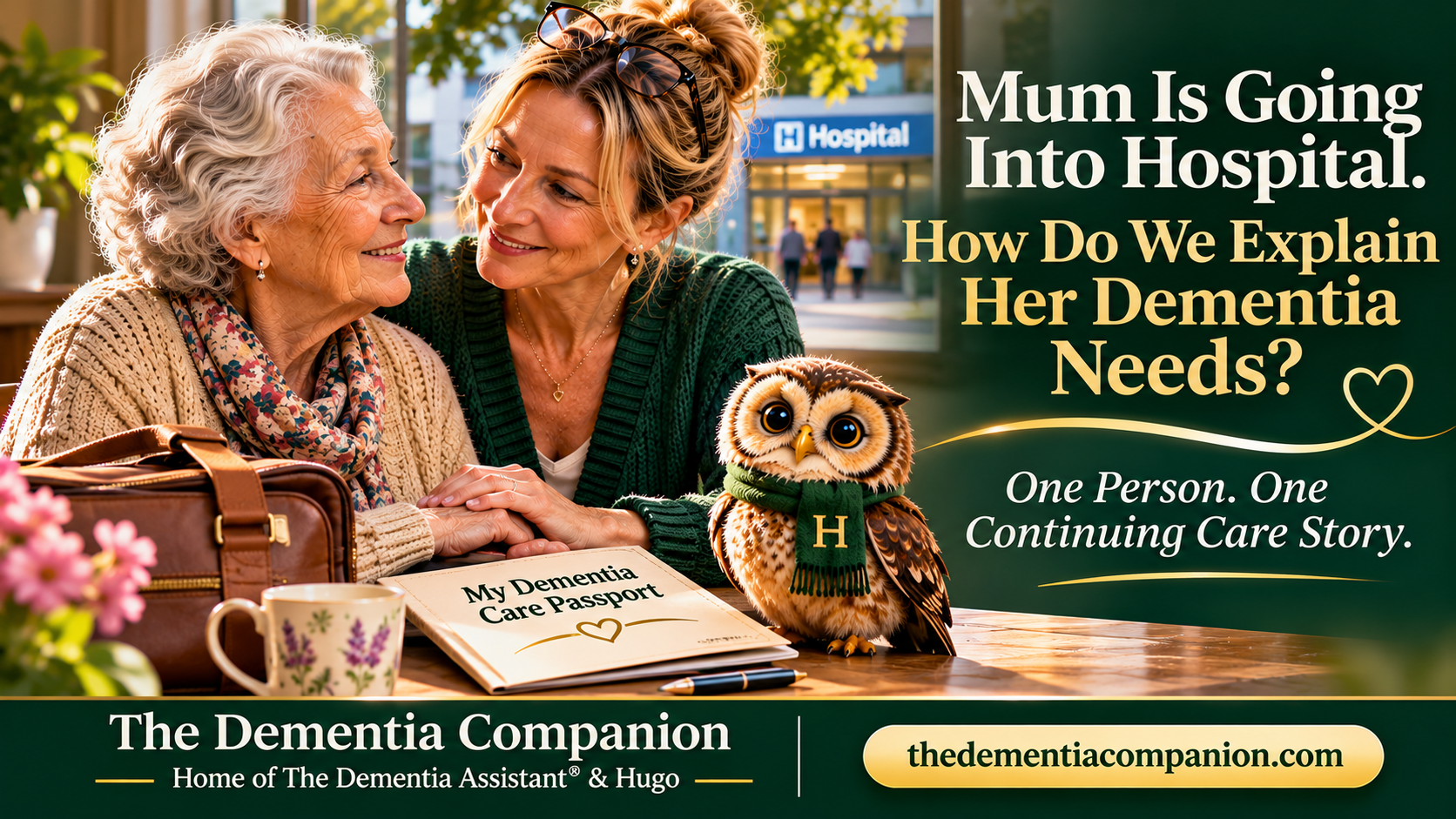
Mum Is Going Into Hospital. How Do We Explain Her Dementia Needs?
The hospital may know her medical history. But who will tell them about the person behind the diagnosis?
By Louise Donaghy, Dementia Practitioner, Founder of The Dementia Companion and The Dementia Assistant®, Creator of Hugo Intelligence™
There’s something particularly unsettling about watching someone you love go into hospital.
Even when you know they’re going to receive care they need.
You help Mum pack a bag. You make sure she’s got her glasses, her slippers and the cardigan she insists is much warmer than every other cardigan ever manufactured.
You check the appointment letter.
You find her medication list.
And somewhere in the middle of all this, another worry begins creeping in.
Will they know she has dementia?
Will they understand when she can’t find her words?
What if she gets frightened?
What if she says she’s fine when she’s actually in pain?
What if I’m not there to explain?
And perhaps the biggest question of all:
How will the hospital understand Mum when they don’t know her?
The answer begins with sharing more than a diagnosis.
Hospital staff need accurate medical information, of course. But they may also benefit enormously from knowing the person’s usual abilities, communication preferences, routines, sources of comfort and what matters to them.
A short, person-centred hospital care passport can help preserve that information.
And if your family already maintains its own continuing dementia care plan, you may have much of it ready.
Why can hospital stays be particularly difficult for someone with dementia?
Hospitals are unfamiliar places.
Different corridors. Different faces. Different routines.
There are alarms, bright lights, interruptions and people asking questions at times when someone might ordinarily be asleep.
For anybody, that can be disorientating.
For someone living with dementia, it may be especially difficult.
They might struggle to understand why they are there.
They may be frightened by unfamiliar surroundings.
They might find it hard to communicate discomfort or explain what they need.
Or they may become unusually quiet, which can be overlooked when everyone is expecting visible distress.
Not everyone with dementia will respond in the same way.
Some people cope remarkably well with hospital admissions.
Others need more reassurance, communication support or adaptations to their surroundings.
Good hospital dementia care begins with recognising the individual, rather than assuming that everybody with the same diagnosis has the same needs.
There is also an important medical consideration.
People living with dementia are at increased risk of delirium during hospital admission.
Delirium is a sudden change in mental functioning that can be associated with illness, medication and other medical factors.
It requires clinical assessment.
New or sudden confusion should never automatically be dismissed as the person’s usual dementia.
What should hospital staff know about Mum’s dementia?
Imagine you’re meeting Mum for the first time.
You know her name, date of birth and diagnosis.
But you don’t know how she normally communicates.
You don’t know she needs extra time to answer questions.
You don’t know that she finds sudden physical contact frightening.
And you don’t know that she always calls her daughter by a childhood nickname.
Those details could make a significant difference to how you approach her.
When preparing information for hospital staff, I would begin with the following.
- Who Mum is
Not simply her diagnosis.
Her preferred name.
The important people in her life.
Her interests.
Her familiar routines.
What matters to her.
Perhaps she spent years working as a teacher.
Perhaps she loves gardening.
Perhaps she is happiest talking about her grandchildren.
Those details offer staff an opportunity to connect with the person rather than communicate only through clinical questions.
Alzheimer’s Society’s This is me resource was created to help people share this kind of personal information with health and care professionals.
It is a valuable starting point.
- How Mum communicates
This deserves particular attention.
Does she understand information more easily when someone speaks slowly and uses short sentences?
Does she need extra time to process a question?
Does she wear hearing aids or glasses?
Does she use gestures, pictures or other communication support?
Does she have a preferred language?
What helps her express pain, discomfort or worry?
You might write:
“Mum prefers to be called Margaret. Please speak directly to her, give her time to answer and avoid asking several questions at once.”
That one sentence could help staff approach a conversation more comfortably.
- What Mum can usually do independently
This is just as important as recording where she needs help.
Can she normally walk independently?
Does she choose her own clothes?
Can she eat and drink without assistance?
Does she usually manage familiar conversations?
Does she need reminders for particular activities?
A clear description of her usual abilities helps staff understand her baseline.
It also makes it easier to recognise changes during the hospital stay.
The diagnosis alone does not tell staff what the person can or cannot do.
- What helps when Mum becomes worried
Perhaps Mum is reassured when someone explains what is happening before touching her.
Perhaps she prefers quiet surroundings.
Perhaps looking at a family photograph helps her settle.
Perhaps she needs someone to explain that she is in hospital and why.
You might write:
“Mum can become anxious when she doesn’t recognise her surroundings. Please introduce yourself, explain where she is and allow time for her to respond.”
Avoid assuming the same approach will work every time.
Staff should consider her current condition, preferences and needs.
- What might indicate pain or discomfort
Some people living with dementia find it difficult to communicate pain clearly.
They may become withdrawn, restless or reluctant to move.
But those changes can have many possible causes.
Tell staff what you’ve previously noticed, without claiming that a particular behaviour always means pain.
For example:
“When Mum has discomfort, she sometimes becomes quiet and avoids moving. Please assess for pain if this happens.”
The professional team remains responsible for investigating symptoms.
- Eating, drinking and personal care
Does Mum have any swallowing difficulties that have been professionally assessed?
Does she require help cutting food?
Does she have dietary requirements or allergies?
Are there familiar preferences that make mealtimes easier?
Does she require assistance with washing, dressing or using the toilet?
These details should be shared respectfully.
And remember that hospital staff must follow current clinical instructions for diet, swallowing safety, medication and personal care.
A favourite food doesn’t override a medically necessary swallowing plan.
- The people she wants involved
Who does Mum want staff to contact?
Who can provide relevant background information?
Who has appropriate authority for particular decisions, if applicable?
Who should receive updates?
A family relationship alone does not automatically grant access to every medical detail or authority to make decisions.
Mum’s wishes, capacity, consent and relevant legal arrangements matter.
What is a dementia hospital passport?
A hospital passport is a short document that tells healthcare staff important things about a person.
It can include communication needs, routines, preferences, relevant support requirements and details that help staff provide individualised care.
Some hospitals have their own versions.
Alzheimer’s Society offers a resource called This is me, which can be used in hospitals and other care settings.
A hospital passport is not a replacement for medical records.
It complements them.
It should be easy to read, accurate and updated when circumstances change.
And wherever possible, the person living with dementia should help decide what it says.
Can our existing dementia care plan help with hospital admission?
Yes.
This is one of the strongest reasons for families to maintain their own continuing care information.
Imagine Mum has already been attending memory clinic appointments.
Perhaps she’s had support from a dementia nurse.
Perhaps someone visits to help at home.
Each professional service may hold information about the care it provides.
But you and Mum may have been developing your own care plan too.
A plan containing her preferences, communication needs, routines, significant health information and daily observations.
When Mum goes into hospital, you can use relevant information from that plan to prepare a concise summary for the team.
You don’t need to give every professional access to every personal detail.
You share what is appropriate, with the person’s wishes and permissions respected.
The family-held care plan stays with the person, rather than being tied to one service.
That doesn’t remove the hospital’s responsibilities.
It simply gives the family a practical way to help the next team understand the person.
What should we take into hospital?
For a planned admission, it may help to prepare:
- The hospital appointment or admission letter.
- A current medication list and relevant allergy information.
- The person’s hospital passport or concise care summary.
- Glasses, hearing aids and other necessary communication aids.
- Important contacts and relevant professional care documents.
- Comfortable clothing and permitted familiar belongings.
- Details of relevant mobility or personal care needs.
- Questions the person wants answered.
Check the hospital’s own instructions about medicines, belongings and admission arrangements.
For an emergency admission, don’t delay urgent treatment while trying to collect paperwork.
Bring or provide relevant information as soon as it is safely possible.
What if Mum becomes distressed in hospital?
First, try to understand what might be happening.
Is she frightened because she doesn’t recognise the surroundings?
Does she need the toilet?
Could she be uncomfortable or in pain?
Is she tired?
Is she struggling to hear or understand?
Has there been a sudden change in her mental state?
Never assume distress is simply dementia.
NICE recommends assessing possible clinical and environmental causes, including pain, illness, delirium and other unmet needs.
You might say to staff:
“Mum is usually quite settled at home. This is different from how she normally presents. Could we explore what might be causing it?”
Or:
“She sometimes needs extra time to understand what is happening. Would it help to explain the procedure before beginning?”
These are useful conversations.
You don’t need to diagnose the cause yourself.
And if you believe a change is sudden or significant, tell the clinical team promptly.
Can family members stay with someone who has dementia in hospital?
Hospital visiting arrangements vary.
Some hospitals support more flexible involvement of unpaid carers, particularly when their presence helps a person with dementia feel safe or communicate.
Dementia UK recommends asking about the hospital’s arrangements and whether a family carer can remain with the person while they settle.
If your presence helps Mum, explain why.
Ask about a carer’s passport or local visiting arrangements where available.
But remember something important.
You should not be expected to provide all of Mum’s care simply because she has dementia.
Hospital staff remain responsible for delivering appropriate clinical care.
Families can offer valuable knowledge and reassurance, but they should be partners in care, not substitutes for adequate staffing.
What if Mum doesn’t speak English comfortably?
This is an especially important consideration.
Language is part of someone’s identity.
Some people living with dementia may find particular languages easier to use than others.
A person who has spoken English for many years may, for example, feel more comfortable using the language they grew up speaking.
That doesn’t happen to everybody, and we must never assume it will.
But it is worth asking.
If Mum prefers Welsh, Irish, Hindi, Spanish, French or another language, record that preference in her care information.
Tell the hospital about her communication needs.
Ask for a qualified interpreter when required.
Family members and AI translation tools should not automatically replace professional interpreters during significant medical discussions, particularly those involving consent, diagnosis or treatment.
The Dementia Assistant® supports 12 interface languages and dictation and translation capabilities spanning 201 languages.
These features can help families organise information and prepare records across language barriers.
They can also support multilingual family communication where appropriate.
Not every feature is necessarily available in every language, and clinical translations must be checked for accuracy.
But giving families more accessible ways to record information can help preserve something very important.
The person’s own voice.
How can Hugo Intelligence™ help us prepare for hospital?
Sometimes you know you need to tell the hospital something important, but you’re struggling to put it into words.
Perhaps there are several concerns.
Perhaps Mum has had a difficult few days.
Perhaps you’re frightened that unfamiliar staff won’t understand her.
You might find yourself thinking:
Where do I even start?
This is where Hugo Intelligence™ can help.
Hugo is a conversational, dementia-focused AI assistant within The Dementia Assistant®, created and powered by Person-Centred Intelligence®.
You can talk to Hugo naturally.
For example:
“Hugo, Mum has dementia and she’s going into hospital tomorrow. What should I tell the staff?”
Or:
“Hugo, Dad gets frightened when people rush him. How can I explain this respectfully?”
Or:
“Hugo, can you help me organise the important information from Mum’s care plan before her admission?”
Hugo can help you think through the information that may be relevant, explore communication approaches and prepare questions for the hospital team.
He does not decide what treatment Mum needs.
He cannot replace a clinical assessment or guarantee how the hospital will respond.
But he can help you approach the conversation feeling more prepared.
Hugo can use the person’s selected care plan
There is an important difference between asking Hugo a general dementia question and asking for guidance about a particular person.
Without a selected care plan, Hugo can provide general dementia guidance.
But when you choose Mum’s care plan, Hugo can draw on relevant recorded information about her routines, preferences, communication needs and circumstances.
This can make guidance more personalised.
Instead of starting from scratch, you can explore questions with the person’s existing information in mind.
That is the purpose of Person-Centred Intelligence®.
Not just understanding dementia. Understanding what matters to the individual.
Save and organise your Hugo conversations
You may have questions before admission.
Different questions while Mum is in hospital.
And another set of questions when she’s ready to return home.
Within The Dementia Assistant®, you can save, categorise and organise your conversations with Hugo.
This allows you to return to earlier guidance without having to start the discussion again.
Saved conversations are not a substitute for medical records or professional instructions.
But they can help families maintain continuity in the questions they’re exploring.
Hugo supports multilingual family conversations
If family members speak different languages, Hugo’s multilingual support, together with The Dementia Assistant®’s dictation and translation tools, can help make information and everyday communication more accessible.
The platform provides 12 interface languages and dictation and translation capabilities spanning 201 languages.
This is particularly valuable when families live in different countries or the person living with dementia prefers a familiar language.
For important medical decisions, always use appropriately qualified professionals and interpreters.
What happens when Mum moves to another ward?
This can be another difficult moment.
You may have explained Mum’s needs beautifully to the admission team.
Then she moves to a ward.
And you realise the next group of staff may not have heard that conversation.
Ask how the information about her communication and care needs is being passed on.
Make sure the hospital passport or relevant summary is available to the new team.
You might say:
“We’ve prepared a short summary of Mum’s usual routines and communication needs. Could we make sure it is available to the ward staff?”
It’s reasonable to ask who your main contact is and how information will be communicated during transfers.
A hospital is responsible for sharing appropriate clinical information between its teams.
Your family-held record can help provide additional background and clarify important personal details.
What should we ask before Mum comes home?
Discharge planning deserves its own careful attention.
Before Mum leaves hospital, ask:
- What treatment has she received?
- Have any medicines changed?
- Is her mobility different from before admission?
- Does she need additional support at home?
- Are there new equipment or rehabilitation needs?
- Who is arranging any follow-up care?
- Who should we contact if there are concerns?
- Has the discharge information been shared with the relevant professionals?
- What does Mum understand and want regarding the arrangements?
Don’t assume that because someone is medically ready to leave hospital, all practical support arrangements have automatically been resolved.
Discuss concerns with the ward and discharge team.
NICE recommends coordinated transition planning that addresses communication, ongoing care and support needs.
When Mum gets home, her family-held care plan can be updated with relevant confirmed information.
But do not alter medication instructions or clinical recommendations independently.
A simple dementia hospital information checklist
Before admission, or as soon as possible during an emergency admission, try to make sure staff know:
- [ ] The person’s preferred name and how they like to be addressed.
- [ ] Their dementia diagnosis and relevant health information.
- [ ] Their usual abilities and everyday routine.
- [ ] How they prefer to communicate.
- [ ] Their preferred language and interpretation needs.
- [ ] Whether they use hearing aids, glasses or communication aids.
- [ ] What helps them feel comfortable and reassured.
- [ ] Any relevant concerns around pain, distress or confusion.
- [ ] Their usual eating, drinking and mobility needs.
- [ ] Important personal preferences and wishes.
- [ ] Who they want involved and who may receive information.
- [ ] Any existing hospital passport or relevant care summary.
- [ ] Any important advance care documents, where applicable.
You don’t have to complete this list perfectly.
And you don’t have to wait for a crisis to begin recording the information.
A few important details can make the next conversation easier.
Mum is more than her hospital notes
I want to finish with something that matters enormously to me.
Your mum is not simply a patient in a bed.
She is a person with a lifetime behind her.
A favourite song.
A particular way of making tea.
People she loves.
Perhaps a wonderfully stubborn streak that has served her very well over the years.
And, quite possibly, strong opinions about hospital food.
Those details matter.
Not because they replace medical care.
But because they help the people caring for her understand the human being receiving that care.
When hospital staff know who someone is, not simply what they have been diagnosed with, it creates more opportunities for compassionate, individualised support.
That is why the person’s continuing care story matters.
⸻
Ask Hugo: Dementia and Hospital Admission Questions
Hugo, Mum has dementia and is going into hospital. What should I tell staff?
Hugo 🦉: Begin with Mum’s own wishes, her usual abilities, communication preferences, important health information and what helps her feel comfortable.
A short hospital passport or relevant summary from her care plan can be useful.
You don’t need to explain her entire life in one conversation. Start with the information most relevant to her immediate care.
What should I put in a dementia hospital passport?
Hugo 🦉: Include the person’s preferred name, communication needs, usual routines, strengths, relevant support needs and things that may help when they feel distressed.
Keep it accurate, concise and developed with the person’s involvement wherever possible.
Can Hugo help us prepare a hospital information summary?
Hugo 🦉: I can help you identify relevant subjects and organise information into a clear structure.
When you select Mum’s care plan, I can use relevant recorded details to support more personalised guidance.
You should review the information and confirm important clinical details with the appropriate professionals.
Can I ask Hugo questions during Mum’s hospital stay?
Hugo 🦉: Yes. You can ask general questions about dementia, communication and preparing for discussions with hospital staff.
I can help you explore possible approaches and questions to raise.
But any urgent concerns or changes in Mum’s health should be brought directly to her clinical team.
Can I save our conversations?
Hugo 🦉: Yes. The Dementia Assistant® allows you to save, categorise and organise your conversations with me.
You can return to earlier discussions as Mum’s situation changes.
What if Mum’s first language isn’t English?
Hugo 🦉: The Dementia Assistant® includes 12 interface languages and dictation and translation capabilities across 201 languages.
These tools can help families organise information and communicate across language barriers.
For important hospital discussions, request qualified interpreting support where needed.
Can The Dementia Assistant® help keep our family informed?
Hugo 🦉: Family Circle features can help appropriately involved relatives share relevant updates.
The information shared should respect Mum’s wishes, privacy and applicable permissions.
Will Mum’s care plan stay with us when she leaves hospital?
Hugo 🦉: Your family-held care plan is independent of a particular hospital or care provider.
Subject to your account arrangements, you can continue maintaining and updating the information as services change.
The hospital’s professional records remain separate.
Does Hugo replace the hospital dementia team?
Hugo 🦉: No.
I provide educational and person-centred guidance. I cannot replace hospital clinicians, nurses, therapists or other healthcare professionals.
I’m here to help families prepare questions, understand general information and explore supportive approaches alongside professional care.
How much does The Dementia Assistant® cost?
Hugo 🦉: The Family subscription is £4.99 per month, and all subscriptions include a 30-day complimentary trial.
You can explore care planning, daily notes, saved Hugo conversations, document organisation, Family Circle and multilingual support.
⸻
One Person. One Continuing Care Story.
When someone living with dementia goes into hospital, the family may find themselves explaining familiar information to unfamiliar professionals.
Then explaining it again when the person moves wards.
And again when they leave hospital and another service becomes involved.
Each organisation has its own professional responsibilities and records.
But the person living with dementia and their family should also have the opportunity to maintain their own continuing care information.
A place to preserve preferences, wishes and routines.
A place to organise relevant documents, observations and appointments.
A place to prepare appropriate information for professionals.
And with Hugo Intelligence™, a place to have supportive conversations, save guidance, explore personalised approaches and access multilingual tools.
The Dementia Assistant® was created to help the person and their family keep their own care information together, even when services change.
It complements professional records and clinical care. It does not replace them.
Different professionals. Different services. One person. One continuing story.
Meet Hugo and The Dementia Assistant®
Created by dementia practitioner Louise Donaghy and powered by Person-Centred Intelligence®, The Dementia Assistant® brings together:
- Hugo Intelligence™ for conversational dementia guidance.
- Personalised, family-held care plans.
- Guided care plan creation.
- Daily notes and observations.
- Important documents and appointment information.
- Saved and categorised Hugo conversations.
- Family Circle, Life Story and Memory & Moments.
- Multilingual support, dictation and translation.
- Dementia education and practical resources.
Every subscription includes a 30-day complimentary trial.
Explore The Dementia Assistant®:
https://thedementiaassistant.com/
The Dementia Companion, home of The Dementia Assistant® and Hugo 🦉
https://thedementiacompanion.com/
Louise and Hugo ❤️🦉
Louise Donaghy
Founder & CEO of The Dementia Assistant®
Created and powered by Person-Centred Intelligence®
Creator of Hugo Intelligence™
⸻
References and Further Reading
- Dementia UK: Hospital Admissions for People With Dementia
Practical advice on preparing for a stay in hospital, communication, family involvement and planning for discharge.
- Alzheimer’s Society: Preparing for a Hospital Stay When a Person Has Dementia
Information about what to prepare, hospital support and helping staff understand the individual.
https://www.alzheimers.org.uk/get-support/help-dementia-care/going-into-hospital
- Alzheimer’s Society: This Is Me
A personal information resource designed to help health and care staff understand a person’s needs, preferences and identity.
https://www.alzheimers.org.uk/get-support/publications-factsheets/this-is-me
- Alzheimer’s Society: Supporting a Person With Dementia During a Hospital Stay
Information about communication, unfamiliar environments, family support and practical hospital care.
https://www.alzheimers.org.uk/get-support/help-dementia-care/during-hospital-stay
- NICE: Dementia Assessment, Management and Support (NG97)
National recommendations about person-centred dementia care, hospital admission considerations and professional support.
https://www.nice.org.uk/guidance/ng97/chapter/recommendations
- NICE: Transition Between Hospital and Community Settings (NG27)
Guidance on communication needs, hospital admission, involving carers and coordinated discharge.
https://www.nice.org.uk/guidance/ng27/chapter/recommendations
- NICE: Delirium Prevention, Diagnosis and Management (CG103)
Clinical recommendations about recognising and managing delirium in hospital and other care settings.
https://www.nice.org.uk/guidance/cg103/chapter/recommendations
- GOV.UK: Hospital Discharge and Community Support Guidance
Official England guidance about safe discharge planning, family involvement and sharing relevant care information.
⸻
Important information: This article provides general educational guidance and does not replace medical assessment, professional hospital care, legal advice or individual discharge planning. Hospital arrangements and relevant legal processes vary across the UK.
Reviewed: 20 November 2026
You May Also Find Helpful
Need help with your own situation? Ask Hugo.
One Person. One Continuing Care Story. The Dementia Companion is where you discover guidance. Inside The Dementia Assistant®, talk with Hugo, save and categorise conversations, record daily notes and involve authorised supporters in a continuing care plan centred around the person.
Ask Hugo About This · Start Your Continuing Care Plan — Families · Continuing Care Planning — Professionals
Personal guidance requires the appropriate account and subscription access. Care-plan information is used only with authorised access and the required consent and selection steps. All subscription plans include a 30-day complimentary trial.