My Mum Has Dementia. How Do I Keep Track of Everything?
My Mum Has Dementia. How Do I Keep Track of Everything?
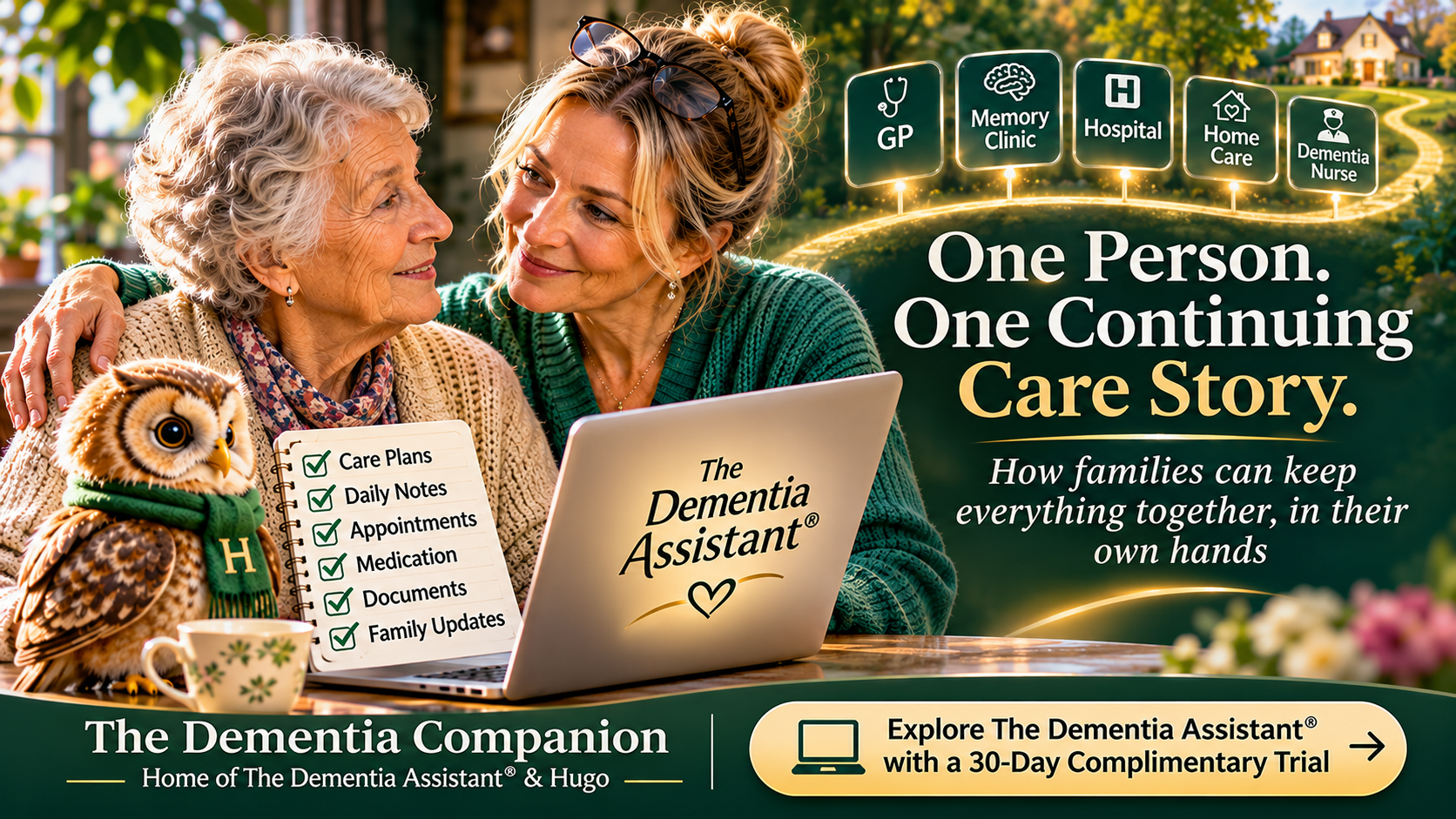
One person. One continuing care story. Because your mum’s life shouldn’t be scattered across ten different filing systems.
By Louise Donaghy, Dementia Practitioner, Founder of The Dementia Companion and The Dementia Assistant®, Creator of Hugo Intelligence™
It usually starts with a notebook.
A perfectly sensible little notebook.
You write down Mum’s next memory clinic appointment, a question for the GP, and perhaps something you’ve noticed about her sleeping.
Then there’s a hospital letter on the kitchen table.
A medication list in your handbag.
An appointment reminder on your phone.
A message from your brother asking how Mum has been.
And a note you definitely put somewhere safe.
So safe, apparently, that nobody has seen it since Tuesday.
Before long, you’ve become the unofficial administrator of your mum’s entire life.
Except nobody gave you a job description, a filing system or even a decent stapler.
If this sounds familiar, you are not alone.
When someone you love has dementia, keeping their care information organised can become almost as demanding as the caring itself.
But it doesn’t have to mean juggling countless notebooks, remembering every conversation or explaining Mum’s entire history every time someone new becomes involved.
You can begin with something surprisingly simple.
One place to keep the important information, one continuing care plan, and Mum at the centre of it all.
Why is organising dementia care so difficult for families?
When someone receives a dementia diagnosis, their care journey rarely involves just one professional.
There may be a GP, a memory clinic, a dementia nurse, hospital appointments, community services, home care providers and different specialists along the way.
Each organisation has its own responsibilities and may maintain its own records.
Those records are important.
But they don’t always contain the complete picture of the person.
The GP may know which medication Mum takes.
The memory clinic may understand her diagnosis.
The hospital may have information about a recent illness.
The home care agency may record the assistance she receives.
But who knows she likes her tea in a particular mug?
Who remembers that she becomes uncomfortable if someone rushes her?
Who knows that she sometimes finds it easier to express herself in the language she grew up speaking?
And who noticed that she was unusually quiet for several days before her last appointment?
Very often, it is Mum herself and the people closest to her.
Yet families can find themselves repeating the same information, answering the same questions and hoping nothing important gets lost between services.
The problem isn’t necessarily that people aren’t caring. It’s that information can become fragmented.
And that fragmentation is exhausting for families.
Should families have their own dementia care plan?
I believe they should have the opportunity to.
Not because professional care plans aren’t important. They absolutely are.
But because a person living with dementia should not have their entire care story dependent on whichever organisation happens to be involved at that particular time.
A family-maintained dementia care plan provides a continuing place to organise information about the person, their wishes, health, routines, needs and everyday experiences.
It can stay relevant when appointments change, new professionals become involved or support needs develop.
And most importantly, the person living with dementia should remain involved in developing and maintaining it as far as possible.
A diagnosis does not automatically mean somebody loses the ability to make decisions.
Their wishes, privacy, consent and rights still matter.
A family-held care plan should support the person’s voice, not replace it.
Professional records remain separate, and decisions about sharing personal information must respect appropriate consent, permissions and legal arrangements.
Where do I start organising Mum’s dementia care?
You don’t need to tackle thirty years of paperwork this afternoon.
Start with five areas.
- Who Mum is, not simply what her diagnosis is
Before recording medical details, record what matters to her.
Her preferred name.
Her important relationships.
Her routines.
Her favourite activities.
Her beliefs and values.
Her preferred language.
The things that make her laugh.
And the things that make her feel uncomfortable or anxious.
Perhaps Mum has always enjoyed her garden.
Perhaps she likes to choose her own clothes.
Perhaps she prefers a quiet morning before anybody starts asking questions.
These details may seem ordinary.
But they are often exactly what a new professional needs to understand when providing person-centred support.
The Dementia Assistant® includes Life Story and personalised care-planning features to help preserve information about the person beyond their diagnosis.
- Medical information and appointments
Keep relevant health information together, including:
- Diagnoses and other significant health conditions.
- Current prescribed medication and allergies.
- GP, memory clinic and other professional contacts.
- Appointment dates and questions.
- Important reports and letters.
- Agreed actions and follow-up arrangements.
Always check medication details against current professional instructions. A family record is useful, but it should never be treated as an independent authority for changing prescribed treatment.
The purpose is to help you arrive at appointments prepared, with the right questions and accurate information.
- Daily notes and observations
This is an area where many families find themselves relying entirely on memory.
Perhaps Mum has been more tired.
Perhaps she has stopped enjoying an activity.
Perhaps she was particularly settled after listening to familiar music.
Or perhaps something happened last Thursday that you wish you had written down.
A short, factual note can be useful.
For example:
“Thursday afternoon: Mum enjoyed lunch with her sister and spent time looking through photographs. She seemed tired by early evening. Mentioned some discomfort when standing from her chair.”
You haven’t diagnosed anything.
You have simply recorded what you noticed.
This can help identify questions to discuss with a professional and give a clearer picture of changes over time.
You don’t need to record every moment.
Mum is entitled to have a life, not an audience taking minutes of it.
- What works well
A care plan should never become a catalogue of everything somebody struggles with.
We should also record what helps.
Perhaps Mum responds better when given time to process a question.
Perhaps she prefers music during personal care.
Perhaps she likes choosing between two outfits rather than being handed something to wear.
Perhaps she enjoys speaking her first language, particularly when tired or unsettled.
These things are valuable.
And they belong in a care plan just as much as medication and appointments do.
- Questions and conversations
This is the section families sometimes forget.
The questions that come into your head at ten o’clock at night.
The conversation with the dementia nurse that made you think differently.
The practical advice you wanted to try.
The concern you weren’t quite sure how to explain.
Having somewhere to keep those thoughts can be a relief.
And this is where Hugo Intelligence™ offers something more than a traditional paper care plan.
Meet Hugo Intelligence™: A conversation, not just another form
One of the reasons I created Hugo was because families don’t always need another checklist.
Sometimes they need somewhere to talk things through.
They need to say:
“Hugo, Mum has been unusually quiet this week. I’m not sure whether I should be worried.”
Or:
“Hugo, Dad is becoming upset when the carers arrive. How can we make things easier for him?”
Or even:
“Hugo, I don’t know what I’m supposed to be doing. Everything feels overwhelming.”
Not every question fits neatly into a form.
And not every conversation begins with the family knowing exactly what to ask.
Hugo Intelligence™ is designed for natural, ongoing conversations about dementia care.
You can explain what’s happening, ask follow-up questions, explore possibilities and discuss approaches without feeling judged for not having all the answers.
Hugo doesn’t expect you to become a dementia expert overnight.
He helps you explore the question in front of you.
Importantly, Hugo isn’t a doctor. He cannot diagnose the cause of symptoms or replace professional clinical assessment.
But he can help you understand information, consider person-centred approaches and prepare sensible questions for the professionals involved.
Can Hugo remember our conversations?
One of Hugo’s particularly useful features is the ability to save and organise your conversations.
Families don’t always need an answer only once.
You might ask about communication today, revisit the advice next week and want to find the conversation again before a future appointment.
Within The Dementia Assistant®, you can categorise, organise and save Hugo conversations for later reference.
That means useful discussions don’t have to disappear into a long stream of messages.
You can return to important guidance, keep related subjects together and maintain continuity in how you explore different situations.
A saved conversation is not the same as a clinical record, and any ongoing concerns or changes still need to be appropriately reviewed.
But it can become a helpful personal resource.
Because sometimes you don’t want to ask the same question again.
You want to pick up where you left off.
Can Hugo give advice based on Mum’s own care plan?
Yes, and this is an important distinction.
You can talk to Hugo about dementia generally without selecting a care plan.
But within The Dementia Assistant®, you can also select Mum’s care plan.
When you do, Hugo can use relevant information that has been recorded about her routines, preferences, circumstances and needs to provide more individualised, person-centred suggestions.
Imagine asking:
“Hugo, Mum becomes unsettled in the evenings. What could we try?”
Hugo can offer general information about possible causes and supportive approaches.
But when Mum’s care plan is selected, the conversation can also consider details you’ve recorded, perhaps her preferred routines, communication needs, sleep patterns or activities she enjoys.
That doesn’t mean Hugo automatically knows why Mum is unsettled.
It means the guidance can start from a better understanding of the person.
Not just dementia. Mum’s dementia experience, her preferences, her life.
And it remains your choice which care plan you select.
Dementia care doesn’t happen in just one language
There is another important part of person-centred dementia care that is too often overlooked.
Language.
Imagine someone who has spent most of their adult life speaking English but grew up speaking Welsh, Irish, Spanish, Hindi or another language.
Or a family whose relatives live in different countries.
Perhaps the person with dementia feels more comfortable using their first language when tired or distressed.
Perhaps an adult child wants to explain important care information to relatives who communicate in another language.
Language is more than a method of passing on information.
It is part of identity, culture, familiarity and belonging.
Some people living with dementia may experience changes in how easily they use different languages. This varies between individuals and should never be assumed.
The Dementia Assistant® provides multilingual support, with 12 interface languages and dictation and translation capabilities covering 201 languages.
These tools can help families and professionals access information, communicate and organise care notes across language barriers.
The distinction matters: not every feature is necessarily available in all 201 languages, and important translated medical information should be checked for accuracy.
For families, the benefit is practical.
A care plan can help preserve a person’s communication preferences.
Dictation may make recording information easier.
Translation may help relatives or professionals understand information that has been shared appropriately.
And Hugo’s conversational approach can support people who find it easier to express a concern naturally rather than completing a complicated form.
Because the person shouldn’t have to fit the system. The system should make room for the person.
What if several family members are involved?
Let’s imagine your sister takes Mum to her memory clinic appointments.
Your brother helps with shopping.
You manage the paperwork.
And another relative lives abroad.
Everybody wants to help.
But somehow everybody has a slightly different version of what is happening.
One person thinks the next appointment is Tuesday.
Another thinks it’s Thursday.
And somebody has forwarded a photograph of a hospital letter into a family WhatsApp group, where it now lives between seventeen birthday messages and a video of a dancing Labrador.
This is where organised information becomes especially helpful.
The Dementia Assistant® includes Family Circle features to support sharing relevant updates and keeping family members involved where appropriate.
Information should only be shared with the right people, with the person’s wishes, privacy and applicable permissions respected.
The aim isn’t to give everybody access to everything.
It is to support better communication without losing sight of the person whose information it is.
How can daily care notes help at the next appointment?
One of the most common questions professionals ask is:
“Have you noticed any changes since we last saw you?”
A perfectly reasonable question.
Unfortunately, it often arrives just as your mind goes completely blank.
Then, on the way home, you remember six things you meant to mention.
Short, factual notes can help you prepare.
Before an appointment, consider:
- What has changed since the last review?
- What is going well?
- Has Mum expressed any concerns?
- Have there been any changes in sleep, eating, mobility or communication?
- Are there medication questions?
- Is there anything we would like help understanding?
You can use The Dementia Assistant® to organise care notes, relevant documents and information you want to discuss.
You can also ask Hugo to help you think through which questions might be useful to raise.
But if Mum becomes suddenly confused, develops an abrupt change in alertness or has another acute concerning symptom, don’t wait to record several days of observations.
Sudden confusion requires immediate medical help.
Does The Dementia Assistant® replace professional care records?
No.
GPs, hospitals, memory clinics, care agencies and other professionals have their own responsibilities to maintain appropriate records and care plans.
Those records remain essential.
And families should not be left to coordinate complex healthcare needs without professional support.
The Dementia Assistant® serves a different purpose.
It provides the person living with dementia and their family with their own continuing place to organise information.
A place that isn’t limited to one GP surgery, care provider or hospital.
A place where the person’s story, preferences and observations can be maintained and updated as circumstances change.
A place where relevant information can be prepared and shared appropriately with professionals.
And a place where Hugo can help the family explore dementia questions, revisit conversations and develop their own understanding.
This family-held information complements professional care records. It doesn’t replace them.
What happens when Mum’s needs change?
Dementia care is rarely static.
There may be periods when very little changes.
There may be times when additional support is needed.
And there may be changes in who provides that support.
A family-held care plan can evolve alongside the person.
If Mum starts receiving help at home, her important preferences remain recorded.
If she needs hospital care, relevant information can be prepared for the team.
If another family member becomes more involved, appropriate updates can help them understand what matters.
If her needs become more complex, her care plan can be reviewed alongside professional guidance.
From the first concerns about memory, through diagnosis and changing needs, and eventually towards later-life or end-of-life care where relevant, the person remains the same individual.
Different professionals. Different services. One person. One continuing story.
A simple way to begin today
If you are sitting at home wondering where to start, here are five manageable steps.
First: Ask Mum what information she would like recorded and who she wants involved.
Second: Gather the most important current information, including appointments, medication details and professional contacts.
Third: Write down what matters to her, including routines, relationships, language preferences and things she enjoys.
Fourth: Choose how you will keep relevant daily observations and questions organised.
Fifth: Review the information gradually, involve appropriate professionals and update it when something meaningful changes.
You don’t need to complete everything in one afternoon.
You are creating something that can grow with the person.
And please remember to put the paperwork down occasionally.
Have a cup of tea together.
Go for that walk.
Watch the programme she loves.
Make another memory.
Because the whole point of organising dementia care is to make room for living, not to turn every day into administration.
⸻
Ask Hugo: Your Questions About Organising Dementia Care
Hugo, my mum has dementia and I’m overwhelmed by all the paperwork. Where do I begin?
Hugo 🦉: Start with what matters most today.
Choose one place to organise Mum’s important information. Begin with her wishes, current medication details, professional contacts and upcoming appointments.
You can build the rest gradually.
Within The Dementia Assistant®, I can also guide you through creating a personalised care plan, one question at a time.
Can I talk to Hugo without creating a care plan first?
Hugo 🦉: Yes.
You can ask general dementia questions and explore situations without creating or selecting a care plan.
If you later choose a specific care plan, I can use the relevant information recorded within it to provide more personalised guidance.
Can I save my conversations with Hugo?
Hugo 🦉: Yes. You can save, categorise and organise your conversations within The Dementia Assistant®.
This allows you to revisit useful discussions rather than starting from the beginning every time you have another question.
Can Hugo help me create Mum’s care plan?
Hugo 🦉: Absolutely.
I can guide you through questions about Mum’s daily life, strengths, preferences, routines, communication and support needs.
You can review and develop the information as you go.
A person-centred care plan should grow with the person, not be something you fill out once and forget.
Can Hugo help if my family speaks different languages?
Hugo 🦉: The Dementia Assistant® supports 12 interface languages and provides dictation and translation capabilities across 201 languages.
These features can help make care information and communication more accessible for multilingual families.
The person’s preferred language should always be respected, and important translations should be checked for accuracy.
Can I record daily changes and prepare for Mum’s memory clinic appointments?
Hugo 🦉: Yes.
The Dementia Assistant® includes daily notes and document organisation, helping you keep relevant observations and information together.
You can also ask me to help you explore questions you may wish to discuss with the healthcare team.
Will Mum’s care information remain with us if she changes care providers?
Hugo 🦉: Your family-held care plan within The Dementia Assistant® is independent of any individual care provider.
Subject to your account and access arrangements, you can continue maintaining your own information as services change.
Professional records remain separate, but you can prepare and share relevant information appropriately.
Does Hugo replace a doctor, dementia nurse or memory clinic?
Hugo 🦉: No.
I can help you understand information, explore everyday dementia questions and consider practical approaches.
I cannot diagnose medical conditions or replace clinical assessment.
Think of me as another supportive tool alongside your healthcare professionals, not instead of them.
How much does The Dementia Assistant® cost?
Hugo 🦉: The Family subscription is £4.99 per month, approximately the price of a cup of coffee.
All subscriptions include a 30-day complimentary trial, so you can explore the features and see whether they are useful for your family.
⸻
One Person. One Continuing Care Story.
When someone is diagnosed with dementia, their journey may involve GPs, memory clinics, dementia nurses, hospitals, home care agencies and other professionals.
Each service may keep its own records.
Families can find themselves repeating the same information, explaining the same routines and trying to make sure important details aren’t lost between appointments.
But dementia care shouldn’t feel fragmented across ten different organisations.
The Dementia Assistant® was created to give the person living with dementia and their family their own continuing place for care information.
A place to record what matters to the person.
A place to preserve their wishes, routines, preferences and life story.
A place to organise documents, daily observations and questions for appointments.
And with Hugo Intelligence™, a place to have natural conversations, save important guidance, explore person-centred approaches and access multilingual support.
The Dementia Assistant® doesn’t replace professional medical records or clinical care plans.
It helps families maintain their own organised information alongside professional care.
Your life. Your care plan. Your information. In your own hands, throughout your dementia journey.
Meet Hugo and The Dementia Assistant®
Created by dementia practitioner Louise Donaghy, The Dementia Assistant® is powered by Person-Centred Intelligence® and brings together practical, person-centred support for families and professionals.
Explore the care-planning tools, conversational Hugo Intelligence™, daily notes, Family Circle, Life Story, multilingual support and learning resources.
Every subscription includes a 30-day complimentary trial.
https://thedementiaassistant.com/
The Dementia Companion, home of The Dementia Assistant® and Hugo 🦉
https://thedementiacompanion.com/
Louise and Hugo ❤️🦉
Louise Donaghy
Founder & CEO of The Dementia Assistant®
Created and powered by Person-Centred Intelligence®
Creator of Hugo Intelligence™
⸻
References and Further Reading
The following authoritative UK resources support the information provided in this article.
- NICE: Dementia, Assessment, Management and Support (NG97)
Guidance on person-centred dementia care, assessment, care coordination and support for people living with dementia and their carers.
https://www.nice.org.uk/guidance/ng97/chapter/recommendations
- NICE: Dementia Quality Standard, Coordinating Care
Recommendations on understanding individual needs and preferences, developing care plans and coordinating support.
https://www.nice.org.uk/guidance/qs184/chapter/quality-statement-4-coordinating-care
- NHS: Help and Support for People with Dementia
Information about dementia care plans, services, assessments and support following diagnosis.
https://www.nhs.uk/conditions/dementia/care-and-support/help-and-support/
- Dementia UK: Getting the Best Out of GP and Other Health Appointments
Practical guidance about preparing questions, recording important information and making the most of consultations.
- Dementia UK: Creating a Life Story for a Person with Dementia
Guidance about recording personal history, meaningful relationships, interests and preferences to support person-centred care.
https://www.dementiauk.org/information-and-support/living-with-dementia/creating-a-life-story/
- NHS: Sudden Confusion (Delirium)
Information about sudden confusion and why it requires immediate medical attention.
https://www.nhs.uk/symptoms/confusion/
⸻
Important information: This article is intended for educational purposes. It does not replace medical assessment, legal advice or individual care planning by qualified professionals. Service and legal arrangements differ across the four UK nations.
Reviewed: 20 November 2026
You May Also Find Helpful
Need help with your own situation? Ask Hugo.
One Person. One Continuing Care Story. The Dementia Companion is where you discover guidance. Inside The Dementia Assistant®, talk with Hugo, save and categorise conversations, record daily notes and involve authorised supporters in a continuing care plan centred around the person.
Ask Hugo About This · Start Your Continuing Care Plan — Families · Continuing Care Planning — Professionals
Personal guidance requires the appropriate account and subscription access. Care-plan information is used only with authorised access and the required consent and selection steps. All subscription plans include a 30-day complimentary trial.