Mum Won’t Let Us Brush Her Teeth. How Do We Support Oral Care With Dignity?
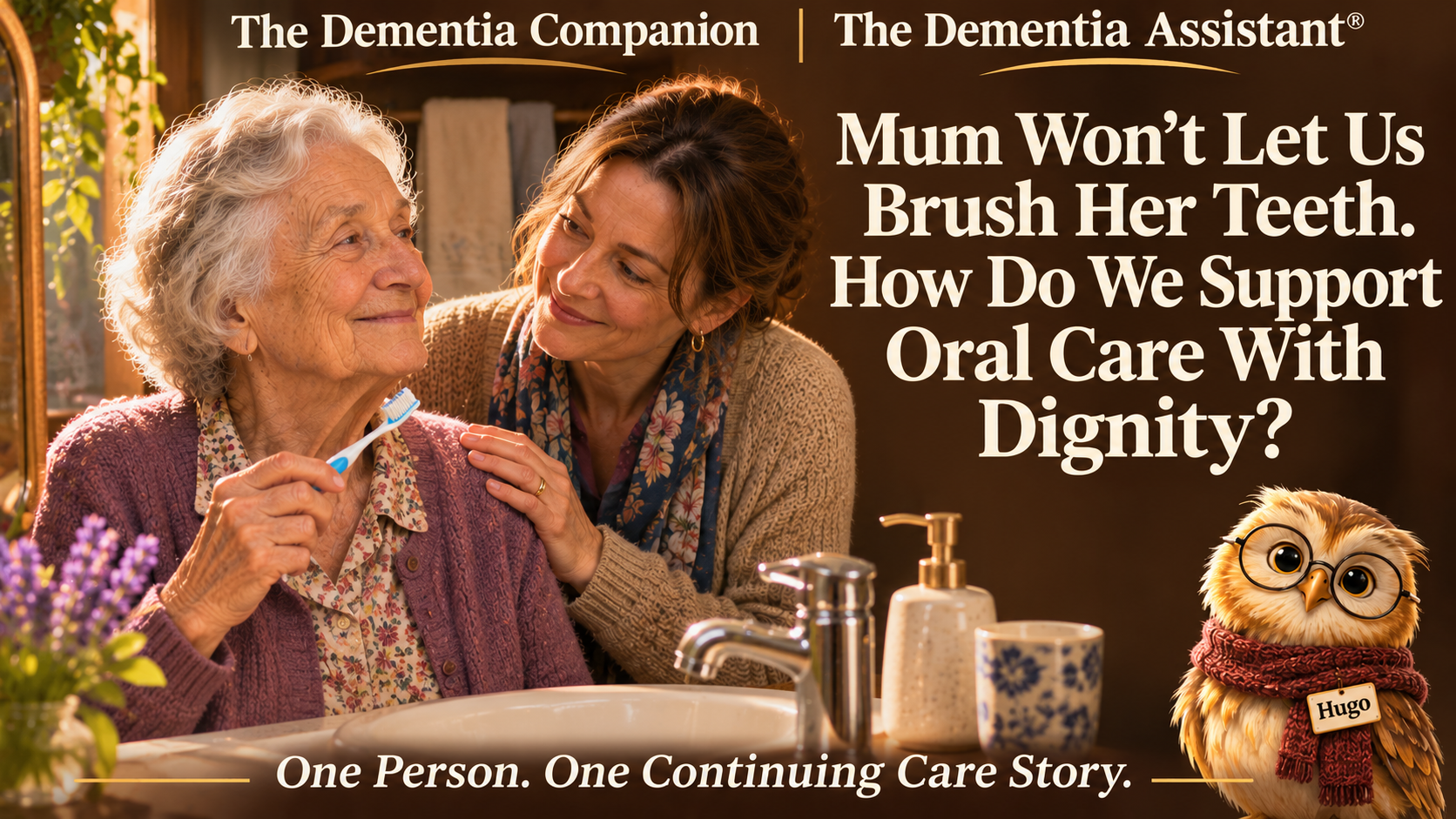
Mum Won’t Let Us Brush Her Teeth. How Do We Support Oral Care With Dignity?
By Louise Donaghy | The Dementia Companion | One Person. One Continuing Care Story.
There was a time when Mum wouldn’t dream of leaving the house without brushing her teeth, fixing her hair and making sure she looked presentable.
She had her routines.
Her favourite toothpaste.
Her little glass beside the bathroom sink.
And perhaps the occasional reminder that you really ought to look after your own teeth properly.
Funny how the tables can turn.
Now, every time you approach her with a toothbrush, she turns her head away.
Sometimes she clamps her mouth shut.
Sometimes she pushes your hand away.
And occasionally she gives you a look that suggests you’ve just proposed something completely outrageous.
“Come on, Mum, we need to brush your teeth.”
“No, thank you.”
“Just for a minute.”
“I said NO!”
Suddenly, something that once took two minutes has become the most stressful part of the morning.
You worry about tooth decay, gum disease, infection and whether she might already be in pain.
But you also don’t want to upset her.
You certainly don’t want her to feel frightened or embarrassed.
And if you’re being completely truthful, you may be wondering how on earth a toothbrush has become the most controversial object in the house.
Here’s what I want families to understand: when someone living with dementia resists having their teeth brushed, there is usually more to explore than simply refusing to cooperate.
Mum may be frightened, confused, uncomfortable, in pain or struggling to understand what is being asked of her.
She may still be perfectly capable of brushing her own teeth but dislike someone taking control.
Or the sensation of a toothbrush in her mouth may have become unpleasant.
Whatever the reason, our first responsibility is to try to understand her experience.
Because oral care matters.
But so do dignity, choice, comfort and trust.
And good dementia care should never require us to sacrifice one simply to achieve the other.
Why does someone with dementia refuse to have their teeth brushed?
Brushing our teeth seems simple because most of us have been doing it for decades.
We pick up the toothbrush, apply toothpaste, brush, spit and carry on with our morning.
Usually while thinking about twelve other things.
But look at how many different abilities that familiar routine requires.
We need to recognise the toothbrush, remember its purpose, understand what toothpaste is, coordinate our movements, tolerate the sensation inside our mouth and complete the sequence of actions.
Dementia can affect some or all of these abilities.
According to the Alzheimer’s Society and Dementia UK, people living with dementia may need increasing assistance with mouth care as the condition progresses.
However, the reason for difficulty will vary enormously between individuals.
- Mum may no longer recognise what the toothbrush is for
Imagine someone approaching you with an unfamiliar object and trying to put it into your mouth.
You don’t understand what it is.
You don’t understand why they’re doing it.
And you certainly haven’t agreed to it.
You might push their hand away too.
Dementia can affect the ability to recognise familiar objects or understand what another person is asking.
A toothbrush that was once completely ordinary might now seem unfamiliar.
Mum’s reaction could be an attempt to protect herself from something she doesn’t understand.
That deserves reassurance, not confrontation.
- She may be experiencing pain
This is one of the first possibilities worth considering.
Perhaps Mum has a painful tooth.
Maybe her gums are inflamed.
Perhaps her dentures are rubbing.
She could have mouth ulcers, broken teeth, tooth decay or a dry mouth.
And she may not be able to explain any of it.
Instead, she might turn away when the toothbrush approaches.
She may refuse particular foods.
She might rub her cheek, become unsettled or suddenly start eating less.
Sometimes what appears to be resistance to care is actually a response to discomfort.
Never assume that a new refusal is simply another symptom of dementia until you have considered possible pain or illness.
- She may feel frightened or overwhelmed
Bathrooms can be surprisingly challenging environments.
Bright lighting.
Cold surfaces.
Running water.
An electric toothbrush making an unfamiliar buzzing sound.
Someone standing very close.
Perhaps several instructions being given at once.
For someone living with dementia, this may be too much information to process comfortably.
The person helping may have the kindest intentions, yet the situation can still feel threatening.
Think about how different it might feel if Mum is allowed to sit comfortably, hold her own toothbrush and take her time.
Sometimes changing the experience matters more than changing the words.
- She may not want someone else taking over
This is particularly important.
Mum may have been independent all her life.
She has raised children, managed a home, made decisions and looked after herself.
Now someone is telling her how to clean her teeth.
And worse still, they may be trying to do it for her.
We must be careful not to interpret a wish for independence as a problem.
Perhaps she can still manage most of the task with a little prompting.
Perhaps she simply needs someone to prepare the toothbrush.
Or perhaps she’d prefer privacy.
Support should begin with what the person can still do, not with what we assume they can no longer manage.
- The sensation may have become unpleasant
Some people experience greater sensitivity to touch, taste, temperature or noise.
A strongly flavoured toothpaste may sting.
Cold water might feel uncomfortable.
An electric toothbrush may be too noisy.
The brushing sensation might feel intrusive.
Consider whether Mum would prefer a soft manual toothbrush, a different toothpaste or another approach recommended by her dental professional.
There is no single toothbrush that suits everyone living with dementia.
- She may not understand the instructions
“Come on, Mum, let’s get your teeth brushed before breakfast because we’ve got to leave for your appointment.”
That may sound perfectly reasonable.
But it contains several pieces of information.
Mum needs to understand what you’re asking, why you’re asking and what she is expected to do.
It may be easier to offer one simple step at a time.
“Here’s your toothbrush.”
Pause.
“Shall we put some toothpaste on?”
Pause.
“Would you like to start?”
Allow time for her to respond.
Sometimes fewer words are more helpful than a longer explanation.
Why is good oral care so important in dementia?
Oral care is not simply about having clean teeth or fresh breath.
It is an important part of general health, comfort and wellbeing.
Poor oral health can contribute to tooth decay, gum disease, pain and infection.
These problems can affect eating, drinking, speaking and quality of life.
They may also be particularly difficult to recognise when someone has dementia.
A person who cannot easily describe toothache might instead show changes in appetite, facial expression or behaviour.
Mum may stop eating the foods she enjoys because chewing hurts.
She may become restless at night because of discomfort.
Or she may become distressed during personal care because her mouth is sore.
This is why regular mouth care and dental assessment remain important.
What is the recommended daily routine?
The NHS recommends that adults generally brush their teeth with fluoride toothpaste twice daily for approximately two minutes, including before bed.
For most adults, toothpaste should contain at least 1,350 parts per million (ppm) fluoride, unless a dental professional recommends otherwise.
After brushing, the usual recommendation is to spit out excess toothpaste without immediately rinsing with water, helping fluoride remain on the teeth.
But the practical approach must be tailored to the individual.
Someone with swallowing difficulties, significant physical limitations or distress during mouth care may require specialist advice on safe techniques, products and positioning.
These recommendations are goals to work towards, not instructions to force someone’s mouth open.
If brushing is repeatedly unsuccessful, seek dental guidance rather than leaving the problem unresolved.
Ten gentle ways to make toothbrushing easier
- Start with reassurance, not the toothbrush
Before you do anything, consider how Mum is feeling.
Is she calm?
Is she comfortable?
Is she tired?
Does she know who you are?
Would she prefer a little conversation first?
Approach from where she can see you.
Speak naturally.
Use her preferred name and familiar communication style.
Perhaps begin with:
“Morning, Mum. How are you feeling?”
Then introduce the activity.
“Shall we freshen up a little?”
This may feel less confrontational than arriving with a toothbrush already in your hand.
But avoid vague explanations if Mum prefers clear, direct language.
The important thing is that she understands what is happening as far as possible.
- Let Mum hold the toothbrush
Whenever she can, encourage Mum to participate.
Put the toothbrush within easy reach.
Let her pick it up.
She might immediately remember what to do.
If she doesn’t, you could demonstrate brushing your own teeth.
The Alzheimer’s Association recommends simple instructions and showing the person what to do.
Sometimes watching someone else perform a familiar action is more useful than listening to several explanations.
You could say:
“Shall we do ours together?”
And yes, you may find yourself standing beside Mum, both of you brushing your teeth in the middle of the afternoon.
There are certainly worse ways to spend five minutes.
- Break the routine into small steps
Rather than asking Mum to complete the entire task, offer one manageable instruction at a time.
For example:
“Here’s your toothbrush.”
“Would you like some toothpaste?”
“Shall we start at the front?”
Allow time between each step.
Avoid rushing or repeating instructions more loudly if she doesn’t respond.
She may need more processing time.
A helpful reminder is that slow does not mean incapable.
- Use the toothbrush she likes
Consider whether the equipment is part of the problem.
A soft, small-headed toothbrush may be more comfortable.
A toothbrush with a larger handle might be easier for someone with arthritis or reduced grip.
An electric toothbrush can help some people but may frighten others because of the noise or vibration.
The best choice is one that Mum can use comfortably and safely.
If she struggles with dexterity, an occupational therapist or dental professional may suggest practical adaptations.
- Try a different time of day
Perhaps Mum becomes tired and unsettled in the evening.
Perhaps mornings are rushed.
Maybe she’s much more relaxed after breakfast.
The ideal routine includes brushing twice daily, particularly before bed, but flexibility can help establish cooperation.
If Mum becomes distressed one evening, it may be better to stop and try again later rather than allow the situation to escalate.
Repeated difficulty should prompt a review of the routine and dental advice.
The objective is to create sustainable care, not win a daily contest.
- Change the environment
Toothbrushing does not always have to take place standing in front of the bathroom mirror.
Some people may feel more comfortable sitting in a familiar chair or another quiet, suitable location.
Make sure Mum is upright and well supported.
Have everything ready beforehand.
Use adequate lighting without creating glare.
Reduce noise and distractions.
And remember that mirrors can be confusing or frightening for some people with dementia.
If the bathroom mirror is contributing to distress, try another position or location.
- Offer help without taking over
Perhaps Mum can brush the front teeth but struggles to reach the back.
Maybe she can hold the brush but needs guidance.
Ask permission before assisting.
You might say:
“Would you like me to help you with the back ones?”
If she welcomes help, provide only what she needs.
Some people benefit from gentle hand-over-hand guidance, where you support their hand as they brush.
Others dislike having their hands touched or controlled.
If she pulls away, respect that response.
What works for one person may feel uncomfortable to another.
- Keep instructions gentle and familiar
Try avoiding repeated commands.
Instead of:
“Open your mouth. Wider. Come on. Keep still.”
Consider:
“Would you like to start with the top teeth?”
Or:
“I’ll show you first.”
Use a calm voice.
Give Mum time.
And where appropriate, offer simple choices.
“Would you like the blue toothbrush or the white one?”
But don’t overwhelm her with a long list of options.
Two meaningful choices are often more manageable than ten.
- Pay attention to her body language
Mum may communicate through facial expression and movement even when words are difficult.
Notice whether she:
- Moves her head away.
- Winces when a particular tooth is touched.
- Clenches her jaw.
- Becomes unusually tense.
- Reaches towards her cheek.
- Appears frightened when someone approaches.
These responses provide useful information.
Stop if she becomes distressed.
Don’t pin her arms down, force her mouth open or continue brushing against active resistance.
If oral care remains difficult, involve dental and healthcare professionals to develop a safe, lawful and individual approach.
- Recognise when enough is enough for the moment
Sometimes the most compassionate decision is to stop.
You have tried reassuring her.
You have adjusted the environment.
You have offered choices.
And Mum still does not want to continue.
Continuing to insist may damage trust and make future attempts harder.
You can acknowledge her feelings.
“That’s all right, Mum. We’ll leave it for now.”
Then try again when she is more comfortable, while arranging professional support if the problem continues.
A difficult morning does not mean you have failed.
But repeated missed mouth care should not be ignored, particularly if there is pain, infection or deteriorating oral health.
What should I say when Mum refuses to open her mouth?
Words can make an enormous difference, especially when someone feels frightened or defensive.
The goal is not to find a magical phrase that makes every refusal disappear.
It is to communicate respect and reduce pressure.
Instead of:
“Mum, open your mouth. We have to clean your teeth.”
Try:
“Would you like to try brushing your teeth yourself? I’m here if you’d like some help.”
Instead of:
“Stop being difficult.”
Try:
“Something doesn’t feel right, does it? Shall we leave it for a moment?”
Instead of:
“You haven’t brushed your teeth for days!”
Try:
“Shall we freshen your mouth? We can take it slowly.”
Instead of:
“You need to let me do this.”
Try:
“Would you feel more comfortable holding the toothbrush?”
Instead of:
“You used to manage this perfectly well.”
Try:
“Let’s find a way that feels comfortable for you now.”
There is no need to remind Mum repeatedly of the abilities she has lost.
She may already feel vulnerable.
Our role is to support the abilities she still has and protect her sense of self.
What if Mum thinks we’re trying to hurt her?
This can be especially upsetting for families.
You know that you are trying to help.
But Mum may experience the situation very differently.
She might not recognise the toothbrush.
She may misunderstand your intentions.
Or the sensation of brushing may genuinely hurt.
If she says:
“You’re hurting me!”
Take that seriously.
Stop and check whether she may be in pain.
You could say:
“I’m sorry, Mum. I don’t want to hurt you.”
Then give her space.
Avoid arguing that you haven’t hurt her.
Her experience deserves consideration, even if you do not yet understand what caused it.
A dental examination may reveal a problem that was previously difficult to identify.
What about dentures?
Dentures need regular care too.
And having no natural teeth does not mean that mouth care is unnecessary.
The gums, tongue and other oral tissues still need to be kept clean and comfortable.
Dentures can become uncomfortable if they no longer fit properly.
They may rub, cause sore areas or become loose.
Someone with dementia may struggle to explain this.
Practical denture care
Depending on the type of denture and professional advice:
- Remove and clean dentures according to the dentist’s recommendations.
- Use an appropriate denture brush and cleaning product rather than abrasive ordinary toothpaste.
- Clean the gums, tongue and remaining natural teeth.
- Check for redness, swelling, ulcers or discomfort.
- Follow professional guidance about removing dentures overnight and storing them safely.
- Arrange a dental review if dentures are loose, painful or repeatedly refused.
If Mum becomes upset when someone tries to remove her dentures, don’t force them out.
Seek advice from her dentist about safe removal and cleaning.
Dentures are personal items.
They can be important for eating, speech, appearance and confidence.
Imagine suddenly having someone remove something from your mouth without explaining why.
We should never lose sight of how intrusive that might feel.
What if dentures go missing?
Families and care services may also need a safe system for storing and identifying dentures.
Keep them in an appropriate container.
Record where they are normally stored.
In shared care settings, ask about identification procedures, with the person’s permission.
Losing dentures can affect nutrition, communication and dignity, and replacement can be stressful and expensive.
Those details belong in the continuing care plan.
Could a dry mouth be making things worse?
Yes.
Dry mouth can occur for several reasons, including medication side effects, dehydration, mouth breathing and some medical conditions.
Saliva helps protect the mouth and teeth.
When saliva is reduced, the risk of discomfort and dental problems may increase.
Mum may find toothpaste unpleasant or complain of a sticky feeling.
She may have difficulty eating dry foods.
Speak with her dentist, pharmacist or clinician about possible causes.
They may suggest appropriate oral moisturising products or review relevant medicines.
Do not independently stop prescribed medication.
Sugar-free gum or sweets may sometimes be suggested for people who can use them safely, but they are inappropriate for some people with swallowing difficulties or choking risks.
Again, the right advice depends on the individual.
What if Mum has swallowing difficulties?
Mouth care remains essential for someone with swallowing difficulties.
However, the technique may need to change.
If Mum coughs or chokes during brushing, struggles to manage saliva, cannot spit safely or has been assessed as having dysphagia, seek advice from her dental and swallowing professionals.
A speech and language therapist, called a speech-language pathologist in some countries, may be involved.
Non-foaming toothpaste or specialist equipment may be appropriate in some situations, following professional advice.
Avoid using mouthwash if Mum cannot safely rinse and spit.
Do not pour fluid into her mouth or attempt to rinse it forcefully.
And never assume that a person who has stopped eating by mouth no longer needs oral care.
Comfortable, clean oral tissues remain important.
In advanced dementia or palliative care, an individual mouth-care plan may place particular emphasis on relieving dryness, preventing discomfort and maintaining dignity.
How do we recognise dental pain when Mum cannot explain it?
Pain is not always expressed in words.
Sometimes it appears as a change in behaviour.
You may notice Mum:
- Refusing foods she previously enjoyed.
- Chewing on one side of her mouth.
- Becoming upset when her face or mouth is touched.
- Rubbing her jaw.
- Wincing during meals.
- Having difficulty wearing dentures.
- Becoming unusually restless or withdrawn.
- Developing bad breath, bleeding gums or visible swelling.
None of these signs proves that she has a dental problem.
But they are reasons to look more closely.
Arrange a dental assessment if you suspect pain, infection, broken teeth or deteriorating oral health.
Don’t assume a person cannot feel or experience dental pain because they have difficulty communicating it.
When is dental help urgent?
Seek prompt dental advice for significant toothache, a suspected abscess, a broken tooth causing pain, facial swelling or signs of infection.
If there is severe swelling affecting breathing or swallowing, or another life-threatening symptom, call emergency services immediately.
In the UK, urgent dental help can be arranged through a dentist or NHS 111, with 999 for emergencies.
International families should use their local urgent dental and emergency services.
Persistent mouth ulcers, unexplained lumps or other suspicious changes also need professional examination.
How do we arrange a dentist appointment for someone with dementia?
Dental visits can become more challenging as dementia progresses, but avoiding them altogether may allow preventable problems to worsen.
Where possible, maintain routine dental care and address concerns early.
Before an appointment, explain to the dental team that Mum is living with dementia and describe any relevant needs.
Useful information might include:
- How Mum prefers to be addressed.
- Whether she understands short instructions.
- What tends to frighten or reassure her.
- Any hearing, vision or communication difficulties.
- Her usual mouth-care routine.
- Known pain or swallowing concerns.
- Medicines and relevant medical conditions.
- Whether she needs help with mobility.
- Any important consent or decision-making arrangements.
Ask whether a quieter appointment time, additional time or a familiar companion would be possible.
For some people, a general dentist can provide the necessary adjustments.
Others may need a special care dental service, community dental service or another specialist pathway.
Availability varies between countries and regions.
The objective is to make appropriate dental care accessible without treating Mum as a collection of difficulties.
She is a patient, a person and an individual with her own preferences.
What about consent when Mum cannot understand treatment?
A dementia diagnosis does not automatically mean someone cannot make decisions.
Decision-making ability can vary according to the particular decision and circumstances.
Mum should be involved and supported to understand and express her wishes as far as possible.
Where she lacks capacity for a particular decision, professionals must follow the applicable laws and procedures in her country, including any relevant legal representatives, advance wishes and best-interests or equivalent decision-making requirements.
Families should not assume that being a relative automatically gives them legal authority to consent to every treatment.
Seek advice from the dental team when decisions are complicated.
Respect for dignity, rights and comfort remains essential at every stage.
A fictional example: When Margaret’s toothbrush became the enemy
The following example is fictional and illustrates how a person-centred approach might work.
Margaret is 84 and lives with Alzheimer’s disease.
She has always been particular about her appearance.
Her daughter Helen remembers watching her get ready every morning.
Hair brushed.
Cardigan buttoned.
Teeth cleaned.
And absolutely no leaving the house looking as though she’d been dragged through a hedge backwards.
But recently, Margaret has started refusing help with her teeth.
Every morning Helen brings her into the bathroom.
Every morning Margaret becomes upset.
She turns her head away and pushes Helen’s hand.
Helen feels increasingly anxious.
She knows how important dental hygiene is.
She worries about infections.
She worries about being judged if Mum’s teeth aren’t clean.
And she worries that she is somehow letting her mother down.
Then Helen begins to look at the situation differently.
Instead of focusing only on getting the task completed, she starts observing what happens before Margaret becomes distressed.
She notices the electric toothbrush makes her flinch.
She notices Margaret dislikes standing in front of the bathroom mirror.
And when Helen tries a softer manual toothbrush, Margaret still seems uncomfortable around one side of her mouth.
Helen arranges a dental appointment.
The dentist identifies a dental problem requiring treatment and discusses a suitable care plan.
With professional guidance, the family begins adapting Margaret’s routine.
She sits comfortably.
She holds her own toothbrush when possible.
Helen offers short, familiar prompts.
If Margaret becomes upset, they stop and try again later.
Some mornings go well.
Other mornings are difficult.
But Helen no longer sees her mother’s reaction as deliberately uncooperative.
She understands that Margaret is communicating something, even when she cannot explain it clearly.
And Margaret?
She still likes to look her best.
That part of her hasn’t disappeared.
Why a person-centred oral care plan makes such a difference
Families often know an enormous amount about the person they support.
They know how Mum likes her tea.
Which cardigan she prefers.
What makes her laugh.
What worries her.
And how she reacts when someone approaches too quickly.
But those details can become scattered across conversations, appointments, care notes and different services.
One daughter discovers that Mum prefers a soft toothbrush.
A care worker notices that she is more comfortable after breakfast.
Another family member observes that she winces when the brush touches the left side of her mouth.
The dentist identifies an issue requiring treatment.
Yet the next person providing care may know none of this.
They simply read:
“Requires assistance with oral hygiene.”
That doesn’t tell the whole story.
And it may mean that Mum experiences the same frightening situation repeatedly.
This is why person-centred care planning matters.
A useful mouth-care plan should help the people involved understand how best to support Mum while recognising her rights, abilities and changing needs.
What should Mum’s oral care plan include?
It might record:
- Mum’s preferred name and communication style.
- Her usual toothbrushing routine.
- Whether she prefers a manual or electric toothbrush.
- Her preferred toothpaste.
- Any known sensitivities.
- Whether she brushes independently or needs assistance.
- Which instructions or demonstrations work best.
- The time of day she is most comfortable.
- Whether mirrors, noise or lighting cause distress.
- Dental conditions, dentures and prescribed products.
- Swallowing recommendations, where relevant.
- Signs that might indicate discomfort or pain.
- Her dental appointments and professional recommendations.
- Any decisions or preferences concerning consent and care.
The care plan should change when Mum’s circumstances change.
A plan written six months ago may no longer reflect what she needs today.
That is why a continuing record can be so valuable.
The Dementia Assistant® — keeping one person’s care story together
The Dementia Companion is our public education and dementia guidance hub.
The Dementia Assistant® extends that support through a person-centred system designed to help families organise information, document changes and access guidance through Hugo Intelligence™.
At the heart of the system is a simple belief:
The person living with dementia should not have to become a stranger each time a different person provides their care.
A family-held person-centred care plan
The Dementia Assistant® enables families to create and maintain a family-held care plan based on the individual’s circumstances, preferences, routines and needs.
This can include details about personal care, medical history, appointments, everyday observations and important documents.
For Mum’s oral care, the plan might explain that she prefers to brush her own teeth, becomes distressed by an electric toothbrush and needs support following a dental assessment.
That context can help the family prepare more consistent information for the people involved in her care.
The care plan does not replace a clinical dental record or automatically transfer information to healthcare providers.
Relevant information can be shared appropriately by the family or authorised people.
Daily notes — recording the details that matter
A daily note could read:
“Monday, 9.15 am. Mum was comfortable after breakfast. She held her toothbrush independently and cleaned her front teeth. Declined assistance with the back teeth. No visible distress.”
Another might say:
“Tuesday, 8.30 pm. Mum became upset when offered the electric toothbrush. Stopped immediately. She settled once it was put away. Will try the familiar manual brush tomorrow.”
And another:
“Wednesday, 10.00 am. Mum winced when eating on her left side. Dental appointment requested.”
These observations are far more informative than simply recording:
“Refused oral care.”
They tell us what happened, what might have contributed and what should happen next.
Daily notes can support a clearer conversation with the dentist, GP or another clinician.
They also help families identify changes without relying entirely on memory.
Family Circle — helping everyone stay informed
Mum may be supported by several people.
A daughter in the morning.
A son at weekends.
A visiting care worker.
Perhaps another relative who lives further away.
Without coordination, one person might know what helps while another unknowingly repeats an approach that causes distress.
Family Circle is designed to support appropriate involvement and coordination between the people helping to care for someone.
With suitable permissions and consent, relevant information can support more consistent care.
For example, the people involved may need to know that Mum has a dental appointment booked, which toothbrush she prefers and which approaches are currently distressing.
Sensitive information should only be accessible to those with appropriate permission.
Family-held does not mean unrestricted access.
Life Story — remembering who Mum has always been
Mum’s Life Story is about much more than medical information.
Perhaps she worked in a profession where appearance mattered.
Perhaps she has always been fiercely independent.
Maybe she has used the same brand of toothpaste for years.
Perhaps she has a favourite dressing table and a particular morning routine.
These details may help explain why personal care feels so important, or why a change to that routine is uncomfortable.
A Life Story can preserve the experiences, relationships and traditions that shaped the person.
It reminds everyone that they are supporting an individual, not simply completing a task.
Meet Hugo Intelligence™ — practical guidance that understands the importance of the person
Within The Dementia Assistant®, families can access Hugo Intelligence™, created and powered by Person-Centred Intelligence®.
Hugo is a conversational guidance system designed to help families explore everyday dementia care situations, understand possible causes of distress, consider practical responses and organise information.
He can help families think through concerns about personal care, prepare questions for healthcare professionals and review observations recorded over time.
Importantly, Hugo is designed to support person-centred thinking.
He does not replace the judgement of a dentist, doctor, speech and language therapist or another appropriately qualified professional.
He cannot diagnose dental pain or determine whether an individual can safely receive a particular treatment.
But he can help a family understand what questions to ask and what information might be useful.
General guidance until a care plan is explicitly selected
There is an important distinction in how Hugo works.
Unless a user explicitly selects an individual’s care plan, Hugo provides general dementia guidance.
He does not automatically assume that every question refers to Mum, Dad or another particular person.
For example, someone might ask:
“Hugo, why do people with dementia sometimes resist having their teeth brushed?”
Hugo can explain possible reasons, practical approaches and when professional advice is needed.
However, when the user deliberately selects Mum’s care plan, Hugo can draw on relevant information contained within that selected plan.
The question might then become:
“Hugo, Mum’s care plan records that she dislikes electric toothbrushes, becomes distressed in front of mirrors and has recently shown signs of discomfort when eating. What should we consider, and how can we prepare for her dental appointment?”
Hugo can help the family explore that situation in the context of Mum’s recorded information.
He should not invent details that aren’t in the plan or treat a possible explanation as a diagnosis.
The distinction is important.
General guidance helps families understand dementia. Person-centred guidance helps them consider the individual once that individual’s plan has been explicitly selected.
Saved conversations — no need to start from the beginning every time
Families may need to revisit a concern several times.
Today, they might ask about toothbrushing.
Next week, they may want to discuss dentures.
Later, they may need help preparing for a dental appointment or understanding how to record a new recommendation.
Hugo’s saved conversations allow families to return to earlier discussions and continue exploring their questions.
Together with the care plan and daily notes, this can provide continuity as circumstances change.
Multilingual support for international families
Dementia care happens across different cultures, countries and languages.
The Dementia Assistant® supports 12 tested interface and voice languages, alongside dictation and translation capabilities covering 201 languages.
This can help families communicate, access guidance and record information across language differences.
The platform stores records in English while retaining original translated content where applicable.
Medical terminology and important clinical instructions should always be checked for translation accuracy before being relied upon.
A person’s preferred language should be respected in their care.
Families can also record cultural practices and personal preferences that are meaningful to them.
Oral care is a good example.
Some people have lifelong routines or traditional oral hygiene practices that deserve consideration alongside appropriate professional dental recommendations.
Creating useful summaries for healthcare professionals
The Dementia Assistant® also supports continuing documentation, including daily observations, relevant documents and summaries that families can use when preparing for appointments.
Imagine being able to explain:
“Mum has been struggling with toothbrushing for three weeks. She prefers a manual brush, is more comfortable in the morning and has recently shown signs of discomfort when eating.”
That provides more useful context than:
“She won’t let us brush her teeth.”
Professionals still need to assess the person themselves.
But a clear record can help families communicate what has been happening between appointments.
One Person. One Continuing Care Story.
17 detailed questions to Ask Hugo about dementia and oral care
These questions can be copied into Hugo Intelligence™.
Hugo provides general guidance unless the user explicitly selects an individual’s care plan. For guidance informed by Mum’s recorded needs and preferences, select her care plan first.
- Why does Mum refuse to have her teeth brushed?
“Hugo, Mum is living with dementia and has started refusing toothbrushing. Explain how fear, pain, confusion, sensory changes, communication difficulties and loss of independence may contribute. Help me identify what to observe without assuming she is simply being difficult.”
- Could Mum be experiencing dental pain?
“Hugo, Mum pulls away when the toothbrush touches her mouth and has also changed the way she eats. Explain possible signs of toothache, gum disease, mouth ulcers and denture discomfort in someone who may struggle to describe pain. When should we arrange a dental assessment?”
- How can I help Mum understand what a toothbrush is for?
“Hugo, Mum sometimes looks confused when I hand her a toothbrush. Suggest gentle ways to introduce the task using familiar objects, demonstrations and short instructions. Explain how to recognise whether she understands and when to provide additional assistance.”
- What can I say when Mum becomes frightened?
“Hugo, Mum becomes distressed when someone approaches with a toothbrush. Give me natural, reassuring phrases that respect her feelings. Explain how to respond if she believes we are trying to hurt her, without arguing or forcing her to continue.”
- How can Mum keep brushing independently?
“Hugo, Mum can still hold a toothbrush but sometimes forgets what to do next. Suggest ways to support her independence through prompts, demonstrations and simple routines. Explain how to offer help without taking over unnecessarily.”
- Should we use a manual or electric toothbrush?
“Hugo, Mum dislikes the noise of her electric toothbrush. Explain the advantages and limitations of different toothbrush designs for someone with dementia, including soft bristles, grip difficulties and sensory preferences. When should we seek advice from a dentist or occupational therapist?”
- What if Mum refuses toothpaste?
“Hugo, Mum accepts the toothbrush but dislikes toothpaste. Explain possible causes such as strong flavours, foaming, discomfort or confusion. What alternatives or adjustments could we discuss with her dentist while still protecting her teeth with appropriate fluoride?”
- Can toothbrushing happen somewhere other than the bathroom?
“Hugo, Mum becomes upset in the bathroom and sometimes seems frightened by the mirror. Suggest safe and dignified alternatives for mouth care in another comfortable environment, including positioning, lighting, privacy and equipment preparation.”
- What should we do when Mum clamps her mouth shut?
“Hugo, Mum keeps her mouth firmly closed when we offer oral care. Explain why forcing her mouth open would be inappropriate and potentially unsafe. Help us explore compassionate alternatives and when persistent difficulty requires professional advice.”
- How do we care for Mum’s dentures?
“Hugo, Mum wears dentures and sometimes refuses to remove them. Explain general denture cleaning, safe storage, signs of poor fit and why the gums and mouth still need cleaning. What should we ask her dentist if removal causes distress or discomfort?”
- How can we recognise oral pain without words?
“Hugo, Mum cannot always tell us when something hurts. Explain possible facial expressions, eating changes, movements and behaviours that may suggest mouth pain. Help us create a respectful observation checklist to discuss with a dental professional.”
- What if Mum has swallowing difficulties?
“Hugo, Mum has difficulty swallowing and struggles to spit out toothpaste. Explain why ordinary mouth-care routines may need specialist assessment. Help us prepare questions for her dentist and speech and language therapist without recommending unsafe rinsing or unassessed products.”
- How can we prepare Mum for a dental appointment?
“Hugo, Mum has dementia and becomes anxious in unfamiliar settings. Help us prepare a practical dental appointment plan covering communication, familiar support, sensory needs, mobility, medicines, known difficulties, consent and the questions we want to ask.”
- What if a professional carer cannot complete Mum’s oral care?
“Hugo, Mum sometimes accepts help from family but refuses when a professional carer offers toothbrushing. Explain how familiarity, approach, timing, consent and communication might influence her response. Suggest ways for family members and professionals to agree on a consistent, respectful plan.”
- How should we record repeated refusal of oral care?
“Hugo, Mum has declined toothbrushing several times this week. Help us write factual daily notes that explain what was offered, how she responded, any signs of pain, what alternatives were tried and whether professional advice was requested. Avoid judgemental language.”
- How can we protect Mum’s oral health in advanced dementia?
“Hugo, Mum now requires considerable assistance with personal care. Explain how oral care may need to adapt as dementia progresses, including comfort, denture care, dry mouth, swallowing concerns and professional support. Emphasise dignity, consent and individual assessment.”
- How do we build a person-centred oral care plan everyone can follow?
“Hugo, several family members and care professionals support Mum. Help us organise a person-centred oral care plan covering her preferences, routines, abilities, signs of distress, communication needs, dental recommendations, daily observations and review arrangements. Explain how to keep her wishes central while ensuring important concerns are not overlooked.”
One Person. One Continuing Care Story.
When we think about dementia care, we often think about memory, communication and changes in behaviour.
But sometimes the most difficult moments happen during the most ordinary tasks.
Brushing teeth.
Washing a face.
Getting dressed.
Making breakfast.
Things that once happened without anyone giving them a second thought.
And when those tasks become difficult, it can be tempting to focus entirely on getting them done.
But I want families to remember something.
Mum is not a task to be completed.
She is a person.
A person who may be frightened.
A person who may be in pain.
A person who may still desperately want to do things for herself.
A person who deserves to be listened to, even when her words are difficult to understand.
Of course we want to protect her teeth.
We want to prevent infection and discomfort.
We want her to eat, drink and smile without pain.
But we also want her to feel safe.
We want her to trust the people around her.
And we want her to retain as much choice and independence as possible.
Sometimes that means demonstrating how to brush.
Sometimes it means offering a different toothbrush.
Sometimes it means recognising that a dental problem needs attention.
And sometimes it means putting the toothbrush down, sitting beside Mum and trying again later.
Not because oral care doesn’t matter.
But because Mum matters more than the argument.
Her comfort, health, preferences and dignity must remain part of the same story.
One Person. One Continuing Care Story.
Continue your family’s care story with The Dementia Companion and The Dementia Assistant®
The Dementia Companion provides free-to-read educational articles, practical dementia guidance and compassionate resources for families, people living with dementia and professionals.
The Dementia Assistant® brings together:
- Hugo Intelligence™ for conversational guidance.
- Family-held person-centred care planning.
- Daily notes and continuing observations.
- Saved conversations and follow-up questions.
- Family Circle for appropriate care coordination.
- Life Story to preserve the person’s identity and preferences.
- Documentation, relevant uploads and appointment preparation.
- Multilingual support for families across the UK, United States and internationally.
Together, these resources are designed to support families in understanding what is happening, keeping important information together and communicating more effectively with those involved in care.
The Dementia Companion: https://thedementiacompanion.com/
The Dementia Assistant®: https://thedementiaassistant.com/
Every subscription includes a 30-day complimentary trial.
Afterwards, the UK Family subscription costs £4.99 per month. Families in other countries can check the subscription options available in their region.
Because families should not have to explain the same story from the beginning at every appointment or whenever a new person becomes involved.
And because that little blue toothbrush should never become more important than the person holding it.
Although if Mum still manages to give you a telling-off about your own teeth, you might want to take her advice.
Some things never change. ❤️
⸻
Authoritative references and further reading
- Alzheimer’s Society — Supporting a person with dementia to keep a healthy mouth.
Detailed guidance on twice-daily toothbrushing, routines, independence, signs of mouth problems and adapting care as dementia progresses.
- Dementia UK — Mouth care and oral health for people with dementia.
Advice on oral hygiene, supporting someone who is reluctant, recognising dental problems, dentures and accessing professional care.
https://www.dementiauk.org/information-and-support/health-advice/mouth-care/
- NHS — How to keep your teeth clean.
Official guidance on fluoride toothpaste, brushing twice daily, cleaning all tooth surfaces and dental hygiene.
https://www.nhs.uk/live-well/healthy-teeth-and-gums/how-to-keep-your-teeth-clean/
- NICE Guideline NG48 — Oral health for adults in care homes.
Evidence-based recommendations on oral health assessments, personalised mouth-care plans, supporting daily hygiene, staff training and responding to care refusals.
https://www.nice.org.uk/guidance/ng48/chapter/recommendations
- Alzheimer’s Association, USA — Dental Care.
Practical guidance for supporting someone with Alzheimer’s or another dementia, including simple instructions, demonstrations, toothbrush choices, dentures and recognising mouth pain.
https://www.alz.org/help-support/caregiving/daily-care/dental-care
- Dementia Australia — Dental care.
International guidance on oral health, dental difficulties and adapting care for a person living with dementia.
https://www.dementia.org.au/living-dementia/staying-healthy/dental-care
- Royal College of Surgeons of England, Faculty of Dental Surgery — Clinical guidelines to support oral healthcare for older adults (2026).
Professional recommendations covering individualised oral care, equipment, dry mouth, fluoride, prevention and support for people with cognitive impairment.
- NHS — Dental abscess.
Guidance on symptoms of dental infection and when urgent dental or emergency care is required.
https://www.nhs.uk/conditions/dental-abscess/
This article provides general educational guidance for international families. It does not replace personalised dental assessment, medical advice, swallowing assessment or local legal requirements concerning consent and decision-making. Seek professional support for persistent oral-care difficulties, suspected pain, dental infection or swallowing concerns.
⸻
Louise, Hugo and Charlie ❤️🦉✨
Louise Donaghy
Founder & CEO of The Dementia Assistant®
Created and powered by Person-Centred Intelligence®
Creator of Hugo Intelligence™
You May Also Find Helpful
Need help with your own situation? Ask Hugo.
One Person. One Continuing Care Story. The Dementia Companion is where you discover guidance. Inside The Dementia Assistant®, talk with Hugo, save and categorise conversations, record daily notes and involve authorised supporters in a continuing care plan centred around the person.
Ask Hugo About This · Start Your Continuing Care Plan — Families · Continuing Care Planning — Professionals
Personal guidance requires the appropriate account and subscription access. Care-plan information is used only with authorised access and the required consent and selection steps. All subscription plans include a 30-day complimentary trial.