Mum with Dementia Is Losing Weight and Forgetting to Eat. What Can I Do?
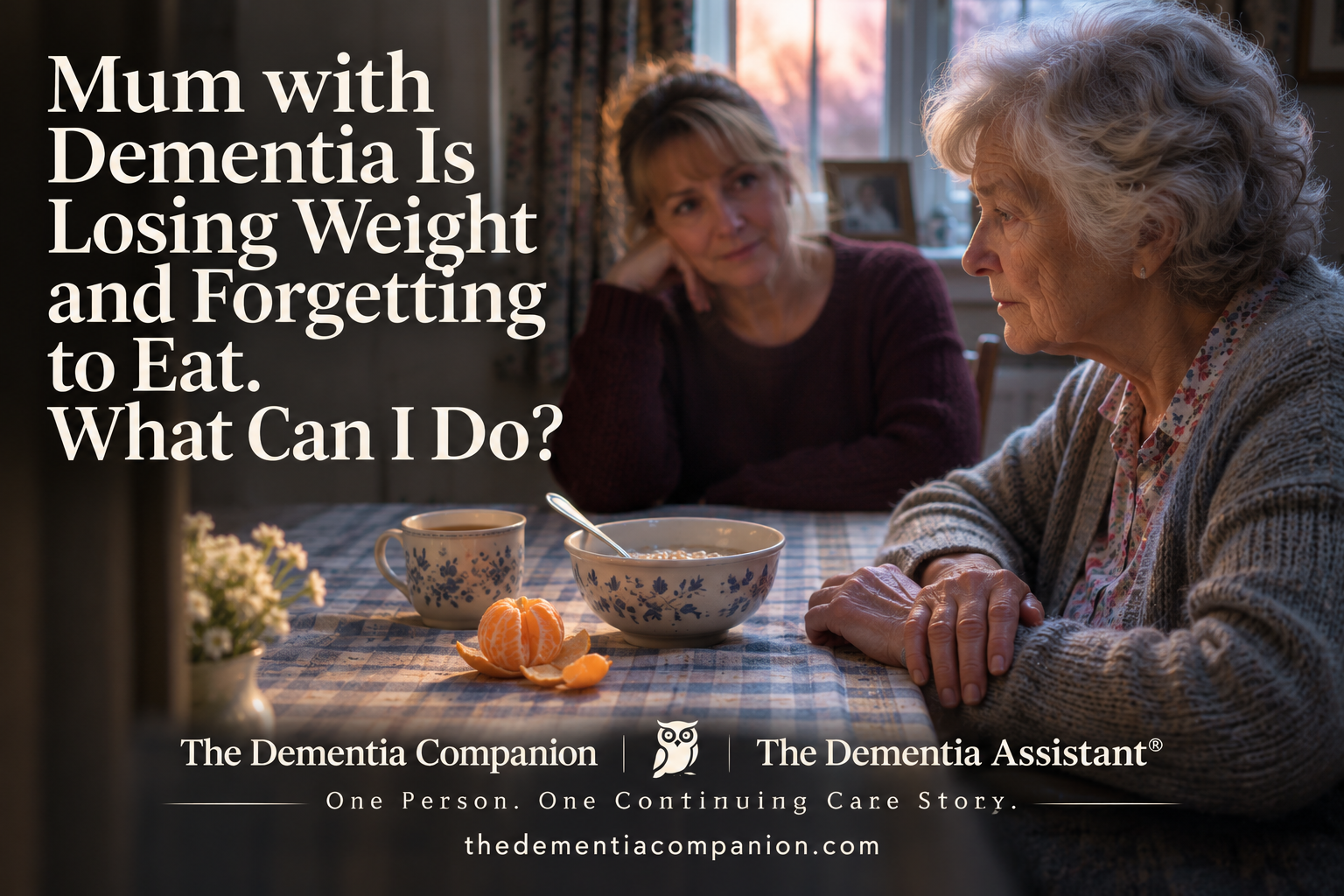
Mum with Dementia Is Losing Weight and Forgetting to Eat. What Can I Do?
One Person. One Continuing Care Story. | Article 30 of 40
By Louise Donaghy, Dementia Practitioner, Founder of The Dementia Companion and The Dementia Assistant®, and Creator of Hugo Intelligence™.
It might begin with something as small as a cardigan.
Mum puts it on, and you notice it looks rather loose.
You ask whether she’s been eating properly.
“Of course I have!”
And because this is Mum, the woman who spent most of your childhood making sure you had eaten enough, she immediately asks whether you’ve had your lunch.
You tell her you have.
She asks again five minutes later.
Some family traditions never quite disappear.
But then you open the fridge.
There’s milk past its use-by date, half a sandwich wrapped in cling film and a shepherd’s pie you brought round three days ago.
It’s barely been touched.
You look in the bread bin.
The loaf is almost full.
Then you notice the unopened groceries.
And suddenly you’re asking yourself something much more serious.
Is Mum actually eating enough when nobody is here?
Perhaps she says she’s already had breakfast, but the bowl is still clean.
Perhaps she sits down to dinner, takes two mouthfuls and pushes the plate away.
Perhaps she’s forgetting to drink.
Or perhaps she’s losing weight despite the family doing everything they can to encourage her.
It’s frightening.
Especially when someone who once enjoyed preparing meals and feeding everybody else now seems uninterested in food.
So what should you do if someone living with dementia is losing weight, forgetting meals or struggling to eat enough?
The first step is to arrange a medical review for unexplained or unintentional weight loss, particularly when it is persistent or accompanied by reduced food intake.
At the same time, try to understand what is making eating difficult.
It might involve memory, appetite, physical discomfort, medication effects, loneliness, changes in taste, swallowing difficulties or the practical challenges of preparing food.
Small, familiar meals, gentle reminders, companionship and appropriate adaptations can help some people.
But there is no single approach that works for everyone.
And please remember something important.
Mum isn’t simply a body that needs feeding. She’s a person with a lifetime of food preferences, routines, memories and choices.
Supporting her nutrition should never mean forgetting that.
Why might someone with dementia forget to eat?
We often think of eating as something that happens automatically.
We feel hungry.
We prepare food.
We eat.
Simple enough.
Except preparing and eating a meal involves quite a remarkable collection of skills.
You need to recognise hunger.
Remember that you haven’t eaten.
Decide what you want.
Find ingredients.
Prepare the food.
Use kitchen equipment safely.
Recognise the meal in front of you.
Pick up the appropriate utensils.
And continue the activity until you’ve finished.
Dementia can affect different parts of this process.
Mum may genuinely believe she’s already eaten
Memory difficulties may mean that Mum cannot remember whether she had breakfast.
She may answer confidently:
“Yes, I’ve eaten.”
And genuinely believe it.
From her perspective, there may be no reason to question her answer.
Repeatedly telling her that she’s wrong might make her feel embarrassed, frustrated or accused of something.
A gentler approach could be:
“I’ve made some toast. Would you like to sit with me?”
Or:
“I fancy a little something. Shall we have lunch together?”
You don’t necessarily need to establish who is correct about breakfast before offering something to eat.
She may no longer recognise hunger in the same way
Some people living with dementia experience changes in recognising or responding to hunger and thirst.
Others recognise hunger but struggle to translate that feeling into preparing or obtaining food.
A person may also become distracted partway through a meal.
This is why an untouched plate doesn’t automatically mean the person dislikes the food.
We need to understand what is happening.
Preparing a meal may have become difficult
Mum might still know how to make a cup of tea but struggle to prepare a full dinner.
She may find the different steps confusing.
Perhaps she cannot remember how long something has been cooking.
Perhaps she’s frightened of using the hob.
Perhaps she opens the fridge and cannot decide what to make.
If cooking has become difficult, she may begin missing meals without deliberately choosing to do so.
This is especially important when someone lives alone.
A full fridge does not necessarily mean that the person is eating.
Could there be a medical reason Mum is losing weight?
Absolutely.
And this deserves attention.
Unexplained weight loss should not automatically be attributed to dementia.
There may be other causes, some of which are treatable.
A healthcare professional may need to consider several possibilities.
Painful teeth, gums or dentures
Imagine trying to enjoy lunch when every mouthful hurts.
Mum may have a sore tooth, uncomfortable dentures, mouth ulcers or another oral health problem.
She might not be able to explain the discomfort clearly.
Instead, she simply stops eating certain foods.
Notice whether she avoids chewing, removes her dentures or seems uncomfortable during meals.
Arrange appropriate dental assessment if needed.
Constipation or digestive discomfort
Constipation can make someone feel uncomfortable, bloated or reluctant to eat.
Other digestive problems may also affect appetite.
If Mum cannot easily describe symptoms, changes in eating or behaviour may be important clues.
Medication effects
Some medications can affect appetite, taste, nausea or digestion.
A new medicine or dose adjustment may be relevant.
Ask the GP, prescriber or pharmacist to review concerns.
Do not stop or change prescribed medication without appropriate professional guidance.
Depression, low mood or loneliness
Eating is not always about hunger.
For many people, meals are social occasions.
Perhaps Mum spent fifty years eating dinner with her husband.
Now she’s sitting alone.
Cooking for one person may feel pointless.
Some people experience depression or low mood, which can affect appetite.
A healthcare professional should consider emotional wellbeing as well as physical health.
Other illnesses
Infection, endocrine conditions, gastrointestinal problems and other illnesses may contribute to weight loss.
These possibilities need professional assessment rather than assumptions.
A dementia diagnosis does not protect somebody from developing another medical condition.
And it should never prevent them from receiving an appropriate investigation.
What should I do first if Mum is losing weight?
Begin with three practical steps.
- Arrange a medical assessment
Contact Mum’s GP or appropriate healthcare professional.
Explain that she has experienced unintentional weight loss, reduced food intake or both.
Describe when you first noticed the change.
Mention any difficulties swallowing, coughing during meals, vomiting, pain, dehydration symptoms or sudden changes in health.
The professional may assess nutritional risk, review medicines, investigate possible causes or arrange referral to a dietitian or other specialist.
Do not wait for severe malnutrition before raising concerns.
- Begin a respectful food and drink record
For a short period, record what Mum actually eats and drinks, where this can be done appropriately.
Not just what food has been bought.
Or what was placed in front of her.
But what she appears to have managed.
For example:
“Breakfast: Half a bowl of porridge, one cup of tea.”
“Lunch: Cheese sandwich offered. Ate approximately half.”
“Afternoon: Small yoghurt and water.”
“Evening: Enjoyed a small portion of chicken and mashed potato.”
Record relevant concerns, such as coughing, discomfort, tiredness or changes in appetite.
This can help a professional understand the pattern.
It should not become an intrusive exercise that leaves Mum feeling watched or criticised.
- Notice what still works
Does Mum enjoy breakfast more than dinner?
Does she eat better when somebody joins her?
Does she prefer small portions?
Is there a particular dish she still enjoys?
Does she manage a sandwich more easily than a meal requiring a knife and fork?
This information is often just as valuable as recording what she refuses.
Good care planning should identify strengths and successful approaches, not simply difficulties.
How can I encourage Mum to eat without nagging?
This can be surprisingly difficult.
Especially when you’re frightened.
You may find yourself saying:
“Mum, please eat something.”
“Just another mouthful.”
“You haven’t eaten enough.”
“I’ve made this specially for you.”
And before long, a lovely family meal has turned into a negotiation that neither of you wanted.
The trouble is, pressure can make eating more stressful.
Try smaller portions
A large plate may feel overwhelming.
Some people find smaller meals and snacks more manageable.
Rather than insisting on three large meals, consider offering food more frequently.
A small breakfast.
A mid-morning snack.
Lunch.
Something in the afternoon.
An evening meal.
The appropriate approach depends on the person’s nutritional requirements and any medical advice.
Eat together
If Mum enjoys company, sharing a meal may help.
You might say:
“I’m having a sandwich. Shall I make one for you?”
Or:
“I thought we’d have a little lunch together.”
This can feel more natural than constantly checking whether she’s eaten.
And it preserves the social pleasure of mealtimes.
Offer familiar favourites
A person may find familiar meals reassuring.
Perhaps Mum enjoys scrambled eggs, homemade soup or a particular family recipe.
Ask what she would like.
If choosing is difficult, offer two manageable options rather than an enormous menu.
For example:
“Would you prefer soup or a sandwich?”
Avoid assuming that a once-loved food will always remain enjoyable.
Preferences can change.
Give her time
Some people need longer to eat.
Don’t rush.
Check whether she is comfortable, seated appropriately and able to see and manage the food.
Let her remain involved as much as possible.
And remember, finishing an entire plate is not the only measure of a successful mealtime.
Enjoyment, comfort and dignity matter too.
How can I make meals easier to manage?
Sometimes a small change makes eating more accessible.
Reduce unnecessary distractions
A busy room, loud television or several people talking at once may make it difficult to concentrate.
If Mum prefers quiet meals, try reducing background noise.
However, some people enjoy conversation and companionship.
Follow her preferences rather than automatically creating silence.
Help her see the food
Changes in vision and perception can affect how someone recognises food and crockery.
A plain plate that contrasts with the food and table may help.
Good lighting is important.
Avoid cluttered table settings if they make the meal confusing.
A person should not have to work unnecessarily hard to understand what is in front of them.
Consider adapted utensils
If Mum finds ordinary cutlery difficult, an occupational therapist may recommend suitable equipment.
Depending on her abilities, this could include adapted cutlery, easier-to-hold cups or different plates.
Do not assume that needing equipment means she has lost independence.
Sometimes the right adaptation is exactly what helps someone remain independent.
Consider suitable finger foods
Some people find foods they can pick up more manageable than meals requiring several utensils.
This might include suitable sandwiches, small pieces of soft food or other familiar options.
But finger foods must still be appropriate for the person’s chewing and swallowing abilities.
If swallowing safety is uncertain, seek professional advice before changing food textures.
Keep familiar routines
Perhaps Mum has always enjoyed lunch at midday.
Perhaps she prefers her main meal earlier in the day.
Perhaps she dislikes eating immediately after waking.
Her established preferences can guide the routine.
Dementia care should adapt to the person wherever possible.
Not force every individual into an identical timetable.
What if Mum says she’s not hungry?
Try to discover whether she means exactly that.
She may not feel hungry.
But she may also be tired, uncomfortable, sad or finding the meal difficult.
You could say:
“That’s all right, Mum. Would you like something small instead?”
Or:
“Is there something else you’d fancy?”
If she declines, don’t immediately begin an argument.
Consider offering something appropriate again later.
Where there is ongoing reduced intake or weight loss, this must be accompanied by professional assessment and an agreed nutrition plan.
Repeated refusal of food should not simply be ignored.
At the same time, supporting nutrition does not justify automatically overriding the person’s choices.
Consent, decision-making ability and appropriate legal requirements remain important.
What if Mum will only eat sweet foods?
This is something families frequently notice.
A person who once loved savoury meals may suddenly prefer puddings, biscuits or sweet drinks.
Changes in taste and smell may contribute.
For some people, stronger or sweeter flavours become more appealing.
But the answer is not necessarily to remove every sweet food.
Nor is it to provide unlimited sugar.
The person’s overall nutritional needs, medical conditions and preferences matter.
If Mum has diabetes, swallowing difficulties or another condition requiring dietary management, seek individual advice.
A dietitian can help families consider appropriate ways to improve nutritional intake.
In some circumstances, energy-rich foods or prescribed nutritional supplements may be recommended.
Do not assume that every person losing weight needs the same high-calorie diet.
The right approach depends on their health and nutritional assessment.
How do I know if Mum is having difficulty swallowing?
This section is especially important.
Sometimes what appears to be poor appetite is actually difficulty chewing or swallowing.
Swallowing problems are known as dysphagia.
They can occur in dementia and other medical conditions.
Possible signs include:
- Coughing or choking while eating or drinking.
- A wet or gurgly-sounding voice after swallowing.
- Holding food in the mouth for a long time.
- Difficulty chewing.
- Food seeming to become stuck.
- Repeated chest infections.
- Discomfort or breathlessness associated with eating.
- Taking considerably longer to finish meals.
New or suspected swallowing difficulties need prompt clinical assessment.
In the UK, NHS guidance recommends urgent GP or NHS 111 advice for concerning swallowing symptoms.
A speech and language therapist, known as a speech pathologist in some countries, may assess swallowing and recommend appropriate strategies.
A dietitian can help ensure nutritional needs are considered alongside any swallowing recommendations.
Please don’t change food textures without advice
Families sometimes assume that simply blending everything into purée or thickening drinks will make eating safer.
That is not necessarily true.
Texture modifications must suit the individual’s swallowing needs.
They can also affect hydration, nutrition and enjoyment.
If swallowing difficulties are suspected, obtain appropriate professional assessment rather than improvising a restrictive diet.
If somebody is choking and cannot breathe, speak or cough effectively, follow local emergency choking procedures and call emergency services.
Hugo cannot assess swallowing safety or provide emergency intervention.
What if Mum isn’t drinking enough either?
Hydration is another important concern.
Some people living with dementia may not recognise thirst, remember to drink or manage getting drinks for themselves.
Dehydration can contribute to serious health problems.
Possible warning signs include reduced urination, dark urine, dizziness, unusual tiredness and increased confusion, although these signs are not specific to dehydration.
The person’s existing medical conditions may also affect how much fluid is appropriate.
Gentle ways to support drinking
You might try offering drinks regularly throughout the day.
Make sure they are within reach.
Use a cup Mum can comfortably hold.
Offer familiar drinks that she enjoys.
Some foods, such as suitable soups, fruit or yoghurt, can also contribute fluid.
If Mum has a prescribed fluid restriction, heart failure, kidney disease or swallowing recommendations, follow her individual clinical plan.
If she is refusing fluids, has signs of dehydration or is becoming unwell, seek medical advice promptly.
Sudden confusion, collapse or severe illness may require emergency assessment.
What about Mum living alone?
This can make eating difficulties harder to recognise.
You may visit in the afternoon and see a full fridge.
Mum tells you she’s been eating.
But the food may not be getting prepared.
Or she may be eating very little.
Consider whether she can still shop, plan meals, recognise food, prepare it safely and remember to eat.
A person might benefit from meal delivery, support with shopping, prepared ingredients, shared meals or scheduled help.
But delivery alone does not guarantee that a meal will be eaten.
Someone may still need practical assistance or companionship.
An occupational therapist, dietitian, GP or relevant social care professional can help assess support needs.
Involving Mum in decisions is important.
She may prefer certain arrangements, and those preferences deserve respect.
What if Mum is in hospital or a care home?
Nutrition should remain part of her individual care.
Families may know things that a new care team does not.
Perhaps Mum dislikes food served too hot.
Perhaps she prefers breakfast early.
Perhaps she needs help recognising utensils.
Perhaps she eats better when someone sits nearby.
Or perhaps she has a particular cultural or religious dietary preference.
Sharing this information can help staff provide more person-centred support.
Ask how food and fluid intake, weight changes and swallowing concerns are being assessed and recorded.
If appropriate, share relevant information from the family’s care plan.
But remember that professional staff remain responsible for their own clinical assessments, care records and instructions.
The family’s information complements those records.
What about eating difficulties in advanced dementia?
Eating and swallowing may become increasingly difficult for some people as dementia progresses.
This can be deeply distressing for families.
There may be concerns about aspiration, infections, comfort, nutrition and hydration.
At this stage, decisions require sensitive, individual professional assessment.
The person’s previously expressed wishes, current preferences, medical circumstances, comfort and legal decision-making arrangements must all be considered.
Questions about assisted feeding, artificial nutrition or clinically assisted hydration cannot be answered safely through a generic recommendation.
Families should be supported by the relevant clinical, speech and language therapy, dietetic and palliative care teams where appropriate.
The aim must remain person-centred.
This includes considering dignity, comfort and quality of life rather than reducing the situation to a number on the scales.
What should I record in Mum’s continuing care plan?
This is where a family-held record can become particularly useful.
Imagine Mum has a GP, a memory clinic and a visiting care worker.
Her daughter helps at weekends.
Her son lives abroad.
One person notices weight loss.
Another notices unopened food.
A third sees that Mum eats quite happily when someone sits beside her.
Each observation matters.
But unless the information is brought together, the wider pattern may be missed.
A useful nutrition section could include:
Usual food preferences: Favourite meals, disliked foods, dietary requirements and cultural preferences.
Current strengths: What Mum can prepare, serve and eat independently.
Support needed: Help with shopping, food preparation, reminders, utensils or eating.
Observed changes: Reduced appetite, missed meals, weight changes or difficulties with drinks.
Relevant health information: Allergies, diabetes, dental concerns, swallowing recommendations and relevant professional advice.
What helps: Familiar meals, quieter surroundings, companionship or smaller portions.
What is difficult: Certain textures, unfamiliar foods, noisy environments or tiredness.
Professional involvement: GP, dietitian, dentist, occupational therapist or speech and language therapist, where appropriate.
Review arrangements: What needs monitoring and when the plan should be reconsidered.
This is not about producing endless paperwork.
It’s about preserving useful information that helps everybody understand the person.
A fictional daily note
“Margaret ate approximately half her breakfast at 8.30 am. She said she wasn’t hungry at lunchtime but accepted a small sandwich and yoghurt. She appeared more interested in food when her daughter sat with her. No coughing observed during the supported meals. Family has arranged a GP appointment because of ongoing unintentional weight loss.”
This note describes observations.
It does not diagnose the cause.
And it gives the next person useful context.
Meet Hugo Intelligence™: support that begins with a conversation
This is exactly the kind of family concern that Hugo Intelligence™ was created to help people explore.
Hugo is the conversational, person-centred guidance system within The Dementia Assistant®, powered by Person-Centred Intelligence®.
Hugo stands for:
H — Human
U — Understanding
G — Guidance
O — One person at a time
Hugo is represented by our owl mascot.
But his purpose is much more meaningful than being another chatbot that produces a generic answer.
He is designed to help people explore dementia-related concerns through natural, continuing conversations.
You don’t need to know what to ask
You could simply say:
“Hugo, Mum seems to be losing weight. She keeps saying she’s eaten, but the food in her fridge hasn’t been touched. I’m really worried.”
Hugo can provide general educational information about possible reasons for changes in eating, practical mealtime approaches and the importance of seeking clinical advice.
He can help you think about what you have observed.
And he can help you prepare for a conversation with the GP.
Hugo can explore the concern through follow-up questions
For example, Hugo may help you consider:
“When did you first notice the weight loss?”
“Does Mum still enjoy particular foods?”
“Is she forgetting meals or declining food when it is offered?”
“Does she live alone?”
“Have you noticed coughing or difficulty swallowing?”
“Has her medication changed?”
“Does she seem uncomfortable when eating?”
“What has helped her eat more comfortably?”
These questions matter because two people with dementia may both be losing weight for completely different reasons.
One may be forgetting mealtimes.
Another may have painful dentures.
Another may be lonely.
Another may have swallowing difficulties.
Hugo cannot determine the medical cause.
But he can help families organise what they know and recognise when professional assessment is needed.
General Hugo: support without a care plan
A person can ask general questions without creating or selecting a care plan.
For example:
“What can I do if someone with Alzheimer’s keeps forgetting to eat?”
Hugo can provide general educational guidance and suggestions to discuss with appropriate professionals.
Personalised Hugo: using the person’s selected care plan
Now imagine the family has created a care plan for Margaret.
The plan includes her preferred meals, routines, health information, communication preferences and relevant observations.
When the user explicitly selects Margaret’s individual care plan, Hugo can use relevant information from that plan to offer more personalised educational guidance.
For example:
“Hugo, using Margaret’s care plan, how could we make lunchtime easier while respecting her preferences and the dietitian’s recommendations?”
Hugo can consider the relevant recorded information when exploring possible approaches.
Hugo does not automatically access every care plan.
The user must select the individual person’s plan.
Families can maintain separate plans for different people.
This helps preserve the individual nature of care and avoid confusing one person’s information with another’s.
All AI-generated guidance must be checked against current professional advice, particularly where nutrition, medication or swallowing safety is concerned.
The Care Planning Centre™ and guided Talk to Hugo
Many families have never created a care plan.
They may not know what information belongs in one.
They might have pages of handwritten notes, messages from siblings and appointment letters scattered across different places.
The Care Planning Centre™ helps families build, review and maintain an individual person-centred care plan.
Through guided Talk to Hugo conversations, users can explore relevant care-planning questions naturally.
For example:
“What foods does Mum enjoy?”
“What can she still do independently?”
“Does she need help preparing meals?”
“What changes have we noticed?”
“Which professional recommendations need to be included?”
“What should a new care worker know?”
Relevant information can be organised into the appropriate sections, with the user reviewing what is recorded.
The platform also provides care-plan review tools, gap suggestions and support with making professional wording clearer.
The aim is to make care planning more accessible to people who do not have professional experience.
The care plan should reflect the person, not simply their diagnosis.
Daily notes: noticing changes between appointments
A GP might see Mum for a short appointment.
The family sees what happens over days and weeks.
The Dementia Assistant® includes daily notes that can help preserve relevant observations.
Perhaps Mum eats breakfast well but consistently misses lunch.
Perhaps her appetite changes after a medication adjustment.
Perhaps she enjoys meals when her granddaughter visits.
Perhaps she begins struggling with food that she previously managed comfortably.
Recording these observations may help the family recognise patterns and prepare useful information for healthcare professionals.
Daily notes should remain factual, respectful and proportionate.
They are not a substitute for professional nutritional assessment.
Saved Hugo conversations and document organisation
A family may begin by asking Hugo why Mum is forgetting meals.
Later, they might ask how to prepare for a dietitian appointment.
Then they may need help understanding general information about safe mealtimes or care planning.
Within The Dementia Assistant®, conversations can be saved, categorised and revisited.
This provides continuity in the family’s questions and guidance.
Saved AI conversations are not verified clinical records.
The platform also supports organising relevant documents, reports and care information.
Applicable export formats include PDF, Word, CSV and JSON.
Families can retain their own records and share appropriate information with professionals when needed, subject to consent, privacy and access arrangements.
The family’s care information complements professional medical records rather than replacing them.
Family Circle: keeping relatives informed
Food and drink concerns often involve several family members.
A daughter may visit daily.
A son may shop for groceries.
Another relative may attend medical appointments.
Someone else may live overseas.
One person notices that Mum has lost weight.
Another sees that she eats better in company.
A third learns that the GP wants her food and fluid intake monitored.
Family Circle helps involved relatives communicate and organise appropriate updates.
This can reduce repeated explanations and help the family maintain a more consistent understanding.
Information sharing must always follow the person’s wishes, consent, privacy and appropriate permissions.
Not every relative automatically needs access to all information.
Life Story and Memory & Moments: food is part of identity
Food can carry a lifetime of memories.
Perhaps Mum made the same Sunday roast every week.
Perhaps she learned to bake from her own mother.
Perhaps she has a favourite recipe from the country where she grew up.
Perhaps a particular soup reminds her of childhood.
The Life Story and Memory & Moments features in The Dementia Assistant® help preserve meaningful experiences, relationships and preferences.
This information can be helpful when considering what makes meals enjoyable.
But it should never be used as a memory test.
We are not trying to prove whether Mum remembers the recipe.
We’re trying to preserve connection and enjoyment.
If cooking remains meaningful, consider how she can safely participate.
Perhaps she chooses ingredients.
Perhaps she stirs something while supported.
Perhaps she shares stories.
Or perhaps she simply enjoys being part of the family meal.
A person does not stop belonging at the table because they need help eating.
Multilingual dementia support: the language of food and home
For many families, food, language and cultural identity are closely connected.
A dish may have a traditional name that doesn’t translate easily.
A parent may prefer discussing food in the language they grew up speaking.
Relatives in different countries may need to exchange information across languages.
The Dementia Assistant® offers 12 interface languages, with dictation and translation capabilities spanning 201 languages.
These tools can support multilingual families when recording information and communicating about care.
Not every platform feature is available in all 201 languages.
And important medical, dietary, swallowing and medication information must be professionally verified when necessary.
Some people living with dementia experience changes in how they use languages.
This varies between individuals.
Never assume everybody returns to their childhood language.
Ask what works best for the person.
Preserving their preferred words, familiar food traditions and cultural identity can help make care more personal.
Dementia Academy™, crisis guidance and the Carer Wellbeing Hub
The Dementia Assistant® includes wider learning and support resources.
The Dementia Academy™ provides educational material on dementia, person-centred communication and practical care topics.
Educational crisis guidance can help families consider situations where urgent medical or professional support may be needed.
Hugo is not an emergency service.
He cannot examine somebody, diagnose malnutrition, assess swallowing or provide emergency treatment.
The Carer Wellbeing Hub recognises the emotional impact of supporting someone living with dementia.
Watching a parent lose weight can be frightening.
You may find yourself worrying about every meal.
You might feel guilty when Mum refuses food.
Or exhausted because you have spent the entire afternoon trying to persuade her to eat.
You deserve support too.
And sometimes the most useful thing a family can do is ask for professional help rather than trying to manage everything alone.
Ask Hugo: 17 questions families ask about dementia, weight loss and forgetting to eat
- Why does my mum with dementia keep forgetting to eat?
Memory, attention, planning and recognition difficulties can affect eating. Mum may forget mealtimes, believe she has already eaten or struggle to prepare food. Medical, emotional and practical factors may also contribute. Persistent problems should be assessed.
- Is weight loss normal in Alzheimer’s disease?
Weight loss can occur in Alzheimer’s disease and other dementias, but it should not automatically be accepted as inevitable. Unintentional weight loss deserves medical assessment to consider nutritional needs and possible treatable causes.
- What should I do if Mum says she’s eaten but hasn’t?
Avoid arguing about whether she remembers correctly. Offer a suitable meal or snack naturally and consider how eating can be supported or monitored respectfully. Record recurring concerns and discuss them with her healthcare professional.
- How can I encourage Mum to eat without nagging?
Try calm invitations, familiar foods, smaller portions, shared meals and a comfortable environment. Give her time and respect her preferences. If intake remains poor, seek professional guidance rather than relying solely on encouragement.
- Can dementia make someone stop feeling hungry?
Dementia can affect appetite and the ability to recognise or respond to hunger. However, poor appetite may also be caused by pain, medication, illness, mood changes or other factors. An individual assessment is important.
- What if Mum refuses every meal?
Consider whether she is uncomfortable, unwell, frightened, tired or experiencing chewing or swallowing difficulties. Respect her responses while seeking prompt professional advice if intake is persistently inadequate.
- Are small meals better than three large meals?
Some people manage smaller, more frequent meals and snacks more comfortably. This depends on individual nutritional needs and health conditions. A dietitian can help develop an appropriate approach when there is weight loss or malnutrition risk.
- Should I give Mum nutritional supplement drinks?
Not automatically. A GP or dietitian can assess whether supplements are appropriate, what type may be suitable and how they fit with any medical conditions or swallowing recommendations. Supplements should not replace assessment of the cause of weight loss.
- Why will Mum only eat biscuits or sweet foods?
Changes in taste, smell, appetite or food preferences may contribute. The response should consider her overall nutritional needs and relevant medical conditions. A dietitian can advise if weight loss or an unbalanced intake is causing concern.
- What if Mum coughs when drinking water?
Coughing during drinking may indicate a swallowing problem. Seek prompt medical assessment and advice from an appropriate speech and language therapist. Do not independently thicken drinks or change textures without professional guidance.
- Could bad dentures cause Mum to stop eating?
Yes. Poorly fitting dentures, mouth pain and dental problems may make chewing uncomfortable. Arrange dental assessment and discuss reduced intake with her healthcare professional.
- How can I tell whether Mum is becoming dehydrated?
Look for changes such as reduced urination, dizziness, unusual tiredness or increased confusion. These symptoms can have several causes. Seek prompt medical advice if dehydration is suspected, and urgent help for sudden confusion or severe illness.
- What if Mum lives alone and forgets meals?
Consider whether she can shop, prepare food and remember to eat safely. Meal support, social visits, appropriate technology or additional care may help. Seek an assessment of her individual needs, especially when weight loss or safety concerns are present.
- Should I keep a food diary for Mum?
A short, factual record can help identify patterns and provide useful information for a GP or dietitian. Record what was actually eaten or drunk, relevant symptoms and any support needed. Keep it respectful and avoid making Mum feel judged.
- Does Mum need a special dementia diet?
There is no single diet suitable for everybody living with dementia. General healthy eating principles matter, but unintentional weight loss, diabetes, swallowing difficulties and other conditions may require personalised nutritional advice.
- Can Hugo help us create a personalised mealtime support plan?
Hugo can provide general educational guidance and help families explore relevant observations and preferences. When the user explicitly selects Mum’s care plan, Hugo can use its relevant information to offer more personalised suggestions. Medical nutrition and swallowing recommendations must still come from appropriate professionals.
- How can we keep Mum’s nutrition information together as her care changes?
The Dementia Assistant® supports individual care plans, daily notes, saved and categorised Hugo conversations, document organisation and appropriate family communication. Families can maintain their own continuing information and share relevant details with professionals, subject to consent and permissions.
One Person. One Continuing Care Story.
Different professionals. Different services. One person. One continuing story.
Imagine Mum begins losing weight.
At first, her daughter notices that her clothes are loose.
A few weeks later, her son discovers unopened groceries.
The GP arranges an assessment.
A dietitian becomes involved.
Perhaps a dentist identifies a problem with her dentures.
Later, an occupational therapist recommends adaptations to help her eat independently.
Eventually, Mum may begin receiving home care.
Or she may need hospital treatment or support in a residential setting.
Every professional may maintain their own records.
Every organisation may use a different system.
And every time somebody new becomes involved, the family may need to explain the same information again.
But Mum is still the same person.
Her favourite foods.
Her routines.
Her dislikes.
Her cultural traditions.
Her changing abilities.
The help she needs.
And the things that continue to bring her pleasure.
Those details should not disappear whenever her care arrangements change.
This is why The Dementia Assistant® exists
The Dementia Assistant® helps people living with dementia and their families maintain their own continuing, person-centred care information.
They can begin recording important details from the earliest memory concerns.
The care plan can develop through assessment, diagnosis and everyday life with dementia.
It can continue as support needs change.
Through home care, hospital admissions, rehabilitation, residential care and palliative or end-of-life support where appropriate.
The person’s information remains connected within the family-held care-planning environment.
Relevant details can be shared with professionals when appropriate, respecting consent, privacy and legal requirements.
The family-held plan complements professional records.
It does not replace clinical assessments, medical instructions or statutory decisions.
One person. One individual care plan.
Mum’s care plan should reflect Mum.
Not a generic list of dementia symptoms.
It should include her strengths and abilities.
Her preferences and wishes.
Her life story.
Her communication needs.
Her relevant health information.
Her support arrangements.
And the changes that need monitoring.
It should also reflect the pleasure she finds in everyday life.
Including something as ordinary, and as meaningful, as enjoying a favourite meal.
The care plan develops as Mum’s needs change
Perhaps Mum prepares lunch independently today.
In six months, she may need reminders.
Later, she may need support preparing food.
And at another stage, she may need more assistance with eating or swallowing.
The care plan should evolve with her.
But it should never lose sight of her as a person.
Different professionals. Different services. One person. One continuing story.
That is the heart of The Dementia Assistant®.
And it is why we believe families should have the opportunity to maintain their own continuing care information, rather than relying exclusively on separate records held by different organisations.
A gentle invitation to meet Hugo
If Mum is forgetting meals, losing weight or struggling with eating, you may be feeling worried and uncertain about what to do next.
You can begin by asking Hugo.
Describe what you’ve noticed.
Ask about practical approaches.
Explore possible reasons for the difficulty.
Prepare questions for the GP or dietitian.
And, when you choose to create and explicitly select Mum’s individual care plan, Hugo can help you explore her circumstances using relevant information recorded in that plan.
The Dementia Companion is our public home for practical dementia education and family guidance.
The Dementia Assistant® is where families can continue those conversations and build their own ongoing care information.
Alongside Hugo Intelligence™, the platform brings together the Care Planning Centre™, guided Talk to Hugo, daily notes, saved conversations, document organisation, Family Circle, Life Story, Memory & Moments, multilingual support, the Dementia Academy™ and the Carer Wellbeing Hub.
Every subscription includes a 30-day complimentary trial.
The UK Family subscription is £4.99 per month after the trial.
International subscription prices are available through the platform.
Explore practical dementia guidance:
https://thedementiacompanion.com/
Meet Hugo and discover The Dementia Assistant®:
https://thedementiaassistant.com/
Hugo offers educational guidance, not medical diagnosis, prescribing, nutritional assessment, swallowing assessment, emergency intervention, statutory assessments or legally binding decisions.
One final thought
There is something very emotional about watching a parent struggle with something as ordinary as eating.
Especially when that parent spent a lifetime making sure everybody else was fed.
You may remember childhood dinners.
Birthday cakes.
Christmas meals.
The smell of something cooking when you arrived home.
Perhaps Mum still asks whether you’ve eaten, even when she can no longer remember her own lunch.
Those moments are part of who she is.
And needing help with food does not take that identity away.
So yes, pay attention to the weight loss.
Seek the appropriate medical help.
Make sure her nutritional needs are properly assessed.
But remember to preserve the pleasure, comfort, choice and companionship that food can bring.
Because mealtimes are about more than calories.
They are about belonging.
Routine.
Family.
And the simple pleasure of sharing something together.
Mum’s needs may change, but she is still the person whose story matters.
And that story deserves to remain connected through every stage of her care.
With love,
Louise and Hugo ❤️🦉
Louise Donaghy
Founder & CEO of The Dementia Assistant®
Created and powered by Person-Centred Intelligence®
Creator of Hugo Intelligence™
⸻
Continue exploring with The Dementia Companion
Explore practical answers in the Ask Hugo Library
https://thedementiacompanion.com/ask-hugo/
The Dementia Companion, home of The Dementia Assistant®
https://thedementiacompanion.com/
Meet Hugo and explore individual care planning
https://thedementiaassistant.com/
Related topics in our continuing care series include kitchen safety, preparing for medical appointments, refusing medication and recognising changes in dementia care needs.
References and authoritative guidance
1. Alzheimer’s Society, UK. Eating and drinking. Covers appetite changes, mealtime difficulties, coordination, nutrition and swallowing concerns.
https://www.alzheimers.org.uk/get-support/living-with-dementia/eating-drinking
2. Alzheimer’s Society, UK. Supporting someone with dementia to eat and drink.
https://www.alzheimers.org.uk/get-support/living-with-dementia/improving-eating-experience-dementia
3. Dementia UK. Eating and drinking with dementia. Covers weight loss, hydration, food preferences and professional support.
https://www.dementiauk.org/information-and-support/health-advice/eating-and-drinking/
4. NICE, UK. Dementia: assessment, management and support for people living with dementia and their carers, NG97. See recommendations concerning eating, drinking and swallowing.
https://www.nice.org.uk/guidance/ng97/chapter/Recommendations
5. British Dietetic Association. Eating and drinking difficulties in dementia.
https://www.bda.uk.com/resource/eating-and-drinking-difficulties-in-dementia.html
6. NHS, UK. Dysphagia, swallowing problems. Includes symptoms, urgent advice and specialist assessment.
https://www.nhs.uk/symptoms/swallowing-problems-dysphagia/
7. NHS, UK. Dehydration.
https://www.nhs.uk/conditions/dehydration/
8. NHS, UK. Sudden confusion, delirium.
https://www.nhs.uk/symptoms/confusion/
9. Alzheimer’s Association, USA. Food and eating. Covers nutrition, appetite, adaptations and mealtime support.
https://www.alz.org/help-support/caregiving/daily-care/food-eating
10. National Institute on Aging, USA. Tips for caregivers: Helping people with Alzheimer’s disease eat well.
https://www.nia.nih.gov/health/healthy-eating-and-alzheimers-disease
11. Alzheimer Society of Canada. Meal time. Practical support for nutrition and mealtimes.
https://www.alzheimer.ca/en/help-information/im-caring-person-living-dementia/providing-day-day-care/meal-time
12. Dementia Australia. Eating and dementia.
https://www.dementia.org.au/living-dementia/home-life/eating-and-dementia
13. Dementia Australia. Nutrition and dementia.
https://www.dementia.org.au/living-dementia/staying-healthy/nutrition-and-dementia
14. Irish Nutrition and Dietetic Institute, with support from the Alzheimer Society of Ireland. Eating and Drinking: A Guide to Support a Person with Dementia, 2025 edition.
https://www.indi.ie/older-adult-nutrition/not-eating-enough-malnutrition1/1857-eating-and-drinking-%E2%80%93-a-guide-to-support-a-person-with-dementia.html
15. Royal College of Speech and Language Therapists. Dementia: clinical information, including eating, drinking and swallowing considerations.
https://www.rcslt.org/speech-and-language-therapy/clinical-information/dementia/
This article provides general educational information. Any significant or unintentional weight loss, suspected malnutrition, swallowing difficulty or concerning health change requires appropriate professional assessment. Medical, nutritional, consent and legal arrangements should be reviewed according to the individual’s circumstances and local requirements. Examples are fictional and do not represent identifiable clients.
You May Also Find Helpful
Need help with your own situation? Ask Hugo.
One Person. One Continuing Care Story. The Dementia Companion is where you discover guidance. Inside The Dementia Assistant®, talk with Hugo, save and categorise conversations, record daily notes and involve authorised supporters in a continuing care plan centred around the person.
Ask Hugo About This · Start Your Continuing Care Plan — Families · Continuing Care Planning — Professionals
Personal guidance requires the appropriate account and subscription access. Care-plan information is used only with authorised access and the required consent and selection steps. All subscription plans include a 30-day complimentary trial.