Coming Home From Hospital With Dementia: What Should Families Check?
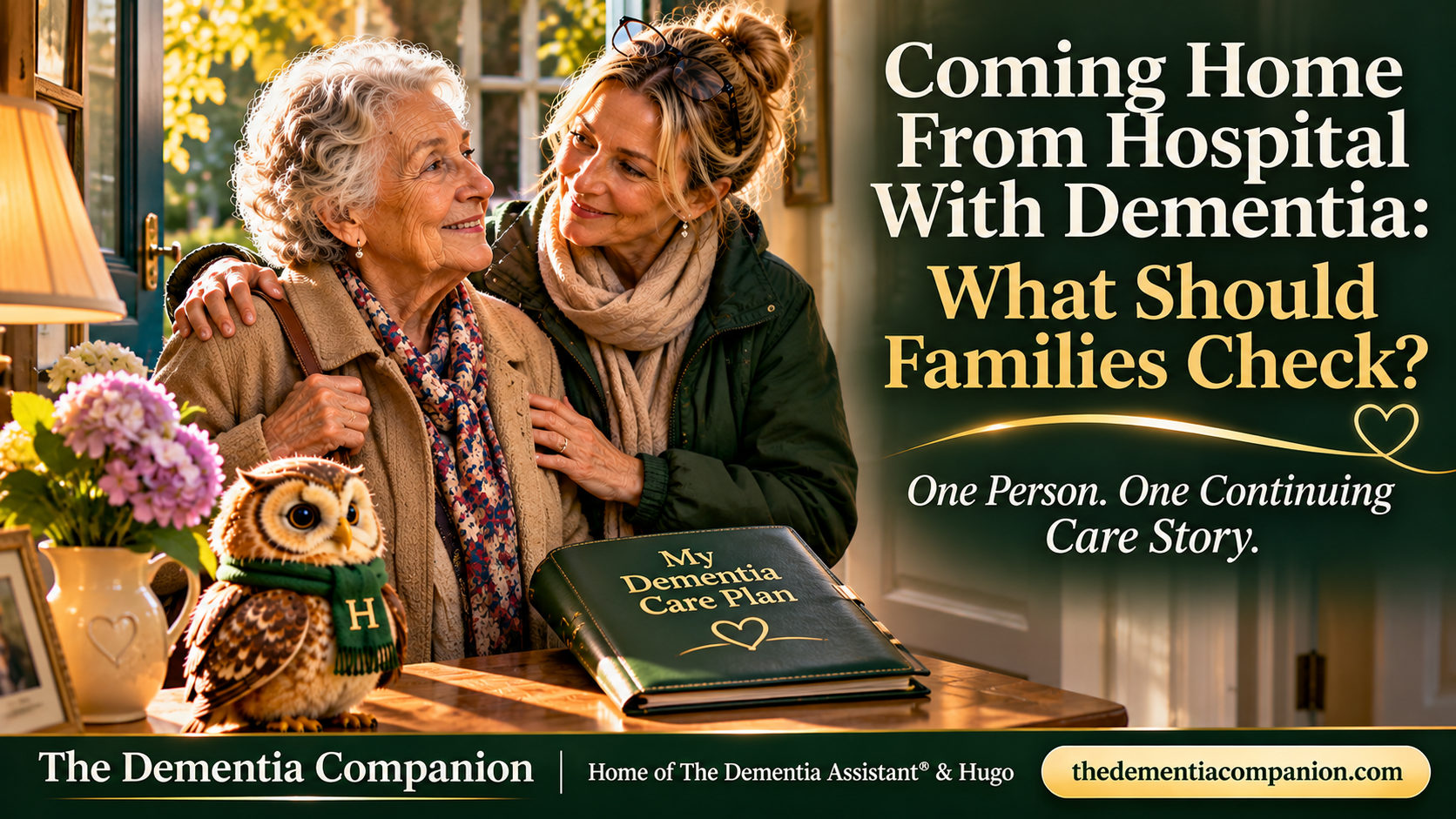
Coming Home From Hospital With Dementia: What Should Families Check?
The hospital says Mum can come home. Wonderful news. But who is checking that everything she needs will be ready when she gets there?
By Louise Donaghy, Dementia Practitioner, Founder of The Dementia Companion and The Dementia Assistant®, Creator of Hugo Intelligence™
“Good news. Your mum can come home tomorrow.”
Wonderful.
You’ve been hoping to hear those words since she was admitted.
You can picture her sitting in her favourite chair, having a proper cup of tea and complaining that nobody in the hospital knows how to make toast.
Then another thought appears.
Tomorrow?
Who’s arranging her medication?
Does she need help walking?
Has anybody spoken to the GP?
Is she still taking the tablets she was on before admission?
Does she need someone to visit?
And who exactly is going to explain all this to the family?
Suddenly, what should feel like a happy moment becomes another collection of questions.
If you recognise that feeling, you’re certainly not alone.
When someone living with dementia is coming home from hospital, families need clear information about medication, mobility, daily care, follow-up appointments, support arrangements and any changes from the person’s usual abilities.
But there is something equally important.
The person living with dementia should remain involved in decisions about going home as far as possible.
Because a successful discharge is not simply about leaving a hospital bed.
It’s about returning to a life that still belongs to the person.
What should families check before someone with dementia leaves hospital?
Before Mum comes home, ask for a clear explanation of the discharge arrangements.
In particular, establish:
- Why Mum was admitted and what treatment she received.
- Whether her medication has changed.
- Whether her mobility or everyday abilities have changed.
- Whether any equipment or home adaptations are required.
- Whether additional care or rehabilitation has been arranged.
- Who will provide support and when it will begin.
- What follow-up appointments are needed.
- Who to contact if something goes wrong.
Ask for written discharge information.
You don’t have to remember everything from a conversation on a busy ward.
And please don’t feel embarrassed about asking someone to explain something again.
You are entitled to understand what is being arranged, particularly if you are being asked to help provide care.
NICE guidance emphasises coordinated discharge planning involving the person, relevant professionals and, with appropriate agreement, their family or carers.
The arrangements can vary between England, Scotland, Wales and Northern Ireland.
What is a hospital discharge plan?
A discharge plan sets out how someone’s care and support will continue when they leave hospital.
It should consider their health needs, medicines, mobility, personal care, rehabilitation, practical support and any follow-up arrangements.
Depending on the person’s circumstances, it might involve:
- The hospital team.
- Their GP.
- Community nurses.
- Occupational therapists.
- Physiotherapists.
- Social care services.
- Home care providers.
- Family or unpaid carers.
Not everyone will need all these services.
Some people return home with little additional assistance.
Others may need short-term rehabilitation or a more detailed support package.
A diagnosis of dementia does not automatically mean somebody cannot return to their own home or live independently.
Support should reflect their actual abilities, wishes and needs.
Who is responsible for organising the discharge?
Ask the ward who is coordinating the discharge arrangements.
For example:
“Could you tell me who is responsible for Mum’s discharge plan, and how we can discuss the support she will need at home?”
If several services are involved, ask who will be your contact after discharge.
You should not have to discover that nobody ordered the equipment when Mum is already sitting in the car outside the hospital.
How do we know whether Mum is ready to come home?
Being medically ready to leave hospital is an important part of discharge planning.
But families may also need reassurance about how the person will manage once home.
Perhaps Mum walked independently before admission but now seems much less steady.
Perhaps she previously managed her meals but needs additional help after an illness.
Perhaps she’s more confused than she was before coming into hospital.
These are reasonable concerns to raise with the discharge team.
You might ask:
“How does Mum’s mobility compare with how she was before admission?”
Or:
“She was managing these activities independently before she became unwell. Has someone assessed what support she might need while recovering?”
An occupational therapy or physiotherapy assessment may be appropriate in some situations.
But remember that additional needs after hospitalisation do not automatically mean permanent loss of independence.
Some people improve with recovery, rehabilitation and appropriate support.
The aim should be to protect abilities and promote independence wherever possible.
Has Mum’s medication changed in hospital?
This is one of the most important things to clarify.
Medicines are sometimes started, stopped or changed during a hospital admission.
The discharge medication list may therefore be different from the one Mum used before admission.
Ask for an accurate, current list that includes the changes.
Check:
- Which medicines should now be taken.
- Which previous medicines have been stopped.
- Whether doses or timings have changed.
- Whether any medicines are temporary.
- Whether monitoring or a medication review is needed.
- Who will provide any ongoing prescriptions.
- Who to contact about a concern or discrepancy.
Do not assume that an old medication box at home still reflects the current instructions.
And never try to reconcile conflicting prescriptions yourself.
If the hospital discharge summary, dispensing label or GP medication record does not agree, contact the relevant hospital team, pharmacist or prescriber promptly for clarification.
The family-held care plan can record the confirmed information, but it must not replace professional medication instructions.
NICE guidance specifically emphasises accurate medicines information when someone transfers between care settings.
What if Mum is more confused after hospital?
This is something families should take seriously.
Hospital stays can be tiring and disorientating, particularly for people living with dementia.
Changes in surroundings, disrupted sleep, illness, pain and medication can all affect how someone feels.
Some people may be more unsettled for a period after discharge.
But an abrupt change in confusion, attention or alertness should never simply be assumed to be dementia progression.
Delirium is a medical condition involving an acute change in mental functioning, and people living with dementia are at increased risk.
If Mum is significantly different from her usual self, tell the healthcare team.
Ask whether delirium or other possible medical causes have been assessed.
If confusion develops suddenly, seek immediate medical help. Call 999 for a life-threatening emergency.
A family-held record of the person’s usual abilities can be useful here.
It allows you to explain what is genuinely different.
For example:
“Before hospital, Mum could follow conversations and recognise her usual surroundings. This sudden confusion is not normal for her.”
That is more useful than assuming every change is caused by dementia.
What care or rehabilitation might be needed at home?
Depending on the person’s assessment, discharge arrangements may include help with:
- Washing and dressing.
- Preparing meals.
- Moving safely around the home.
- Managing prescribed medication.
- Rehabilitation exercises.
- Mobility equipment.
- Community nursing support.
- Follow-up reviews.
Some people may benefit from short-term reablement or intermediate care aimed at rebuilding independence.
Eligibility, availability, funding and charging arrangements vary by location and service.
In England, hospital discharge guidance emphasises assessing needs and arranging appropriate support when someone requires assistance after leaving hospital.
Ask exactly what has been arranged.
Not simply what somebody thinks might happen.
For example:
“Has the first care visit been confirmed?”
“Who is providing the equipment?”
“When will the physiotherapist review Mum?”
“What happens if the planned support does not arrive?”
If the arrangements are unclear or you believe the proposed discharge is unsafe, raise those concerns with the ward and discharge coordinator before the person leaves.
What if the family cannot provide all the care?
This is a conversation that needs to happen openly.
Perhaps Mum lived independently before hospital.
Now she needs help transferring from bed to chair, preparing meals or attending to personal care.
And perhaps the hospital assumes someone in the family will manage.
But that family member might work full time.
They might have their own health needs.
They might live several hours away.
Or they may simply not be able to provide the level of care required.
Being someone’s daughter, son, husband or wife does not automatically mean you can safely provide every aspect of their care.
You can love somebody deeply and still need professional help.
In England, discharge guidance recognises the importance of involving unpaid carers appropriately and considering their willingness and ability to provide support.
Other UK nations have their own health and social care arrangements.
Be clear about what you can realistically do.
You might say:
“I want Mum to come home safely, but I cannot provide overnight care or physically assist her with transfers. What support is being arranged?”
That’s not being difficult.
It’s making sure the care plan reflects real circumstances.
What should we prepare at home before discharge?
You do not need to turn Mum’s house upside down.
In fact, familiar surroundings can be reassuring.
But practical preparations may be needed.
Think about mobility
Can Mum access her bedroom, bathroom and favourite chair safely?
Has an occupational therapist recommended equipment?
Are there any immediate hazards that need addressing?
Do not purchase specialised equipment without checking whether it is suitable for the person’s assessed needs.
Think about meals and drinks
Will Mum be able to prepare food as she normally does?
Are there any new swallowing or dietary instructions?
Does she need assistance with shopping or meals?
Check whether any restrictions or support recommendations have been made by the clinical team.
Think about medication
Is the correct medication available?
Are the instructions clear?
Does Mum need help managing it?
If someone else will be supporting medication, make sure the arrangements have been agreed appropriately.
Think about comfort
A familiar cardigan.
Her favourite chair.
A photograph.
The normal morning routine.
Sometimes these small things help someone feel that they’re home again.
And after hospital food, there may be a surprisingly enthusiastic welcome for a decent cup of tea.
Why should the family keep its own discharge information?
Think about what happens during a hospital stay.
The hospital has its records.
The GP has information.
There may be a community nursing referral.
A care agency may receive instructions.
A physiotherapist may have an assessment.
Each professional service has a legitimate reason to maintain its own records.
But Mum and her family may still need one place to keep together the important details of what happened and what comes next.
This is where the idea of One Person. One Continuing Care Story becomes particularly important.
A family-held care plan can help preserve:
- Mum’s wishes and preferences.
- Her abilities before admission.
- Changes identified during her hospital stay.
- Confirmed medication information.
- Discharge documents.
- Follow-up appointments.
- Everyday observations after returning home.
- Questions for professionals.
- Important details about the support she now receives.
It doesn’t replace hospital or GP records.
It simply allows the person and family to maintain their own continuing information alongside them.
Because Mum’s story shouldn’t begin again every time a different professional becomes involved.
How can The Dementia Assistant® help after hospital discharge?
This is one of the reasons I created The Dementia Assistant®.
I wanted families to have a place for their own continuing dementia care information.
Not a system that only belongs to the hospital.
Not a care plan that disappears when an agency changes.
Not a collection of important documents scattered across handbags, kitchen drawers and old email messages.
But a person-centred record that can continue as the person’s needs change.
Within The Dementia Assistant®, families can:
- Create and update a personalised dementia care plan.
- Organise relevant hospital discharge documents.
- Maintain daily notes and observations.
- Record changing routines, preferences and support needs.
- Prepare for GP and memory clinic appointments.
- Preserve the person’s Life Story.
- Use Family Circle features for appropriate updates.
- Access Hugo Intelligence™ for conversational guidance.
- Save and categorise Hugo conversations.
- Use multilingual dictation and translation tools.
And because the care plan belongs within the person’s or family’s own account, it isn’t dependent on one particular provider.
The family can continue maintaining its information as services change, subject to the account arrangements and the person’s wishes and permissions.
Meet Hugo Intelligence™: When you have questions after discharge
Sometimes the discharge paperwork is perfectly organised.
But the family still has questions.
What should we expect during recovery?
What should we ask the GP?
How can we help Mum feel settled at home?
How do we update the care plan?
And what if everyone in the family has understood the discharge instructions slightly differently?
You might ask:
“Hugo, Mum is coming home after a hospital stay. Can you help me organise the questions we need answered?”
Or:
“Hugo, Dad seems worried about returning home. How can we make the transition feel more familiar?”
Or:
“Hugo, what should we record in Mum’s care plan after her hospital admission?”
Hugo Intelligence™ provides conversational, person-centred dementia guidance.
You can explain the situation naturally, ask follow-up questions and explore possible approaches without feeling judged.
Hugo is designed to support understanding, communication and care planning.
He cannot assess whether someone is medically fit for discharge, interpret symptoms as a diagnosis or replace the hospital discharge team.
But he can help families organise their questions and explore practical considerations.
Hugo can use a selected care plan
You can ask Hugo general questions without selecting a care plan.
But when you choose Mum’s care plan within The Dementia Assistant®, Hugo can use relevant information recorded about her circumstances, routines and preferences to offer more individualised guidance.
For example, if Mum becomes anxious when routines change, you can explore supportive approaches that consider her familiar activities and communication preferences.
This is the principle behind Person-Centred Intelligence®.
The person comes first.
Not the condition.
Not the paperwork.
Not whichever service happens to be involved that week.
Save your Hugo conversations for continuity
Hospital discharge often involves more than one conversation.
Questions before Mum comes home.
Questions during the first few days.
And further questions at the next GP appointment.
Within The Dementia Assistant®, families can save, categorise and organise their conversations with Hugo.
You can revisit relevant discussions instead of starting from the beginning each time.
Saved conversations are a way to preserve useful guidance and the questions you’ve explored.
They do not replace verified clinical instructions or medical records.
Hugo’s multilingual support: One care story across different languages
For multilingual families, hospital discharge can present another challenge.
Perhaps Mum feels most comfortable speaking Welsh.
Perhaps her daughter speaks English, while relatives abroad prefer Hindi or Spanish.
Perhaps an important family member wants to understand what support is being arranged but finds English medical terminology difficult.
Language is part of identity and person-centred care.
The Dementia Assistant® supports 12 interface languages and dictation and translation capabilities spanning 201 languages.
These tools can help families organise information, communicate across language barriers and record care notes in ways that are more accessible.
Hugo’s conversational approach also allows families to express concerns naturally rather than relying only on complicated forms.
Not every feature is available in all 201 languages.
And medication instructions, discharge plans, consent discussions and other important clinical information must be checked for accuracy.
Where professional interpretation is needed, it should be arranged through the healthcare service.
But language should not become an unnecessary barrier to keeping a continuing family care record.
One person. One continuing care story. Whatever language helps tell it.
What should families record during the first few days at home?
You do not need to turn the living room into a nursing station.
But if Mum has returned home after an illness, it may help to keep brief notes about how she is recovering.
Relevant observations might include:
- Her comfort and general wellbeing.
- Mobility compared with her usual abilities.
- Appetite and drinking.
- Sleep and rest.
- Any new concerns or symptoms.
- How she manages familiar activities.
- Whether agreed support visits are taking place.
- Questions about follow-up care.
Record what you actually notice.
Avoid diagnosing the reason for a change.
For example:
“Mum returned home on Friday. She enjoyed lunch and was pleased to see her garden. She needed more assistance standing from her chair than before admission. We have contacted the rehabilitation team to clarify the support plan.”
That is factual and useful.
And it also recognises something positive.
Mum enjoyed being home.
That matters too.
What if the care arrangements don’t work?
Sometimes the plan looks reasonable on paper.
Then reality arrives.
The first care visit doesn’t happen.
The equipment isn’t there.
Mum needs more assistance than expected.
Or a family member discovers they cannot safely manage what has been arranged.
Don’t struggle silently.
Contact the named discharge or community care contact, relevant care provider or GP service according to the urgency and the situation.
Explain specifically what is not working.
For example:
“Mum now needs assistance with transfers, but the arranged support doesn’t cover that. We need the care plan reviewed.”
If there is an immediate safety concern, seek urgent help.
The purpose of discharge planning is to ensure appropriate care continues after hospital.
Families should not be left to solve unsafe arrangements by themselves.
A practical hospital discharge checklist for families
Before Mum leaves hospital, or as soon as possible if discharge has already happened, check:
- [ ] Mum has been involved in planning as far as possible.
- [ ] The discharge summary is available.
- [ ] Current medication and changes have been explained.
- [ ] Any conflicting medication information has been clarified.
- [ ] Mobility and support needs have been assessed.
- [ ] Equipment and home arrangements are confirmed where needed.
- [ ] Care visits or rehabilitation support have been arranged where required.
- [ ] Follow-up appointments and responsibilities are clear.
- [ ] You know whom to contact with concerns.
- [ ] Any sudden confusion or major changes have been discussed with clinicians.
- [ ] Relevant information has been shared with appropriate professionals.
- [ ] The family’s continuing care plan can be updated with confirmed information.
- [ ] The person’s familiar routines, preferences and wishes remain central.
You don’t have to do everything yourself.
And you certainly shouldn’t have to guess what happens next.
Home is more than an address
For someone living with dementia, home may represent much more than a building.
It might be the familiar sound of the kettle.
The view from a favourite chair.
The garden they’ve tended for years.
The photographs on the mantelpiece.
The dog who is completely convinced that every returning family member has been missing for approximately six months.
Those familiar details can matter enormously.
And when Mum comes home, she deserves support that recognises more than her recent hospital treatment.
She deserves care that understands the person she is.
Her independence should be protected wherever possible.
Her wishes should remain important.
And her care information should continue alongside her, even as different professionals become involved.
Because the person should never become lost between services.
⸻
Ask Hugo: Coming Home From Hospital With Dementia
Hugo, Mum has dementia and is coming home from hospital. What should we check?
Hugo 🦉: Begin by making sure the hospital has explained Mum’s medication, mobility, care needs, follow-up appointments and any support being arranged.
Ask for a written discharge summary and details of who to contact if there are problems.
Most importantly, make sure Mum is involved in decisions as far as possible.
What if Mum needs more help than she did before hospital?
Hugo 🦉: Tell the discharge team what Mum could manage before admission and what has changed.
Ask whether rehabilitation, equipment or additional care support is needed.
Don’t assume that every new difficulty is permanent, but don’t ignore genuine safety concerns.
Can Hugo help us organise Mum’s discharge information?
Hugo 🦉: I can help you think through the information you may want to keep together, such as discharge documents, confirmed medication changes, appointments, routines and questions.
Within The Dementia Assistant®, you can maintain a personalised care plan and organise relevant records.
Important clinical details must always be checked against professional instructions.
Can Hugo use Mum’s own care plan?
Hugo 🦉: Yes, when you select Mum’s care plan.
I can use relevant recorded information to help explore person-centred approaches based on her routines, preferences and circumstances.
Without a selected plan, I can still provide general guidance.
Can we save our conversations with Hugo?
Hugo 🦉: Yes. The Dementia Assistant® allows you to save, categorise and revisit our conversations.
That can help you return to useful guidance as circumstances change.
What if our family speaks different languages?
Hugo 🦉: The Dementia Assistant® provides 12 interface languages and dictation and translation capabilities spanning 201 languages.
These features can support multilingual family communication and record organisation.
For important medical discussions and medication instructions, seek appropriate professional interpretation and verification.
Can family members share updates after Mum comes home?
Hugo 🦉: Family Circle features can support sharing relevant information with appropriately involved relatives.
Mum’s wishes, privacy and applicable permissions should always guide what is shared.
Will our care plan remain with us if Mum changes care agencies?
Hugo 🦉: Your family-held care plan within The Dementia Assistant® is independent of any particular care agency.
Subject to your account and access arrangements, you can continue maintaining your own information as services change.
Professional care records remain separate.
Can Hugo tell us if Mum is medically safe at home?
Hugo 🦉: No. That requires professional clinical assessment.
I can help you organise concerns and prepare questions, but I cannot determine whether Mum is medically fit for discharge or diagnose new symptoms.
If you believe she is unsafe or unwell, contact the appropriate healthcare service promptly.
How much does The Dementia Assistant® cost?
Hugo 🦉: The Family subscription is £4.99 per month.
All subscriptions include a 30-day complimentary trial, allowing you to explore personalised care planning, daily notes, Family Circle, saved conversations and multilingual support.
⸻
One Person. One Continuing Care Story.
Hospital discharge should not mean starting the person’s care story again.
The hospital has its records.
The GP has theirs.
The community team may have another.
And a care agency may create its own plan.
Those professional records are necessary.
But the person living with dementia and their family should also have their own continuing place for the information that matters to them.
A place to preserve the person’s wishes.
A place to organise care information.
A place to record observations and changing needs.
A place to prepare for appointments and share relevant details appropriately.
And with Hugo Intelligence™, a place to have supportive conversations, save guidance, explore person-centred approaches and benefit from multilingual tools.
The Dementia Assistant® was created to put the person living with dementia and their family at the centre of their own continuing care information.
Not to replace professional healthcare.
But to help ensure that important information can remain with the person as services change.
Different professionals. Different services. One person. One continuing story.
Meet Hugo and The Dementia Assistant®
Created by dementia practitioner Louise Donaghy and powered by Person-Centred Intelligence®, The Dementia Assistant® brings together:
- Hugo Intelligence™ for conversational, person-centred guidance.
- Personalised family-held care plans.
- Guided care plan creation.
- Daily notes and observations.
- Organised documents and appointment information.
- Saved and categorised Hugo conversations.
- Family Circle, Life Story and Memory & Moments.
- Multilingual dictation and translation.
- Dementia education and practical support resources.
Every subscription includes a 30-day complimentary trial.
Explore The Dementia Assistant®:
https://thedementiaassistant.com/
The Dementia Companion, home of The Dementia Assistant® and Hugo 🦉
https://thedementiacompanion.com/
Louise and Hugo ❤️🦉
Louise Donaghy
Founder & CEO of The Dementia Assistant®
Created and powered by Person-Centred Intelligence®
Creator of Hugo Intelligence™
⸻
References and Further Reading
- NHS: Being Discharged From Hospital
Official NHS information about discharge arrangements, care planning, medicines and support after a hospital stay.
https://www.nhs.uk/nhs-services/hospitals/going-into-hospital/being-discharged-from-hospital/
- NICE: Transition Between Hospital and Community or Care Home Settings (NG27)
Recommendations covering discharge planning, communication between services, medication information and family involvement.
https://www.nice.org.uk/guidance/ng27/chapter/recommendations
- GOV.UK: Hospital Discharge and Community Support Guidance
Official guidance for England covering discharge arrangements, care coordination, social care support and involving unpaid carers.
- Alzheimer’s Society: Hospital Discharge for Someone With Dementia
Practical guidance about planning discharge, assessing needs and support following a hospital stay.
https://www.alzheimers.org.uk/get-support/help-dementia-care/hospital-discharge
- Dementia UK: Hospital Admissions for People With Dementia
Guidance about hospital care, family involvement and planning for discharge.
- NICE: Delirium Prevention, Diagnosis and Management (CG103)
Clinical guidance about recognising delirium and the importance of detecting sudden changes in mental functioning.
https://www.nice.org.uk/guidance/cg103/chapter/recommendations
- NHS: Sudden Confusion (Delirium)
Explains why sudden confusion requires immediate medical assessment.
https://www.nhs.uk/symptoms/confusion/
⸻
Important information: This article provides general educational guidance, not individual medical advice or a substitute for professional discharge planning. Care services, eligibility, charging and legal arrangements vary across UK nations. Seek urgent medical help for sudden confusion or other acute concerning symptoms.
Reviewed: 20 November 2026
You May Also Find Helpful
Need help with your own situation? Ask Hugo.
One Person. One Continuing Care Story. The Dementia Companion is where you discover guidance. Inside The Dementia Assistant®, talk with Hugo, save and categorise conversations, record daily notes and involve authorised supporters in a continuing care plan centred around the person.
Ask Hugo About This · Start Your Continuing Care Plan — Families · Continuing Care Planning — Professionals
Personal guidance requires the appropriate account and subscription access. Care-plan information is used only with authorised access and the required consent and selection steps. All subscription plans include a 30-day complimentary trial.