Mum Keeps Leaving the Gas On or Taps Running. How Can I Keep Her Safe?
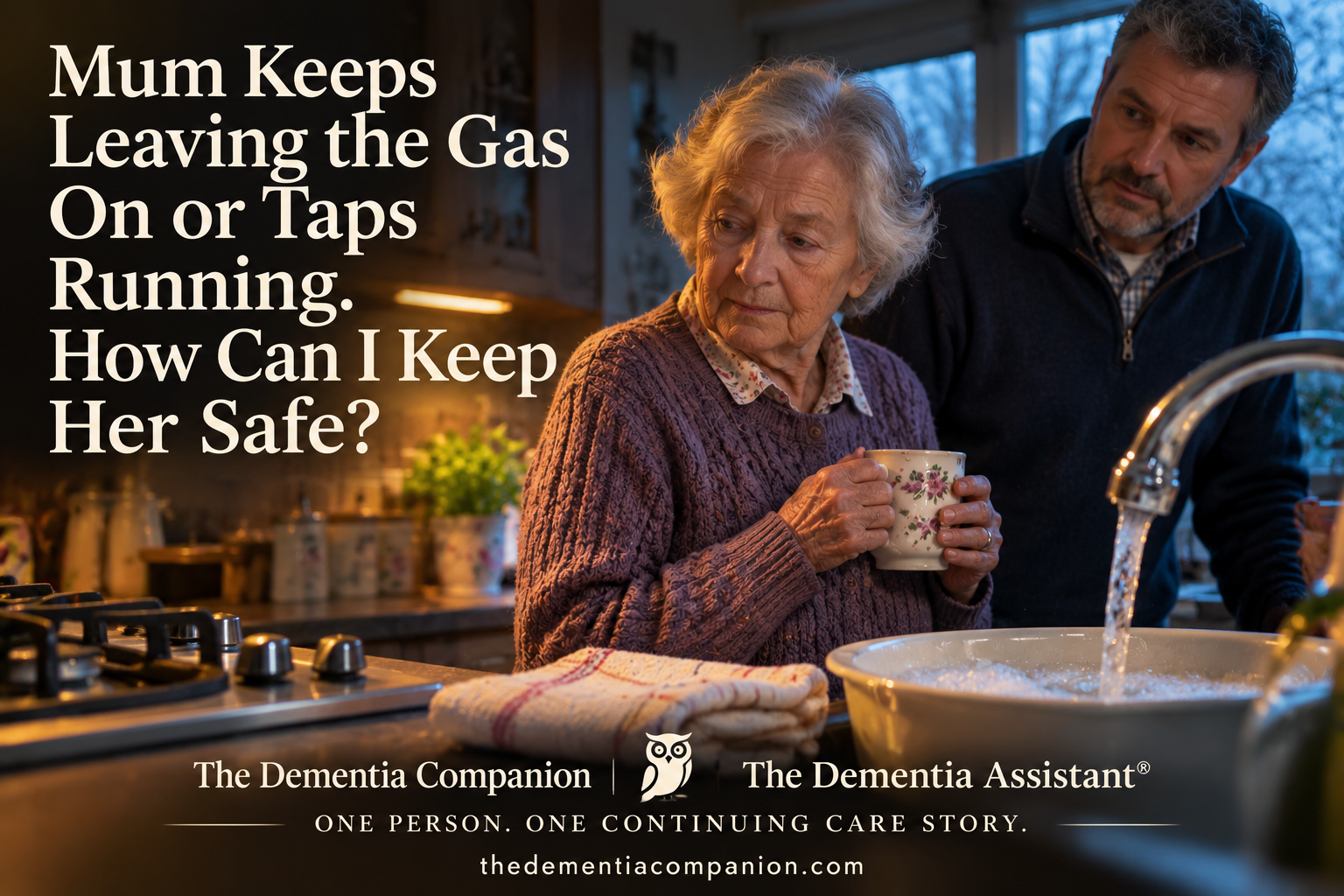
Mum Keeps Leaving the Gas On or Taps Running. How Can I Keep Her Safe?
One Person. One Continuing Care Story. | Article 28 of 40
By Louise Donaghy, Dementia Practitioner, Founder of The Dementia Companion and The Dementia Assistant®, and Creator of Hugo Intelligence™.
It starts with something quite ordinary.
You pop round to see Mum. The kettle is on, the kitchen smells faintly of toast, and she’s telling you all about somebody down the road whose business you probably shouldn’t know quite so much about.
Everything feels reassuringly normal.
Then you notice the tap running.
The sink is nearly full.
You turn it off without making a fuss.
A few days later, you visit again.
This time there’s a saucepan on the cooker, and Mum has wandered into the living room to watch television.
And suddenly, something that was once simply part of everyday life becomes a frightening question.
Is Mum still safe in her own kitchen?
Perhaps she’s left the gas on without lighting it.
Perhaps she’s forgotten something in the oven.
Perhaps the sink has overflowed, or she’s accidentally turned on the hot tap when she meant to use the cold.
And perhaps when you gently mention it, she becomes terribly offended.
“I’ve been cooking for sixty years. I think I know how to use my own cooker!”
Well, she’s got a point.
She probably has been cooking longer than you’ve been alive.
She may have produced countless Sunday roasts, birthday cakes and Christmas dinners in that kitchen.
So how do you tell somebody who has spent a lifetime looking after everyone else that you’re now worried about their safety?
The answer is to take the risks seriously, make immediate hazards safe, and look for ways to preserve independence wherever possible.
Dementia does not automatically mean a person must stop cooking.
But repeatedly leaving gas appliances on, forgetting running taps or struggling with hot water are warning signs that deserve attention.
The goal isn’t to take the kitchen away from Mum.
It’s to understand what has changed, assess the risks and help her continue doing the things she enjoys as safely as possible.
And sometimes, that means changing how an activity happens rather than stopping it altogether.
Why might someone with dementia leave the gas on or taps running?
Cooking and using a kitchen involve more thinking than we sometimes realise.
Take making a cup of tea.
You need to remember what you intended to do, find the kettle, recognise which tap to use, fill it appropriately, switch it on and return when the water is ready.
Then there’s the cup, the teabag, the milk and remembering where you put your glasses.
That last one isn’t necessarily dementia. Most of us have conducted a full-scale search for glasses that were sitting on our heads.
But with dementia, difficulties with memory, attention, planning, judgement and interpreting the environment may make familiar tasks harder.
Forgetting the next step
Mum might begin filling the sink and then become distracted by the telephone.
She may start preparing lunch, leave the room and forget there is something cooking.
The problem might not be remembering how to cook.
It may be remembering that she is cooking.
Difficulty following a sequence
Some forms of dementia affect the ability to organise several steps in the correct order.
Mum may know perfectly well what a saucepan is for but find it harder to manage the sequence of preparing food, using the hob and switching everything off afterwards.
Changes in recognising objects or controls
Visual and perceptual difficulties can affect how someone interprets their surroundings.
A familiar cooker may become confusing.
The markings around the knobs may be difficult to read.
A new tap may look attractive but be unfamiliar to use.
Even replacing a traditional cooker with a modern touchscreen can make a previously manageable task much harder.
Physical or sensory difficulties
Poor eyesight, hearing difficulties, arthritis, reduced hand strength or changes in mobility may contribute.
Sometimes the most useful solution isn’t a memory prompt.
It is better lighting, clearer controls or equipment that is physically easier to manage.
Something else may have changed
Never assume every new difficulty is caused by dementia.
A sudden deterioration, increased confusion, illness, medication-related effects, pain or another health problem may need clinical assessment.
If the change is sudden or accompanied by concerning symptoms, seek urgent medical advice.
Understanding why a particular task has become difficult is just as important as identifying that it is difficult.
What should I do if Mum has actually left the gas on?
First, distinguish between finding an appliance still safely burning and discovering a possible gas leak.
If you smell gas, suspect a leak or discover unlit gas escaping, treat it as a gas emergency.
Do not continue an ordinary conversation about kitchen safety while a potential leak remains unresolved.
Get people to safety, avoid naked flames and smoking, and do not operate electrical switches or equipment that could cause a spark.
Follow your gas network’s instructions. Where it is safe to do so, ventilation and isolating the gas supply may be advised. Do not delay evacuation or put yourself at risk to do either.
Contact the appropriate gas emergency service from outside or another safe location.
Do not return until the relevant professionals confirm it is safe.
Gas emergency numbers
Great Britain: England, Scotland and Wales
National Gas Emergency Service: 0800 111 999
Northern Ireland
Northern Ireland Gas Emergency Service: 0800 002 001
Republic of Ireland
Gas Networks Ireland: 1800 20 50 50
United States and Canada
Move to safety and contact 911 or your local emergency service and gas utility, according to local guidance.
Australia
Move to safety and contact your local gas emergency provider. Call 000 if emergency fire, ambulance or police assistance is required.
Elsewhere, follow your country’s gas emergency procedures.
These numbers relate to emergency situations, not routine appliance adaptations.
Do not attempt to install, disconnect, repair or modify gas equipment yourself.
Use an appropriately licensed or registered professional in your jurisdiction.
What about carbon monoxide?
Carbon monoxide is particularly dangerous because it cannot be seen or smelled.
Faulty fuel-burning appliances may produce it.
Headaches, dizziness, nausea, weakness or confusion can be warning signs, although symptoms vary.
If a carbon monoxide alarm sounds or poisoning is suspected, get everyone into fresh air, contact emergency services or the gas emergency provider as appropriate, and seek urgent medical assessment.
Do not assume that somebody’s confusion is simply dementia.
Suitable carbon monoxide alarms, smoke alarms and properly maintained appliances are important parts of home safety.
An ordinary gas alarm and a carbon monoxide alarm detect different hazards, so families should obtain appropriate devices for the property’s equipment and local requirements.
How can I make Mum’s cooker safer without taking away her independence?
This is where a little thought can make an enormous difference.
A person may still enjoy preparing food, but the way the cooker operates may need reviewing.
Consider automatic cooker shut-off devices
Some systems are designed to stop gas or electricity being supplied to a cooker under specified conditions.
Depending on the system, they may respond to prolonged use or other safety triggers.
These devices may reduce particular risks, although no device eliminates every danger.
Compatibility, suitability, installation and maintenance should be assessed by qualified professionals.
An automatic shut-off system should never be treated as a guarantee that someone can cook without appropriate support.
Ask about locking cooker valves or isolation controls
In some situations, a professionally installed control can prevent a gas cooker being used when it is unsafe to do so.
This may be useful when someone repeatedly turns knobs accidentally or forgets to turn the appliance off.
However, restricting access to cooking equipment is a significant decision.
The person’s wishes, decision-making ability, alternatives and safety needs should all be considered.
It should not automatically be the first solution.
And we must never forget that somebody still needs access to food, drinks and meaningful activities.
Use straightforward visual prompts
A clearly positioned reminder may help some people.
For example:
“Finished cooking? Check the cooker is off.”
Or a simple picture showing the correct off position.
But a reminder is only useful if the person can notice, understand and act on it.
A sign is not an adequate substitute for supervision or properly assessed safety measures when the risk is serious.
Consider whether the cooker itself is suitable
Are the controls clear?
Is the lighting good?
Are the markings easy to see?
Does Mum recognise how the cooker operates?
Would changing the arrangement of frequently used items make tasks easier?
Before buying an entirely new appliance, consider whether an occupational therapist can assess the kitchen and suggest practical adaptations.
Replacing familiar equipment can occasionally create additional confusion.
The best solution is the one suited to the person.
What if Mum keeps leaving the taps running?
An overflowing sink may appear less frightening than a gas cooker.
But it can still cause significant problems.
Water can damage floors, furniture and electrical equipment.
A wet floor can create a slipping hazard.
And very hot water can cause burns.
Start with the ordinary explanation
Was Mum interrupted?
Is the tap difficult to turn?
Does she understand the controls?
Has something changed recently?
Is the sink plug getting stuck?
Does she become distracted while washing dishes?
You may discover that the difficulty is very specific.
Consider flood prevention equipment
Depending on the home, useful options may include:
- Flood detectors or water sensors that alert someone when water reaches an unexpected area.
- Overflow safety plugs designed to release water above a certain level.
- Automatic water isolation systems that can shut off water under particular conditions.
- Better-designed tap controls or clear hot-and-cold markings.
- Appropriate temperature-limiting devices to reduce scalding risk.
Discuss suitability with an occupational therapist and qualified installer where appropriate.
Don’t create a completely unfamiliar kitchen without first considering whether the changes themselves could cause confusion.
What should I say to Mum?
If she becomes upset when you point out a running tap, avoid turning it into a test of her memory.
Instead of:
“Mum, you’ve left that running again. How many times have I told you?”
Try:
“That tap seems to be giving us a bit of trouble. Shall we have a look at it together?”
Or:
“I’d like to make this easier for you. Let’s see what might help.”
The problem is the situation, not Mum’s worth or competence as a person.
What if Mum becomes angry when I suggest kitchen safety changes?
This is often the most emotionally difficult part.
You are concerned about fire, burns or flooding.
Mum hears that she can no longer be trusted in her own home.
Neither of you feels understood.
Before approaching the conversation, remember what the kitchen may represent.
It might be where Mum baked with her children.
Where neighbours gathered for tea.
Where she made packed lunches before school.
Where she took pride in feeding everyone.
The kitchen may be one of the last places where she feels confident and in control.
Removing that independence abruptly can affect her identity and wellbeing.
Begin with her perspective
You might say:
“Mum, I know how much you enjoy cooking.”
“I don’t want you to stop doing the things you love.”
“I’m a little worried about the cooker, and I’d like us to find a way to make it safer.”
Then listen.
She may have her own ideas.
She may agree that the knobs are difficult to see.
She may say she hates the new tap.
Or she may genuinely believe there is no problem.
Avoid arguing about whether she remembers a particular incident.
Focus on a practical solution.
Offer choices rather than commands
Instead of:
“You’re not allowed to use the cooker anymore.”
Try:
“Would you prefer us to cook dinner together, or shall we look at something that makes the cooker easier to use?”
If a particular activity cannot be carried out safely, be clear about the risk while involving Mum in decisions as much as possible.
Do not offer a choice that isn’t actually available.
And remember that consent and decision-making arrangements must follow the relevant law.
Can Mum still enjoy cooking if she needs more help?
Absolutely, depending on her abilities, interests and the risks involved.
Cooking isn’t only about operating a cooker.
It can be about choosing ingredients, preparing vegetables, mixing, tasting, arranging food and sharing a meal.
Someone who cannot safely manage a gas hob alone may still enjoy many other parts of preparing food.
Make cooking a shared activity
Perhaps Mum can choose what to make while somebody else manages the heat.
She may enjoy washing vegetables, mixing ingredients or arranging food on plates.
She might help prepare a sandwich or make a cold dessert.
Choose tasks appropriate to her abilities and safety, with supervision where needed.
Preserve familiar recipes
If Mum has made the same apple crumble for fifty years, that recipe may be part of her identity.
Perhaps she can describe how she made it.
Perhaps she can help with one or two familiar steps.
Perhaps she can sit nearby and supervise the family’s efforts.
And if she tells you that you’ve put too much sugar in it, you can be fairly certain some family traditions remain wonderfully intact.
The aim is not to keep the person busy for appearances.
It’s to offer meaningful involvement, enjoyment and choice.
Keep the kitchen familiar
Familiar surroundings may support confidence.
Try to keep frequently used objects in consistent places.
Reduce unnecessary clutter.
Make important items easy to see.
Consider good lighting and contrasting colours for objects that are difficult to distinguish.
Ask Mum which arrangements she prefers.
A dementia-friendly kitchen should not feel like an unfamiliar clinical environment.
It should still feel like home.
How do I know when cooking alone is no longer safe?
There is no single test that applies to everyone.
A diagnosis of dementia does not automatically determine whether a person can cook safely.
Equally, a person’s previous experience does not guarantee that they can continue every task without risk.
Look at what actually happens.
Questions worth considering include:
- Does Mum remember to turn off cooking appliances?
- Can she recognise and respond to smoke, burning food or other hazards?
- Does she understand the controls?
- Can she manage hot pans and liquids safely?
- Has she experienced burns, fires, leaks or repeated near misses?
- Can she follow the steps of the activity?
- Is she able to respond appropriately when something unexpected happens?
- Would supervision, equipment or changes to the task reduce the risk sufficiently?
An occupational therapist can assess functional abilities and the home environment.
The person’s GP, memory service or wider care team may also need to consider whether there has been a significant change in cognition, health or daily functioning.
A repeated serious hazard should never be managed by reassurance alone.
It is possible to respect somebody’s independence while recognising that a particular activity is no longer safe without assistance.
What about Mum living alone?
This creates a different level of concern.
If a person regularly leaves the gas on, struggles to respond to a fire alarm or cannot recognise serious kitchen hazards, a formal review of home safety and support arrangements is important.
Consider how often somebody is present.
What happens during the evening or overnight?
Who would know if there were an emergency?
Are there appropriate alarms or monitoring arrangements, with consent and consideration for privacy?
Could scheduled support, meal provision or environmental adaptations help?
Would the person benefit from a reassessment of their care needs?
Technology can support safety, but it does not replace human assessment or guarantee that the person is safe alone.
If serious risks remain despite reasonable adjustments, more substantial changes to support arrangements may be needed.
Such decisions should be individualised, proportionate and made through appropriate legal and professional processes.
Practical help in the UK, USA, Canada, Australia and Ireland
United Kingdom
A GP, memory service or relevant social care service may help arrange further assessment.
In England, families can contact their local council to request a care needs assessment and discuss home adaptations or occupational therapy.
Arrangements, eligibility and funding differ across England, Scotland, Wales and Northern Ireland.
Dementia UK, Alzheimer’s Society and local fire and rescue services provide relevant home safety guidance.
For gas work, use a Gas Safe registered engineer.
United States
Families can discuss functional changes with the person’s healthcare professional and seek an occupational therapy home safety assessment where available.
The Alzheimer’s Association and National Institute on Aging provide dementia home safety information.
Gas and electrical work must meet applicable state and local requirements.
Canada
Families may contact their provincial or local Alzheimer Society, healthcare professional or occupational therapy service.
Home care provision, equipment schemes and funding differ by province and territory.
Local gas and fire safety rules also vary.
Australia
A GP, occupational therapist or relevant community support service can help assess home safety.
Dementia Australia offers guidance on dementia-friendly environments and assistive technologies.
Fire safety and appliance requirements should be checked with the relevant state or territory authority.
Republic of Ireland
Families may speak with the person’s GP, HSE services or appropriate occupational therapy team.
The Alzheimer Society of Ireland provides dementia support.
Gas installation and safety arrangements must follow Irish requirements.
What about Mum’s rights, wishes and decision-making?
This is important.
Dementia does not automatically mean that someone lacks the ability to make decisions.
People may be able to make some decisions independently while requiring support with others.
Decision-making ability may also change over time.
The person’s views should be sought, and information should be explained in a way they can understand.
For England and Wales, the Mental Capacity Act provides a legal framework for decision-making when a person may lack capacity for a particular decision.
Scotland and Northern Ireland have different legal frameworks.
Ireland, the United States, Canada and Australia also have their own laws and arrangements.
A family relationship alone does not automatically give someone authority to make every decision.
Where serious safety measures affect independence or restrict activities, consider the relevant legal and professional requirements.
Aim for the least restrictive effective approach that adequately manages the risk, consistent with the applicable law.
Why the family’s own continuing care plan matters
Imagine Mum lives independently.
Her daughter visits on Monday and notices the cooker has been left on after lunch.
Her son visits on Wednesday and finds the sink overflowing.
A home carer arrives on Friday and discovers Mum is struggling with the new tap.
Each person sees a different incident.
Without good communication, nobody may appreciate the full pattern.
The daughter thinks it’s an isolated mistake.
The son suspects the tap is faulty.
The carer assumes Mum needs a reminder.
But together, these observations may suggest that Mum needs a proper assessment and a more consistent safety plan.
This is why a family-held continuing care plan is so valuable.
What should families record?
A useful kitchen safety section might include:
The person’s wishes: Mum enjoys preparing breakfast and wants to remain involved in cooking.
Current strengths: She can choose meals, prepare some cold food, recognise familiar utensils and participate in simple tasks.
Observed difficulties: The gas hob has been left on after cooking on two occasions. The kitchen tap was left running on three occasions.
Possible contributing factors: Mum becomes distracted when the telephone rings. Cooker controls are difficult to see.
Agreed safety arrangements: Professional appliance assessment requested. Cooking with heat is currently supported by another person while risks are reviewed.
Equipment: Smoke and carbon monoxide alarms checked. Occupational therapy advice requested about cooker and water safety devices.
Communication preferences: Explain changes calmly, involve Mum in decisions and avoid presenting safety support as punishment.
Review arrangements: Reassess after professional input, equipment installation or further incidents.
These are fictional examples, not an assessment of a real individual.
Record what happens, not what you assume
Avoid:
“Mum is becoming dangerous.”
Prefer:
“At 1.20 pm, the electric hob was found switched on after lunch. Mum was in the living room. The hob was switched off safely. No injury or fire occurred. Family arranging safety review.”
A factual observation is more useful than an unsupported judgement.
And if a gas leak is suspected, the emergency response must come before documenting the incident.
Meet Hugo Intelligence™: one person at a time
When families encounter situations like this, they often have more questions than answers.
Should Mum stop cooking?
Is it safe to leave her alone?
What equipment might help?
How do we speak to her without making her feel incapable?
What should we tell her GP?
This is where Hugo Intelligence™ can provide a supportive starting point.
Hugo is the conversational, person-centred dementia guidance system within The Dementia Assistant®, powered by Person-Centred Intelligence®.
His name reflects the principles behind his approach:
H — Human
U — Understanding
G — Guidance
O — One person at a time
Hugo is represented by our owl mascot.
But what matters most isn’t the owl.
It’s the philosophy behind the guidance.
Understand the person before deciding what support may be appropriate.
Ask Hugo naturally
You don’t have to know the right terminology.
You could simply write:
“Hugo, my mum keeps leaving the cooker on. She gets really angry when we try to help. What can we do?”
Hugo can provide general educational guidance about kitchen safety, communication, possible contributing factors and practical questions to explore with appropriate professionals.
You can then continue:
“She lives alone.”
“She’s always loved cooking.”
“She says we’re taking her independence away.”
“The cooker is gas.”
“What should I ask the occupational therapist?”
Hugo can help you think through the situation progressively.
He can explain information in simpler terms, suggest respectful phrases and help you organise questions for a healthcare professional.
He cannot inspect the kitchen, determine whether an appliance is safe or provide an emergency response.
General Hugo: guidance without a care plan
A user can ask Hugo a general question without first creating or selecting an individual care plan.
For example:
“What safety equipment can help someone with dementia who forgets to turn off the cooker?”
Hugo can explain general options and relevant professional considerations.
Personalised Hugo: guidance using Mum’s selected care plan
Now imagine the family has developed a care plan for Mum.
It includes her routines, abilities, history, communication preferences and relevant observations.
When the user explicitly selects Mum’s individual care plan, Hugo can use relevant information from that plan to help make the discussion more personalised.
For example:
“Hugo, using Mum’s care plan, how could we keep her involved in preparing dinner while making sure she doesn’t use the gas hob unsupervised?”
Hugo can consider the information available in that selected plan when exploring suitable approaches.
That might include Mum’s enjoyment of cooking, what she can still do, what has caused difficulty and how she prefers support to be offered.
Hugo does not automatically access every care plan in the account.
The user must select the individual person’s plan.
Families supporting several people can maintain separate plans, helping keep their records and circumstances distinct.
The guidance remains educational and should not replace a professional assessment of safety or capacity.
The Care Planning Centre™ and guided Talk to Hugo
Many families have never written a care plan before.
They may not know what information to include or how to describe a concern accurately.
The Care Planning Centre™ is designed to make this process more accessible.
Through guided Talk to Hugo conversations, families can work through relevant care-planning questions.
For example:
“What does Mum enjoy doing in the kitchen?”
“Which activities can she still do independently?”
“What difficulties have we noticed?”
“What arrangements have we agreed?”
“What should another carer know?”
Relevant information can be organised into the appropriate parts of the individual’s care plan, with the user reviewing what is recorded.
The platform also includes review tools, gap suggestions and assistance with improving the clarity and professional wording of care information.
A family can revisit the plan as circumstances change.
This matters because a care plan that was suitable six months ago may no longer reflect the person’s current abilities or needs.
The plan should be a continuing record, not a completed form left untouched.
Saved conversations, daily notes and documents
The Dementia Assistant® provides tools to help families maintain continuity beyond a single conversation.
Saved and categorised Hugo conversations
A family may have a useful conversation with Hugo about cooker safety, then another about changes in memory, or how to explain the situation to a sibling.
Conversations can be saved, categorised and revisited.
This helps families return to information they found useful rather than having to start every discussion from the beginning.
A saved AI conversation is not a verified medical record or a substitute for professional instructions.
Daily notes
Daily notes help the family record factual observations over time.
For kitchen safety, these could include dates, incidents, activities, relevant changes, safety actions and professional follow-up.
Records should be respectful, accurate and avoid unsupported diagnoses.
They may help a GP, memory clinic or occupational therapist understand what has been happening.
Document organisation and exports
Relevant professional reports, assessments and other care information can be organised within The Dementia Assistant®.
The platform supports applicable exports, including PDF, Word, CSV and JSON formats.
This helps the family keep appropriate information available when needed.
It does not replace the original clinical or professional record.
Families should check accuracy and share information only with appropriate consent and permissions.
Family Circle: helping everyone understand the same safety plan
Kitchen safety becomes more complicated when different relatives provide support.
A daughter might visit every morning.
A son may handle appointments.
Another relative may live abroad.
Professional carers may come in at different times.
Without communication, one person might believe Mum is safe to cook alone while another has witnessed a serious incident.
Family Circle supports appropriate communication and updates between involved relatives.
A family can use the platform to help keep relevant information together and reduce the need to repeatedly explain changes.
Access must remain subject to the person’s wishes, privacy, consent and appropriate permissions.
Not every family member should automatically see every piece of information.
Life Story and Memory & Moments: keeping cooking meaningful
There is something lovely about how food connects us to family history.
The smell of a favourite meal.
A recipe handed down through generations.
A particular Sunday dinner.
The birthday cake nobody else could ever make quite the same way.
These details matter.
The Life Story and Memory & Moments features in The Dementia Assistant® help families preserve important experiences, relationships, interests and personal preferences.
Perhaps Mum grew up helping her grandmother cook.
Perhaps she has a treasured recipe book.
Perhaps preparing food was part of her cultural or religious traditions.
Recording these details can help relatives and care professionals understand why cooking matters so much to her.
If a person can no longer safely operate a cooker alone, that does not mean the whole experience of cooking must disappear.
A meaningful activity can often be adapted.
The aim is to preserve identity and enjoyment, not simply remove risk by removing everything the person values.
Multilingual support: keeping the person’s own words and traditions
Many families support relatives across different countries and languages.
A parent may prefer one language while adult children speak another.
Family members living overseas may need to understand updates.
A person living with dementia may also experience changes in language use, although this varies and should never be assumed.
The Dementia Assistant® offers 12 interface languages, with dictation and translation capabilities spanning 201 languages.
This can support multilingual communication, note-taking and the preservation of meaningful information in the person’s preferred language.
Not every platform feature is available in all 201 languages.
Translation must be checked carefully, especially for medical, medication, legal and safety-critical information.
Professional interpreting should be used when necessary.
A simple example might be recording that Mum understands cooking instructions best in the language she has used for much of her life.
Or preserving the original name of a traditional family recipe.
Because cultural identity and language are part of the person’s continuing story.
Dementia Academy™, crisis guidance and the Carer Wellbeing Hub
The Dementia Assistant® also includes learning and support resources to help families understand everyday dementia care.
The Dementia Academy™ provides educational material relevant to person-centred approaches, communication and practical support.
The platform’s crisis guidance can help users recognise situations requiring urgent or professional attention.
It cannot replace emergency services or provide real-time physical protection.
And the Carer Wellbeing Hub recognises the emotional strain that comes with caring.
Because finding the cooker left on can be frightening.
So can lying awake wondering whether it might happen again.
Families may experience exhaustion, disagreements and anxiety about the future.
They need practical support, not simply encouragement to try harder.
Hugo can help carers explore concerns and prepare questions, but human support, respite and professional assistance remain important.
Ask Hugo: 17 questions about dementia and kitchen safety
- Why does Mum with dementia keep leaving the cooker on?
Dementia can affect attention, memory, planning and the ability to complete familiar tasks. Mum may become distracted or have difficulty remembering the final step. Physical, sensory and medical factors may contribute. An individual assessment can help identify what is happening.
- Is it safe for someone with Alzheimer’s disease to use a gas cooker?
Some people may continue using a cooker safely with appropriate adaptations or support. Others may face serious risks. The diagnosis alone does not determine safety. Look at actual abilities, incidents and the person’s response to hazards, and seek professional assessment when concerns arise.
- What should I do if I find the gas has been left on without a flame?
Treat suspected escaping gas as an emergency. Move people to safety, avoid ignition sources and electrical switches, and contact the relevant gas emergency service from a safe location. Do not attempt appliance repairs yourself.
- Can I install something that automatically turns Mum’s cooker off?
Automatic shut-off systems and appropriate isolation controls may be available. Their suitability depends on the appliance, the person’s needs and the home. Seek advice from an occupational therapist and appropriately qualified installers.
- What if Mum gets angry when I tell her she should stop cooking?
Acknowledge what cooking means to her. Explain your concern without blame, offer choices where possible and involve her in finding alternatives. Where a serious risk exists, prioritise safety and seek appropriate professional and legal guidance.
- Does leaving the tap running mean Mum’s dementia is getting worse?
Not necessarily. It may relate to distraction, difficulty using the tap or another problem. Notice patterns and consider health changes. A sudden or significant change should be medically assessed rather than automatically attributed to dementia progression.
- How can I prevent the sink from overflowing?
Depending on the circumstances, options may include flood detectors, overflow safety plugs, water isolation devices and simpler tap controls. Ask an occupational therapist or appropriate professional what would suit the person and property.
- Should I put reminder signs around the kitchen?
Some people find clear, simple signs helpful. Others may not notice or understand them. Use signs only as part of a wider individualised approach. They are not a sufficient safety measure when someone repeatedly creates a serious hazard.
- Can Mum still cook if she needs supervision?
Potentially, yes. Assess which activities are safe and meaningful. She might help select meals, prepare cold ingredients or participate in cooking while another person manages heat. Respect her choices and preferences.
- What if Mum insists she has never left the cooker on?
Avoid turning the conversation into an argument about her memory. Explain the safety concern calmly and focus on solutions. Record incidents factually and seek an assessment when necessary.
- Is a microwave always safer than a gas cooker?
No appliance is automatically safe for every person. Microwaves can still create risks involving hot food, unsuitable containers and confusion about controls. Any alternative should be assessed for the person’s actual abilities and needs.
- When should I ask for an occupational therapy assessment?
Consider requesting one when everyday tasks become difficult, repeated incidents occur, equipment changes are being considered or family members are unsure how to balance safety and independence. Do not wait for a serious injury if risks are already evident.
- Should Mum continue living alone if she forgets to turn things off?
This depends on the severity and frequency of incidents, her ability to respond, available support and whether risks can be adequately managed. Repeated serious hazards require prompt assessment. Home safety technology alone does not guarantee safety.
- What if different relatives disagree about Mum’s safety?
Bring the discussion back to documented incidents, Mum’s wishes, professional assessment and agreed arrangements. Avoid relying solely on opinions or individual visits. The family-held care plan can help keep information consistent.
- Can Hugo tell us whether Mum is safe to live alone?
No. Hugo cannot inspect the home, assess safety in person or make legally binding decisions. He can help families organise observations, explore general guidance and prepare questions for an occupational therapist, GP or other appropriate professional.
- Can Hugo use Mum’s existing care plan to suggest more personalised approaches?
Yes. When the user explicitly selects Mum’s individual care plan, Hugo can consider relevant information from that plan, including routines, preferences and recorded observations, to offer more personalised educational guidance. Hugo does not automatically access every plan.
- How can we keep Mum’s kitchen safety information together as her care changes?
Through The Dementia Assistant®, the family can maintain relevant details in Mum’s individual care plan, record observations in daily notes, organise documents and save useful Hugo conversations. Appropriate information can then be shared with professionals, subject to consent, permissions and legal requirements.
One Person. One Continuing Care Story.
Different professionals. Different services. One person. One continuing story.
Imagine what might happen over the next few years.
Today Mum lives at home.
Her daughter notices a problem with the cooker.
A few months later, she has an occupational therapy assessment.
Perhaps new equipment is installed.
Later, a home care agency begins visiting.
There may eventually be hospital appointments, rehabilitation or residential support.
Each professional may hold separate records.
Each organisation may have its own assessments and care plans.
But Mum is still Mum.
The woman who made her children’s favourite dinners.
Who knows precisely how much milk belongs in a cup of tea.
Who has preferences, habits, relationships and a lifetime of experiences that cannot be reduced to a diagnosis.
The person should remain the connecting thread through every change in care.
That is the purpose of One Person. One Continuing Care Story.
The family’s knowledge should not disappear between services
If Mum moves into hospital, the family may want to share information about her everyday abilities, health, communication and safety needs.
If new carers become involved, they should have access to appropriate information about her routines and agreed support.
If her needs change, the family can update its own record.
If a professional asks what has been happening over the past few months, factual observations may already be organised.
The Dementia Assistant® is designed to help the person or family maintain that continuing picture.
One person. One individual life story. One continuing person-centred care plan.
That plan complements professional records.
It does not replace medical assessments, clinical instructions, statutory care plans or legal decisions.
But it can help families maintain their own coherent information as professionals and services change.
One care plan does not mean one unchanging set of instructions
A care plan must develop with the person.
Mum might prepare breakfast independently today.
She may need some help in six months.
Later, her role in the kitchen may change again.
The support should reflect her current abilities, preferences and needs.
It should also continue to recognise what she can do, not merely what she can no longer manage.
And whenever possible, Mum should participate in decisions about her own life.
A good person-centred care plan is not just about preventing problems.
It is about supporting the person’s wellbeing, dignity, strengths and choices.
That is why the continuing care story belongs to the person, with family support as appropriate.
A gentle invitation to meet Hugo
If you are worrying about Mum’s kitchen safety, you may already be trying to manage several difficult things at once.
You want to protect her.
You don’t want to frighten her.
You don’t want to take away everything she enjoys.
And you may be wondering how to explain your concerns to a GP, memory clinic or occupational therapist.
You can begin by asking Hugo.
Describe what has happened.
Explain what you’ve noticed.
Ask for ideas about what to say.
Explore the questions you want to take to a professional.
And if you choose to create and select Mum’s individual care plan, Hugo can help you consider her personal circumstances alongside the general guidance.
Within The Dementia Assistant®, you can continue building the family’s care information as life changes.
Not just for one frightening incident.
Not just until the next appointment.
But as part of the person’s continuing care story.
All subscriptions include a 30-day complimentary trial.
The UK Family subscription is £4.99 per month following the complimentary trial.
For international subscriptions, consult the current pricing available through the platform.
Explore practical dementia articles and support:
https://thedementiacompanion.com/
Meet Hugo and explore The Dementia Assistant®:
https://thedementiaassistant.com/
Hugo provides educational guidance, not medical diagnosis, appliance inspection, emergency intervention, medication prescribing, statutory assessments or legally binding decisions.
One final thought
There may come a day when Mum cannot safely use her cooker without help.
That can be a difficult change for everybody.
But needing assistance does not take away her history.
It doesn’t take away her right to be included.
And it certainly doesn’t take away the importance of everything she has spent a lifetime doing.
Perhaps she can still choose what is for dinner.
Perhaps she can share a favourite recipe.
Perhaps she can tell you, with absolute conviction, that your gravy needs another ten minutes.
The way she participates may change.
But the person remains.
And that is what we should be protecting, alongside her physical safety.
Because good dementia care isn’t simply about making life safer. It’s about making life safer without forgetting whose life it is.
With love,
Louise and Hugo ❤️🦉
Louise Donaghy
Founder & CEO of The Dementia Assistant®
Created and powered by Person-Centred Intelligence®
Creator of Hugo Intelligence™
⸻
Continue exploring with The Dementia Companion
How to Support a Parent With Dementia
https://thedementiacompanion.com/articles/how-to-support-a-parent-with-dementia/
Dementia Communication Tips: How to Connect With Confidence
https://thedementiacompanion.com/articles/dementia-communication-tips/
Creating a Person-Centred Dementia Care Plan: Ask Hugo
https://thedementiacompanion.com/ask-hugo/person-centred-dementia-care-plan/
Using Life Story in Dementia Care: Ask Hugo
https://thedementiacompanion.com/ask-hugo/life-story-dementia-care/
Dementia Crisis Support Guide
https://thedementiacompanion.com/articles/dementia-crisis-support-guide/
Explore the Ask Hugo Library
https://thedementiacompanion.com/ask-hugo/
References and authoritative guidance
The following resources support the information on home safety, adaptations, dementia care, independence and emergency procedures.
1. Dementia UK. Making the home safe and comfortable for a person with dementia.
https://www.dementiauk.org/information-and-support/living-with-dementia/making-the-home-safe-and-comfortable-for-a-person-with-dementia/
2. Alzheimer’s Society (UK). How technology can help.
https://www.alzheimers.org.uk/get-support/living-with-dementia/how-technology-can-help
3. NHS (UK). How to make your home dementia friendly.
https://www.nhs.uk/conditions/dementia/living-with-dementia/home-environment/
4. NICE (UK). Dementia: assessment, management and support for people living with dementia and their carers, NG97.
https://www.nice.org.uk/guidance/ng97/chapter/recommendations
5. NHS (England). Mental Capacity Act.
https://www.nhs.uk/social-care-and-support/making-decisions-for-someone-else/mental-capacity-act/
6. National Gas (Great Britain). Emergency contacts and gas safety advice.
https://www.nationalgas.com/emergency-contacts
7. nidirect (Northern Ireland Government). Energy, power supply and utilities, including the Northern Ireland Gas Emergency Service.
https://www.nidirect.gov.uk/articles/energy-power-supply-and-utilities
8. Gas Networks Ireland. What to do if you smell gas.
https://www.gasnetworks.ie/gas-safety/do-you-smell-gas
9. Alzheimer’s Association (USA). Alzheimer’s and dementia home safety tips.
https://www.alz.org/help-support/caregiving/safety/home-safety
10. National Institute on Aging (USA). Home safety checklist for Alzheimer’s disease.
https://www.nia.nih.gov/health/safety/home-safety-checklist-alzheimers-disease
11. Alzheimer Society of Canada. Making your environment safe.
https://www.alzheimer.ca/en/help-support/im-caring-person-living-dementia/ensuring-safety-security/making-your-environment-safe
12. Dementia Australia. Tips to create a dementia-friendly home.
https://www.dementia.org.au/living-dementia/home-life/creating-dementia-friendly-home
13. Dementia Australia. Tools and aids to help at home.
https://www.dementia.org.au/living-dementia/home-life/tools-and-aids-help-home
14. Fire and Rescue NSW (Australia). Fire safety for people living with dementia.
https://www.fire.nsw.gov.au/fire-safety/home-fire-safety/topics/fire-safety-for-people-living-with-dementia
15. NHS (England). Home adaptations.
https://www.nhs.uk/social-care-and-support/care-services-equipment-and-care-homes/home-adaptations/
This article is intended for general education and family guidance. Emergency instructions, equipment requirements, consent, legal authority and access to support must be checked against the relevant local services and laws. All family scenarios are illustrative and do not describe identifiable clients.
You May Also Find Helpful
Need help with your own situation? Ask Hugo.
One Person. One Continuing Care Story. The Dementia Companion is where you discover guidance. Inside The Dementia Assistant®, talk with Hugo, save and categorise conversations, record daily notes and involve authorised supporters in a continuing care plan centred around the person.
Ask Hugo About This · Start Your Continuing Care Plan — Families · Continuing Care Planning — Professionals
Personal guidance requires the appropriate account and subscription access. Care-plan information is used only with authorised access and the required consent and selection steps. All subscription plans include a 30-day complimentary trial.