Mum Keeps Hiding Food Around the House. What Might Be Happening?
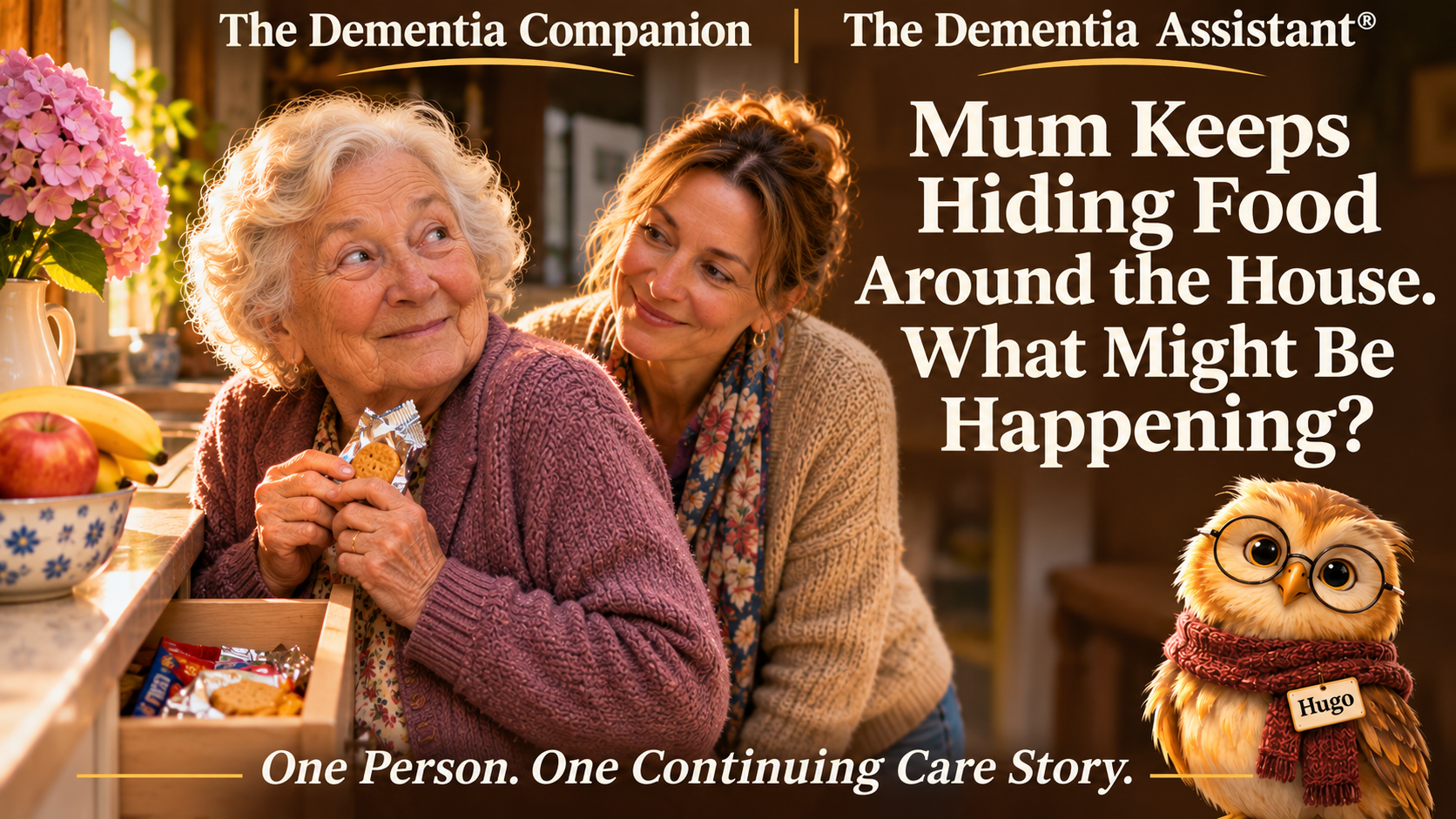
Mum Keeps Hiding Food Around the House. What Might Be Happening?
By Louise Donaghy | The Dementia Companion | One Person. One Continuing Care Story.
It started with a biscuit.
Just one innocent chocolate digestive tucked into Mum’s handbag.
You smiled, put it back in the kitchen and thought nothing more of it.
Then you discovered a sandwich in her bedside drawer.
A packet of crackers behind the sofa.
Three bananas wrapped in a tea towel.
And, somewhere between the clean towels and her favourite cardigan, half a sausage roll that had clearly been enjoying a rather extended holiday.
At this point, you might be forgiven for wondering whether Mum has opened a secret branch of the local supermarket.
But underneath the humour, there’s often genuine worry.
Why is Mum hiding food?
Is she frightened there won’t be enough?
Has she forgotten where food belongs?
Is she hungry?
Could the food become unsafe to eat?
And how do you keep her safe without upsetting her or making her feel that you’re taking away her belongings?
The important thing to understand is that hiding or collecting food in dementia is not necessarily deliberate misbehaviour, and it does not always mean the person is hoarding.
There may be a perfectly understandable reason from Mum’s point of view, even if it doesn’t immediately make sense to us.
She may be protecting something she values, responding to uncertainty, following an old habit or simply putting food somewhere she believes is sensible.
Our job is to understand what might be happening and respond with compassion while managing genuine health and safety risks.
Because there is a person behind that packet of biscuits.
And her reasons matter.
Why might someone with dementia hide food?
Dementia affects more than memory.
It can change how a person interprets their surroundings, recognises objects, plans activities, processes emotions and responds to uncertainty.
The Alzheimer’s Society explains that people living with dementia may hide belongings, store them for long periods or put them somewhere unusual.
Food can become part of this pattern.
However, the explanation is not the same for everyone.
- Mum may forget where food belongs
Perhaps Mum takes a sandwich into the sitting room.
She becomes distracted.
A visitor arrives, the television catches her attention or she decides to put the sandwich somewhere safe.
She places it in a drawer.
Later, she forgets doing so.
From our perspective, she’s hidden her lunch.
From Mum’s perspective, she may simply have put it away.
The difficulty may be remembering where it belongs, rather than intending to conceal it.
- She may be worried about not having enough food
Some people feel a need to collect or protect food because they are worried it may not be available later.
This concern may be linked to anxiety, uncertainty or changes in how they understand their circumstances.
Perhaps Mum cannot remember that the fridge is full.
Perhaps she’s concerned that somebody else will take the food.
She may feel reassured by knowing she has something available.
Instead of assuming the behaviour is irrational, consider the feeling that might be driving it.
Sometimes what looks like hiding is actually an attempt to feel secure.
- Earlier life experiences may influence her behaviour
Food has a powerful connection to our personal histories.
Some people grew up during periods of rationing, poverty, war or food insecurity.
Others were raised in households where wasting food was strongly discouraged.
Perhaps Mum was taught that every scrap should be saved.
Or perhaps she spent years managing a household on a tight budget.
These experiences can shape lifelong attitudes towards food.
The Alzheimer’s Society also describes how changes in a person’s sense of time may influence their behaviour.
Someone might believe they are living in an earlier period of life when circumstances were very different.
But we must be careful.
Not every older person hiding food is reliving wartime rationing or childhood hardship.
That may be relevant to some individuals, but it should never become an automatic explanation.
The best way to understand Mum is to learn about her actual life, rather than make assumptions based on her age.
- Keeping food may give her a sense of control
Dementia can gradually make everyday life feel less predictable.
Appointments are arranged.
People provide assistance.
Routines change.
Other people may begin making decisions that Mum previously made herself.
Even when these changes are necessary, they can feel unsettling.
Keeping a few familiar items may give someone a sense of ownership and independence.
A packet of biscuits in her handbag might mean:
“These are mine.”
“I know where they are.”
“I can have something when I want it.”
That sense of control deserves respect.
The challenge is finding a way to preserve it without creating unnecessary food safety risks.
- She may genuinely be hungry
Before assuming Mum is hiding food because of dementia, check whether she is eating enough.
Has she missed meals?
Does she forget that food is available?
Does she struggle to prepare something independently?
Are her meals satisfying?
Has her appetite changed?
Some people living with dementia forget they have eaten, while others forget to eat altogether.
Changes in hunger, appetite and eating behaviour also deserve consideration.
If Mum is regularly searching for food, losing weight, overeating or experiencing a marked change in appetite, a healthcare professional may need to assess her nutritional and medical needs.
- She may want to save food for someone else
Imagine finding six biscuits wrapped carefully in a napkin.
You assume Mum is collecting them for herself.
But perhaps she tells you:
“They’re for the children.”
She may be thinking about an earlier family routine.
Perhaps she always saved treats for grandchildren.
Perhaps keeping food for visitors has been part of her identity for decades.
We cannot know what she’s thinking without listening and observing.
But it reminds us that what appears unusual may be connected to a familiar role or meaningful relationship.
- She may simply enjoy collecting and organising things
Some people enjoy sorting, arranging or storing objects.
That preference may have existed long before dementia.
Others develop repetitive behaviours or become particularly focused on certain items.
The important question is whether the activity is causing distress, interfering with daily life or creating a genuine risk.
A drawer containing three packets of unopened biscuits may not require the same response as raw chicken stored in a wardrobe.
Those are very different situations.
And person-centred care means recognising that difference.
Is hiding food the same as hoarding?
Not necessarily.
People sometimes use the word hoarding whenever they discover items stored in unusual places.
But there is an important difference between occasionally misplacing something, deliberately saving it, collecting supplies and persistent accumulation that creates difficulties.
A person might put a biscuit somewhere unusual because they have forgotten where it belongs.
Another person might collect food because it provides reassurance.
Someone else may have a longstanding habit of saving things.
These behaviours should not automatically be given a psychiatric label.
The Alzheimer’s Society encourages families to consider the possible needs and feelings behind keeping or collecting items.
Rather than asking only, “How do we stop this?”, consider:
“What is Mum trying to achieve, protect or communicate?”
That question may lead to a much more compassionate solution.
When does hidden food become a health risk?
This is where families need to balance dignity with practical safety.
A sealed packet of biscuits is not the same as a ham sandwich hidden under a pillow.
Some foods can become unsafe if they are stored incorrectly.
Perishable foods, including many cooked dishes, dairy products, meat, fish and prepared sandwiches, may require refrigeration.
The UK Food Standards Agency advises that cooked leftovers should generally be cooled and refrigerated within two hours.
Food that has been stored at an unsafe temperature, or whose storage history is unknown, may need to be discarded.
Food can look and smell perfectly normal while still being unsafe to eat.
That is particularly important for older people and others who may be more vulnerable to serious foodborne illness.
What should families check?
Pay attention to:
- Cooked meat, fish and poultry hidden outside the fridge.
- Sandwiches containing perishable fillings.
- Milk, cream, yoghurt and other chilled foods.
- Prepared meals left in warm rooms.
- Food with passed use-by dates.
- Food with damaged packaging.
- Signs of pests, mould or contamination.
- Foods stored near medicines, cleaning products or chemicals.
If Mum has a swallowing difficulty, diabetes, allergies or another medical condition, additional risks may also need consideration.
Always follow appropriate local food safety guidance.
If you’re unsure whether a hidden perishable item has been safely stored, it is safer not to serve or eat it.
But what if Mum becomes upset when we throw food away?
This can be very difficult.
From Mum’s point of view, the food may still be valuable.
She may not understand why it needs to be removed.
She may believe someone is stealing from her.
And if she already feels anxious about food supplies, discovering that things have disappeared could increase that anxiety.
Start by explaining gently when possible.
You might say:
“This sandwich isn’t safe to eat now, Mum. Shall we make you a lovely fresh one?”
Or:
“That one’s been sitting there for a while. Let’s find something fresh together.”
Avoid shaming her or treating her as though she has done something naughty.
For clearly unsafe food, protecting health may require removal, but do so respectfully and explain what is happening as far as she can understand.
If the situation is repeated or causes substantial distress, seek professional advice on an individual approach.
The aim is to protect Mum, not punish her for a difficulty she may not be able to control.
Ten practical ways to support someone who hides food
- Look for patterns before changing everything
Notice when Mum hides food.
Is it after meals?
Before bedtime?
When visitors leave?
When she feels unsettled?
Does she hide particular foods?
Are the items always placed in the same drawer?
Patterns may help you understand what is happening.
A simple observation might be more useful than immediately rearranging the entire kitchen.
- Make food easy to see and find
Someone living with dementia may forget what food is available when it is hidden behind cupboard doors.
Consider keeping suitable everyday foods visible and accessible.
Clear containers, simple labels and familiar storage places may help.
A fruit bowl or a designated snack area could provide reassurance.
However, consider allergies, dietary requirements, swallowing risks and individual abilities when deciding what should remain accessible.
The goal is to support independence, not remove choice.
- Offer a familiar, safe place for snacks
If Mum enjoys keeping snacks nearby, you might offer a dedicated place for suitable shelf-stable foods.
Perhaps a familiar tin on the kitchen counter.
Or a small basket containing individually packaged snacks.
She could help choose what goes inside.
Explain where it is and encourage her to use it.
This may help preserve the sense of security that comes from having food available.
It will not work for everyone, and it should not become a way of restricting food without considering individual needs.
- Reassure her that food is available
If Mum seems worried about running out, offer reassurance.
You could say:
“We’ve got plenty for today, Mum.”
Or:
“Shall we look at what we’ve got together?”
A regular shopping or meal routine may help some people.
But reassurance should not become an argument.
If Mum believes there isn’t enough food, repeatedly insisting that she is wrong may increase distress.
Try to understand what she needs to feel secure.
- Involve Mum in choosing and organising food
Where possible, let Mum remain part of familiar household routines.
She might enjoy choosing fruit, arranging biscuits in a tin or helping prepare a simple snack.
Perhaps she would like to make a shopping list.
These activities can support choice, participation and independence.
Safety needs to be considered, especially around knives, cooking appliances and food hygiene.
But dementia does not mean someone should automatically lose every opportunity to contribute.
- Check familiar hiding places respectfully
If Mum repeatedly stores perishable food in particular places, regular checks may be sensible.
Perhaps she uses the bedside drawer, handbag or coat pockets.
Agree an approach with her wherever possible.
Avoid unnecessary rummaging through private belongings.
Respect privacy and seek appropriate consent.
If food is creating an immediate health risk, safety may require action, but the least intrusive approach should be used.
- Maintain predictable meals and snacks
Regular routines may help some people feel reassured that food will be available.
Offer meals and snacks according to Mum’s nutritional needs and preferences.
Notice whether she eats more comfortably at particular times.
If there are concerns about weight loss, excessive eating or poor nutrition, speak with a clinician or dietitian.
Don’t assume that reducing access to food is the right solution.
- Preserve meaningful traditions
Perhaps Mum has always kept a biscuit tin for visitors.
Maybe she loves baking.
Perhaps saving leftovers has always been part of family life.
You may be able to preserve the tradition while adapting the practical arrangements.
For example, she might help put suitable packaged foods into a familiar tin while perishable leftovers are stored safely in the fridge.
The tradition remains.
The unnecessary risk is reduced.
And Mum remains involved.
- Work together as a family and care team
If several people support Mum, everyone needs a consistent understanding of the situation.
One family member may quietly throw away anything she saves.
Another might tell her off.
Someone else may keep replacing food without considering why she collects it.
Conflicting approaches can make matters more confusing.
Agree what to observe, how to respond and when to seek additional advice.
Respect Mum’s choices and privacy throughout.
- Seek professional advice when necessary
If food hiding is becoming frequent, distressing or unsafe, speak with an appropriate healthcare professional.
A GP, primary-care clinician, dementia specialist, occupational therapist or dietitian may be able to help, depending on the concern.
A sudden change in behaviour should prompt consideration of pain, illness, medication effects, delirium or other potentially treatable problems.
Never assume dementia explains every new difficulty.
What can I say when Mum hides food?
Language matters.
Especially when Mum believes she is doing something sensible.
Instead of:
“Mum, why have you hidden another sandwich?”
Try:
“I’ve found your sandwich, Mum. Would you like me to keep it somewhere safe for you?”
Instead of:
“Stop putting food in your drawers!”
Try:
“Shall we find a nice place for your snacks so they’re easy to find?”
Instead of:
“You’re being ridiculous. There’s loads of food!”
Try:
“You’re worried about having enough, aren’t you? Let’s see what we’ve got together.”
Instead of:
“You can’t keep that. It’s disgusting.”
Try:
“That food isn’t safe to eat now. Shall we choose something fresh?”
Instead of:
“You’re hiding things again!”
Try:
“I can see these are important to you. How can we keep them safe?”
These phrases are examples, not guaranteed solutions.
Some people prefer straightforward explanations.
Others respond better to familiar routines or practical reassurance.
And sometimes Mum may not want to discuss it at all.
That’s worth respecting too, provided there is no immediate danger.
What if Mum accuses us of stealing her food?
This can be particularly upsetting.
You remove an unsafe sandwich from her bedroom.
Later, Mum notices it is missing.
She believes someone has taken it.
She becomes angry or frightened.
It can feel deeply unfair when you’re simply trying to keep her safe.
But consider how the situation might appear to her.
She knew where her food was.
Now it has disappeared.
She may not remember that you discussed removing it.
Or she may genuinely believe she had a different arrangement.
The most helpful response is usually to acknowledge the concern without agreeing with an unverified accusation.
You could say:
“You’re looking for your food, aren’t you? Let’s see what we can find.”
Or:
“I can see you’re upset. I want to help.”
When appropriate, explain what happened and offer a safe alternative.
Do not dismiss the possibility of a genuine problem simply because someone has dementia.
Food, money and belongings can sometimes go missing for real reasons, and safeguarding concerns deserve appropriate attention.
What if Mum is hiding food in her bedroom?
Begin with observation.
Is she keeping packets of biscuits beside the bed?
Or is she storing perishable meals that could spoil?
Does she appear anxious about not having food nearby?
Is she eating during the night?
Could she have difficulty finding the kitchen?
Perhaps keeping a small supply of suitable food nearby would provide comfort.
But any arrangement should consider choking risks, allergies, dietary requirements, pests, hygiene and her ability to manage food safely.
If Mum is eating while lying down or has swallowing difficulties, seek individual professional advice before leaving food accessible without appropriate support.
A bedroom snack arrangement may be helpful for one person and unsafe for another.
Person-centred care means recognising both possibilities.
How can we protect Mum’s dignity when checking for hidden food?
Mum’s home and belongings are still hers.
Even when she needs additional support, that doesn’t automatically remove her right to privacy, choice or involvement in decisions.
Whenever possible:
- Explain what you want to check and why.
- Ask permission before opening personal drawers or bags.
- Invite Mum to take part.
- Avoid embarrassing remarks.
- Deal with spoiled food discreetly and respectfully.
- Record recurring safety concerns factually.
- Seek advice where significant decisions involve consent or capacity.
A diagnosis of dementia does not automatically mean someone lacks the capacity to make decisions.
Legal requirements differ between countries.
Where a person cannot make a particular decision, appropriate local consent and decision-making laws must be followed.
The challenge is to balance independence and protection without treating either as unimportant.
A fictional example: Margaret and the mystery of the missing sandwiches
The following example is fictional and illustrates how a person-centred approach might work.
Margaret is 83 and lives with Alzheimer’s disease.
Her daughter Helen visits several times each week.
Recently, Helen has discovered food in some very unusual places.
Crackers in the wardrobe.
A bread roll in the handbag.
And two sandwiches carefully wrapped inside a bedside drawer.
At first, Helen becomes frustrated.
She worries about hygiene.
She worries that Margaret may eat something unsafe.
And she cannot understand why her mother has started doing this.
Then she remembers something.
Margaret spent many years raising a family on a very limited income.
She had always been careful with food.
Nothing was wasted unnecessarily.
But Helen doesn’t assume that this childhood and family history explains everything.
Instead, she begins observing.
She notices that Margaret tends to save food after visitors leave.
Margaret sometimes asks whether there will be anything for supper.
Helen also realises that Mum cannot always remember what is in the kitchen.
They begin trying a different approach.
Helen makes sure Margaret can see suitable snacks in a familiar container.
She involves her in choosing what to keep there.
They establish a predictable meal routine.
Helen gently checks for perishable food in the places where it has previously been found, with Margaret’s involvement where possible.
She also shares her observations with the people involved in Margaret’s care.
Not every sandwich immediately finds its way to the fridge.
And Margaret occasionally still produces a biscuit from a completely unexpected location.
But there is less confrontation.
Helen has begun to understand that the behaviour may be connected to uncertainty and the need for reassurance.
More importantly, she has stopped seeing her mother as the problem.
They are working together to manage the difficulty.
One Person. One Continuing Care Story. Why these small details matter
Food hiding may appear to be a minor household problem.
But the observations families make can reveal important information about someone’s changing needs.
Perhaps Mum has started worrying about food availability.
Perhaps she is forgetting meals.
Perhaps she has become less confident finding things in the kitchen.
Or perhaps she is holding on to a longstanding habit that gives her comfort.
One family member might notice the behaviour.
Another might discover a particular hiding place.
A professional carer may recognise a change in appetite.
A clinician may need to consider nutritional or medical concerns.
If those observations remain scattered across conversations and scraps of paper, important information can be missed.
This is why continuing person-centred records matter.
The person living with dementia should not have to become a stranger every time somebody new becomes involved in their care.
That is the principle behind our campaign:
One Person. One Continuing Care Story.
The Dementia Assistant® — supporting a family-held continuing care story
The Dementia Companion provides accessible education, practical dementia guidance and resources for families, professionals and people living with dementia.
The Dementia Assistant® builds on that support with a person-centred system designed to help families organise information and maintain continuity.
A family-held person-centred care plan
Families can create and maintain a care plan that reflects the individual’s needs, preferences, routines and life history.
For someone hiding food, the plan might include:
- Preferred meals and snacks.
- Usual eating routines.
- Important dietary or medical requirements.
- Previous experiences and attitudes towards food.
- Areas where food is frequently stored.
- Possible patterns of anxiety or uncertainty.
- Communication approaches that provide reassurance.
- Food safety considerations.
- Professional recommendations.
- Strategies that have helped, or made matters worse.
The purpose is to keep Mum’s individuality central to her care.
The record can evolve as circumstances change.
It is held by the family and can support appropriate sharing with healthcare professionals, rather than replacing clinical records or automatically transferring information between services.
Daily notes — turning observations into understanding
Imagine recording:
“Monday, 3.30 pm. Found two wrapped biscuits in Mum’s bedside drawer. Mum said she was keeping them for later. She appeared comfortable. Discussed keeping snacks in her familiar kitchen tin.”
Or:
“Wednesday, 11.00 am. Discovered a sandwich in Mum’s handbag. Unsure how long it had been there. Explained the food safety concern and offered a fresh sandwich. Mum seemed worried about having enough food.”
These notes give much more useful context than simply writing:
“Mum hoarding again.”
Over time, daily observations may reveal changes in patterns, health or emotional needs.
They can also help families prepare clear summaries for medical appointments.
Family Circle — keeping everyone informed
When several people support someone, information can easily become fragmented.
A daughter may know that Mum prefers a snack tin.
A son may know she becomes anxious in the evening.
A visiting care worker may notice food being placed in drawers.
Family Circle is designed to support coordinated involvement among appropriate family members and carers, subject to consent, permissions and privacy arrangements.
Relevant information can help everyone work towards a consistent approach.
That does not mean every relative automatically has access to all personal records.
Sharing should remain appropriate and respectful.
Life Story — understanding the person behind the behaviour
Mum’s Life Story can help preserve the experiences, relationships and traditions that have shaped her.
Perhaps she grew up in a household where food was carefully rationed.
Perhaps she always enjoyed baking for visitors.
Maybe she took enormous pride in managing the family budget.
Or perhaps she simply loves having a biscuit ready for anyone who calls round.
These details help us understand the person beyond a diagnosis.
They should inform care without becoming assumptions about what someone is thinking.
Saved conversations and ongoing guidance
Families rarely resolve a concern with one question.
They may first ask about food hiding, then notice a change in appetite, then need help preparing questions for a GP or dietitian.
The Dementia Assistant® supports saved conversations, allowing users to revisit previous discussions with Hugo and continue exploring concerns.
Alongside daily notes and the care plan, this can help families build a more connected understanding over time.
Meet Hugo Intelligence™ — guidance that begins with the person
Within The Dementia Assistant®, families can access Hugo Intelligence™, created and powered by Person-Centred Intelligence®.
Hugo is designed to provide conversational dementia guidance, help families explore possible explanations, consider practical approaches and organise information for professional discussions.
Someone might ask:
“Hugo, why does Mum keep hiding sandwiches around the house?”
Hugo can explain possible reasons and suggest things worth observing.
He can also help develop gentle communication approaches, discuss food safety considerations and prepare questions for a healthcare professional.
However, there is an important distinction in how Hugo works.
General guidance until an individual care plan is explicitly selected
Hugo provides general guidance until the user explicitly selects an individual’s care plan.
He does not automatically assume that every question refers to a particular person.
When a user deliberately selects Mum’s care plan, Hugo can use relevant information recorded in that selected plan to make his guidance more specific to her circumstances.
For example:
“Hugo, Mum’s selected care plan records that she often worries about food running out, prefers familiar snacks and has recently started hiding sandwiches in her bedroom. What practical approaches could we consider?”
Hugo can then help the family think through the situation using the documented context.
He should not invent personal details, diagnose the cause or assume that one explanation is correct.
Hugo is not a replacement for a doctor, dietitian, occupational therapist or other qualified professional.
His role is to support understanding, organisation and more informed conversations about care.
Multilingual guidance for international families
Dementia care crosses languages, cultures and countries.
The Dementia Assistant® supports 12 tested interface and voice languages, with broader dictation and translation capabilities covering 201 languages.
This can help families access guidance and capture information across different languages.
Records are stored in English, with original translated content retained where applicable.
Important medical translations should always be checked for accuracy.
Language, culture and personal history deserve a place in person-centred care.
17 detailed questions to Ask Hugo about hiding food and dementia
These questions can be copied into Hugo Intelligence™.
For general guidance, simply ask Hugo. For responses informed by an individual’s recorded circumstances, explicitly select their care plan first.
- Why does Mum keep hiding food?
“Hugo, Mum is living with dementia and has started hiding biscuits, sandwiches and other food around the house. Explain possible reasons involving memory, anxiety, uncertainty, control and familiar habits. Help me understand what to observe without assuming the behaviour is deliberate or caused by one particular factor.”
- Could Mum be frightened of running out of food?
“Hugo, Mum appears worried about having enough food, even when the kitchen is well stocked. Explain how dementia might affect her sense of security or ability to remember what is available. Suggest compassionate ways to reassure her while respecting her independence.”
- Could Mum’s earlier life experiences be influencing her behaviour?
“Hugo, Mum grew up during difficult financial circumstances and has always disliked wasting food. Explain how her personal history might be relevant to her current behaviour without assuming that past experiences are definitely the cause. Suggest ways to use her Life Story sensitively.”
- Is food hiding different from hoarding?
“Hugo, explain the difference between misplacing food, saving it intentionally, repetitive collecting and persistent hoarding behaviour. What patterns should families notice, and when might professional assessment be appropriate?”
- What should we do if Mum hides perishable food?
“Hugo, Mum has started putting sandwiches and other chilled foods into drawers. Explain the general food safety risks, what types of food need particular attention and how to respond respectfully when food may no longer be safe to eat.”
- How can we remove unsafe food without upsetting Mum?
“Hugo, Mum becomes distressed when we remove food that has spoiled. Suggest compassionate, truthful phrases and practical ways to protect her health while acknowledging her feelings, privacy and sense of ownership.”
- How can we help Mum feel secure about food?
“Hugo, Mum seems reassured by knowing that she has food nearby. Suggest ways to make suitable snacks visible and accessible, establish predictable meal routines and involve her in decisions without unnecessarily restricting her choices.”
- Could Mum be hiding food because she is hungry?
“Hugo, help me consider whether Mum is eating enough throughout the day. Explain how memory problems, appetite changes, meal routines and possible medical conditions could affect hunger. What observations should we record, and when should we speak with a clinician or dietitian?”
- Why does Mum hide food in her bedroom?
“Hugo, Mum regularly stores snacks in her bedside drawer. Help me explore possible reasons, including convenience, security, memory changes and familiar routines. Suggest ways to balance independence, privacy, food hygiene and swallowing safety.”
- What if Mum accuses us of stealing her food?
“Hugo, Mum becomes angry when food she has stored is removed. Explain how memory changes and uncertainty might affect her interpretation of events. Give me natural, compassionate phrases that acknowledge her distress without confirming an unverified accusation.”
- How do we check hiding places without invading Mum’s privacy?
“Hugo, we are concerned about food spoiling in Mum’s bedroom and handbag. Help us develop a respectful approach to checking familiar storage places, seeking consent, explaining safety concerns and using the least intrusive support possible.”
- Could Mum’s food hiding indicate another medical problem?
“Hugo, Mum’s food hiding is new and seems to be increasing. Explain what other changes we should notice, including appetite, weight, confusion, pain, medication effects and possible illness. When should we seek medical assessment rather than attributing everything to dementia?”
- How can we use Mum’s Life Story to understand her food habits?
“Hugo, help us explore Mum’s lifelong food traditions, cultural background, household routines and personal preferences. Suggest questions we could ask her and ways to record meaningful information without making assumptions about her memories or motivations.”
- How can several family members respond consistently?
“Hugo, different relatives and carers have different opinions about Mum hiding food. Help us develop a simple shared approach covering reassurance, food safety, observations, respect for choice and when to seek professional support.”
- What should we include in Mum’s daily care notes?
“Hugo, help us create factual, respectful daily observations about food hiding. Include where the food was found, its safety, Mum’s response, any possible triggers, what support was offered and whether further action was needed. Avoid judgemental descriptions.”
- How do we prepare for a professional care review?
“Hugo, Mum has been hiding food more frequently. Help us organise a concise summary for her GP, dementia practitioner or care team covering changes in behaviour, nutrition, food safety concerns, emotional wellbeing, medical factors and approaches already tried.”
- How can we keep Mum’s care person-centred as her needs change?
“Hugo, I want to keep Mum safe without making her feel controlled or embarrassed. Help me balance her dignity, independence, personal history, food preferences, family involvement and genuine safety concerns. Explain how a family-held continuing care plan can support consistent decisions.”
One Person. One Continuing Care Story.
Sometimes dementia changes things in ways we never expected.
We prepare ourselves for memory difficulties.
We learn about communication changes.
We try to understand confusion and distress.
But nobody necessarily prepares you for discovering a packet of biscuits inside Mum’s slippers.
And yet these everyday situations can reveal so much.
Perhaps Mum needs reassurance.
Perhaps she is struggling to remember where food belongs.
Perhaps she is trying to preserve a familiar routine.
Or perhaps there is a health concern that needs attention.
Whatever the explanation, Mum is still a person with a lifetime of experiences, preferences and feelings.
She deserves to be understood.
Not simply corrected.
We can protect food safety without humiliating her.
We can offer reassurance without dismissing what she believes.
We can recognise risks without automatically removing her independence.
And we can record the little things that help us understand her changing needs.
Because the knowledge gathered by families, carers and healthcare professionals should form part of one continuing understanding of the person.
One Person. One Continuing Care Story.
Continue your family’s care story with The Dementia Companion and The Dementia Assistant®
The Dementia Companion provides accessible dementia education, practical guidance and resources for people living with dementia, families and professionals.
The Dementia Assistant® brings together Hugo Intelligence™, person-centred care planning, family-held continuing records, daily notes, saved conversations, Family Circle, Life Story and multilingual support.
Together, they are designed to help families organise important information, understand everyday changes and maintain greater continuity as care needs evolve.
The Dementia Companion:
https://thedementiacompanion.com/
The Dementia Assistant®:
https://thedementiaassistant.com/
Every subscription includes a 30-day complimentary trial.
Afterwards, the UK Family subscription costs £4.99 per month. International families can check the subscription options available in their region.
Because families deserve practical support.
And people living with dementia deserve care that recognises who they are, not simply what they do.
As for that banana you eventually find in the linen cupboard?
Well, perhaps some mysteries are best left to the compost bin.
With love, patience and a little humour, we keep going. ❤️
⸻
Authoritative references and further reading
- Alzheimer’s Society — Dementia and hiding, hoarding or losing things.
Explains reasons people living with dementia may store, hide or misplace belongings, and offers practical approaches to support.
- Alzheimer’s Society — How can I help a person with dementia who is hoarding things? (May 2026).
Discusses insecurity, personal history, changes in time perception, habitual collecting and the need to retain control.
- National Institute on Aging, USA — Coping With Alzheimer’s Behaviors: Rummaging and Hiding Things.
Practical guidance on understanding rummaging, checking storage places and removing spoiled food.
https://www.nia.nih.gov/health/when-person-alzheimers-rummages-and-hides-things
- Dementia UK — Eating and drinking with dementia (March 2026).
Information about memory changes, appetite, nutrition, food recognition, medical concerns and practical support.
https://www.dementiauk.org/information-and-support/health-advice/eating-and-drinking/
- Alzheimer Society of Canada — Meal Time.
Guidance on changes in food-related behaviour, independence and supporting enjoyable, safe eating.
- Food Standards Agency, UK — Cooking your food.
Official information about safe food handling, chilling cooked food and preventing food poisoning.
https://www.gov.uk/government/publications/cooking-your-food/cooking-your-food
- Dementia UK — Making the home safe and comfortable for a person with dementia.
Advice about household safety, checking food storage and supporting people to remain comfortable at home.
- Alzheimer’s Society — Changes in eating habits and food preference.
Explores changes in food choices, appetite and the importance of understanding the person’s life history.
https://www.alzheimers.org.uk/get-support/living-with-dementia/changes-eating-habits-food-preference
This article provides general educational information for international families. It does not replace individual medical, nutritional, safeguarding or food safety advice. Local regulations and professional recommendations should be followed where appropriate.
⸻
Louise, Hugo and Charlie ❤️🦉✨
Louise Donaghy
Founder & CEO of The Dementia Assistant®
Created and powered by Person-Centred Intelligence®
Creator of Hugo Intelligence™
You May Also Find Helpful
Need help with your own situation? Ask Hugo.
One Person. One Continuing Care Story. The Dementia Companion is where you discover guidance. Inside The Dementia Assistant®, talk with Hugo, save and categorise conversations, record daily notes and involve authorised supporters in a continuing care plan centred around the person.
Ask Hugo About This · Start Your Continuing Care Plan — Families · Continuing Care Planning — Professionals
Personal guidance requires the appropriate account and subscription access. Care-plan information is used only with authorised access and the required consent and selection steps. All subscription plans include a 30-day complimentary trial.