Grief in Dementia: When Loss Feels New Again and Again
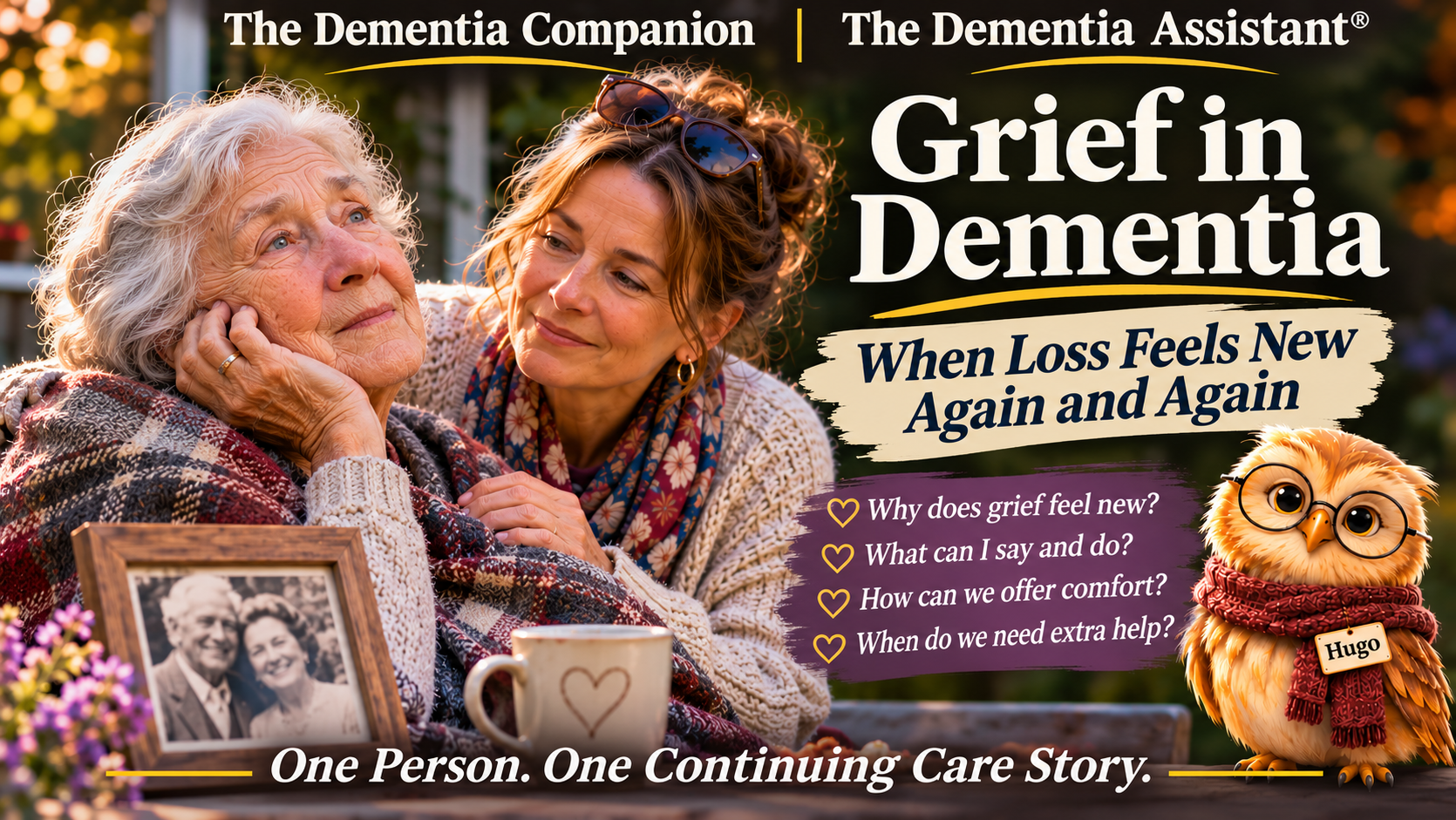
Grief in Dementia: When Loss Feels New Again and Again
By Louise Donaghy | The Dementia Companion | One Person. One Continuing Care Story.
“Mum, where’s Dad?”
It’s a question you’ve heard many times.
You take a moment before answering.
Dad died five years ago.
You remember the funeral, the flowers, the family gathered together and those awful first weeks when everything felt so terribly quiet.
You’ve lived through the birthdays without him, the Christmases, the anniversaries and all those ordinary moments when you instinctively reach for the telephone before remembering he isn’t there.
But Mum is looking at you expectantly.
“Where is he? He should be home by now.”
You feel that familiar ache in your chest.
Do you tell her again?
Do you explain that he’s died?
Do you gently change the subject?
What if she becomes upset?
What if she remembers?
And what if, ten minutes later, she asks the same question all over again?
There is no instruction manual for moments like these.
No perfectly worded sentence that will always make everything better.
And certainly no magical cup of tea, although goodness knows we’ve all tried that one.
One of the most heartbreaking experiences in dementia care is watching someone encounter the pain of loss as though it has happened for the very first time.
The person may have been told about the death before.
They may have attended the funeral.
They may even have spoken about their grief.
Yet dementia can affect their ability to remember and process what has happened.
For some people, the news may feel devastatingly new each time they hear it.
But there is something else we need to recognise.
The person living with dementia is not the only one grieving.
Often, the family member answering that question is grieving too.
Sometimes for the person who has died.
Sometimes for the relationship that dementia is changing.
And sometimes for both.
This article is about understanding that complicated grief, finding compassionate ways to respond and remembering that, even when memory changes, feelings, relationships and the need for comfort remain deeply important.
Why can grief feel new again and again in dementia?
Grief is a natural human response to loss.
It can involve sadness, disbelief, anger, loneliness, confusion, anxiety and a longing for the person who has died.
There is no single correct way to grieve.
And having dementia does not mean someone stops experiencing these emotions.
According to the Alzheimer’s Society, people living with dementia may have difficulty remembering that someone has died.
Some may forget being told.
Others may remember the person but not the circumstances of their death.
Some may believe they are living in an earlier period of their life when that person was still alive.
This is sometimes described as time-shifting.
- Memory difficulties may prevent the news being retained
Imagine being told that someone you love has died.
You experience the shock, the sadness and the disbelief.
Then, because of changes in memory, you are unable to retain what you’ve been told.
Later, you ask where the person is.
Someone tells you again.
And the shock returns.
This may happen repeatedly for some people living with dementia.
However, it is not inevitable.
Some people retain an understanding of bereavement, especially when they are supported to process what has happened.
Others may remember the loss but struggle with certain details.
We must never assume that everyone with dementia experiences grief in the same way.
- The person may believe they are living in an earlier time
Mum may believe she is forty years old rather than eighty.
She may think her husband is at work.
Perhaps she believes her mother is still living in the family home.
Her understanding of the present may be influenced by memories from an earlier period.
When she asks for someone who has died, she may genuinely expect that person to appear.
Telling her that the death happened decades ago might not help her understand.
Instead, she may experience confusion, disbelief or fresh distress.
- Emotional experiences may remain even when details are forgotten
Memory and emotional experience do not always change in the same way.
Someone may forget the details of a conversation but continue feeling unsettled afterwards.
Perhaps Mum cannot remember why she was crying earlier.
She may not recall being told about a death.
Yet she still seems sad or anxious.
We cannot know precisely what she is experiencing without understanding her individual circumstances.
But we should never assume that forgetting an event means the emotional experience has disappeared.
A person may struggle to remember the explanation for their sadness while still needing comfort and reassurance.
- Familiar routines can remind someone of an absence
Sometimes grief appears at particular times.
Perhaps Mum always had afternoon tea with her husband at four o’clock.
Maybe they watched the evening news together.
Perhaps he always sat in the same chair.
When that familiar moment arrives, she may notice something missing.
She might ask:
“Where’s John?”
Or:
“Has he gone to work?”
The question may be about more than remembering where someone is.
It may express loneliness, uncertainty or longing for familiar company.
Understanding those routines can help families offer support.
Should we keep telling Mum that Dad has died?
This is one of the most difficult questions families face.
And there is no answer that suits every person.
The Alzheimer’s Society and Dementia UK both explain that decisions about telling someone with dementia about a death should consider their understanding, relationship with the person, wishes and emotional response.
When telling the truth may be important
If Mum has recently experienced a bereavement and can understand what has happened, she deserves the opportunity to know.
She may want to grieve.
To talk.
To attend the funeral.
To say goodbye.
To participate in family decisions.
Dementia does not automatically remove someone’s right to receive important information about their life.
In the earlier stages, explaining the death sensitively may help the person begin processing their loss.
Use clear language.
For example:
“Mum, I have something very sad to tell you. Dad died yesterday.”
Allow time.
Stay with her.
Offer comfort.
Avoid confusing expressions such as “he’s gone to sleep” if these could be misunderstood.
When repeating the news may cause unnecessary suffering
Now imagine Mum was told about Dad’s death several years ago.
Each time you repeat the news, she becomes devastated.
She cries.
She asks what happened.
She believes she has just lost him.
And an hour later, the same question returns.
In that situation, repeatedly breaking the news may not be helping her process the loss.
It may simply expose her to repeated shock.
Dementia UK advises that when a person has been told several times but cannot retain the information, families may decide to stop repeatedly breaking the news.
This does not mean there is a blanket rule to withhold the truth.
It means considering what is most compassionate and appropriate for that particular person.
A dementia specialist nurse, doctor or other relevant professional can help families consider difficult situations.
Is it wrong to avoid answering directly?
Families sometimes feel guilty about this.
They worry that changing the subject means being dishonest.
But there is an important difference between deliberately deceiving someone for convenience and responding sensitively to an emotional need.
For example, if Mum asks:
“Where’s my husband?”
You might say:
“You’re missing him today, aren’t you?”
Or:
“Tell me about him. What was he like when you first met?”
You have acknowledged her feelings without immediately delivering potentially devastating news.
If Mum asks directly whether he has died, consider her ability to understand, her wishes and how she has responded previously. Avoid inventing elaborate stories that could create further confusion.
The aim is not simply to avoid difficult truths. It is to communicate with compassion, respect and an understanding of the individual.
What can I say when Mum asks for someone who has died?
These moments require sensitivity.
There are no magic words.
But acknowledging the emotion behind the question may help.
When Mum asks for her husband
Instead of:
“Mum, I’ve told you a hundred times. Dad died five years ago.”
Try:
“You’re thinking about Dad, aren’t you? You loved him very much.”
If appropriate:
“Shall we look at some photographs together?”
When Mum asks for her mother
Instead of:
“Your mother has been dead for forty years!”
Try:
“You’re missing your mum today. Tell me about her.”
Or:
“She was very special to you, wasn’t she?”
When Mum becomes frightened
Instead of:
“There’s nothing to cry about. You know what happened.”
Try:
“You seem upset. I’m here with you.”
Or:
“Would you like me to sit beside you for a while?”
When Mum needs a clear explanation
If she is able to understand and wants to know what has happened, respond clearly and gently.
“I’m sorry, Mum. John died. I know how much you loved him. I’m here with you.”
Give her time to react.
When your first approach doesn’t help
Sometimes talking about the person brings comfort.
Other times it increases distress.
If Mum becomes more upset, you might offer a change of environment or a familiar activity.
“Shall we go and sit somewhere comfortable?”
Or:
“Would you like to listen to some music together?”
Don’t rush to distract her simply because tears make everyone uncomfortable.
Sometimes someone needs the opportunity to express sadness.
And sometimes they need help moving towards something reassuring.
The difference lies in understanding the individual.
Ten compassionate ways to support grief in dementia
- Acknowledge the feeling before correcting the facts
When someone is distressed, the emotional experience may be more important than the precise factual question.
If Mum is crying because she misses her husband, begin by recognising that sadness.
“I can see you’re missing him.”
“You loved him very much.”
“I’m here with you.”
These simple acknowledgements can communicate respect.
They don’t require you to argue about dates or memories.
- Listen when the person wants to talk
Grief doesn’t always need fixing.
Sometimes it needs witnessing.
Mum might want to talk about her husband’s laugh.
Perhaps she remembers their wedding.
Maybe she wants to complain about how stubborn he was.
Allow room for those memories.
You don’t need to turn every conversation into a cheerful activity.
And if she tells the same story several times?
Well, perhaps you’ve heard it before.
But the pleasure or comfort she gets from sharing it may still be meaningful.
- Use familiar photographs carefully
Photographs can help some people reconnect with meaningful memories.
A wedding photograph.
A holiday.
A family celebration.
A picture of someone they loved.
But photographs can also trigger distress.
Some people may not recognise the people in the pictures.
Others may become upset when reminded of someone who is no longer present.
Observe how Mum responds.
If she smiles, continue.
If she becomes frightened or distressed, consider putting the photograph away and offering reassurance.
- Make room for familiar music
Music can carry emotional associations.
Perhaps Mum and Dad enjoyed a particular song.
Maybe they danced together.
Perhaps a hymn reminds her of family gatherings.
Listening together may provide a meaningful connection.
But not every familiar song will bring happiness.
Some may intensify sadness.
The right choice is guided by the person’s preferences and response, not simply by whether a song is old or familiar.
- Respect faith and cultural traditions
Grief is influenced by culture, spirituality, religion and personal beliefs.
For some people, prayer provides reassurance.
Others may value religious ceremonies, familiar readings, memorial traditions or quiet reflection.
Some families have particular practices surrounding death, mourning and remembrance.
These preferences should be recorded and respected.
Don’t assume that a person follows a tradition simply because of their cultural background.
Ask what matters to them.
Their own wishes should guide their care wherever possible.
- Preserve familiar connections
A person may miss not only someone who has died but also the ordinary routines they shared.
Afternoon tea.
A walk.
A favourite television programme.
Sitting together in the garden.
Some of those routines may still offer comfort.
Perhaps a daughter could join Mum for tea at the familiar time.
Maybe the family could continue a Sunday tradition.
This isn’t about replacing the person who died.
Nobody can do that.
It is about preserving meaningful connections with everyday life.
- Allow grief to look different
Not everyone cries.
Some people become quiet.
Others become restless, withdrawn or unusually irritable.
A person may repeatedly search for someone.
They may hold tightly to a photograph, cardigan or familiar possession.
These behaviours can sometimes be associated with grief, but they can also have other explanations.
Remain curious.
Notice patterns.
Don’t assume you know the cause simply because bereavement is part of the person’s history.
- Keep the person involved in important decisions
When someone close dies, the person living with dementia should be supported to participate in relevant decisions as far as possible.
They may wish to attend a funeral or memorial.
They may want to choose flowers.
Perhaps they want to visit a meaningful place.
Consider practical support, emotional needs and their ability to understand the occasion.
A dementia diagnosis does not automatically mean they should be excluded.
Where decision-making is difficult, follow the relevant laws, consider their previously expressed wishes and seek appropriate professional guidance.
- Keep a record of what comforts them
Families often discover helpful approaches through experience.
Perhaps Mum settles when someone sits with her.
Maybe she likes looking at her wedding photograph.
Perhaps mentioning a particular death repeatedly causes significant distress.
Record these observations.
They may help other relatives and professionals provide more consistent support.
The record should be factual and respectful.
It should describe what helped, not label Mum as difficult.
- Recognise when grief requires additional help
Grief is not an illness.
But persistent or severe distress may need professional support.
If Mum stops eating, withdraws from usual activities, experiences significant sleep changes or shows ongoing signs of depression, speak with her healthcare professional.
A sudden change in confusion or behaviour also requires assessment for possible physical illness, pain, delirium or other causes.
Never automatically attribute every change to dementia or bereavement.
And remember that the family may also need emotional support.
What if Mum forgets the funeral?
This can be heartbreaking.
She may have attended the funeral.
She may have helped choose the flowers.
She may have spoken to relatives and shared memories.
Yet weeks later, she asks when the funeral will take place.
Or she may believe the person is still alive.
Dementia can affect the ability to retain and organise memories of recent events.
For some people, familiar objects such as an order of service or photographs may help them understand what happened.
For others, these reminders may be confusing or distressing.
Consider the person’s previous response.
Avoid repeatedly testing their memory.
Questions such as:
“Don’t you remember the funeral?”
may cause embarrassment or upset.
Instead, focus on what they want to know and what would help them feel supported.
What if Mum keeps searching for someone who has died?
Searching may reflect several different needs.
Perhaps she believes her husband is nearby.
Perhaps she is worried about his safety.
Maybe she feels lonely.
Or perhaps she is following a familiar routine.
If Mum becomes distressed, approach calmly.
Ask what she is worried about.
Offer reassurance.
Check whether she needs companionship, comfort or help with something practical.
If she is trying to leave the house and may be unsafe, arrange an individual risk assessment and appropriate support.
Avoid unnecessarily restricting her movement or using restraint.
A familiar activity may help, but the aim should not be simply to stop her asking.
It should be to understand the need behind the search.
What about grief when the person living with dementia has lost their main carer?
This deserves particular attention.
Imagine Dad has always been supported by his wife.
She knows his routines, medicines, favourite meals and how he likes his morning tea.
She understands his expressions and the little signs that tell her when something isn’t right.
Then she dies.
Dad hasn’t simply lost his wife.
He may also have lost the person who helped him make sense of everyday life.
His home may change.
New carers may become involved.
Appointments, routines and arrangements may be unfamiliar.
The Alzheimer’s Society identifies the loss of a main carer as a situation that can create significant practical and emotional difficulties.
Families may need to arrange additional care while also supporting bereavement.
This is one of the clearest examples of why a continuing, family-held care plan can be valuable.
The person’s routines, needs, history and preferences should not disappear when the individual who knew them best is no longer there.
The grief families experience while dementia progresses
There is another kind of grief that deserves just as much recognition.
Sometimes the person you love is still sitting beside you.
You can hold their hand.
You can hear their voice.
You can share a cup of tea.
But your relationship is changing.
Perhaps Mum no longer recognises you.
Maybe Dad can no longer share the conversations you once enjoyed.
Perhaps the person you always turned to for advice now depends on you for everyday decisions.
You love them.
They are still here.
And yet you may find yourself grieving changes that have already happened.
This is often described as anticipatory grief, ambiguous loss or living grief.
These terms are related, although they describe somewhat different experiences.
Anticipatory grief involves grieving a loss that is expected or approaching.
Ambiguous loss can involve the painful uncertainty of someone being physically present while aspects of the relationship or connection have changed.
The Alzheimer’s Society and Dementia UK recognise these experiences as important parts of the emotional impact of dementia.
You can love someone and grieve what has changed
These feelings can exist together.
You may enjoy an afternoon with Mum and cry when you get home.
You may laugh at something Dad says, then feel terribly sad that he no longer remembers a shared experience.
You might feel frustrated by repeated questions and guilty about that frustration afterwards.
There is no requirement to feel only one emotion at a time.
And there is no reason to believe that grief means the relationship has lost its value.
New ways of connecting can remain meaningful.
A smile.
A familiar song.
A shared joke.
A hand held quietly.
The relationship may change, but the person remains worthy of love, connection and respect.
When family grief becomes overwhelming
Speak with someone you trust.
Consider bereavement counselling, a dementia support service or a carer support group.
You might need practical respite as well as emotional support.
And if you are caring for someone while grieving another family member, recognise that you may be carrying two substantial responsibilities at once.
You are allowed to need help.
A fictional family story: The photograph beside the teapot
The following example is fictional and illustrates how a family might approach repeated bereavement-related distress.
Margaret is 84 and lives with Alzheimer’s disease.
Her husband, Peter, died six years ago.
They were married for fifty-eight years.
Every afternoon, Peter made tea in their favourite blue teapot.
He always put two biscuits on Margaret’s plate, even when she insisted she only wanted one.
Her daughter Sarah still visits at teatime.
Recently, Margaret has started asking where Peter is.
“Has your father gone shopping?”
Sarah gently explains that Peter died several years ago.
Margaret begins crying.
“No. Nobody told me.”
Sarah sits beside her mother, struggling to hold back her own tears.
The next afternoon, the same thing happens.
And the afternoon after that.
Eventually, Sarah speaks with a dementia specialist nurse.
They discuss Margaret’s understanding, her emotional response and how to provide support without repeatedly causing unnecessary distress.
Sarah begins approaching the question differently.
When Margaret asks for Peter, she says:
“You’re thinking about Dad today, aren’t you?”
Margaret nods.
“He always made the tea.”
“He did,” Sarah replies. “And he always gave you two biscuits.”
Margaret smiles.
“Even when I told him not to.”
They sit together.
Sometimes Margaret talks about Peter.
Sometimes she becomes sad.
Sometimes she simply enjoys her tea.
Sarah doesn’t pretend that Peter is alive.
But she also doesn’t automatically repeat devastating news every time the question arises.
She pays attention to what Margaret needs in that moment.
The family records what helps and shares appropriate information with the people supporting her.
It doesn’t remove the grief.
But it allows space for memory, affection and connection.
And every afternoon, the blue teapot still comes out.
Not because Margaret must remember everything.
But because some traditions remain worth keeping.
One Person. One Continuing Care Story. Why grief belongs in the care plan
We often think of dementia care plans as places to record medication, appointments, mobility and daily routines.
Those things matter enormously.
But so does emotional history.
Who has the person loved?
Who have they lost?
Which relationships shaped their life?
What memories bring comfort?
What subjects cause distress?
What happens when they ask for someone who has died?
Imagine a new care worker visiting Mum.
They have been told she has Alzheimer’s disease.
But they don’t know that her husband died.
They don’t know she asks for him every afternoon.
And they don’t know that repeatedly explaining the death can leave her devastated.
The worker may act with kindness and give a truthful answer.
Yet without the relevant context, the response may cause unnecessary distress.
This is why a person-centred continuing record matters.
The information needs to follow the person appropriately, with consent, privacy and dignity.
One Person. One Continuing Care Story.
The Dementia Assistant® — keeping the person’s emotional story connected
The Dementia Companion provides compassionate education, dementia guidance and practical resources for families, people living with dementia and professionals.
The Dementia Assistant® brings this approach into a family-held person-centred care system.
Its purpose is to help families maintain important information as the person’s circumstances and care needs change.
Person-centred care planning
A person’s care plan may include relevant information about grief and loss.
For example:
- Important family relationships.
- Significant bereavements.
- Previously expressed wishes about receiving difficult news.
- The person’s understanding of a recent death, where known.
- Questions they repeatedly ask.
- Situations associated with distress.
- Responses and forms of reassurance that have helped.
- Important spiritual or cultural practices.
- Preferred ways of communicating.
- Family and professional contacts.
- Significant emotional changes requiring review.
This information should be recorded respectfully and updated as circumstances change.
It is not about deciding in advance that every person should receive the same response.
It is about understanding the individual.
Daily notes — recognising the pattern behind the emotion
A daily note might say:
“Monday, 4.15 pm. Mum asked where her husband was. She appeared tearful. Acknowledged that she was missing him and sat with her while she talked about their afternoon tea routine. She became more settled.”
Another might record:
“Wednesday, 5.00 pm. Mum appeared distressed after being reminded of her husband’s death. She cried for approximately twenty minutes. Discussing a consistent response with the family and dementia specialist nurse.”
These notes provide context without judgement.
Over time, they can help families and professionals understand what is happening and whether the approach should change.
Family Circle — helping the family respond consistently
Different relatives may respond to grief in different ways.
One daughter may feel strongly that Mum should always be told the truth.
A son may worry about causing repeated distress.
Another family member may not know how Mum has responded previously.
These disagreements can be emotionally difficult because everyone is grieving too.
Family Circle is designed to support appropriate involvement and coordination among authorised family members and carers, respecting consent and privacy.
A shared understanding of Mum’s preferences, responses and professional guidance can help everyone make more consistent decisions.
This does not mean that private family information should automatically be accessible to everyone.
Life Story — preserving the people who shaped us
Life Story is especially important when grief and bereavement are involved.
A person’s life cannot be understood solely through their diagnosis.
Their relationships, traditions, cultural background, marriage, friendships and memories all form part of their identity.
Perhaps Mum and Dad met at a dance.
Perhaps they spent years travelling together.
Maybe they loved gardening or listening to music.
Recording meaningful details can help families preserve connections that remain important.
Life Story can support reminiscence without assuming that every memory will always be comforting.
The person’s response should guide how it is used.
Saved conversations and continuing support
Families may first ask Hugo how to respond when Mum mentions her husband.
Later, they may want help preparing for a bereavement discussion.
Perhaps they need to explore care planning after the death of a main family carer.
Hugo’s saved conversations allow users to return to previous discussions and continue asking questions.
Combined with daily notes and the person’s care plan, this can support continuity as circumstances change.
Meet Hugo Intelligence™ — guidance that respects the person behind the question
Within The Dementia Assistant®, families can access Hugo Intelligence™, created and powered by Person-Centred Intelligence®.
Hugo is designed to provide conversational dementia guidance, help families explore difficult situations, consider practical approaches and organise relevant information.
He can support families who are struggling with repeated questions about someone who has died, concerns about grief, communication difficulties and changes in emotional wellbeing.
General guidance until a care plan is explicitly selected
There is an important distinction in how Hugo works.
Hugo provides general guidance unless the user explicitly selects an individual’s care plan.
He does not automatically assume that a question concerns a specific person.
For example, someone might ask:
“Hugo, should I keep telling someone with dementia that their husband has died?”
Hugo can explain the general considerations and why there is no single answer.
When the user deliberately selects an individual’s care plan, Hugo can use relevant information recorded in that selected plan to make guidance more specific.
A family member might ask:
“Hugo, Mum’s selected care plan records that Dad died six years ago. She asks for him every afternoon and becomes extremely distressed when the death is explained again. Help us consider compassionate responses and questions to discuss with her dementia specialist nurse.”
Hugo can use the recorded context to help the family explore the situation.
He should not invent personal details, claim to know Mum’s feelings or make decisions that require professional assessment.
Hugo does not replace a doctor, mental health professional, dementia specialist nurse or bereavement counsellor.
His role is to support understanding, preparation and communication.
Multilingual support for international families
Grief, mourning and remembrance are influenced by language, culture and personal beliefs.
The Dementia Assistant® supports 12 tested interface and voice languages, with wider dictation and translation capabilities covering 201 languages.
Records are stored in English while original translated content is retained where applicable.
Important clinical information and translations should always be checked for accuracy.
This can help international families record and communicate meaningful care information across language differences.
Above all, the person’s preferred language and cultural identity should remain central.
17 detailed questions to Ask Hugo about grief and dementia
For general guidance, simply ask Hugo. For responses informed by a particular person’s recorded circumstances, explicitly select their care plan first.
- Why does Mum experience grief as though it is happening again?
“Hugo, Mum has dementia and sometimes reacts to an old bereavement as though the person has only just died. Explain how memory changes, time-shifting and emotional responses may contribute. Help me understand what we should observe without assuming every experience is the same.”
- Should I keep telling Mum that Dad has died?
“Hugo, Mum repeatedly asks where Dad is, although he died several years ago. Explain the compassionate and ethical considerations around repeating the news, including her ability to understand, her wishes, previous reactions and when professional guidance would be helpful.”
- What can I say when Mum asks for her deceased husband?
“Hugo, Mum asks for her husband and becomes upset when he doesn’t appear. Give me natural, compassionate phrases that acknowledge her feelings, avoid unnecessary confrontation and allow her to talk about him if she wishes.”
- Is it wrong to change the subject?
“Hugo, I worry that redirecting Mum when she asks about someone who has died is dishonest. Explain the difference between compassionate reassurance, acknowledging emotion, avoiding unnecessary repeated shock and deliberately misleading someone. Help me consider an approach that respects her dignity.”
- How can I recognise grief when Mum cannot explain her feelings?
“Hugo, Mum has become quieter and sometimes cries without being able to explain why. Describe possible emotional and behavioural signs of grief while recognising other causes such as pain, depression or illness. When should we request professional assessment?”
- Can familiar photographs help?
“Hugo, I want to use family photographs to help Mum remember her husband. Explain when photographs may support comforting reminiscence, when they might cause distress and how to follow her emotional response rather than insist she remembers.”
- What if Mum thinks her parents are still alive?
“Hugo, Mum sometimes believes she is much younger and asks to visit her parents, who died decades ago. Explain time-shifting and suggest respectful, compassionate responses that acknowledge her feelings without repeatedly forcing her into a distressing confrontation with the facts.”
- How can we support a recent bereavement?
“Hugo, someone close to Mum has recently died. Help us understand how to share difficult news sensitively, support her involvement in mourning arrangements and consider her wishes, communication needs and emotional wellbeing.”
- Should someone with dementia attend a funeral?
“Hugo, our family is unsure whether Mum should attend the funeral of someone she loves. Help us explore her wishes, ability to understand, emotional needs, cultural traditions, practical support and ways to make an individual decision without automatically excluding her.”
- How can music and familiar routines offer comfort?
“Hugo, Mum often becomes sad at the time she used to have tea with her husband. Suggest ways to explore comforting routines, familiar music, meaningful possessions and companionship while recognising that some reminders may increase distress.”
- How do we respect faith and cultural traditions around grief?
“Hugo, our family has particular religious and cultural practices surrounding death and remembrance. Help us consider how to record and respect the person’s own beliefs, preferred language, rituals and wishes without making assumptions.”
- What if Mum becomes very distressed every afternoon?
“Hugo, Mum repeatedly asks about her husband at approximately the same time each day and becomes tearful. Help us identify patterns, consider emotional and environmental triggers, record what helps and decide when additional professional support is appropriate.”
- What happens if the person who dies was Mum’s main carer?
“Hugo, Mum’s main family carer has died. Help us think through her emotional needs, changes in routine, practical care arrangements, familiar relationships and the importance of preserving her continuing person-centred care information.”
- How do I manage my own grief while supporting Mum?
“Hugo, I am grieving my father’s death while Mum repeatedly asks where he is. Help me understand why these conversations can be emotionally exhausting and suggest compassionate ways to seek support, set boundaries and care for my own wellbeing.”
- What is anticipatory grief in dementia?
“Hugo, I sometimes feel grief about how my relationship with Mum is changing, even though she is still here. Explain anticipatory grief and ambiguous loss, why different emotions can exist together and what support may be helpful.”
- How can our family and care team respond consistently?
“Hugo, different relatives respond differently when Mum asks about deceased family members. Help us develop a respectful, flexible communication approach based on her wishes, understanding, emotional responses and professional advice. Explain how to document what helps without imposing rigid scripts.”
- How can we preserve the person’s continuing care story through grief?
“Hugo, help us create a person-centred approach to recording Mum’s important relationships, bereavements, traditions, Life Story, emotional needs and daily observations. Explain how the family-held care plan, Family Circle and saved conversations can support continuity while respecting dignity, consent and privacy.”
When do we need extra help?
Grief can be painful without being a medical condition.
But some changes deserve professional attention.
Seek advice if the person experiences persistent severe distress, significant withdrawal, prolonged changes in eating or sleeping, or possible depression.
A GP, primary-care clinician, dementia specialist nurse or appropriate mental health professional can assess potential causes and support needs.
Sudden confusion or a rapid change from the person’s usual behaviour requires prompt medical evaluation because delirium and other acute illnesses may occur alongside dementia.
If someone expresses a wish to die, talks about harming themselves or presents an immediate safety concern, take it seriously and seek urgent professional help.
In the UK, NHS 111 can advise on urgent mental health support, while 999 is for emergencies involving immediate danger to life.
International families should follow their local healthcare and emergency pathways.
Family carers should also seek support if grief, exhaustion or emotional distress is affecting their ability to cope or provide safe care.
There is no requirement to navigate bereavement alone.
One Person. One Continuing Care Story.
Grief is not something we simply finish and put away.
It changes.
It moves through our lives.
Sometimes quietly.
Sometimes unexpectedly.
And sometimes it returns when we hear a familiar song, see an old photograph or notice an empty chair at the kitchen table.
For someone living with dementia, those experiences may be further complicated by changes in memory and their understanding of time.
A loss from many years ago may feel terribly recent.
A familiar person may be desperately missed.
And the family may find themselves answering the same painful question repeatedly.
But our responsibility is not simply to correct someone’s memory.
It is to understand what they are experiencing and support them with compassion.
Sometimes that means explaining the truth.
Sometimes it means sitting quietly and allowing sadness.
Sometimes it means sharing a memory.
And sometimes it means recognising that repeating devastating news may be causing unnecessary pain.
There is no single sentence that will always be right.
But there is a principle that should remain constant.
The person matters more than winning an argument about what they remember.
Their relationships matter.
Their feelings matter.
Their history matters.
And the people supporting them matter too.
When families and professionals understand the person’s Life Story, their bereavements, their routines and what provides comfort, care can become more consistent and meaningful.
That information should not disappear between appointments, services or changes in care arrangements.
Because behind every difficult question is a human being with a whole lifetime of love.
One Person. One Continuing Care Story.
Continue your family’s care story with The Dementia Companion and The Dementia Assistant®
The Dementia Companion provides accessible dementia education, compassionate guidance and practical resources for people living with dementia, families and professionals.
The Dementia Assistant® brings together Hugo Intelligence™, person-centred care planning, family-held continuing records, daily notes, saved conversations, Family Circle, Life Story and multilingual support.
Together, they are designed to help families understand changing needs, preserve meaningful information and support more connected care.
The Dementia Companion:
https://thedementiacompanion.com/
The Dementia Assistant®:
https://thedementiaassistant.com/
Every subscription includes a 30-day complimentary trial.
Afterwards, the UK Family subscription costs £4.99 per month. International families can check the subscription options available in their region.
Because good dementia care is about more than remembering facts.
It’s about remembering the person.
And sometimes, when Mum asks where Dad is, the most meaningful thing we can offer isn’t a perfect answer.
It’s the reassurance that she doesn’t have to face her sadness alone.
Perhaps we sit beside her.
Perhaps we hold her hand, if she welcomes it.
Perhaps we look at that old photograph.
And perhaps, just for a little while, we remember the love rather than concentrate entirely on the loss.
That matters too. ❤️
⸻
Authoritative references and further reading
- Alzheimer’s Society — Supporting the person with dementia to grieve.
Guidance on grieving, repeatedly asking about someone who has died, emotional reassurance and meaningful memories.
https://www.alzheimers.org.uk/get-support/help-dementia-care/supporting-person-dementia-grieve
- Alzheimer’s Society — Supporting a person with dementia during a bereavement.
Advice about sharing news of a death, funeral participation, communication and past bereavements.
- Dementia UK — Breaking difficult news to a person with dementia.
Practical guidance on communicating a death compassionately, particularly when information is repeatedly forgotten.
- Alzheimer’s Society — Difficult questions and telling the truth to a person with dementia.
Explores ethical considerations, repeated questions and responding compassionately when someone asks about a deceased relative.
https://www.alzheimers.org.uk/about-dementia/stages-and-symptoms/difficult-questions-truth-telling
- Dementia UK — Grief, bereavement and loss.
Information on grief, anticipatory grief, continuing bonds and emotional support for carers.
- Dementia Australia — Is it ever okay to lie to someone living with dementia?
International guidance on acknowledging emotions, reassurance and individual responses to difficult questions.
https://www.dementia.org.au/news/it-ever-okay-lie-someone-living-dementia
- Hospice UK — Talking about death and dying to someone with dementia.
Advice on difficult conversations, advance care planning and supporting the person’s wishes.
- NICE Guideline NG97 — Dementia: Assessment, management and support.
Clinical recommendations on person-centred care, communication, distress assessment and supporting carers.
https://www.nice.org.uk/guidance/ng97/chapter/Recommendations
- Cruse Bereavement Support — Dementia and Grief.
Guidance about the experience of grief when dementia changes relationships, including support for family carers.
https://www.cruse.org.uk/understanding-grief/grief-experiences/dementia-and-grief/
- NHS — Where to get urgent help for mental health.
Official UK guidance on obtaining urgent mental health assistance.
https://www.nhs.uk/nhs-services/mental-health-services/where-to-get-urgent-help-for-mental-health/
This article provides general educational information for international families. It does not replace individual medical, psychological, bereavement or legal advice. Decisions about sharing difficult news, mental health support and care arrangements should consider the person’s circumstances, wishes, rights and applicable local guidance.
⸻
Louise, Hugo and Charlie ❤️🦉✨
Louise Donaghy
Founder & CEO of The Dementia Assistant®
Created and powered by Person-Centred Intelligence®
Creator of Hugo Intelligence™
You May Also Find Helpful
Need help with your own situation? Ask Hugo.
One Person. One Continuing Care Story. The Dementia Companion is where you discover guidance. Inside The Dementia Assistant®, talk with Hugo, save and categorise conversations, record daily notes and involve authorised supporters in a continuing care plan centred around the person.
Ask Hugo About This · Start Your Continuing Care Plan — Families · Continuing Care Planning — Professionals
Personal guidance requires the appropriate account and subscription access. Care-plan information is used only with authorised access and the required consent and selection steps. All subscription plans include a 30-day complimentary trial.