Dad Keeps Taking His Clothes Off in Public. How Should We Respond?
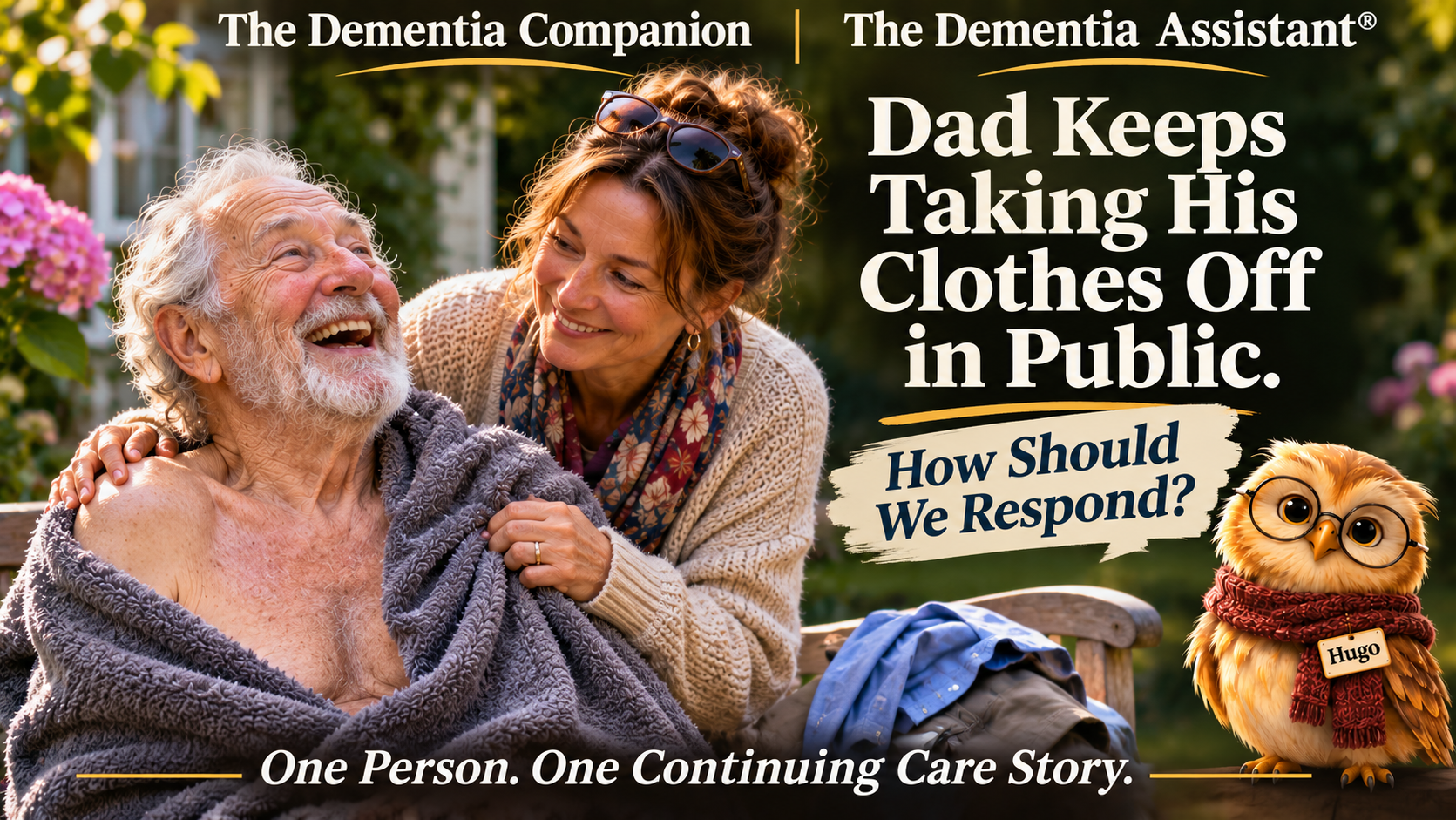
Dad Keeps Taking His Clothes Off in Public. How Should We Respond?
By Louise Donaghy | The Dementia Companion | One Person. One Continuing Care Story.
There are certain moments in dementia care that nobody quite prepares you for.
You’ve managed to get Dad dressed.
He’s had his breakfast, found his shoes and agreed to go out for some fresh air.
You’ve remembered his glasses, his medication, his coat and everything else required for what was supposed to be a perfectly ordinary afternoon.
You sit down together in the café.
The waitress brings the tea.
Dad looks around, smiles pleasantly and begins taking off his shirt.
And suddenly, your peaceful afternoon takes a rather unexpected turn.
“Dad! What are you doing?”
“I’m hot!”
“But we’re in a café!”
“So?”
And there you are, desperately trying to protect Dad’s dignity while wondering whether everyone in the room has noticed.
They probably haven’t.
Although that doesn’t stop you feeling as though the entire café has suddenly become an audience.
If you’ve experienced something similar, you may feel embarrassed, frightened, frustrated or completely unsure what to do.
But I want you to remember something.
Dad isn’t necessarily trying to embarrass you, behave inappropriately or attract attention.
He may be uncomfortable, confused, too warm, anxious, needing the toilet or struggling to understand where he is.
Some people living with dementia experience changes in their awareness of social expectations. Others may be trying to meet a perfectly ordinary physical need.
Occasionally, there may be a medical problem that requires attention.
The important thing is to look beyond the behaviour.
Because Dad is still Dad.
And in that difficult moment, he needs understanding, reassurance and protection from unnecessary embarrassment.
Not an audience.
Not a lecture.
And certainly not a public telling-off.
Why might someone with dementia take their clothes off in public?
Dementia can affect how the brain processes information, recognises surroundings, makes decisions and understands social situations.
For some people, this includes changes in inhibition.
Inhibition is the ability to recognise when something might be unsuitable in a particular setting and adjust our behaviour accordingly.
Most of us automatically understand that removing clothing in the privacy of our bedroom is different from doing so in a busy supermarket.
We rarely need to think about it.
But some types of dementia can affect that automatic understanding.
The Alzheimer’s Society explains that a person living with dementia may remove clothing in public because they feel too hot or uncomfortable, without recognising why others consider the behaviour inappropriate.
However, loss of inhibition is only one possible explanation.
We need to consider the person’s physical comfort, environment, emotional state and medical needs before deciding what is happening.
- Dad may simply be too hot
Let’s start with the obvious possibility.
He might actually be hot.
Perhaps the room is overheated.
Perhaps he’s wearing several layers.
Maybe the sun has come out and his thick jumper is uncomfortable.
If Dad feels too warm, taking something off may seem like a perfectly sensible solution.
And from his perspective, it is.
He may not recognise the social expectations surrounding where he is or how much clothing is appropriate to remove.
Before trying to redirect him, consider whether you could help him cool down.
Could he take off his coat?
Would a lighter shirt be more comfortable?
Could you move somewhere cooler?
Sometimes the problem isn’t complicated.
Sometimes Dad is simply roasting.
And we’ve all experienced the moment when someone insists that the heating needs to be on full blast despite the room resembling a tropical greenhouse.
- His clothes may be uncomfortable
Clothing can become uncomfortable for several reasons.
A waistband may be too tight.
A label might scratch.
A seam may rub against sensitive skin.
An unfamiliar fabric could feel unpleasant.
Perhaps his underwear no longer fits comfortably.
He may also have skin irritation, a rash, pain or another physical problem.
Dementia can make it more difficult to explain exactly what feels wrong.
Instead of saying:
“This waistband is digging into my stomach.”
Dad may simply begin removing his trousers.
The action may be communicating something that he cannot easily express in words.
- Dad may need the toilet
This is an important possibility.
Imagine needing the toilet urgently but being unable to find it.
You know you need to remove your trousers.
You may not understand where you are.
And you cannot work out how to explain what you need.
So you start getting ready.
Unfortunately, you’re sitting in the middle of a shopping centre.
From Dad’s point of view, he may be responding to a genuine bodily need.
From everyone else’s point of view, it appears that he is undressing in public.
Before assuming the behaviour is sexual or disinhibited, consider whether he needs the bathroom.
You could quietly ask:
“Dad, shall we find the toilet?”
The Dementia UK guidance on changes in sexual behaviour specifically identifies toileting needs and physical discomfort as possible explanations for undressing that might otherwise be misinterpreted.
- He may be confused about where he is
Dementia can affect orientation and recognition.
Dad may believe he is at home.
He may think he is preparing for bed.
Perhaps he believes he is in his own bathroom.
He might not recognise the café, hospital waiting room or care setting around him.
If he genuinely believes he is somewhere private, removing clothing may feel entirely appropriate.
Correcting him repeatedly may not help.
A calm explanation, reassurance and gentle guidance to a more private place may be more effective.
- He may have difficulty understanding social boundaries
Some types of dementia can affect judgement, impulse control and awareness of social expectations.
This is sometimes described as disinhibition.
For example, someone may say things they previously kept private, behave more impulsively or remove clothing in situations where they once would not have done so.
Changes in inhibition are particularly recognised in behavioural variant frontotemporal dementia, although they can occur in other conditions.
However, undressing in public does not mean Dad has frontotemporal dementia.
It is one possible behaviour with many potential explanations.
Any new or significant change should be considered in the context of his existing diagnosis and overall health.
- Dad may be anxious or overwhelmed
Busy environments can be difficult for some people living with dementia.
Bright lights.
Unfamiliar faces.
Several conversations happening at once.
Music playing.
People moving around.
Perhaps Dad feels trapped or uncomfortable.
He may begin pulling at his clothing because he is distressed, restless or trying to escape an unpleasant sensation.
Rather than concentrating only on the clothes, consider what was happening immediately beforehand.
Was the environment noisy?
Had he been waiting for a long time?
Was someone giving him several instructions?
Did he seem frightened?
Changes in behaviour can sometimes be a response to the environment.
- There may be a medical or medication-related cause
A sudden change in behaviour deserves particular attention.
Pain, infection, constipation, urinary problems, medication effects, dehydration or delirium may contribute to changes in a person’s usual behaviour.
Delirium is a serious, often sudden disturbance in attention and awareness that can occur alongside dementia.
It requires prompt medical assessment.
If Dad suddenly begins behaving very differently, becomes acutely confused or shows other signs of illness, do not assume the dementia is simply progressing.
The NICE dementia guideline recommends exploring clinical and environmental causes of distress, including pain, delirium and inappropriate care, before choosing treatment approaches.
That principle is just as relevant when someone begins undressing unexpectedly.
Is taking clothes off in public a sexual behaviour?
Not necessarily — and often it has nothing to do with sex.
This is an important distinction.
If Dad removes his trousers because he needs the toilet, that is not automatically a sexual act.
If he takes off his shirt because he is too hot, that does not mean he is deliberately exposing himself.
If he becomes confused about where he is, he may not understand that the setting is public.
The Alzheimer’s Society, Dementia UK and Alzheimer Society of Canada all recognise that undressing can be associated with non-sexual needs.
However, dementia can also affect sexual behaviour, impulse control and awareness of boundaries.
Sometimes sexual disinhibition genuinely is involved.
When this happens, we need to respond respectfully while protecting Dad and other people.
Having dementia does not remove someone’s right to intimacy or personal dignity.
But it does not remove other people’s rights to privacy, safety and consent either.
If Dad is exposing himself, making unwanted sexual advances or touching another person without consent, calmly intervene to protect everyone involved.
Create space, redirect the situation where safe and seek appropriate professional support if the behaviour continues.
Avoid treating it as a joke or expecting other people simply to tolerate unwanted contact.
An assessment can help identify possible causes and a suitable management approach.
What should I do in the moment when Dad starts undressing?
This is often the question families most urgently need answered.
You’re in public.
Dad is removing his clothes.
People may be looking.
And you need to respond without making the situation worse.
Step 1. Stay as calm as possible
Easier said than done, I know.
Especially when Dad has selected the busiest possible location to remove his trousers.
But your reaction can influence how the situation develops.
Try not to shout, panic or draw unnecessary attention.
Take a moment to consider what he might need.
You don’t have to solve every possible cause immediately.
First, focus on comfort, safety and dignity.
Step 2. Approach quietly and respectfully
Move close enough to speak to Dad without announcing the situation to everyone nearby.
Use his name.
Speak in a calm, familiar voice.
Avoid grabbing his clothes or suddenly pulling them back onto him.
Unexpected physical contact may frighten or upset him.
You might say:
“Dad, shall we pop somewhere a little quieter?”
Or:
“Let’s get you comfortable.”
If he seems hot:
“That jumper looks warm. Shall we take your coat off instead?”
Step 3. Offer privacy
If possible, guide Dad towards a private or quieter area.
A nearby toilet, changing room or private space may be appropriate, depending on the circumstances.
If his body is exposed, you could offer a coat, blanket or other suitable covering.
Ask permission where possible and explain what you are doing.
Avoid forcibly covering or restraining him simply because others are watching.
The aim is to protect his dignity and safety, not make him feel physically threatened.
Step 4. Look for an immediate need
Once things are calmer, ask yourself:
Is Dad too hot?
Does he need the toilet?
Are his clothes uncomfortable?
Is he in pain?
Is he confused about where he is?
Could he be frightened or overwhelmed?
You may not get an immediate answer.
But observing his response can help.
Step 5. Redirect without humiliating him
Rather than saying:
“You can’t take your clothes off here!”
Try:
“Let’s find somewhere more comfortable.”
Or:
“Shall we go and sort your clothes out together?”
Give him time to respond.
If he becomes distressed, consider whether moving away from the environment would help.
Step 6. Reflect afterwards
Once Dad is comfortable and safe, think about what happened.
Was there a trigger?
Did he seem uncomfortable before removing his clothes?
What helped?
What made things worse?
Was this new or part of an existing pattern?
These observations can help prevent further difficulties and provide useful information for his healthcare team.
What can I say without embarrassing Dad?
Sometimes our first instinct is to correct the behaviour.
But words such as “stop”, “don’t” and “you can’t do that” may cause distress if Dad doesn’t understand what is happening.
Consider these alternatives.
Instead of:
“Dad! Put your clothes back on! Everyone’s looking!”
Try:
“Let’s get you comfortable, Dad. Shall we go somewhere quieter?”
Instead of:
“What on earth are you doing?”
Try:
“Are you feeling too warm?”
Instead of:
“You can’t take your trousers off here!”
Try:
“Do you need the toilet? I’ll help you find it.”
Instead of:
“You’re embarrassing me!”
Try:
“Let’s sort this out together.”
Instead of:
“Stop being silly!”
Try:
“Something doesn’t feel right, does it? Let’s see what we can do.”
These are not guaranteed scripts.
Some people respond best to direct language.
Others need more reassurance.
Dad may prefer humour, or he may find it upsetting.
The most helpful words will depend on the person, his circumstances and how he communicates.
And if you’re feeling embarrassed yourself, that’s understandable.
You’re human.
Just try not to make Dad carry that embarrassment.
How can we prevent Dad from undressing in public?
Prevention begins with understanding patterns.
It is not about making Dad’s clothes impossible to remove.
It is about identifying what may be causing discomfort or confusion and making suitable adjustments.
- Choose comfortable clothing
Check whether clothes fit properly.
Consider soft fabrics, comfortable waistbands and familiar styles.
Avoid unnecessary layers in warm environments.
Look for scratchy labels or seams.
If Dad has arthritis or reduced dexterity, clothing may need to be easier to manage.
The Alzheimer’s Society recommends supporting comfort and individuality when helping someone with dementia choose what to wear.
Clothes should reflect Dad’s preferences and identity, not simply what other people find convenient.
- Pay attention to temperature
If undressing tends to happen in warm places, reconsider what Dad is wearing.
A lighter shirt may be more suitable than a thick jumper.
Layers can allow him to adjust his temperature without removing everything.
Check room temperatures and seating arrangements where possible.
- Plan toilet opportunities
If toileting appears to be a trigger, consider whether Dad would benefit from being offered the toilet before leaving home and at suitable points during outings.
Make sure he knows where the nearest bathroom is.
Where appropriate, discuss continence concerns with a healthcare professional.
Do not restrict his fluid intake without medical advice simply to reduce toilet visits.
- Reduce overwhelming environments
Notice whether Dad becomes unsettled in crowded or noisy places.
Perhaps he enjoys cafés but finds shopping centres too busy.
Maybe shorter outings are more comfortable.
Perhaps visiting at a quieter time would help.
The aim is not to stop him enjoying life.
It is to make the experiences he enjoys more manageable.
- Keep a familiar routine
Predictable routines can be reassuring for some people with dementia.
Consider the time of day when Dad feels most comfortable.
Avoid unnecessary rushing.
Make sure he has opportunities for rest.
And adapt the plan when his needs change.
- Include him in clothing choices
Ask Dad what he would like to wear.
Offer manageable choices.
Perhaps:
“Would you prefer your blue shirt or the green one?”
Allow him to dress independently where possible.
If he needs support, explain what you are doing and respect his privacy.
- Consider professional assessment if the problem continues
Persistent undressing may require input from the GP or primary-care clinician, dementia specialist, occupational therapist or other relevant professional.
They may help investigate physical discomfort, changes in behaviour, medication effects, environmental triggers and practical clothing adaptations.
Specialist advice should be individualised.
Avoid restrictive clothing, locking fastenings or other measures designed to prevent someone from undressing without appropriate professional assessment of safety, rights, consent and less restrictive alternatives.
Clothing should never become a form of punishment or unnecessary restraint.
What if Dad refuses to put his clothes back on?
First, consider whether there is an immediate safety concern.
Is he exposed to cold weather?
Is he in danger of injury?
Are other people at risk?
If the situation is not immediately dangerous, try not to turn it into a physical struggle.
Offer choices.
“Dad, would you like your cardigan or your jacket?”
“Shall we sit somewhere private for a moment?”
“Those trousers look uncomfortable. Would you prefer another pair?”
If he refuses, observe why.
Perhaps he is still too hot.
Perhaps something hurts.
Perhaps the clothing feels unpleasant.
Or perhaps he does not understand what you are asking.
If he remains distressed, seek help appropriate to the setting.
Respecting autonomy does not mean ignoring serious risks.
But protecting someone does not automatically justify forcing clothing onto them either.
What should we do if strangers stare or make comments?
This can be one of the most emotionally difficult parts of caring.
You may feel protective, angry or humiliated.
Someone might stare.
Someone might make an unhelpful remark.
Someone else may misunderstand the situation entirely.
Where it is useful and appropriate, a simple explanation may help.
“My dad has dementia. We’re helping him get comfortable.”
You don’t owe everyone a detailed account of his medical history.
And Dad’s diagnosis should not become public information simply because other people are curious.
Protect his privacy as much as possible.
If staff at a venue can provide a private space or practical assistance, ask discreetly.
If another person feels threatened or has experienced unwanted contact, take their concerns seriously while supporting Dad respectfully.
If security staff or police become involved, calmly explain relevant communication and health needs without excusing unsafe behaviour.
You might say:
“He has dementia and may be confused about where he is. Please speak calmly and give him time to respond. We’re trying to help him get somewhere private.”
Seek appropriate professional support afterwards if the incident raises ongoing safety concerns.
What if Dad starts undressing in a care home or hospital?
The same person-centred principles apply.
Staff should consider physical comfort, temperature, toileting, skin irritation, pain, confusion and environmental factors.
A new or sudden change should prompt appropriate health assessment.
If undressing happens during personal care, consider whether Dad understands what staff are doing and whether he feels safe.
Perhaps he prefers a particular approach.
Maybe he is more comfortable with a familiar carer.
Perhaps he needs greater privacy or more time.
Families can provide valuable information about his previous routines and preferences.
But professional care settings also have responsibilities concerning safeguarding, privacy, consent, assessment and safe care.
Repeated incidents should be reviewed rather than simply recorded as “inappropriate behaviour”.
An individual plan can help staff respond consistently.
And Dad’s dignity should be protected whether he is at home, in hospital or living in residential care.
When should we seek medical advice?
Arrange a medical review if Dad’s public undressing is new, increasing, causing significant distress or creating safety concerns.
Consider asking for assessment if there are signs of:
- Pain or physical discomfort.
- Skin irritation, itching or rash.
- Constipation or urinary difficulties.
- Changes in medication.
- Increasing confusion.
- Sleep disturbance.
- New agitation or distress.
- Significant changes in personality or inhibition.
Sudden changes need particular attention
If Dad develops sudden confusion, unusual drowsiness, marked agitation or a rapid change from his normal behaviour, seek urgent medical assessment.
Delirium, infection and other acute illnesses may require prompt treatment.
In the UK, use urgent medical services such as NHS 111 or emergency services according to severity.
International families should use their local healthcare pathways.
If there is an immediate threat to life or serious injury, call emergency services.
Never assume that every change must be dementia progressing.
A fictional example: Peter and the afternoon at the garden centre
The following example is fictional and illustrates a person-centred approach.
Peter is 81 and lives with vascular dementia.
He has always enjoyed gardening.
His daughter Sarah takes him to a local garden centre because she knows how much he loves looking at the plants.
They wander through the displays.
Peter admires the roses.
They sit down for tea.
And then Peter begins unbuttoning his shirt.
Sarah notices immediately.
“Dad, what are you doing?”
Peter looks puzzled.
“I’m boiling!”
Sarah feels embarrassed.
There are people sitting nearby.
She starts telling him to button his shirt again.
Peter becomes irritated.
He pulls harder at his clothes.
The situation becomes increasingly uncomfortable for both of them.
Afterwards, Sarah begins to reconsider what happened.
Peter had been wearing a thick jumper beneath his jacket.
The café was very warm.
He had also been waiting for quite some time.
At their next outing, Sarah helps Peter choose lighter clothing.
They sit in a cooler area.
She offers a toilet visit before lunch.
And she pays attention to his comfort throughout the afternoon.
When Peter starts tugging at his shirt again, she quietly asks:
“Too warm, Dad?”
He nods.
They remove his jacket and move to a cooler seat.
The moment passes.
Sarah records the observations in Peter’s continuing care notes.
She also discusses the new behaviour with his healthcare team to make sure there isn’t another contributing problem.
The family now has a clearer understanding of what might be happening.
Peter still enjoys his trips to the garden centre.
Sarah has learned that an embarrassing moment can sometimes contain an important message.
And Peter?
He’s still far more interested in the roses than whether anyone thinks his jumper matches his trousers.
One Person. One Continuing Care Story. Why observing behaviour matters
A single incident can be embarrassing.
Repeated incidents can become worrying.
But the observations surrounding them may provide valuable insight.
Perhaps Dad removes clothing when he becomes overheated.
Perhaps he does it when he needs the toilet.
Maybe he struggles with certain fabrics.
Or perhaps the behaviour occurs when he feels overwhelmed.
These are not simply details to be forgotten once everyone gets home.
They may help explain changing needs.
A daughter notices one pattern.
A professional carer recognises another.
A clinician identifies a possible medical factor.
But what happens when those observations remain scattered?
The next person supporting Dad may know nothing about them.
And Dad may experience the same distress all over again.
This is why continuing care records can be so important.
The person should not have to become a stranger each time someone new becomes involved in their care.
That belief is at the heart of our campaign.
One Person. One Continuing Care Story.
The Dementia Assistant® — keeping Dad’s story together
The Dementia Companion provides accessible dementia education, practical guidance and compassionate resources for people living with dementia, families and professionals.
The Dementia Assistant® builds on that support through a person-centred system designed to help families organise information, document changing needs and support continuity.
Family-held person-centred care planning
Families can create and maintain a care plan reflecting the person’s needs, preferences, routines and life history.
For Dad, this might include:
- Clothing preferences and comfort requirements.
- His usual daily routines.
- Preferred fabrics and familiar clothes.
- Toileting and continence needs.
- Known medical conditions.
- Medication and relevant clinical information.
- Communication approaches that work.
- Situations that may cause distress.
- Previous incidents of undressing and possible triggers.
- Practical responses that have helped.
- Professional advice and review arrangements.
The plan can change as Dad’s needs change.
It is held by the family and can support appropriate sharing of information with healthcare and care professionals.
It does not replace clinical records or mean information is automatically transferred between services.
Daily notes — understanding what happens before, during and after
A daily note might say:
“Monday, 2.30 pm. Dad began removing his jumper while sitting in a warm café. He said he felt hot. Offered a cooler place to sit and helped him remove his outer layer. He settled comfortably.”
Another might record:
“Wednesday, 11.15 am. Dad began unfastening his trousers in the shopping centre. Asked whether he needed the toilet. He agreed and appeared more comfortable afterwards.”
Or:
“Friday, 4.00 pm. Dad repeatedly pulled at the waistband of his trousers and appeared uncomfortable. Checked for visible irritation and arranged advice from his clinician.”
These notes are more useful than simply writing:
“Undressed inappropriately again.”
They describe what happened without judgement.
Over time, the family may recognise patterns and be better prepared for professional conversations.
Family Circle — helping everyone respond consistently
Different relatives and professionals may support Dad at different times.
One daughter might know that he dislikes tight clothing.
A son may notice he becomes restless when he needs the toilet.
A care worker may observe that he struggles in overheated rooms.
Family Circle is designed to support appropriate involvement and coordination among the people supporting him, with consent, permissions and privacy safeguards.
Relevant information can help those involved respond more consistently.
Sensitive personal details should only be shared when appropriate.
The purpose is not to expose Dad’s private experiences to unnecessary scrutiny.
It is to support care that respects him.
Life Story — remembering the man behind the behaviour
Dad may have spent decades choosing his own clothes, managing his appearance and making decisions independently.
Perhaps he always wore smart shirts.
Maybe he hated tight collars.
Perhaps he worked outdoors and preferred practical clothing.
His Life Story can help preserve those personal details.
It can also capture his preferences, relationships, culture and familiar routines.
This helps remind everyone that Dad is not simply a person exhibiting a behaviour.
He is someone with an identity and a lifetime of experiences.
Those experiences should remain part of his care.
Saved conversations and continuing support
Families rarely encounter one difficulty and never need to discuss it again.
Today, the concern may involve public undressing.
Tomorrow, the family may need help reviewing clothing preferences or preparing for a medical appointment.
Later, they may want to revisit what helped during a previous incident.
Hugo’s saved conversations allow families to return to earlier guidance and continue exploring their questions.
Together with the care plan and daily notes, this supports a more connected understanding over time.
Meet Hugo Intelligence™ — general guidance and person-centred support
Within The Dementia Assistant®, families can access Hugo Intelligence™, created and powered by Person-Centred Intelligence®.
Hugo is designed to provide conversational dementia guidance, help families explore possible explanations, consider practical responses and organise information for discussions with professionals.
He can help someone understand why undressing might occur, identify possible unmet needs, consider communication approaches or prepare questions for a clinician.
But there is an important distinction in how Hugo provides guidance.
General guidance until a care plan is explicitly selected
Hugo provides general guidance until the user explicitly selects an individual’s care plan.
He does not automatically assume a question concerns a particular person.
For example, without a selected care plan, someone might ask:
“Hugo, why do people living with dementia sometimes take their clothes off in public?”
Hugo can explain general possibilities and practical considerations.
When a family member deliberately selects Dad’s individual care plan, Hugo can use relevant information recorded in that selected plan to make guidance more specific to his documented circumstances.
The question could become:
“Hugo, Dad’s selected care plan records that he dislikes tight clothing, becomes uncomfortable in warm environments and sometimes struggles to find the toilet. What approaches could help us support him during outings?”
Hugo can then help the family consider those recorded details when exploring practical options.
He should not invent personal information, claim to know Dad’s thoughts or present possible explanations as a diagnosis.
Hugo does not replace a GP, dementia specialist, occupational therapist or other qualified professional.
His purpose is to support understanding, organisation and better-informed conversations.
Multilingual guidance for international families
Dementia care takes place across countries, cultures and languages.
The Dementia Assistant® has 12 tested interface and voice languages, alongside broader dictation and translation capabilities covering 201 languages.
This can support families who communicate in different languages and help them capture relevant care information.
Records are stored in English, with original translated content retained where applicable.
Important medical translations should always be checked for accuracy.
Language and cultural background can also influence expectations about clothing, privacy and personal dignity.
These preferences should be recorded and respected as part of person-centred care.
Supporting professional conversations
The Dementia Assistant® supports family-held care records, observations, relevant document uploads and summaries that can help families prepare for appointments.
Instead of saying:
“Dad keeps taking his clothes off.”
A family may be able to explain:
“Dad has begun removing his clothing in warm public environments. We have noticed it happens more frequently when he is uncomfortable or needs the toilet. We would like to discuss possible medical causes and ways to support him.”
That provides more useful context.
Healthcare professionals still need to assess the individual.
But a clear continuing record can help families communicate what has been happening between appointments.
17 detailed questions to Ask Hugo about undressing in dementia
These questions can be copied into Hugo Intelligence™.
For general guidance, simply ask Hugo your question. For responses informed by a particular person’s recorded circumstances, explicitly select their care plan first.
- Why does Dad remove his clothes in public?
“Hugo, Dad is living with dementia and has started removing his clothes in public places. Explain possible reasons including discomfort, temperature, confusion, toileting needs, anxiety and changes in inhibition. Help me understand what to observe without assuming the behaviour is deliberate or sexual.”
- Could Dad be too hot or uncomfortable?
“Hugo, Dad often begins pulling at his clothes when we are out. Explain how overheating, tight waistbands, itchy fabrics, skin irritation or physical discomfort might contribute. Suggest practical clothing and environmental changes while preserving his preferences.”
- How can I tell whether Dad needs the toilet?
“Hugo, Dad sometimes begins unfastening his trousers in public. Help me understand how urgency, difficulty recognising toilet signs or problems communicating his needs might contribute. Suggest respectful ways to offer toileting support and when to seek continence advice.”
- What should I do immediately if Dad starts undressing?
“Hugo, Dad has started taking off his clothes in a café. Give me a calm, practical sequence for protecting his privacy, offering reassurance, checking immediate needs and moving somewhere quieter if appropriate. Explain how to avoid confrontation or unnecessary physical restraint.”
- What can I say without embarrassing Dad?
“Hugo, I become flustered when Dad removes his clothes in front of others. Suggest natural, compassionate phrases I can use that preserve his dignity and help us understand what he needs. Include alternatives if he doesn’t respond to my first approach.”
- Could this be caused by changes in inhibition?
“Hugo, explain how dementia can affect judgement, impulse control and awareness of social expectations. Describe why public undressing may occur and why this behaviour alone cannot identify a particular type of dementia.”
- Is Dad’s behaviour sexual or could it be something else?
“Hugo, Dad sometimes removes clothing in public and I am worried people may interpret it as sexual behaviour. Explain the difference between possible physical needs, confusion and genuine sexual disinhibition. Include how to respect Dad’s dignity while protecting other people’s boundaries and consent.”
- What if Dad refuses to put his clothes back on?
“Hugo, Dad sometimes refuses when we offer to help him get dressed again. Suggest ways to understand the refusal, offer choices, provide privacy and manage immediate safety concerns. Explain why forcing clothing onto him may increase distress.”
- How can we choose clothes that are more comfortable?
“Hugo, Dad has become sensitive to certain clothing. Suggest practical considerations for fabrics, waistbands, layers, fastenings and familiar styles. Explain how to maintain his independence and when an occupational therapist could help.”
- Could medication or illness be contributing?
“Hugo, Dad’s undressing behaviour is new. Explain why sudden behavioural changes should prompt consideration of pain, infection, medication effects, constipation, urinary problems or delirium. Help us prepare questions for his clinician without recommending medication changes.”
- How can we plan safer, more enjoyable outings?
“Hugo, Dad enjoys visiting cafés and garden centres but sometimes removes clothing in public. Help us create a flexible outing plan covering clothing, temperature, toilet access, quieter environments, familiar routines, privacy and support if he becomes uncomfortable.”
- How should we respond if strangers stare or complain?
“Hugo, people sometimes stare when Dad behaves unexpectedly in public. Suggest respectful ways to protect his privacy, explain a difficult situation briefly if appropriate and seek assistance from venue staff. Include how to respond if another person’s safety or consent has been affected.”
- What if Dad undresses in a care home or hospital?
“Hugo, Dad has started removing his clothes in a professional care setting. Explain what staff should assess, including comfort, personal care routines, toileting, pain, environmental factors and consent. Help us prepare for a person-centred care discussion with the team.”
- How can we recognise patterns in Dad’s behaviour?
“Hugo, help us create a simple observation approach recording what happened before, during and after an undressing incident. Include location, temperature, clothing, emotional state, toileting needs, possible discomfort, responses tried and what helped.”
- How do we write respectful daily care notes?
“Hugo, Dad has removed his clothing several times during outings. Help us write factual, non-judgemental notes that describe the circumstances, his expressed needs, our response, the outcome and whether professional advice is needed. Avoid labelling him as inappropriate or difficult.”
- How can several family members and carers respond consistently?
“Hugo, different relatives and professional carers support Dad. Help us create a shared approach to privacy, comfortable clothing, toileting, reassurance, safety and recording observations. Explain how to respect Dad’s consent, preferences and personal information.”
- How do we keep Dad’s dignity central as his needs change?
“Hugo, I want Dad to continue enjoying life outside the house, but public undressing has become difficult. Help me balance independence, dignity, safeguarding, comfort and practical risk management. Explain how a family-held person-centred care plan, Life Story, daily notes and appropriate professional guidance can support him as an individual.”
One Person. One Continuing Care Story.
There are moments in dementia care that leave us feeling completely unprepared.
Moments that make us laugh afterwards.
Moments that bring us close to tears.
And moments when all we want is for the ground to open up and swallow us.
But I want families to remember something.
Dad is still the same person who has lived a lifetime.
He may have raised children, worked hard, supported others and made countless decisions independently.
He has preferences, habits, feelings and a right to dignity.
Dementia may change how he understands certain situations.
It may make it harder for him to recognise discomfort or communicate what he needs.
But those difficulties do not make him less deserving of respect.
When Dad starts removing his clothes, our first thought may be:
“How do I stop him?”
Perhaps a more useful question is:
“What is Dad trying to tell us?”
Is he hot?
Is he uncomfortable?
Does he need the toilet?
Is he frightened?
Or has something changed that requires medical attention?
Sometimes there will be a straightforward explanation.
Sometimes there won’t.
And sometimes we will need professional help.
But the person behind the behaviour must remain at the centre of every decision.
We can protect Dad’s privacy without humiliating him.
We can manage safety without unnecessarily removing his independence.
And we can record what we’re learning so the next person involved in his care understands him a little better.
Because good dementia care should never be about simply controlling behaviour.
It should be about understanding the person.
One Person. One Continuing Care Story.
Continue your family’s care story with The Dementia Companion and The Dementia Assistant®
The Dementia Companion provides accessible dementia education, compassionate guidance and practical resources for people living with dementia, families and professionals.
The Dementia Assistant® brings together Hugo Intelligence™, person-centred care planning, family-held continuing records, daily notes, saved conversations, Family Circle, Life Story and multilingual support.
Together, they are designed to help families understand everyday changes, organise important information and maintain continuity as care needs evolve.
The Dementia Companion:
https://thedementiacompanion.com/
The Dementia Assistant®:
https://thedementiaassistant.com/
Every subscription includes a 30-day complimentary trial.
Afterwards, the UK Family subscription costs £4.99 per month. International families can check the subscription options available in their region.
Because families deserve practical support.
And people living with dementia deserve to be understood, supported and treated with dignity.
Even when the afternoon at the garden centre takes a rather unexpected turn.
And if Dad tells you that he’s simply too hot?
Well, perhaps before we all panic about his trousers, we should check whether somebody has turned the heating up again.
Sometimes the simplest questions reveal the most useful answers. ❤️
⸻
Authoritative references and further reading
- Alzheimer’s Society — Loss of inhibitions and dementia.
Explains how dementia can affect social awareness, judgement and inhibition, including removing clothing in public because of heat or discomfort.
- Dementia UK — Changes in sexual and inappropriate behaviour.
Discusses public undressing, non-sexual physical needs, changes in sexual behaviour and appropriate family responses.
https://www.dementiauk.org/information-and-support/living-with-dementia/changes-in-sexual-behaviour/
- Alzheimer’s Society — What causes changes in behaviour in people with dementia?
Explores physical discomfort, emotional needs, environmental factors and changes in how people communicate.
- NICE Guideline NG97 — Dementia: Assessment, management and support.
Recommends structured exploration of reasons for distress, including pain, delirium and environmental or care-related factors.
https://www.nice.org.uk/guidance/ng97/chapter/Recommendations
- NHS — How to deal with challenging behaviour in adults.
Includes practical guidance for understanding behaviours such as public undressing and considering communication, anxiety or physical needs.
- Alzheimer’s Society — How to support a person with dementia to get dressed or change clothes.
Guidance on comfortable clothing, independence, familiar routines and supportive assistance.
https://www.alzheimers.org.uk/get-support/living-with-dementia/getting-dressed-changing-clothes
- Alzheimer Society of Canada — Sexual behaviour.
Information about changes in sexual behaviour, possible non-sexual explanations for undressing, communication and social situations.
- NHS — Sudden confusion (delirium).
Explains why sudden changes in confusion require prompt medical assessment.
https://www.nhs.uk/symptoms/confusion/
- Dementia Services Development Centre, University of Stirling — Changes in behaviour.
Explores public undressing, discomfort, clothing preferences and ways to understand what behaviour may be communicating.
https://dementiainformation.stir.ac.uk/home/changes-in-behaviour/
This article provides general educational guidance for international families. It does not replace individual medical assessment, professional dementia care, safeguarding advice or relevant local laws concerning consent, capacity and restrictive practices. Sudden behavioural changes, signs of acute illness or serious safety concerns should be assessed promptly.
⸻
Louise, Hugo and Charlie ❤️🦉✨
Louise Donaghy
Founder & CEO of The Dementia Assistant®
Created and powered by Person-Centred Intelligence®
Creator of Hugo Intelligence™
You May Also Find Helpful
Need help with your own situation? Ask Hugo.
One Person. One Continuing Care Story. The Dementia Companion is where you discover guidance. Inside The Dementia Assistant®, talk with Hugo, save and categorise conversations, record daily notes and involve authorised supporters in a continuing care plan centred around the person.
Ask Hugo About This · Start Your Continuing Care Plan — Families · Continuing Care Planning — Professionals
Personal guidance requires the appropriate account and subscription access. Care-plan information is used only with authorised access and the required consent and selection steps. All subscription plans include a 30-day complimentary trial.