Mum Is Frightened of Mirrors and Reflections. Why Might This Happen?
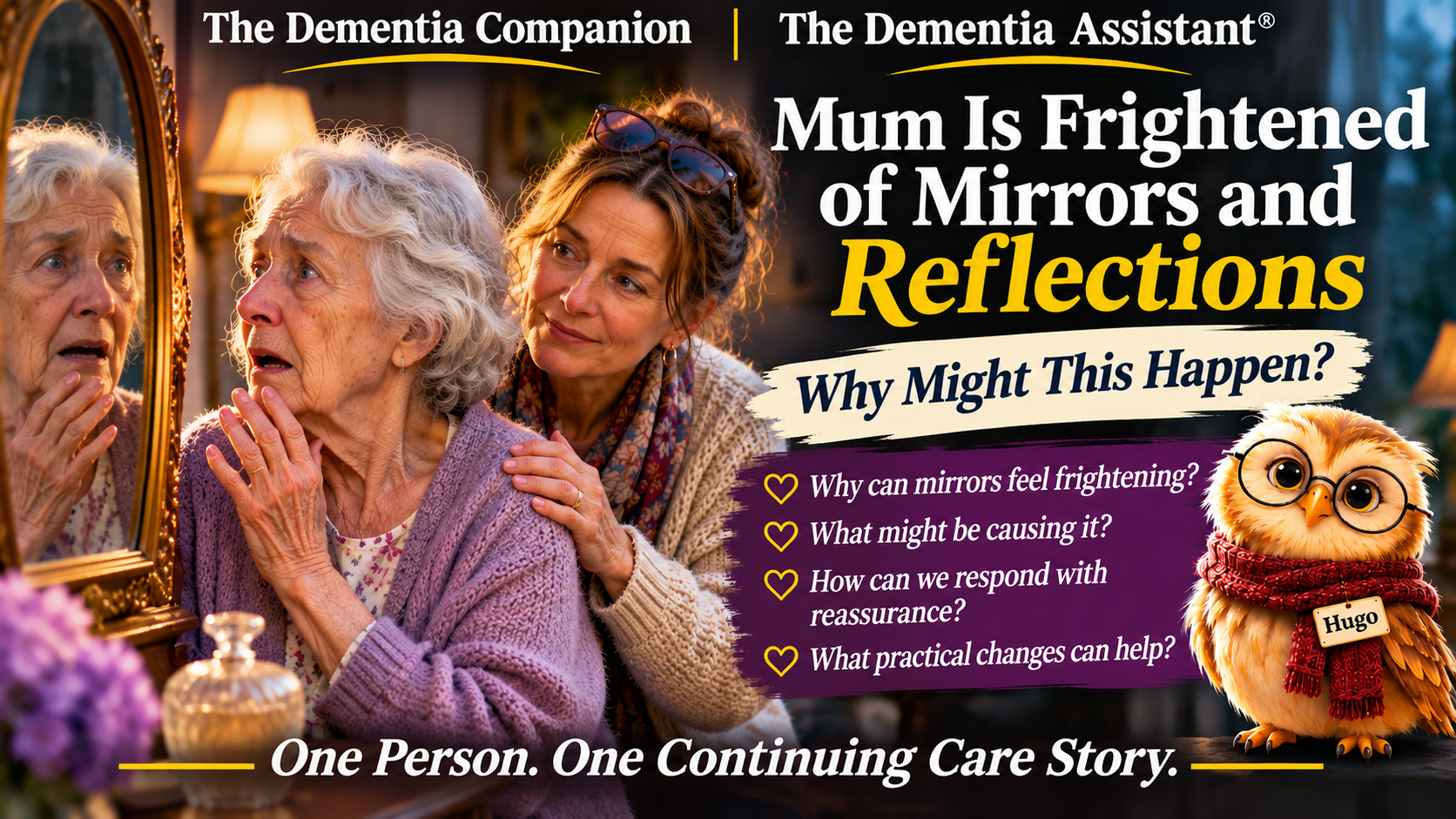
Mum Is Frightened of Mirrors and Reflections. Why Might This Happen?
By Louise Donaghy | The Dementia Companion | One Person. One Continuing Care Story.
There was a time when Mum wouldn’t dream of leaving the house without checking herself in the mirror.
Hair brushed.
Cardigan straightened.
Perhaps a little lipstick.
And heaven help anyone who suggested she was ready before she’d decided so herself.
Now, something has changed.
You find her standing in the hallway, looking frightened.
She’s staring at the mirror.
“Who’s that woman?”
You look towards the glass.
“Mum, that’s you.”
“No, it isn’t! Who is she? What’s she doing in my house?”
You try explaining.
You stand beside her and point to your reflection.
You tell her there’s nobody there.
But Mum becomes increasingly distressed.
She knows what she can see.
There’s a woman standing in front of her.
And from her perspective, that woman may be a complete stranger.
Meanwhile, you’re standing there wondering how on earth you’ve ended up having an argument with a mirror.
For some people living with dementia, mirrors and reflections can become confusing, unfamiliar or genuinely frightening.
A person may stop recognising their own reflection.
They might believe someone else is standing in the room.
They may speak to their reflection, become suspicious of it or refuse to enter a room containing a mirror.
Others might find reflections perfectly comforting and continue using mirrors without difficulty.
The important thing is that Mum’s fear is real to her, even when the person she believes she is seeing isn’t actually standing in front of her.
Understanding what might be happening can help us respond without dismissing her feelings, creating unnecessary arguments or removing more independence than necessary.
Because Mum isn’t being silly.
She may simply be experiencing the world differently.
And if we can understand a little more about that experience, we can make her surroundings feel safer.
Why can dementia make mirrors frightening?
When we look in a mirror, our eyes receive an image.
But recognising that image requires much more than eyesight.
Our brains interpret what we’re seeing.
We recognise faces, understand that a mirror produces a reflection and connect the image with our knowledge of ourselves.
Usually, this happens automatically.
We look in the mirror and know who is looking back.
Even on those mornings when we might prefer not to.
Dementia can affect the brain’s ability to interpret visual information and recognise familiar faces.
According to the Alzheimer’s Society and Dementia UK, changes in perception and recognition can cause someone to mistake their reflection for another person.
For some individuals, this is associated with something called mirror self-misidentification.
But not every person who becomes frightened by a mirror has the same underlying difficulty.
There are several possible explanations.
- Mum may no longer recognise her own reflection
Imagine looking into a mirror and seeing an unfamiliar person staring back.
You move.
They move.
You look worried.
They appear worried too.
You try to get away.
But whenever you look back, they’re still there.
That could feel extremely unsettling.
For some people living with dementia, the connection between their reflection and their own identity becomes difficult to understand.
The image may be interpreted as another person.
Mum might say:
“Who’s that woman?”
“Why is she watching me?”
“Get her out of my house!”
Or she might simply move away, avoid the room or become visibly frightened.
We must avoid assuming that she is being deliberately difficult or seeking attention.
She may genuinely believe someone unfamiliar is present.
- Her reflection may not match the person she believes herself to be
This is particularly interesting.
Dementia can affect someone’s understanding of time.
The Alzheimer’s Society describes a phenomenon known as time-shifting, where a person may experience themselves as living in an earlier period of life.
Mum might believe she is forty years old.
Perhaps she remembers herself as a young mother.
She may expect to see the face she knew decades ago.
Instead, the mirror shows an older woman with white hair and wrinkles.
Someone she doesn’t recognise.
Imagine expecting to see your younger self and discovering someone who appears forty years older staring back.
You might find that rather alarming too.
In this situation, the difficulty may involve more than recognising a reflection.
It can involve a mismatch between Mum’s current appearance and her internal sense of who she is.
This doesn’t happen to everyone with dementia, and it shouldn’t automatically be assumed.
But it is one possible explanation worth understanding.
- Changes in visual perception may affect what she sees
Our brains don’t simply record images like cameras.
They interpret shapes, movement, depth, colour and context.
Dementia can affect this process.
Someone might mistake a dark rug for a hole in the floor.
A shadow may look like an animal.
A shiny surface may appear wet or slippery.
And a reflection may be interpreted as another person standing nearby.
The Alzheimer’s Society explains that these difficulties can occur even when the eyes themselves are functioning reasonably well.
The problem may lie in how the brain processes visual information.
However, ordinary eyesight problems can make things worse.
Cataracts, glaucoma, macular degeneration, an incorrect glasses prescription or other visual difficulties may contribute.
That is why vision problems should be assessed rather than everything being attributed to dementia.
- Reflections may look different depending on the lighting
Have you ever looked towards a dark window in the evening and been startled by your own reflection?
For a moment, it can look as though someone is standing outside.
Then you realise it’s just you.
Now imagine having difficulty interpreting that image.
Mum may see a reflection in a window and believe someone is outside watching her.
A mirrored wardrobe could appear to contain another person.
A switched-off television screen might reflect movement.
A shiny cupboard door may create a confusing image.
At certain times of day, changes in lighting, shadows and contrast can make these reflections more noticeable.
The NHS specifically advises checking whether mirrors and reflective windows cause distress for someone living with dementia.
Closing curtains in the evening can sometimes help.
- Mum may feel that her privacy is being invaded
This is an important possibility that families may overlook.
Imagine Mum is getting dressed.
She looks towards the mirror and believes a stranger is standing in the bedroom.
She may feel frightened or embarrassed.
Perhaps she covers herself.
She might become angry.
Or she may refuse personal care because she believes someone is watching.
From our perspective, there’s nobody else in the room.
From Mum’s perspective, a stranger may be witnessing something deeply private.
Her response may be an attempt to protect her dignity.
And that deserves understanding.
- She may be experiencing a different visual disturbance
Not every frightening visual experience is caused by a reflection.
Some people living with dementia experience visual hallucinations, where they see something without a corresponding external object.
Others experience misperceptions, where something real is interpreted incorrectly.
A mirror reflection that is mistaken for an unfamiliar person is generally a problem of perception or identification rather than a hallucination.
This distinction matters.
If Mum sees a person in the mirror, there is a real visual image being misinterpreted.
If she sees a person standing in an empty room without a reflection or another object explaining the image, a hallucination may be involved.
Visual hallucinations are particularly associated with dementia with Lewy bodies, although they can occur in other conditions.
Families should not attempt to diagnose the cause themselves.
New, frequent or distressing visual experiences should be discussed with an appropriate healthcare professional.
Is Mum imagining the person in the mirror?
The word imagining can be misleading.
It suggests Mum has simply made something up.
But her experience may involve genuine changes in how the brain interprets visual information.
The reflection exists.
The difficulty is understanding what it represents.
And the emotional response can be very real.
Consider how frightened you might feel if you believed a stranger had entered your home.
Your heart might race.
You might become angry.
You might try to protect yourself.
Telling Mum that she’s imagining things may not help her feel safe.
Instead, try responding to what she’s experiencing.
We don’t have to agree that a stranger is present to acknowledge that Mum feels frightened.
That is the difference between validating someone’s emotion and confirming something we cannot verify.
What should I say when Mum is frightened of her reflection?
This is where compassionate communication can make a difference.
When Mum asks, “Who’s that woman?”
Instead of:
“Mum, don’t be ridiculous. It’s you!”
Try:
“You’ve noticed someone there, haven’t you? You seem worried.”
Then consider helping her move somewhere more comfortable.
When Mum says, “Get her out of my house!”
Instead of:
“There’s nobody there. You’re imagining things!”
Try:
“You don’t feel comfortable with what you’re seeing. Let’s go and sit somewhere quieter.”
When Mum thinks someone is watching her
Instead of:
“Stop making a fuss. It’s just a mirror.”
Try:
“You’d like some privacy, wouldn’t you? Let’s make the room more comfortable.”
When Mum becomes angry
Instead of:
“You’ve got to understand that’s your reflection!”
Try:
“I can see this is upsetting you. I’m here with you.”
When Mum is willing to listen
You might gently explain:
“That’s a reflection in the mirror, Mum.”
But pay attention to her response.
If she understands and feels reassured, that’s helpful.
If she becomes more distressed, repeating the explanation more loudly is unlikely to improve matters.
Sometimes moving away from the mirror is a better solution than trying to convince her what it is.
Ten practical ways to make mirrors and reflections less frightening
- Identify which reflections are causing difficulty
Before covering every reflective surface in the house, notice where the problem occurs.
Is Mum frightened by the bathroom mirror?
Does she become upset when she sees herself in the wardrobe?
Is it the dark sitting-room window?
Does she react to the television screen when it is switched off?
Or does she only become frightened at certain times?
The answers can help you make targeted changes rather than unnecessarily altering the whole home.
- Cover or reposition mirrors that repeatedly cause distress
If a particular mirror causes fear, consider covering it temporarily, moving it or changing its position.
The NHS and Alzheimer’s Society both recommend reducing troublesome reflections when they cause confusion.
A lightweight curtain or suitable covering may help.
Make sure coverings are securely fitted and don’t create trip hazards.
If Mum uses the mirror comfortably at other times, consider whether it needs to be covered only during periods of distress.
There is no need to remove every mirror automatically.
- Close curtains when windows become reflective
During daylight, Mum may enjoy looking into the garden.
But after dark, the same window can act like a mirror.
She might believe someone is standing outside or looking into the room.
Closing curtains or blinds before reflections become prominent may help.
This is a simple adjustment that can preserve the enjoyment of the window during the day.
- Improve lighting and reduce confusing shadows
Poor lighting can make visual interpretation harder.
Check for dark corners, glare and strong shadows.
Consider whether lamps create reflections in glass or shiny surfaces.
Appropriate lighting can help someone see their surroundings more clearly.
However, very bright lights can sometimes create glare or discomfort.
The aim is comfortable, even lighting that suits the individual’s vision and preferences.
- Support Mum’s eyesight
Make sure her glasses are clean, comfortable and appropriate for the activity.
If she has experienced changes in vision, arrange an examination with an optometrist, optician or relevant eye-care professional.
Don’t assume that dementia is responsible for every visual difficulty.
Poor eyesight can increase confusion and reduce confidence.
New or sudden loss of vision, particularly with other neurological symptoms, requires urgent medical assessment.
- Preserve familiar surroundings
Someone living with dementia may rely heavily on familiarity.
Moving furniture, replacing familiar objects and changing room layouts can make orientation more difficult.
If a mirror needs to be moved, think carefully about the rest of the environment.
Avoid making unnecessary changes all at once.
Try to preserve familiar furniture, routines and useful visual cues.
Sometimes a small adjustment can reduce distress without making the whole room feel unfamiliar.
- Make personal care more comfortable
If Mum becomes frightened by the bathroom mirror, consider whether the mirror can be covered during washing, dressing or toothbrushing.
Perhaps she would prefer to sit somewhere else to brush her hair.
Maybe she can manage some grooming activities independently in a different room.
Offer privacy.
Explain what you’re doing.
Ask permission before assisting.
And allow her to participate as much as possible.
The objective is to support personal care without creating a frightening experience.
- Avoid forcing Mum to confront the mirror
It may be tempting to demonstrate repeatedly that the reflection is hers.
You might wave.
Ask her to wave.
Stand beside her.
Point to both reflections.
But if Mum is frightened, this may simply prolong the distress.
There is no need to force recognition.
If a brief explanation helps, use it.
If not, focus on reassurance and comfort.
- Create a consistent family approach
Different family members may respond in different ways.
One person might insist that Mum recognise herself.
Another may cover the mirror.
Someone else may laugh because the situation seems unusual.
Without agreement, Mum could experience repeated confusion.
Discuss what helps.
Record the approaches that reduce distress.
Make sure carers and visiting professionals understand the situation.
And remember that a person-centred plan should be flexible.
What helps today may need reviewing tomorrow.
- Seek professional advice when necessary
If Mum becomes increasingly frightened, avoids important activities or experiences repeated visual disturbances, seek advice.
A GP, primary-care clinician, dementia specialist, occupational therapist or relevant vision professional may be able to help.
An occupational therapist with dementia experience may advise on practical environmental adaptations.
Persistent distress deserves assessment rather than simply being dismissed as part of dementia.
What if Mum talks to her reflection?
This can be confusing for families.
You may find Mum chatting pleasantly to the woman in the mirror.
Perhaps she’s telling her about the weather.
Maybe she’s commenting on her cardigan.
And occasionally she might appear to be having a rather lively disagreement.
The important thing is her response.
Is Mum comfortable, or is she distressed?
If she is smiling and enjoying the experience, there may be no need to interrupt immediately.
For some people, a reflection may appear to provide companionship.
But avoid assuming that this is always harmless.
Observe whether Mum becomes anxious, suspicious or frightened.
Does she believe the person is preventing her from entering the room?
Does she become upset when the reflection moves?
Could she injure herself by approaching or striking the glass?
The aim is not automatically to stop every conversation with a reflection.
It is to understand whether the experience is reassuring, neutral or causing difficulty.
What if Mum thinks the reflection is a stranger or intruder?
This can be particularly frightening.
Mum may believe someone has entered the house.
She might shout.
She may call for help.
Or she may try to protect herself.
Approach calmly and avoid sudden movements.
You could say:
“You’ve had a fright, haven’t you? I’m here.”
If she is worried about someone being in the room, consider helping her move somewhere she feels secure.
Check that there isn’t an actual safety concern before assuming the experience is caused by dementia.
Once the situation is calm, consider whether the mirror or reflective surface should be covered, repositioned or removed.
If Mum repeatedly experiences this fear, discuss it with her healthcare professional.
Don’t wait for the situation to become dangerous.
Why does Mum sometimes recognise herself and sometimes not?
Dementia symptoms can fluctuate.
Someone may recognise their reflection in the morning but become confused later.
Possible contributing factors include tiredness, attention, lighting, illness, changes in the environment and the effects of the underlying dementia.
Mum might be comfortable using her dressing-table mirror one day and frightened by it the next.
This can feel inconsistent to family members.
But it doesn’t necessarily mean she is choosing when to recognise herself.
Her ability to process information may vary.
Rather than concentrating on why she managed yesterday but cannot today, focus on what she needs in the present moment.
A familiar mirror that was helpful previously may now require a different approach.
What if Mum is frightened of mirrors during bathing or dressing?
Personal care is a particularly sensitive situation.
Imagine being undressed in front of what you believe is an unfamiliar person.
You may feel exposed.
Embarrassed.
Angry.
Or frightened.
If Mum believes someone is watching her through a mirror, resisting personal care may be an understandable protective response.
Consider covering the reflection before beginning.
Explain each step.
Use familiar towels, clothing and routines.
Preserve privacy and allow Mum as much control as possible.
Ask whether she would prefer to wash or dress somewhere else, provided it is safe and appropriate.
If she becomes distressed, stop and reconsider the approach rather than forcing her to continue.
Professional advice may be needed if essential hygiene or health needs cannot be met safely.
The aim should never be simply to complete the task regardless of Mum’s experience.
Personal care should protect dignity, not take it away.
Could mirror confusion be worse during the evening?
Yes, it may be more noticeable for some people.
As natural daylight fades, reflections become more prominent in windows and certain surfaces.
Fatigue may also make it harder to process complex visual information.
Some people living with dementia experience increased confusion or distress later in the day.
This is sometimes described as sundowning.
However, not every evening difficulty is sundowning, and the term should not replace an assessment of possible causes.
Consider whether lighting changes, tiredness, discomfort or an unfamiliar environment could be contributing.
A simple evening routine that includes closing curtains and reducing troubling reflections may help.
When should we seek medical help?
Not every episode of mirror confusion requires emergency care.
But some changes deserve assessment.
Arrange a clinical review if Mum:
- Develops new or increasingly frequent problems recognising reflections.
- Becomes repeatedly frightened or distressed.
- Stops entering important rooms because of fear.
- Experiences visual hallucinations or other new perceptual changes.
- Has difficulties with vision that have not been assessed.
- Becomes unsafe around glass or reflective surfaces.
- Experiences changes affecting bathing, dressing, eating or other daily activities.
Sudden changes require particular attention
If Mum suddenly becomes much more confused over hours or days, do not simply assume that dementia is progressing.
Possible causes include delirium, infection, dehydration, pain, medication problems or other acute illnesses.
The Alzheimer’s Society and NICE recommend urgent assessment for sudden changes in confusion or distress.
In the UK, contact the GP, NHS 111 or emergency services according to the severity of symptoms.
International families should use their local healthcare services.
If there is an immediate threat to life, serious injury or another medical emergency, call emergency services.
Medication should not automatically be the first response to mirror-related distress.
NICE recommends assessing physical, emotional and environmental causes before considering treatment for distress in dementia.
A fictional family example: Eileen and the lady in the hallway
The following example is fictional and illustrates how a person-centred approach might work.
Eileen is 83 and lives with Alzheimer’s disease.
She has always taken pride in her appearance.
Her daughter Claire remembers watching her get ready for family outings.
Hair brushed.
Lipstick applied.
A final look in the hallway mirror.
And then, invariably:
“Do I look all right?”
To which the correct answer was always yes.
Recently, things have changed.
Claire notices that her mother avoids the hallway in the evenings.
One afternoon, Eileen suddenly becomes frightened.
“There’s a woman standing over there!”
Claire looks towards the mirror.
She can see Eileen’s reflection.
At first, she tries explaining.
“Mum, that’s you!”
Eileen becomes more upset.
“No, it isn’t! I don’t know her!”
Claire begins to realise that explaining isn’t helping.
Instead, she gently leads her mother into the sitting room.
They sit together.
Claire offers reassurance.
Later, she begins observing when the problem happens.
She notices that Eileen is usually comfortable with the small dressing-table mirror in the morning.
But the large hallway mirror causes distress, particularly when the light is fading.
Claire discusses the changes with Eileen’s healthcare team and arranges a vision check.
She also covers the hallway mirror temporarily and makes sure the evening lighting is more comfortable.
The family records what happened and which adjustments helped.
Over the following days, Eileen seems more comfortable walking through the hallway.
There are still occasional moments of confusion.
But Claire has learned something important.
Her mother wasn’t being difficult.
She was frightened by something she couldn’t interpret in the way she once did.
And Claire didn’t need to convince her mother that she was wrong.
She needed to help her feel safe.
One Person. One Continuing Care Story. Why these observations matter
One of the greatest challenges in dementia care is that important details can become scattered.
A daughter notices Mum avoids the hallway mirror.
A professional carer sees her become upset during morning washing.
A son discovers she is frightened by her reflection in the television.
A visiting clinician identifies a change in visual perception.
Each person has observed something valuable.
But unless those observations are brought together, nobody may recognise the pattern.
The next person supporting Mum might simply hear:
“She gets frightened sometimes.”
That tells us very little.
A more useful explanation would be:
“Mum sometimes mistakes reflections for unfamiliar people. The hallway mirror causes particular distress in the evening. Covering it and offering calm reassurance have helped. A vision assessment has been arranged.”
That information supports more consistent and individualised care.
And it helps prevent Mum from having to experience the same frightening situation repeatedly.
The person’s story should not disappear every time someone new becomes involved in their care.
That is why we created the campaign:
One Person. One Continuing Care Story.
The Dementia Assistant® — preserving the person behind the diagnosis
The Dementia Companion is our public education and dementia guidance hub, providing practical resources for people living with dementia, families and professionals.
The Dementia Assistant® builds on this approach through a family-held person-centred care system designed to help families organise information and maintain continuity.
The purpose is simple.
To keep the person’s needs, preferences, history and changing circumstances connected.
Person-centred care planning
A person-centred care plan can record information that helps others understand how Mum experiences her surroundings.
For example:
- Which mirrors or reflective surfaces cause distress.
- When difficulties are most noticeable.
- Whether lighting or tiredness affects recognition.
- Known eyesight conditions and professional recommendations.
- Communication approaches that provide reassurance.
- Personal care routines and preferences.
- Environmental adjustments that have helped.
- Any relevant medical concerns.
- Appointments and professional assessments.
- Mum’s own expressed wishes and choices.
The plan can be updated as needs change.
It is held by the family and can support appropriate information-sharing with professionals.
It does not replace clinical records or mean that personal information is automatically transferred between healthcare services.
Daily notes — noticing the difference between a difficult moment and a pattern
A daily note might say:
“Monday, 5.30 pm. Mum became frightened when passing the hallway mirror. She said a woman was watching her. Offered reassurance and accompanied her into the sitting room. She became more comfortable.”
Another might record:
“Tuesday, 9.15 am. Mum used her small dressing-table mirror independently and appeared comfortable.”
Or:
“Wednesday, 6.00 pm. Closed the hallway curtains before dusk. Mum appeared comfortable walking through the room. No mirror-related distress observed during the visit.”
These observations provide context.
They help families recognise when something happens, what may contribute and which approaches are worth discussing with professionals.
They should be factual, respectful and proportionate.
Family Circle — helping everyone understand Mum’s needs
When several relatives and carers support someone, consistency matters.
One daughter may know that Mum is frightened by the hallway mirror.
A son might not realise why the curtains are always closed in the evening.
A visiting carer may not know that mirrors can make personal care distressing.
Family Circle is designed to support coordinated involvement among appropriate family members and carers, with consent, permissions and privacy safeguards.
Sharing relevant information can help the people involved understand what works.
It does not mean everyone automatically receives unrestricted access to personal records.
Mum’s privacy and rights remain central.
Life Story — remembering the woman behind the reflection
This is particularly important.
Mum may no longer recognise her reflection, but her identity is much more than the face she sees in the glass.
Perhaps she was a hairdresser.
Maybe she loved fashion.
Perhaps getting ready for church every Sunday was an important part of her routine.
Maybe she always wore a particular shade of lipstick.
Her Life Story can preserve these meaningful details.
It can also help families understand why appearance, privacy or personal care are especially important to her.
Knowing who someone has always been helps us support who they are today.
Saved conversations and continuing guidance
Families may first ask Hugo why Mum is frightened by a mirror.
Later, they may need help adapting the bathroom.
Another day, they may want to prepare questions for a vision assessment.
Hugo’s saved conversations allow users to return to earlier guidance and continue exploring concerns.
Alongside daily notes and the care plan, this can help families maintain a clearer understanding as circumstances change.
Meet Hugo Intelligence™ — support that begins with understanding
Within The Dementia Assistant®, families can access Hugo Intelligence™, created and powered by Person-Centred Intelligence®.
Hugo is designed to provide conversational dementia guidance, explore possible explanations, suggest practical responses and help families organise information for discussions with healthcare professionals.
Someone might ask:
“Hugo, why does Mum think there’s a stranger in the mirror?”
Hugo can explain general changes in visual perception, misidentification and practical environmental adjustments.
He can help families explore communication approaches, identify patterns and consider when professional advice may be required.
But there is an important distinction in how Hugo works.
General guidance until an individual care plan is explicitly selected
Hugo provides general guidance until the user explicitly selects an individual’s care plan.
He does not automatically assume that every question refers to Mum, Dad or another particular person.
Without a selected plan, Hugo can explain general dementia-related difficulties with mirrors and reflections.
When a family member deliberately selects Mum’s care plan, Hugo can use relevant information recorded within that selected plan to make guidance more specific to her documented circumstances.
For example:
“Hugo, Mum’s selected care plan records that she becomes frightened by the hallway mirror in the evening but still enjoys using her dressing-table mirror in the morning. What practical adjustments could we consider?”
Hugo can help explore the situation using those recorded details.
He should not invent information, claim to know exactly what Mum is experiencing or present a possible explanation as a medical diagnosis.
He does not replace a doctor, dementia specialist, optometrist or occupational therapist.
His role is to help families understand, organise and communicate the information that matters.
Multilingual support for international families
Dementia affects families across countries, cultures and languages.
The Dementia Assistant® supports 12 tested interface and voice languages, alongside broader dictation and translation capabilities covering 201 languages.
This can help families access guidance and record information across language differences.
The platform stores records in English while retaining original translated content where applicable.
Important medical information and translations should always be checked for accuracy.
Language and cultural preferences should remain part of person-centred care.
Preparing useful summaries for healthcare professionals
The Dementia Assistant® also supports family-held documentation, relevant uploads, daily observations and summaries.
Instead of arriving at an appointment and saying:
“Mum is scared of mirrors.”
The family may be able to explain:
“Mum has recently started mistaking reflections for unfamiliar people. It happens most often in the hallway during the evening. She becomes distressed, but covering the mirror and offering reassurance have helped. We would like advice about possible visual or medical causes.”
That provides useful context for professional assessment.
17 detailed questions to Ask Hugo about mirrors, reflections and dementia
These questions can be copied directly into Hugo Intelligence™.
For general guidance, simply ask Hugo your question.
For guidance informed by an individual’s recorded circumstances, explicitly select that person’s care plan first.
- Why does Mum think a stranger is in the mirror?
“Hugo, Mum is living with dementia and sometimes believes another woman is standing in front of her when she looks into a mirror. Explain how dementia can affect visual perception, facial recognition and understanding reflections. Help me explore possible reasons without assuming one explanation is correct.”
- What is mirror self-misidentification?
“Hugo, explain mirror self-misidentification in clear, family-friendly language. How is it different from ordinary forgetfulness, and why might someone living with dementia believe their reflection belongs to another person?”
- Could Mum think she is younger than she actually is?
“Hugo, Mum sometimes talks as though she is much younger. Explain how time-shifting in dementia may affect her recognition of her present appearance. Why might an older reflection seem unfamiliar or frightening, and how can we respond compassionately?”
- Is Mum hallucinating or misinterpreting a real reflection?
“Hugo, help me understand the difference between visual hallucinations, misperceptions and misidentification in dementia. Mum sometimes sees a stranger in the mirror. Explain what information we should observe and when a healthcare professional should assess her experiences.”
- What should I say when Mum becomes frightened?
“Hugo, Mum becomes upset and says a stranger is watching her through the mirror. Give me gentle, natural phrases that acknowledge her fear without confirming that an intruder exists. Explain how to offer reassurance and move away from the situation without arguing.”
- Should we cover the mirrors in Mum’s house?
“Hugo, Mum is distressed by some mirrors but uses others comfortably. Help us consider when covering, moving or repositioning mirrors may be useful, when a mirror might support her independence and how to avoid unnecessary changes to her familiar surroundings.”
- Why are window reflections worse at night?
“Hugo, Mum sometimes believes someone is standing outside when she sees her reflection in a dark window. Explain how changing light, reflections and visual processing difficulties may contribute. Suggest practical changes to curtains, blinds and lighting.”
- Could Mum’s eyesight be making things worse?
“Hugo, Mum has dementia and seems increasingly confused by reflective surfaces. Explain how cataracts, glaucoma, macular degeneration, glasses prescriptions and other eyesight problems may affect what she sees. What should we discuss with her optometrist or clinician?”
- Why does Mum refuse to enter the bathroom?
“Hugo, Mum has begun avoiding the bathroom and appears frightened when she sees the large mirror. Help me explore possible causes, including reflections, privacy concerns, sensory discomfort and other unmet needs. Suggest respectful environmental adjustments.”
- How can we support personal care without frightening Mum?
“Hugo, Mum becomes distressed during dressing and washing when she sees her reflection. Suggest ways to protect her dignity, explain each step, offer choices, adapt the environment and preserve independence without forcing personal care.”
- What if Mum talks to the person in the mirror?
“Hugo, Mum sometimes talks to her reflection as though it is another person. She occasionally seems happy but sometimes becomes suspicious. Help me understand how to distinguish a harmless or comforting experience from one causing distress or safety concerns.”
- Why does Mum recognise herself some days but not others?
“Hugo, Mum sometimes uses mirrors normally and at other times becomes frightened by her reflection. Explain how fatigue, attention, lighting, visual changes and dementia symptoms might contribute to fluctuations. What patterns would be useful to record?”
- How can we make Mum’s home more dementia-friendly?
“Hugo, help us review mirrors, glass doors, dark windows, shiny floors, lighting, shadows and contrasting colours. Suggest practical adjustments that could reduce visual confusion without unnecessarily changing familiar rooms or restricting Mum’s independence.”
- Could this be related to Lewy body dementia?
“Hugo, I understand that visual hallucinations and changes in perception can occur in dementia with Lewy bodies. Explain how this differs from mirror misidentification, why mirror fear alone cannot diagnose a type of dementia and when specialist assessment is appropriate.”
- When should we seek urgent medical advice?
“Hugo, Mum’s confusion about reflections has suddenly become much worse. Explain the warning signs of delirium, infection, medication problems, sudden vision changes and other medical concerns. Help me distinguish routine review needs from urgent symptoms and emergencies.”
- How should we record Mum’s experiences in her daily notes?
“Hugo, help us write respectful, factual observations about Mum’s reactions to mirrors. Include the time, location, lighting, what she said, signs of distress, possible triggers, reassurance offered, environmental changes and the outcome. Avoid judgemental language or making an unconfirmed diagnosis.”
- How do we keep Mum’s continuing care story person-centred?
“Hugo, several family members and professional carers support Mum. Help us create a person-centred approach to recording her visual perception difficulties, preferred routines, Life Story, environmental needs, communication preferences and professional recommendations. Explain how a family-held care plan, Family Circle, daily notes and saved conversations can support consistent care while respecting her rights, consent and dignity.”
One Person. One Continuing Care Story.
There are moments in dementia care that can be difficult to understand.
A familiar room suddenly becomes frightening.
A reflection becomes a stranger.
A woman who spent decades brushing her hair in front of a mirror now refuses to look into one.
And the family standing beside her may feel confused, upset or helpless.
But there is something I want us to remember.
Mum is not choosing to be frightened.
She may be experiencing something that genuinely feels threatening.
Her brain may no longer interpret familiar images in the way it once did.
And telling her repeatedly that she is wrong may not change what she believes she can see.
Our role is not to win an argument with a mirror.
It’s to help Mum feel safe.
Perhaps that means changing the lighting.
Perhaps it means covering a reflection.
Perhaps it means arranging a vision assessment.
Or perhaps it means simply sitting beside her, listening and offering reassurance.
Sometimes we will understand the cause.
Sometimes we won’t.
But we can always approach the person with curiosity, compassion and respect.
And when we record what we’ve learned, the next person supporting Mum can understand her needs without beginning from the very start.
Because Mum’s story is not just about her dementia.
It’s about her life.
Her preferences.
Her relationships.
Her experiences.
Her fears.
And everything that makes her the person she is.
One Person. One Continuing Care Story.
Continue your family’s care story with The Dementia Companion and The Dementia Assistant®
The Dementia Companion provides practical dementia education, compassionate guidance and resources for people living with dementia, families and professionals.
The Dementia Assistant® brings together Hugo Intelligence™, person-centred care planning, family-held continuing records, daily notes, saved conversations, Family Circle, Life Story and multilingual support.
Together, they are designed to help families understand everyday changes, organise important information and support more connected care.
The Dementia Companion:
https://thedementiacompanion.com/
The Dementia Assistant®:
https://thedementiaassistant.com/
Every subscription includes a 30-day complimentary trial.
Afterwards, the UK Family subscription costs £4.99 per month.
International families can check the subscription options available in their region.
Because good dementia care should never be about simply managing symptoms.
It should be about understanding the person.
And sometimes the kindest thing we can do is stop trying to convince Mum who she’s seeing in the mirror.
Instead, we can help her feel safe enough to walk away from it.
As for the rest of us?
Well, some mornings I suspect we’d all be perfectly happy to put a curtain over the bathroom mirror.
Particularly before that first cup of tea.
But for Mum, the fear deserves real understanding, thoughtful support and a little more kindness than simply telling her she’s mistaken.
And that is what person-centred care is all about. ❤️
⸻
Authoritative references and further reading
- Alzheimer’s Society — How can dementia change a person’s perception?
Explains misperceptions, misidentifications, visual processing difficulties and the ways dementia may change how a person interprets their surroundings.
https://www.alzheimers.org.uk/about-dementia/stages-and-symptoms/how-dementia-changes-perception
- Dementia UK — Changes in perception and hallucinations in dementia.
Guidance on altered visual perception, mirror misidentification, hallucinations, eyesight concerns and practical responses.
- NHS — How to make your home dementia-friendly.
Official advice on mirrors, reflective windows, lighting, flooring, colour contrast and home adaptations.
https://www.nhs.uk/conditions/dementia/living-with-dementia/home-environment/
- Alzheimer’s Society — Time-shifting and dementia.
Explains why someone may experience themselves as younger and fail to recognise their present-day reflection, with practical support suggestions.
https://www.alzheimers.org.uk/about-dementia/stages-and-symptoms/dementia-symptoms/time-shifting
- Alzheimer’s Society — Supporting a person with dementia who’s experiencing vision and perception problems.
Practical advice on checking eyesight, recognising patterns, improving lighting and responding compassionately.
- Dementia UK — Coping with hallucinations in a person with dementia.
Discusses reducing distress from reflective surfaces, closing curtains and making the environment more comfortable.
https://www.dementiauk.org/news/coping-with-hallucinations-in-a-person-with-dementia/
- NICE Guideline NG97 — Dementia: Assessment, management and support.
Evidence-based recommendations to assess physical, environmental and care-related causes of distress before considering treatment.
https://www.nice.org.uk/guidance/ng97/chapter/Recommendations
- Alzheimer’s Association, USA — Hallucinations.
Practical information on responding to frightening visual experiences, checking the environment and seeking professional advice.
https://www.alz.org/help-support/caregiving/stages-behaviors/hallucinations
- Forward with Dementia, Australia — Sensory and perceptual changes.
Guidance on how dementia affects the interpretation of sensory information, including reflections, glare and shiny surfaces.
This article provides general educational guidance for international families. It does not replace individual assessment by a doctor, dementia specialist, optometrist or occupational therapist. Sudden changes in confusion, vision or behaviour may require urgent medical attention.
⸻
Louise, Hugo and Charlie ❤️🦉✨
Louise Donaghy
Founder & CEO of The Dementia Assistant®
Created and powered by Person-Centred Intelligence®
Creator of Hugo Intelligence™
You May Also Find Helpful
Need help with your own situation? Ask Hugo.
One Person. One Continuing Care Story. The Dementia Companion is where you discover guidance. Inside The Dementia Assistant®, talk with Hugo, save and categorise conversations, record daily notes and involve authorised supporters in a continuing care plan centred around the person.
Ask Hugo About This · Start Your Continuing Care Plan — Families · Continuing Care Planning — Professionals
Personal guidance requires the appropriate account and subscription access. Care-plan information is used only with authorised access and the required consent and selection steps. All subscription plans include a 30-day complimentary trial.