How to Explain Dementia to a Child or Grandchild
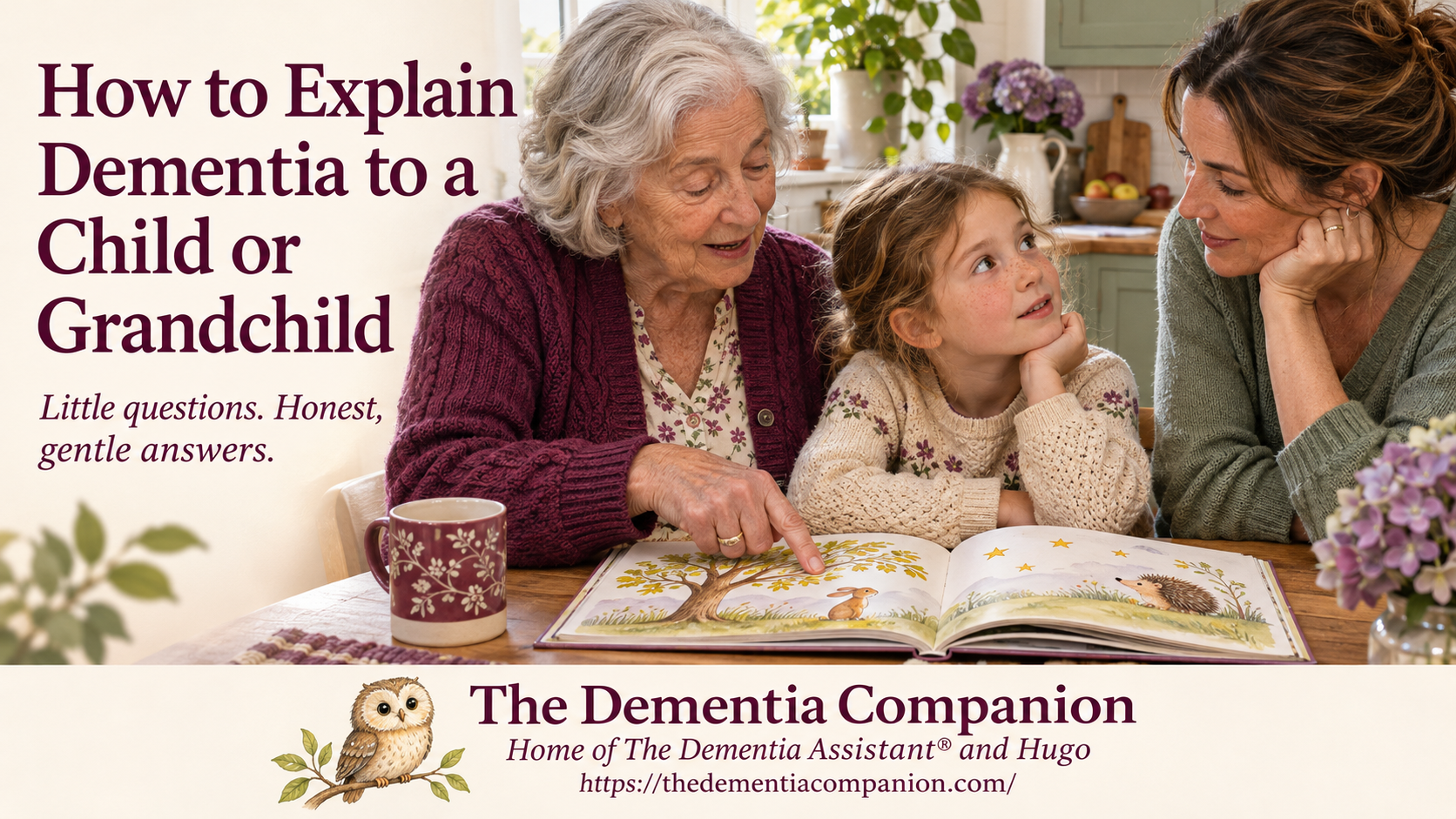
How to Explain Dementia to a Child or Grandchild
By Louise Donaghy, Founder of The Dementia Assistant® and The Dementia Companion, Creator of Hugo Intelligence™
“Why does Granny keep asking me the same thing?”
“Is Grandad cross with me?”
“Does she still know who I am?”
They are little questions that can catch you somewhere very deep.
You might already be trying to understand the changes yourself. Perhaps you are missing the easy conversations, worrying about what comes next or holding everything together with a cup of tea that has been reheated three times and still hasn’t been drunk.
Then a child looks up and asks the very question you don’t quite know how to answer.
Take a breath. You do not need a perfect speech.
The best place to start is with what they have noticed, using honest words they can understand. Explain that dementia involves an illness affecting the brain, reassure them that they did not cause it and cannot catch it, and remind them that the grown-ups are responsible for care.
Then leave room for whatever comes next. That might be another question. It might be a cuddle. It might be, “Can I have a biscuit?”
Children can move between big feelings and ordinary life remarkably quickly. The biscuit does not mean they weren’t listening.
Start with what the child has noticed
When we are worried about someone we love, it is tempting to prepare an explanation covering absolutely everything. We want to get it right. We want to protect our children from fear, confusion and hurt.
But before we explain, it helps to listen.
A gentle “Have you noticed anything different when we visit Grandma?” may tell you more than a carefully rehearsed talk ever could.
Perhaps your child has noticed the repeated questions. Perhaps they are wondering why Grandad no longer collects them from school. Or perhaps they think Grandma stopped playing their favourite game because they did something wrong.
We cannot reassure a child about a worry we have not yet heard.
If they mention repeated questions, you could say:
“Grandma has an illness called dementia. It affects her brain and can make it difficult to remember something that happened a few minutes ago. She may not remember that she has already asked us.”
Then bring the conversation back to Grandma herself.
“She still enjoys looking at your drawings,” might be true. Or, “She still likes sitting outside with us and watching the birds.”
Dementia needs explaining, but it does not need to become the only thing we say about someone.
This is still the person who knows how you like your toast, who once wore a ridiculous paper crown throughout Christmas dinner, or who has very firm opinions about the proper strength of tea. Some abilities and responses may change, but their history, preferences and dignity still matter.
And if your child does not want to talk just then, you can leave the door open:
“You don’t have to ask me anything now. If you think of something later, you can always come to me.”
If you are struggling to find a starting point, you can ask Hugo within The Dementia Assistant®: “My child has noticed Grandma repeating herself. Help me explain it gently in a few sentences.” Read the response yourself first and make it sound like your family. Your child needs your familiar voice, not a presentation.
Choose words that fit their age
Children do not all understand things at the same pace. Age can guide us, but so can their personality, communication needs and what is happening in their world.
Some want to know how the brain works. Others simply want to know whether Sunday lunch is still happening.
Both are reasonable places to begin.
For a younger child, a short explanation may be enough:
“Grandad has an illness called dementia. It makes some things harder for his brain, like remembering words or what we have just done. You haven’t done anything wrong.”
You can follow that with something practical and reassuring:
“We’re going to see him for a little while. I’ll stay with you, and you can bring your picture if you want.”
Knowing what will happen during a visit may matter more to a young child than understanding the name of the illness.
Try to avoid descriptions such as “Grandma’s brain is broken” or “Grandad is becoming a baby”. They can frighten or confuse children, and they do not reflect the dignity of the adult they love.
A primary-school child may be ready for a little more explanation. You might talk about how our brains help us remember, speak, understand things and find our way around. Illnesses that cause dementia can make some of those things more difficult.
If the person has Alzheimer’s disease, explain that Alzheimer’s is one cause of dementia. It is not something that happens to everyone simply because they grow older.
Then pause. “Is there anything you want me to explain differently?” is kinder than checking whether they have remembered every word. There will be plenty of spelling tests in their life. This does not need to become another one.
Teenagers deserve clear information too, alongside some respect for how complicated everything may feel.
They might understand the diagnosis but worry about what it means for family life. Will Mum be away more? Can friends still come round? Is everyone expecting them to help? Are they allowed to feel embarrassed, frustrated or fed up?
Yes. Those feelings can exist alongside love.
A teenager who says very little may still be taking everything in. Offer a conversation without demanding one, and let them know that their own life still matters.
Stories and pictures can help when explanations feel too abstract. You can ask Hugo to direct you to storybooks, comics or learning activities within the site, describing the child’s age and interests. Explore them together, without expecting any resource to do all the talking for you.
Answer the questions children may be afraid to ask
Sometimes the biggest worry is tucked behind a much smaller question.
“Do we have to visit?” might mean, “I’m frightened she won’t recognise me.”
“Why is he like that?” might mean, “Could this happen to you?”
And “Was Grandma cross?” might really mean, “Was it my fault?”
Give children permission to say the uncomfortable things. They need to know that a question will not upset the whole family or get them into trouble.
If they wonder whether they caused the dementia, be completely clear:
“No. Nothing you said, thought or did caused this.”
They did not cause it by arguing, forgetting to telephone or refusing a hug. They cannot make it disappear by being especially good, either. That is far too heavy a responsibility for a child to carry.
If they ask whether dementia is catching, explain that they cannot catch it by sitting beside someone, sharing an activity or having a cuddle. A cuddle should, of course, be something both people want. Affection does not need to be compulsory to be meaningful.
Then there is the question that can make an adult’s heart ache:
“Does Grandma still love me?”
It is understandable to want to promise that Grandma will always know them. But recognition can change, and a promise like that may leave a child more confused later.
Instead, you might say:
“Grandma finding it difficult to remember your name doesn’t mean you have become less important. Dementia can make recognising people and showing feelings harder. The love you have shared matters, and we can look for ways to feel close that are comfortable for you both.”
Perhaps that means listening to music. Perhaps it means sitting nearby with a book. Connection does not always arrive in a conversation, and it does not have to pass a memory test.
If a child has been shouted at or frightened, acknowledge that too. Do not rush straight to explaining the dementia before recognising their hurt.
“That was upsetting, wasn’t it? Grandad may have been confused or overwhelmed, but you did not deserve to be shouted at. Come to me whenever you feel uncomfortable.”
Compassion for the person living with dementia and protection for the child belong together.
Some children will ask whether the person will get better or die. These are difficult conversations, especially when you are frightened yourself. Answer gently, according to what is known about the person’s circumstances, without offering certainty you do not have.
You might explain that dementia usually gets worse over time, although support and care can help the person live as comfortably as possible. If asked about death, you can say that dementia is a serious illness that can shorten someone’s life, but you may not know when that will happen.
“I don’t know, but I will talk with you about it” is an honest answer. You do not have to hide every tear, either. You can explain, “I’m sad because I love her. You haven’t upset me by asking.”
If you need to gather your thoughts beforehand, Hugo can help you prepare gentle wording. Ask him to help with the particular question, rather than trying to explain the whole future in one sitting.
Help them stay connected without responsibility for care
A child should be able to enjoy being a grandchild.
They can bring their enthusiasm, their drawings, their wonderfully unexpected observations and their detailed account of something that happened in the playground. They do not need to bring a care plan.
Small moments together can be enough. Looking at birds through the window, listening to a favourite song, sharing pictures or watering a plant with an adult nearby may offer an easy way to spend time together.
Start with what both people enjoy. If Grandad has never liked crafts, dementia does not automatically mean he is going to welcome an afternoon involving glitter. Frankly, some of us remain firmly opposed to glitter at every stage of life.
A child might show a drawing and say, “I made this for you,” rather than asking, “Do you remember what we did yesterday?” That removes the pressure to find an answer and lets the moment be what it is.
Keep expectations gentle. A short visit that feels comfortable may be better than a long one everyone struggles through. Agree beforehand how the child can ask for a break, and respond without making them feel guilty.
They can love Grandma and still want to go outside.
They can miss Grandad and still laugh with their friends.
They can have a lovely visit one week and find the next one difficult.
None of this makes them unkind.
Adults should remain responsible for medication, personal care, safety and managing distress. If a child is already carrying substantial caring duties, it is worth seeking local young-carer or family support.
For ideas, explore the Family Hub, or ask Hugo to direct you to Memory & Moments and the Life Story Book. You could ask for an activity that takes only a few minutes and suits both the child and the person they love.
The aim is time together, not another task completed.
When a story can say what we are struggling to explain
Sometimes sitting beside a child with a book feels easier than sitting opposite them with a difficult question.
A character can voice a worry they recognise. A picture can give them something to point to. They may ask about the story first and their own family later.
There is no need to hurry that process.
On The Dementia Companion’s children and young people’s page, families can explore Grandma Asked Me Again, an English story presented for ages three to five, and La historia de Mía y su abuela, a Spanish-language story about understanding dementia within a family.
There are also Children’s Picture Books within The Dementia Assistant®.
Read a little and see where the conversation goes. “What did you think about that?” may be enough. And if the child wants to examine the illustration instead of discussing their emotions, let them. Not every page needs to lead to a profound family breakthrough.
For children who enjoy illustrated adventures, there are Comics for Kids and Schools and Dementia Detective Comics. The Family workspace also lists Junior Dementia Champions, Grandchild Adventures, Dementia Detectives for ages eight to twelve, and the Detective Academy Library.
The idea I want children to take away is curiosity with kindness. What might help someone feel included? How could we make a conversation easier? What does this person enjoy?
They do not need to become detectives investigating their grandparent. Grandma should still be allowed to misplace her glasses without a formal enquiry.
If you are unsure where to begin, simply ask Hugo:
“Please help me find the children’s storybooks, detective comics and Grandchild Adventures. I’m looking for something we can explore together.”
You can also ask him to direct you to Quizzes & Games, Colouring & Activities, Printable Certificates, and Posters & Activity Packs. Choose what interests the child and leave the rest for another day.
The Companion’s public comic archive offers another way into conversations, although it covers general dementia experiences, so adults should preview individual comics before sharing them with younger readers.
Taking understanding into the classroom
When dementia affects a family, a child may feel as though nobody at school could possibly understand.
Thoughtful education can help make those conversations less lonely. It can also introduce children who have no personal experience of dementia to the idea that people may communicate, remember or respond differently and still deserve respect and inclusion.
The Dementia Assistant® education materials describe a 50-mission Dementia Detective Academy and a six-week school curriculum, with lesson plans, presentations, worksheets, discussion and reflection activities, teacher guidance, parent information, posters and certificates.
These resources give adults ways to begin teaching and talking. Teachers should review the current materials for their pupils’ ages, needs and local curriculum.
The School Education Programme Demo is a starting point. The Family workspace also lists the Educator & Parent Manual, School Resource Pack, Teacher & Parent Guides, and Classroom Pack.
You do not need to know your way around every section before you start. Ask Hugo to direct you:
“I’m a teacher. Please help me find the six-week school curriculum, Dementia Detective Academy and classroom resources.”
Or, as a parent:
“Which children’s dementia resources could I share with my child’s teacher, and where can I find them?”
A classroom can talk about kindness and inclusion without asking a child to tell everyone about their own family. Nobody should have to disclose a diagnosis, share a painful experience or become the class spokesperson for dementia.
Some children will want to contribute. Others will be relieved simply to hear the subject discussed with care.
There should be room for both.
Remember the child who seems to be coping
The child who asks lots of questions is not necessarily the one struggling most. Sometimes it is the child who says, “I’m fine,” and tries very hard not to add to anyone’s worries.
Keep making space for ordinary time together. A walk, a drive or making something in the kitchen can offer an opportunity to talk without the intensity of a formal conversation.
If worries persist or begin affecting sleep, school, friendships or everyday life, seek support from a trusted teacher, school pastoral team, family doctor or an appropriate child mental health professional. Involve the child in deciding what is shared with school as far as possible.
When the person living with dementia is a parent, the child may also be facing major changes in their sense of security and daily life. They deserve support that recognises the size of that experience.
Families can find further information through Alzheimer’s Society’s guidance on explaining dementia to children, Alzheimer’s Research UK’s Dementia Explained resources and the Alzheimer’s Association’s resources for children and teenagers.
These provide UK and US perspectives, while many of the conversations will be familiar to families elsewhere. Local support arrangements differ, so you can also ask Hugo to help you find relevant family or young-carer support in your country, then check the service details directly.
You do not have to get every word right
There may be a conversation you wish you had handled differently. Perhaps you were tired. Perhaps the question caught you off guard. Perhaps you said, “We’ll talk later,” and then life became very full.
You can come back.
“I’ve been thinking about what you asked me. Shall we have another little chat?”
That is a caring thing to do. Children do not need us to know everything. They need to know that we will listen, tell them the truth as gently as we can, and help them feel safe.
And there can still be laughter.
There can still be a favourite song sung slightly off-key, a drawing proudly displayed, or a shared joke that makes the whole room feel lighter. We can welcome humour that everyone enjoys, without making the person living with dementia the joke.
Dementia brings difficult changes. It does not mean every family moment has to become solemn.
If you need help finding the words, choosing a story or locating school resources, ask Hugo within The Dementia Assistant®. Tell him what you are looking for and ask him to direct you to the relevant part of the site. An adult can explore the guidance and resources with the child, sharing only the personal information needed.
The Dementia Companion, home of The Dementia Assistant® and Hugo 🦉, brings together person-centred dementia education, stories, films and practical guidance for people living with dementia, families, carers and professionals.
Within The Dementia Assistant®, you can explore Hugo Intelligence™, family support, care planning and learning, grounded in Person-Centred Intelligence®.
Because the person matters. The child matters. And the grown-up trying to find the right words while reheating that cup of tea matters too.
Louise and Hugo ❤️🦉
https://thedementiacompanion.com/
https://thedementiaassistant.com/
Hugo provides educational guidance and practical support. He does not replace trusted adults, professional advice or emergency services.
You May Also Find Helpful
Need help with your own situation? Ask Hugo.
One Person. One Continuing Care Story. The Dementia Companion is where you discover guidance. Inside The Dementia Assistant®, talk with Hugo, save and categorise conversations, record daily notes and involve authorised supporters in a continuing care plan centred around the person.
Ask Hugo About This · Start Your Continuing Care Plan — Families · Continuing Care Planning — Professionals
Personal guidance requires the appropriate account and subscription access. Care-plan information is used only with authorised access and the required consent and selection steps. All subscription plans include a 30-day complimentary trial.