How Can Life Stories Improve Dementia Care?
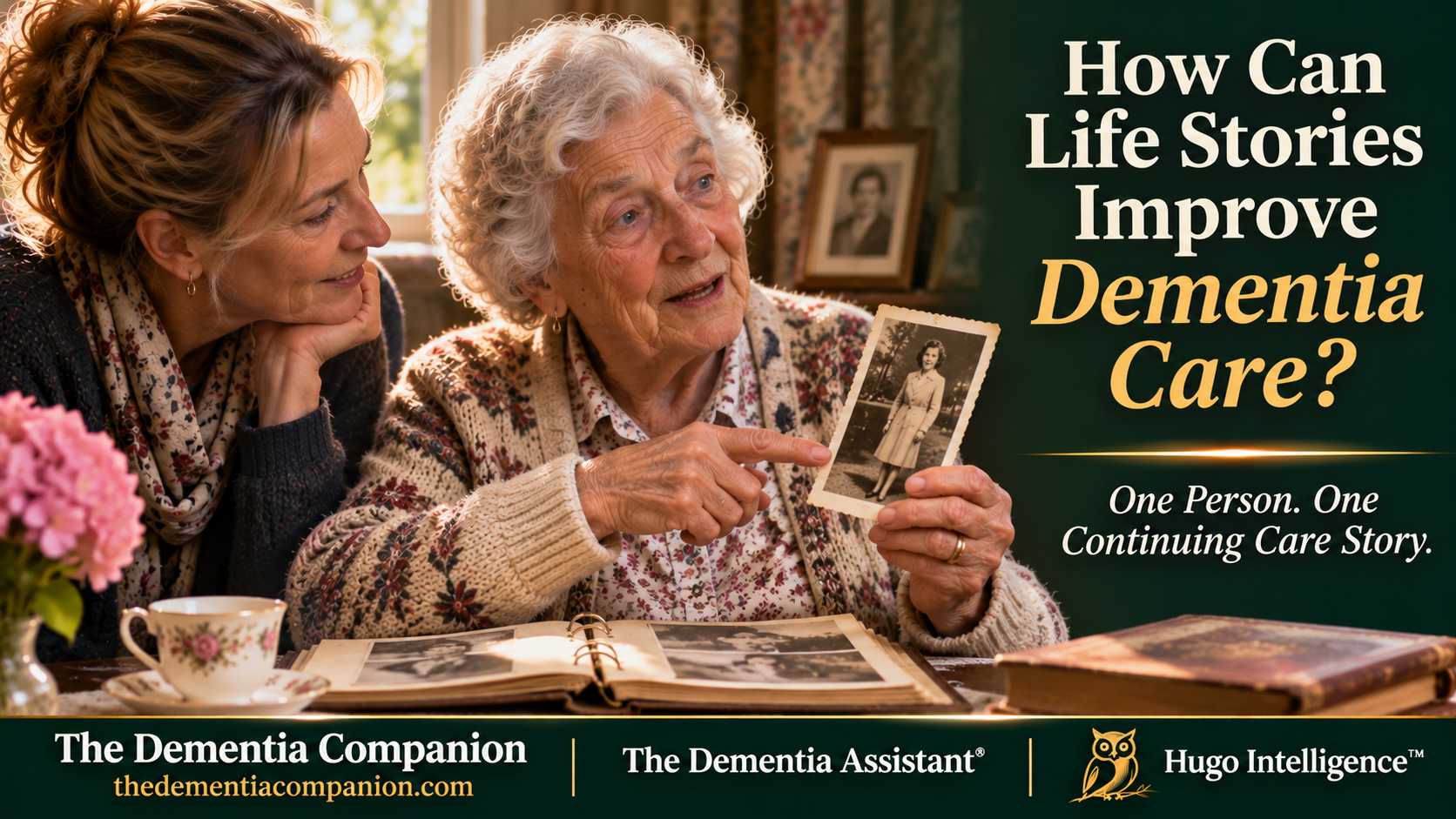
The hospital note says "82, dementia, needs assistance". But where does it say she spent thirty years running a bakery, loves old jazz records and cannot bear being rushed in the morning?
By Louise Donaghy, Dementia Practitioner and Founder of The Dementia Assistant®
A new carer arrives and asks Mum whether she would like breakfast.
Mum says no.
The carer tries again. Mum becomes upset.
What the carer doesn't know is that Mum worked an early shift for most of her life, likes her tea before food and absolutely hates anyone hovering over her. Her favourite breakfast is toast with marmalade, but never before the first cup of tea.
This isn't a medical secret. It is simply Mum.
And it may be the difference between a comfortable morning and a difficult one.
A dementia life story is a record of the person's experiences, relationships, routines, preferences, values and present wishes. It can help relatives and care professionals communicate more respectfully, understand what brings comfort or distress, preserve identity and offer activities that are meaningful to the person. It should be created with the person wherever possible, not simply about them.
What is life story work in dementia care?
Life story work can be a short "About Me" page, a book, photographs with captions, recorded conversations, a memory box, a digital collection or several formats together. Dementia UK recommends including not only past events, but present life and future wishes, and keeping the record updated.
It isn't a school project and it isn't a memory test. It does not need to start at birth or cover every decade. The person's own view should determine what matters.
A useful life story might include: important people, names and preferred forms of address; occupation and meaningful roles; family and cultural traditions; preferred language; favourite music, activities, foods and places; routines; sources of pride; things the person dislikes; communication tips; comforting habits; personal values and wishes for the future.
A person with dementia is still living their story. Include what they enjoy now, not only what they did forty years ago.
How can a life story improve everyday communication?
Knowing somebody's history can turn an awkward exchange into a meaningful conversation.
Instead of "Do you remember who this is?" a carer could say "This is a lovely photo of you and your sister on holiday." Instead of demanding "Come and do the activity", someone might ask whether the former gardener would like to look at the spring planting.
If Dad becomes upset when somebody touches his tools, his life story may explain that he was a skilled engineer who took great pride in his workspace. That doesn't prove why he is upset today, but it helps a professional ask better questions.
If a person prefers being addressed formally, their name and preference should be respected. If they prefer Spanish, Punjabi, Welsh or another language, recording that can help staff arrange appropriate communication.
The US Alzheimer's Association recognises that reminiscence and life history can support connection and meaningful engagement. The benefit varies by person and activity; it is not a cure for dementia or a guarantee of improved memory.
Is life story work the same as reminiscence therapy?
They overlap, but they are not identical.
A life story record captures information that can guide ongoing care. Reminiscence involves talking about past experiences, sometimes using photographs, music or familiar objects. A formal reminiscence therapy programme is different again and may be delivered by trained practitioners.
Someone may enjoy reminiscing with their daughter but dislike being presented with an album in a noisy group. Another person might prefer stories about today. Neither response is wrong.
Don't treat photographs as an examination. Avoid repeatedly asking "Who is that?" if it makes the person feel they are failing. Try commenting gently and letting them lead.
Where should we start if Mum finds questions tiring?
Start small. Ask permission and offer choice.
"Would you like to tell me about your favourite holiday?"
"Which music do you enjoy at the moment?"
"Is there anything you want a new carer to know about you?"
Record short phrases in the person's own words where possible. If they prefer pictures, audio, video or objects, use those. If they don't want to talk about a topic, stop.
You don't need to complete a 40-page document in one sitting. Two or three useful details are a start. A good care record can grow over time.
A fictional example: Janet says little during a new home-care visit. Her daughter shares that Janet always loved being outdoors and prefers to talk while looking at her garden. The carer begins by asking about the roses. Janet seems more comfortable. We cannot prove the life story caused that response, but it offered a more thoughtful approach than repeatedly asking generic questions.
What about painful memories, trauma and private information?
This is crucial. Not every childhood was happy. Some people experienced abuse, forced separation, discrimination, war or bereavement. Other memories may be personal or simply none of a carer's business.
Do not pressure the person to disclose difficult events. Ask whether they want material included, who may read it and whether some details should remain private. Sensitive information that staff need to know to avoid distress can sometimes be conveyed as a practical preference without retelling the full event.
For example, a note might say "Prefers a female support worker for intimate care" without describing an unrelated private history. Only share what is necessary, lawful and appropriate. The person retains a right to dignity and to participate in decisions about their information.
And don't publish photos, personal details or intimate stories to social media simply because they are in a family album.
How does a life story help during a hospital admission or move into care?
Imagine Mum is admitted to hospital. A clinician needs to know her allergies, medication and medical needs, but staff may also benefit from knowing she wears hearing aids, needs extra time to answer, dislikes being touched without explanation and calms when someone speaks her preferred language.
A one-page summary can be more useful in an urgent setting than an enormous album. Include essential communication, comfort, mobility and preference information, supported by the appropriate medical and professional documents.
If Mum moves between home care, hospital, respite and residential care, her individual history can help prevent her being treated as "the new dementia patient in room 4". Each provider still has its own professional duties and records; the family-held life story complements them.
Can life story work ever be unhelpful?
Yes, if it becomes something done to the person. A carer may get caught up trying to complete every section, pressuring the person to remember or insisting a certain photo ought to make them happy. A reminder may trigger loss or distress. People also change: the music they once loved may now irritate them.
Review the record. Ask what the person enjoys today. Be alert to the possibility that relatives hold different versions of family history. Label uncertainty clearly and give the person's own voice priority where possible.
What should a practical dementia life-story page contain?
Start with a readable one-page summary:
How I like to be addressed: My preferred name and pronouns.
What matters to me: People, activities, beliefs, values and routines.
How I communicate best: Language, hearing or vision support, pacing and helpful phrases.
My strengths: What I can still do and want to keep doing.
What helps when I am distressed: Individual comfort and reassurance preferences.
What I dislike: Approaches, sounds or situations to avoid.
Important relationships: People I want involved and how to contact them appropriately.
What I want others to know now: Current wishes, preferences and goals.
The longer version can hold stories, photographs, family milestones and memories. Keep health details and formal legal documents in appropriately protected parts of the care record, rather than assuming every life-story viewer needs access.
Meet Hugo Intelligence™: Turning a life story into better questions
Families might ask: "Hugo, how can I help Mum start her life story without making it feel like a memory test?" Or: "What should new carers know about Dad's previous work, language and morning routine?"
Hugo can suggest accessible conversation prompts, help the family organise information and prepare a concise, respectful summary. The person or family should check accuracy and approve what is recorded.
When a user selects one individual's care plan, Hugo can use relevant information from that selected record to offer more individualised educational suggestions. Without a selected plan, the guidance remains general. Hugo doesn't automatically combine relatives' records.
Within The Dementia Assistant®, the Care Planning Centre™, guided Talk to Hugo, Life Story, Memory & Moments, daily notes, document organisation and Family Circle can help maintain a continuing picture. Family Circle is permissioned; not everyone needs access to every private memory. Saved and categorised Hugo conversations can be revisited as the record develops. Multilingual capabilities can support families across languages, subject to feature and translation limitations.
A life story is not proof of a clinical diagnosis and Hugo does not determine care eligibility or consent. Its value is helping people ask better questions and preserve the individual's own story.
Ask Hugo: Common family questions
When should we start a life story? Whenever the person wishes. Earlier may allow greater direct involvement, but meaningful stories can also be created later with respectful support.
What if Mum cannot remember dates? Dates are not the point. Record the memories and preferences she wants to share; avoid testing her.
Can a life story include present-day interests? It should. A good life story continues to change.
Can carers see the whole record? Share only the relevant information, with appropriate agreement and permissions.
Does every photo help? No. Let the person's response guide you; photographs can also be upsetting.
Can Hugo write it for us? Hugo can help with prompts and structure, but the person and family should review and retain control over the content.
Can a life story improve medical care? It can support communication and person-centred care, but never replaces clinical assessment, medication records or professional judgement.
What if different relatives disagree? Preserve the person's own perspective where possible. Note uncertainty rather than quietly inventing a single family narrative.
One Person. One Continuing Care Story
Different professionals may see different parts of a person's life: the GP, memory clinic, support worker, hospital team, home-care agency or specialist service. The person remains one individual throughout. That is why the family's own continuing record should preserve strengths, preferences, communication, meaningful relationships, relevant observations and professional recommendations, instead of allowing their identity to disappear across separate organisational notes.
The Dementia Assistant® provides family-held, individual care plans through the Care Planning Centre™, guided Talk to Hugo, daily observations, document organisation, Life Story, Memory & Moments, Family Circle and saved conversations. Care-plan information can be updated and shared appropriately, with the person's wishes, privacy, consent and permissions respected. It complements, and never replaces, the care plans, medical records, prescriptions or statutory assessments held by professionals.
Hugo Intelligence™ provides natural conversational dementia guidance. People can ask general questions without selecting a care plan. When a user explicitly selects a particular person's care plan, Hugo can use relevant information recorded in that plan to offer more individualised educational suggestions. Hugo does not automatically access all plans, make diagnoses, decide someone's legal capacity or replace urgent professional care. Conversations can be saved, categorised and revisited.
The Dementia Assistant® offers multilingual workflows. Coverage varies by feature, content, browser, device and subscription access. Important clinical and legal information needs appropriate human verification, and qualified interpreting where necessary.
The Dementia Companion offers free practical articles and education at https://thedementiacompanion.com/ . Families can explore Hugo, individual care plans, learning resources and the Carer Wellbeing Hub at https://thedementiaassistant.com/ . The UK Family subscription is £4.99 a month, with a 30-day complimentary trial for all subscriptions. International pricing should be checked on the platform.
Different professionals. Different services. One person. One continuing story.
Louise, Hugo and Charlie ❤️🦉✨
Louise Donaghy | Founder & CEO of The Dementia Assistant® | Created and powered by Person-Centred Intelligence® | Creator of Hugo Intelligence™
References and further reading
- Dementia UK, Creating a life story: https://www.dementiauk.org/information-and-support/living-with-dementia/creating-a-life-story/
- Alzheimer's Society, Therapy and approaches for memory loss support: https://www.alzheimers.org.uk/about-dementia/stages-and-symptoms/dementia-symptoms/approaches-therapy-memory-loss
- Alzheimer's Association (USA), Reminiscence and reminiscence therapy: https://www.alz.org/help-support/caregiving/daily-care/reminiscence-and-reminiscence-therapy
- NICE, Dementia assessment, management and support (NG97): https://www.nice.org.uk/guidance/ng97/chapter/recommendations
- Alzheimer's Society, Ideas to help a person record their stories: https://www.alzheimers.org.uk/get-support/publications-and-factsheets/dementia-together/apr-may-2021/ideas-help-person-dementia-record-their-stories
- Alzheimer's Association, Dementia care practice recommendations: https://www.alz.org/professionals/professional-providers/dementia_care_practice_recommendations
This is educational guidance. Life-story information should be collected and shared in accordance with the person's wishes, privacy and applicable law. Memory activities are not diagnostic tests or treatments.
You May Also Find Helpful
- How Do I Know When Mum with Dementia Needs a Care Home?
- Mum Seems Fine at the GP but Struggles at Home. How Do I Get Her Needs Heard?
- Mum with Dementia Is Coming Home from Hospital. How Do I Make Sure Her Care Continues?
- How Do I Know If Mum's Dementia Care Needs Are Changing?
- Need help with this situation? Ask Hugo
Need help with your own situation? Ask Hugo.
One Person. One Continuing Care Story. The Dementia Companion is where you discover guidance. Inside The Dementia Assistant®, talk with Hugo, save and categorise conversations, record daily notes and involve authorised supporters in a continuing care plan centred around the person.
Ask Hugo About This · Start Your Continuing Care Plan — Families · Continuing Care Planning — Professionals
Personal guidance requires the appropriate account and subscription access. Care-plan information is used only with authorised access and the required consent and selection steps. All subscription plans include a 30-day complimentary trial.