How Do We Prepare for a Dementia Care Needs Assessment?
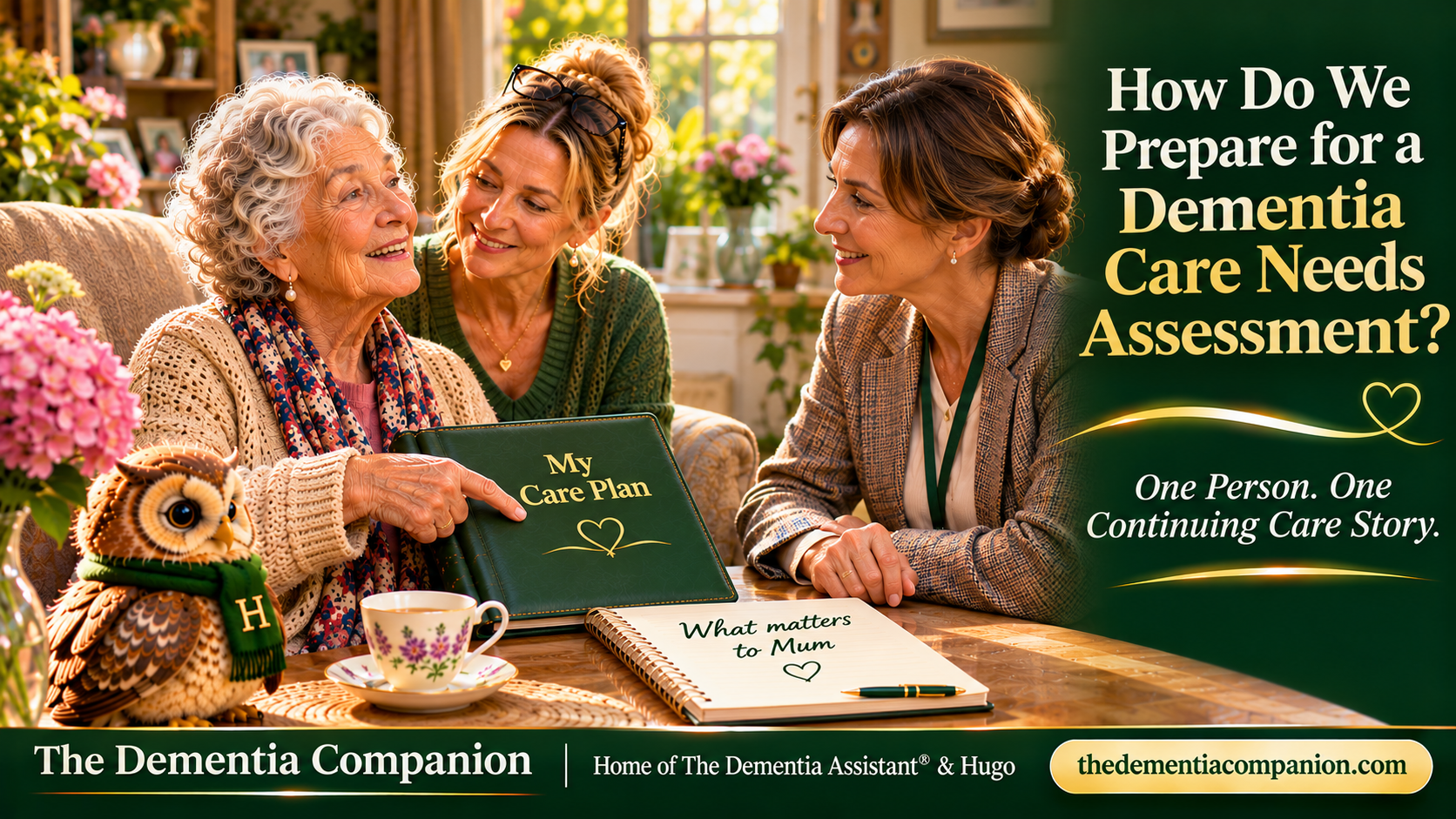
The assessor is coming, Mum says she’s absolutely fine, and you’ve got three notebooks full of things you want to explain. Here’s how to prepare without losing sight of the person.
By Louise Donaghy, Dementia Practitioner, Founder of The Dementia Companion and The Dementia Assistant®, Creator of Hugo Intelligence™
“Someone from social services is coming to do Mum’s care assessment.”
Well, that’s good news.
You’ve been asking for some help, and finally there’s an appointment.
You’ve got your list of concerns ready.
The appointments Mum has missed.
The mornings when getting dressed has become difficult.
The shopping she’s struggling to manage.
The fact that Dad is absolutely exhausted but insists he’s perfectly fine.
And then the assessor arrives.
Mum answers the door.
She’s beautifully dressed, smiling and offering everybody a cup of tea.
She remembers the assessor’s name.
Chats about the weather.
And announces that she manages absolutely everything herself.
Meanwhile, you’re sitting in the corner wondering whether you’ve accidentally brought the assessor to the wrong house.
Because that’s not quite how the last three weeks have felt.
If this sounds familiar, I can understand why preparing for a care needs assessment might make families nervous.
The best way to prepare for a dementia care needs assessment is to bring together the person’s wishes, strengths, everyday support needs, examples of difficulties and information about the help already being provided.
You don’t need a perfect folder.
You don’t need to prove that Mum cannot do anything.
And you certainly don’t need to turn the appointment into a list of everything that has gone wrong.
The assessment should help establish what matters to the person, what they can manage, where they need support and how their wellbeing and independence can be protected.
Because good dementia care doesn’t begin by asking what somebody has lost. It begins by understanding the person and the life they want to continue living.
What is a dementia care needs assessment?
A care needs assessment is a process used by social care services to understand what support a person may need in everyday life.
It is different from a memory clinic assessment.
A memory clinic assessment focuses on investigating concerns about memory, thinking and related symptoms.
A social care needs assessment looks at the person’s daily life, wellbeing and support requirements.
Depending on the individual, this might include:
- Washing, dressing and personal care.
- Preparing meals and eating.
- Moving around the home safely.
- Maintaining a suitable living environment.
- Managing everyday activities.
- Accessing the community.
- Maintaining relationships and meaningful activities.
- Communication and understanding.
- Keeping safe.
- Support already provided by family, friends or professionals.
The assessment should also consider what the person wants to achieve.
Perhaps Mum wants to continue living at home.
Perhaps she wants to visit her favourite café.
Perhaps she needs help preparing meals but wants to continue choosing what she eats.
Or perhaps her biggest concern is that everybody has started making decisions without asking her.
Those wishes matter.
A care needs assessment is not simply a test of whether someone can complete certain tasks. It’s an opportunity to understand how they live and what support would make a meaningful difference.
Is a dementia care needs assessment free?
In England, yes.
A care needs assessment through the local council is free.
You do not need to be on a low income to request one, and you can ask for an assessment even if you expect to pay privately for care.
This is an important distinction.
The assessment is free. The care and support arranged afterwards may not be.
If the assessment identifies eligible needs, the council may carry out a separate financial assessment to establish whether the person must contribute towards the cost of certain services.
Some types of support are provided without charge, while others may be means-tested.
The rules differ across England, Scotland, Wales and Northern Ireland.
Don’t let uncertainty about the cost of care prevent you from asking what assessment and support options are available.
How do we request a dementia care needs assessment?
England
Contact the adult social care department of the local council where the person lives.
Ask for a care needs assessment.
The person can request one themselves, or somebody may help make the request on their behalf with appropriate consent or other lawful authority.
You can also ask a GP, hospital team or relevant professional about a referral.
The council should consider the person’s needs regardless of whether they are likely to pay for their own care.
Scotland
Contact the local council’s social work or social care department.
Scotland has its own arrangements for assessing needs and providing support, including free personal and nursing care for eligible people, subject to the applicable rules.
Wales
Contact the local authority’s social services department.
Assessments operate under the Social Services and Well-being (Wales) Act 2014, with an emphasis on wellbeing, personal outcomes, participation and the person’s wishes.
Northern Ireland
Contact the relevant Health and Social Care Trust.
Health and social care assessments are arranged through the Trust system rather than the same council processes used in England.
If you’re reading this outside the UK, the appropriate assessment, funding and eligibility arrangements will depend on the country where the person lives.
What should we prepare before Mum’s assessment?
Please don’t feel you need to arrive with a forty-page presentation.
Unless you particularly enjoy PowerPoint, in which case I won’t stop you.
But I would recommend beginning with six areas.
- What matters most to Mum
Before discussing what she struggles with, ask what she wants.
Perhaps she wants to remain at home.
Perhaps her garden is important.
Perhaps she wants to continue visiting friends.
Perhaps she would like help with certain tasks but feels strongly about maintaining her independence elsewhere.
These are not minor details.
They help the assessor understand what support should achieve.
You might write:
“Mum wants to continue living at home, choosing her own clothes, attending her weekly social group and spending time in the garden.”
That’s a meaningful starting point.
- What Mum can still do independently
Record her strengths.
Perhaps Mum prepares her breakfast.
Perhaps she manages personal care with reminders.
Perhaps she enjoys walking to the local shop.
Perhaps she can make decisions comfortably when information is explained clearly.
We should never assume a dementia diagnosis means someone needs help with everything.
The assessor needs to understand which abilities should be supported and preserved.
Independence isn’t simply about doing everything alone. It’s also about having choices and being supported to do what matters.
- Where Mum needs assistance
Be factual.
Perhaps Mum has difficulty using the oven safely.
Perhaps she needs reminders about appointments.
Perhaps washing and dressing have become more complicated.
Perhaps she becomes distressed when unfamiliar people arrive.
Describe what happens and how it affects her.
Rather than:
“Mum can’t manage anything.”
Try:
“Mum can choose her clothes, but she sometimes needs support arranging them in the correct order. She becomes frustrated if someone takes over.”
That’s much more useful.
It identifies the difficulty while preserving her strengths.
- How often support is needed
This is particularly important.
Some difficulties happen every day.
Others happen occasionally.
Some are worse when the person is tired, unwell or distressed.
Try to explain the pattern.
For example:
“Mum normally manages breakfast but has needed support with her evening meal on several occasions this month.”
Or:
“Dad is helping Mum with washing and dressing most mornings, but he has arthritis and is finding the physical demands increasingly difficult.”
You don’t need to exaggerate.
You need to explain what is genuinely happening.
- What support is already being provided
Who is helping?
A spouse?
An adult child?
A neighbour?
A paid carer?
Someone from a community service?
Explain the tasks they provide and whether the arrangements are sustainable.
This is especially important when a family member has quietly taken on more responsibilities over time.
- What isn’t working
Perhaps Mum’s current care visits are too rushed.
Perhaps she doesn’t want unfamiliar carers changing every day.
Perhaps she needs assistance at a different time.
Perhaps Dad is struggling to provide overnight support.
The assessor needs to understand what existing arrangements do and do not achieve.
A care plan should fit the person’s life. The person shouldn’t have to fit the care plan.
What if Mum has a particularly good day during the assessment?
This is one of the biggest worries families raise.
And it’s understandable.
Perhaps Mum is confident and sociable when somebody visits.
Perhaps she enjoys the conversation.
Perhaps she answers questions beautifully.
But that doesn’t necessarily show what happens at six in the evening, when she’s tired and struggling with her routine.
Equally, a difficult day doesn’t mean she always experiences those difficulties.
The assessor needs the broader picture, not simply a snapshot of one hour.
You can help by preparing factual examples of what happens on different days.
For example:
“Mum is usually very sociable during visits. However, during the last fortnight she’s needed help managing meals on several evenings. We’ve recorded some examples because we thought they would be useful.”
This is not contradicting Mum.
It’s adding relevant information.
Where possible, discuss the observations with her beforehand.
Don’t make the assessment into a disagreement about whether Mum is telling the truth.
She may genuinely feel she manages well.
She may also have different perceptions of the assistance she receives.
Both perspectives deserve respectful consideration.
Should we keep a diary before the assessment?
A short diary can be very helpful.
Alzheimer’s Society recommends preparing information about the person’s daily difficulties and current support.
You don’t need to record every moment.
Focus on relevant examples.
For instance:
Monday: Mum prepared breakfast independently. Needed help organising her medication questions for the GP.
Tuesday: Enjoyed lunch with a friend. Asked for support with getting ready to go out.
Wednesday: Dad helped Mum with washing and dressing. He said this is becoming physically difficult for him.
Thursday: Mum went for a familiar walk and enjoyed it. Needed reassurance about an upcoming appointment later in the day.
These are fictional examples, but they illustrate something important.
The person has strengths.
The person has wishes.
There are also support needs.
All three belong in the assessment.
If there are sudden medical changes or immediate safety concerns, seek professional assistance rather than waiting for the assessment date.
What documents should we take to a care needs assessment?
You don’t need to provide every document the family has collected.
But it can help to have relevant information available.
Consider:
- A short summary of the person’s wishes and preferences.
- Current support arrangements.
- A record of relevant daily difficulties.
- Important professional contacts.
- A current medication list where relevant.
- Recent reports or letters that explain support needs.
- Relevant hospital discharge information.
- Communication and language preferences.
- Questions the person wants answered.
- Information about support the family is already providing.
Ask the assessor beforehand whether particular documents are required.
And don’t assume the assessment cannot proceed if you haven’t organised everything perfectly.
The conversation itself matters.
Can the family speak during Mum’s assessment?
Usually, the person may have someone they trust involved, subject to their wishes and appropriate arrangements.
But remember whose assessment this is.
Mum should be supported to participate in the discussion as fully as possible.
Ask whether she would like you present.
If she wants you to help explain particular difficulties, agree how to do that respectfully.
Avoid answering every question before she has a chance.
You might say:
“Mum, would you like to explain how your mornings have been, or would you like me to help?”
That gives her a choice.
If she struggles to express herself, the assessor should consider what communication support is appropriate.
In England, the council has duties concerning independent advocacy where a person would otherwise have substantial difficulty participating and there is no appropriate person to support them.
The legal arrangements differ in other UK nations.
What if Mum doesn’t want an assessment?
Take her concerns seriously.
Perhaps she thinks social services will make her move into a care home.
Perhaps she’s worried about losing control.
Perhaps she doesn’t want strangers asking personal questions.
Or perhaps she simply doesn’t think she needs help.
Don’t assume refusal is automatically caused by dementia.
Ask what worries her.
You might say:
“Mum, the assessment is about understanding what help you might want, not automatically changing where you live. Would you like us to find out more before deciding?”
A care needs assessment does not automatically mean somebody must accept services or move into residential care.
But if essential needs are unmet and there are concerns about safety or decision-making capacity, seek appropriate professional advice.
Capacity is decision-specific.
Dementia does not automatically mean a person lacks the ability to make decisions about their care.
Will a care needs assessment mean Mum has to go into a care home?
No.
A care needs assessment is not automatically a step towards residential care.
The outcome might involve:
- Information and community services.
- Support with everyday tasks.
- Equipment or home adaptations.
- Assistance with personal care.
- Day opportunities or social support.
- Rehabilitation or reablement services.
- Other appropriate care arrangements.
Residential care may be discussed where relevant, but it is not the automatic result of a dementia diagnosis or assessment.
The assessment should consider the person’s wishes, needs, wellbeing and the support options available.
If Mum wants to continue living at home, that should be part of the discussion.
What if Dad is exhausted from caring for Mum?
Then Dad’s needs deserve attention too.
This is something families can overlook.
Perhaps Dad has supported Mum for several years.
He manages shopping, appointments, meals and personal care.
He says he’s fine.
But he’s tired.
His own health is suffering.
And he hasn’t had a proper day off in months.
A care needs assessment should take account of the support already provided and whether it can realistically continue.
But Dad may also need his own carer’s assessment.
In England, unpaid carers can request a free carer’s assessment through the local council.
It’s separate from Mum’s needs assessment, although the two may be arranged together.
A carer’s assessment considers how caring affects the person’s wellbeing and what support they may need.
This might include exploring breaks from caring, information, practical help or other services.
Other UK nations have their own assessment arrangements.
The person living with dementia matters. And so does the person supporting them.
What questions should families ask the assessor?
You don’t have to remember everything.
Write down a few questions that matter to Mum and the family.
For example:
- What support needs have been identified?
- How have Mum’s wishes and strengths been included?
- What assistance might help her remain independent?
- Is equipment or an occupational therapy assessment appropriate?
- Are there community activities or services she could access?
- What support is available for family carers?
- Will there be a separate financial assessment?
- Who is responsible for arranging any agreed services?
- When will we receive a written outcome or care plan?
- Who should we contact if Mum’s circumstances change?
- What happens if we disagree with the outcome?
- When will the plan be reviewed?
Choose the questions relevant to your situation.
You don’t need to interrogate the assessor as though they’re appearing before Parliament.
But you are entitled to ask for clear explanations.
What happens after the care needs assessment?
In England, the local council considers whether the person’s needs meet the eligibility criteria for care and support.
If eligible needs are identified, the next steps may involve developing a care and support plan and considering how appropriate support will be arranged.
There may also be a financial assessment to establish contributions towards the cost of chargeable services.
Ask for a copy of the assessment outcome and any agreed care and support plan.
Review the information with the person.
Check that it reflects their wishes, strengths and needs.
Make sure responsibilities and follow-up arrangements are clear.
If services are arranged, ask when they will begin and who to contact with questions.
If the council decides that needs do not meet the relevant eligibility threshold, ask for the reasons and information about alternative support.
You can also ask about review or complaints procedures if the assessment appears inaccurate or incomplete.
The assessment shouldn’t simply end with a conversation. Families need to understand what happens next.
What if Mum’s care needs change after the assessment?
A care plan is not something that should be written once and forgotten.
Needs can change.
Preferences can change.
Family circumstances can change.
And sometimes a temporary illness affects what someone can manage.
If Mum begins needing more support, contact the relevant service and ask for a review.
Don’t assume that the original assessment must remain accurate indefinitely.
NICE recommends coordinated, person-centred dementia care and ongoing reviews.
The person should continue to be involved in decisions as far as possible.
And a family-held record can help you explain what has changed since the last assessment.
Why should families have their own continuing dementia care plan?
This is where I want to explain something that matters enormously to me.
Imagine Mum has been assessed by adult social care.
She also has a GP.
A memory clinic.
Perhaps a dementia nurse.
A home care provider.
And occasionally hospital appointments.
Each professional service has its own responsibilities and records.
Those records are important.
But Mum’s life doesn’t change into a different story depending on who is reading it.
She is still the same person.
With her own history, routines, relationships and preferences.
The Dementia Assistant® was created to give people living with dementia and their families their own continuing place for care information.
A place to preserve the person’s wishes.
A place to record strengths and abilities.
A place to organise relevant observations, appointments and documents.
A place to record support arrangements and questions for professionals.
And a place that can continue when the services around the person change.
A family-held care plan does not replace the official assessment or professional care and support plan.
It complements those records.
The family can maintain its own information, subject to the person’s wishes, access permissions and account arrangements.
Different professionals. Different services. One person. One continuing story.
Meet Hugo Intelligence™: Preparing for an assessment through conversation
Sometimes families don’t know which information is important.
They know something has changed.
They know they need support.
But they’re struggling to explain the situation clearly.
Perhaps Mum manages most things independently but needs help at particular times.
Perhaps Dad’s caring responsibilities are becoming overwhelming.
Perhaps you’re worried that the assessor won’t understand what happens between visits.
You might ask:
“Hugo, Mum has a care needs assessment next week. Can you help us prepare?”
Or:
“Hugo, Dad is doing nearly everything for Mum, but he doesn’t recognise how much it’s affecting him. What should we discuss?”
Or:
“Hugo, how do I explain that Mum is independent in some areas but needs support in others?”
Hugo Intelligence™ offers natural, conversational, person-centred dementia guidance within The Dementia Assistant®.
You can explain what is happening in your own words.
Ask follow-up questions.
Explore concerns.
And work through practical preparation without feeling judged.
Hugo can help you organise questions, consider the person’s wishes and identify everyday information that may be useful to discuss.
He cannot conduct the statutory assessment, determine eligibility or decide what services the council must provide.
Those remain professional and legal responsibilities.
But he can help families prepare for the conversation.
Hugo can use the person’s selected care plan
You can ask Hugo general dementia questions without selecting a care plan.
But when you select Mum’s care plan, Hugo can use relevant recorded information about her routines, strengths, communication preferences and support needs to offer more individualised guidance.
For example, if Mum’s plan records that she enjoys preparing breakfast but needs help with evening routines, that information can help you think through what should be discussed at the assessment.
Not simply:
“What support does someone with dementia need?”
But:
“What support would help Mum continue the life she wants?”
That is the principle behind Person-Centred Intelligence®.
Save and organise your Hugo conversations
The assessment may raise questions you haven’t considered.
Perhaps you want to revisit a conversation about home support.
Or return to guidance about maintaining independence.
Or prepare for another discussion after receiving the outcome.
Within The Dementia Assistant®, you can save, categorise and organise Hugo conversations.
This allows you to return to useful discussions without starting again.
Saved conversations are educational guidance, not official assessment records or legal decisions.
But they can help families maintain continuity in the questions they’re exploring.
Hugo’s multilingual support: Care planning in the person’s own language
Imagine Mum feels most comfortable speaking Welsh.
Perhaps Dad grew up speaking Irish.
Perhaps a family member prefers Hindi, French or Spanish.
Or perhaps the person living with dementia finds complex questions much easier to understand in their familiar language.
Language is part of identity.
And it can affect how someone participates in important conversations about their own care.
The Dementia Assistant® supports 12 interface languages and offers dictation and translation capabilities spanning 201 languages.
These tools can help families record observations, organise information and prepare questions across language barriers.
Dictation can make it easier for somebody to explain their circumstances without typing.
Hugo’s conversational approach also allows families to ask questions naturally.
Not every feature is available in all 201 languages.
Important clinical, legal and financial information should be checked for translation accuracy.
If the person needs an interpreter or communication adjustments for the formal assessment, ask the assessment service to arrange appropriate support.
A person-centred assessment should recognise the language and communication style that helps the person express their wishes.
Can Family Circle help everyone prepare?
When several relatives are involved, different people may know different parts of Mum’s life.
One person helps with shopping.
Another attends appointments.
Someone else lives abroad.
And perhaps Dad provides most of the daily support.
The Dementia Assistant® includes Family Circle features to support appropriate sharing of care updates.
This can help involved relatives communicate about relevant arrangements, while respecting the person’s wishes, privacy and access permissions.
But don’t turn the assessment into an opportunity for every family member to submit a list of everything they think Mum should be doing differently.
Her voice matters most.
The family is there to support her.
Not to vote on her independence.
A practical dementia care needs assessment checklist
Before the appointment, consider:
- [ ] Have we asked what Mum wants from the assessment?
- [ ] Do we understand what she manages independently?
- [ ] Have we recorded relevant difficulties honestly?
- [ ] Have we considered better days as well as difficult days?
- [ ] Do we know what support is already being provided?
- [ ] Are family caring responsibilities realistic and sustainable?
- [ ] Have we gathered relevant professional information?
- [ ] Have we recorded communication and language preferences?
- [ ] Does Mum want someone to support her during the assessment?
- [ ] Have we considered whether an advocate or interpreter is needed?
- [ ] Are there activities and relationships Mum wants to maintain?
- [ ] Have we prepared questions about equipment or home support?
- [ ] Do we understand that assessment and funding are separate questions?
- [ ] Will we ask for a written outcome and agreed next steps?
- [ ] Do we know whom to contact if needs change?
You don’t need to complete every item perfectly.
The aim is to make the assessment more useful, not create another burden.
The assessment is about a life, not a list of limitations
I want to finish with something I think families sometimes need reminding of.
Mum is not a collection of tasks.
She isn’t simply somebody who needs help washing, dressing or remembering appointments.
She is a woman who has lived an entire life.
Who may love her garden.
Who has her own sense of humour.
Who knows exactly how she likes her tea.
And who may have some rather strong opinions about somebody suggesting she needs help choosing her clothes.
Those opinions matter.
Her independence matters.
Her dignity matters.
And her family’s wellbeing matters too.
A good assessment should explore what support would help Mum live the life she wants as far as possible.
It should recognise what she can do, where she needs assistance and what matters to her beyond the diagnosis.
Because the question isn’t simply:
“What can Mum no longer manage?”
It’s:
“What support would help Mum continue being Mum?”
And that is where person-centred dementia care should always begin.
⸻
Ask Hugo: Dementia Care Needs Assessment Questions
Hugo, Mum has a dementia care needs assessment. What should we prepare?
Hugo 🦉: Start with Mum’s wishes, daily routines, strengths and the areas where she needs support.
Keep a few factual examples of difficulties and information about the help she already receives.
I can help you organise your questions, while the assessor remains responsible for the formal assessment.
Is a dementia care needs assessment free?
Hugo 🦉: In England, the local council’s care needs assessment is free.
The care arranged afterwards may involve charges, depending on the services and any financial assessment.
Scotland, Wales and Northern Ireland have different arrangements.
What if Mum seems perfectly fine when the assessor visits?
Hugo 🦉: Explain that her abilities and support needs may vary.
You can share factual examples from different days while respecting Mum’s perspective and allowing her to participate.
A short record of relevant observations may be helpful.
Will Mum automatically have to move into a care home?
Hugo 🦉: No. A care needs assessment does not automatically mean residential care.
It considers what support may help the person, including assistance at home, equipment and other services where appropriate.
Mum’s wishes and individual circumstances should remain central.
Can Hugo help us prepare a person-centred care plan?
Hugo 🦉: Yes. Within The Dementia Assistant®, I can help you work through care-planning questions about the person’s life, routines, strengths, preferences and support needs.
You can review the information and maintain your own continuing care plan.
Can Hugo use Mum’s existing care plan when answering questions?
Hugo 🦉: Yes, when you select Mum’s care plan.
I can use relevant recorded information to provide more individualised guidance.
Without a selected plan, I can still provide general dementia information.
Can I save my conversations with Hugo?
Hugo 🦉: Yes. You can save, categorise and organise our conversations within The Dementia Assistant®.
This means you can revisit useful guidance before or after the assessment.
Can Hugo help if Mum speaks another language?
Hugo 🦉: The Dementia Assistant® supports 12 interface languages and dictation and translation capabilities spanning 201 languages.
These tools can help families prepare information in different languages.
For formal assessments, ask for appropriate professional interpretation or communication support when necessary.
Can Family Circle help relatives share information?
Hugo 🦉: Family Circle can support appropriate family updates.
The person’s wishes, privacy and permissions should guide who receives information.
Does Hugo replace the council’s assessment?
Hugo 🦉: No. I can help you prepare questions and organise information, but I cannot carry out statutory assessments, establish eligibility or make funding decisions.
What if Dad also needs support as Mum’s carer?
Hugo 🦉: He may be able to request a carer’s assessment.
In England, this is a separate, free assessment through the local council.
It considers how caring affects him and what support may help.
How much does The Dementia Assistant® cost?
Hugo 🦉: The Family subscription is £4.99 per month.
Every subscription includes a 30-day complimentary trial, allowing you to explore personalised care planning, saved conversations, daily notes, Family Circle and multilingual support.
⸻
One Person. One Continuing Care Story.
When someone living with dementia needs additional support, several services may become involved.
Adult social care.
The GP.
The memory clinic.
Community nurses.
Home care providers.
Occupational therapists.
Each organisation may maintain its own professional records.
But the person living with dementia and their family should also have their own continuing place for care information.
A place to preserve the person’s wishes.
A place to record strengths, preferences and routines.
A place to organise relevant documents and everyday observations.
A place to prepare for care assessments and professional appointments.
And with Hugo Intelligence™, a place to ask questions naturally, save conversations, explore personalised guidance and benefit from multilingual support.
The Dementia Assistant® was created to help the person living with dementia and their family maintain their own continuing care information throughout the journey.
It doesn’t replace professional assessments, care plans or clinical records.
It complements them.
Different professionals. Different services. One person. One continuing story.
Would You Like Hugo to Help You Prepare for Mum’s Assessment?
You don’t have to begin with a complicated form.
Tell Hugo what’s happening.
Explain what Mum enjoys, what she manages and where she might need support.
You can explore practical questions and use the guided Care Planning Centre™ to build information around the person.
The Dementia Assistant® also brings together:
- Person-centred, family-held care plans.
- Hugo Intelligence™ for conversational dementia guidance.
- Daily notes and observations.
- Organised documents and appointment information.
- Saved and categorised Hugo conversations.
- Family Circle for appropriate updates.
- Life Story and Memory & Moments.
- Multilingual support, dictation and translation.
- Dementia learning and practical resources.
Your care information can continue with you as professionals and services change.
Every subscription includes a 30-day complimentary trial.
Explore The Dementia Assistant®:
https://thedementiaassistant.com/
The Dementia Companion, home of The Dementia Assistant® and Hugo 🦉
https://thedementiacompanion.com/
Louise and Hugo ❤️🦉
Louise Donaghy
Founder & CEO of The Dementia Assistant®
Created and powered by Person-Centred Intelligence®
Creator of Hugo Intelligence™
⸻
References and Further Reading
- NHS: Getting a Care Needs Assessment
Official guidance about requesting a free care needs assessment in England, preparing for it, financial assessments and what happens afterwards.
- Alzheimer’s Society: The Care Needs Assessment, Support for People With Dementia
Detailed information about preparing for assessment, daily examples, family involvement, supporting evidence and outcomes.
https://www.alzheimers.org.uk/get-support/legal-financial/dementia-care-needs-assessment
- Dementia UK: The Care Needs Assessment and Financial Means Test
Guidance from dementia specialist Admiral Nurses about assessment, care needs and potential care costs.
- NHS: Care and Support Plans
Explains what an agreed care and support plan may contain and how it should be reviewed.
- NICE: Dementia, Assessment, Management and Support (NG97)
Guidance about coordinated, individualised dementia care, care planning and involving people in decisions.
https://www.nice.org.uk/guidance/ng97/chapter/recommendations
- NHS: Carer’s Assessments
Information about free assessments for unpaid carers in England.
https://www.nhs.uk/social-care-and-support/support-and-benefits-for-carers/carer-assessments/
- GOV.UK: Care and Support Statutory Guidance
Official statutory guidance under the Care Act 2014, including person-centred assessment and eligibility processes in England.
- MyGov Scotland: How to Get Personal and Nursing Care
Official guidance about requesting an assessment through local social work services in Scotland.
https://www.mygov.scot/personal-nursing-care/how-to-get-it
- Welsh Government: Social Services and Well-being (Wales) Act, Part 3 Code of Practice
Guidance about assessing needs, personal outcomes and involvement in Wales.
- NI Direct: Arranging Health and Social Care
Official Northern Ireland guidance about needs assessments through Health and Social Care Trusts.
https://www.nidirect.gov.uk/articles/arranging-health-and-social-care
⸻
Important information: This article provides general educational guidance and does not replace individual social care assessments, professional medical advice, safeguarding procedures or legal advice. Assessment, charging and care arrangements differ between UK nations and internationally.
Reviewed: 21 November 2026
You May Also Find Helpful
Need help with your own situation? Ask Hugo.
One Person. One Continuing Care Story. The Dementia Companion is where you discover guidance. Inside The Dementia Assistant®, talk with Hugo, save and categorise conversations, record daily notes and involve authorised supporters in a continuing care plan centred around the person.
Ask Hugo About This · Start Your Continuing Care Plan — Families · Continuing Care Planning — Professionals
Personal guidance requires the appropriate account and subscription access. Care-plan information is used only with authorised access and the required consent and selection steps. All subscription plans include a 30-day complimentary trial.