Dementia Care Diary: What Should Families Record Each Day?
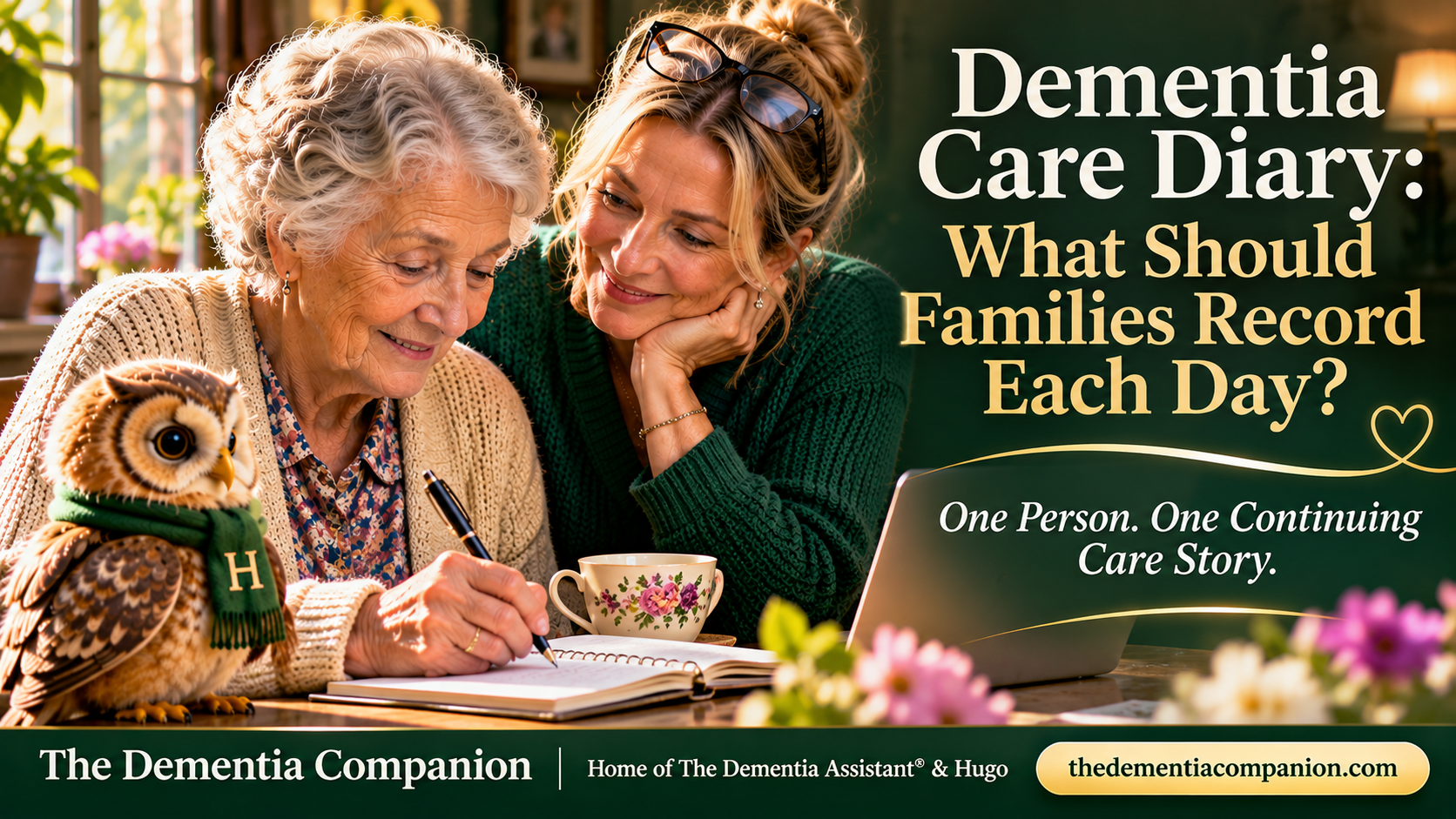
Dementia Care Diary: What Should Families Record Each Day?
The little things you notice today might help explain the bigger picture tomorrow. But a care diary should never take over someone’s life.
By Louise Donaghy, Dementia Practitioner, Founder of The Dementia Companion and The Dementia Assistant®, Creator of Hugo Intelligence™
“How has Mum been since we last saw her?”
Such an innocent question.
Usually asked by a GP, memory clinic specialist or dementia nurse while you’re sitting opposite them trying desperately to remember what happened over the last six weeks.
You remember Tuesday. Or was it Thursday?
You remember Mum wasn’t herself one afternoon.
You remember she had a wonderful day when her granddaughter visited.
And you’re certain there was something important you wanted to mention about her sleeping.
But the minute somebody asks, your brain decides it’s time for a little holiday.
Then, naturally, you remember everything on the journey home.
This is one of the reasons a dementia care diary can be so useful.
A dementia care diary helps families keep a simple, factual record of everyday wellbeing, meaningful changes, concerns and things that work well.
It doesn’t need to be complicated.
It shouldn’t become a running commentary on everything somebody does.
And it certainly shouldn’t make the person living with dementia feel as though they’re constantly being assessed.
A useful diary should help protect their wellbeing, dignity and independence.
Not turn their life into paperwork.
What is a dementia care diary?
A dementia care diary is a personal record that helps someone living with dementia, or people supporting them, keep track of relevant everyday experiences and changes.
It might include information about sleep, eating, drinking, mood, communication, health concerns, activities or appointments.
But it can also record something equally important.
What went well.
Perhaps Mum enjoyed a visit from an old friend.
Perhaps Dad managed his usual walk independently.
Perhaps a familiar song helped someone feel calmer.
Those details matter too.
A good dementia care diary should show the person behind the diagnosis, not simply provide a list of difficulties.
It can be kept in a notebook, on a calendar or within a secure digital care-planning system.
What matters is that it works for the person and those appropriately involved in supporting them.
Why might keeping a dementia diary help?
Dementia can affect memory, thinking, communication and everyday functioning in different ways.
But changes in someone’s wellbeing are not necessarily caused by dementia.
Pain, illness, medication effects, poor sleep, environmental changes and other factors can also affect how someone feels or behaves.
A brief diary may help families notice when something happens, what was happening around the person and whether there are patterns worth discussing with a professional.
The NHS suggests that a diary kept over one or two weeks can sometimes help identify possible triggers for changes in behaviour.
That does not mean a diary can diagnose the cause.
It simply provides information that might help guide further conversations.
And that can be particularly useful when several different professionals are involved.
What should families record each day?
You do not need to record every category every day.
Choose information that is relevant to the person’s current circumstances.
- Mood and emotional wellbeing
Has the person appeared comfortable, content, worried, withdrawn or unusually distressed?
Where possible, ask how they feel rather than relying entirely on your interpretation.
For example:
“Mum said she felt worried about tomorrow’s appointment. She seemed more relaxed after we talked through the plans together.”
That is more useful than writing:
“Mum was difficult today.”
The first records an experience and what appeared to help.
The second labels the person without explaining what happened.
- Sleep and rest
If sleep has become a concern, it may help to record:
- Approximate bedtime and waking time.
- Significant periods of waking during the night.
- Daytime tiredness.
- Any discomfort or concerns reported.
- Changes from the person’s usual sleep routine.
You do not need to monitor someone’s every movement.
The purpose is to notice relevant changes, not create another reason for everyone to lose sleep.
- Eating and drinking
If there are concerns about appetite, hydration or swallowing, relevant observations may include:
- Meals and drinks accepted or declined.
- Foods the person particularly enjoyed.
- Changes in appetite.
- Difficulties with eating or drinking.
- Any coughing, choking or swallowing concerns.
If the person is having difficulty swallowing, repeated choking or signs of dehydration, seek appropriate medical advice rather than relying on diary entries alone.
- Mobility, pain and physical comfort
Sometimes a person may struggle to describe discomfort clearly.
You might notice they are moving differently, avoiding a usual activity or appearing uncomfortable when sitting or standing.
Record what happened without assuming the cause.
For example:
“Dad said his knee hurt when he stood up from the chair. He walked more slowly than usual afterwards.”
A record like this can help you explain a concern accurately.
Dementia UK advises that changes in behaviour can sometimes be related to pain and that recording observations may help identify patterns.
- Communication and everyday activities
Has the person found a familiar task more difficult?
Have they had trouble following a conversation?
Have they enjoyed an activity that is particularly meaningful to them?
Keep these notes specific.
For example:
“Mum found the television remote confusing this afternoon. She was happy to choose the programme while I helped with the buttons.”
Notice the difference.
We haven’t written that Mum can no longer use the television.
We’ve described one difficulty and a practical way she continued making her own choice.
That’s person-centred care.
- Medication questions and health concerns
If a concern arises around medication, record the facts and speak to an appropriate healthcare professional.
Do not make medication changes based on diary observations alone.
Keep any medication administration records accurate where these are part of an agreed care arrangement.
A family diary can complement formal medication records but should not replace them.
- The good moments
This is the section I especially want families to remember.
Record the laugh.
The outing.
The favourite song.
The afternoon in the garden.
The joke Dad told for approximately the four-hundredth time, which everyone still enjoyed.
Because a dementia care diary should not make the person disappear beneath their symptoms.
Good care is about supporting a life, not simply documenting a condition.
What does a good dementia care diary entry look like?
Let’s use a fictional example.
Tuesday, 17 November
Morning: Mum enjoyed breakfast and chatted about her garden. She chose her clothes independently.
Afternoon: We went for a short walk. Mum said she felt tired afterwards and rested comfortably.
Evening: Mum became worried about an appointment she thought was happening tomorrow. We looked at the calendar together and she said she felt reassured.
Health observations: No new physical concerns reported.
What worked well: Keeping the afternoon quiet and checking the appointment calendar together.
Follow-up: Ask Mum whether she would find a larger calendar helpful.
That’s enough.
There’s no need to write a novel.
Unless, of course, you’ve always wanted to write one, in which case I would recommend a slightly more exciting plot.
The important thing is that the entry is factual, respectful and useful.
Should I record dementia symptoms every day?
Not necessarily.
Some families find daily notes helpful, especially when circumstances are changing or several people are involved in support.
Others only need to record significant events.
The person living with dementia should be involved in deciding what is recorded wherever possible.
A diary should never feel like surveillance.
It should also respect privacy, particularly when recording personal care, emotional distress or sensitive family matters.
If you’re recording information about someone else, consider whether the information is necessary, who can see it and whether appropriate permission has been given.
And don’t forget that the person may want to write or dictate their own observations.
It’s their life.
Their perspective matters.
Can a dementia diary help identify patterns?
Sometimes.
Suppose someone becomes unsettled at a similar time on several evenings.
A diary might help you notice whether they have been tired, uncomfortable, hungry, overwhelmed by noise or affected by a change in routine.
It may also show that some evenings are completely different.
That’s useful information.
But be careful about drawing conclusions too quickly.
One pattern does not prove a cause.
For example, if somebody appears distressed after dinner, it doesn’t automatically mean dinner caused the distress.
There could be pain, illness, medication effects, tiredness or other factors requiring assessment.
NICE recommends considering clinical, environmental and other possible causes of distress in dementia.
A diary may help you explain what you’ve noticed to an appropriate professional.
It isn’t a substitute for that professional assessment.
When should we seek medical help instead of recording symptoms?
This is particularly important.
Sudden confusion or an abrupt change in alertness requires immediate medical assessment.
Do not assume that a sudden deterioration is simply the dementia progressing.
Acute confusion may be caused by delirium or another health problem.
If someone develops sudden confusion, seek immediate medical help. Call 999 for a life-threatening emergency.
Other concerning changes, such as significant pain, repeated falls, reduced eating or drinking, swallowing difficulties or persistent distress, should also be discussed promptly with an appropriate healthcare professional.
A diary is there to support good care.
Never to delay it.
Who should keep the dementia care diary?
There isn’t one correct answer.
Some people living with dementia may wish to maintain their own diary independently.
Others may prefer support from a family member.
Some families may have several people helping.
The important thing is that the person’s choices, privacy and involvement are respected as far as possible.
And when different people are supporting someone, a shared approach can reduce confusion.
For example, one family member might record an appointment.
Another might note a concern that arose during a visit.
Another might help update the person’s care plan.
Information should only be shared with people who have appropriate permission and a genuine reason to receive it.
The goal is to create continuity without taking control away from the person.
Why shouldn’t a family’s care diary belong only to a care agency?
A person living with dementia may receive support from many different organisations over time.
The GP has medical records.
The memory clinic has assessment information.
A hospital has its own records.
A care agency may maintain daily care notes.
These professional records are essential.
But families may still need their own continuing place for information.
A place that doesn’t depend entirely on which service is currently involved.
A place where everyday experiences, preferences, observations and important conversations can stay together.
The Dementia Assistant® was created to help people living with dementia and their families maintain their own person-centred care information throughout the journey.
Professional records remain separate.
The family-held care plan complements them.
Because the person should not have to start their story from the beginning every time a new service becomes involved.
How does The Dementia Assistant® help with daily care notes?
This is where I wanted to make things a little easier.
Not everyone enjoys paperwork.
Some people find typing difficult.
Others are supporting someone while juggling their own work, children, appointments and everyday responsibilities.
And sometimes, after a long day, the last thing anybody wants is another complicated form.
The Dementia Assistant® brings together personalised care plans, daily notes, documents, Life Story, Family Circle and Hugo Intelligence™.
Families can maintain their own care information in one continuing account.
They can record observations, preserve important preferences and organise information that may be helpful during professional appointments.
And they can ask Hugo for guidance about everyday situations.
But Hugo offers something particularly useful beyond simply storing information.
He can have a conversation with you about it.
Meet Hugo Intelligence™: More than a place to store notes
Imagine writing:
“Mum seemed unsettled after lunch today. I’m not sure what was bothering her.”
You might want to explore whether something about her routine, comfort or surroundings could have contributed.
With Hugo Intelligence™, you can ask questions in natural language, explain what’s happening and explore possible person-centred approaches.
You might ask:
“Hugo, Mum has been more unsettled in the afternoons. What should I look out for?”
Or:
“Hugo, Dad seems to enjoy music but becomes tired afterwards. How could we adapt his routine?”
Or simply:
“Hugo, I’m worried and don’t know where to start.”
Hugo provides conversational dementia guidance, helping families think through situations without judgement.
He cannot diagnose symptoms, identify a medical cause from a diary or replace healthcare professionals.
But he can help you explore relevant questions and prepare for discussions with the people providing clinical care.
Guidance based on a selected care plan
Hugo can answer general dementia questions without access to a particular person’s care plan.
However, when you select a care plan within The Dementia Assistant®, Hugo can use relevant information recorded about that person’s routines, preferences and circumstances to provide more individualised guidance.
That means a conversation about afternoon distress can take account of the person’s recorded preferences and daily life, rather than relying entirely on generic suggestions.
The person remains at the centre.
Save and organise your Hugo conversations
Sometimes an important conversation doesn’t finish in one sitting.
You might ask Hugo about sleep today.
Revisit the subject next week.
And want to find the discussion again before the next GP appointment.
Within The Dementia Assistant®, you can save, categorise and organise Hugo conversations for later reference.
This creates continuity in the questions you explore, alongside your own continuing care records.
Not another answer lost in a sea of messages.
A useful conversation you can return to.
Multilingual dementia care: Recording information in the language that matters
Language is part of someone’s identity.
It can shape how they express feelings, describe pain, communicate preferences and connect with people around them.
For multilingual families, dementia care can involve additional challenges.
One relative may speak English.
Another may feel more comfortable in French, Spanish, Hindi, Welsh or another language.
Family members may live in different countries.
And some people living with dementia may experience changes in how they use their languages over time.
The Dementia Assistant® supports 12 interface languages and provides dictation and translation capabilities spanning 201 languages.
These tools can help families record observations, organise information and communicate across language barriers.
The person’s preferred language should be recorded within their care information wherever relevant.
This is particularly important when someone expresses themselves differently in different languages.
Not every feature is available in every language, and significant medical information should always be checked for translation accuracy.
Professional interpreting remains important for clinical conversations when needed.
But accessible multilingual tools can help make everyday dementia support more inclusive.
Because person-centred care should understand not only what someone is saying, but the language in which they feel most comfortable saying it.
How can care diary entries help at GP and memory clinic appointments?
A short series of factual observations can help explain what has happened between appointments.
Before a review, consider looking back through your records.
Ask:
- Have there been significant changes?
- Has a concern happened more than once?
- What has the person said about how they feel?
- What has been going well?
- Are there questions about medication or other health issues?
- What support would the person like?
The Dementia Assistant® can help keep relevant notes and documents organised, while Hugo can help you explore questions you may wish to raise.
The final interpretation of symptoms and decisions about clinical care remain with appropriately qualified professionals.
The family diary should help the conversation.
Not replace it.
What if the person moves between care services?
This is one of the most important reasons to keep a continuing record.
Imagine that Mum attends a memory clinic, then receives hospital treatment, later begins receiving support at home and eventually requires additional care.
Different services may be involved.
Different professionals may ask questions.
Different records may be created.
But the person is still Mum.
Her preferences still matter.
Her history still matters.
Her routines, relationships and wishes still matter.
One Person. One Continuing Care Story.
With a family-held care plan and relevant daily notes, information can continue to be maintained as services change.
The Dementia Assistant® is designed to give the person and family their own place to organise that information, independent of any single provider.
It doesn’t replace professional records or guarantee that every service will automatically accept or access the family’s information.
But it provides a way to preserve and prepare relevant details for appropriate sharing.
A diary should help you live, not take over your life
If there’s one thing I’d like you to remember, it is this:
You do not have to document every single moment.
You don’t need to spend your evenings writing reports about someone you love.
You don’t need to turn a perfectly lovely afternoon into a clinical observation.
Sometimes a walk is simply a walk.
A laugh is simply a laugh.
And a cup of tea together is a cup of tea together.
Those moments are important whether you write them down or not.
A good dementia diary helps when information needs remembering, sharing or discussing.
It should give you more confidence and clarity, not another burden to carry.
⸻
Ask Hugo: Questions About Dementia Care Diaries
Hugo, what should I write in Mum’s dementia care diary?
Hugo 🦉: Start with relevant changes, important appointments, wellbeing concerns and things that help Mum enjoy her day.
You don’t need to record everything.
Keep entries factual, respectful and centred on her own experience.
Should I keep daily notes even when nothing is wrong?
Hugo 🦉: Only if they’re useful to Mum and your family.
You can record positive experiences, favourite activities and things that work well.
But there’s no need to document every moment. Ordinary life and privacy matter too.
Can I record dementia care notes in The Dementia Assistant®?
Hugo 🦉: Yes.
The Dementia Assistant® includes daily notes and personalised care-planning tools so you can maintain information about your loved one’s care and everyday experiences.
Can Hugo help me understand patterns in Mum’s daily notes?
Hugo 🦉: I can help you explore possible questions and person-centred approaches based on information you choose to discuss.
When you select Mum’s care plan, I can also use relevant recorded details to make guidance more individualised.
But I cannot diagnose the cause of symptoms or replace medical assessment.
Can I save the conversations I have with Hugo?
Hugo 🦉: Yes. You can save, organise and categorise our conversations within The Dementia Assistant®.
That means you can return to important discussions and continue exploring questions over time.
Can I dictate daily notes instead of typing them?
Hugo 🦉: The Dementia Assistant® includes dictation features, which can make recording information easier for people who prefer speaking rather than typing.
It also provides multilingual translation and dictation capabilities across 201 languages, alongside 12 interface languages.
Always review dictated and translated information for accuracy.
Can other family members help keep the care diary?
Hugo 🦉: Family Circle features can help appropriately involved relatives share updates and stay connected.
Access and information sharing should respect the person’s wishes, privacy and relevant permissions.
What if the GP or care agency already keeps records?
Hugo 🦉: Their professional records remain important.
Your own family-held record has a different purpose. It helps you maintain relevant information about the person across different services and appointments.
How much does The Dementia Assistant® cost?
Hugo 🦉: The Family subscription is £4.99 per month.
All subscriptions include a 30-day complimentary trial, allowing you to explore the care-planning tools, daily notes, multilingual support and Hugo Intelligence™.
⸻
One Person. One Continuing Care Story.
When someone is living with dementia, their journey may involve GPs, memory clinics, hospitals, dementia nurses, home care providers and other professionals.
Each service may keep its own records.
But the person and their family should have the opportunity to maintain their own continuing care information.
A place to record what matters.
A place to preserve strengths, preferences and wishes.
A place to organise daily observations, important documents and appointment information.
And with Hugo Intelligence™, a place to have supportive conversations, save guidance, explore personalised approaches and use multilingual tools.
The Dementia Assistant® was created to help put the person living with dementia and their family at the centre of their own continuing care story.
It does not replace professional clinical records or professional care.
It helps families maintain their own information alongside those services.
Different professionals. Different services. One person. One continuing story.
Meet Hugo and The Dementia Assistant®
Created by dementia practitioner Louise Donaghy and powered by Person-Centred Intelligence®, The Dementia Assistant® brings together:
- Hugo Intelligence™ for conversational, person-centred guidance.
- Guided personalised care planning.
- Daily notes and observations.
- Organised documents and appointment information.
- Saved and categorised Hugo conversations.
- Life Story, Memory & Moments and Family Circle.
- Multilingual support, dictation and translation.
- Dementia education and practical resources.
Every subscription includes a 30-day complimentary trial.
Explore The Dementia Assistant®:
https://thedementiaassistant.com/
The Dementia Companion, home of The Dementia Assistant® and Hugo 🦉
https://thedementiacompanion.com/
Louise and Hugo ❤️🦉
Louise Donaghy
Founder & CEO of The Dementia Assistant®
Created and powered by Person-Centred Intelligence®
Creator of Hugo Intelligence™
⸻
References and Further Reading
- NHS: Coping With Dementia Behaviour Changes
Explains how keeping a diary over one or two weeks may help identify possible triggers and changes in behaviour.
https://www.nhs.uk/conditions/dementia/living-with-dementia/behaviour/
- Dementia UK: Understanding Dementia and Pain
Discusses how changes in behaviour may be associated with discomfort and why recording observations can help.
https://www.dementiauk.org/information-and-support/health-advice/pain-and-dementia/
- Dementia UK: Getting the Best Out of GP and Other Health Appointments
Provides guidance on recording changes, preparing questions and organising information for consultations.
- NICE: Dementia, Assessment, Management and Support (NG97)
National guidance covering person-centred care, appropriate assessment, care planning and support.
https://www.nice.org.uk/guidance/ng97/chapter/recommendations
- Alzheimer’s Society: Reducing and Managing Behaviour That Challenges
Explains how recording circumstances around a change in behaviour may help identify possible contributing factors.
- NHS: Sudden Confusion (Delirium)
Explains why sudden confusion requires immediate medical attention.
https://www.nhs.uk/symptoms/confusion/
⸻
Important information: This article provides general educational guidance and does not replace medical assessment, legal advice or professional care planning. Sudden confusion and other acute concerning changes need prompt medical attention.
Reviewed: 20 November 2026
You May Also Find Helpful
- How Do I Know When Mum with Dementia Needs a Care Home?
- Person-Centred Dementia Care Plan: Complete Checklist
- Mum Seems Fine at the GP but Struggles at Home. How Do I Get Her Needs Heard?
- Mum with Dementia Is Coming Home from Hospital. How Do I Make Sure Her Care Continues?
- Need help with this situation? Ask Hugo
Need help with your own situation? Ask Hugo.
One Person. One Continuing Care Story. The Dementia Companion is where you discover guidance. Inside The Dementia Assistant®, talk with Hugo, save and categorise conversations, record daily notes and involve authorised supporters in a continuing care plan centred around the person.
Ask Hugo About This · Start Your Continuing Care Plan — Families · Continuing Care Planning — Professionals
Personal guidance requires the appropriate account and subscription access. Care-plan information is used only with authorised access and the required consent and selection steps. All subscription plans include a 30-day complimentary trial.