Dementia Care After Diagnosis: Where Do We Start?
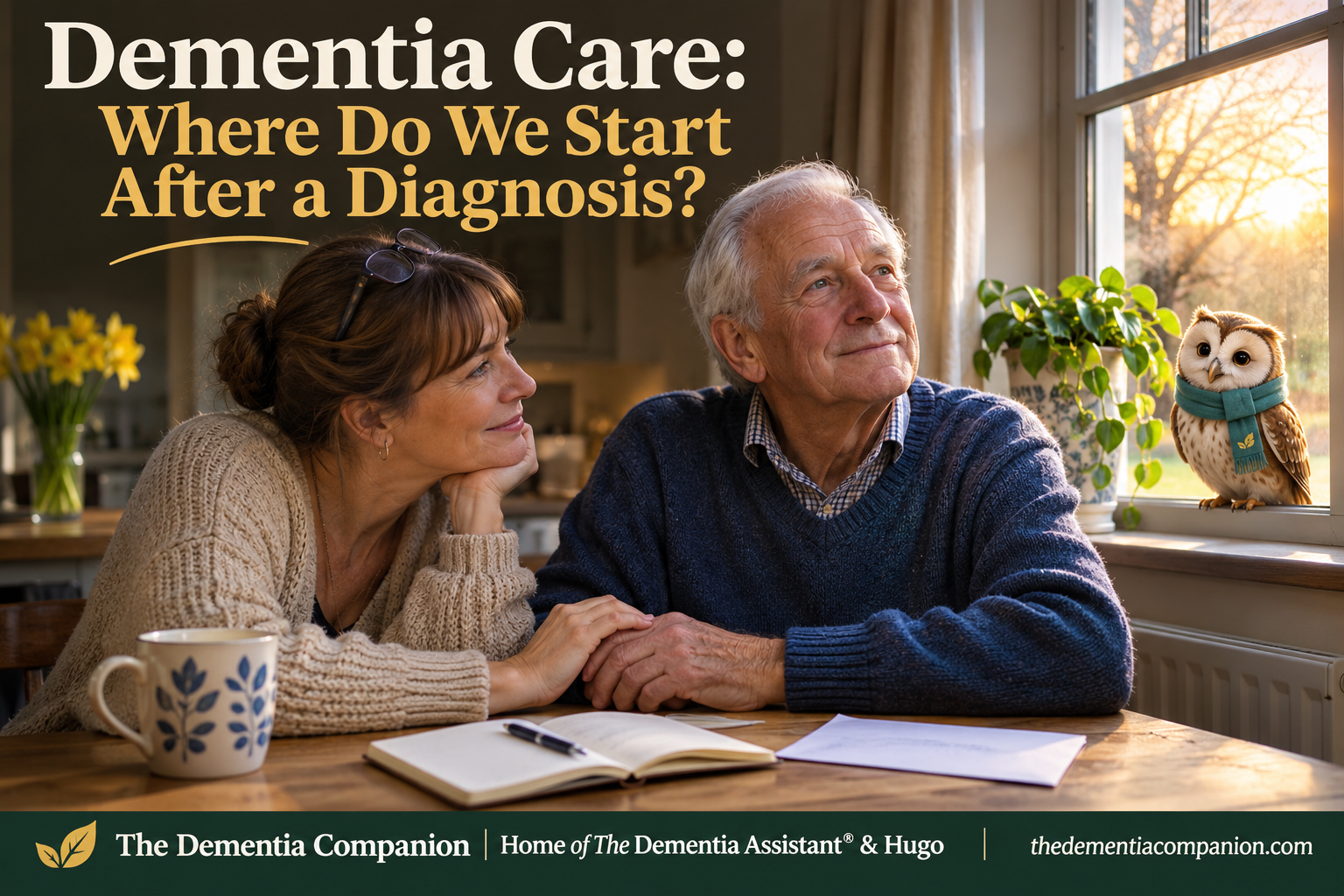
Dementia Care: Where Do We Start After a Diagnosis?
Your first steps towards understanding dementia, finding support and continuing to live life, one manageable day at a time.
By Louise Donaghy, Dementia Practitioner, Founder of The Dementia Companion and The Dementia Assistant®, and Creator of Hugo Intelligence™.
There is a moment after a dementia diagnosis that nobody really prepares you for.
The appointment finishes. The doctor has explained what they can. Someone hands you a leaflet, perhaps mentions a memory clinic, and tells you there is support available.
Then you walk out of the building.
And suddenly, the questions begin.
What do we do now? Will Mum still be able to live at home? Does Dad need someone with him all the time? Who do we tell? What happens next?
You might feel frightened, angry, relieved to finally have an explanation, or strangely numb. You might even find yourself discussing what to have for dinner on the way home because neither of you quite knows what else to say.
And that is all right.
If someone you love has recently been diagnosed with dementia, you do not need to organise their entire future this afternoon.
Start by understanding the diagnosis, listening to what matters to the person, arranging appropriate follow-up support and making everyday life a little easier where needed.
You can explore other decisions gradually.
A diagnosis tells you something important about a person’s health. It does not tell you everything about their abilities, their personality or the life they can continue to enjoy.
And that is where good dementia care begins.
What is dementia care, and where should we start?
Dementia care is not simply helping someone who forgets things.
It is about supporting a person to live as well as possible, with their identity, relationships, choices and dignity respected.
For one person, that might mean a reminder about an appointment. For another, it might mean adapting how information is presented, getting help with medication or arranging more practical support.
Some people will need significant assistance. Others may continue managing much of their everyday life independently for quite some time.
There is no single timetable that applies to everyone.
When a family first receives a diagnosis, I would encourage them to begin with three questions:
- What matters most to the person right now?
- What, if anything, is becoming difficult in everyday life?
- What support could make things easier without taking away independence unnecessarily?
Notice what these questions do not ask.
They do not begin with everything the person might lose.
They begin with the person.
First, remember the person is still the person
Your mum is still your mum.
She may still enjoy her garden, insist nobody makes tea quite like she does, and have very strong opinions about where the Christmas decorations belong.
Your husband may still love his music, enjoy teasing the grandchildren and believe the television remote has been deliberately designed to test his patience.
Dementia does not erase someone’s individuality on the day they receive their diagnosis.
One of the most important early conversations is not about medication, finances or paperwork.
It is simply asking:
“What would you like life to look like now?”
Perhaps they want to keep attending church, walking the dog, visiting friends or going to their favourite café.
Perhaps they want more information about their diagnosis.
Perhaps they would rather have a few quiet days before talking about it again.
Where possible, let the person guide these conversations.
Do not assume that receiving a diagnosis means they are immediately unable to make decisions.
Decision-making ability depends on the particular decision and circumstances. People should be supported to make their own choices wherever possible.
What does person-centred dementia care look like?
Person-centred care means understanding someone’s life, not just their symptoms.
It includes their:
- Personal history, family relationships and important memories.
- Preferred name, language and communication style.
- Culture, beliefs, routines and values.
- Interests, strengths and abilities.
- Likes, dislikes, worries and sources of comfort.
- Wishes about who should be involved in their support.
These details are not extras to think about when the paperwork is finished.
They are part of the foundation of good care.
A person who has always enjoyed a quiet morning may not suddenly appreciate six relatives arriving with colour-coded folders and fifteen excellent suggestions.
Even when everyone means well.
Sometimes the most helpful thing a family can do is make a cup of tea, sit together and ask what would help today.
What should we do in the first few days after a dementia diagnosis?
There are some practical things worth addressing reasonably soon, but there is no need to tackle them all in one sitting.
Understand the diagnosis
If the appointment felt like a blur, ask for the information again.
You can contact the memory clinic, GP practice or diagnosing specialist.
Useful questions include:
- What type of dementia has been diagnosed?
- What does that diagnosis mean for this person?
- Are there treatment options or other health conditions we should discuss?
- What follow-up appointments or reviews are planned?
- Who should we contact if something changes?
- Will a care and support plan be arranged?
- What local support is available?
Different types of dementia can affect people differently, and an individual person’s needs may change over time.
You do not need to become an expert overnight.
You just need somewhere sensible to begin.
Find out who your main professional contact is
Families can sometimes leave an appointment with several leaflets but no clear idea who to ring.
Ask for the name and contact details of the professional or service coordinating follow-up care.
Depending on where you live, this might involve a GP, memory service, dementia adviser, specialist nurse or another professional.
NICE guidance recommends access to appropriate specialist dementia services following diagnosis, alongside an agreed care and support plan.
If nobody has explained what happens next, it is reasonable to ask.
You are not being difficult.
You are asking for continuity of care.
Review anything affecting immediate safety or wellbeing
A dementia diagnosis does not automatically mean someone needs constant supervision.
But it can be sensible to talk together about whether there are any current difficulties involving medication, cooking, travelling, managing money or finding their way around.
The aim is to identify genuine concerns, not remove activities simply because a diagnosis has been made.
If the person drives, they must notify the relevant licensing agency and their motor insurer. In Great Britain this is the DVLA, and in Northern Ireland it is the DVA. A dementia diagnosis does not automatically mean an immediate permanent loss of the driving licence.
Seek professional advice about individual safety concerns rather than making assumptions.
How can we support everyday life without taking over?
One of the biggest changes after a diagnosis can happen not to the person with dementia, but to everyone around them.
Suddenly, somebody wants to manage the diary.
Somebody else wants to reorganise the kitchen.
And another relative has decided all the cupboards need labels.
By Friday, the person whose home it actually is may be wondering when everyone is planning to leave.
Good intentions are lovely. Too many at once can be exhausting.
Before changing a familiar routine, ask whether something genuinely needs changing.
Start with small, practical adjustments
Depending on the person’s preferences and needs, helpful ideas may include:
- Keeping frequently used items in familiar places.
- Using a calendar or reminders if the person finds these helpful.
- Making written information clear and easy to follow.
- Reducing unnecessary distractions during conversations.
- Checking that glasses and hearing aids are working comfortably.
- Supporting regular meals, hydration, sleep and enjoyable activity.
- Making appointments and medication information easier to find.
These are options, not compulsory instructions.
If someone manages their morning routine perfectly well, there is no need to redesign it.
And please remember that accepting support does not mean surrendering independence.
Sometimes the right adjustment gives someone more freedom, not less.
Why is a dementia care plan important?
A dementia care plan should never be just a collection of medical facts.
It should describe the person, what matters to them, the support they want or need, and how that support can be reviewed.
In England, NHS guidance says people should have a care plan after diagnosis, with opportunities for the person and relevant family members or carers to contribute.
Good care planning might include:
The person: Their name, preferences, relationships, background and what is important to them.
Their strengths: What they can do independently and what they want to continue doing.
Their health: Relevant diagnoses, medication, appointments and professional advice.
Communication: How they prefer information to be shared and what makes conversations easier.
Daily life: Routines, activities, food preferences, mobility, rest and social connections.
Support: Where assistance may be useful and who has agreed to provide it.
Review: What is changing, what is working and what needs discussing with professionals.
A care plan should be developed with the person’s involvement as far as possible, shared appropriately and updated as circumstances change.
It belongs to the person’s life, not simply to a filing cabinet.
Keeping information together can help
Families often find themselves repeating the same information to different services.
One appointment asks about medication. Another asks about changes at home. A third wants to know about sleep, eating or behaviour.
Keeping a clear record can help everyone prepare.
That might be a simple notebook, a folder or a digital care-planning system.
The important thing is that information is accurate, shared with appropriate permission and useful to the person receiving care.
This is one of the reasons I created The Dementia Assistant®, home to Hugo Intelligence™.
It gives individuals, families and professionals a way to bring person-centred information together, develop care plans, record daily changes, save important details and prepare for appointments.
Not to replace a doctor, nurse or dementia specialist.
But to help families arrive at those conversations feeling more organised and better able to explain what has been happening.
Where can we find dementia support in the UK?
Support following a dementia diagnosis is available through healthcare services, social care, charities and community organisations.
However, services, referral arrangements and legal processes vary across England, Scotland, Wales and Northern Ireland.
England
Start with your GP practice or memory service and ask about follow-up care, a dementia care plan and local support.
Alzheimer’s Society provides information, a dementia support line and a directory of local services.
Dementia UK offers specialist dementia nursing support through its Admiral Nurses and advice services.
Your local council can explain how to request an adult social care needs assessment and how family carers can seek a carer’s assessment.
Scotland
People newly diagnosed with dementia are entitled to post-diagnostic support under Scotland’s national approach.
Ask your diagnosing service or GP about referral arrangements and local dementia support, including Dementia Link Workers where available.
Alzheimer Scotland and NHS inform provide information and guidance.
Wales
Ask your GP, memory assessment service or local health board about post-diagnostic support.
Wales has been developing dementia connector arrangements to help people and families access ongoing guidance. Availability and local arrangements should be confirmed with your health board.
Alzheimer’s Society Cymru and local authority services can also help families explore community and care support.
Northern Ireland
Your GP, memory service or local Health and Social Care Trust can help explain local dementia services and available assessments.
Alzheimer’s Society provides information and support in Northern Ireland.
Arrangements for powers of attorney, driving notifications and some care services are different from those in Great Britain.
Wherever you live, ask one straightforward question:
“Who can help us understand what support is available locally, and how do we access it?”
You do not have to navigate every service without guidance.
How do we look after emotional wellbeing after a diagnosis?
There is a great deal of practical advice surrounding dementia, but sometimes the emotional side gets pushed to the bottom of the list.
A person may be grieving changes they have noticed.
They may be worried about how their family will see them.
They may feel relieved that their experiences finally have an explanation.
They might want to talk. They might not.
There is no correct emotional response to a diagnosis.
Try not to make every conversation about dementia.
Continue discussing ordinary life, funny family stories, tomorrow’s plans, the garden, the dog and whether the weather has finally decided what season it is.
Enjoyable activity, companionship, movement suited to someone’s abilities and meaningful routines remain important.
If anxiety, persistent low mood, sleep difficulties or distress are affecting daily life, discuss them with an appropriate healthcare professional.
People living with dementia deserve emotional support just as much as practical support.
What about family members and unpaid carers?
Families can find themselves becoming organisers, advocates, chauffeurs, appointment secretaries and unofficial detectives investigating the whereabouts of somebody’s glasses.
Sometimes all before breakfast.
But supporting a person with dementia should not mean one family member has to carry everything alone.
If you are providing unpaid care, ask about a carer’s assessment and local support.
Depending on your circumstances and where you live, this may include practical information, emotional support, respite options, training, financial guidance and community services.
You may not think of yourself as a carer.
You might simply think, “I’m her daughter.”
And of course you are.
But recognising the support you provide can make it easier to access help when you need it.
Try to have conversations about sharing responsibilities before everyone becomes exhausted.
One person might manage appointments. Another might help with shopping or transport. Someone else may be best at organising paperwork.
Support does not always have to mean doing more.
Sometimes it means making sure nobody has to do everything.
What decisions can wait, and what should we plan ahead for?
This is where families can become understandably overwhelmed.
Search online for dementia care and, before long, you may find yourself reading about legal documents, specialist equipment, residential care and situations that may be years away or may never apply in quite the way described.
It is useful to plan ahead.
It is not useful to frighten yourself into believing every possible difficulty is waiting around the corner.
Things to consider reasonably soon
Discuss the diagnosis, follow-up arrangements, any immediate health or safety concerns and how the person would like others to be involved.
If the person drives, meet the legal notification requirements promptly.
If they are working, ask for relevant advice about employment and any work-related safety requirements.
It may also be sensible to begin conversations about legal and financial planning while the person can actively express their preferences.
Things you can explore gradually
These might include:
- Future care preferences and advance care planning.
- Powers of attorney and financial arrangements.
- Benefits or financial support that may be available.
- Possible adaptations to the home.
- Additional community services.
- Longer-term care preferences.
A dementia diagnosis does not automatically remove a person’s legal capacity.
In England and Wales, lasting powers of attorney allow someone to appoint trusted people for specified decisions. Scotland and Northern Ireland have different legal arrangements.
The person should be involved in planning and decision-making as fully as possible. Seek qualified legal advice where needed.
There may be good reasons not to delay certain legal arrangements indefinitely, but they should not be presented as proof that independence has ended.
Planning ahead is about protecting choice.
Not taking it away.
What if things suddenly get worse?
Dementia usually involves changes over time, but not every new symptom is caused by dementia.
Sudden confusion or an abrupt change in behaviour, alertness or functioning may indicate an illness or another medical problem, including delirium.
This needs urgent medical assessment.
Do not simply assume that the dementia has suddenly progressed.
Similarly, new pain, significant distress, reduced eating or drinking, repeated falls or concerning medication effects should be discussed with an appropriate healthcare professional.
For sudden confusion, seek immediate medical help. If there is a life-threatening emergency, call 999.
A diagnosis must never become a reason to overlook another treatable health problem.
A gentle first-week checklist after a dementia diagnosis
You do not need to complete this list in seven days. Think of it as somewhere to begin, rather than another test you have to pass.
Start with the person.
Ask what they understand about the diagnosis, what they would like to know and what matters most to them.
Find your professional contact.
Check who will provide follow-up support and when the next appointment or review will take place.
Write down your questions.
You will probably think of important questions approximately three minutes after leaving an appointment. Almost everyone does.
Keep a notebook or shared document so you can remember them next time.
Identify any immediate concerns.
Discuss current difficulties or safety issues without assuming everything needs to change.
Find one useful source of support.
That might be a memory service, dementia charity, local adviser or community organisation.
Begin a simple care record.
Record what matters to the person, relevant health details and useful information for future appointments.
Make space for ordinary life.
Have lunch together. Go for a walk. Watch a favourite programme. Laugh at something completely unrelated to dementia.
Life is still happening.
Frequently asked questions about dementia care after diagnosis
What is the first thing to do after a dementia diagnosis?
Begin by listening to the person’s wishes, understanding their diagnosis and confirming who will provide follow-up support. Address immediate health or safety concerns, but avoid making unnecessary changes to everyday life.
Can someone with dementia continue living independently?
Yes, many people continue living independently after a diagnosis, sometimes with little or no immediate assistance. Individual needs and abilities vary. Support should be based on the person’s circumstances rather than the diagnosis alone.
Does someone with dementia need a care plan?
A person-centred care plan is an important part of good dementia support. In England, NHS guidance says people should have a care plan after diagnosis. Ask your GP or memory service what planning and reviews are available locally.
Is dementia care free on the NHS?
NHS healthcare is generally provided under the relevant NHS arrangements, but social care and practical support may be subject to different eligibility, assessment and charging rules. These vary across the UK. Ask your local health and social care services for information specific to your nation and circumstances.
What support is available for families caring for someone with dementia?
Support can include dementia advisers, GP and memory services, charities, carer’s assessments, community groups, practical care services and specialist dementia nursing advice. Availability varies locally.
How quickly does dementia progress after diagnosis?
There is no single timetable. Progression varies depending on the type of dementia, the individual and other health factors. A diagnosis does not tell a family exactly how quickly someone’s needs will change.
How can Hugo help after a dementia diagnosis?
Hugo Intelligence™ can help families explore everyday dementia questions, prepare for appointments, think about communication and understand person-centred approaches.
Within The Dementia Assistant®, families can also organise care plans, record observations, preserve life-story details and use the information they choose to share to support more individualised guidance.
Hugo is a support and information tool, not a replacement for clinical assessment or professional advice.
You do not have to work everything out today
If there is one thing I would like you to take away from this article, it is this:
The diagnosis may be new, but the person you love is not.
You do not have to turn your home into a care setting overnight.
You do not have to learn every medical term before the weekend.
And you certainly do not have to anticipate every possible challenge.
Begin with what matters today.
Keep the person’s voice at the centre.
Ask questions, find support and make one manageable decision at a time.
There may be difficult days ahead. There may also be beautiful, funny, surprising and completely ordinary days.
Those ordinary days still matter.
And dementia care should help protect as many of them as possible.
Meet Hugo: a little guidance when you need it
I created The Dementia Companion and The Dementia Assistant®, powered by Person-Centred Intelligence®, because families deserve practical, compassionate support that sees the person before the condition.
Through Hugo Intelligence™, families can ask questions, explore approaches and find guidance that helps them feel a little less alone.
The Dementia Companion offers accessible information and educational resources. The Dementia Assistant® brings together interactive guidance, care planning, daily notes, family information and practical tools in one place.
All subscriptions to The Dementia Assistant® include a 30-day complimentary trial.
Explore The Dementia Companion:
https://thedementiacompanion.com/
Meet Hugo and The Dementia Assistant®:
https://thedementiaassistant.com/
Because dementia care should never begin by forgetting the person.
Louise and Hugo ❤️🦉
Louise Donaghy
Founder & CEO of The Dementia Assistant®
Created and powered by Person-Centred Intelligence®
Creator of Hugo Intelligence™
⸻
Important information: This article provides general educational guidance, with a focus on the United Kingdom. It does not replace medical, legal or individual care advice. Services and legal arrangements differ across the four UK nations. Reviewed: 20 November 2026.
References and Further Reading
The following trusted UK resources provide additional information about dementia diagnosis, care planning, support services and living well with dementia.
1. NICE: Dementia Assessment, Management and Support (NG97)
National guidance covering dementia diagnosis, person-centred care, care planning and ongoing support.
https://www.nice.org.uk/guidance/ng97/chapter/recommendations
2. NHS: Just Diagnosed with Dementia
Practical advice about what happens after a dementia diagnosis, including treatment, follow-up appointments and planning ahead.
https://www.nhs.uk/conditions/dementia/symptoms-and-diagnosis/just-been-diagnosed/
3. NHS: Dementia Help and Support
Information about care plans, local services, assessments and support for people living with dementia and their families.
https://www.nhs.uk/conditions/dementia/care-and-support/help-and-support/
4. Dementia UK: After a Diagnosis of Dementia, Next Steps Checklist
A practical guide to understanding the diagnosis, finding professional support and planning the next steps.
https://www.dementiauk.org/information-and-support/specialist-diagnosis-and-support/how-to-get-a-diagnosis-of-dementia/after-a-diagnosis-of-dementia-next-steps-checklist/
5. NHS inform: Advice Following a Dementia Diagnosis in Scotland
Information about support, services and next steps for people diagnosed with dementia in Scotland.
https://www.nhsinform.scot/illnesses-and-conditions/brain-nerves-and-spinal-cord/dementia/caring-for-someone-with-dementia/advice-if-youve-just-had-a-dementia-diagnosis/
6. Welsh Government: Dementia Action Plan Progress Update
Information about dementia support developments and post-diagnostic services in Wales.
https://www.gov.wales/dementia-action-plan-progress-update-march-2025
7. NI Direct: Dementia and Managing Money
Official Northern Ireland guidance about financial arrangements and planning following a dementia diagnosis.
https://www.nidirect.gov.uk/articles/dementia-and-managing-money
8. NHS: Sudden Confusion (Delirium)
Important guidance explaining why sudden confusion requires urgent medical assessment and should not automatically be attributed to dementia.
https://www.nhs.uk/symptoms/confusion/
Article reviewed: 20 November 2026
The Dementia Companion, home of The Dementia Assistant® and Hugo Intelligence™.
https://thedementiacompanion.com/
Ask Hugo: Your Questions About Dementia Care After Diagnosis
Q: Hugo, someone in my family has just been diagnosed with dementia. Where do we start?
Hugo 🦉: First, remember that a diagnosis does not change who your loved one is. You don’t need to make every decision today. Start by asking what matters to them, understanding their diagnosis and finding out what support is available. Take things one step at a time, and remember to make room for ordinary life too.
Q: Can my loved one still live independently after a dementia diagnosis?
Hugo 🦉: Absolutely, many people continue living independently following a diagnosis. Dementia affects everyone differently. The important thing is to understand what the person can still do, where they might welcome a little support and how to protect their independence for as long as possible. A diagnosis alone should never determine someone’s abilities.
Q: What is a dementia care plan, and do we really need one?
Hugo 🦉: Think of a care plan as a way of keeping everything important about a person together. Not just their diagnosis and medication, but their routines, preferences, personality, strengths and wishes.
With The Dementia Assistant®, you can create and develop a personalised care plan, record daily observations, add relevant documents and keep useful information organised for appointments and care discussions.
And you don’t have to start with a blank page. I can guide you through building that care plan, one manageable question at a time.
Q: How can Hugo help us with everyday dementia care?
Hugo 🦉: You can ask me questions whenever something feels confusing or difficult.
Perhaps Mum keeps asking when she’s going home, Dad is becoming unsettled in the evenings, or you’re not sure how to approach personal care without causing distress.
I can help you explore what might be happening, suggest gentle ways to communicate and consider practical approaches based on the person’s needs.
Within The Dementia Assistant®, you can also select an existing care plan so I can provide more personalised guidance using the information you’ve chosen to record.
I’m here to support your understanding, not to replace medical professionals or make diagnoses.
Q: Can The Dementia Assistant® help us prepare for GP and memory clinic appointments?
Hugo 🦉: Yes. You can keep track of changes in mood, sleep, communication, eating, daily routines and other observations through daily notes.
You can also organise relevant documents and care information, helping you prepare clearer summaries and questions for healthcare appointments.
It means you don’t have to rely entirely on remembering everything when somebody asks, “How have things been since we last saw you?”
Q: What if several family members are involved in caring for someone?
Hugo 🦉: Caring for somebody can involve an entire family, sometimes living in different towns or even different countries.
The Dementia Assistant® includes Family Circle features to help keep relevant updates and information organised, with appropriate access and permissions.
The aim is to support communication, reduce repeated explanations and help everyone remain focused on the person receiving care.
Q: Does The Dementia Assistant® only help families?
Hugo 🦉: Not at all. It’s designed for people living with dementia, families, unpaid carers and professionals.
It includes care planning, daily notes, document organisation, person-centred guidance, learning resources and tools to support communication.
Professionals and organisations can use these resources to support their work, while families can maintain their own records and continue building a picture of the person’s needs over time.
Q: What if English isn’t our family’s first language?
Hugo 🦉: The Dementia Assistant® includes multilingual support, translation and dictation features to make dementia information and care documentation more accessible.
Language is part of someone’s identity. Being able to communicate in a familiar language can be especially important when supporting a person living with dementia.
Q: Is The Dementia Assistant® expensive?
Hugo 🦉: Support shouldn’t feel out of reach.
The Family subscription to The Dementia Assistant® is £4.99 per month, approximately the price of a cup of coffee.
All subscriptions include a 30-day complimentary trial, allowing you to explore the features and discover what works for you.
Q: Hugo, what is the most important thing you want families to remember?
Hugo 🦉: That the person comes first. Always.
You don’t have to have every answer, and you won’t get everything right every day. Nobody does.
Start with what matters to the person you love. Protect their choices, celebrate their strengths and ask for help when you need it.
And please remember, you’re allowed to laugh together, enjoy ordinary moments and continue making memories.
A dementia diagnosis is part of someone’s story. It isn’t their whole story.
Meet Hugo and The Dementia Assistant®
Created by dementia practitioner Louise Donaghy, The Dementia Assistant®, powered by Person-Centred Intelligence®, brings practical dementia support together in one place.
From your first questions following diagnosis to personalised care planning, everyday guidance, daily records, family communication and professional care discussions, Hugo is here to help you navigate each stage.
Explore The Dementia Assistant® and start your 30-day complimentary trial:
https://thedementiaassistant.com/
The Dementia Companion, home of The Dementia Assistant® and Hugo 🦉
https://thedementiacompanion.com/
Because dementia care should always begin with the person, not the diagnosis.
Louise and Hugo ❤️🦉
You May Also Find Helpful
Need help with your own situation? Ask Hugo.
One Person. One Continuing Care Story. The Dementia Companion is where you discover guidance. Inside The Dementia Assistant®, talk with Hugo, save and categorise conversations, record daily notes and involve authorised supporters in a continuing care plan centred around the person.
Ask Hugo About This · Start Your Continuing Care Plan — Families · Continuing Care Planning — Professionals
Personal guidance requires the appropriate account and subscription access. Care-plan information is used only with authorised access and the required consent and selection steps. All subscription plans include a 30-day complimentary trial.