Dementia at Night: Who Helps When Family Carers Cannot Sleep?
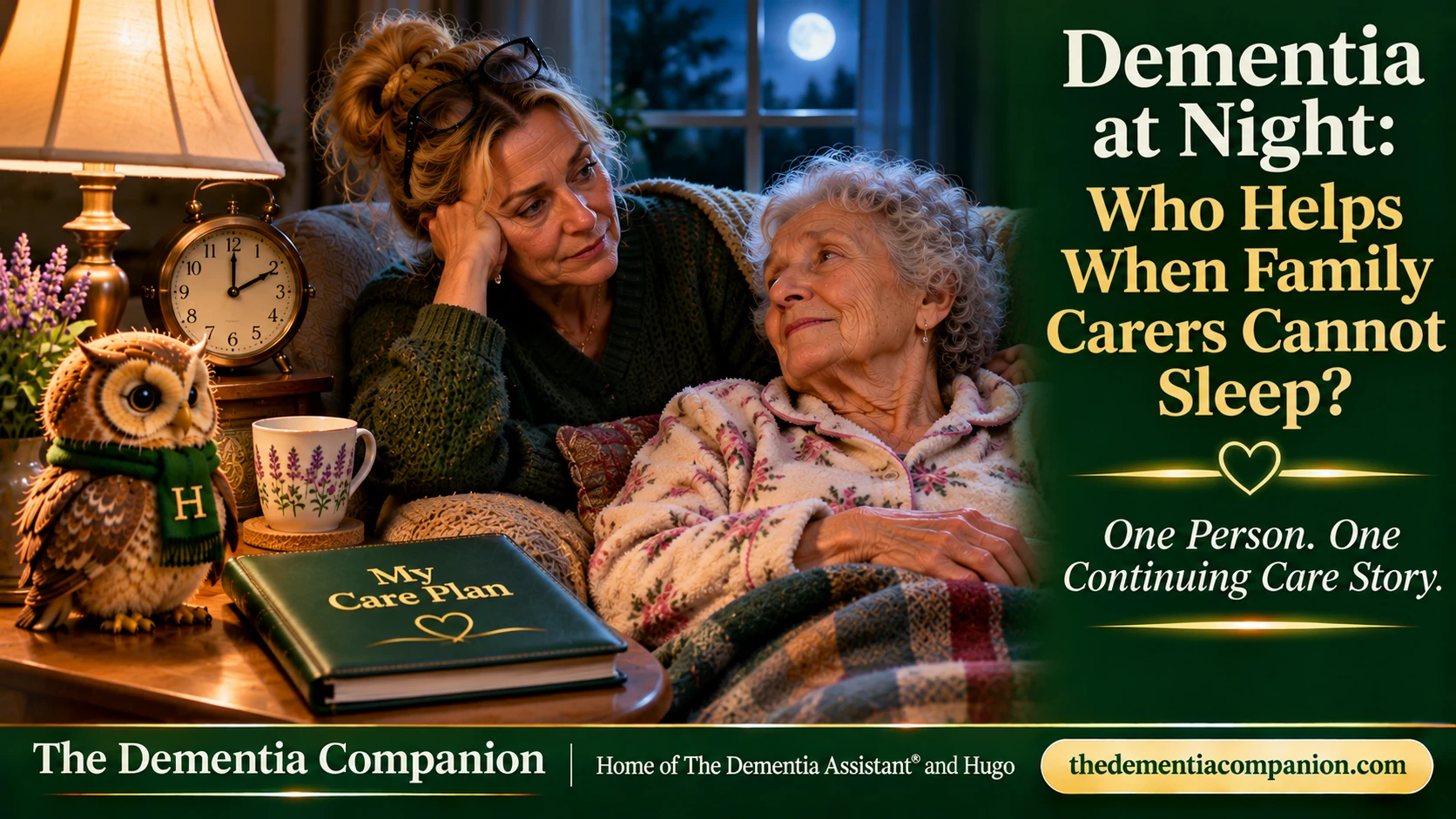
It’s 2.17 in the morning. Mum is awake again. You’re exhausted, you’ve barely slept, and tomorrow’s responsibilities haven’t disappeared. So who looks after the carer when dementia keeps everyone awake?
By Louise Donaghy, Dementia Practitioner, Founder of The Dementia Companion and The Dementia Assistant®, and Creator of Hugo Intelligence™
It’s 2.17am.
You’re finally asleep.
Properly asleep.
The sort of sleep you’ve been dreaming about since approximately half past seven yesterday evening.
Then you hear it.
“Mum?”
Or perhaps:
“Where are my shoes?”
“Is it time to get up?”
“I need to go home.”
You open one eye.
Check the clock.
And briefly wonder whether there is any possibility you’ve accidentally slept through an entire night and it’s actually breakfast time.
Sadly, no.
It’s 2.17am.
Again.
You get up, make sure Mum is comfortable, explain that it’s still nighttime and help her settle.
Twenty minutes later, you’re back in bed.
At 3.05am, she’s awake again.
By 5am, you’ve given up pretending sleep is going to happen.
And by breakfast, Mum is quite cheerful.
You, on the other hand, are surviving on caffeine, determination and the increasingly unrealistic dream of eight uninterrupted hours.
If you’re caring for someone living with dementia who regularly wakes during the night, you may recognise this experience.
Night-time waking can occur with dementia, but persistent sleep difficulties deserve attention because they may have several causes, including discomfort, illness, medication effects, changes in the sleep-wake cycle or unmet care needs.
The starting point is to understand what may be waking the person, check for health or safety concerns and explore support that works for their individual circumstances.
But there’s another part of dementia care we don’t discuss enough.
The person providing care needs sleep too.
And when caring has become a twenty-four-hour responsibility, a few adjustments to the bedtime routine may no longer be enough.
Sometimes families need practical help.
Sometimes they need overnight care.
Sometimes they need a proper break.
And sometimes they need somebody to recognise that the person looking after everyone else is exhausted.
Because good dementia care should never depend on one family member staying awake indefinitely.
Why does someone with dementia keep waking during the night?
There isn’t one explanation that fits everyone.
Dementia can affect the brain processes involved in sleep and the body’s natural sleep-wake cycle.
Someone may feel sleepy during the day but alert during the night.
They may wake frequently, struggle to fall asleep or become uncertain about the time.
But dementia isn’t the only possible explanation.
Other factors may include:
- Pain or physical discomfort.
- Needing the toilet.
- Constipation or urinary problems.
- Medication side effects.
- Anxiety, fear or distress.
- A change in familiar routines.
- Too little daylight or activity during the day.
- An uncomfortable bedroom.
- Other sleep conditions, such as sleep apnoea.
- Illness or an acute change in health.
Different types of dementia may also affect sleep in different ways.
For example, people living with Lewy body dementia or Parkinson’s disease dementia may experience particular sleep disturbances that require professional attention.
The important thing is not to assume that every nighttime difficulty has the same cause.
Before asking how to make Mum sleep, ask what might be preventing her from sleeping comfortably.
That question can lead to a much more useful conversation with her GP or dementia care team.
What should I do if Mum wakes at two o’clock in the morning?
First, consider whether she is safe and whether there is an immediate health concern.
If Mum is experiencing sudden confusion that is new or markedly different from her usual presentation, seek emergency medical help. In the UK, the NHS advises calling 999 for sudden confusion.
If she is awake but otherwise appears to be her usual self, try approaching gently.
Perhaps she doesn’t know what time it is.
Perhaps she needs the toilet.
Perhaps she’s uncomfortable.
Or perhaps she believes it’s time to prepare for work.
You might say:
“Hello, Mum. It’s still nighttime. You’re at home and I’m here. Is there anything you need?”
If she seems frightened:
“You seem worried. Would you like to tell me what’s troubling you?”
If she wants to get dressed:
“You’ve plenty of time. Shall we sit together for a moment?”
The exact words will depend on the person.
There is no magical sentence that makes everyone living with dementia immediately fall asleep.
Wouldn’t that be lovely?
I’d have it printed on a pillow.
But a calm response, familiar surroundings and taking the person’s concern seriously may help.
Check for comfort
Consider whether Mum needs the toilet, is in pain, feels too hot or cold or has another immediate need.
If she’s hungry or thirsty, follow any appropriate dietary, swallowing or fluid guidance.
Don’t assume the answer is always more reassurance when something physical may be wrong.
Keep the environment calm
Where appropriate, use gentle lighting that makes it safe to move around.
Avoid suddenly switching on bright lights everywhere.
Consider whether television, noise or other distractions are making it harder to settle.
Some people find familiar music or a quiet activity reassuring.
Others prefer silence.
Avoid an argument about the time
If Mum believes it’s morning, repeatedly telling her she’s wrong may increase distress.
You can offer gentle orientation without turning the conversation into a battle.
Perhaps:
“It’s very early yet. We haven’t had breakfast. Would you like to sit with me for a moment?”
Remember that she may genuinely experience the situation differently.
The goal isn’t to win an argument about the clock.
It’s to help her feel comfortable and safe.
What if Dad keeps getting up because he thinks he needs to go to work?
This is something families may encounter.
A man who worked early shifts for forty years wakes at three in the morning and believes he needs to leave for work.
He starts looking for his clothes.
His wife explains he’s retired.
He insists he’s going to be late.
And suddenly they’re having a disagreement about an employer he hasn’t worked for since 1994.
If this happens, try looking beyond the literal words.
Perhaps Dad feels he has a responsibility.
Perhaps he is following a familiar routine.
Perhaps he is unsure where he is in time.
You might respond:
“You’re thinking about work. You always took your responsibilities seriously. Everything’s all right for now. Come and have a sit-down with me.”
Don’t automatically dismiss his concern.
But don’t confirm something untrue that could create further confusion or distress either.
The most useful response may be to acknowledge the feeling and offer reassurance.
If he is attempting to leave the house and there are immediate safety risks, seek appropriate support and address those risks without unnecessarily restricting his freedom.
This is especially important if the behaviour is new or recurring.
The reason someone gets out of bed may matter more than the fact that they’ve got out of bed.
Is nighttime waking the same as sundowning?
Not exactly.
Sundowning describes a pattern of increased confusion, distress or restlessness that some people experience later in the day or towards evening.
Nighttime waking may involve different difficulties.
Someone might fall asleep comfortably but wake repeatedly throughout the night.
Another person may be awake because of pain.
Someone else may be struggling with the body’s sleep-wake cycle.
And another may feel frightened when they wake in unfamiliar surroundings.
The two experiences can overlap, but they shouldn’t automatically be treated as the same thing.
This article focuses specifically on broken sleep, overnight support and the needs of family carers.
Our separate sundowning guidance explores what families can say and do when evenings become unsettled.
Understanding the difference can help families describe the problem more clearly and seek appropriate support.
Could pain or illness be keeping Mum awake?
Yes.
And this is an important possibility to consider.
Someone living with dementia may find it difficult to explain pain, discomfort or other symptoms.
Perhaps Mum has arthritis.
Perhaps she is constipated.
Perhaps she needs the toilet more often.
Perhaps she has an infection or another illness.
Perhaps a medication has been changed.
Instead of assuming her dementia has worsened, ask what has changed.
If night waking is new, persistent or associated with other concerning symptoms, contact the GP.
A clinician may consider physical health, medication, pain, sleep disorders and other possible causes.
If a person suddenly becomes much more confused or acutely unwell, seek urgent medical attention rather than waiting for a routine appointment.
Not every sleepless night is caused by dementia progression.
And recognising another possible cause may lead to appropriate treatment or support.
What daytime changes might help someone with dementia sleep better?
NICE recommends a personalised approach to sleep problems in dementia, including sleep hygiene, exposure to daylight, exercise and meaningful activities.
The important word is personalised.
Not everyone needs exactly the same routine.
Some people may benefit from more daylight and activity during the day.
Others may need adjustments to the timing of rest.
And somebody who is frail or unwell may require a different approach entirely.
Make daylight part of the day
Natural light, especially in the morning, may help support the body’s sleep-wake cycle.
Perhaps Mum enjoys sitting in the garden.
Perhaps Dad likes a short morning walk.
Or perhaps sitting near a bright window is more comfortable.
Choose something appropriate to the person’s mobility and health.
Keep meaningful activities in the day
A person who spends much of the day inactive may find it more difficult to settle at night.
Consider activities they enjoy.
Gardening.
Music.
A gentle walk.
A familiar hobby.
A visit from a friend.
The aim isn’t to exhaust them so they’ll sleep.
It’s to support a satisfying, comfortable day with an appropriate balance of activity and rest.
Build a familiar bedtime routine
Perhaps Mum enjoys washing, changing into comfortable nightwear and listening to quiet music before bed.
Perhaps Dad prefers a familiar radio programme.
Try to preserve routines the person already finds comfortable.
Consider daytime sleeping
Long or late naps may affect nighttime sleep for some people.
But don’t automatically prevent someone from resting when they genuinely need it.
Sleep needs vary, and illness or medication may affect how tired a person feels.
Discuss persistent problems with the GP or dementia team.
Review caffeine and other factors
Caffeine later in the day can disturb sleep in some people.
The same applies to certain medications and health conditions.
A GP or pharmacist can advise on medication concerns.
Don’t stop or adjust prescribed treatment independently.
The aim is a more comfortable sleep routine, not a military operation in which Mum must be asleep by exactly 9.07pm.
Should we ask the GP for sleeping tablets?
It’s understandable to wonder whether medication might help.
Especially when the entire household is exhausted.
But sleeping medication is not automatically the best option for someone living with dementia.
Some medicines can cause additional problems, including daytime drowsiness, confusion or falls.
NICE recommends a personalised, non-drug approach to sleep difficulties and does not recommend melatonin for treating insomnia in people with Alzheimer’s disease.
That doesn’t mean a clinician will never consider medication for an individual.
It means the decision requires careful professional assessment of possible causes, benefits and risks.
Ask the GP:
“Could we review what’s causing the night waking and whether any current medication might be contributing?”
Do not give sleeping tablets, sedating antihistamines, herbal products or supplements to someone living with dementia without checking with an appropriate healthcare professional.
And never increase medication simply to make nighttime care easier.
The person’s comfort and safety must remain central.
What if Mum keeps getting up and walking around the house?
First, try to understand what she’s doing.
Perhaps she’s looking for the toilet.
Perhaps she’s hungry.
Perhaps she is confused about the time.
Perhaps she is restless.
Or perhaps walking has always been part of her routine.
Not every nighttime walk is automatically dangerous.
But certain situations may create genuine concerns, particularly if there are stairs, falls risks, difficulty finding the bathroom or attempts to leave the house while disorientated.
Practical adjustments might include:
- Suitable night lighting.
- A clear route to the toilet.
- Removing obvious trip hazards.
- Keeping appropriate mobility aids accessible.
- Maintaining a comfortable bedroom.
- Reviewing individual risks with an occupational therapist.
- Considering appropriate alerting or telecare systems.
Any monitoring arrangements should respect the person’s privacy, wishes and decision-making rights.
Avoid automatically locking someone into a room or using restrictions that create distress or danger.
And don’t assume a sensor or alarm replaces necessary supervision.
If nighttime movement is creating repeated safety concerns, ask for a professional assessment and review of the care arrangements.
Safety matters. So does the person’s dignity and freedom.
What should families record about nighttime waking?
When everybody is exhausted, remembering what happened during the night can be surprisingly difficult.
You know Mum was awake several times.
You know you barely slept.
But when the GP asks how often it happens, the nights have all merged into one.
A brief record may help.
You might include:
- Approximately what time the person went to bed.
- When they woke.
- How long they appeared to remain awake.
- What they said or did.
- Whether they reported pain or discomfort.
- Any relevant toileting or other needs.
- What seemed to help.
- How they were during the following day.
- How much sleep the family carer lost.
- Any professional advice sought.
Keep observations factual.
Avoid deciding the cause yourself.
A fictional example
“Tuesday: Mum went to bed at approximately 9.30pm. She woke at 12.45am and asked whether it was morning. She used the toilet and returned to bed after reassurance. She woke again at 3.10am and spent around forty minutes sitting in the living room. She reported no pain when asked. Daughter slept approximately four interrupted hours and felt very tired the following day.”
That is useful information.
It describes Mum’s experience.
And it recognises the impact on her daughter.
Because both are relevant when reviewing the support arrangements.
You don’t need a detailed log every night indefinitely.
A short record over several days may be enough to identify concerns worth discussing.
Record what happens, not what you think it proves.
Who can help when family carers cannot sleep?
This is the question at the heart of our article.
Sometimes families have tried the bedtime routine.
They’ve considered daylight.
They’ve discussed medication.
They’ve asked about pain.
They’ve made the home more comfortable.
And still, Mum is awake repeatedly.
Meanwhile, her husband is getting three hours of broken sleep.
Or her daughter is working all day and providing care all night.
At this point, the question may no longer be:
“How do we get Mum to sleep?”
It may be:
“What support do we need so everybody can receive appropriate care and rest?”
Dementia UK recognises that paid carers can sometimes provide nighttime support so family members can sleep.
Depending on the person’s needs and local availability, options may include the following.
Overnight waking care
A waking-night carer remains awake during the agreed shift to provide the support specified in the care arrangements.
This may be appropriate when someone needs regular assistance or supervision throughout the night.
Ask exactly what the service includes, what training the carer has and what happens if the person becomes unwell.
Sleeping-night care
Some providers offer an arrangement where a carer sleeps at the property and is available for agreed assistance when needed.
This isn’t suitable for every situation.
If someone requires frequent, sustained support or continuous supervision, a sleeping-night arrangement may not meet their needs.
Ask the provider to explain the distinction clearly.
Replacement care or respite
Respite care allows a family carer to have a break while the person they support receives appropriate care.
It might involve help at home, short-term residential care or another suitable arrangement.
The purpose is to help make caring sustainable.
Support from family or friends
Sometimes a relative can help with an agreed overnight shift or provide daytime support that allows the main carer to rest.
But this needs to be realistic.
Don’t assume someone is available because they live nearby.
And don’t assign complex care responsibilities to someone who cannot safely provide them.
Professional review of the care package
If the person already receives home care, ask for the arrangements to be reviewed.
The existing plan may not reflect what is now happening overnight.
There is a difference between providing loving support and having to remain responsible for someone’s safety every minute of every day and night.
Sometimes additional professional support is the most appropriate next step.
How do we arrange overnight dementia care in the UK?
The exact process depends on where the person lives.
England
Contact the local council’s adult social care department and ask about a care needs assessment or review.
Explain the overnight needs, any safety concerns and the effect on the family carer.
The unpaid carer can also request a separate carer’s assessment.
Ask what support is available locally, including replacement care, overnight home care or respite.
Scotland
Contact the local council’s social work or social care department.
Ask for an assessment or review of the person’s care needs and support for the unpaid carer.
Services, availability and charging arrangements depend on the applicable Scottish rules.
Wales
Contact the local authority’s social services department.
Ask about assessment and review arrangements, including support for unpaid carers and any nighttime needs.
Northern Ireland
Contact the relevant Health and Social Care Trust.
The Trust can assess health and social care needs and advise about appropriate services and local support.
Not every area has the same overnight care availability.
Funding and eligibility also vary.
But families can ask for an assessment, explain what is happening and request that nighttime care needs are properly considered.
What should we say when asking for help?
You might say:
“My husband is living with dementia and is waking several times every night. I’m providing most of his support and I’m not getting enough sleep to continue safely. We need his overnight care needs reviewed and an assessment of what help is available.”
That’s a clear explanation.
You don’t have to minimise the situation.
And you shouldn’t have to wait until somebody is injured or the family carer becomes unwell before raising concerns.
What if the family cannot afford overnight care?
This is a genuine worry.
Private overnight care can be expensive, and not everyone can afford to arrange it independently.
Start by asking about local assessments and funding arrangements.
In England, a care needs assessment considers the person’s support requirements, while a separate financial assessment may determine contributions towards chargeable services.
A carer’s assessment can identify support needs for the unpaid carer.
Some respite or replacement-care options may be available through local authorities, charities or other services, depending on eligibility and availability.
Scotland, Wales and Northern Ireland have different funding frameworks.
Ask for current, written information about local options.
And don’t assume the answer is automatically to pay privately for everything.
The fact that a family provides unpaid care should not mean their own need for sleep becomes invisible.
What if Dad refuses overnight help?
Take his concerns seriously.
Perhaps he doesn’t want a stranger in the house.
Perhaps he feels he should manage.
Perhaps Mum has always preferred being cared for by him.
Or perhaps he’s worried about the cost.
Try exploring what worries him.
“Dad, I know you’ve always looked after Mum. But you’re barely sleeping. What sort of help would feel comfortable for both of you?”
He may prefer a regular carer.
He may want a shorter introduction.
He may agree to daytime respite first.
Or he may need reassurance that asking for help doesn’t mean somebody is taking over his role as a husband.
Also involve Mum in decisions about her care wherever possible.
She may have preferences about who comes into her home and what support she receives.
If the current arrangements are unsafe or essential needs cannot be met, seek professional advice rather than relying on repeated family arguments.
Good care planning should consider both the person receiving support and the person providing it.
How much sleep deprivation is too much for a family carer?
There isn’t a single number of interrupted nights that tells everybody when they must ask for help.
But repeated sleep loss can affect concentration, physical health, mood, decision-making and the ability to provide care safely.
Alzheimer’s Society recognises that poor sleep can have a significant effect on family carers and may make it increasingly difficult to continue providing care at home.
Perhaps you are struggling to drive safely.
Perhaps you’re forgetting your own medication.
Perhaps you’re becoming tearful or irritable.
Perhaps you’re so exhausted that ordinary tasks feel overwhelming.
Or perhaps you’re frightened you’ll make a mistake.
Those are reasons to seek support, not signs that you simply need to try harder.
Speak with your GP about how sleep deprivation is affecting your own health.
Ask for a carer’s assessment where applicable.
And discuss the nighttime care arrangements with the relevant services.
You are still a person with health needs of your own.
You deserve sleep.
You deserve rest.
And you deserve support before exhaustion becomes a crisis.
What if Dad’s nighttime needs mean he cannot safely remain at home?
Sometimes families reach a point where the existing arrangements cannot adequately meet the person’s needs.
Perhaps there are repeated overnight falls.
Perhaps the person requires continuous supervision.
Perhaps a family carer is no longer physically able to provide necessary support.
Or perhaps even additional home care is not sufficient.
This doesn’t automatically mean residential care is the only answer.
A professional review may identify other options, such as a different home care package or more extensive overnight support.
But it may also be appropriate to explore alternative care settings.
The decision should consider the person’s wishes, clinical and social care needs, available support, risks and relevant legal arrangements.
It should not be based solely on whether the family has managed to endure another sleepless night.
Love is not measured by how long somebody can remain awake.
And seeking a different arrangement should never mean the person’s dignity, preferences or continuing care story are forgotten.
Why should nighttime needs be included in a family-held care plan?
Imagine Dad receives support from several services.
His GP.
The memory clinic.
A community nurse.
A home care provider.
Perhaps a specialist sleep service.
Each may have relevant professional records.
But the family needs a continuing place to keep track of what actually happens at home.
What time does Dad usually settle?
What tends to wake him?
What helps him feel comfortable?
What support does he need?
What has the GP advised?
How is the current arrangement affecting his wife?
And what matters to Dad during the night?
This is where a family-held dementia care plan can help preserve the whole picture.
The Dementia Assistant® allows the person living with dementia and their family to maintain relevant information about routines, preferences, support needs and daily observations.
It can help them organise documents, prepare for appointments and maintain information when different services become involved.
It does not replace clinical sleep assessments or professional care plans.
But it provides a continuing place for the person’s own care story.
Different professionals. Different services. One person. One continuing story.
And that story includes what happens overnight, not just between nine and five.
Meet Hugo Intelligence™: Someone to ask when the house is quiet
Sometimes the hardest part of nighttime dementia care is feeling that you’re the only person awake.
Perhaps Mum has settled at last.
You’re sitting downstairs with a cup of tea.
You’re too tired to do anything useful, but too worried to go back to bed.
And there are questions running through your mind.
Why is this happening?
What can we change?
Should we speak to the GP?
What if I can’t manage another night?
You might ask:
“Hugo, Mum keeps waking up at night. What should we consider?”
Or:
“Hugo, Dad gets dressed at 3am because he thinks it’s time for work. What can I say?”
Or:
“Hugo, I’m exhausted from caring for my husband at night. What support could we ask for?”
Hugo Intelligence™ provides conversational, person-centred dementia guidance within The Dementia Assistant®.
You can explain the situation in ordinary language.
Ask follow-up questions.
Explore possible approaches.
And talk through concerns without judgement.
You don’t need a perfectly organised question.
Sometimes:
“Hugo, I’m exhausted and I don’t know what to do next.”
is enough to begin.
Hugo can help you explore general dementia guidance, organise relevant observations and prepare questions for professionals.
He cannot diagnose the cause of nighttime waking, prescribe sleeping medication, provide live human supervision or arrange emergency care.
But for non-urgent questions, he offers a place to continue a conversation rather than beginning from scratch every time.
Personalised support through the selected care plan
You can ask Hugo general dementia questions without selecting a care plan.
But when you select Mum’s or Dad’s individual care plan, Hugo can use relevant recorded information about their routines, preferences, communication needs and circumstances to provide more individualised suggestions.
Perhaps Dad previously worked night shifts.
Perhaps Mum has always preferred a late bedtime.
Perhaps the person’s care plan records difficulties with nighttime toileting.
Those details may help you explore questions that are relevant to their actual circumstances.
Not simply generic dementia advice. Guidance that starts with the person.
The person or family should review the suggestions and seek professional assessment where necessary.
Save and organise your Hugo conversations
Nighttime difficulties often develop over days or weeks.
Perhaps you discuss bedtime routines with Hugo today.
Later, you want to prepare questions for the GP.
Then you want to revisit guidance about overnight care.
Within The Dementia Assistant®, you can save, categorise and organise Hugo conversations for later reference.
That can help preserve continuity in your questions and discussions.
Saved AI conversations are not medical records or verified treatment instructions.
But they can make it easier to return to information you’ve already explored.
Can Hugo help at 2am?
For non-urgent dementia questions, you can access Hugo through The Dementia Assistant® and explore guidance whenever the platform is available.
That can be useful when the household is quiet and you want to organise your thoughts.
But let’s make something absolutely clear.
Hugo is not an emergency service, a 24-hour human helpline or a replacement for overnight care.
If someone becomes suddenly confused, seriously unwell or is in immediate danger, seek medical help.
In England, Scotland and Wales, NHS 111 can direct people to appropriate urgent care for non-life-threatening medical problems. In Northern Ireland, contact the relevant GP out-of-hours service.
For life-threatening emergencies or sudden confusion, call 999.
Hugo belongs alongside appropriate human and professional support.
Not in place of it.
Hugo’s multilingual support: Understanding nighttime worries in the person’s own language
Language can become especially important when somebody wakes feeling frightened or disorientated.
Perhaps Mum grew up speaking Welsh.
Perhaps Dad feels most comfortable speaking Irish.
Perhaps a family member communicates in Hindi, Spanish, French or another language.
Some people living with dementia may experience changes in how they use different languages, although this varies between individuals.
We should never assume someone automatically returns to a childhood language.
But we should understand which language helps them communicate comfortably.
The Dementia Assistant® supports 12 interface languages and dictation and translation capabilities spanning 201 languages.
These tools can help families record observations, organise care information and communicate across language barriers.
Dictation may make it easier to record a brief note after a difficult night.
Hugo’s conversational approach gives families a way to express questions naturally.
Not every feature is available in all 201 languages.
Important clinical, medication and consent-related information must be checked for accuracy.
Qualified interpreters should be used when necessary for formal medical discussions.
Because understanding the person’s needs includes understanding the language in which they feel most comfortable expressing them.
How can Family Circle help when everyone is exhausted?
When one person provides most of the nighttime care, other family members may not realise what’s happening.
They visit Mum during the afternoon.
She’s cheerful.
She’s enjoying a cup of tea.
Everything seems quite manageable.
Meanwhile, Dad has slept approximately nine hours in the last three nights.
And when he mentions being tired, someone cheerfully suggests that he should get more rest.
Brilliant idea.
If only he’d thought of that.
This is where clearer family communication can help.
The Dementia Assistant® includes Family Circle features for sharing appropriate updates with involved relatives.
Families can communicate relevant changes in care needs, subject to the person’s wishes, privacy and access permissions.
A factual record may help relatives understand that nighttime care has become more demanding.
But Family Circle shouldn’t become a way to monitor everybody’s contribution or turn the person’s private life into a family report.
The goal is to encourage practical understanding and support.
Perhaps somebody can take responsibility for an appointment.
Perhaps someone can provide daytime companionship.
Perhaps the family can help arrange suitable overnight care.
Sometimes the most helpful response to an exhausted carer isn’t another piece of advice. It’s somebody actually taking a task off their hands.
A practical dementia nighttime support checklist
If someone living with dementia is regularly waking during the night, consider:
- [ ] Has there been a sudden change that requires urgent medical attention?
- [ ] Have we considered pain, illness, toileting or other physical discomfort?
- [ ] Could medication be contributing to poor sleep?
- [ ] Does the person need a GP or specialist review?
- [ ] Are nighttime routines comfortable and familiar?
- [ ] Is there appropriate daylight and meaningful activity during the day?
- [ ] Are mobility and falls risks being considered?
- [ ] Does the person know how to find the toilet safely?
- [ ] Are their language and communication preferences understood?
- [ ] Have we recorded a few factual examples of nighttime waking?
- [ ] Does the current care plan reflect overnight support needs?
- [ ] Is the family carer getting enough sleep?
- [ ] Have we considered a carer’s assessment or care needs review?
- [ ] Would waking-night care, sleeping-night care or respite be appropriate?
- [ ] Do we know whom to contact for urgent medical concerns?
- [ ] Are the person’s wishes and independence still central to decisions?
You don’t need to work through every question tonight.
If somebody is unwell or unsafe, deal with that first.
Then begin identifying the most useful professional and practical support.
You are allowed to need sleep
I want to finish by speaking directly to the person who’s reading this at two o’clock in the morning.
Perhaps you’re sitting beside your husband.
Perhaps you’ve just helped Mum back to bed for the fourth time.
Perhaps tomorrow you have work, appointments, children to organise or a hundred other responsibilities.
And perhaps you’re wondering how much longer you can keep doing this.
Please remember something.
You matter too.
Your health matters.
Your sleep matters.
Your wellbeing matters.
And the person you’re caring for deserves support that doesn’t depend entirely on you becoming exhausted.
Dementia can change the way someone sleeps.
It can change the support they need.
And it can change family life in ways nobody expected.
But it should never mean that one person must carry every responsibility, every hour, every night.
Sometimes the answer is a different routine.
Sometimes it’s medical treatment for an underlying problem.
Sometimes it’s additional support at home.
And sometimes it’s somebody else taking over for a while so you can close your eyes and properly rest.
Because good dementia care is not simply about helping the person living with dementia get through the night.
It’s about making sure the people who love and support them can get through tomorrow too.
⸻
Ask Hugo: Dementia at Night and Support for Exhausted Family Carers
Hugo, Mum keeps waking at night. Why is this happening?
Hugo 🦉: Night waking can have several possible causes, including changes in the sleep-wake cycle, pain, toileting needs, medication effects or other health concerns.
I can help you explore general information and organise observations.
But a GP or appropriate clinician should assess persistent or concerning changes.
What can I say when Dad believes it’s morning at 3am?
Hugo 🦉: Try responding calmly and acknowledging what he’s experiencing.
You might gently explain that it’s still nighttime, ask whether he needs anything and offer reassurance.
Avoid turning the conversation into an argument.
The most helpful approach depends on Dad’s individual preferences and circumstances.
Is nighttime waking the same as sundowning?
Hugo 🦉: Not necessarily.
Sundowning generally refers to changes in distress or confusion later in the day or towards evening.
Night waking may involve sleep disruption, physical discomfort or other causes.
The two can overlap, but they shouldn’t automatically be treated as identical.
Can Hugo help me create a nighttime care plan?
Hugo 🦉: I can help you explore care-planning questions about routines, communication, comfort, observations and support needs.
Within The Dementia Assistant®, you can maintain a personalised care plan.
Professional assessments and clinical instructions remain separate.
Can Hugo use Mum’s own care plan?
Hugo 🦉: Yes, when you select Mum’s individual care plan.
I can use relevant recorded information to provide more personalised suggestions.
Without a selected plan, I can still provide general dementia guidance.
Can I save our nighttime conversations?
Hugo 🦉: Yes. You can save, categorise and revisit conversations within The Dementia Assistant®.
This can help you return to previous guidance and prepare for professional appointments.
Can Hugo help at two o’clock in the morning?
Hugo 🦉: You can explore non-urgent questions through The Dementia Assistant® whenever the platform is available.
I am not an emergency service or a replacement for overnight carers or healthcare professionals.
For sudden confusion or a life-threatening emergency, call 999 in the UK.
How can I arrange nighttime care for my husband?
Hugo 🦉: Start by requesting a review of his care needs and explaining what support is required overnight.
Depending on your location and circumstances, waking-night care, sleeping-night arrangements or respite may be possible.
In England, contact adult social care. Arrangements differ across UK nations.
Can I ask for help because I’m not sleeping?
Hugo 🦉: Yes. Your wellbeing is important.
You may be able to request a carer’s assessment, explore replacement care or discuss the impact of sleep deprivation with your GP.
You don’t need to wait until you’re completely exhausted before seeking support.
Can Hugo help us communicate across different languages?
Hugo 🦉: The Dementia Assistant® supports 12 interface languages and dictation and translation capabilities spanning 201 languages.
These tools can help families organise information and communicate across language barriers.
Important medical information should always be checked for accuracy.
Can Family Circle help other relatives understand the nighttime difficulties?
Hugo 🦉: Family Circle can support appropriate sharing of relevant care updates.
The person’s wishes, privacy and access permissions should guide what is shared.
Does The Dementia Assistant® replace professional nighttime care?
Hugo 🦉: No.
The Dementia Assistant® provides conversational guidance, care planning and information-organisation tools.
It cannot provide physical supervision, respond to emergencies or replace necessary professional care.
How much does The Dementia Assistant® cost?
Hugo 🦉: The Family subscription is £4.99 per month.
Every subscription includes a 30-day complimentary trial.
You can explore Hugo Intelligence™, personalised care planning, saved conversations, daily notes, Family Circle and multilingual support.
⸻
One Person. One Continuing Care Story.
Dementia care doesn’t stop when the sun goes down.
A person may need support from GPs, memory clinics, community nurses, social care professionals, home carers and specialist services.
Each organisation may maintain its own professional records.
But the person living with dementia and their family should also have their own continuing place for information.
A place to preserve routines and preferences.
A place to record nighttime observations.
A place to organise professional advice and care arrangements.
A place to prepare for assessments and appointments.
A place to recognise the needs of the person providing support.
And with Hugo Intelligence™, a place to ask questions naturally, save conversations, explore personalised guidance and use multilingual tools.
The Dementia Assistant® was created to help people living with dementia and their families maintain their own continuing care information, independently of any one care provider.
It doesn’t replace professional medical records, clinical assessments, emergency services or overnight care.
It complements them.
Different professionals. Different services. One person. One continuing story.
Would You Like Hugo to Help You Explore Your Nighttime Care Arrangements?
If someone you love is waking repeatedly during the night, and urgent medical concerns have been addressed, Hugo can help you organise observations, explore person-centred approaches and prepare questions about additional support.
Within The Dementia Assistant®, you can explore:
- Hugo Intelligence™ for natural, conversational dementia guidance.
- Guided care planning and personalised care plans.
- Family-held continuing care information.
- Daily notes and observations.
- Organised documents and appointment information.
- Saved and categorised Hugo conversations.
- Family Circle, Life Story and Memory & Moments.
- Multilingual support, dictation and translation.
- Dementia education and practical resources.
- The Carer Wellbeing Hub.
Created by dementia practitioner Louise Donaghy and powered by Person-Centred Intelligence®, The Dementia Assistant® helps families keep the person at the centre while recognising the needs of those supporting them.
Every subscription includes a 30-day complimentary trial.
https://thedementiaassistant.com/
The Dementia Companion, home of The Dementia Assistant® and Hugo 🦉
https://thedementiacompanion.com/
Louise and Hugo ❤️🦉
Louise Donaghy
Founder & CEO of The Dementia Assistant®
Created and powered by Person-Centred Intelligence®
Creator of Hugo Intelligence™
⸻
Continue Exploring Dementia Care and Support
Ask Hugo: Everyday Dementia Questions
https://thedementiacompanion.com/ask-hugo/
The Dementia Companion Wellbeing Hub
https://thedementiacompanion.com/wellbeing-hub
Meet Hugo Intelligence™
https://thedementiacompanion.com/meet-hugo/hugo-intelligence/
Inside The Dementia Assistant®
https://thedementiacompanion.com/inside-the-app/
⸻
References and Further Reading
- NICE: Dementia, Assessment, Management and Support (NG97)
National recommendations on personalised sleep management, including sleep hygiene, daylight exposure, activity and support for carers.
https://www.nice.org.uk/guidance/ng97/chapter/recommendations
- Dementia UK: Dementia and Sleep
Guidance about nighttime waking, possible causes, sleep routines and practical approaches.
https://www.dementiauk.org/information-and-support/living-with-dementia/dementia-and-sleep/
- Alzheimer’s Society: How Does Dementia Affect Sleep?
Information about changes to the body’s sleep-wake cycle, other health conditions and the effect on family carers.
https://www.alzheimers.org.uk/about-dementia/stages-and-symptoms/sleep
- Alzheimer’s Society: How to Support Someone With Dementia to Sleep Better at Night
Advice on sleep routines, daylight exposure, activity and addressing possible underlying problems.
https://www.alzheimers.org.uk/about-dementia/stages-and-symptoms/healthy-sleep-tips
- NHS: Coping With Dementia Behaviour Changes
Information about nighttime waking, sleep disturbance and seeking advice when changes occur.
https://www.nhs.uk/conditions/dementia/living-with-dementia/behaviour/
- NHS: Looking After Someone With Dementia
Advice about helping someone sleep, staying safe at home and finding support for carers.
https://www.nhs.uk/conditions/dementia/living-with-dementia/looking-after-someone/
- Dementia UK: Finding Help and Support at Home
Information about professional home care, overnight support, replacement care and recognising carers’ needs.
- NHS: Carers’ Breaks and Respite Care
Explains different types of respite and how to seek practical support.
- NHS: Carer’s Assessments
Information about requesting an assessment of the unpaid carer’s own support needs in England.
https://www.nhs.uk/social-care-and-support/support-and-benefits-for-carers/carer-assessments/
- NICE: Supporting Adult Carers (NG150)
Recommendations about carer wellbeing, assessments, replacement care and respite.
https://www.nice.org.uk/guidance/ng150/chapter/recommendations
- Alzheimer’s Society: Your Physical Health as a Carer
Guidance about protecting carers’ health, including difficulties getting enough sleep.
https://www.alzheimers.org.uk/get-support/help-dementia-care/physical-health-for-carers
- NHS: Sudden Confusion (Delirium)
Official guidance explaining why sudden confusion needs immediate medical assessment.
https://www.nhs.uk/symptoms/confusion/
- NHS Scotland: NHS 24 on 111
Guidance about obtaining urgent, non-life-threatening medical advice in Scotland.
- NHS 111 Wales
Information about accessing urgent medical advice in Wales.
- Dementia UK: Admiral Nurse Dementia Helpline
Specialist dementia nursing support for people living with dementia and their families. This is not an emergency or overnight medical service.
⸻
Important information: This article provides general educational guidance and does not replace medical assessment, professional sleep advice, emergency services or individual care planning. Sudden confusion or serious acute symptoms require immediate medical attention. Nighttime care services, funding and assessment arrangements differ across the UK and internationally.
Reviewed: 21 November 2026
You May Also Find Helpful
Need help with your own situation? Ask Hugo.
One Person. One Continuing Care Story. The Dementia Companion is where you discover guidance. Inside The Dementia Assistant®, talk with Hugo, save and categorise conversations, record daily notes and involve authorised supporters in a continuing care plan centred around the person.
Ask Hugo About This · Start Your Continuing Care Plan — Families · Continuing Care Planning — Professionals
Personal guidance requires the appropriate account and subscription access. Care-plan information is used only with authorised access and the required consent and selection steps. All subscription plans include a 30-day complimentary trial.